


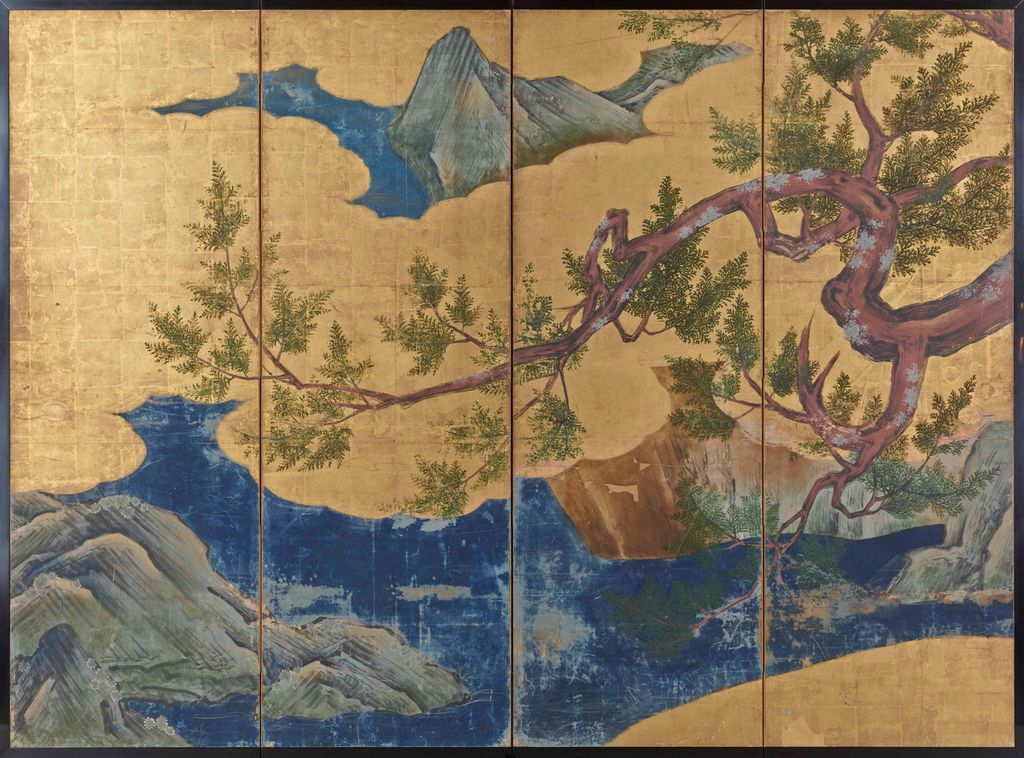
Kanō Eitoku, Cypress Trees, one of two current four-panel screens. Tokyo National Museum, A-1069. Image: ColBase; resized for this page.
 by Tom Gurney
Tom Gurney BSc (Hons) is an art history expert with over 20 years experience
Published on September 25, 2026 / Updated on September 25, 2026
Email: tomgurney1@gmail.com / Phone: +44 7429 011000
What survives of a painter of castles
Kanō Eitoku (狩野永徳, 1543–1590) made paintings for a world in which an image could occupy an entire wall. Sliding doors divided reception rooms; folding screens could reshape a space or provide a brilliant background for an audience. When a tree trunk crosses several panels, the viewer must move to take it in. When gold covers the ground behind that trunk, it catches available light and makes the painted form read across the room. Eitoku was neither the first Kano painter nor the inventor of gold grounds, but his surviving work and the tradition around it show how such resources could be enlarged and intensified for the powerful patrons of the late sixteenth century. The Metropolitan Museum of Art describes his large compositions as a dynamic development of the school inherited from his grandfather Motonobu. Tokyo National Museum connects this manner to the interiors and tastes of Oda Nobunaga and Toyotomi Hideyoshi. [1] [2]
At a glance
- ArtistKanō Eitoku (狩野永徳)
- Dates1543–1590
- CentreKyoto
- SchoolKano
- FormatsSliding doors, folding screens and ink paintings
The scale of his former output should not be confused with the size of the surviving autograph corpus. Castle and palace commissions were repeatedly rebuilt, moved or lost. Kyoto National Museum's review of its major Eitoku exhibition stresses that relatively few extant works receive universal acceptance as his own hand. Attributions on museum labels therefore matter. A work “by Eitoku,” a work of his workshop, a work “in his style,” and a painting by one of his sons may all show related visual decisions, but they answer different historical questions. This page starts with firmly identified objects, then uses less secure comparisons only when their status is made explicit. [3] [4]
Contents
- What survives of a painter of castles
- Cypress Trees : a painting that pushes against its frame
- Gold was a spatial material
- Chinese Lions and the danger of treating a pair as one autograph
- Ink, not only spectacle
- A city screen and the politics of its making
- A school's inheritance is not a single person's output
- Books on Japanese Art
Cypress Trees: a painting that pushes against its frame
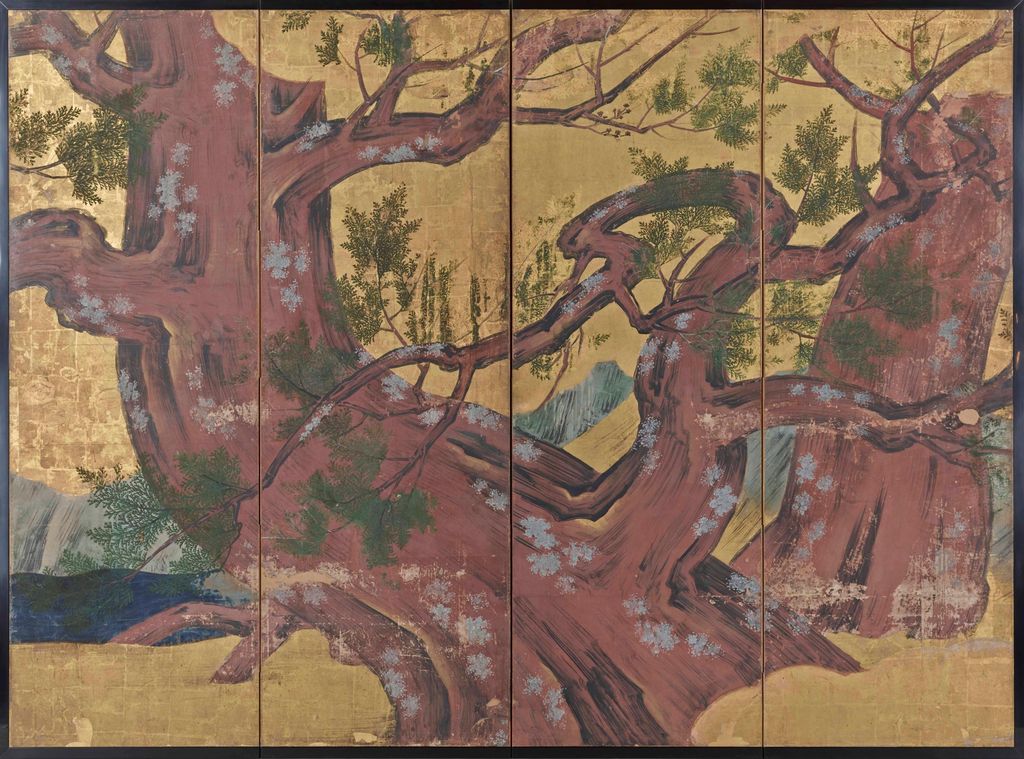
In Cypress Trees, one giant trunk bends across the join between panels and sends branches outward. The tree has enough mass to dominate the composition, yet it is not drawn as a sealed silhouette. Blue-grey rocks and water break into the gold; foliage and smaller branches interrupt the broad curves. The painting asks the viewer to negotiate two scales at once: a near view of twisting wood and a more distant expanse of ground and water. The tree looks as though it might continue beyond the pictured surface. Tokyo National Museum calls this kind of forceful large-scale painting taiga, or “large painting,” and describes the cypress as almost bursting through the screen's boundaries. [2]
The current object is a pair of four-panel screens, each 170 by 230.4 centimetres. Its history is more complicated than the present pair suggests. Traces of the metal pulls of fusuma, or sliding doors, show that the painted paper once belonged to a room. When those doors were remounted as screens, a viewer could no longer encounter them in quite the original way: the panels now fold rather than slide, and their relative positions became a museum and conservation question. An older Tokyo National Museum image archive describes one eight-panel screen, while the current object record and the 2015 conservation exhibition use a pair of four-panel screens. The change in description reflects the object's physical treatment and should not be flattened into two contradictory paintings. [2] [5]
The association with the Hachijō palace is supported by more than later taste for attributing a grand work to a famous painter. In the 2012–14 repair, conservators found a mica paulownia pattern on the back of the painted paper that matched paper from the Hachijō residence. Tokyo National Museum also points to surviving handle traces. These findings make the proposed original setting more concrete, although they do not supply a spectator's account of every room or panel position. The palace is described as completed in December 1590; Eitoku died that September. It would therefore be misleading to picture him admiring the completed building. What the painting can show is the kind of visual statement planned for that residence near the end of his career. [2] [6]
Gold was a spatial material
Gold grounds in these paintings are sometimes treated as a synonym for luxury. They could indeed assert wealth, but they also changed how a painted room was seen. The light on a screen shifts as a person walks past it; the unpainted gold between motifs can keep a large composition legible from a distance. The Metropolitan Museum of Art notes the use of oversize animals, figures and nature against gold foil in works associated with Eitoku's grand commissions. Cypress Trees makes a specific version of that effect: dense gold remains visible around a relatively limited group of motifs, so the tree's branching line has room to gather momentum. The proposition can be tested by comparing it with the gold-ground grapevine screens in the Smithsonian, which use the same broad material contrast but distribute the vegetal forms differently. [1] [2] [7] [8]
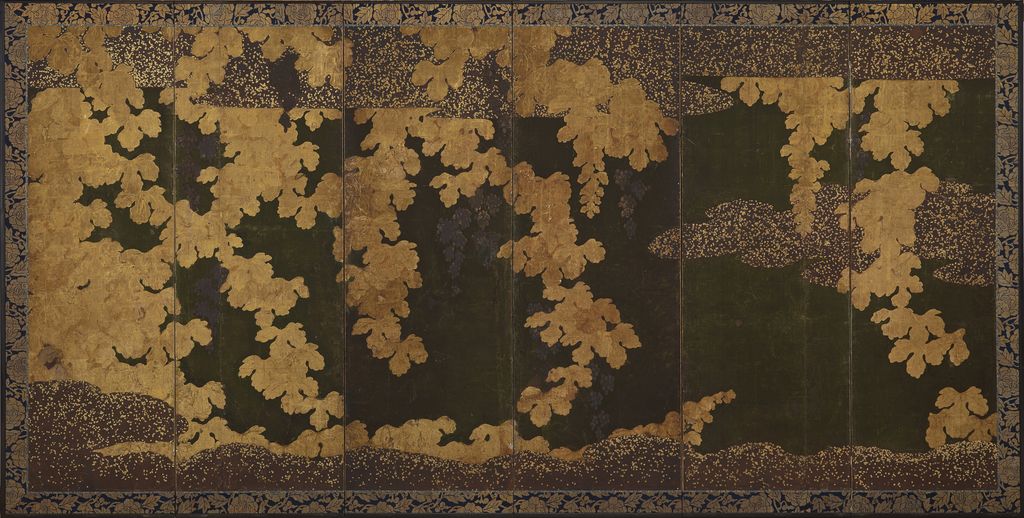
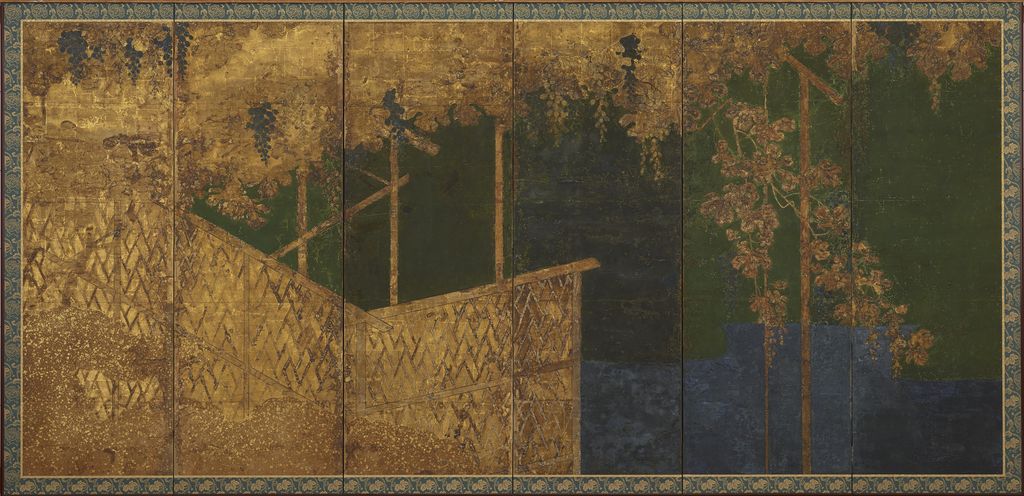
The National Museum of Asian Art credits Grape Vines and Fruiting Grapevines on a Bamboo Trellis directly to Eitoku. The first spreads large pale vine leaves and hanging grapes across a dark field edged with gold. Its six panels make a long, continuous image, yet each fold can alter the angles at which clusters appear. The second brings the bamboo trellis more clearly into view, so the support for the plant becomes part of the subject. Neither screen should be called another section of Cypress Trees simply because all three use large plant forms. They are independent museum objects with different accessions, scale, surfaces and collecting histories. The Smithsonian's image records allow a comparison to be shown without merging their identities. [7] [8]
The collecting histories supply another distinction. The National Museum of Asian Art records Charles Lang Freer's purchase of Fruiting Grapevines through Yamanaka & Company in 1904; its accession is F1904.353. The present object's route from a Japanese working screen to an American museum is not the screen's sixteenth-century biography. Recording that later route helps explain why useful comparative examples now sit in Washington while other surviving works are retained by Japanese temples or museums. It also discourages a misleading map that puts all of Eitoku's images in one original building. [8]
A Chinese love story on a Japanese screen
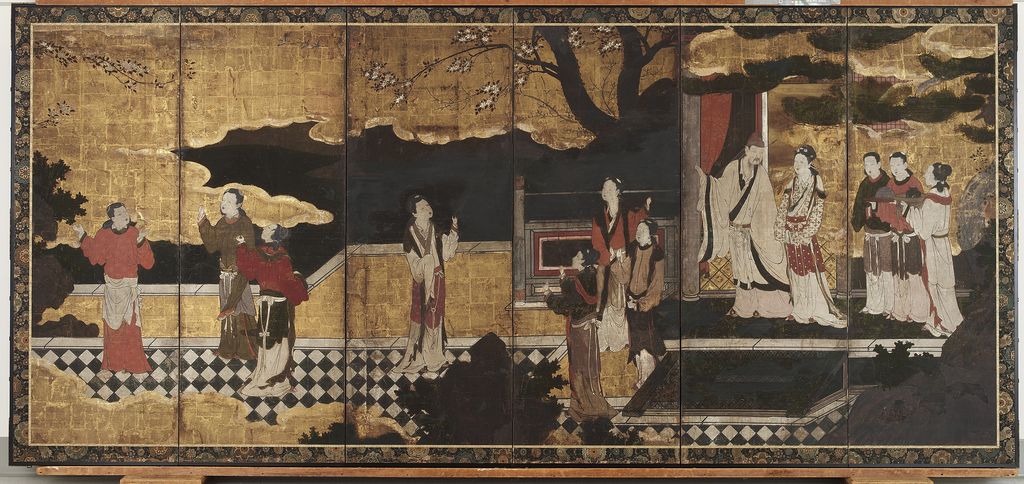
Another Smithsonian six-panel screen, The Chinese Emperor Minghuang and His Concubine Yang Guifei, gives the gold-ground room a different subject. The museum identifies Eitoku as maker and describes the scene of the emperor and Yang Guifei in an open pavilion. Ladies in the garden pull threads attached to flowering trees. The Smithsonian traces the picture's story to Bai Juyi's Song of Everlasting Sorrow, whose tale of love, court disorder, death and grief was long read in Japan. Its label also notes the poem's reception at the Heian court. The screen should therefore not be mistaken for a documentary picture of Tang China: it is a Japanese, late-sixteenth-century imagining of a Chinese literary and historical theme. [21]
Compare its handling of scale with the botanical screens. The pavilion groups several figures into a set of encounters; the flowering tree and gold field hold those encounters within a larger decorative surface. The screen neither becomes a little book illustration enlarged without change nor abandons narrative for ornament. It shows one way a Kano painter could use a broad, folding support to make a literary episode legible in a room. The Smithsonian records the present screen at 156.7 by 360.6 centimetres and traces its acquisition by Freer through Yamanaka & Company in 1900. Those facts identify the exact object used here, rather than another later screen of the same story. [21]
The painter of Genji subjects
The range of Eitoku's subjects also reached The Tale of Genji. In the checked Met/Yale catalogue The Tale of Genji: A Japanese Classic Illuminated, Kyoko Kinoshita discusses seventeenth-century records saying that a pair of Genji screens accompanied the famous 1574 presentation of Kyoto city screens to Uesugi Kenshin. Their present whereabouts are unknown. Kinoshita also treats an extant pair of Genji paintings as attributed to Eitoku and his studio; the doors may have belonged to a room in the Hachijō prince's Kyoto residence. Those claims cannot be compressed into a caption saying that the surviving doors are the missing gift screens or that Eitoku alone painted every surviving figure. [25]
The book's account is useful because it explains an artistic crossing of subject traditions. Genji imagery had long been associated with Tosa painters, while the Kano school was strongly shaped by Chinese painting. Eitoku's studio could nevertheless take on the classical Japanese tale when a prestigious patron wanted that narrative at the scale of screens or walls. This casts the Minghuang and Yang Guifei screen in a wider light: it is not an isolated Chinese court story among otherwise purely botanical works, but part of a repertoire that could move between Chinese literary episodes, Japanese court fiction, legendary recluses and the geography of Kyoto. The screen format was one means of making these different subjects work in the same architectural world. [25] [21]
Kinoshita's catalogue follows the traditional account that Nobunaga ordered the Kyoto panorama; recent Japanese scholarship argues for an earlier Ashikaga Yoshiteru commission. The disagreement concerns patronage, not whether a Genji subject could belong to Eitoku's professional range. Keeping those questions separate helps a reader use a published book without treating every sentence in it as the last word on a disputed screen. [25] [18]
Chinese Lions and the danger of treating a pair as one autograph
The huge Chinese Lions screens offer another way to see Eitoku's enlarged forms. The Museum of the Imperial Collections attributes the right six-panel screen to Eitoku. A second, similarly sized left screen was supplied much later by Kanō Tsunenobu, a descendant. Tokyo National Museum explains that Eitoku's painting may originally have had a different architectural or portable form before the pair was assembled. The lions' simplified, powerful bodies are often used to exemplify the imposing image favoured by military patrons; the present pair also records a later family's effort to maintain and augment its ancestor's work. A caption attributing the entire pair to Eitoku would erase that history. [9] [10]
The two screens are a useful reminder that a famous composition can change identity as an object travels. Its current national-treasure status tells us how it is valued now, but does not prove that every panel took shape at one moment. The museum's separate attributions, the measurements of each screen and the possibility of an earlier setting all belong to the work's history. [9] [10]
Ink, not only spectacle
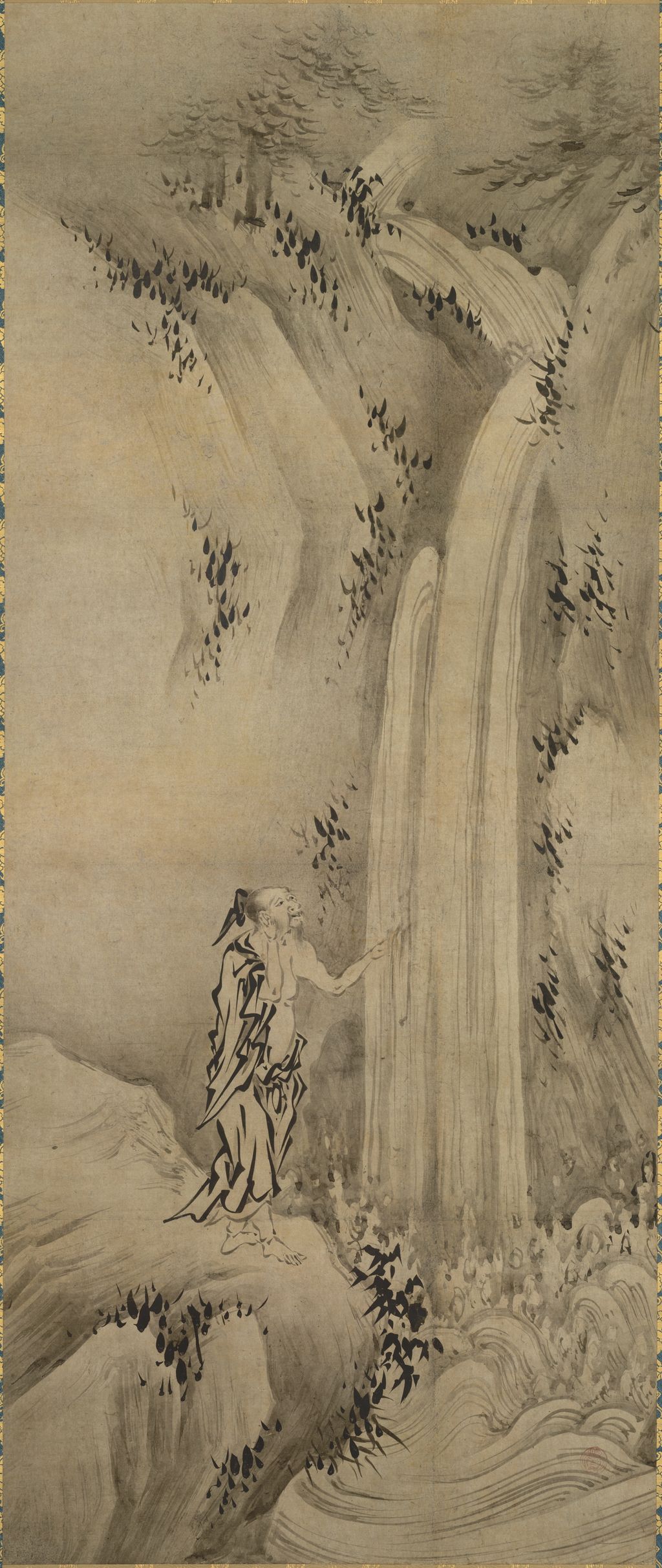
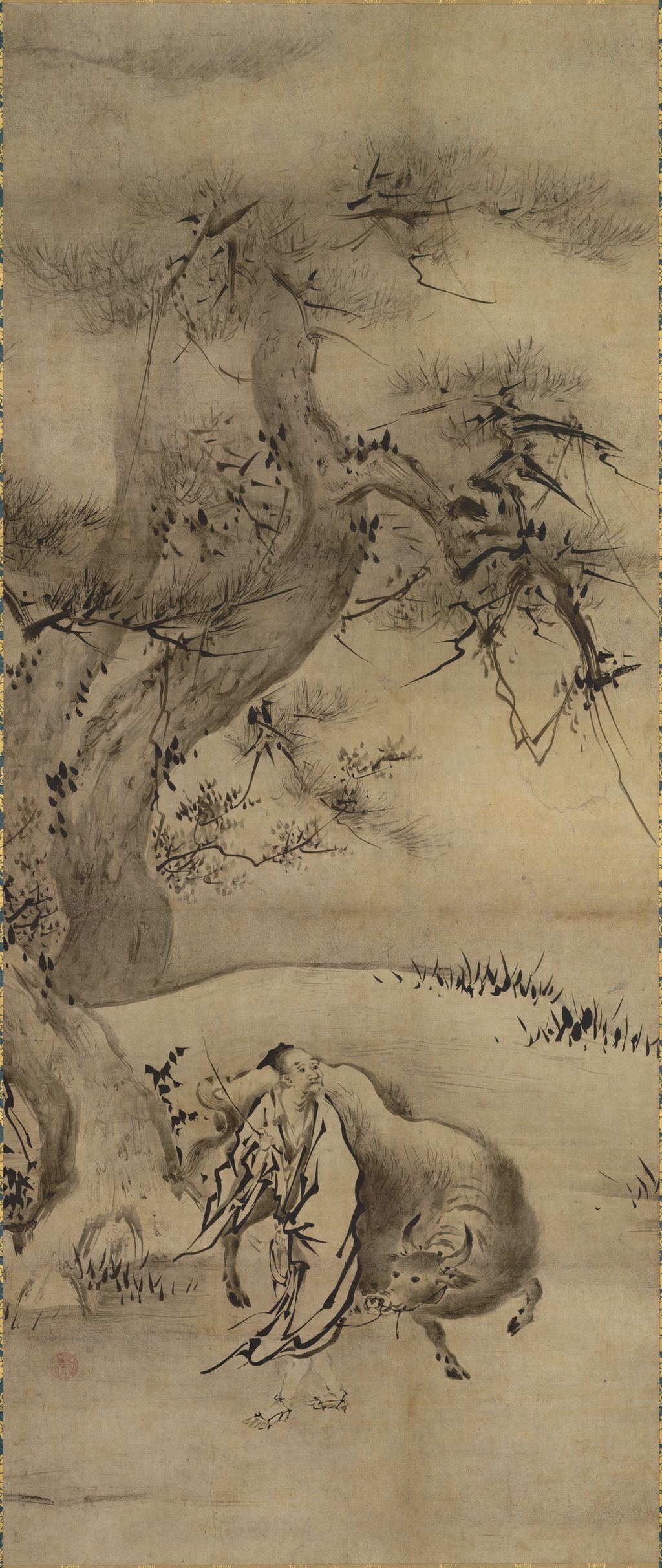
Eitoku's place in the Kano tradition cannot be understood only through gold-ground animals and trees. Tokyo National Museum's Xuyou and Chaofu consists of two ink-on-paper hanging scrolls, classed as an Important Cultural Property and directly credited to him. Each scroll gives a figure space to act within a landscape. The encounter is quieter and more concentrated than an entire wall of cypress. The subjects derive from Chinese reclusion lore: Xuyou rejects the offer of rulership and is associated with washing his ears; Chaofu, leading an ox, refuses to let it drink water he regards as contaminated by such worldly ambition. A reader can follow this narrative in the figures, water and movement, but should not mistake the scrolls for a transparent record of two historical men. The paintings put a moral story into a composition of brushwork and space. [12] [13]
Kyoto National Museum's 2007 Eitoku exhibition placed the ink-painted fusuma at Jukō-in, a Daitoku-ji subtemple, at the beginning of its visitor route. In a curatorial review, Nakabe Yoshitaka described their lively movement as a direct challenge to an observer, then used the fan paintings in the next gallery to reconnect Eitoku's work to older Kano practice. This sequence guards against the tempting idea that Eitoku began with gold and simply made everything bigger. Ink room paintings, portable fans, urban panoramas and brilliant gold-ground pictures all belonged to the artist's range. [3]
The current format hides a further history. The National Institutes for Cultural Heritage's object essay says Kanō Tsunenobu copied the work on 17 March 1694, when it was still a pair of two-panel screens. At an unknown later date it was remounted as the two hanging scrolls now catalogued by Tokyo National Museum. This is another case in which a picture's present shape cannot be projected back onto its first audience. The essay also reports a Xuyou and Chaofu painting in descriptions of Azuchi Castle, decorated by the Kano group from 1576, but says that castle picture was lost when the building burned. A shared subject does not make the Tokyo National Museum painting the lost Azuchi original. [22] [12]
Kyoto National Museum discusses another ink work, Hermits and a Fairy, by comparing its facial features and brushwork with the Tokyo scrolls. The curatorial text says that similarity suggests Eitoku may have made the Kyoto work too. That is a valuable art-historical comparison, not a licence to remove the word “may” from its label. It also shows what an attribution argument can be: a specific relationship between handling of faces, lines and figure groups, assessed across objects. The Tokyo scrolls provide the securely catalogued point of comparison. [12] [14]
A city screen and the politics of its making
The Uesugi family's Scenes in and Around Kyoto is among the most consequential paintings associated with Eitoku's early career. It draws a crowded capital across a pair of folding screens: roads, houses, shrines, processions and named political spaces. Yonezawa City Uesugi Museum identifies it as Eitoku's work and records the well-known account that Nobunaga presented the screens to Uesugi Kenshin in 1574. The gift is part of the object's later history. It does not by itself settle who commissioned the painting or when the design was first conceived. [15]
University of Tokyo historical research and a Tokyo National Museum curatorial discussion show why the distinction matters. Scholars have argued that Ashikaga Yoshiteru commissioned the screens as a diplomatic or political message to Kenshin before Nobunaga's later handover. Shimokawa Masahiro proposes an order in late 1563 or 1564, reading specific buildings and the route of a procession as expressions of Yoshiteru's hoped-for restoration of political power. His article also says that an earlier order remains possible and that the identity of Yoshiteru as patron is an inference. The proposal gives the scene sharper historical possibilities, but the page should present a range of interpretations rather than replacing one simple patron legend with another certainty. [16] [17] [18]
This pair will need a separate, illustrated page if its exact image rights and a usable master can be secured. A map-style exploration could help readers find a few identified sites in the picture, but only where a scholarly source locates them in this actual Uesugi version. Kyoto city guides and other rakuchū rakugai screens offer context; they cannot be pasted over this object as though every version shows the same streets at the same date. In the artist overview, the city screen marks a distinct kind of scale: Eitoku could organise not only a monumental tree or animal but also a capital full of different human actions. [15] [16]
A school's inheritance is not a single person's output
The grand horizontal image did not begin with Eitoku. Kyoto National Museum dates his grandfather Motonobu's Birds and Flowers of the Four Seasons at Daisen-in to 1513. Those paintings originally decorated sliding doors and now survive as separate hanging works. The museum describes a sequence moving from right to left through the seasons, with a large pine, waterfall, rocks, quiet water and birds placed across the long architectural support. Ming Chinese painting supplied important models, but the composition was adapted to a Japanese room. Seen beside Cypress Trees, it gives Eitoku a precise inheritance: a family method for distributing motifs across doors and making a viewer read nature while moving along them. His contribution can then be examined in the heavier isolated trunk, broad gold field and unusually forceful scale, rather than credited with inventing the format itself. [26] [2]
Eitoku's designs spread through a family and professional network. His sons and successors received commissions after his death, adapted the imposing scale he had made desirable, and responded to new patrons. Kyoto National Museum's exhibition on the painters after Eitoku frames his death as a difficult transition for the Kano group, intensified by the rise of Hasegawa Tōhaku and political change. The Metropolitan Museum of Art documents later works that follow Eitoku's bold arrangement yet credits them to sons' studios. Such records help explain influence, but they are not a reason to add every Kano screen to Eitoku's personal oeuvre. [19] [4]
Kyoto's account names the different roles. Eitoku's eldest son Mitsunobu took leadership after the death in 1590 and developed a more delicate manner alongside the inherited grand one. His younger brother Sōshū had already run the Kyoto headquarters while Eitoku worked at Azuchi Castle. Sanraku entered the workshop as a disciple with Hideyoshi's support, and the second son Takanobu later helped maintain the school and train a further generation. This is a working network, not a single hand copied many times. A sixteenth-century Kano bird-and-flower screen in the British Museum offers a useful, carefully labelled comparison: the museum describes a large Kano-school composition, with door-handle traces showing a previous life as sliding doors. It is evidence for the broader painting practice, not automatically an Eitoku autograph. [23] [24]
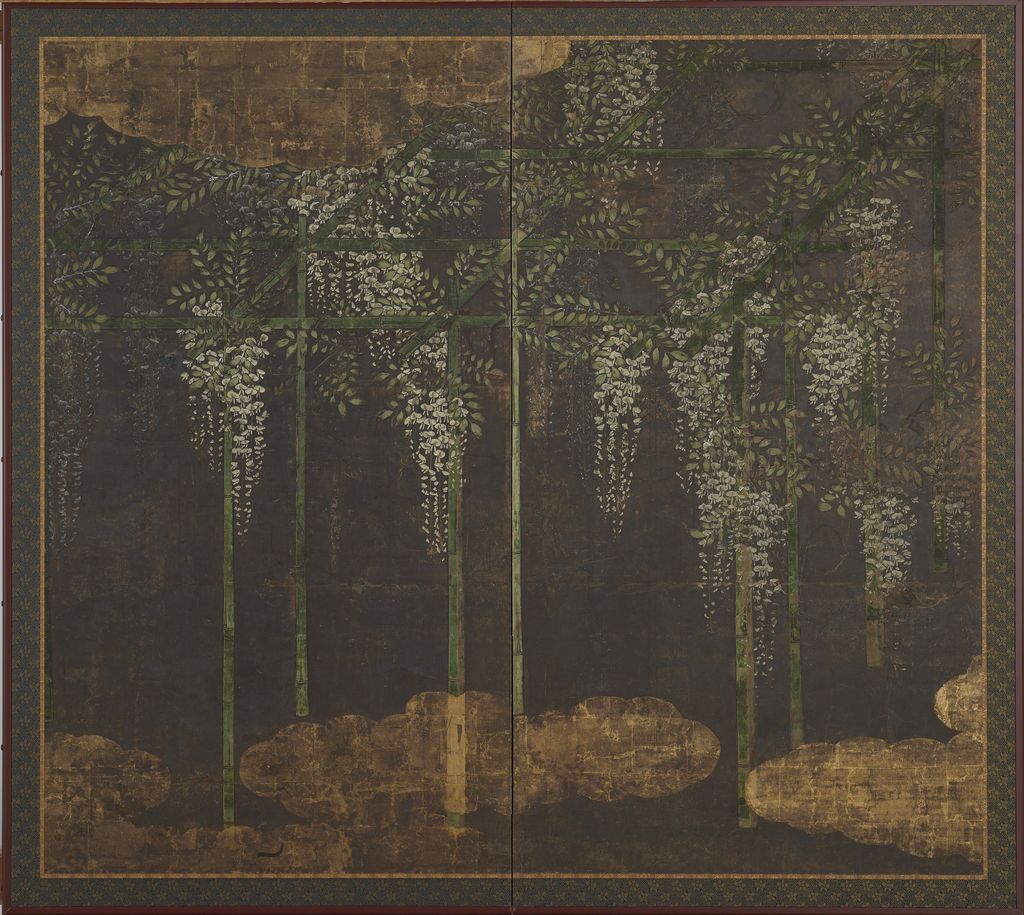
One instructive case is the Smithsonian's Blossoming Wisteria on a Bamboo Trellis. Its collection record says “Style of Kanō Eitoku.” Its dark, gold-accented trellis and cascading flowers can be compared with the directly credited grapevine screens, yet no caption here should imply that Eitoku painted it. Another is the Metropolitan Museum's Four Accomplishments material: its account describes Eitoku's influence while assigning the surviving doors to Kano-school painters working under a son. A comparison image can deepen the story only if this separation stays visible. [20] [4]
A more surprising case is Kyoto National Museum's Birds and Flowers of the Four Seasons, a pair of six-panel screens catalogued to Mitsunobu. Its record notes a “Shūshin” seal that Eitoku also used, but explains that the painting's style supports attribution to his son. The seal is a piece of evidence, not an automatic verdict. The museum gives the pair's accession as A甲2017 and describes it as a representative late-Momoyama example of Mitsunobu's gold-ground work. Keeping that record distinct from the older Motonobu Birds and Flowers at Daisen-in prevents three related generations from collapsing into one famous name. It also shows why individual object records, not a generic image search for “Kano,” have to control the captions in an illustrated artist cluster. [27] [26]
The surviving record therefore offers several Eitokus at once: the painter whose ink scrolls can tell a restrained Chinese moral tale; the designer of gold-ground forms large enough to command a room; the maker associated with an exact city screen whose patron remains debated; and the family ancestor whose successors continued to make his manner useful. Seeing those strands separately is more informative than treating a grand “Momoyama style” as a signature on every similar painting. The biography follows the dated life and workshop succession; the Cypress Trees artwork page examines the painting's design, former sliding-door setting and conservation evidence in detail. [1] [2] [3]
Frequently Asked Questions
He is particularly associated with powerful, large-scale paintings for castle and palace interiors. Cypress Trees and the Eitoku half of Chinese Lions are prominent surviving examples. The Uesugi Scenes in and Around Kyoto shows that his work also encompassed a densely peopled city panorama, while Xuyou and Chaofu preserves a restrained ink mode. “Best known” should not become “only painted”: his surviving subjects and formats are more varied than the famous monumental screens. [2] [9] [12] [15]
No. The current museum pair joins a right screen attributed to Eitoku to a later left screen by Kanō Tsunenobu. Tsunenobu made the companion on a comparable scale, helping produce the balanced pair now displayed. The captions should name both artists even when the two screens appear in one photograph. [9] [10]
The traditional account says Nobunaga gave the screens to Uesugi Kenshin in 1574. Researchers have argued that Ashikaga Yoshiteru may have commissioned them earlier, with the later presentation a separate event. The proposed Yoshiteru commission and its timing remain scholarly arguments. The museum record and the academic debate should both be stated rather than treating the 1574 gift as an automatic answer to the commission question. [15] [16] [18]
No. The current pair of four-panel screens contains painting that once decorated sliding doors. Traces of the door hardware and paper discovered during conservation support the proposed connection to the Hachijō residence. The remounting affects what a modern viewer sees at the panel joins and how the painting occupied space. [2] [6]
No. The school comprised several generations and studios. Kyoto National Museum's successor exhibition distinguishes works by Eitoku's sons, brother, disciple and later members. A museum label saying “Kano school,” “style of Eitoku,” or “formerly attributed to Eitoku” is a meaningful boundary. Similarity can demonstrate influence, but it cannot by itself identify the painter's hand. [3] [23] [20]
Discussion
Compare Eitoku’s screens, scrolls and attribution labels before drawing a conclusion.
Reader Insights
Where does the cypress seem to cross or resist its current panel boundaries?
How would your understanding of Chinese Lions change if the later Tsunenobu screen were captioned as Eitoku?
Which formal similarities make the wisteria a useful style comparison, and what cannot they prove?
Join the Conversation
Share a documented example or reliable source below, keeping observation separate from inference.
References
- The Metropolitan Museum of Art, “The Kano School of Painting”.
- Tokyo National Museum, Cypress Trees, A-1069.
- Kyoto National Museum, “The Story of the Kanō Eitoku Exhibition”.
- The Metropolitan Museum of Art, Appreciation of Painting, Kano School.
- ColBase, Cypress Trees, original object files.
- Tokyo National Research Institute for Cultural Properties, completion of the Cypress Trees repair.
- National Museum of Asian Art, Grape Vines, F1903.242.
- National Museum of Asian Art, Fruiting Grapevines on a Bamboo Trellis, F1904.353.
- Museum of the Imperial Collections, Chinese Lions, SZK002944.
- Tokyo National Museum, Imperial Collection exhibition account.
- Japan Search, ColBase discovery entry for Chinese Lions; linked file currently unavailable.
- ColBase, Xuyou and Chaofu, A-10598.
- Tokyo National Museum, Xuyou and Chaofu exhibition record.
- Kyoto National Museum, Hermits and a Fairy.
- Yonezawa City Uesugi Museum, Uesugi Scenes in and Around Kyoto.
- Tokyo National Museum, curatorial note on the Uesugi and other Kyoto screens.
- University of Tokyo Historiographical Institute, overview of Uesugi Kyoto-screen research.
- Shimokawa Masahiro, “『上杉本洛中洛外図屏風』の注文時期とその動機に関するノート”, 駒沢女子大学研究紀要 22 (2015), 69–84.
- Kyoto National Museum, “Momoyama Kano School: Eitoku’s Successors”.
- Smithsonian, Blossoming Wisteria on a Bamboo Trellis, F1897.26.
- National Museum of Asian Art, The Chinese Emperor Minghuang and His Concubine Yang Guifei, F1900.10.
- National Institutes for Cultural Heritage, Xuyou and Chaofu object essay; research text only, not an image source.
- Kyoto National Museum, “Kano Painters of the Momoyama Period: Eitoku's Legacy”.
- British Museum, large Kano-school bird-and-flower screen, A_2022-3035-1; research comparison only, image rights unverified.
- Kyoko Kinoshita, “Evolving Iconographies,” in The Tale of Genji: A Japanese Classic Illuminated (Metropolitan Museum of Art/Yale University Press, 2019), p. 63, relevant passage checked in the complete PDF.
- Kyoto National Museum, Motonobu's Birds and Flowers of the Four Seasons at Daisen-in, object essay on the original sliding-door sequence and later remounting.
- Kyoto National Museum, Mitsunobu's Birds and Flowers of the Four Seasons, A甲2017, catalogue discussion of the “Shūshin” seal and stylistic attribution.