


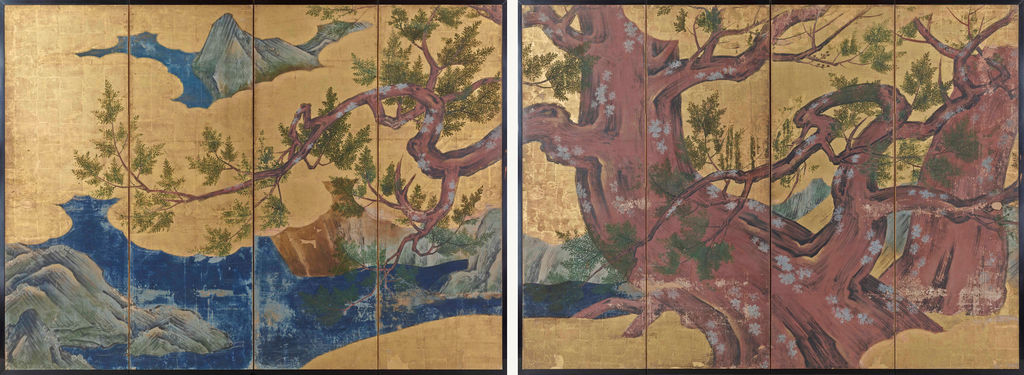
Kanō Eitoku, Cypress Trees, current two-screen arrangement. Tokyo National Museum A-1069. Images: ColBase; two files juxtaposed and resized.
 by Tom Gurney
Tom Gurney BSc (Hons) is an art history expert with over 20 years experience
Published on September 25, 2026 / Updated on September 25, 2026
Email: tomgurney1@gmail.com / Phone: +44 7429 011000
A tree that fills the room
At first sight, Kanō Eitoku's Cypress Trees seems to give almost all its space to one tree. The trunk swells beyond the scale of the rocks and smaller foliage; thick limbs bend across gold, and a blue river or pool runs beneath them. The picture has little sky in the ordinary landscape sense. Gold serves as light, distance and a field against which the cypress advances. What looks simple from across a gallery is an intricate negotiation between the force of a painted tree and the joins of the surfaces carrying it. [1] [2]
At a glance
- ArtistKanō Eitoku (1543–1590)
- Date1590
- Current formPair of four-fold screens
- Earlier formFour sliding doors
- HolderTokyo National Museum, A-1069
The work belongs to Tokyo National Museum and is a National Treasure, accession A-1069. The museum dates it to 1590 and identifies Eitoku as its painter. Today it is a pair of four-fold screens, each 170 by 230.4 centimetres without mounting, made with colour and gold on paper. Yet this familiar screen form is neither its earliest known form nor the one in which viewers saw it for much of the twentieth century. Traces of door handles point to four original sliding doors. Later remounting made a single eight-fold screen; conservation completed in 2014 produced the present pair. A good reading begins with those transformations, because the cypress was composed for a surface and a room, not for a flat web image. [1] [3]
Contents
- A tree that fills the room
- Reading the two halves
- A painting made for architecture
- Four doors, one screen, two screens
- How the painting’s format changed
- What was found behind the picture
- Looking closely without overclaiming
- Look closely at the cypress
- Attribution, date and a responsible conclusion
- Books on Japanese Art
Reading the two halves
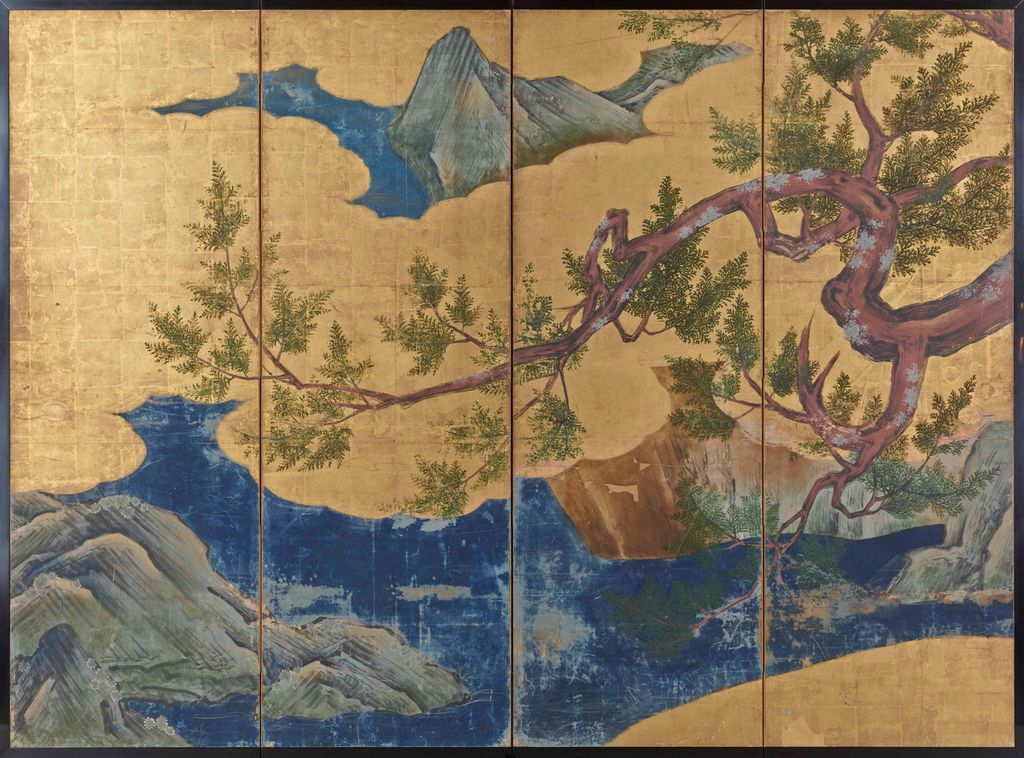
The current left screen has more open gold. A narrow offshoot of the cypress crosses this expanse horizontally, while the river broadens below. Blue and green-blue bands press against gold banks; angular rocks interrupt their edge. The tiny sprays of leaves around the long branch set up a change of scale: in the same view the painter can make us register individual greenery and feel a tree whose main trunk is mostly elsewhere. This is not an empty half awaiting the star subject. It gives the tree room to extend, and it makes the more crowded right screen feel even more abrupt. The following description is close looking at the ColBase photographs of the current screens, rather than a claim about a lost original room arrangement. [4]
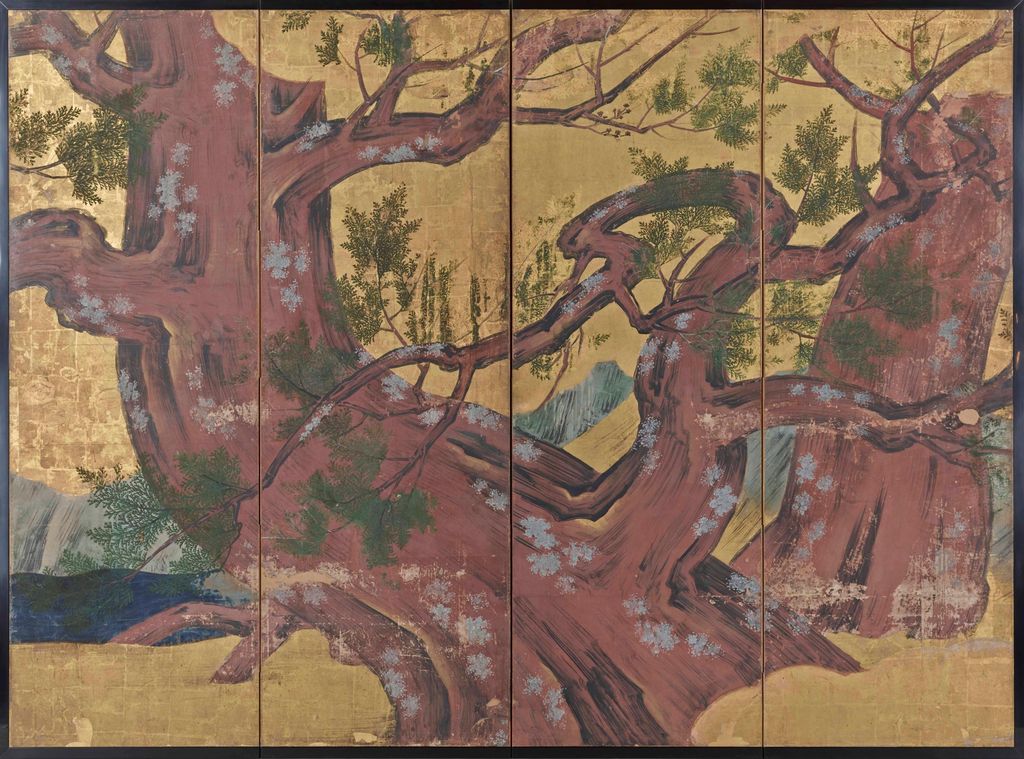
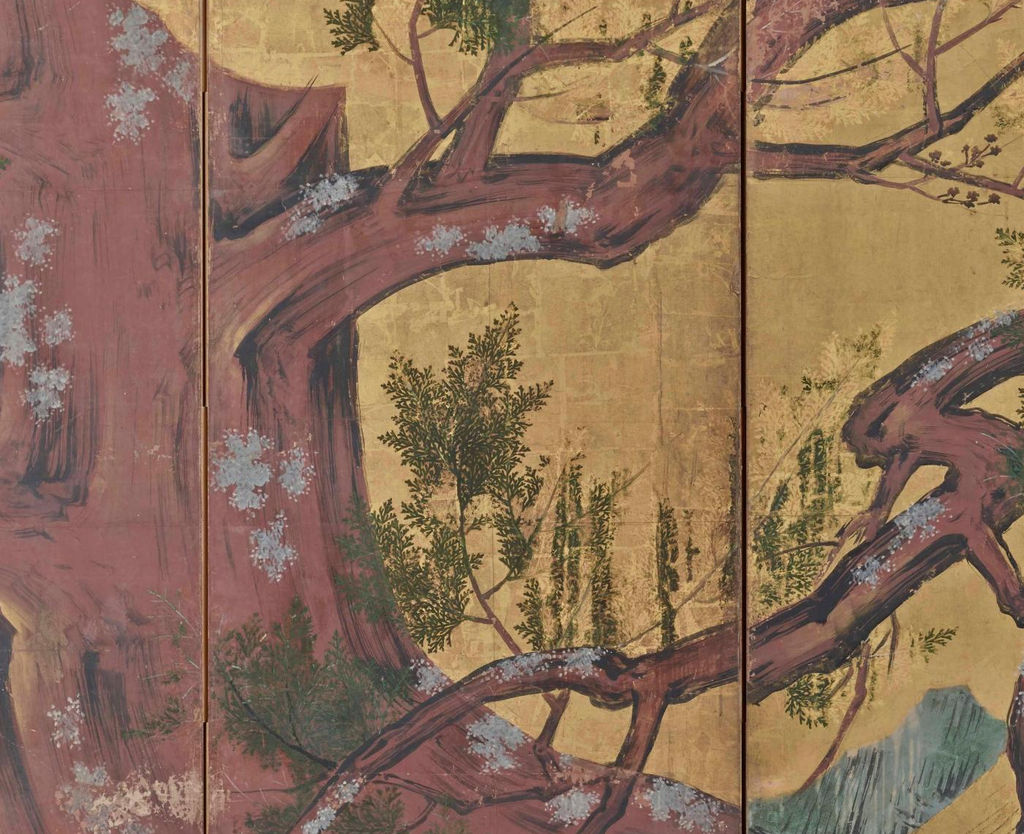
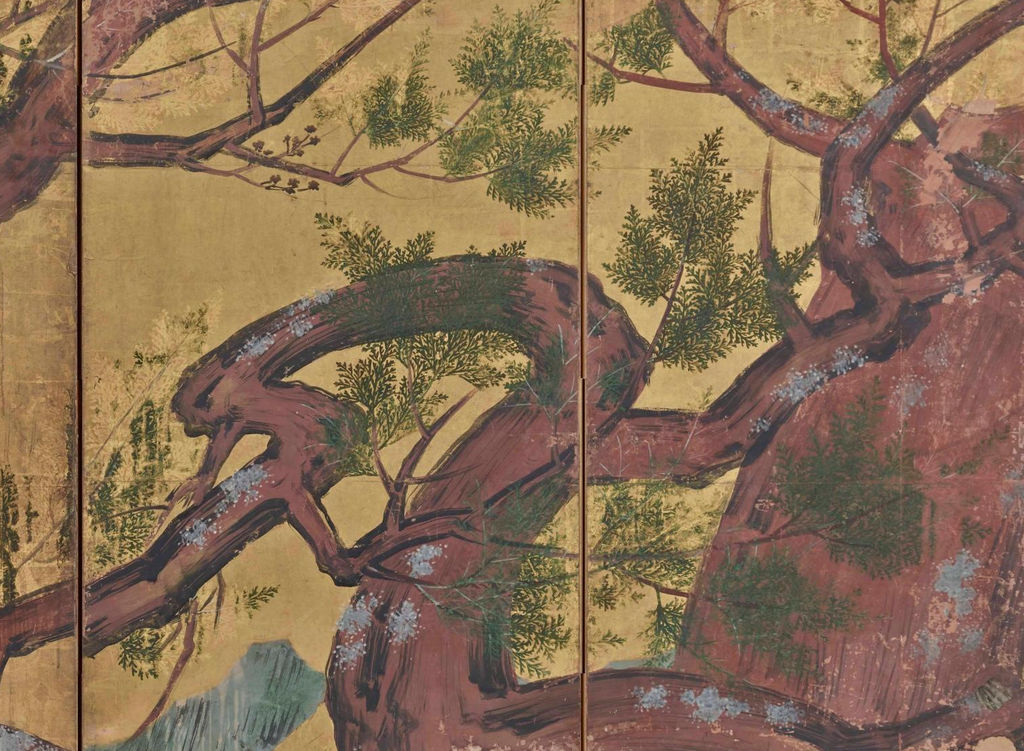
On the right screen, the trunk almost becomes a landscape itself. It divides, turns back and pushes broad diagonal limbs outward. Dark marks travel along russet bark; pale patches interrupt it; green foliage gathers in small clouds around branches whose underlying form is stark and knotted. The tree is neither a tidy botanical specimen nor a decorative silhouette pasted onto gold. A viewer has to follow a route through bends and reversals, from lower trunk to side branch to top edge, before grasping the whole. That movement makes the screen's four vertical folds active. The picture breaks at physical hinges, yet Eitoku's curves continually invite the eye to cross them. [4]
Gold performs several jobs at once. It provides the brilliant surface expected of an elite interior, but it also separates form from a conventional receding horizon. The largest voids are near the blue water and behind the sprawling branches. Those are pauses in the sequence of bark and rock. A tree painted this large could become an unreadable mass; the gold gives its irregular outline space to be seen from a distance. Tokyo National Museum's conservation pamphlet describes the removal of secondary motifs and the concentrated colours as part of the work's impact. The analytical claim here is narrower: in the present photograph, the gold areas make the route from left-bank water to right-hand trunk legible across a painting divided by panels. [3] [4]
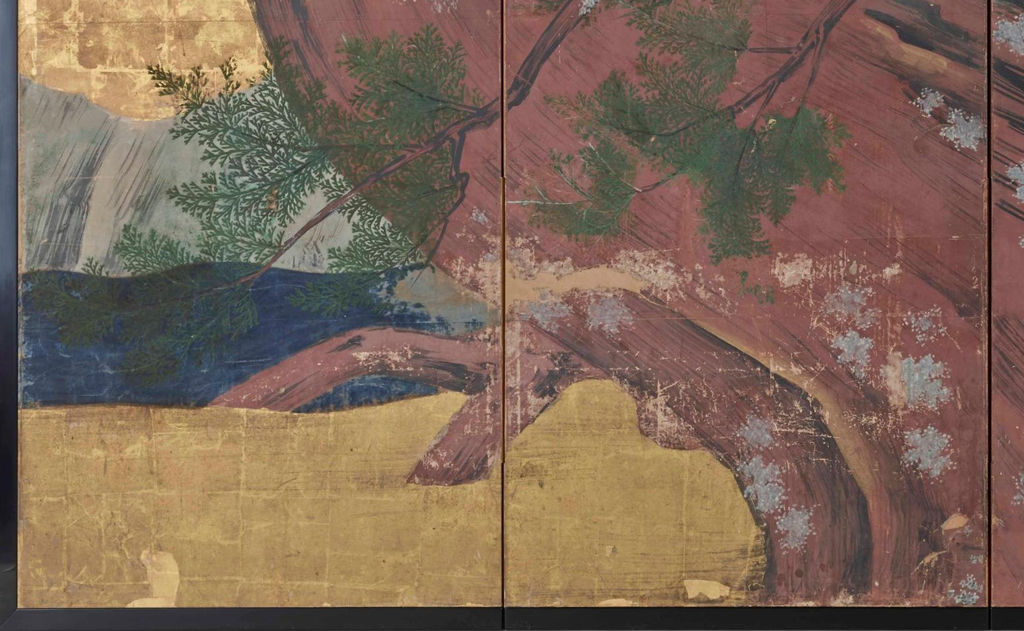
The water resists being merely a blue strip at the foot of the tree. Its upper edge cuts into the gold with an irregular contour; below, shifts of dark and pale blue imply movement or changing depth. Green-blue rocks on the left are treated with brisk directional marks, and a darker bank on the right grounds the trunk. From a reproduction, we can observe the strong colour opposition. We should be slower to identify exact pigments or assert precisely how much blue and green have changed since 1590. The official National Center for the Promotion of Cultural Properties notes ultramarine in the water and suggests that foliage may once have held more green. The surviving surface remains an aged and conserved one, rather than an untouched sample of the artist's palette. [2] [4]
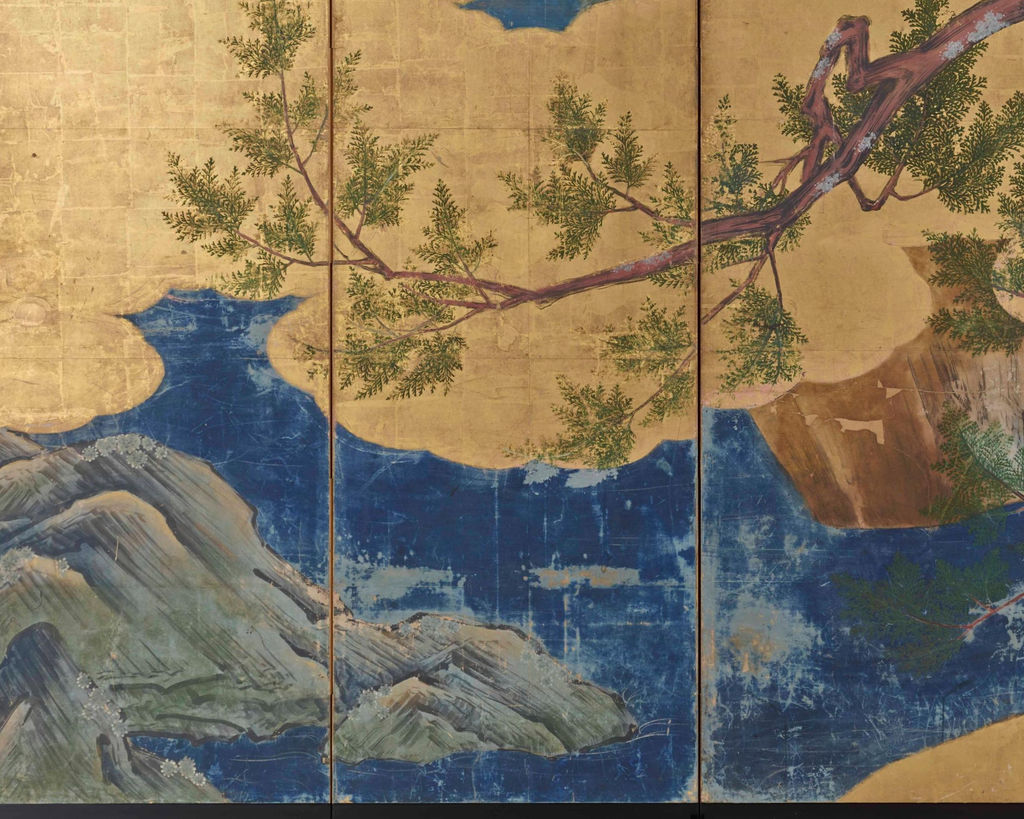
There is a visual surprise in the relation of water to tree. The river is not a distant view glimpsed past the trunk. On the left it occupies the foreground, and on the right the tree seems to press directly into its edge. A viewer can move between reading a landscape with a plausible bank and reading a giant cypress whose form is stronger than any realistic account of where each root, branch and rock sits. That tension is one reason the photograph should present the two screens both separately and side by side. A tight image of the trunk conveys mass but loses the watery counterweight; a reduced full-pair image shows the balance but hides the leaves and brush marks. The two views answer different questions about a work originally meant to be seen at architectural scale. [4]
A painting made for architecture
The door-handle traces distinguish Cypress Trees from a screen conceived solely as a movable display. They tell us that its painted paper was attached to a sequence of sliding doors. That is enough to imagine the changing view produced as people approached and opened an interior. It is not enough to reconstruct the door's exact room, its lighting or the original positions of every threshold. A modern pair of folding screens gives us the image; it does not put us back inside a sixteenth-century residence. [1] [3]
The probable setting was the Hachijō no Miya residence, later associated with the Katsura no Miya family. Tokyo National Museum relates its construction to an order from Toyotomi Hideyoshi and says the house was completed in December 1590. Eitoku died in September of that year. This chronology allows a late commission for a building still in progress, but it prevents the attractive image of the painter admiring the completed palace from becoming part of the story. The museum's wording is cautious about the original location. A matching decorative paper found during treatment strengthens a Hachijō connection, yet it cannot identify the exact bay of sliding doors or show how natural light struck the gold. [1] [3] [6]
In his final decades, Eitoku worked for the powerful patrons whose residences demanded pictures on a much larger scale than a hanging scroll. The Metropolitan Museum of Art describes the Kano school's capacity to provide grand architectural painting to rulers and elites. Eitoku's important interiors for Azuchi, Osaka and other residences have largely disappeared. Cypress Trees therefore matters as a surviving chance to examine the physical size and emphatic visual language associated with his late career, while keeping the loss of other programmes separate from this particular object. It should not be introduced as a fragment of Azuchi or Osaka. [7] [3]
The composition is grand without crowding the surface with architectural description. There is no castle in the picture and no procession of patrons. A single tree, banks, water, rocks and gold carry the impression. The reduction is a decision about legibility as well as taste: large forms can meet a viewer across a room, while branch and foliage reward closer attention. The phrase taiga, or “grand painting,” often appears in accounts of Eitoku's style. Here it can be made concrete through scale, broad colour fields and the physical sweep of the cypress rather than left as a compliment meaning only “important.” [1] [7]
There is a useful comparison within Eitoku's own architectural career. Kyoto National Museum presents the sliding-door paintings at Jukō-in as an earlier demonstration of vigorous movement across multiple surfaces. Its curator Chūbu Yoshitaka, writing about a 2007 Eitoku exhibition, placed Jukō-in at the entrance and Cypress Trees among the final large gold-ground works, seeing related energy in the latter's almost animal-like reach. That is a curator's reading of an exhibition, not proof that one composition was a preparatory study for the other. The comparison helps explain development without turning Eitoku's career into a simple march toward ever larger trunks: the paintings belong to different settings, dates and survival histories. [8]
Later Kano painters could take up the great-tree formula while changing its effect. In a 1979 peer-reviewed study, Kawai Masatomo compared Eitoku's Cypress Trees and Jukō-in paintings with the large pines on sliding doors at Myōhō-in. He argued that the latter borrowed a compositional formula but differed in the handling of trunks, rocks and gold-ground space, and proposed Eitoku's brother Sōshū as their maker. The proposal is Kawai's attribution, not a new label for the TNM cypress. It is valuable here because it makes visible the difference between a memorable arrangement and an individual painter's execution. A motif that became part of the Kano vocabulary cannot on its own settle who painted a later tree. [9]
Four doors, one screen, two screens
An object label that says “pair of four-fold screens” is correct for the current museum object. It can still conceal centuries of alteration. The original four sliding doors were at some point turned into a single eight-fold screen. When Tokyo National Museum considered a major conservation project, the folded support was no longer stable. Its paper backing had cracked and deformed; some adhesion was failing, and coloured areas had been abraded or had begun to flake. The old joins could also interrupt continuity in places where the painting had been cut and reframed. These problems were practical and visual together: a damaged screen is harder to display safely, and a shifted line can change how a branch or bank reads. [3]
The 18-month treatment ran from October 2012 to March 2014. Conservators considered a return to a door format. Instead they made a pair of four-fold screens, stabilised the backing, repaired loose and cracked areas and cleaned the work. The present form allows handling and exhibition while giving the image a flow closer to the former door painting than the misaligned eight-fold format offered. This does not mean that conservators “put it back exactly as Eitoku left it.” The museum's own explanation describes a historically informed choice between possible formats, not a recovered original installation. The two-screen arrangement was introduced to the public in 2015. [3] [6]
Why choose screens if the handle traces point to doors? A museum does not possess the vanished room or all of the conditions that made those doors function. Recreating four doors as furniture would be another modern interpretation and might require a new structure hard to store or exhibit. The pair of screens can be opened enough to make the broad composition readable, closed for handling, and supported in a way suited to the conserved paper. The conservation pamphlet treats these aims as linked. Its account is useful precisely because it presents a choice among imperfect options, rather than a magic recovery of an “original” state. The pre-treatment single screen was itself an adaptation; the current pair is another, documented one. When the page shows a diagram of the three states, each label should name the evidence for that state and avoid a false line of inevitable improvement. [3]
The material measurements reinforce this distinction. The current collection record gives 170 × 230.4 centimetres for each painted screen without mounting; the conservation pamphlet also provides 175.5 × 236.0 centimetres with mounting. Neither measurement is a dimension for the entire original four-door installation. A screen's physical frame changes what is measured, while its painted leaves and branches keep their own scale. Captions elsewhere may use still older dimensions from the single-screen mounting. Giving the format and the measurement basis together is more informative than copying a bare size into a fact box. [1] [3]
The change in format has a subtle consequence for a viewer. The two screens now have an intentional gap. In a gallery, the eye must carry a branch or current across that break, guided by composition but aware of two separate supports. In the earlier single eight-fold arrangement, the same paper had been gathered into one continuous piece of furniture, yet the history of cuts and joins could make painted lines fail to meet. An image comparison can illustrate this only if both historical photographs are licensed. The page's default production photographs should be the current ColBase files; a simple diagram can make the three arrangements intelligible without reproducing a rights-restricted pre-treatment image. [3] [5]
How the painting’s format changed
Handle traces and conservation records distinguish three arrangements of the same painted work. This is a schematic, not a reconstruction of the original room. [3]
Four sliding doors
handle-fitting traces
One eight-fold screen
before treatment
Two four-fold screens
after the 2014 treatment
What was found behind the picture
The conservation team looked at material usually hidden in display. On the back of the painted paper they found brush-written numbers from one to eight. On four panels they could also read inscriptions corresponding to “landscape” and “cypress.” Those notes matter because they document the work's construction and later organisation. They are not a painted signature by Eitoku, and they do not reveal the lost room. A reader accustomed to treating the front photograph as the entire evidence for a work of art may be surprised by how much the reverse can say. [3]
Another discovery tied the object more strongly to the Hachijō family. Remnants of decorative paper carried a mica-printed paulownia pattern. The team compared its form, scale and distribution with backing paper from Flowers and Birds in the Museum of the Imperial Collections, also linked to the family, and with paper associated with Katsura Villa doors. The pamphlet describes the pattern as a five-seven paulownia motif. The correspondence is a material relationship, not merely a stylistic resemblance between two front-facing paintings. It makes the proposed residence history more persuasive while still leaving the precise first placement open. [3] [6]
The conservators then made a new reverse paper related to that history. Surviving woodblocks once used to print decorative backing for Katsura Villa sliding doors became available through the Imperial Household's Kyoto office. Their use allowed a new paulownia design on the restored screens. This was a deliberate modern conservation choice informed by older material, and it belongs in an object's history in that language. It would be misleading to describe the new backing as the actual paper handled by Eitoku in 1590. The museum's bilingual pamphlet reproduces the pattern and the blocks, but the site's image licences for those conservation photographs have not been verified; the page should explain them in prose or with a new schematic until permission is clear. [3]
The paulownia find also changes how one weighs the palace claim. A famous courtly connection repeated in later descriptions could be a weak tradition if it stood alone. The handle fittings tell one physical story, the family provenance another, and the patterned paper a third. Their agreement makes a Hachijō context more persuasive than any single clue could. The same convergence has a boundary: it still does not identify which painter laid down which portion of a workshop commission or prove a precise room. It is possible to present a strong attribution and provenance without converting every probability into certainty. The museum's own language offers that model by naming the likely residence while reserving “presumed” for elements that remain inferential. [1] [3]
Looking closely without overclaiming
The central and right portions of the trunk carry many pale marks. At web size, they can look like splashes of white paint, bare ground, lichen or losses. Conservation evidence confirms that the picture has suffered abrasion and flaking in places, but a single digital reproduction does not assign each visible patch to a specific condition category. A useful annotation can point to the varying surface and ask the reader to notice it; it should not label every pale area as damage or translate every dark incision into a known brush technique. The strongest kind of annotated image says exactly what can be seen and only then explains what the museum evidence permits. [3] [4]
The eye can follow three dependable visual paths. First, trace the river from the water-dominant left screen toward the tree's base. The movement shifts from wide blue passages to banks that cradle the trunk. Second, follow the low-reaching branch across gold and watch how small leaf clusters change its apparent weight. Third, look upward through the right-hand trunk, where each turn is answered by a new contour or fork. These are paths suggested by the visible composition, not a claim that there is only one correct order in which a historical visitor saw the doors. On a screen that was once part of an interior, walking, sliding doors and changing light would have produced many views. [4]
Recent university research points to a still finer scale of looking. In the University of Tsukuba's 2024 examination report on Chikamoto Yukiko's doctoral thesis, the chapter on Cypress Trees is described as an inquiry into the raised handling of cypress leaves, its relation to depth, and the effect of placing a vast trunk and branch across a wide format. The public examination summary supports that description; it does not supply the chapter's full argument or technical measurements. Its significance for this page is that foliage is not mere filler between stronger limbs. Differences in the paint's handling may help articulate depth within the green clusters, a question best considered beside a true high-resolution image or the object itself. A 1024-pixel page image cannot independently establish the precise relief of pigments. [10]
Look closely at the cypress
Choose a marker to inspect a detail. Each explanation is also available below the image.
Annotated image details
The 3000-pixel ColBase source is retained as a 300 dpi working master; each displayed crop is exported at 1024 px, JPEG quality 80 and 144 dpi.
A turn in the trunk
The heavy trunk changes direction, carrying its mass across several panels.
Branch against gold
A bright gold opening lets the irregular branch contour remain legible.
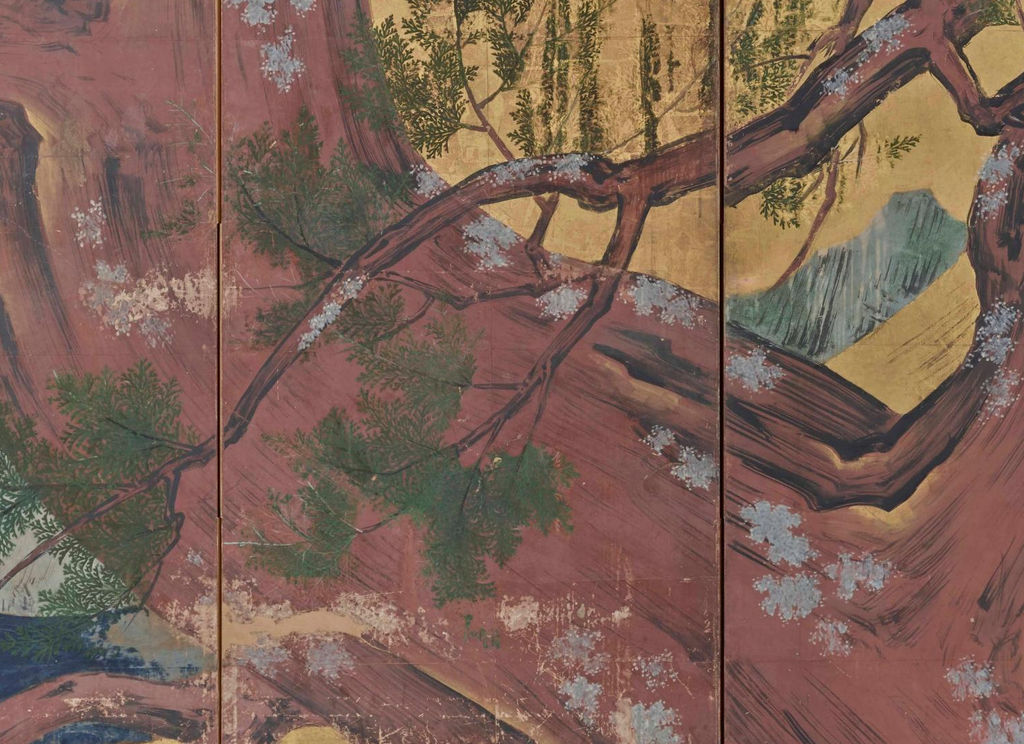
Clusters of foliage
Uneven leaf density changes the apparent depth around the branches.
Waterline and rock
A dark bank and blue-green rock meet near the base of the cypress.
Kanō Eitoku, Cypress Trees, Tokyo National Museum A-1069. Image: ColBase. Editorial annotations; detail images cropped and resized.
Attribution, date and a responsible conclusion
Tokyo National Museum catalogues the work as Eitoku's and dates it to 1590. The conservation account relates it to the Hachijō residence and to his final months. These are strong institutional anchors, but different kinds of evidence should not be made to do each other's work. Handle traces support a door origin; the paulownia paper supports a family link; the completed residence date gives a terminus for the palace, and the painter's death date sets a limit on what he could personally have seen. None is a discovered contract naming the room, and the numbers on the back are not his autograph. This distinction makes the work more compelling: an apparently direct and forceful image has a surprisingly layered material history. [1] [3] [6]
Its route into the museum can be traced after its earlier family ownership. The Hachijō line was later known as Katsura no Miya. When that branch ended, the work passed to the Imperial household in 1881 and was transferred to Tokyo National Museum in 1920. Such provenance does not tell us every previous movement. It does explain why an artwork made for a late-sixteenth-century setting survived to be conserved, recatalogued and shown in a modern museum. The single tree that confronts us now has survived changes in patronage, ownership, furniture form and conservation practice. [1] [3]
Cypress Trees is therefore more than an illustration of Eitoku's celebrated “grand manner.” It lets us see what that phrase can mean in practice: a landscape reduced to commanding forms, painted across architectural surfaces, with a trunk large enough to make the spaces between panels matter. It also lets us see the care necessary when a historic work is remounted. The image is not static across its long life, though the ColBase photographs faithfully show its present form. Looking between gold and blue, branch and gap, we can hold both truths together: the painting's extraordinary immediate force and the slower history that has made it visible today. [2] [3] [4]
Frequently Asked Questions
Tokyo National Museum holds it as National Treasure A-1069. It is not permanently on view; check the museum's current display information before a visit. [1]
The evidence points to the Hachijō family residence, but the exact original room is unproven. The residence was completed in December 1590, after Eitoku's death in September. The better-supported statement is that this is a late work associated with that family and probable building programme. [1] [3]
The left screen gives much of its area to gold, water and a reaching branch; the right is dominated by the great trunk. The difference makes the tree's scale and extension legible across the pair. This is a visual reading of the current ColBase images, not a record of Eitoku's written intentions. [4]
The museum describes stabilisation, repair, cleaning and remounting, plus newly made decorative backing paper. It does not say that conservators reconstructed an exact 1590 colour scheme or repainted the entire front. [3]
Discussion
Compare the present image with the evidence discovered during conservation.
Reader Insights
What can the present panel folds tell us about the four original doors?
What does the paired-screen format make clearer or safer to show?
How far does the paulownia backing support a Hachijō connection?
Join the Conversation
Share an observation with its object record or source below.
References
- Tokyo National Museum, “Cypress Trees,” collection record A-1069. Current format, materials, size, date, provenance and door-handle description.
- National Center for the Promotion of Cultural Properties, “Cypress Trees,” object and reproduction essay. Used for the visual description, not as a production image source.
- Tokyo National Museum, *Conservation Project for the National Treasure Cypress Trees* (bilingual museum pamphlet, 2015), pp. 2–6. Full six-page PDF checked visually from the linked museum page.
- National Institutes for Cultural Heritage, ColBase, A-1069 image records, exact file URLs and hashes in `foundation-image-ledger-2026-09-25.json`. The two images show the current paired screens.
- National Center for the Promotion of Cultural Properties, ColBase image-reuse guidance. Credit, link and disclosure of modification required.
- Tokyo National Research Institute for Cultural Properties, 2015 conservation notice for *Cypress Trees*; and Tokyo National Museum, conservation exhibition information. These corroborate the treatment and revised format.
- The Metropolitan Museum of Art, “The Kano School of Painting”. General architectural and school context, not an A-1069 object source.
- Chūbu Yoshitaka, “The story of the Kanō Eitoku exhibition”, Kyoto National Museum newsletter, no. 158 (2008). Curatorial exhibition reading, not an object-provenance record.
- Kawai Masatomo, “On the fusuma-e painting of ‘Pine Trees’ of the Ohgenkan of the Myohoin temple,” *Aesthetics* 30, no. 3 (1979), pp. 12–27, abstract. The attribution proposal is Kawai's and concerns Myōhō-in, not TNM A-1069.
- University of Tsukuba, examination report for Chikamoto Yukiko, *A Study of Tree Expression in Japanese Painting: Focusing on Colour Expression* (doctorate awarded 25 March 2024), chapter 2 summary. The thesis chapter itself was not consulted.