 by Tom Gurney
Tom Gurney BSc (Hons) is an art history expert with over 20 years experience
Published on June 19, 2020 / Updated on November 20, 2026
Email: tomgurney1@gmail.com / Phone: +44 7429 011000
Introduction
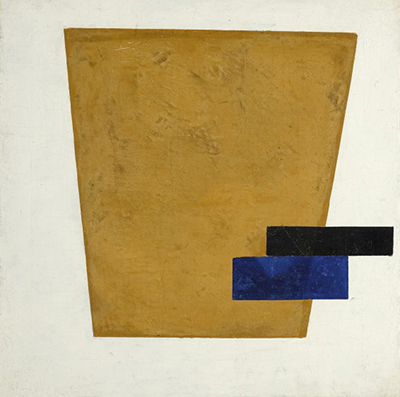
A yellow trapezoid dominates Suprematist Composition with Plane in Projection. A blue bar and a black bar meet its right side; a much larger white field surrounds them. The picture's economy makes every edge count. The yellow shape is not a mathematically regular rectangle, and the two smaller strips do not simply decorate it. Their shift in scale and direction unsettles what at first looks like a stable central form. [1] [2]
The painting was catalogued by Sotheby's New York for a 16 May 2017 sale as a 1915 oil on canvas, with Andréi Nakov's catalogue number S-159 in its literature list. Matthew Drutt's 2003 Guggenheim catalogue also reproduces and discusses the work. Those object-specific sources let this page identify the existing image without treating a similar Suprematist title as proof that it is the same canvas as another painting. [1] [2]
At a Glance
- ArtistKazimir Malevich
- TitleSuprematist Composition with Plane in Projection; Sotheby's notes this wording is not Malevich's own
- Date1915 in Sotheby's and the 2003 Guggenheim catalogue
- MediumOil on canvas
- Dimensions53.3 × 53 cm in Sotheby's 2017 catalogue; 57 × 57 cm in the 2003 Guggenheim catalogue
- Catalogue keyNakov S-159, as cited by Sotheby's
- Documented public saleSotheby's New York, lot 32, 16 May 2017
- Current collectionNot established by the consulted public sources
Contents
- Three painted forms and their relationships
- A title supplied after the painting
- Did it hang at the 0.10 exhibition?
- Provenance, measurement and the 2017 sale
- How a plane can seem to project
Three painted forms and their relationships
The large yellow plane has an irregular trapezoidal outline. Its sides taper, so the eye cannot use the field as a perfectly stable geometric frame. The blue and black strips extend from the right, overlapping or pressing against the larger form in a compact cluster. Their combined shape makes the otherwise open white space feel asymmetrical. The white is therefore part of the composition's balance, not an expendable blank margin. [1] [2]
The bars differ in colour, position and apparent weight. Black sits above and reaches farther right; blue sits below and ends sooner. A reader can follow the small offset between them, then return to the immense yellow area they interrupt. This motion is a visual effect of placement. It does not require identifying the painted units as pieces of an aeroplane, a building or another pictured object. [1]
The surface matters as well as the diagram of shapes. In Sotheby's catalogue essay, Aleksandra Shatskikh draws attention to the relief and texture of this early Suprematist painting. A small online reproduction may flatten that feature. The local image shows visible unevenness inside the yellow field, but it cannot substitute for direct examination of the canvas. The painting's sparse arrangement and material surface should be considered together. [1]
A title supplied after the painting
Shatskikh's signed essay in the 2017 sale catalogue explicitly says Suprematist Composition with Plane in Projection is not Malevich's title. She relates its central trapezoid and lower longitudinal stripes to a preparatory drawing and a larger work known through a photograph but no longer preserved. That proposed link is an art historian's reconstruction supported by comparative documents; it should not be presented as a surviving note by Malevich naming this canvas. [1]
The description “plane in projection” can help a viewer notice how the trapezoid appears to lean or compress, yet it need not be read as a technical drawing title. The painted form does not obey a visible system of architectural perspective. Its taper and its relation to the strips create a sense of directed movement in a shallow white field. Malevich's nonobjective work often uses simple shapes, but simplicity does not mean that every composition follows the same geometry. [1] [2]
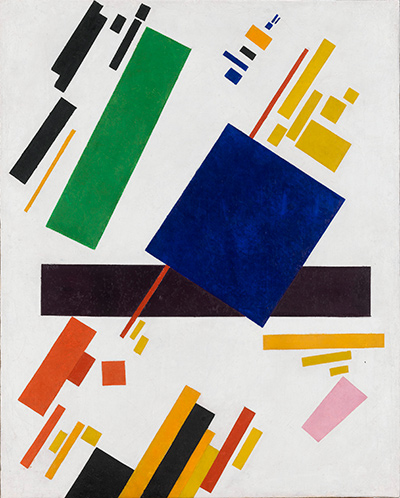
The Nakov number S-159 is a firmer way to track this physical work across catalogues than a broad title search. Malevich produced many paintings named Suprematist Composition in translation. This one is distinct from the 1916 Suprematist Composition identified as Nakov S-97 and from the Stedelijk's blue-triangle and black-rectangle painting, A 7671. Their shapes, measurements and histories differ. [1] [2] [4]
 Kazimir Malevich.jpg)
Did it hang at the 0.10 exhibition?
The 1915–16 0.10: The Last Futurist Exhibition of Paintings is central to the public emergence of Suprematism. Sotheby's exhibition list marks this canvas's participation “probably.” Shatskikh's essay argues more strongly from its appearance, materials and Malevich's working sequence, but the painting is not visible in the surviving installation photograph. The evidence therefore supports a plausible connection rather than an unqualified statement that this exact canvas can be identified on the wall. [1]
The 2017 catalogue lists later appearances with less qualification: a 1920 Moscow exhibition, the 2003–04 Guggenheim/Menil Kazimir Malevich: Suprematism exhibition, Tate Modern in 2014 and Fondation Beyeler in 2015–16. Drutt's Guggenheim catalogue reproduced the work and described its surface as unlike many of Malevich's other early Suprematist canvases. These records show the picture's sustained exhibition and research history without resolving every claim about its first display. [1] [2]
This distinction matters because a famous exhibition can become a catch-all label for paintings of the same year. The visual resemblance of one painting to documented 0.10 works is evidence to investigate, not by itself a catalogue number or installation proof. Treating the “probably” in the primary sale catalogue seriously makes the chronology clearer, not weaker. [1]
Provenance, measurement and the 2017 sale
Sotheby's pre-sale provenance names the scholar and collector Nikolai Khardzhiev, then Galerie Gmurzynska from 1994, followed by a private owner. Its catalogue gives 53.3 × 53 cm. The 2003 Guggenheim book captions what appears to be this same work at 57 × 57 cm, then described as a private collection courtesy of Galerie Gmurzynska. The consulted sources do not explain the difference. It might reflect measurement conventions or later examination, but neither explanation is documented here. Both figures are kept with their source labels. [1] [2]
The painting led Sotheby's evening sale on 16 May 2017, according to the auction house's sale report, and sold for approximately $21.2 million. That is a dated transaction, not an estimate of the work's current market value. The public sources consulted for this page do not independently establish its present owner or display location after the sale. [1] [3]
The old page treated the sale price as a springboard for generic claims about modern art, Soviet politics and unrelated Cubist painters. The painting's own documentary record is more useful: a specific canvas, a later assigned title, a plausible but qualified 0.10 link, two published measurements and an unusually spare arrangement that remains visually active. [1] [2]
How a plane can seem to project
A plane in the mathematical sense is flat, but in a painting its angle and relation to other forms can give a suggestion of depth. The long shapes here provide visible edges that a viewer can follow across the light ground. A change of direction can make the next form appear to have a different relation to that ground. The effect rests partly on the way painted shapes approach each other and partly on the amount of light field that remains around them. One can test it by looking first at the edges and then at the intervening space. [1] [2]
The same kind of looking helps explain why the words Plane in Projection are useful even though the title history calls for care. They point towards a way in which the flat elements can seem to occupy space. That reading can be tested on the image, independently of any proposal about how the canvas was displayed in 1915. The technical and exhibition records answer different questions. The first locates the painting by its support and dimensions, while the second depends on matching a work to the evidence of a particular show. [1] [2]
Frequently Asked Questions
How large is it?
Was it shown at 0.10?
Possibly. Sotheby's exhibition list labels that appearance “probably.” Shatskikh argues for it in the catalogue essay, but no surviving installation photograph identifies this exact painting on the wall. [1]
Did Malevich give the work this title?
Shatskikh says the current English title is not Malevich's own. Its Nakov S-159 catalogue reference is a more stable object identifier. [1]
What did it sell for in 2017?
Sotheby's reported an approximately $21.2 million sale result on 16 May 2017. That figure describes the historical auction only. [3]
Discussion
Does the large yellow plane feel stable once you follow its tapered sides?
How do the black and blue bars change the white space around the picture?
Reader Insights
Sotheby's identifies this oil painting as a 1915 work, Nakov S-159.
The 2003 Guggenheim catalogue and 2017 auction catalogue give different measurements.
The 0.10 exhibition link is plausible but qualified in the auction's exhibition list.
Join the Conversation
Share a close observation or an object-specific source for Nakov S-159.
References
- Sotheby's New York, Suprematist Composition with Plane in Projection, lot 32, 2017: object description, 53.3 × 53 cm measurement, provenance, exhibition qualifications and Aleksandra Shatskikh's signed essay. View source.
- Matthew Drutt, Kazimir Malevich: Suprematism (Guggenheim, 2003), printed pp. 27 and 130: original exhibition catalogue's discussion and illustrated caption, with its different 57 × 57 cm measurement. View source.
- Sotheby's, “Suprematist Masterwork Leads Impressionist & Modern Evening Sale,” 2017: primary sale report with rounded $21.2 million result. View source.
- Christie's, Suprematist Composition (Nakov S-97), 2018: distinct 1916 painting used to prevent title-only conflation. View source.