


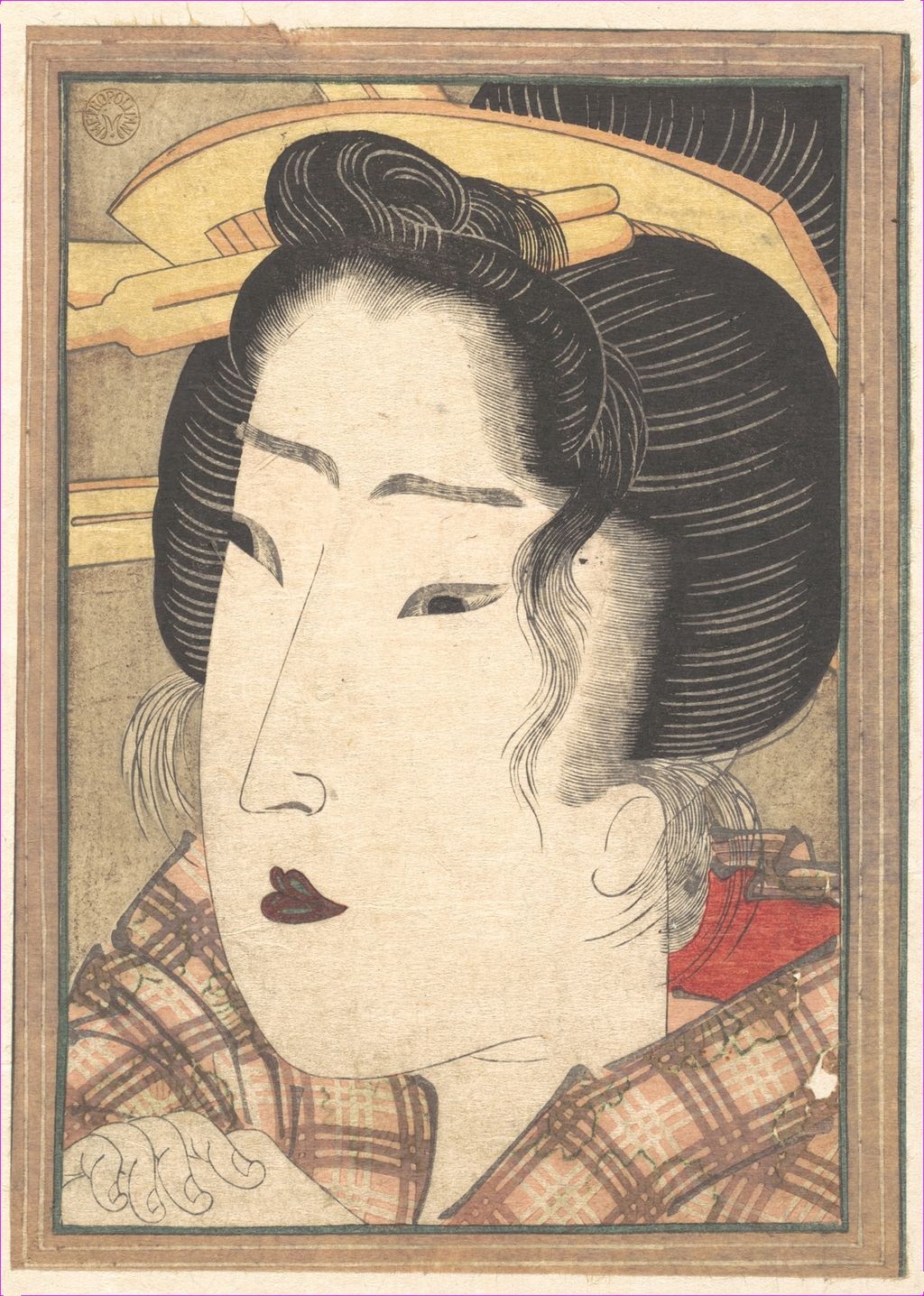
Keisai Eisen, Head of a Beauty, c.1825. The Metropolitan Museum of Art, JP1070. Museum object record.
 by Tom Gurney
Tom Gurney BSc (Hons) is an art history expert with over 20 years experience
Published on September 25, 2026 / Updated on September 25, 2026
Email: tomgurney1@gmail.com / Phone: +44 7429 011000
Keisai Eisen: more than the beauties of late Edo
Keisai Eisen (渓斎英泉, died 1848) is often introduced through his pictures of women: faces framed by intricate hair, closely observed fabrics and an expression that can seem more guarded than the polished beauties of an earlier generation. That is an important part of his achievement, but it cannot contain his career. He designed prints of waterfalls and roads, illustrated books, made paintings and worked in the privately commissioned world of surimono. Chiba City Museum of Art organised its 2012 Eisen exhibition around precisely this range, drawing on a collection of nearly 300 works and a wider exhibition of about 350 objects. Its curator Masako Tanabe argues that a history centred only on the famous beauty prints leaves Eisen's later work and other subjects hard to see. [1] [2]
The surviving evidence is unusually good for an artist who still attracts shorthand descriptions. One can place a documented print next to an exhibition catalogue, compare a later state of a road print with an early impression, or examine how a book differs from a sheet intended for sale. The evidence is not complete. Catalogues differ even on Eisen's birth year: Chiba gives 1791, while the British Museum and the Met give 1790. The artist home can safely describe his active decades and his death in 1848; the separate biography will set out that disagreement instead of forcing a false precision into the opening line. [1] [3] [5]
Contents
- Keisai Eisen: more than the beauties of late Edo
- A portrait is a designed encounter
- Read Hanamurasaki’s print up close
- Printed books, private commissions and paintings
- When the subject changes scale
- The road he shared with Hiroshige
- Blue, reuse and the problem of dating a print
- The city after the famous road
- How to recognise what survives
- Books on Japanese Art
Eisen worked in the same commercial Edo world as Hokusai, Hiroshige and Kunisada, but those names do not make him a minor version of any one of them. An Eisen portrait asks us to look at a specific kind of public image of a woman. A road print asks how an artist and publisher turned travel into an image one could buy. A painted hanging scroll has a different scale and use from either. We need to follow these formats and their surviving objects to see the choices particular to Eisen. [1] [2]
At a glance
- Lifeborn 1790 or 1791; died 1848
- Main periodLate Edo print culture
- SubjectsBeauties, books, birds, landscapes
- Look forTitle, signature, publisher and impression
Splash / figure 1: Met JP1070, Head of a Beauty, c.1825, 17.8 × 12.7 cm. Use the exact retained Met master and 1024px Q80/144dpi export. A close, upright image makes the opening claim visible immediately. Caption it as a colour woodblock print, not a painted scroll or a portrait of a named historical sitter. The Met record supplies neither sitter identity nor a series title. [5]
A portrait is a designed encounter
The Met's Head of a Beauty brings the face near the viewer without giving us a biography of its subject. The dark gathered hair, carefully shaped brows and the layered fabric at the shoulders take up much of a sheet only seven inches high. The angle of the eyes and the asymmetry of the face make the image feel less like a formula than an encounter interrupted halfway through a glance. Yet its museum title is deliberately general. We can describe the visible arrangement and the circa 1825 catalogue date; we cannot assign the woman a name or an occupation from this sheet alone. [5]
This distinction matters in Eisen's better documented pleasure-quarter prints. Cleveland identifies one figure as Hanamurasaki of the Tsuchiya, in its Beauties in their Finery amid Mallow Flowers series. Here a named courtesan, a named house and a series title give a different kind of evidence from the Met's anonymous head. Hanamurasaki's body turns among blossoms and patterned textiles. The densely layered costume does not merely fill empty space: it presents a display of fabric and status that an Edo buyer could inspect. We should caption her with the institution's full identification rather than reduce her to a generic “geisha.” The record calls her a courtesan; it does not establish that the print is an unmediated likeness of the living person. [6]
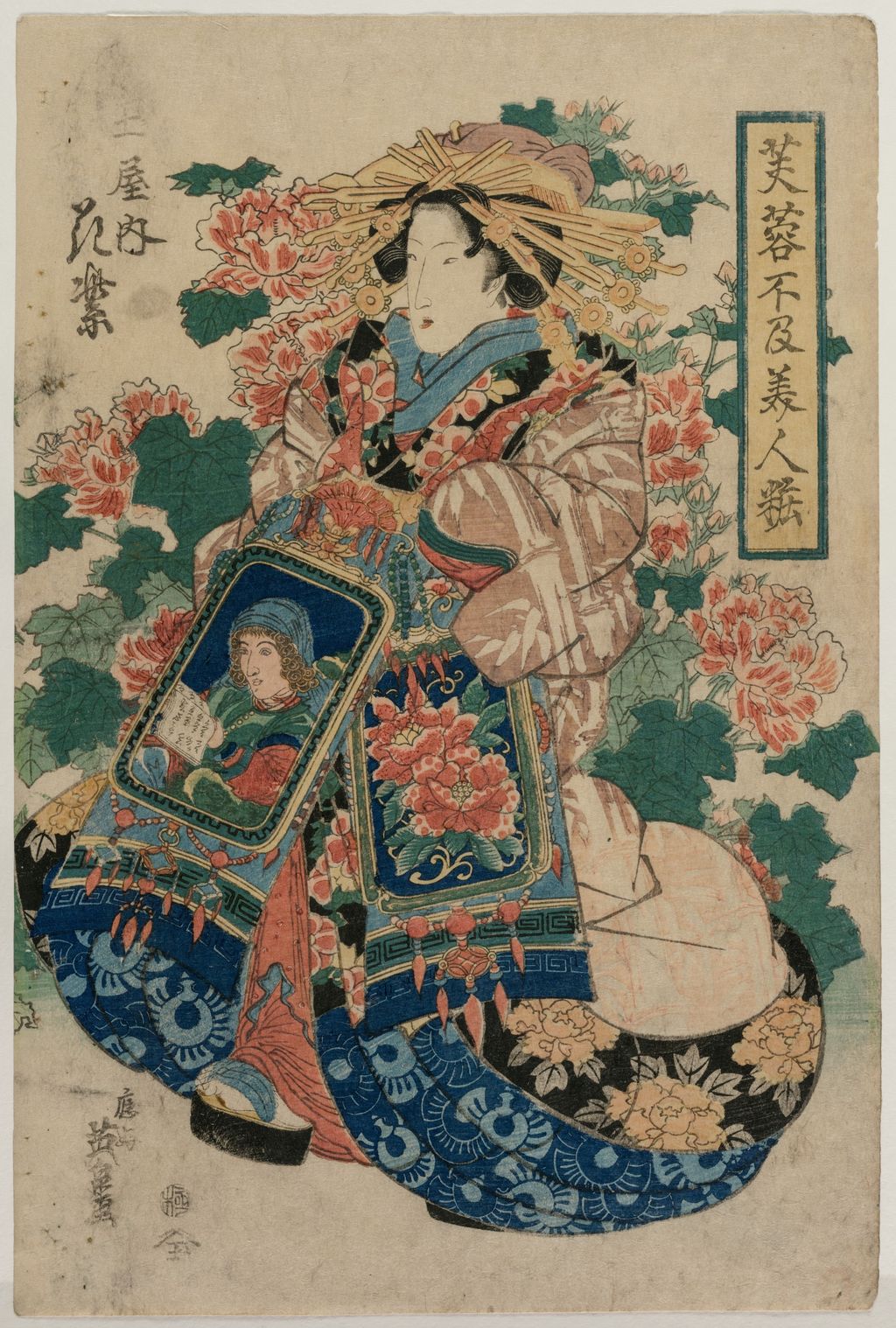
Figure 2: Cleveland 1916.1163, The Courtesan Hanamurasaki of the Tsuchiya, early or mid-1830s, 37.6 × 25.1 cm. Place the full sheet beside the comparison between named and unnamed subjects. The title, house and series belong in the caption. An enlarged textile detail is possible only from the retained 2,294 × 3,400 master; check that the proposed feature stays legible at popup size. [6]
The retained high-resolution Hanamurasaki file rewards that closer look. At full size, her elaborate hairpins, the layered pink blossoms, a sharply bordered blue panel on the robe and the right-hand title cartouche occupy different zones of the sheet. Inside the robe's panel is a small figure with a conspicuously different dress and hairstyle from Hanamurasaki's. Its identity is not supplied in Cleveland's brief record, so it should be described as an inset figure rather than declared a specific European woman or imported picture. The visual effect is enough: the viewer first sees a richly dressed courtesan, then encounters another image embedded in the clothing. A close-up could let readers discover that second image and return to the full sheet to understand how it contributes to the costume's complexity. This is a better annotation than a generic hotspot labelled “kimono pattern.” [6]
Read Hanamurasaki’s print up close
Choose a number to enlarge a detail from the retained high-resolution museum image. Locate it in the complete print, then read the explanation below.
Explained details
Hairpins and flowers
Fine hairpins and surrounding flowers direct attention toward the face; they do not reveal the sitter’s private feelings.
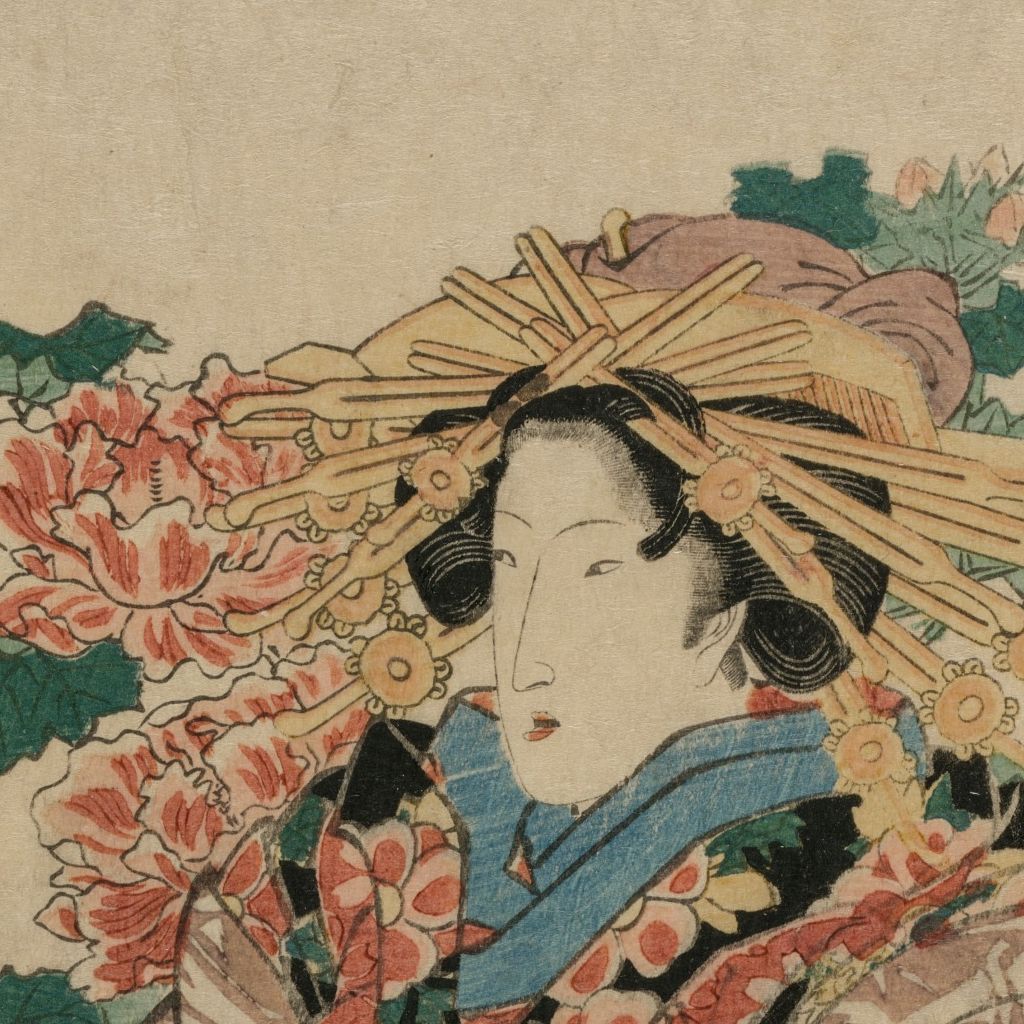
Cleveland Museum of Art Object record 1916.1163. Editorial crop and resize disclosed.
A figure within the robe
A second figure appears inside a blue-bordered textile panel. The museum record does not identify its source or nationality.
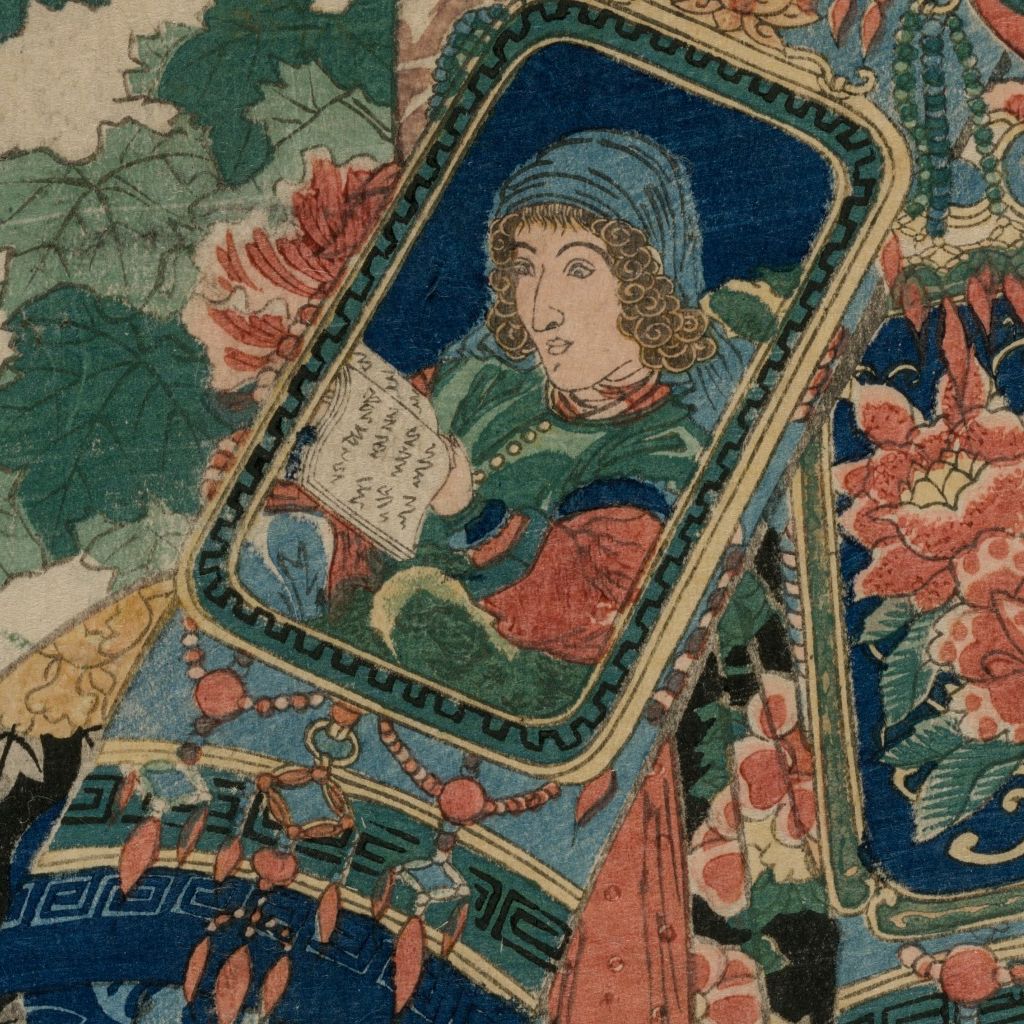
Cleveland Museum of Art Object record 1916.1163. Editorial crop and resize disclosed.
The title cartouche
Locate the right-hand text box within the whole sheet. Use the museum’s verified person and series names without guessing a transcription.
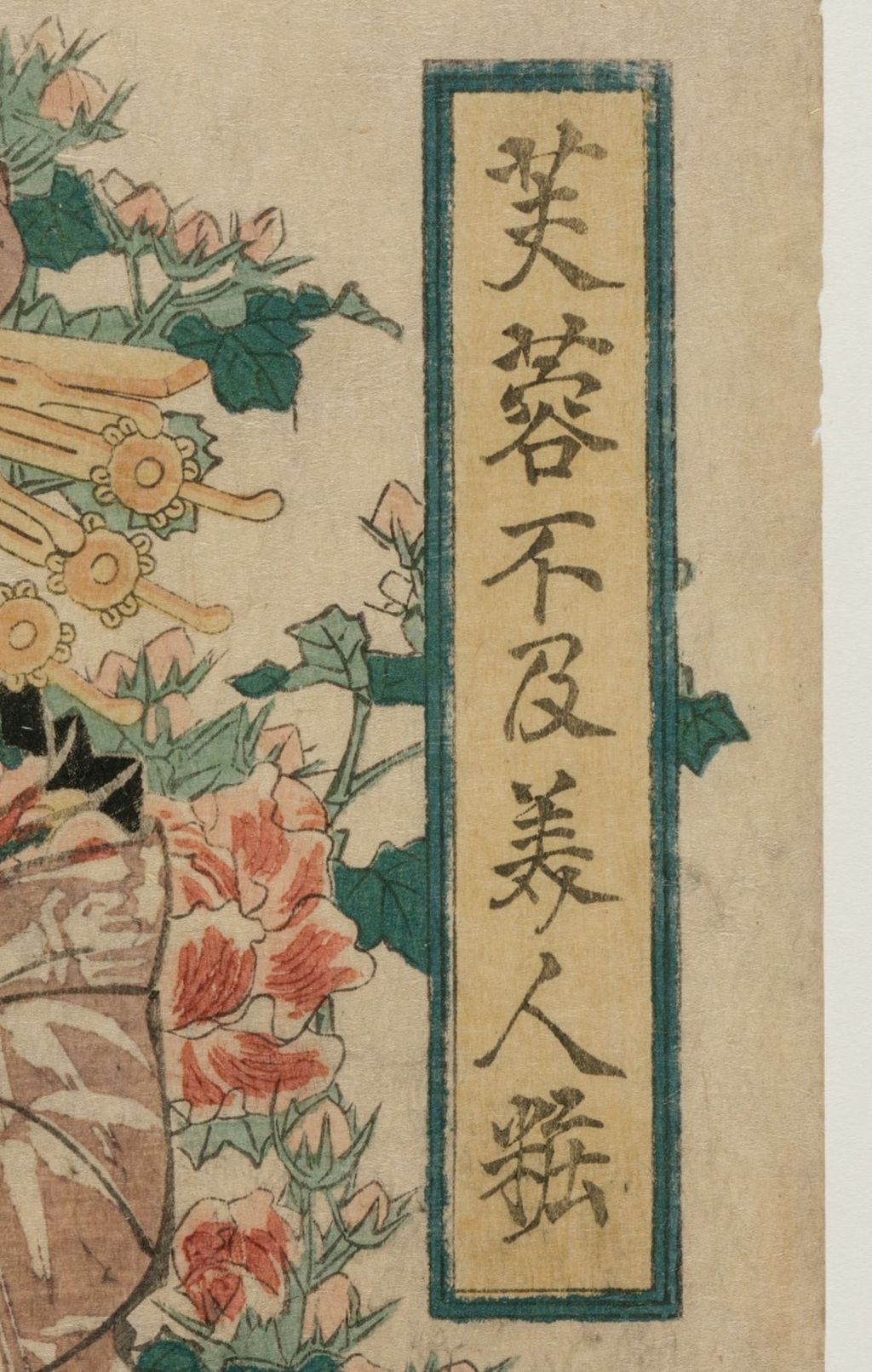
Cleveland Museum of Art Object record 1916.1163. Editorial crop and resize disclosed.
The two museum pictures also differ in the amount of information their framing leaves available. The Met's small head print concentrates attention on face, coiffure and collar; Cleveland's larger sheet has space for body, flowers, an inscribed series panel and a named social setting. One is not simply a “zoomed-in” version of the other. They ask a buyer to recognise and enjoy different things. If the site presents them side by side, equal-width thumbnails would make their sheets appear similar in size, so the captions should retain the physical dimensions. The comparison is about both visual design and the scale of the surviving paper, not a claim that every buyer saw these two impressions together. [5] [6]
The shift from the whole figure to a large head was not simply a matter of cropping the same subject. Tanabe traces Eisen's early prints through the circle of Kikukawa Eizan and then to a more independent style around 1821–22. Her account ties that chronology to signatures, seals, theatrical references and surviving series. The early women could resemble Eizan's slender, idealised figures closely; the later large-head portraits put distinctive expressions at the centre of a buyer's attention. Chiba's exhibition places Eisen among the leading producers of beauty prints by the middle of the Bunsei period (1818–30). Those are claims about dated groups and the print market, not a claim that every later Eisen woman shares one face. [2] [1]
The Japanese title 今様美人拾二景 is usually rendered Twelve Views of Modern Beauties. Chiba catalogues its Tōei-zan Kan'ei-ji Temple: Aspect of a Happy Woman with a location and a feeling in the same object title. This is a useful corrective to treating a “beauty” series as twelve anonymous samples of costume. Eisen's title asks readers to relate a person, a place and an expressed mood. Such a label is not evidence that the artist personally witnessed one particular woman's private happiness; it is part of the print's constructed scene. Ōta Memorial Museum's account of another horizontal large-head series also shows that a portrait format can vary: it identifies four other known designs sharing the distinctive cartouche arrangement of its own example. The series, its label and the orientation all affect how an image is read. [7] [8]
Chiba and Ōta use strong language for Eisen's later women, sometimes translated as sensuous or decadent. Those terms describe a historical response to their make-up, bearing and atmosphere; they should not substitute for looking. In a particular print, a low viewpoint, a sideways glance, a tilted head or the weight of a patterned robe can give the figure force. In another, the background may supply the social setting. The reader should be able to identify which of those effects is actually present in the chosen impression. “Decadent” alone would turn a diverse body of portraits into an untestable mood. [1] [22]
The Cleveland sheet Pictures of Eastern Brocade, from Famous Products of Edo, is a useful counterpoint to the two close portraits. It shows a woman with an object and a designed text panel, asking us to consider the commercial idea of Edo's famous products alongside her dress. A print titled for a product is doing more than describing a face. The surviving object's early-1820s date also places it near the years in which Tanabe sees Eisen moving away from Eizan's style. It would be too much to claim the print advertises an exact shop or commodity without a checked reading of its cartouche; the object can already demonstrate how person, setting and text work together. [9] [2]
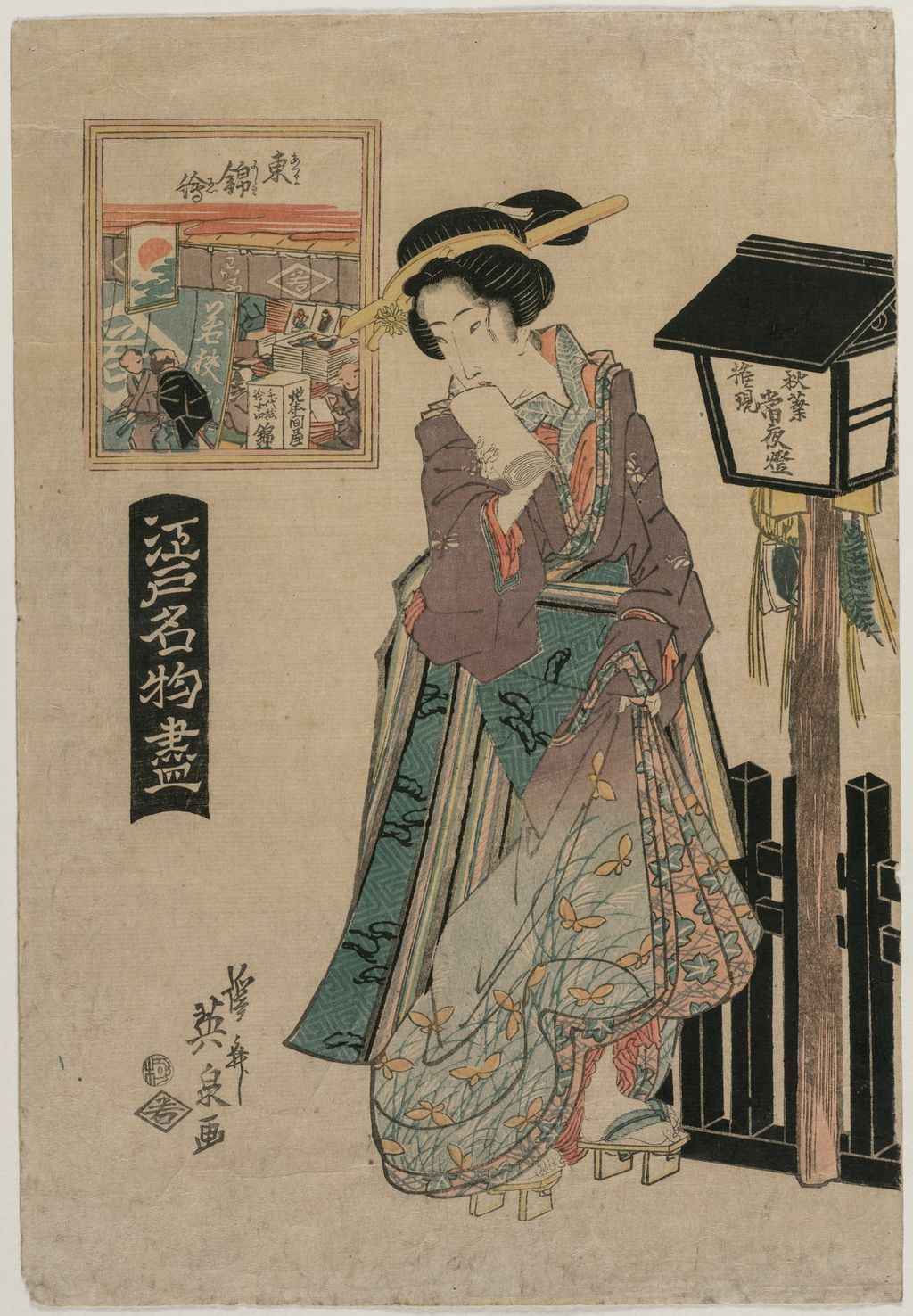
Figure 3: Cleveland 1928.128, Pictures of Eastern Brocade, c. early 1820s, 38.4 × 26.3 cm. Show the whole sheet with its title block. The print can anchor a brief visual-reading module: where the figure looks, where the product label sits, and why a crop of the woman alone would omit the picture's commercial framing. Do not transcribe or translate the block from an unverified visual guess. [9]
Printed books, private commissions and paintings
The Met's Picture Album of the Floating World (Ukiyo efu, 浮世画譜), catalogued to the 1820s, is a set of three woodblock-printed books. Its open spread has facing pages and a gutter; it is not a single loose print that happened to be mounted horizontally. A browser can zoom across the spread, but the book's physical sequence and binding shaped how its first readers met an illustration. That difference matters for Eisen because books formed a substantial part of his work. The British Museum catalogues him as an author as well as a printmaker and painter and lists many illustrated books among his associated objects. A page that only counts single-sheet beauties cannot give the reader this second way of encountering his imagery. [10] [3]
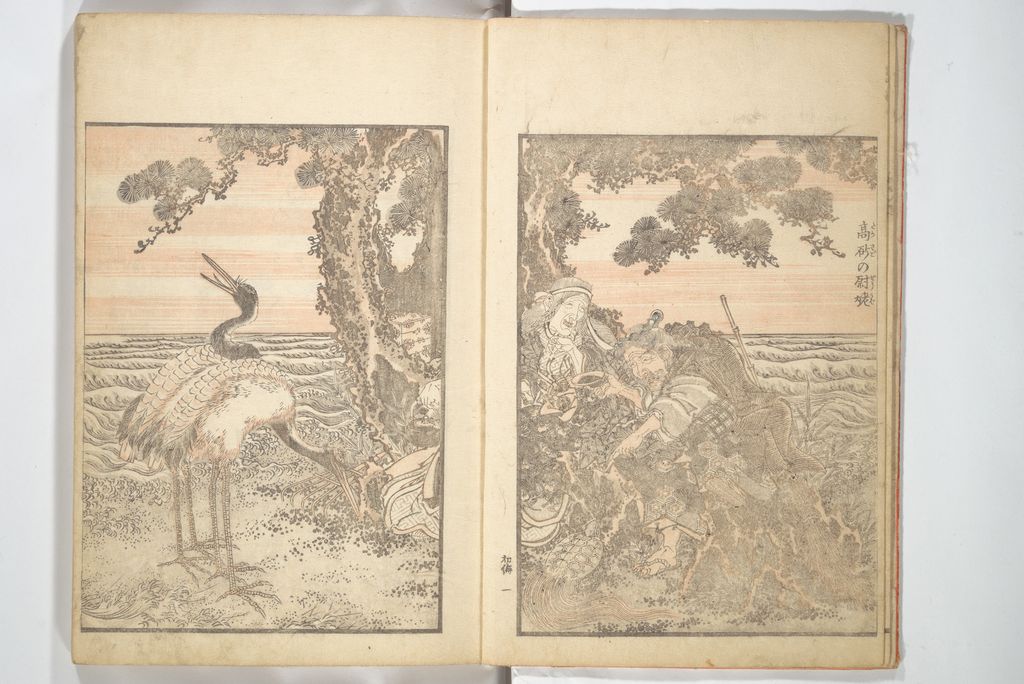
Figure 4: Met 2013.675a–c, Picture Album of the Floating World, c.1820s. Use the retained photograph of the complete spread, with a caption specifying set of three books and that the displayed image is a photographed opening. Its series of pages should not be treated as though the whole work consisted only of the one photographed spread. [10]
Tanabe's study makes another distinction within Eisen's printed work. Surimono were specially commissioned prints circulating in a world of poetry, gifts and cultivated associations. Her account of a catalogue of more than a hundred Eisen surimono works suggests that this was a major part of his career, not an occasional pastime. She records patrons including a restaurateur with a poetry name and a domain lord who wrote kyōka, showing that the commissioners did not belong to one social class. These prints could carry written verse and material refinements tied to their intended audience. The exact sheet, poem, date and right to reproduce it must be verified before one is used as a supporting image here; no member of our present eleven-object packet is labelled as a surimono merely because it has a poetic appearance. [2]
Painting is a further part of the story. Chiba catalogues Mitate of the Third Princess (見立女三の宮図) as a hand-painted work on silk and reads its female figure against an older image of the Third Princess and her cat. The title invokes a literary comparison, not a direct portrait of a real princess. Chiba's exhibition also included hanging-scroll paintings, while the British Museum catalogues painted works in its Eisen holdings. A painted scroll cannot be collapsed into a colour woodblock sheet simply because both show a woman. Brush, support, viewing arrangement and production number differ. We may discuss Chiba's painting with a linked reference; its photograph is a research illustration until that institution's file rights are individually cleared. [20] [1] [3]
This range also sets a limit on easy psychological readings. The British Museum's artist biography recounts family losses, changes of work and involvement in business beyond printmaking. Chiba recounts a turbulent life, while Adachi City Museum also records his training in the Kikukawa circle and his landscape collaboration. But a print's downcast gaze is not proof that Eisen was describing his own hardship, and a painting of an elegant figure is not a diary entry. The biography page should weigh those claims against dates and sources. [4] The artist home can say something firmer: the surviving media show him answering different commissions and audiences, from public print buyers to book readers and private poetry circles. [3] [1] [2]
When the subject changes scale
The Cleveland print Sparrows, Bamboo and Falling Snow demonstrates how much the eye must change when Eisen is no longer presenting a human figure. The small sheet, about 23.6 × 17.2 centimetres, depends on angled stems, a few birds and the white ground of falling snow. There is no large figure to announce the image's importance. The spaces between leaves and wings help make the moment visible. A reader familiar with Eisen only through packed robes can see here that restraint was also among his tools. The museum dates this example to the late 1820s, so this quieter subject need not be treated as a wholly separate “late style.” [11]
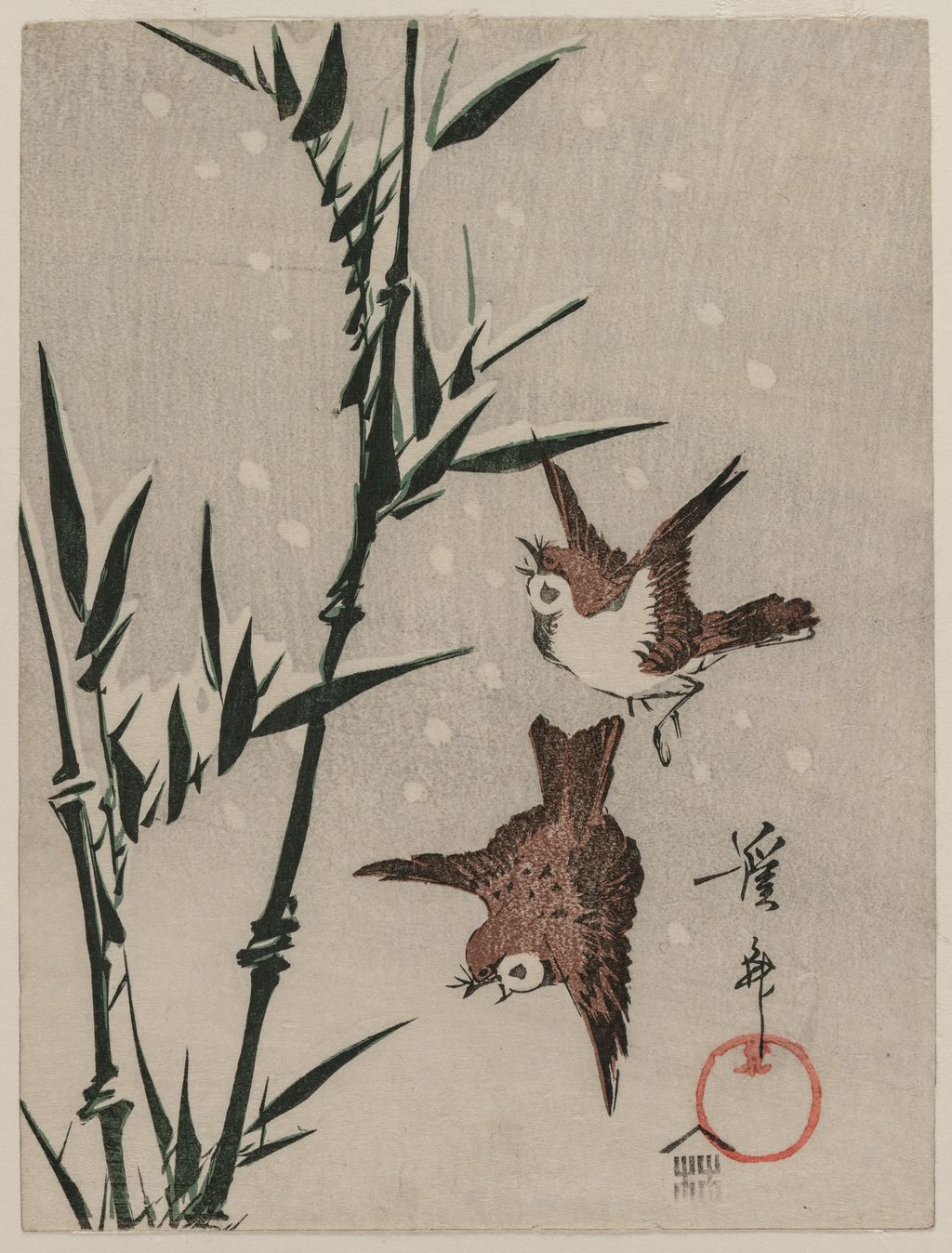
Figure 5: Cleveland 1930.192, Sparrows, Bamboo and Falling Snow, c. late 1820s. Retain the full sheet rather than cropping out its open paper; the empty areas are part of the composition. The individual birds and bamboo stems can support an annotation if the 2,583 × 3,400 source gives a clear detail at popup size. [11]
Cleveland's tall Carp Ascending a Waterfall provides almost the opposite effect. Water runs down beside a fish that drives upward; the narrow sheet makes their movements collide. Its 72.4-centimetre height was not an incidental choice of crop. The vertical format gives the animal room to climb and keeps a viewer's gaze moving from the lower body toward the head. Cleveland dates the work to the early or middle 1830s. We can describe a visible carp and waterfall without inventing the exact occasion of its making; a fuller account of its symbolism would need a source tied to this particular print. [12]
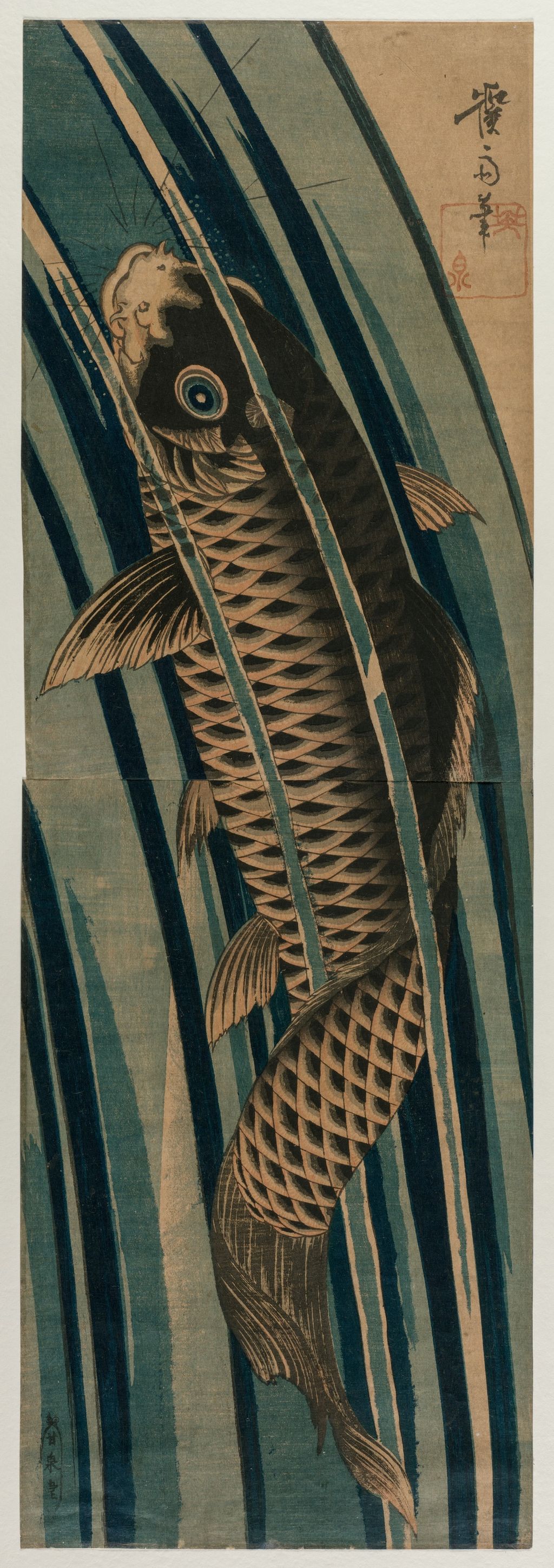
Figure 6: Cleveland 1940.1049, Carp Ascending a Waterfall, early or mid-1830s, 72.4 × 24.2 cm. Display the full vertical design. Its retained master is only 1,202 pixels across although 3,400 pixels high; a very tight horizontal detail may not withstand enlargement. The site derivative nevertheless meets 1024px width, JPEG quality 80, 144dpi. [12]
The Met's Kegon Waterfall turns another fall of water into a landscape. Where the carp picture uses an animal to define motion, the Met print lets the pale descending water divide darker rock and vegetation. A small figure near the fall, visible in the reproduced object, gives a human measure to the setting without making the person its principal subject. Its object record supplies the name, medium and dimensions, but does not give a specific year. We should not call it an 1830 or 1840 work simply because nearby dated Eisen landscapes exist. An uncertain date need not make the visual comparison uncertain. [13]
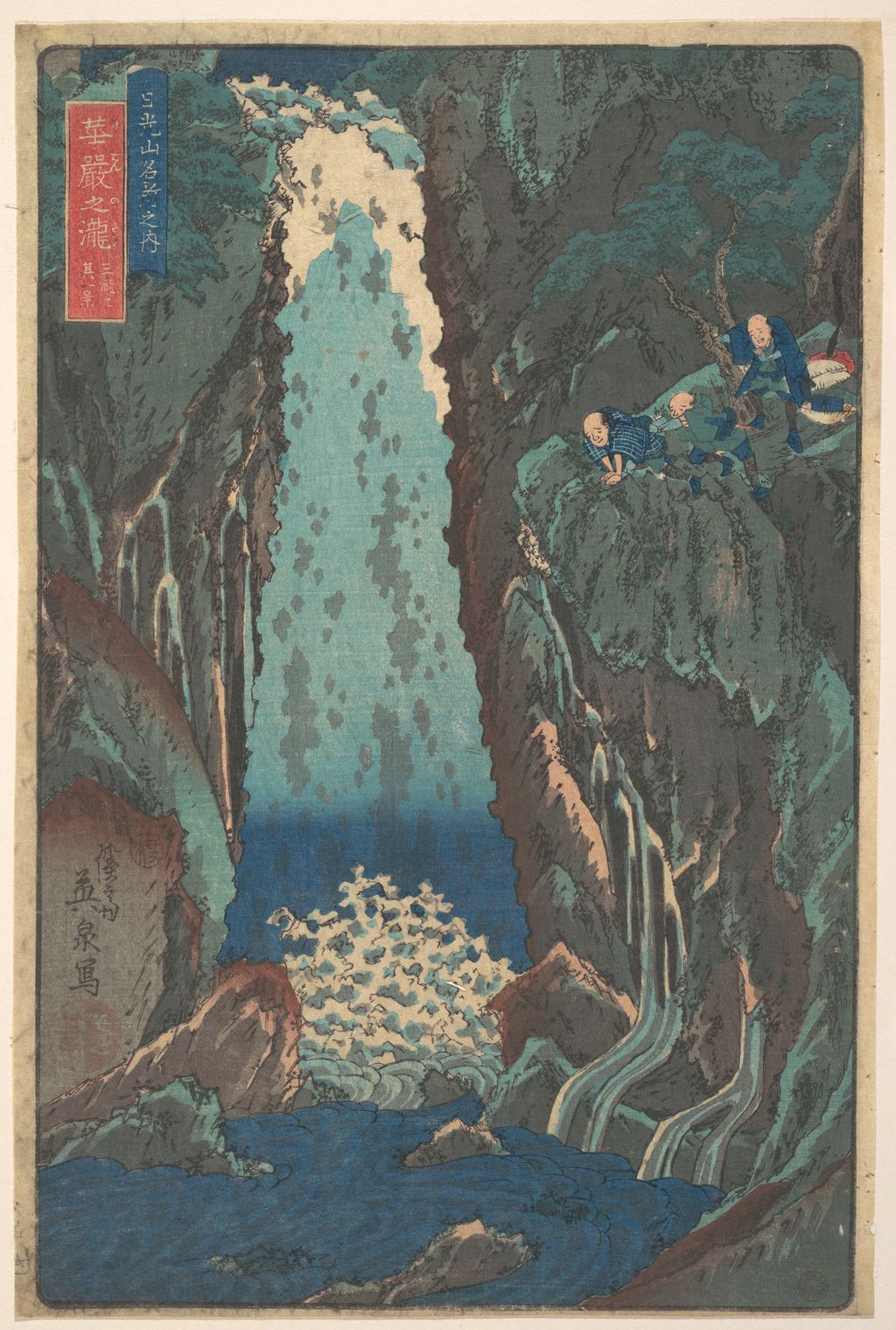
Figure 7: Met JP1229, Kegon Waterfall, 34.3 × 22.1 cm, date not specified in the Met record. Pair it with the carp print only after allowing each complete format its own space. Do not label the Met sheet part of a series without a source. [13]
The road he shared with Hiroshige
Before turning to an actual highway, another Eisen road shows how flexible the language of travel could be. The Met holds an album of 56 prints from A Tōkaidō Board Game of Courtesans, Fifty-three Pairings in the Yoshiwara (Keisei dōchū sugoroku, Mitate Yoshiwara gojūsan tsui). The title turns the familiar count of Tōkaidō stations into a structure for a pleasure-quarter sequence. It is not a documentary record of 56 women travelling between the stations. Nor is the Met album a single loose Eisen sheet: its record calls it 56 woodblock prints mounted together, to be viewed from right to left. Even the museum's digital presentation preserves that reading direction. This is a useful example of mitate, a playful recasting of one known subject through another, while the precise identity of each woman and station pairing belongs to a closer study of the full album. [24]
The album makes an important boundary visible. A beauty print may borrow a road's sequence as a literary or commercial framework, whereas a landscape sheet from the Kiso project represents a station and the route's physical setting. Both can invoke travel, but they answer different reader questions. A future page about Eisen's Tōkaidō courtesans would need to read the mounted sequence and individual inscriptions. It should not be folded into Hiroshige's Tōkaidō or the Eisen–Hiroshige Kiso Road merely because all three use station names. [24] [15]
The series commonly called The Sixty-nine Stations of the Kiso Road is a good example of why Eisen must be seen beyond his beauty prints. Its title refers to the road's stations, but the completed suite has 70 designs, including the Nihonbashi starting point and the route to Ōtsu. Tokyo National Museum and the Japan Ukiyo-e Museum identify it as a project by Eisen and Utagawa Hiroshige, not a single artist's uninterrupted set. The series began around 1835. Tanabe's study counts 24 designs by Eisen, the remainder taken on by Hiroshige. The British Museum's artist record independently gives Eisen the same 24-design contribution. These are series-level counts; an individual sheet still needs its own attribution and state checked. [15] [23] [2] [3]
One Eisen sheet, the Met's Warabi no Eki, Todogawa Watashi, lets the reader watch people and a boat negotiate a broad river rather than simply recognise a station name. The river occupies much of the horizontal print. The two shores, low trees and figures create a crossing whose distance matters. The Met dates its object to about 1838 and gives Eisen as artist. That date belongs to its catalogued impression; the series was issued over several years and particular station designs had their own histories. Nor should we assume that the exact Met object illustrates the original first printing of Warabi without a comparison of seals, title cartouches and states. [14] [2]
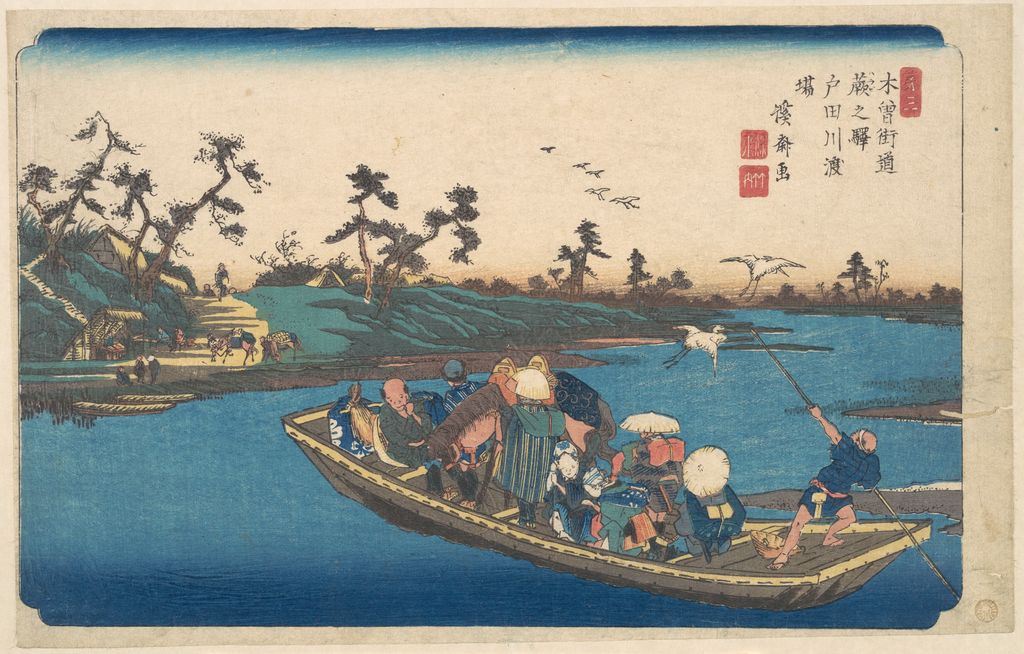
Figure 8: Met JP1031, Warabi no Eki, Todogawa Watashi, c.1838, 21.9 × 34.3 cm. Use the full horizontal image so both banks and the ferry remain legible. Caption the Met's transliterated title and Eisen attribution; a checked Japanese transcription can be added later. A useful annotation would locate the ferry, the changing shorelines and the title cartouche, then explain how each helps identify this particular print. [14]
The road itself did not dictate publication order. Japan's Tobacco and Salt Museum points out that Eisen depicted Shiojiri, the thirty-first station, among his contributions, showing that the sheets were not necessarily published in the same sequence as a traveller would encounter the places. This matters whenever a numbered station is mistaken for a production date. It also means an interactive route map should let readers travel along the road without implying that the printed series was released station by station. The map's labels should distinguish place order, artist attribution and, only where evidence exists, publication chronology. [16]
Publication and attribution grew more complex after Eisen left the project. Tanabe traces a change from the publisher Hōeidō Takeuchi Magohachi to joint publication with Kinjudō Iseya Rihei and then to Kinjudō alone. She notes later impressions from which Eisen's signature has disappeared and says that a dispute has been supposed, while the reason remains unknown. The safer story is therefore about observable changes: different publisher combinations, later impressions and a changed artist credit. Claiming a proven personal quarrel with Hiroshige would go beyond the documented object evidence. Chiba's own collection includes an explicitly labelled later impression of Eisen's Itabashi and an explicitly labelled first impression of his Oiwake; these labels show why a copied composition alone cannot settle which physical state one has in hand. [2] [17] [18]
The two Chiba records give more than a theoretical warning. The museum dates both objects to approximately 1835–36, even though it distinguishes the print state of one from the other. The date range is not a simple stamp saying that both pieces of paper left the press in the same week. A work catalogue may date the design or its first publication while using “later impression” to identify the exhibited sheet. A close comparison would need the specific blocks, seals, pigments and title panels visible in each object. Until that is done, the site should let the museum's state labels stand and avoid inventing a sequence between the Itabashi and Oiwake sheets. [17] [18]
The series' authorship also explains a frequent catalogue trap. A modern book cover or online gallery may say “Hiroshige's Kiso Road” because Hiroshige produced the larger share and became the more famous name. That shorthand should not make Eisen vanish from the 24 works assigned to him. Conversely, an Eisen station is not evidence that he designed every station before it or that Hiroshige merely copied his plan. A carefully labelled set can show both artists, the varying publishers and the persistence of the same route. The user can then move from one artist's cluster to the other's without receiving conflicting accounts of the same publication. [15] [2]
Blue, reuse and the problem of dating a print
Eisen's place in the history of blue printing is more specific than the familiar sentence that Japanese artists adopted Prussian blue. Chiba's exhibition describes his deliberate work with imported bero-ai, while Tanabe examines a historical account of an Eisen fan print in blue and traces how blue-only beauty designs were sold. The fan account makes him an early participant in a fashionable technique; it does not prove that Eisen invented the pigment or brought it into Japan unaided. Nor is every blue patch in a digital file automatically chemical proof of Prussian blue. Pigment identification for a particular sheet needs a conservator's analysis or an institution's documented material description. [1] [2]
Tanabe identifies an especially revealing practice: some Eisen blue-only prints reused the blocks of earlier full-colour beauty prints. She compares a Yoshiwara interior featuring the courtesan Sugatano with a later blue-print version whose context has been altered after a fire and temporary relocation of the quarter. Blocks could be retained while backgrounds, written information, colouring and marketing changed. She also warns that an older signature form might survive simply because its woodblock survived. A signature therefore cannot on its own prove the date when the particular blue impression was printed. This is a concrete example of how a design, a block and an impression are related but not identical. [2]
The point has consequences for the way this site uses images. If an illustration shows a later state, its caption must say later impression rather than label it the first appearance of the design. If a blue colourway is discussed, an image of a separately catalogued full-colour state cannot silently stand in for it. The local image ledger records the exact museum object and source file so that a future editor can trace each displayed sheet back to the institution that dated and licensed it. Chiba's Itabashi pair would be an excellent standalone comparison after reproduction rights for its individual files are cleared; it should not be recreated by recolouring a different museum's sheet. [2] [17] [18]
The same caution applies to the beauty prints on this page. Cleveland's Woman with Papers in Mouth and Fan in Hand is clearly attributed to Eisen, but its public API gives the strange creation_date 1789–1851, a span wider than any of the principal institutional life dates for the artist. That cannot be the year the sheet was made. We can use the image to discuss the interaction of figure, written matter and accessory if needed, while leaving it undated. Another precisely identified print is preferable for a chronological argument. Catalogue fields are evidence to inspect, not commands to repeat uncritically. [21] [3]
The city after the famous road
The Kiso prints did not exhaust Eisen's landscape interests. The Met catalogues Clearing Weather at Nihonbashi within his Eight Views of Edo (Edo hakkei) series and dates this sheet to 1843–47. Its horizontal format looks down a crowded bridge scene toward a more open distance. Many small figures share the foreground; the city becomes a social space as well as a view. The word seiran, “clearing weather,” belongs to a long pictorial and poetic vocabulary of “eight views”; here it names a particular Edo scene in a named series. The scene's evident bustle should not lead us to mistake it for a documentary photograph of one day. Eisen designed an urban view for a reproducible print. [19] [2]
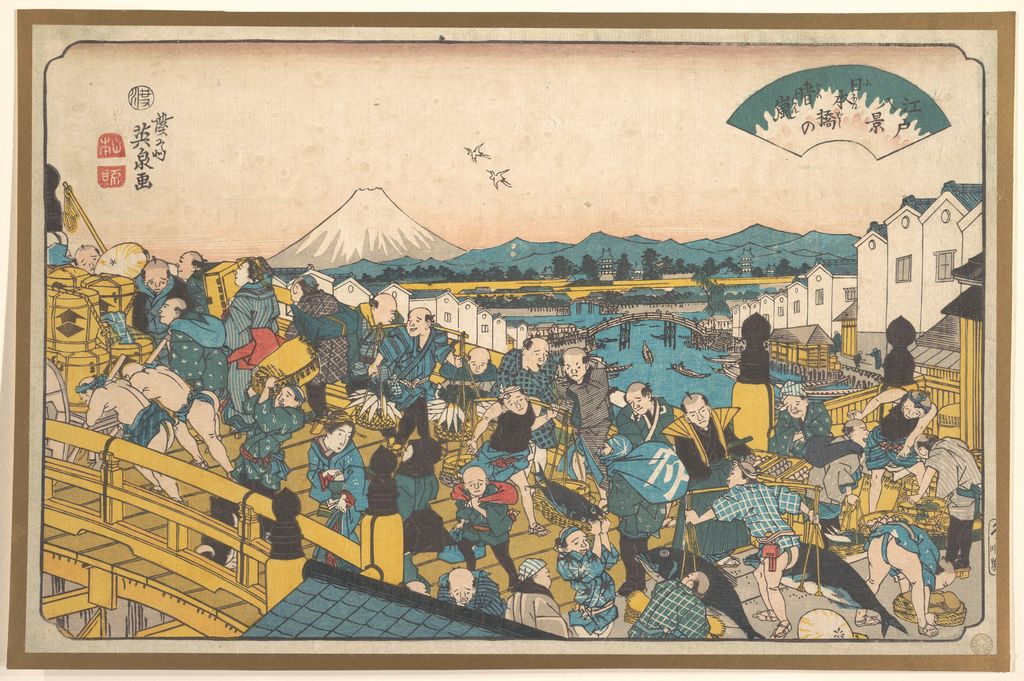
Figure 9: Met JP1283, Clearing Weather at Nihonbashi, 1843–47, image 22.9 × 35.6 cm. Show the whole bridge and surrounding crowd. The print's title, series, date range and accession all appear in the Met object record. A vintage bridge photograph could be added nearby only after its own date, viewpoint and reuse rights are documented; no photograph should be presented as the exact visual source for this designed image without evidence. [19]
Tanabe's late-career analysis distinguishes the Kiso project from subsequent landscapes made for other publishers. She also finds evidence that Eisen was looking at Hokusai's landscape innovations while pursuing something visually heavier in some works. That is a curatorial comparison, not a claim that every Eisen river or bridge directly copies a Hokusai print. In the Met's Nihonbashi sheet, bridge, pedestrians and distant architecture compete for attention; in the Warabi ferry, the river separates groups across a wide horizontal space. Both may be called landscapes, yet their human scale and picture structure differ. An illustrated overview earns its images when it lets the reader make such a comparison. [2] [14] [19]
How to recognise what survives
An Eisen image is not identified by name alone. His catalogue names include several signatures and aliases; the British Museum lists variants such as Kokushunrō and Mumeiō. A printed signature may help, but it should be read with seals, titles, publisher and state. Tanabe's early series dating uses a combination of censor seal and a theatrical clue rather than the shape of one name. Her later blue-print case shows why an old signature can persist on a newly marketed impression. The correct question is not simply “does the sheet say Eisen?” but “which design, block and printing does the surviving sheet represent?” [3] [2]
Media labels matter just as much. A book spread is not a single-sheet print; a painting is not a print; a first printing and a later state are not interchangeable. Even two images of the same design from two museums may record different paper, wear or colours. This page's Cleveland and Met files remain attached to accession numbers and catalogue wording. A visitor can follow the inline reference from an argument to an institution's object, while the visible caption names the specific piece reproduced. That is particularly important for a print culture in which a composition could live through many physical impressions. [10] [17] [18]
Eisen can now be placed beside the other artists without turning him into an appendix. He began by designing within a successful portrait tradition and found a distinctive presence in close views of women. He also worked in poetry circles and book publishing, turned to demanding vertical animal and waterfall designs, helped shape a landmark road series, and made city views after that series had passed to another artist. The evidence of old blocks, new colourways and changing publisher credits shows a career embedded in the decisions of print production. An artist home should leave the reader with both the breadth of this work and the habit of asking exactly which object makes each claim possible. [1] [2] [15]
Frequently Asked Questions
Beauty prints brought him strong recognition, especially in the Bunsei period, but Chiba's collection and career study document landscapes, illustrated books, surimono, paintings and other subjects. A description limited to beauties leaves important later work out. [1] [2]
No. Japanese museum catalogues identify a joint Eisen–Hiroshige series. It has 70 designs including the route's starting point; Tanabe and the British Museum assign 24 designs to Eisen. The artist and printing state of a particular sheet still need checking. [15] [23] [2] [3]
Chiba City Museum of Art gives 1791–1848, while the British Museum and Met give 1790–1848. The difference is unresolved in the institutional sources used here; the artist's death year and active nineteenth-century career are not in dispute. [1] [3] [5]
It is a print made chiefly in blue tones. Chiba's research traces Eisen's role in the fashion for imported Prussian blue and shows that some later blue-only prints reused blocks from earlier multicolour beauties. The exact pigment and printing history of one sheet must be checked rather than inferred from a digital image. [1] [2]
Discussion
Compare individual Eisen objects, their titles and the evidence for a particular printing.
Reader Insights
What can Hanamurasaki’s title tell us that the Met’s unnamed head cannot?
How does a Yoshiwara Tōkaidō pairing differ from a Kiso station landscape?
Which parts of a Kiso sheet could reveal a later impression or changed publisher?
Join the Conversation
Share a documented example or reliable source below, keeping observation separate from inference.
References
- Chiba City Museum of Art, Ukiyo-e Artist Keisai Eisen exhibition, 2012. Japanese institutional overview, life dates, genres, representative works and exhibition scope.
- Masako Tanabe, “渓斎英泉の画業展開について,” Siren 15, pp. 7–22, Chiba City Museum of Art. Relevant early-style, blue-print and Kiso sections checked in the retained 19-page paper; OCR is unreliable for some numerals and names, so verify against the scan before quoting.
- British Museum, Keisai Eisen, artist biography BIOG806. Names, life dates, media, training account and 24-design Kiso statement.
- Adachi City Museum, 渓斎英泉. Short Japanese institutional biography and Kiso context.
- Metropolitan Museum of Art, Head of a Beauty, JP1070. Exact public-domain print and date.
- Cleveland Museum of Art, The Courtesan Hanamurasaki of the Tsuchiya, 1916.1163. Exact CC0 impression, title and attribution.
- Chiba City Museum of Art, 今様美人拾二景 東叡山寛永寺・うれしそう. Exact Japanese title and subject gloss.
- Ōta Memorial Museum of Art, collection 15: 溪斎英泉 今よふすかた. Horizontal large-head portrait and series context.
- Cleveland Museum of Art, Pictures of Eastern Brocade, 1928.128. Exact CC0 impression.
- Metropolitan Museum of Art, Picture Album of the Floating World, 2013.675a–c. Exact public-domain book set and photographed opening.
- Cleveland Museum of Art, Sparrows, Bamboo and Falling Snow, 1930.192. Exact CC0 sheet.
- Cleveland Museum of Art, Carp Ascending a Waterfall, 1940.1049. Exact CC0 vertical sheet.
- Metropolitan Museum of Art, Kegon Waterfall, JP1229. Exact public-domain sheet; no narrow object date stated.
- Metropolitan Museum of Art, Warabi no Eki, Todogawa Watashi, JP1031. Exact public-domain ferry impression.
- Tokyo National Museum, ukiyo-e display and works list. Japanese 70-design, two-artist Kiso series summary.
- Tobacco and Salt Museum, 渓斎英泉画「木曽街道」. Japanese account of Shiojiri and non-sequential issue.
- Chiba City Museum of Art, Second Kiso Road: Itabashi Station, later impression. Exact institutionally labelled later state; research image only.
- Chiba City Museum of Art, Oiwake Station with View of Mount Asama, first impression. Exact institutionally labelled early state; research image only.
- Metropolitan Museum of Art, Clearing Weather at Nihonbashi, JP1283. Exact public-domain Eight Views of Edo sheet.
- Chiba City Museum of Art, Mitate of the Third Princess. Hand-painted silk work and curatorial interpretation; research image only.
- Cleveland Museum of Art, Woman with Papers in Mouth and Fan in Hand, 1940.718. Exact CC0 image; API dating field requires correction/verification.
- Ōta Memorial Museum of Art, “Japanese Beauty” exhibition. Curatorial context for changes in beauty imagery.
- Japan Ukiyo-e Museum, The Sixty-nine Stations of the Kiso Road exhibition. Japanese two-artist, 70-design series summary.
- Metropolitan Museum of Art, A Tōkaidō Board Game of Courtesans, album of 56 prints. Exact public-domain album and display direction; not yet selected as a production image.