


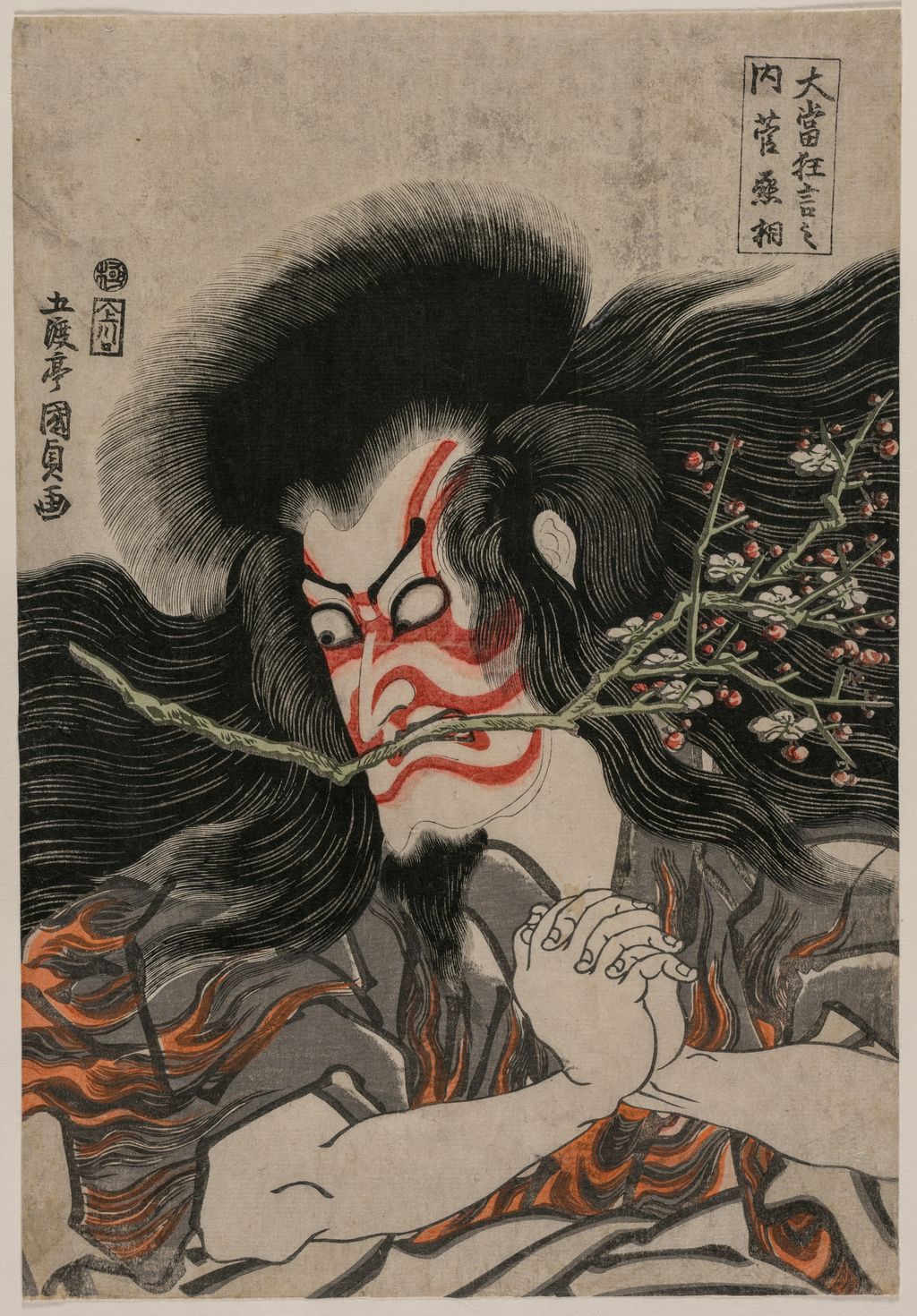
Utagawa Kunisada, Ichikawa Danjūrō VII as Kan Shōjō, 1814. Cleveland Museum of Art, 1985.333. Museum object record.
 by Tom Gurney
Tom Gurney BSc (Hons) is an art history expert with over 20 years experience
Published on September 25, 2026 / Updated on September 25, 2026
Email: tomgurney1@gmail.com / Phone: +44 7429 011000
Utagawa Kunisada: the pictures of a changing Edo
Utagawa Kunisada (1786–Genji 1/1864 in the Japanese calendar, January 1865 in the Gregorian calendar) was a print designer for an audience eager to recognise the latest actor, a familiar poem, a fashionable garment or a much-discussed story. Known in later life as Utagawa Toyokuni III, he worked across much of the nineteenth century, when woodblock prints moved quickly through the commercial life of Edo. Kabuki actors were his central subject, but his pages and sheets also offered women in domestic and public spaces, illustrated fiction, warriors and occasional landscapes. A Kunisada print could be both a timely object and a densely layered picture. [1] [2] [3]
The long life of these pictures has made their immediate purpose easy to overlook. Many actor prints accompanied a specific theatre production. A purchaser could identify a performer's name and crest, recognise a character, or remember the force of a stage pose. The Fitzwilliam Museum describes a market in which commercial prints were relatively affordable and often issued in response to current performances. They were made to be enjoyed quickly, even though some survived in albums and became museum objects. Kunisada's art belongs equally to that first audience and to the slower looking a surviving impression invites today. [3] [4]
Contents
- Utagawa Kunisada: the pictures of a changing Edo
- Read Danjūrō’s dramatic pose up close
- What an actor print lets us read
- Beautiful women and the places around them
- Warriors, working people and an uncommon landscape
- A new Genji in books and prints
- The Tōkaidō: three kinds of picture, two artists
- Printing effects, censorship and change
- Reading the name, date and impression
- What to look at next
- Books on Japanese Art
Read Danjūrō’s dramatic pose up close
Choose a number to enlarge a detail from the high-resolution museum image. Find its position in the whole print and compare the explanation below.
Explained details
Make-up and mie
Red-and-white make-up, crossed eyes and a tense mouth hold an aragoto mie. This is Danjūrō performing Kan Shōjō’s transformation, not an unqualified personal portrait.
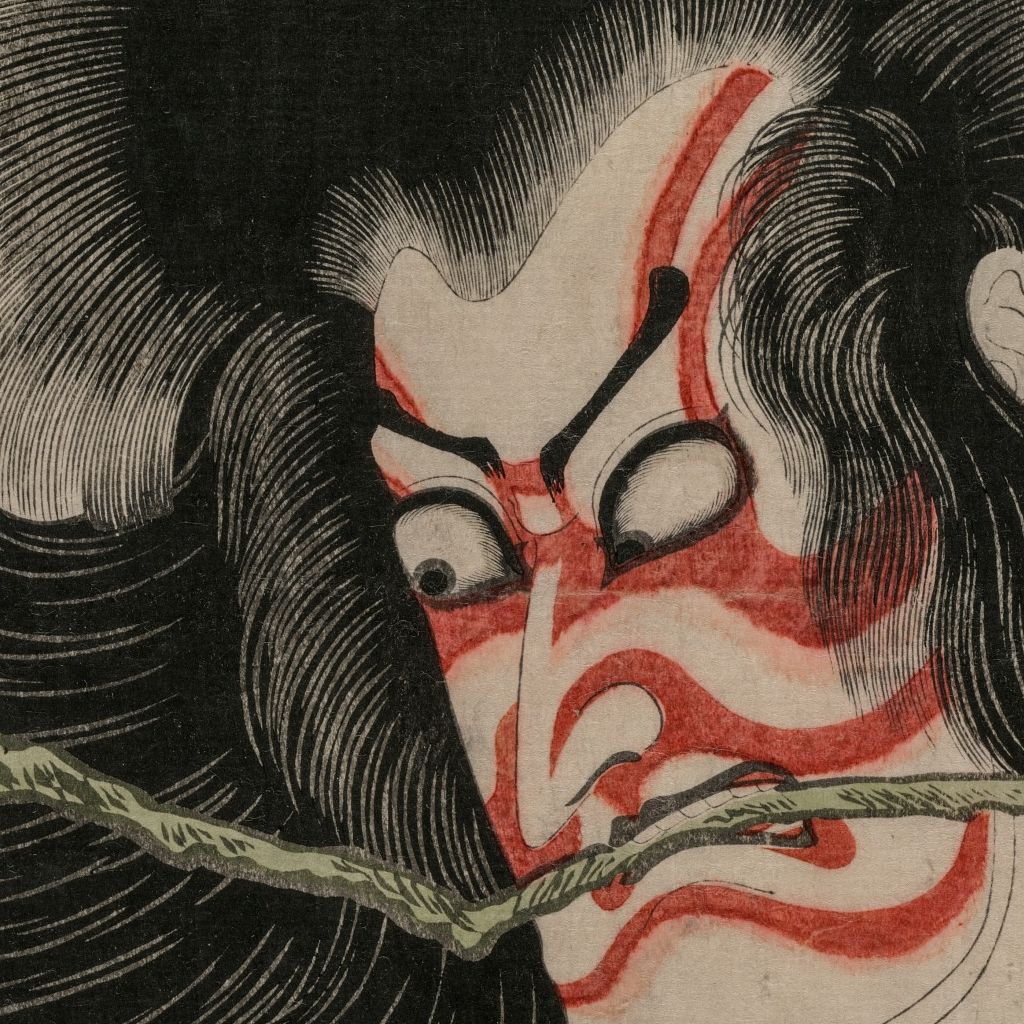
Cleveland Museum of Art Object record 1985.333. Editorial crop and resize disclosed.
The plum branch
The flowering branch crosses the mouth; smaller blossoms sit amid the sweeping hair. Return to the whole sheet to see how they interrupt the face.
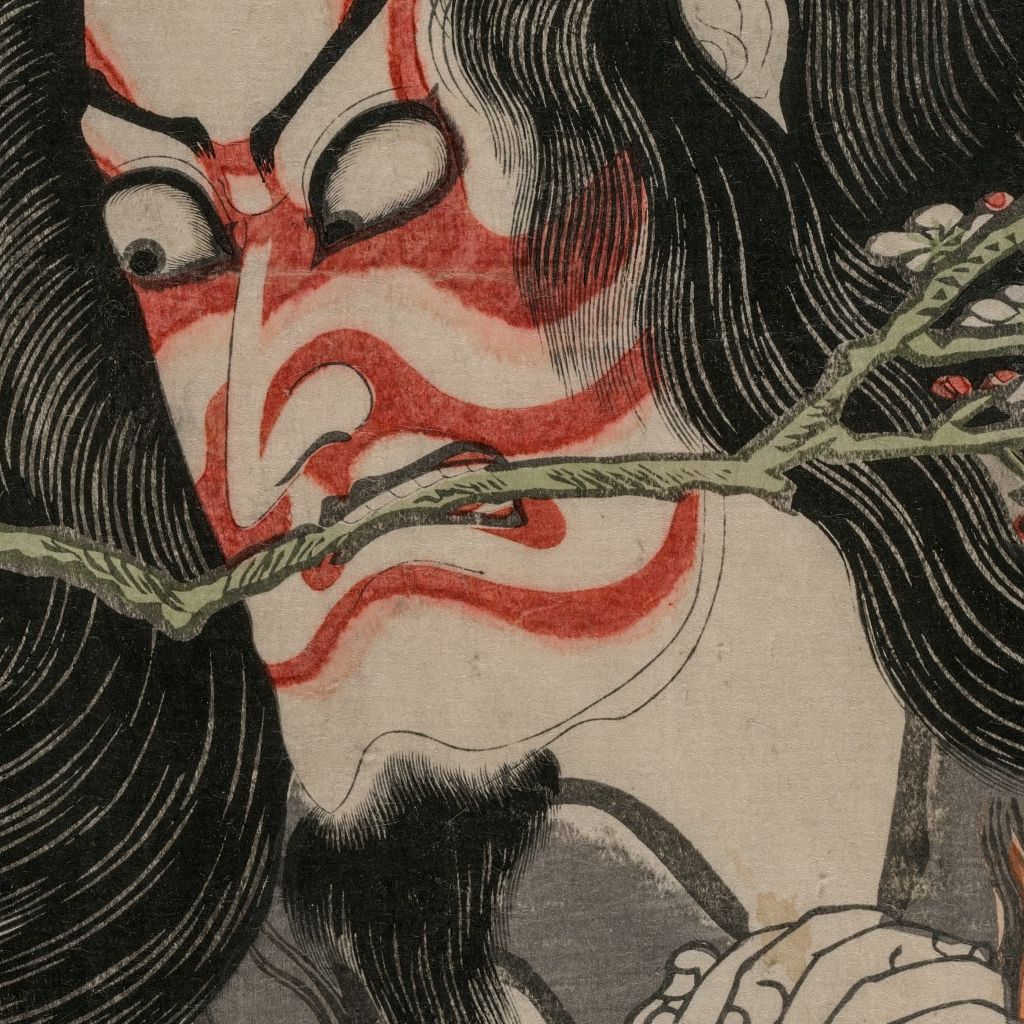
Cleveland Museum of Art Object record 1985.333. Editorial crop and resize disclosed.
The upper-right cartouche
The text box helps locate the picture within a named role and series. Read it with the museum identification; do not guess a transcription from the crop.
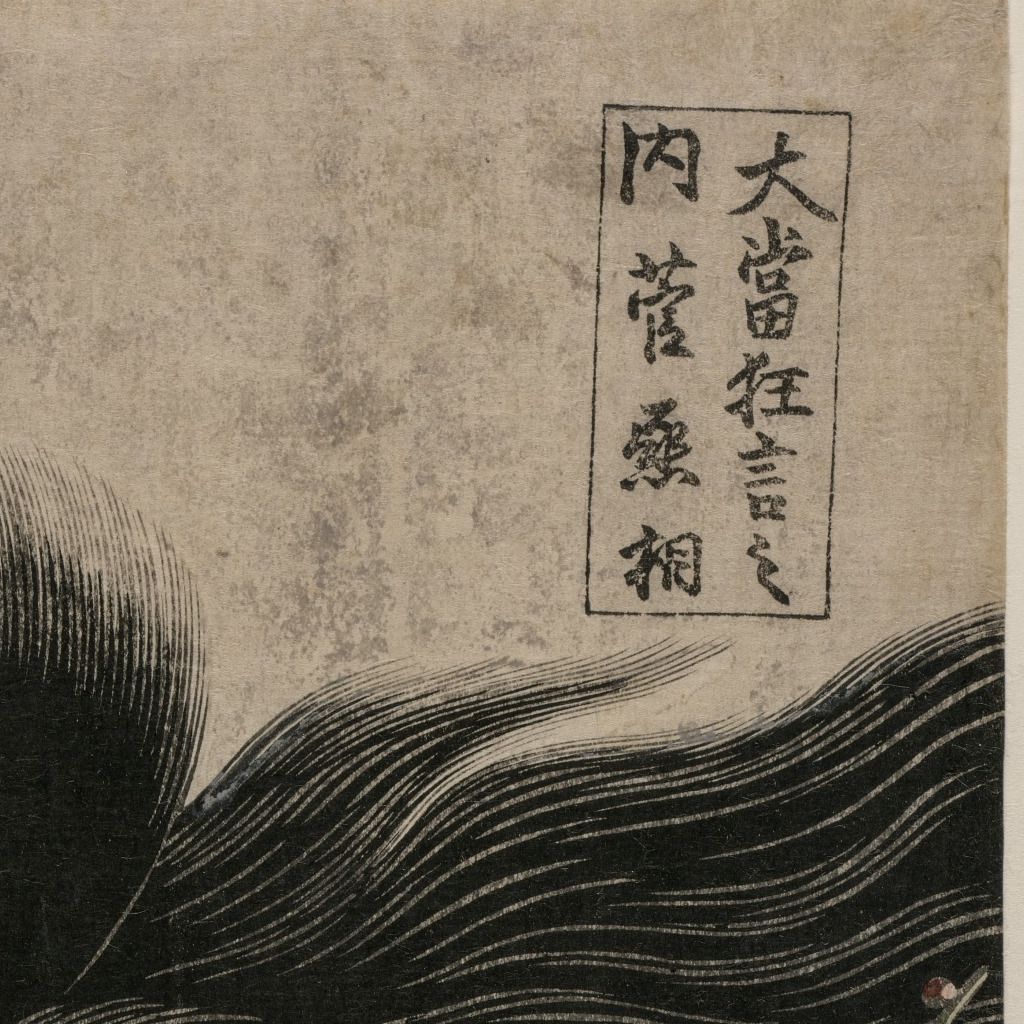
Cleveland Museum of Art Object record 1985.333. Editorial crop and resize disclosed.
An early place to begin is Cleveland's Ichikawa Danjūrō VII as Kan Shōjō in the Mt. Tenpai Scene, from Famous Kabuki Plays. The museum dates its impression to 1814 and describes a colour woodblock print with mica. The actor's face and hair command the narrow sheet, while the role and the scene title identify a performance world beyond its edges. It is a portrait of a performer in a role, not an independent likeness of Danjūrō at home or a generic warrior. The subject also catches Kunisada early in the long relationship between his actor imagery and the Ichikawa stage line. [5] [6]
At a glance
- Life1786–January 1865 (Gregorian calendar)
- Main periodLate Edo print culture
- SubjectsKabuki actors, beauties, illustrated fiction
- Look forActor and role, signature, publisher and impression
The Cleveland Museum's object essay identifies the scene more fully. Kan Shōjō is an exiled statesman at the moment of transformation into a thunder god. Danjūrō's red-and-white kumadori make-up and crossed eyes belong to the forceful aragoto acting style. The flowering plum branch held across his mouth is not a random bit of costume: it interrupts the face just as the tense pose brings attention to his eyes and clenched hands. In the high-resolution museum image, long lines of black hair surge to either side, enclosing small sprays of blossom. These are visible features worth explaining in a close-up, and the museum's identification of the transformation lets the page connect them to a particular role. [5]
There is a useful tension between the print's immediacy and its layers of artifice. A buyer who had seen the performance might remember the held pose and its applause; another might recognise the Ichikawa actor from his distinctive make-up. Our modern viewer first meets an accessioned sheet, not a stage. An annotation can bridge that gap by locating the plum, the eyes and the cartouche on the full image before presenting two or three enlarged details. It should not paste a generic explanation of Kabuki over the object. Its strongest claim is specific: this is Danjūrō VII portraying Kan Shōjō, and the museum links the pictured pose to the scene's transformation. [5] [3]
The numbers used for Kunisada's names can also mislead. He signed as Kunisada until the 1840s and then adopted his teacher Toyokuni's name. Some transitional prints called him the second Toyokuni because he did not accept another claimant, Toyoshige, as the legitimate bearer. Museums now generally count Toyoshige as Toyokuni II and Kunisada as Toyokuni III. The same person therefore appears under two professional names and two historical numbering systems. A name in a catalogue is a clue to the history of a sheet, not proof that two differently labelled sheets have different designers. [7] [8]
What an actor print lets us read
An actor print combines several kinds of information that modern readers can separate. The performer is Ichikawa Danjūrō VII; the character in the Cleveland sheet is Kan Shōjō; Famous Kabuki Plays is its series title; and Kunisada is the designer. Those four labels answer different questions. The performer can appear again as another character. The character can be played by another performer. A series can gather prints from different plays. Keeping the labels distinct prevents a common error: treating the face in a role print as though it were an unqualified portrait of the historical actor. [5] [9]
The Fitzwilliam Museum explains why the face mattered. Earlier actor pictures could rely heavily on costume, pose and a family crest. By Kunisada's time, the conventions of nigao, or recognisable actor likenesses, put repeated facial traits to work as identifiers. Kunisada's teacher Toyokuni I even published a manual on drawing actor likenesses in 1817. His instructions linked the shapes of eyes and brows to the expression of a dramatic moment. A viewer who knew the actor and the play could read the print with far more precision than a visitor meeting it as a standalone image two centuries later. [10]
The difference between recognising a face and knowing a person matters. The force of a furrowed brow, theatrical make-up or an emphatic hairstyle is not evidence of a sitter's private temperament. It belongs to a performed scene and to a visual language designed for fans. Nor did an actor's name always stay fixed: stage names passed between generations, and a performer might take another name during his career. Danjūrō VII passed the Danjūrō name to his son in 1832 and later performed under the name Ebizō V. That is why the numeral after a stage name is as important to an identification as the name itself. [9] [10]
An actor's crest can provide another line of evidence. The Ichikawa family's mimasu emblem is three nested rice-measure squares; it might appear on a costume or elsewhere in an image. A crest is an aid to recognition, not a replacement for the inscription, date or performance history. The Fitzwilliam's guide to actors' names also identifies the shouted yagō, a theatre “shop name,” and poetry names that could attach to the same star. To read a Kunisada actor sheet well is to notice this network of names rather than expect a single caption to settle every identity. [9]
Kabuki's mie, the arresting pose in which action is held at a moment of maximum feeling, was especially well suited to a still image. A print can isolate an instant a live spectator saw amid movement, sound and the unfolding story. The Fitzwilliam places such poses within a theatre of elaborate costume, make-up and dramatic conflict. The art historian's language of “expression” should not make us forget the plot and actor who gave the expression meaning. In the Cleveland Danjūrō print, the title directs us toward a named scene; its power is sharpened when we keep that context beside the visual effect. [3] [5]
The actor sheet is also the result of a printing business. Kunisada designed the image, but a woodblock cutter, printers and publisher translated it into saleable impressions. The sheet's present colours and paper are those of one surviving object. A different impression of the design might carry different wear or printing effects. The Fitzwilliam gives an unusually clear example of a publisher reusing blocks from a 1831 actor set for a later 1835 performance: the older designs had to be made to stand for different performers. That exceptional case warns against dating or identifying a sheet from composition alone. If another print looks familiar, inspect its actor name, role, seals and performance evidence before calling it the same state. [11] [12]
Beautiful women and the places around them
Actor prints are only part of Kunisada's achievement. The Ōta Memorial Museum puts yakusha-e and bijin-ga at the centre of his reputation, and its retrospective makes room for other genres. The term bijin-ga, often translated as pictures of beautiful women, can be a helpful collection category. It does not tell us whether a particular figure is a named courtesan, a fictional character, a woman engaged in an everyday action, or an actor performing a female role. The picture and its title must do that work. [1] [3]
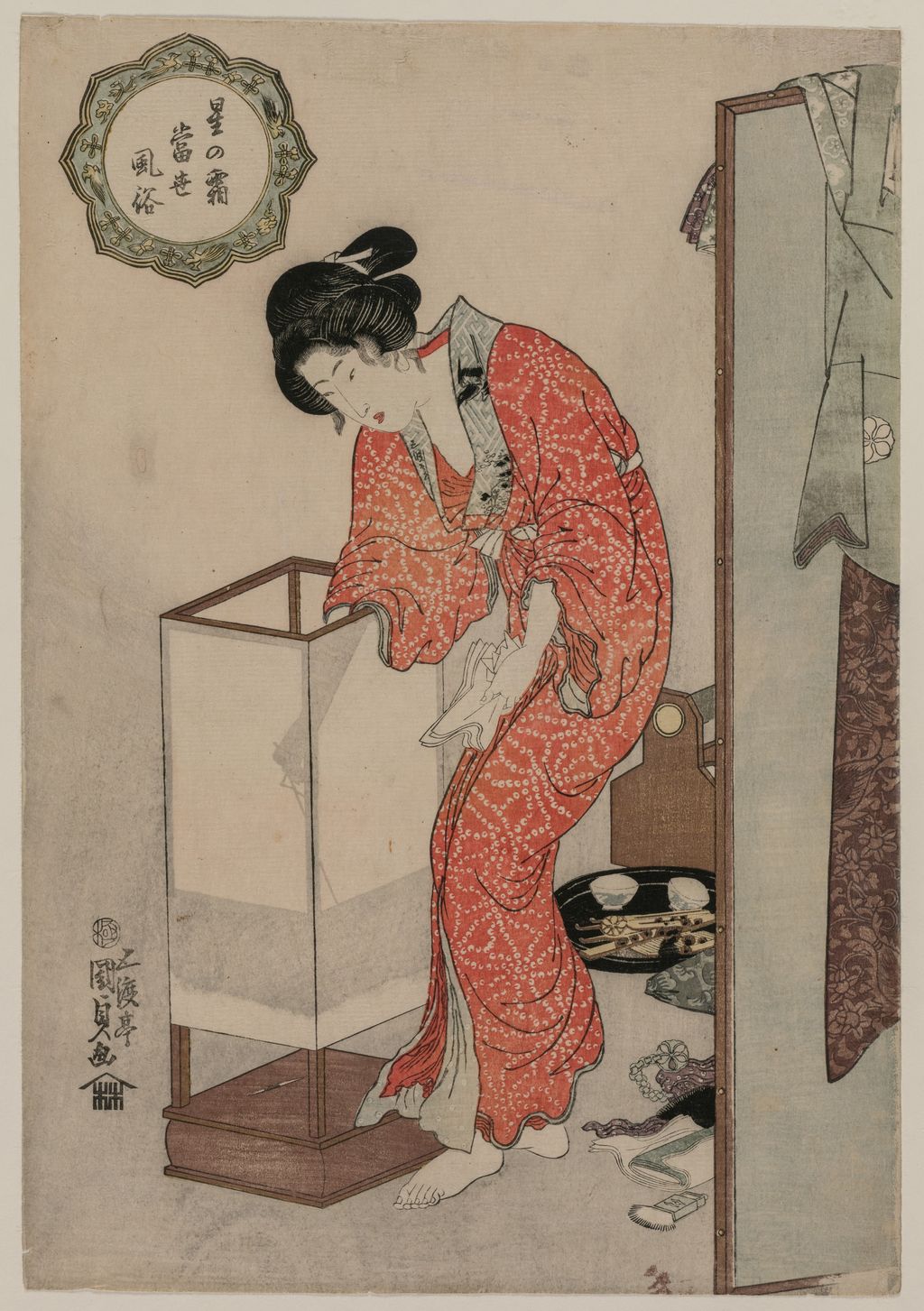
Cleveland's Woman Putting Out a Light belongs to a series translated by the museum as Modern Customs: Frost Beneath the Stars. Its date is around 1820. The woman bends toward a tall lamp in an interior; the small action gives the large vertical sheet its focus. Light is not painted as a Western-style halo but suggested through the lamp, the woman's gesture and the surrounding space. The title identifies an action, not a biography. We do not know from this record the woman's name or what she does after leaving the room. That restraint makes the image more interesting: a familiar practical task has been arranged as an event worth looking at. [13]
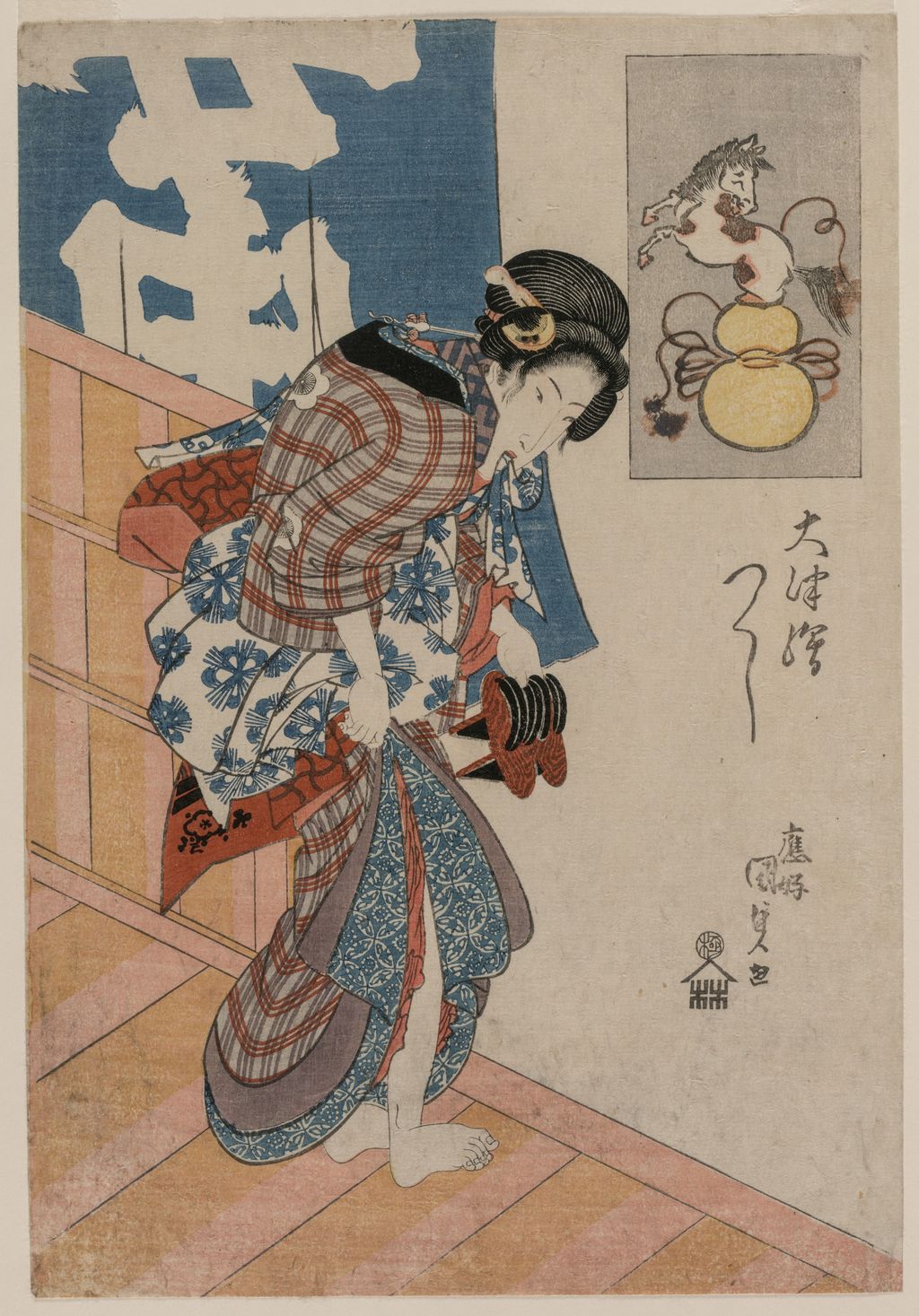
Woman Leaving a Bath House, from Cleveland's Pictures from Ōtsu, moves a woman through a different setting. The figure appears to step away from the bath, her body and clothing directed across a spare ground. A viewer may be tempted to treat every beauty print as a scene from the Yoshiwara; this title points to a bath house instead. The series title requires care as well: an Ōtsu association in a printed title need not mean the museum has documented a particular person or a particular bath building. We can describe what the sheet shows and preserve the museum's dating of roughly the mid-1820s without inventing a place-based eyewitness report. [14]
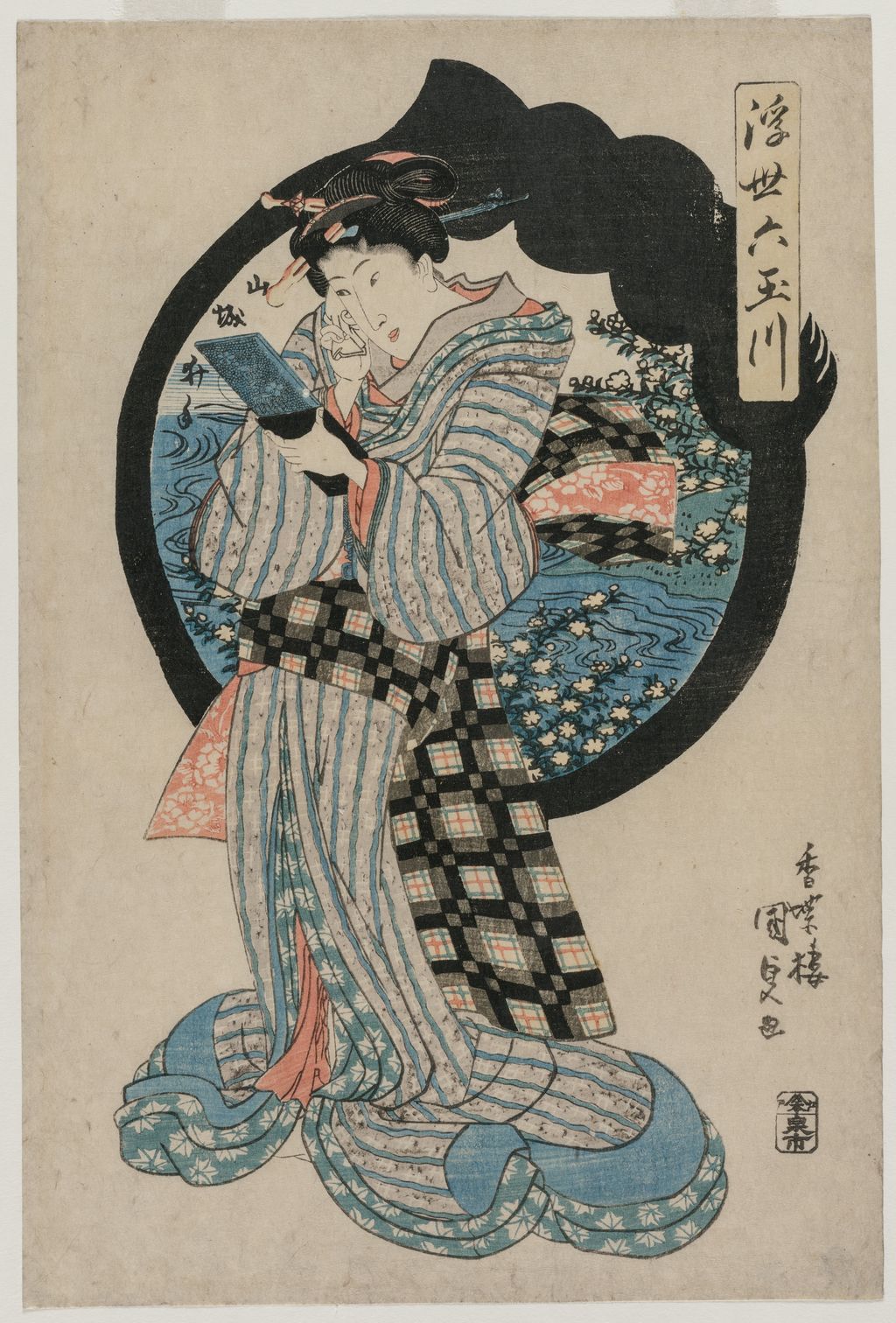
Woman with a Hand Mirror, from The Six Tama Rivers of the Floating World, is another reminder that the title can operate on more than one level. The act of holding a mirror is clear in Cleveland's early-1830s sheet, while the series invokes the famous Tamagawa or “Jewel Rivers” of Japanese verse. Kunisada can place a contemporary-looking person in a domestic field of vision and ask a knowledgeable viewer to bring literary associations to it. The river is not automatically a topographic background to measure against a map. For this print, the series title creates a second kind of setting: a remembered poetic geography. [15]
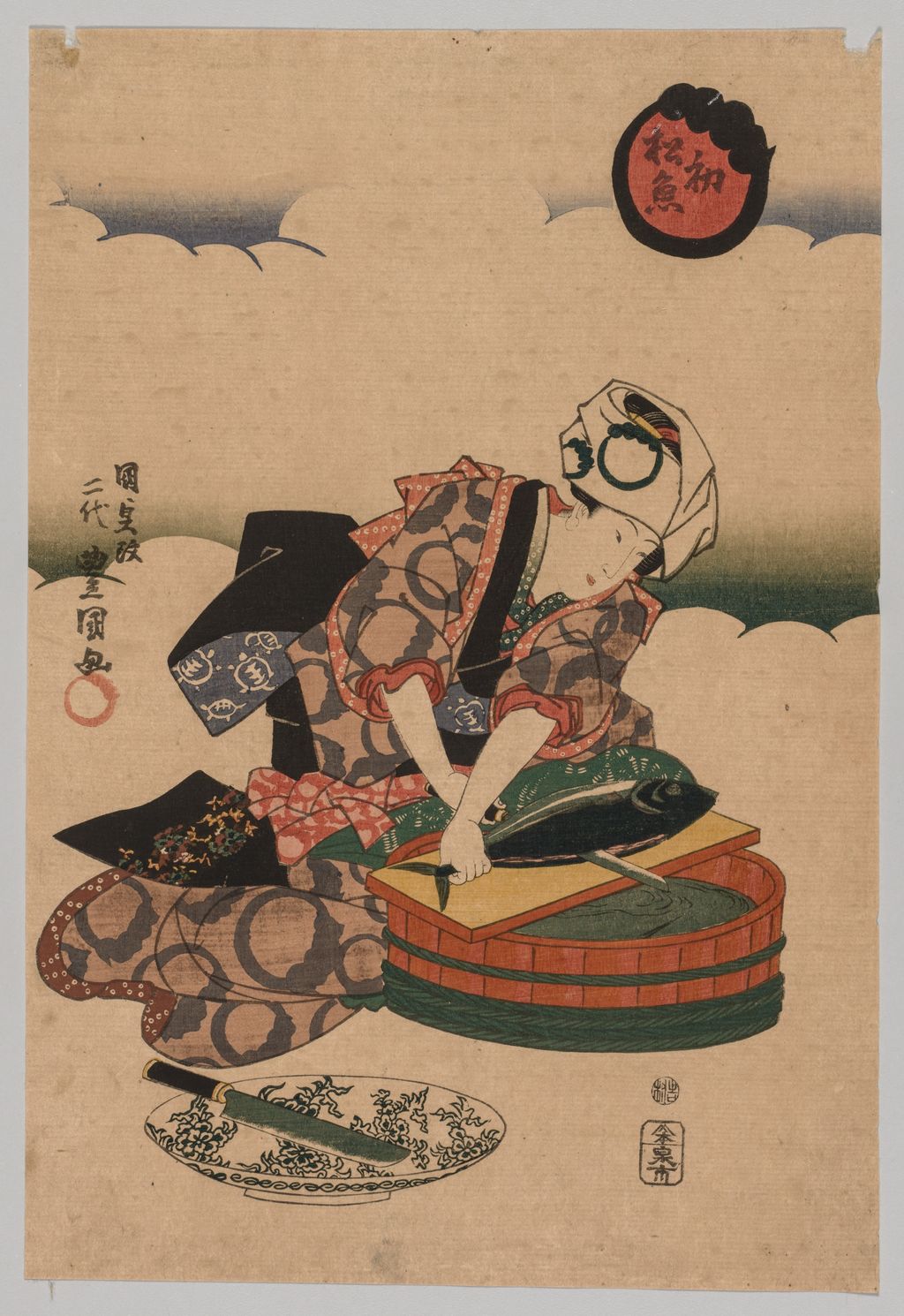
Later subjects continue to refuse a single formula. Cleveland dates First Bonito of the Year to 1844–48. The woman and the fresh fish bring seasonal consumption into the picture: a commodity can be the event around which a fashionable figure is drawn. Woman Standing Beside a Plum Tree, dated about 1850, places a figure beside a blossom-bearing plant. The prints differ in subject and visual setting, even though both can sit in a broad museum category of beauty pictures. Pairing them on the page lets readers notice how titles direct attention toward a first catch in one case and a plant in the other. [16] [17]
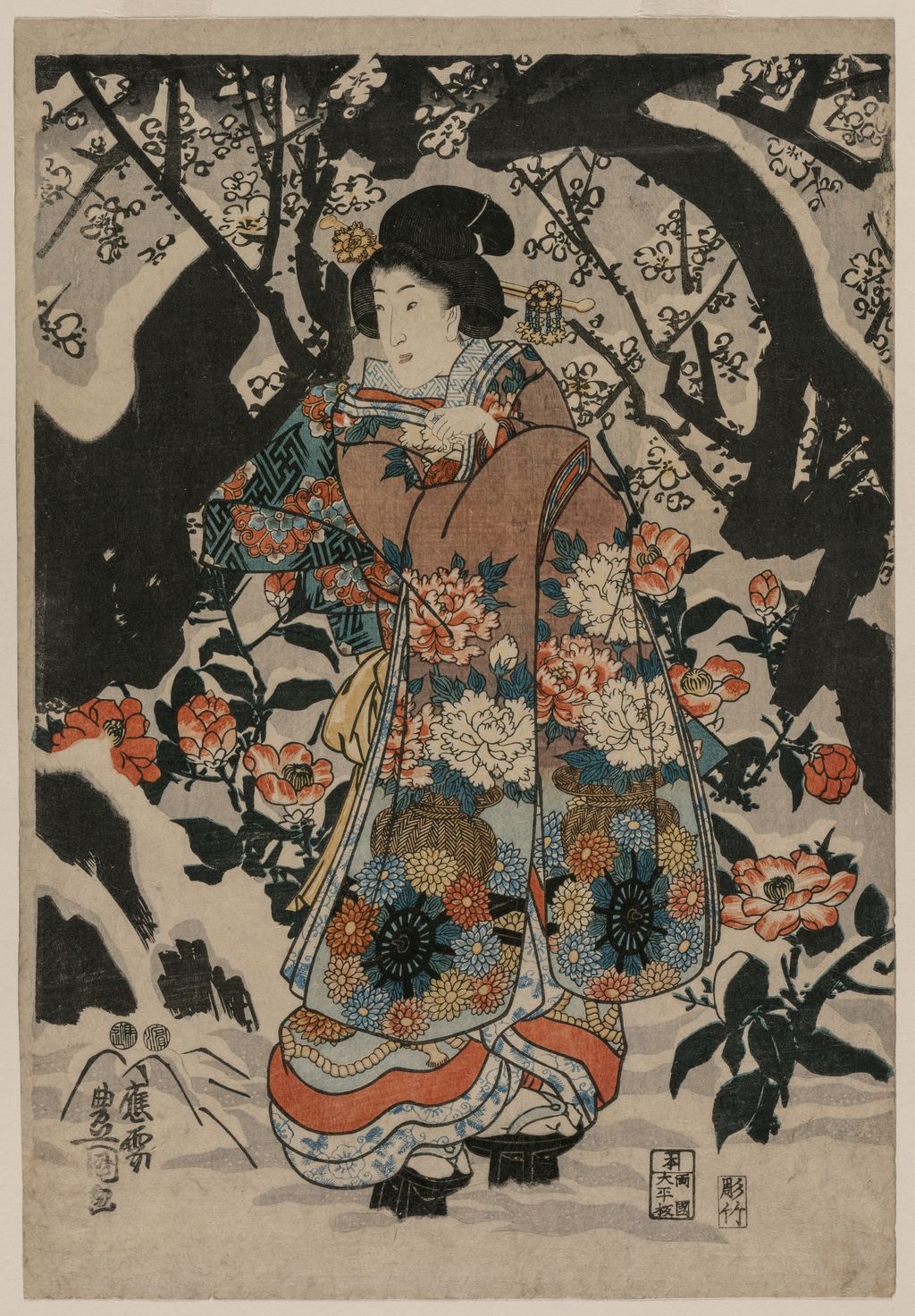
The images also bring social questions into view without answering them all. A beautiful garment can reveal how a designer and publisher sold fashion, but it cannot by itself establish the wearer’s real occupation. A print of a named courtesan is different from a nameless woman in a scene of domestic action. An onnagata, a male actor playing a woman on stage, is different again. Kunisada represented these subjects in a print culture where theatre and the pleasure quarters were entwined, but the categories need to stay visible in the copy. The Ōta and Fitzwilliam exhibitions are valuable precisely because they describe the actor and beauty markets together without making every woman in an image interchangeable. [1] [3]
Warriors, working people and an uncommon landscape
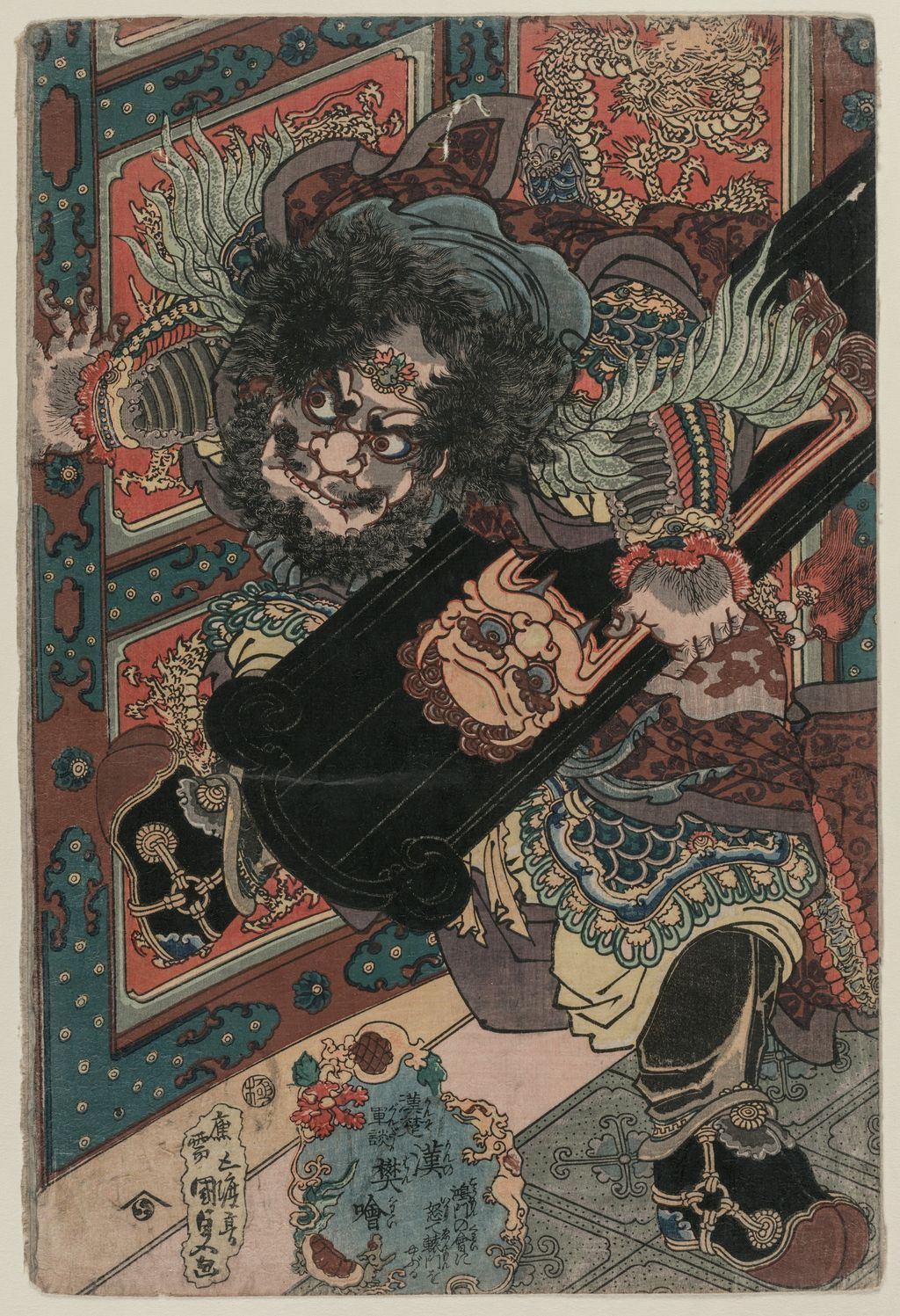
The 2014 Ōta retrospective stresses that Kunisada's range extended beyond his two best-known genres. Cleveland's The Military Tales of Han and Chu: Fan Kuai of the Han, placed in the late 1820s, makes that point vividly. The figure, equipment and crowded design evoke a heroic narrative rather than a current Kabuki star or an intimate domestic moment. Its title specifies Fan Kuai of the Han and a Han–Chu tale; calling the print simply “a samurai” would erase its Chinese historical reference. The paper's scale and the figure's force can be compared with the early Danjūrō sheet, but the viewer is being asked to recognise a different kind of name. [1] [18]
The horizontal Abalone Divers off the Coast of Ise is a useful counterweight. Cleveland dates the sheet to the early 1830s, places it in an untitled landscape series, and records Yamaguchiya Tōbei as its publisher. Boats, water and the shore organise a print that does not depend on the single enlarged figure familiar from many actor sheets. The title links the location to Ise and the labour of gathering abalone. It does not certify Kunisada's personal visit to the coast. The Ōta Memorial Museum notes that he made relatively few landscapes, which makes this exact surviving impression valuable in an introductory article. It shows range without asking us to rename him primarily a landscape specialist. [1] [19]
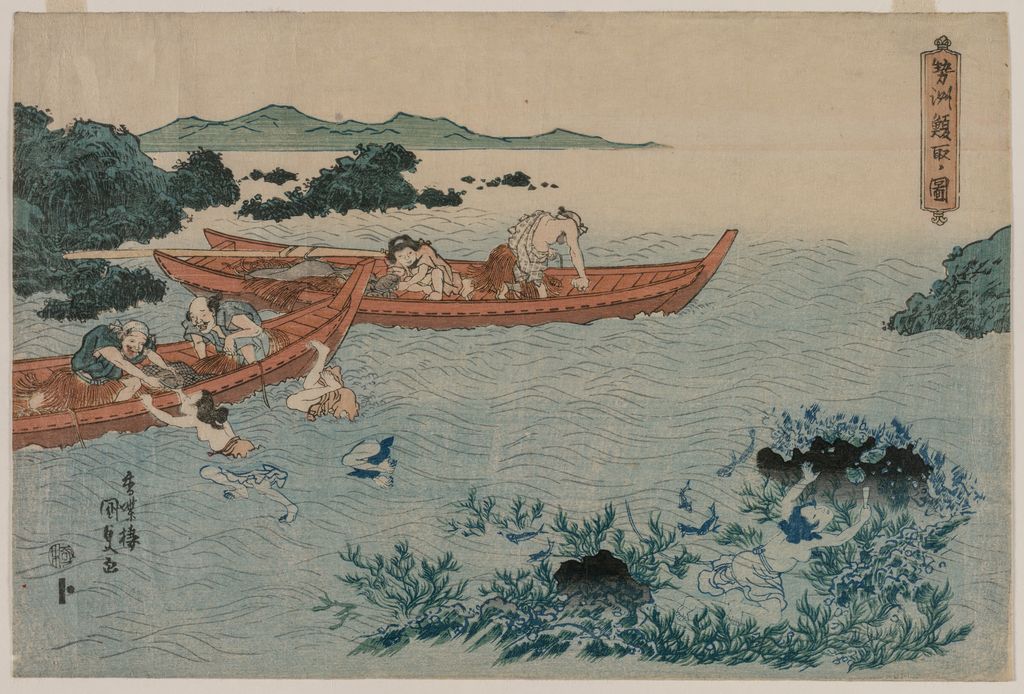
Kunisada's figure-focused and landscape-oriented designs therefore offer a more interesting comparison than a ranking. The actor print addresses a specific theatrical recognition; the landscape opens a longer sweep of water and work; the Chinese tale expects narrative recognition of another kind. A single museum search term can return all three, yet they would not have meant the same thing to their first buyers. This is one reason an artist home needs to show both breadth and distinctions. It can connect readers to deeper pages later without splitting every genre into a thin article now. [3] [1]
A new Genji in books and prints
Kunisada's work for 偐紫田舎源氏 (Nise Murasaki Inaka Genji, often rendered A Country Genji by a Fake Murasaki or Rustic Genji) connected print design to a major illustrated literary success. The writer was Ryūtei Tanehiko; Kunisada supplied illustrations. The National Diet Library's reference service records the first printed part in 1829 and the thirty-eighth in 1842, with two further parts surviving as unpublished drafts. The name alludes to Murasaki Shikibu and The Tale of Genji, but the adaptation belongs to a different story world and historical moment. Calling it simply an illustrated edition of the classical novel would misrepresent both Tanehiko's writing and Kunisada's contribution. [20] [21]
The Ōta Memorial Museum explains the distinction between classical Genji pictures, playful allusions to The Tale of Genji, and the later genre of pictures inspired by Rustic Genji. That distinction matters whenever a print has a “Genji” title. A reader may reasonably expect the eleventh-century hero Hikaru Genji, yet the nineteenth-century adaptation centres a reimagined figure and a different plot. It also generated pictures beyond the book itself. A page that gathers all “Genji” objects under one undifferentiated label would hide the very transformation that made this material popular. [21]
Cleveland's Muraogi belongs to a print series the museum calls The False Murasaki's Rustic Genji. It is a single colour woodblock sheet from the 1830s, not a leaf from the bound illustrated novel. A reader can see a named character framed within a decorative design, then ask how the book's characters entered the separate market for prints. The specific object is enough to make the relationship visible while keeping the medium and edition right. A fuller article about 偐紫田舎源氏 should compare securely identified book pages and later print series, but that image and rights work belongs to its own gate. [22] [20]
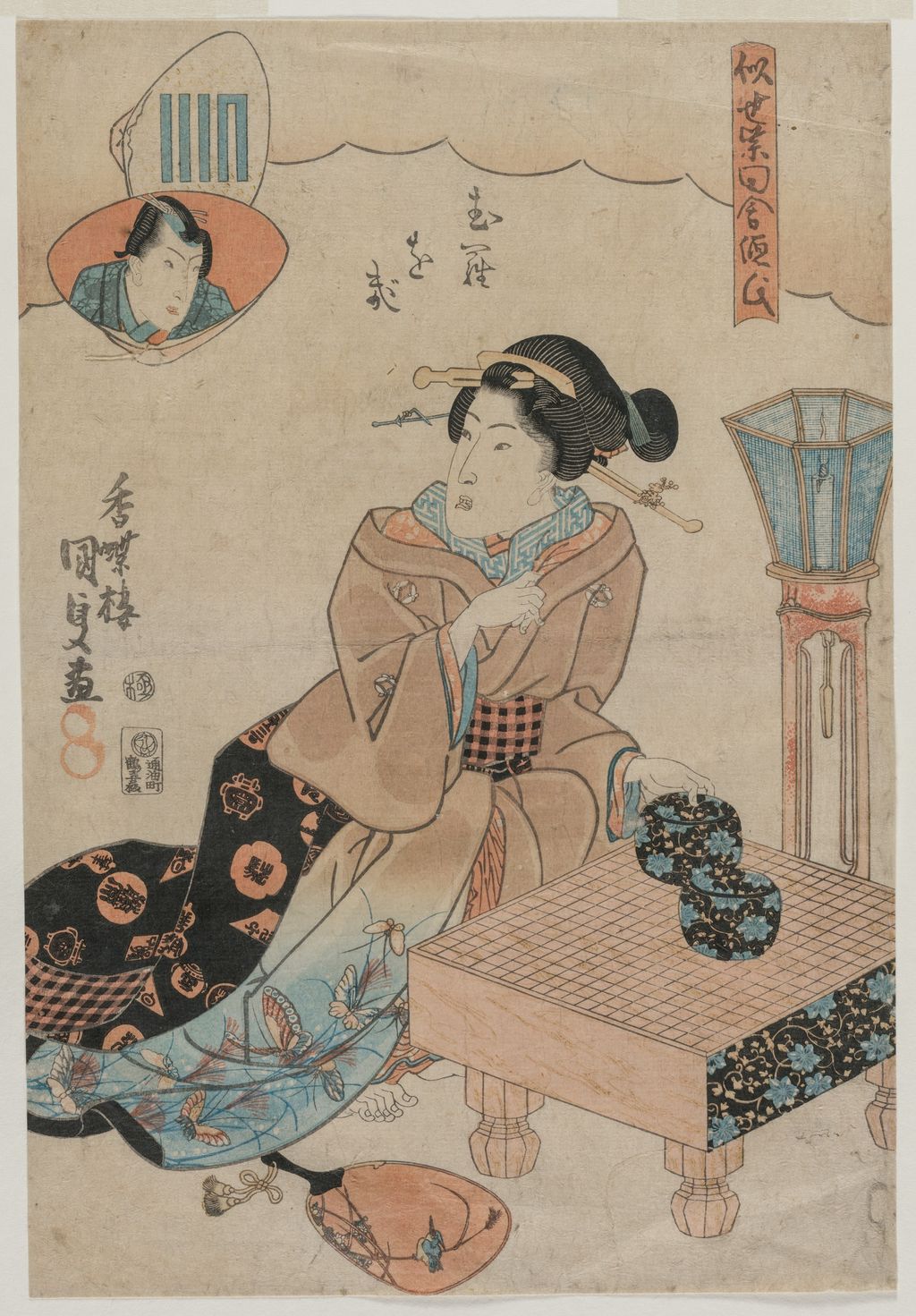
The timing of Rustic Genji also asks for care. The book began before the 1842 Tenpō publication controls discussed below and stopped in the year those reforms reached print culture. A chronological overlap is not itself proof of a single cause for every unrealised part. The library's record gives publication and draft facts; explanations for the ending should be attributed to a source that actually makes them. The best introduction shows what can be established, leaves competing causal accounts to deeper research, and lets the reader recognise Kunisada's role as an illustrator working with a writer, publishers and a multiplying visual culture. [20] [23]
The Tōkaidō: three kinds of picture, two artists
The Tōkaidō was not one series shared between Kunisada and Hiroshige. The Ōta Memorial Museum identifies at least three related but distinct enterprises. In one, often called the “beauties Tōkaidō,” Kunisada brought a woman to the foreground and quoted or adapted the setting of Hiroshige's earlier Hōeidō route prints. Another set put actors beside the famous station names. In 双筆五十三次 (Sōhitsu gojūsan-tsugi, the “Fifty-three Stations by Two Brushes”), Hiroshige designed landscape backgrounds and Kunisada contributed figures. The shared road should not conceal different subjects, dates, authorship and publishing projects. [24]
An artist overview can explain those boundaries without creating a premature series page. A beauty set that borrows a landscape is not the same work as a jointly designed print. An actor associated with a station is not evidence of a documented performance there. Names of stations can function as pictorial prompts, just as poetic rivers can function as literary prompts. For a visitor who knows Hiroshige's route prints, Kunisada's human figures offer a way to see how publishers and artists extended the road's appeal. The production history of each series deserves exact objects and dates before it is given a separate URL. [24]
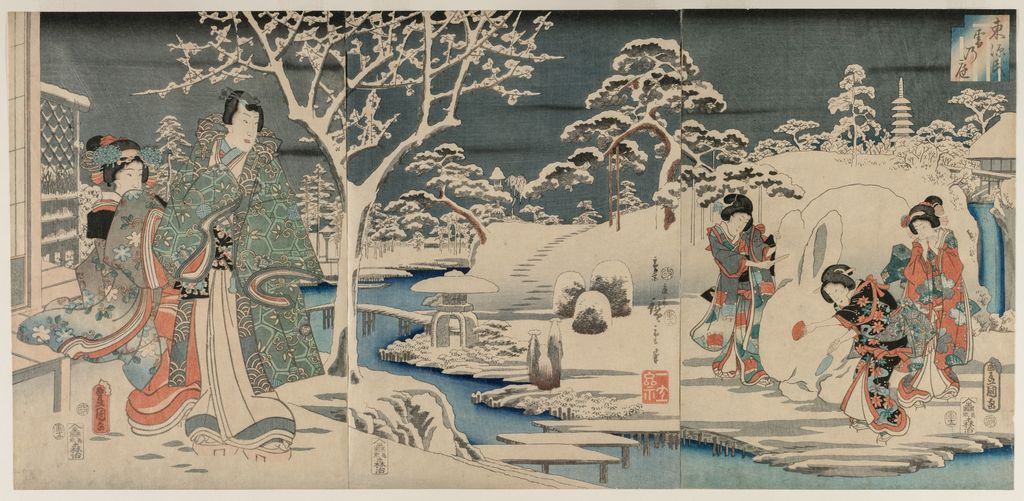
Cleveland's The Snowy Garden, dated 1854, is catalogued as a triptych jointly attributed to Utagawa Hiroshige and Utagawa Kunisada. It stretches across a sheet group 75 centimetres wide; the resulting composition cannot be represented fairly by cutting out a single figure for a square thumbnail. The two names in Cleveland's creator fields are the reason it belongs here, and the reason the caption must not quietly make Kunisada the sole designer. The image is also a chance to explain how the wider format lets a reader follow a scene across three joined sheets. It should not be labelled a Sōhitsu gojūsan-tsugi station unless the object record independently identifies that series. [25]
Printing effects, censorship and change
The richness of a present impression can be a record of materials as well as drawing. The Fitzwilliam's Kunisada exhibition describes mica, metallic pigments, blind embossing and burnishing in deluxe actor prints, especially after he began signing Toyokuni. Mica is also listed for Cleveland's 1814 Danjūrō object. A web image may show a gleam weakly or miss raised paper entirely; the museum's technique field and a high-resolution original can guide a careful explanation. We should not claim an embossed detail in a Cleveland sheet merely because embossing is present in other Kunisada prints. The description must follow the exact impression on the page. [3] [5]
This is a suitable place for a single annotated image, provided the retained 3,400-pixel-high Danjūrō original reveals a meaningful detail under inspection. An enlargement of face, costume, inscription or mica field could answer an actual reader question: how does the print identify its actor and role, or where does the recorded material effect appear? The annotation should start from a 300-dpi working copy of that original, use the standard site hotspots and popups, and explain each selected detail underneath. If the mica cannot be distinguished digitally, choose another visible feature instead. [5] [9]
The retained Cleveland master has now been inspected at its original size. The actor's eyes, the plum branch crossing the mouth, the nested lines of the hair and the upper-right cartouche are all legible. They offer a useful sequence for the site's standard annotation module: first look at how the face signals a held moment, then identify the branch and flower, then see how text anchors the named performance. A crop of the cartouche alone may still need Japanese transcription checked against the object record before translation. The grey background is visibly textured, but the digital reproduction alone does not safely locate each mica particle; an annotation should say only that the museum records mica as a material, unless a specific surface effect can be demonstrated in the detail. [5]
The 1842 Tenpō reforms are another point where a simple before-and-after story fails. The Ōta Memorial Museum records restrictions aimed at images of courtesans and identifiable actors. The Fitzwilliam describes limits on luxury and ways publishers worked around actor-print controls, including presenting performers as figures from exemplary history or literature. The law and the evolving market altered what could appear openly in titles and pictures; they did not erase the genre from circulation for the rest of Kunisada's career. Its later decades include both increasingly elaborate actor imagery and different subject matter. In an artist overview, this context explains why a figure's historical or literary guise might conceal an actor reference. [2] [3]
Kunisada's 1844 adoption of the Toyokuni name falls after those restrictions and near the start of a different phase of work, but the coincidence should not be made into a one-cause stylistic theory. The Fitzwilliam organises later prints by signature and material effects; Japanese museums trace the lineage and competitive position of the Utagawa artists. Both help us locate a work, yet neither can make every later image look alike. Cleveland's late-1840s fish subject, c.1850 plum-tree beauty and 1854 collaboration already show how many kinds of picture could coexist under the Toyokuni name. [2] [3] [16] [17] [25]
Reading the name, date and impression
Because Kunisada designed so many prints and used several names, identification should proceed as a set of questions. What does the signature actually read? Is the apparent Toyokuni “II” the 1844 transition name of the artist now catalogued as Toyokuni III? Does a publisher seal or actor inscription narrow the date? Can a named performance or role be checked against theatre records? Is a print a lifetime impression or a later edition? Does the object have a second named artist? The Fitzwilliam's signature guide gives the working names, and Ritsumeikan researcher Masae Kurahashi warns that signature typologies cannot settle a date alone. [7] [26]
A visible name can belong to a character as well as to the artist. The Danjūrō portrait has a performer and a role; Muraogi has a literary character; Fan Kuai names a figure from Chinese history. Attributions can likewise refer to distinct kinds of contribution. Cleveland records Yamaguchiya Tōbei as publisher of Abalone Divers, and both Hiroshige and Kunisada as artists on The Snowy Garden. Treating every name in an object record as a second designer would produce a false history of collaboration. The object catalogue's role fields help build captions that readers can trust. [5] [19] [22] [25]
There is also the question of which object is being shown. Ukiyo-e designs could exist in multiple impressions and later states. A museum's accession number anchors a specific piece of paper, with its own dimensions, pigments and condition. The image on this page is not “the” single original of a design independent of printing history. The Cleveland files have cleared CC0 rights and retained master images; their exact object URLs accompany the captions. Research at Ōta, the Fitzwilliam or the British Museum can explain a work, but a production photograph from one museum should not inherit another museum's accession or rights statement. [11] [27]
The distinction between a published impression and an unrealised design reaches an unusually pointed conclusion at the end of Kunisada's life. Ōta's retrospective identifies 江戸美人尽 (Edo bijin-zukushi) as a projected late beauty series with 42 known pictures remaining as drawings and block-ready designs; the series was not issued as finished prints. Those surviving designs enlarge the story of his later work, but an image caption that calls them circulating woodblock prints would reverse the museum's finding. The series is a good future research subject precisely because it sits at the boundary between making an image and publishing it. [1]
Finally, Kunisada's life dates themselves teach a small lesson about catalogues. Japanese institutions commonly give 1786–1864 because his death fell on the fifteenth day of the twelfth month of Genji 1, a Japanese year identified with 1864. Gregorian conversion places that death in January 1865, which is why Cleveland and the Fitzwilliam use 1786–1865. The National Museum of Japanese History preserves the original date on a memorial print. Sources consulted here disagree on the precise converted January day, so this page gives the year transition without pretending the day is settled. [1] [3] [28]
What to look at next
The introduction has followed ten exact impressions through acting, fashion, literary adaptation, history, work and collaboration. The fuller biography should establish the chronology behind those subjects, including training, the Toyokuni succession and the evidence of patrons and publishers. A separate study of 偐紫田舎源氏 should give Tanehiko's text, Kunisada's book illustration and later Genji prints their own identities. The three Tōkaidō projects need exact sets before they become separate pages. Those deeper studies will be useful because they answer different questions; the artist home gives the reader a way to know which question to ask. [2] [20] [24]
Frequently Asked Questions
Yes. Kunisada adopted his teacher Toyokuni's professional name in 1844. He sometimes styled himself Toyokuni II, but modern catalogues usually count the earlier Toyoshige as II and call Kunisada Toyokuni III. [7]
Kabuki actor prints were a major part of his output; the Fitzwilliam Museum estimates about 70%. He also designed prints of women, book illustrations, literary and warrior subjects, and some landscapes. The precise mix in a museum's holdings need not reflect the mix of his entire production. [3] [1]
No. Ryūtei Tanehiko wrote the popular nineteenth-century adaptation; Kunisada illustrated it. Prints inspired by its story are separate objects from pages of the illustrated book. [20] [22]
Yes. Ōta records their shared Sōhitsu gojūsan-tsugi, with Hiroshige responsible for landscape backgrounds and Kunisada for foreground figures. Cleveland also attributes The Snowy Garden to both artists. Neither fact makes every Kunisada Tōkaidō picture collaborative. [24] [25]
His recorded death date is in the Japanese year Genji 1, usually paired with 1864. That late lunar-calendar month falls in January 1865 by the Gregorian calendar. The precise converted day differs among sources consulted for this page, so the year difference is the reliable point here. [28]
Discussion
Use individual Kunisada impressions to compare roles, stories, publishers and named collaborators.
Reader Insights
How does the Danjūrō VII sheet identify a performer and the character Kan Shōjō?
What makes Muraogi a print after Rustic Genji rather than a page from the book?
How should a caption for The Snowy Garden represent both Kunisada and Hiroshige?
Join the Conversation
Share a documented example or reliable source below, keeping observation separate from inference.
References
- Ōta Memorial Museum of Art, “Utagawa Kunisada: 150 Years After His Death” exhibition page (2014).
- Ōta Memorial Museum of Art, “Kunisada, Kuniyoshi, Hiroshige and Their Times” exhibition page (2008).
- Fitzwilliam Museum, University of Cambridge, “Introducing Kunisada and Kabuki” (archived 2001 exhibition).
- Fitzwilliam Museum, “How to Read an Actor Print”.
- Cleveland Museum of Art, accession 1985.333, Ichikawa Danjūrō VII as Kan Shōjō.
- Fitzwilliam Museum, “Ichikawa Danjūrō VII”.
- Fitzwilliam Museum, “Kunisada's Names”.
- Odawara City Digital Archive, “Utagawa Kunisada = Toyokuni III”.
- Fitzwilliam Museum, “Actors' Names and Crests”.
- Fitzwilliam Museum, “True Likenesses (nigao)”.
- Fitzwilliam Museum, “The Reuse of Printing Blocks”.
- Masae Kurahashi, Ritsumeikan University, “A List of Kunisada's Signatures: Its Usefulness and Problems”, p. 2.
- Cleveland Museum of Art, accession 1930.201, Woman Putting Out a Light.
- Cleveland Museum of Art, accession 1940.711, Woman Leaving a Bath House.
- Cleveland Museum of Art, accession 1916.1131, Woman with a Hand Mirror.
- Cleveland Museum of Art, accession 1940.1013, First Bonito of the Year.
- Cleveland Museum of Art, accession 1916.1172, Woman Standing Beside a Plum Tree.
- Cleveland Museum of Art, accession 1980.86, The Military Tales of Han and Chu: Fan Kuai of the Han.
- Cleveland Museum of Art, accession 1916.944, Abalone Divers off the Coast of Ise.
- National Diet Library reference service, “On Nise Murasaki Inaka Genji” (2013).
- Ōta Memorial Museum of Art, “Genji Pictures in Ukiyo-e” (2008).
- Cleveland Museum of Art, accession 1985.334, Muraogi, from The False Murasaki's Rustic Genji.
- Ōta Memorial Museum of Art, “Kunisada, Kuniyoshi, Hiroshige and Their Times,” Tenpō reform section (2008).
- Ōta Memorial Museum of Art, “The World of the Fifty-three Stations: Hiroshige and Kunisada” (2012).
- Cleveland Museum of Art, accession 1940.989, The Snowy Garden.
- Masae Kurahashi, Ritsumeikan University, “A List of Kunisada's Signatures: Its Usefulness and Problems”, pp. 1–2.
- Cleveland Museum of Art, Open Access policy; exact object-level CC0 entries in the image ledger.
- National Museum of Japanese History, Toyokuni III memorial print, F-320-576; compare the Met's Tale of Genji date-convention note.