


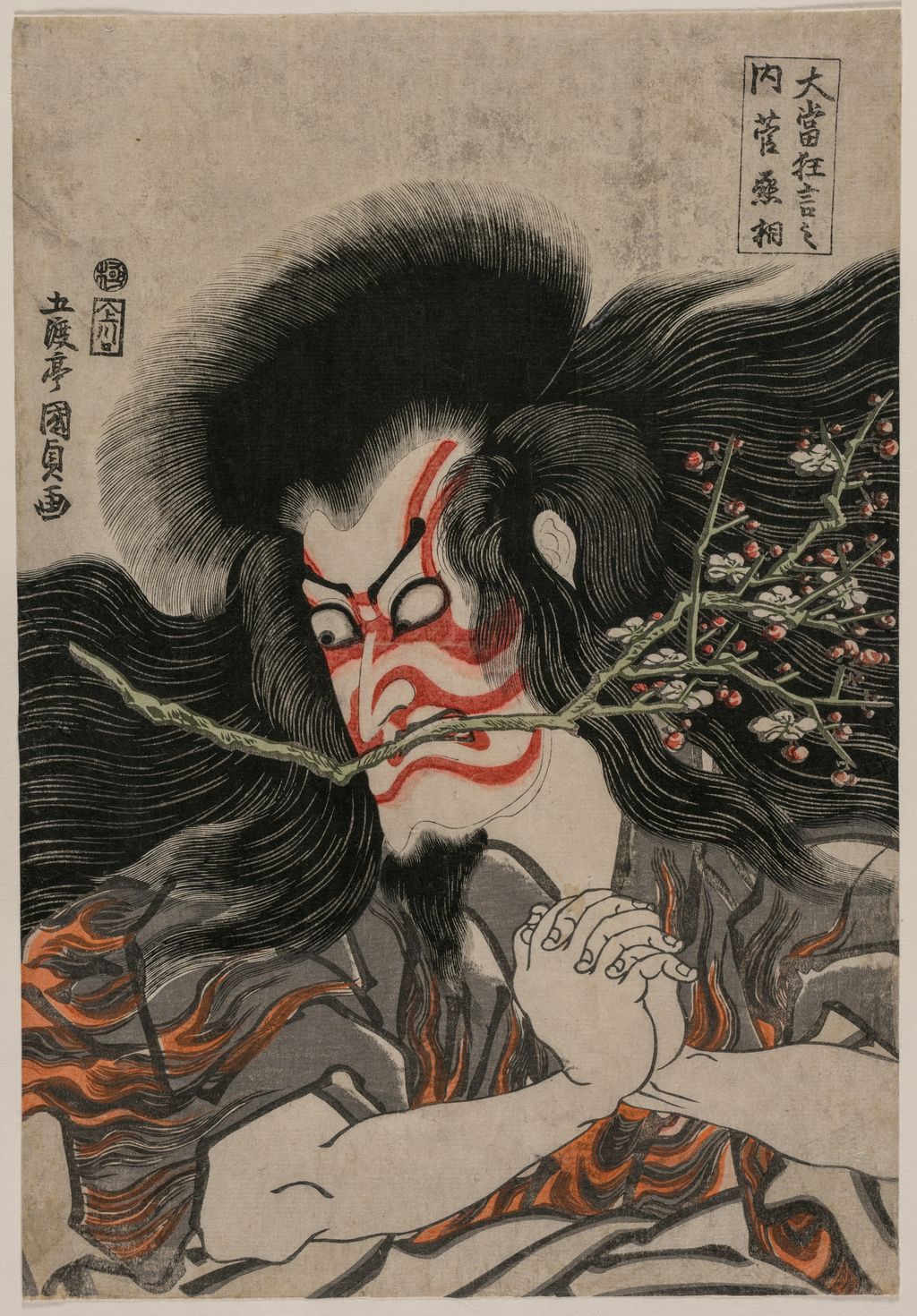
Utagawa Kunisada, Ichikawa Danjūrō VII as Kan Shōjō, 1814. Cleveland Museum of Art, 1985.333. Museum object record.
 by Tom Gurney
Tom Gurney BSc (Hons) is an art history expert with over 20 years experience
Published on September 25, 2026 / Updated on September 25, 2026
Email: tomgurney1@gmail.com / Phone: +44 7429 011000
Utagawa Kunisada: a life visible through prints
Utagawa Kunisada worked through almost six decades of change in the illustrated culture of Edo. A print published near the start of his career can name a Kabuki actor and a role; a later sheet may sign him Toyokuni instead; a memorial print records his death under the Japanese calendar. Those objects offer a fuller account of professional life than surviving evidence offers of childhood or private thought. A biography must therefore follow the things that can be dated and attributed, while leaving room for what a print cannot tell us. [1] [2]
Kunisada was born in 1786, and his family name was Sumida. That name did not usually appear as the signature on his published work. Utagawa identified the school to which he belonged; Kunisada was the professional name given by his teacher, Utagawa Toyokuni I. Later, when he assumed Toyokuni's name, he became the artist generally called Toyokuni III. The three labels describe connections and changes in a career rather than three separate makers. They also remind us that a catalogue record may use a modern numbering convention different from the one a sheet displays. [3] [4]
Contents
- Utagawa Kunisada: a life visible through prints
- The family name and the master's workshop
- Finding a voice in the actor market
- Read Danjūrō’s dramatic pose up close
- Women, books and a wider business
- The Toyokuni name: succession and argument
- Working after the reform years
- A studio and its successors
- Death, memorials and the name left behind
- How to read the life in the work
- Books on Japanese Art
The Ōta Memorial Museum calls him a central figure of the late Edo print world, particularly in pictures of actors and women. The Fitzwilliam Museum describes a highly successful, prolific designer whose actor-print style became distinct from that of his master. The large surviving output is real evidence of demand, but a number assigned to all his prints is necessarily an estimate: designs, impressions, reprints, books and collaborative works are not the same units. This page uses individual dated objects and contemporary names where possible, rather than turning a huge catalogue total into a substitute for biography. [1] [5] [6]
At a glance
- Life1786–January 1865 (Gregorian calendar)
- TeacherUtagawa Toyokuni I
- Name changeKunisada to Toyokuni, c.1844
- Late evidenceUnpublished manuscript and memorial prints
The family name and the master's workshop
We can say more securely who trained Kunisada than where every part of his training happened. The Fitzwilliam name guide says Toyokuni I bestowed the name Kunisada on him at the start of his career. Ōta places him, along with the later rival Kuniyoshi, among the pupils of Toyokuni. This is a documented school relationship, but the sources checked here do not present a dated apprenticeship contract, a lesson diary or a list of exact duties performed in the studio. An attractive story of the child immediately recognised as a genius is not needed to explain the art that survived. [3] [4]
Toyokuni's workshop mattered because it put training close to the commercial print trade. The master was himself a major designer of actor pictures. A student would have encountered not only ways of drawing figures but also the requirements of publishers, plays, blocks, inscriptions and repeated sheets. An image designed for sale passed from drawing into carving and printing; the designer's signature does not erase those other hands. Yet it would be too easy to imagine Kunisada following a single fixed workshop syllabus. What is certain is that he entered a practice in which recognisable actors and saleable compositions were central. [4] [8] [5]
The approximate opening of his public career can be triangulated without pretending to know a first day. Odawara City's artist note gives 1807 as the beginning of his working period. The Fitzwilliam dates prints signed Kunisada from 1807. Ōta says that he debuted at twenty-two, an age consistent with activity around 1807–08 depending on counting. These accounts locate a young designer in the print world by the end of the first decade of the nineteenth century. They do not identify one universally agreed “first print.” A biography should distinguish the appearance of a signature in surviving objects from the beginning of an artist's learning. [3] [9] [1]
His name appears in Japanese catalogues as 初代歌川国貞, “the first Utagawa Kunisada,” because a pupil later inherited Kunisada too. That numeral belongs to the history of names, not to a claim that the young designer already knew he would lead a lineage. It becomes useful only when later prints and memorial objects need to be separated from works by successors. A visitor searching for a print should read the full creator field, date and signature rather than assume every result under “Kunisada” belongs to the same hand. [3] [10]
Finding a voice in the actor market
The Fitzwilliam's Kunisada and Kabuki exhibition centres the commercial actor prints of the 1820s and 1830s, when his style is recognisably different from Toyokuni's. That comparison gives the phrase “came into his own” a basis in surviving prints rather than an invented personal break with his teacher. His designs served audiences who knew actor names, family emblems, theatres, roles and particular performances. A spectator could recognise the same performer in a series of characters; a viewer today may need the printed labels and the museum's performance identification to recover that distinction. [5] [8] [11]
Cleveland's 1814 Ichikawa Danjūrō VII as Kan Shōjō demonstrates the opportunity and the limit. Its object record identifies the performer, character and series. Danjūrō's face, make-up and extraordinary hair give Kunisada material for an arresting image of a stage moment. The clenched pose and plum branch can be examined in the retained high-resolution photograph. But the image does not document how the men met or what either thought of the other. Even an exceptionally vivid actor picture remains a designed role image. [7] [12]
Read Danjūrō’s dramatic pose up close
Choose a number to enlarge a detail from the high-resolution museum image. Find its position in the whole print and compare the explanation below.
Explained details
Make-up and mie
Red-and-white make-up, crossed eyes and a tense mouth hold an aragoto mie. This is Danjūrō performing Kan Shōjō’s transformation, not an unqualified personal portrait.
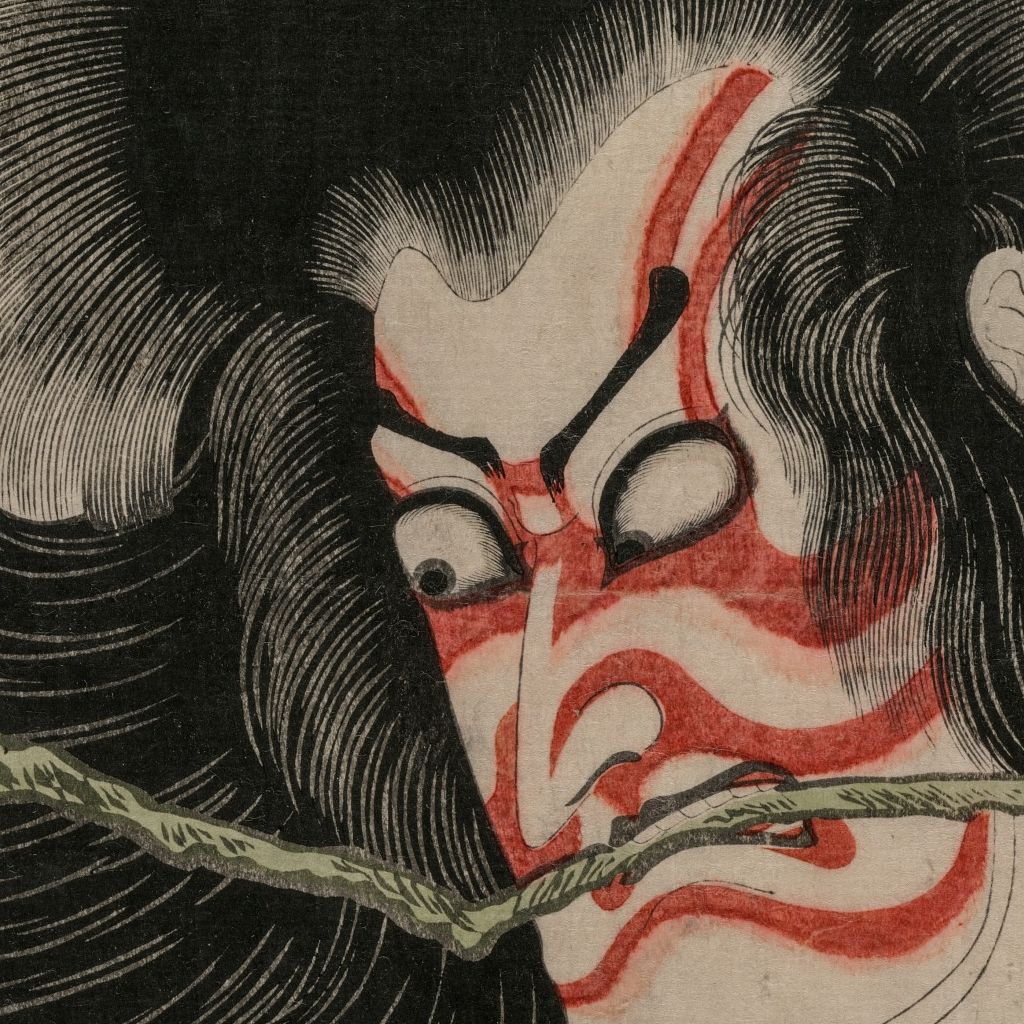
Cleveland Museum of Art Object record 1985.333. Editorial crop and resize disclosed.
The plum branch
The flowering branch crosses the mouth; smaller blossoms sit amid the sweeping hair. Return to the whole sheet to see how they interrupt the face.
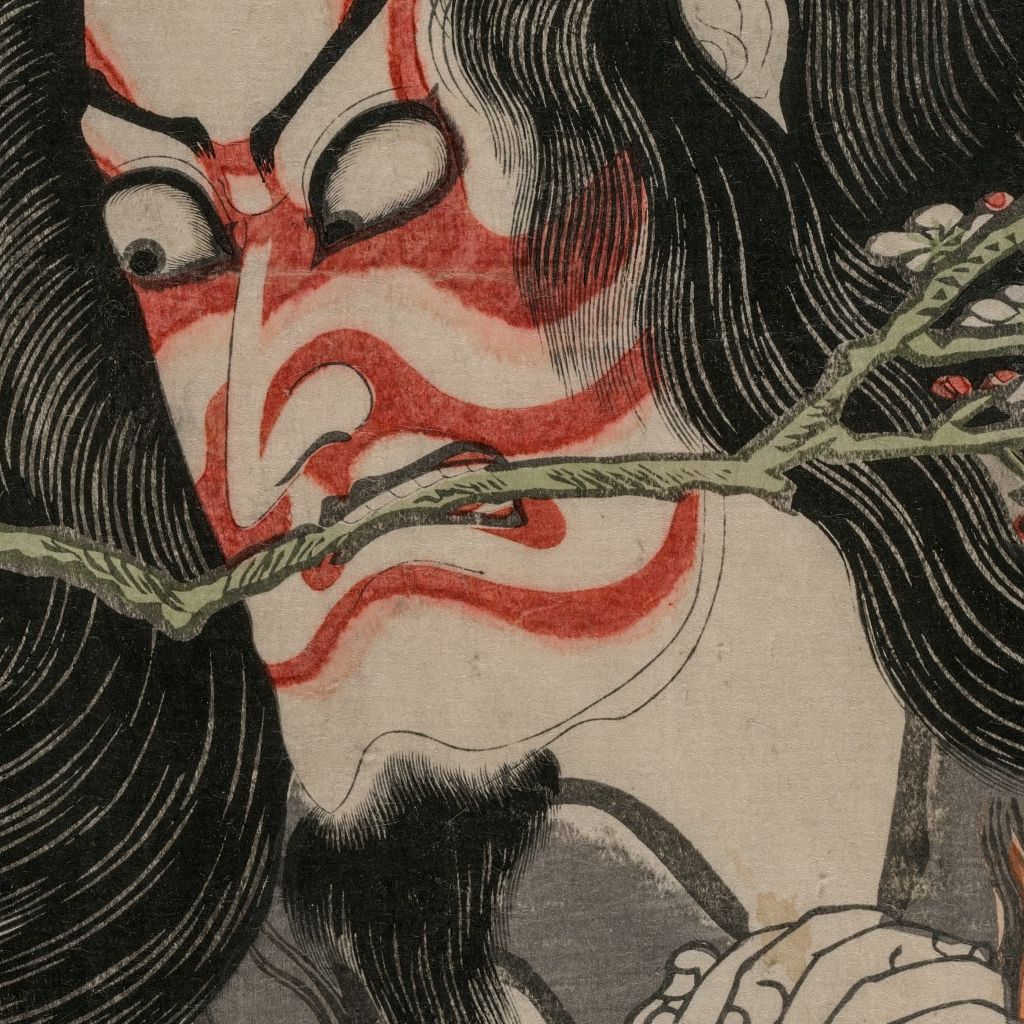
Cleveland Museum of Art Object record 1985.333. Editorial crop and resize disclosed.
The upper-right cartouche
The text box helps locate the picture within a named role and series. Read it with the museum identification; do not guess a transcription from the crop.
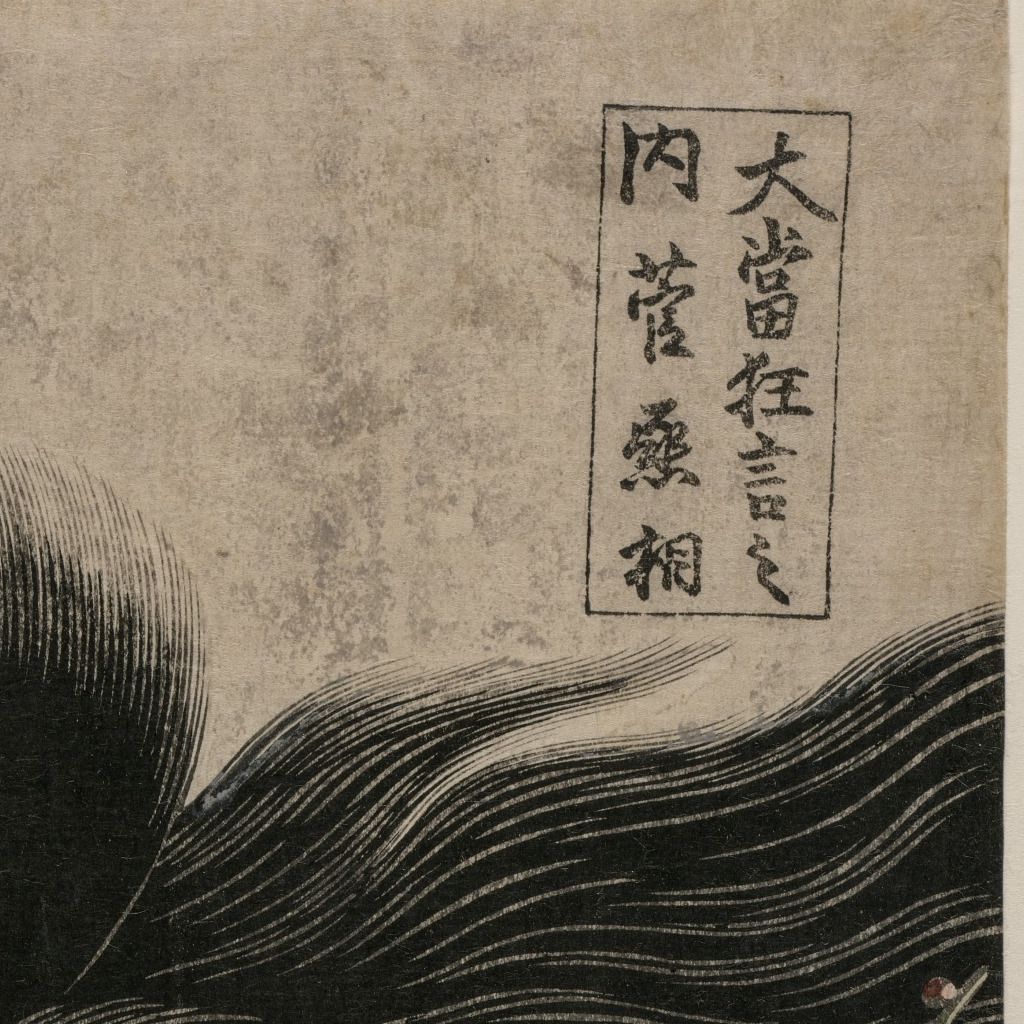
Cleveland Museum of Art Object record 1985.333. Editorial crop and resize disclosed.
The relationship with Danjūrō nevertheless has a longer history than one object. The Fitzwilliam says Kunisada pictured Danjūrō VII more often than any other actor over about fifty years, in commercial prints, books and privately issued surimono. It notes that some private prints document an acquaintance outside the ordinary market. Those varied objects strengthen a biographical account of repeated contact, though they cannot turn every depiction into proof of intimacy. Danjūrō later used the stage name Ebizō V after passing the Danjūrō name to his son. A bibliography or image search that treats those names as different people would fracture the continuity the sources reveal. [12] [11]
A pair of fan-print designs discussed by the Fitzwilliam places Kunisada in another theatre format in 1819. It identifies Danjūrō VII and the female-role actor Segawa Kikunojō V in lead roles from a new production of a familiar play. These were uchiwa-e, images intended for round fans, not merely cropped versions of an ordinary upright print. Their format reminds us that the artist's early theatre work circulated on different kinds of things. It also gives a dated point between the 1814 Cleveland sheet and the better documented actor-series success of the 1820s. A sequence of surviving objects can therefore trace diversification without claiming that every year between them is known. [30]
Actor pictures were also time-sensitive goods. A print could respond to the appeal of a performance while remaining saleable to people who never entered the theatre. The Fitzwilliam describes the practice of nigao, recognisable actor likeness, and identifies Toyokuni's 1817 drawing manual as one of its sources. Kunisada worked in an environment where small changes to eyes, brow or mouth might help a fan recognise a performer while costume and stance identified the role. Describing the drawing as “realistic” without this theatrical purpose risks missing the audience for which it was made. [13] [11]
The price and speed of that market help explain its reach. The Fitzwilliam's exhibition introduction says an ordinary large print could cost twenty mon, compared with a cheap meal or haircut, and about half the least expensive Kabuki ticket. Its figures are historical estimates supplied in an institutional interpretation, not surviving price labels on every Kunisada sheet. They make a useful point nonetheless: an actor fan could purchase a portable image at a fraction of the cost of attending the theatre, while a publisher had an incentive to issue it close to a performance. The print was a fresh piece of entertainment before it became a collectible museum object. [5]
The same exhibition distinguishes ordinary sheets from luxury impressions, which could use thick paper, metallic pigment, blind embossing and burnishing. These are properties of particular impressions. A photograph of the 1814 Cleveland Danjūrō sheet shows a striking design but does not automatically verify each of those effects in that particular object. An artist's biography can explain why elite patrons and demanding collectors mattered to his professional options, while captions should reserve claims about mica or embossed texture for files and catalogue records that actually establish them. [5] [29]
The original block could outlive the performance for which it was made. A Fitzwilliam case shows an 1831 actor composition reused for an 1835 production, with alterations so that old blocks could represent new performers. The episode is useful biographical context because it shows the pressures of a publisher's stock and a theatre calendar. It also sets a limit: a familiar pose alone will not securely date a particular impression. In a life reconstructed from prints, the impression, actor label and any changes to the block matter at least as much as the invention of the initial composition. [14]
Privately distributed surimono broaden the picture further. The Fitzwilliam describes them as commissioned gifts, often on heavier paper with poems, rather than ordinary stock issued by a commercial publisher. Kabuki actors could commission such objects for sponsors and fans. A Kunisada design made for a private circle and a cheaply sold actor print might represent the same theatre world but answer different social needs. In the first, poetry, expensive printing and the identity of the commissioner might matter as much as the depicted performer. The distinction helps us avoid calling every finely printed sheet “mass-produced” simply because it was made from blocks. [29]
Women, books and a wider business
Actor pictures were a central source of his reputation, but they were never the whole career. Ōta's retrospective brings together actor and beauty prints with warriors, landscapes and other subjects. Cleveland's Woman Putting Out a Light, dated around 1820, makes the range tangible at an early point: the action is small, indoors and unconnected to a named stage role. Woman Leaving a Bath House, dated broadly to the middle 1820s, places another figure in a different social setting. These museum titles and dates give us objects to describe without supplying the women's personal identities. That is a productive boundary for biography. [1] [15] [16]
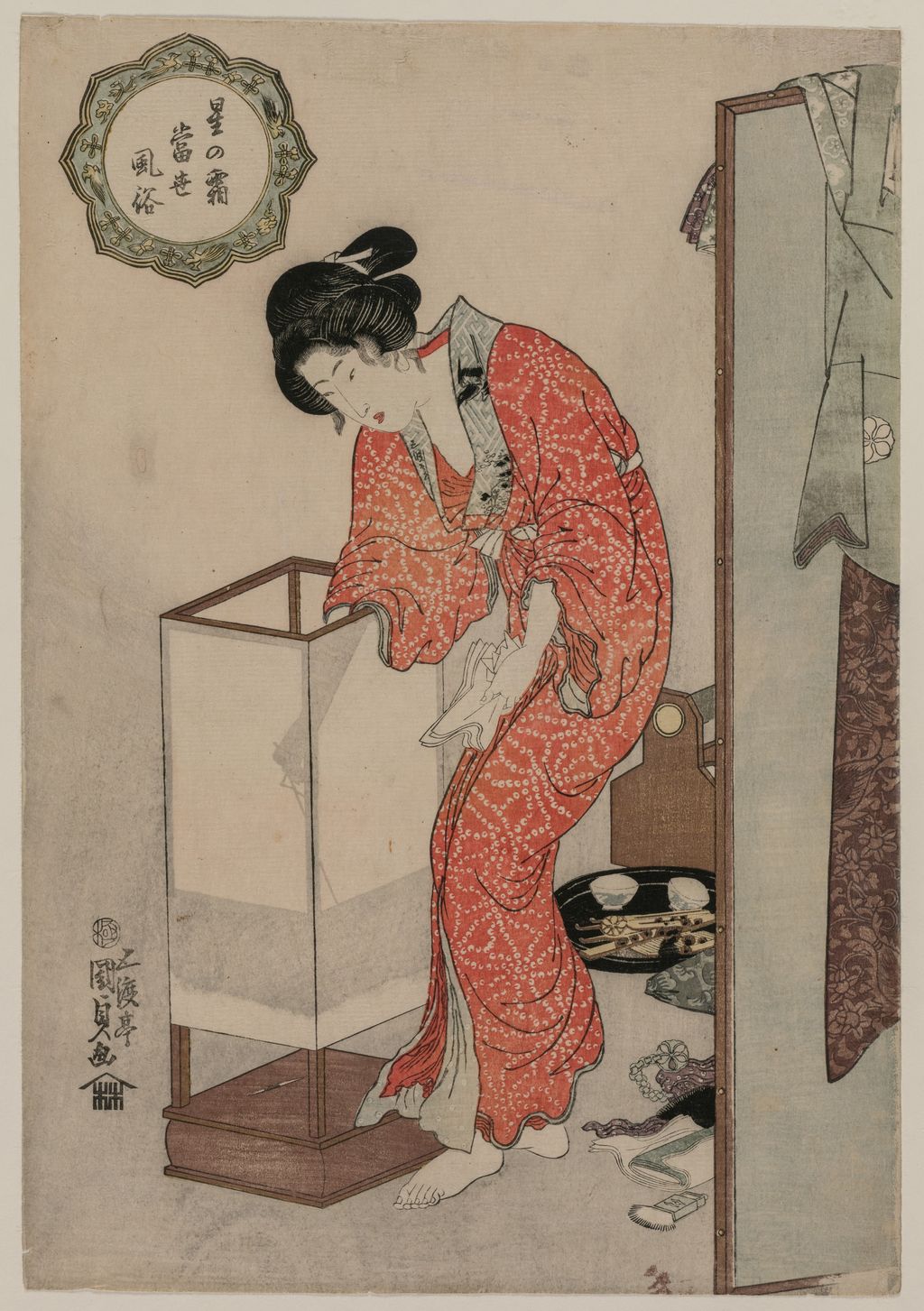
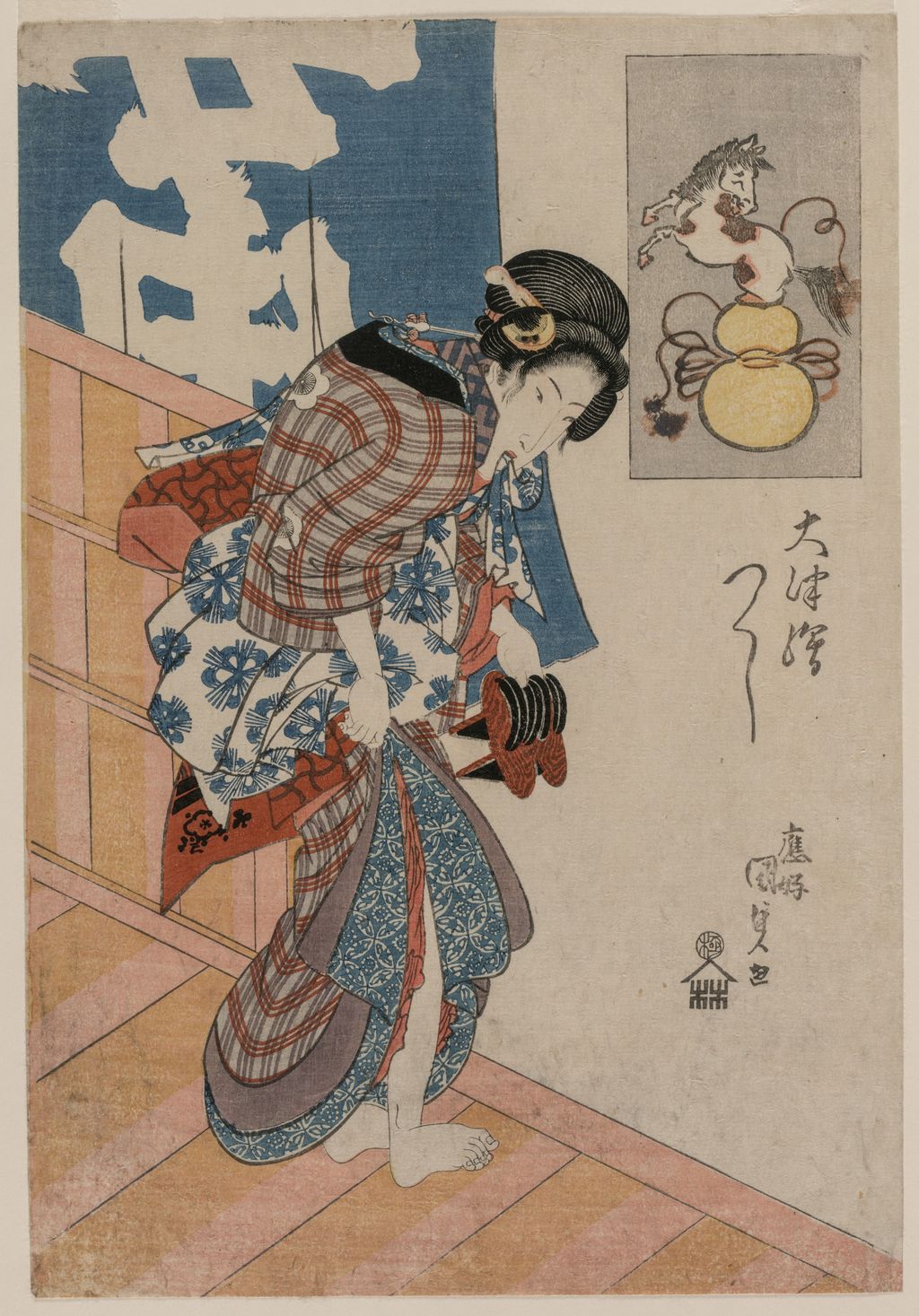
One may see technical and compositional confidence across these subjects, but the existence of a sheet does not prove a visit to the pictured location or a meeting with a sitter. A woman in a bath-house image may be a type or fictional figure; a beauty in a printed series may carry a poetic association rather than an identifiable address. Kunisada's working life extended into markets for fashionable clothing, domestic scenes and literary allusion. His customers' interests can be inferred cautiously from what publishers issued and preserved, while the artist's private experience remains much harder to infer. [15] [16] [17]
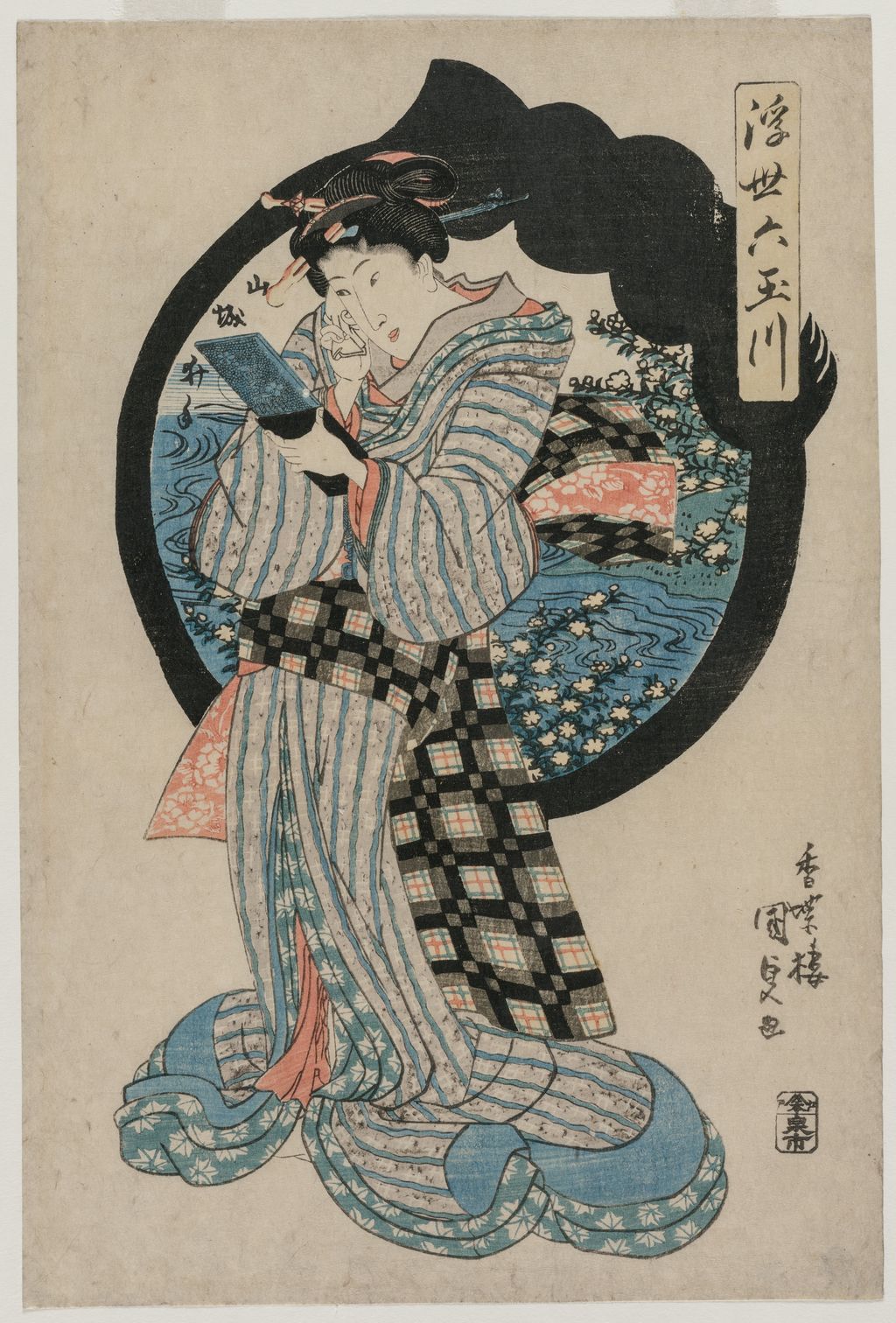
Cleveland's Woman with a Hand Mirror, dated to the early 1830s, belongs to a series named for the Six Tama Rivers. The mirror and the woman's gesture are visible, whereas the series title carries a literary geography that need not be pictured as an actual riverside. This is a dated point in Kunisada's mature work, and it shows how a figure's everyday action could coexist with a learned title. Nothing in the object record identifies a real woman who posed or a place where the artist met her. Its value to the life narrative is the breadth of the audience he addressed, from readers of fashionable figures to people alert to poetic associations. [17]
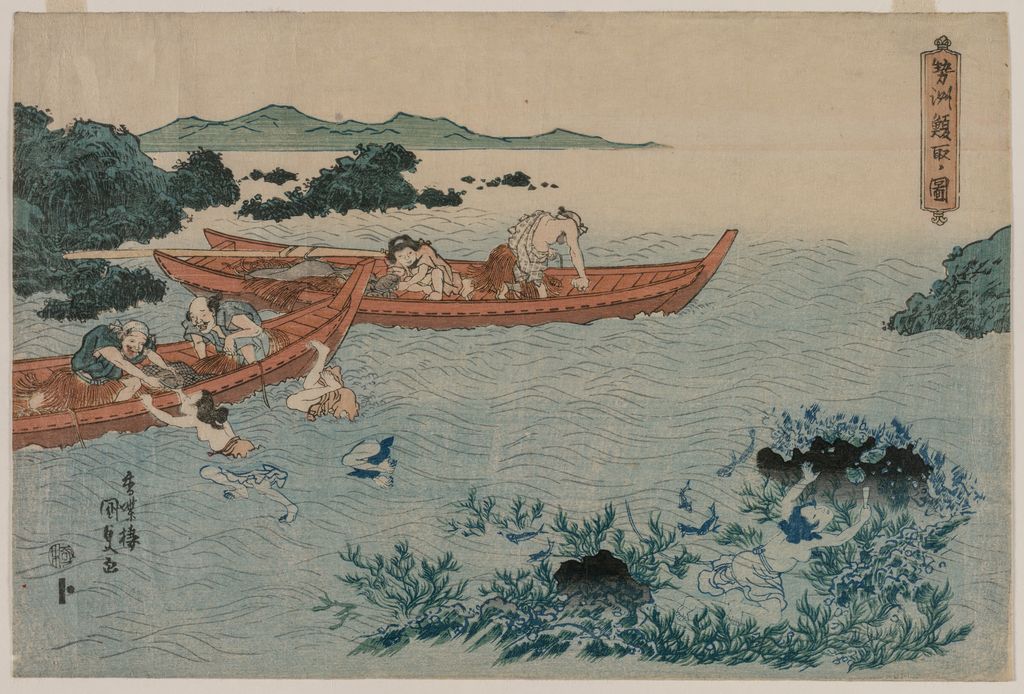
The horizontal Abalone Divers off the Coast of Ise, dated by Cleveland to the early 1830s, is unusual in a career often represented through upright enlarged people. It records Yamaguchiya Tōbei as publisher. The shore, boats and women gathering abalone give the sheet an apparent place and occupation, but the object does not document a journey by Kunisada to Ise. What it documents is that his designs could serve a landscape-oriented series and a publisher's programme beyond actor portraiture. Naming the publisher is valuable here because it keeps the practical enterprise visible beside the artist's signature. [18] [1]
Ōta's retrospective makes an unusual point about his education after success: after the age of forty, it says, Kunisada entered the Hanabusa school of painting. That belongs in a biography precisely because it interrupts the simple account of a youthful apprenticeship followed by unchanged mastery. It suggests further study when he was already an established Utagawa artist. The exhibition text does not, however, identify a particular Hanabusa teacher, a dated admission document or a direct stylistic effect on one Cleveland print. The responsible conclusion is narrower and more interesting: the museum reports continuing artistic learning in mid-career, while the exact course of that study remains to be reconstructed. [1]
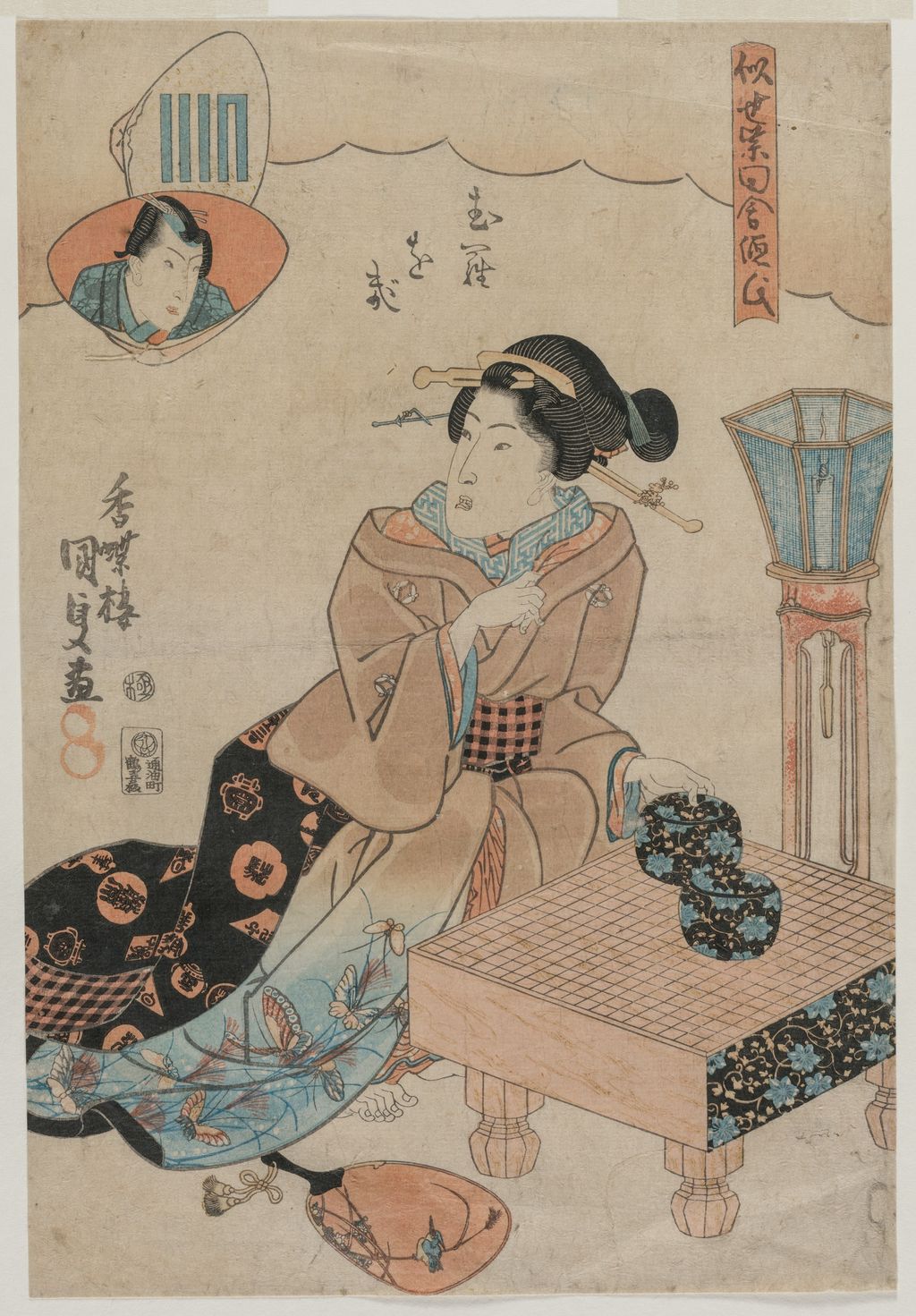
Books reveal another aspect of the business. Kunisada contributed illustrations to 偐紫田舎源氏, written by Ryūtei Tanehiko. The National Diet Library records the first printed part in 1829, the thirty-eighth in 1842, and manuscripts for two further, unpublished parts. That sequence places Kunisada in a durable collaboration with a named author and a serial publishing project. It does not make him the novel's writer. Nor does it make every later “Genji” colour print a page removed from the book. Separate formats could exploit the story's popularity in different ways. [19] [20]
The Metropolitan Museum's Tale of Genji publication discusses how word and image worked together in the adaptation, and describes the 1842 interruption in relation to the Tenpō Reforms. The NDL catalogue establishes the surviving printed and draft sequence; the Met interpretation helps explain the larger publishing event. Keeping these source roles separate matters. A sweeping claim that “the government banned everything Kunisada made” is not supported by either. His subsequent printed work is evidence against such a simple story, even though restrictions on actor and courtesan imagery affected how publishers presented subjects. [21] [19] [4]
Cleveland's Muraogi, a colour print from a 1830s series after the Rustic Genji story, demonstrates the distinction. The character appears as an independent sheet, not a leaf in the novel's bound sequence. It can follow the book discussion as a visual trace of a wider market. A full account of the literary adaptation will need exact volumes, states and other impressions. In the biography, the important point is that the same designer could move between a writer's book project and saleable prints inspired by its characters. [22] [20]
The Toyokuni name: succession and argument
Toyokuni I died in 1825. Another member of the school, Toyoshige, used the Toyokuni name before his death in 1835. When Kunisada eventually adopted his master's name, he did not accept Toyoshige's place in the sequence as modern museum catalogues usually do. The Fitzwilliam points to transition sheets of 1844–45 signed “Kunisada changing to Toyokuni II.” Today's common “Toyokuni III” counts Toyoshige as II. A sheet that calls Kunisada II and a catalogue that calls him III can both refer to the same man and the same historical dispute. [3] [4]
There is a delay between Toyokuni I's death and Kunisada's assumption of the name. It should not be filled with an invented personal quarrel. The reviewed sources document the sequence of names more securely than they document a private negotiation. The fact that Toyoshige had used the name and that the family or school might contest succession gives context, but a cause for a particular year needs a source that directly supports it. The biography can show readers the transition signature and explain the modern numbering without claiming to overhear a conversation in the studio. [3] [23]
Professional names also sit beside art names. The Fitzwilliam identifies Gototei with Kunisada, Kōchōrō with both Kunisada and Toyokuni, and Ichiyōsai with Toyokuni. Such patterns are useful but not mechanical. A signature may include a suffix equivalent to “drawn by” or “from the brush of,” while later impressions, replacements and a publisher's reuse of blocks complicate the visible dating. Ritsumeikan researcher Masae Kurahashi explicitly argues that signatures should be organised with actor and performance information, rather than read as an infallible clock. The name is evidence; it is not a stand-alone date stamp. [3] [24]
Kurahashi's method has a broader biographical consequence. A printed performer may be identifiable through an actor name and a known theatre programme, while the design itself bears one of several signatures. If the play date and the signature appear to disagree, the answer is not automatically that the museum has misread the print. A later issue, a reworked block or a name used during a transition may need investigation. This is the kind of problem a long working life creates: a single man can be visible in dozens of sign-off forms while the publishing workshop changes the material object around him. Using the signature as one piece of evidence is slower than assigning a date from a name chart, but it is truer to the surviving prints. [24] [14]
The practical consequence is especially important on a bilingual site. A Japanese caption might read 二代豊国 on the print while the heading uses 三代歌川豊国; an English record might use “Utagawa Kunisada I (Toyokuni III).” Rather than silently normalise every label, the biography should tell the reader what the object actually says and which convention the modern catalogue follows. This avoids assigning late prints to the wrong artist merely because two generations inherited a name. [2] [3] [10]
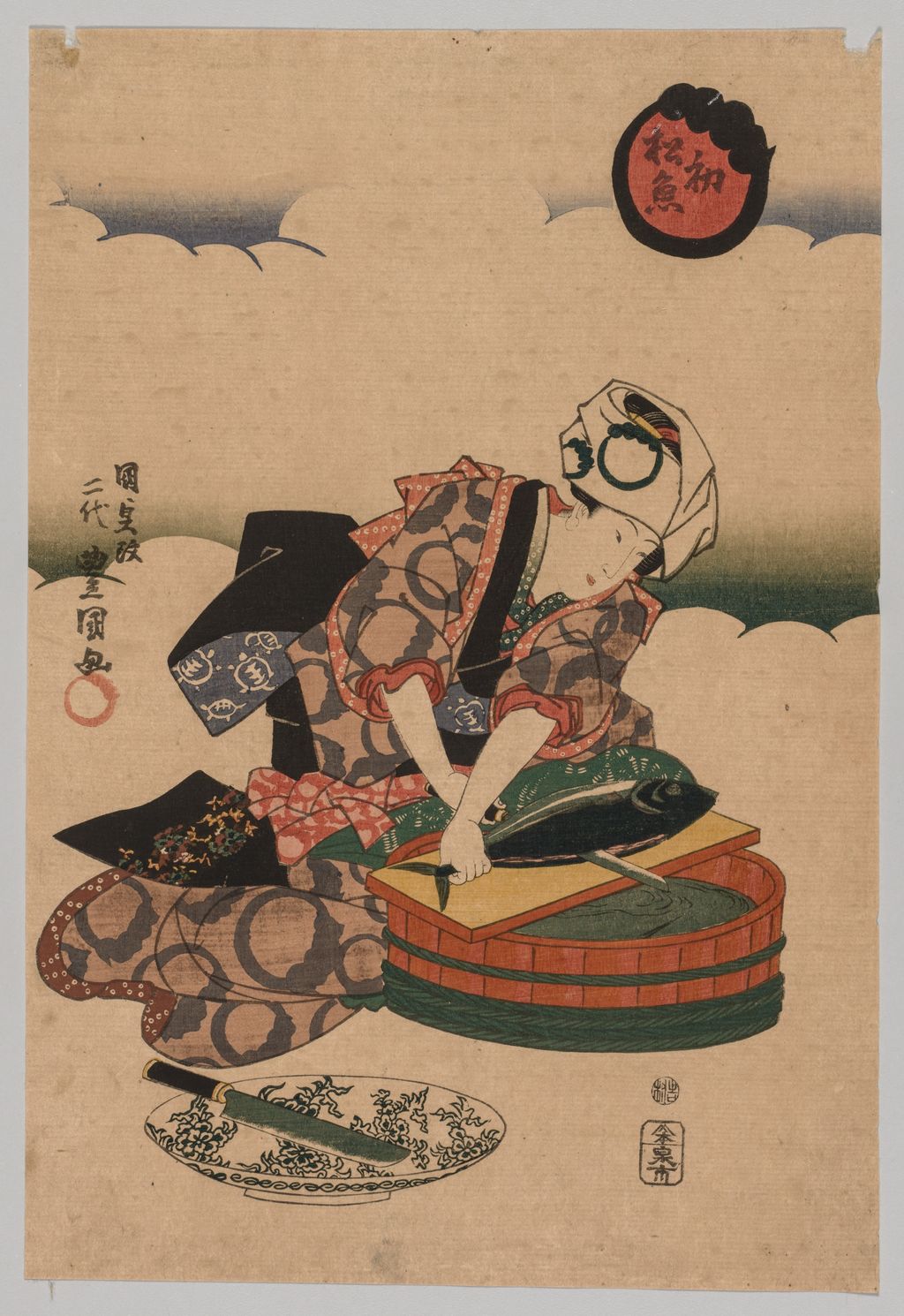
Cleveland's First Bonito of the Year sits near the transition, but the museum dates the sheet only to 1844–48. It uses a seasonal food and fashionable figure rather than an actor's dramatic role, showing that the change of professional name did not narrow him to theatre imagery. The date span is also a warning: this impression cannot establish the month in which Kunisada first signed Toyokuni. A later article could put legible transition signatures next to each other; this sheet should be captioned for the subject and range it actually documents. [32]
Working after the reform years
The years following 1842 did not bring Kunisada's career to an end. The Ōta Memorial Museum describes how publication controls changed the presentation of actors and courtesans, while its collections show large numbers of later designs. A change in subject labels or setting must be read with the specific print and regulation in view. Saying simply that actors disappeared from prints would ignore the ingenuity with which theatre imagery continued to circulate. The biography should track the dated objects and the terms of the museum's account, rather than compress a complicated policy period into a single prohibition. [4] [1]
The Fitzwilliam's introduction gives that period sharper edges. It describes the government's 1842 banishment of Danjūrō VII from Edo as a disciplinary example, and a decree directed at publishers of actor, courtesan and geisha prints. Its account also says restrictions on colour blocks and prices were relaxed by about 1850, even though the formal rule endured. This is not a story in which law switched every image off and then back on. Publishers found allusive titles and exemplary historical identities through which audiences could recognise performers. Such evasions require close reading of an actual print: a “loyal hero” might carry an actor's face, but the phrase in a title is not by itself proof of a specific hidden performance. [5]
The changing market could make later impressions more elaborate, not merely poorer. The Fitzwilliam distinguishes deluxe examples from routine issues of similar subjects and identifies special effects in the 1850s and 1860s. A richly printed survivor cannot represent the appearance and cost of every copy that a contemporary buyer saw. Conversely, an ordinary impression does not show the maximum care a patron might commission. That variability is part of Kunisada's biography because he designed for a field with different customers and budgets. It is also why an image caption should be about the exact museum impression on screen rather than an imagined universal edition. [5] [29]
Kunisada's three Tōkaidō enterprises illustrate the range of later commercial strategies. Ōta distinguishes a beauties series, an actor series and the jointly designed Sōhitsu gojūsan-tsugi. In the last, Hiroshige made landscape backgrounds and Kunisada supplied foreground figures. The grouping under a famous road does not make the designs a single set, nor does a station name prove that an actor performed there. The projects show how an established designer and publisher could connect people, roles and literary or geographic associations within the print market. [25]
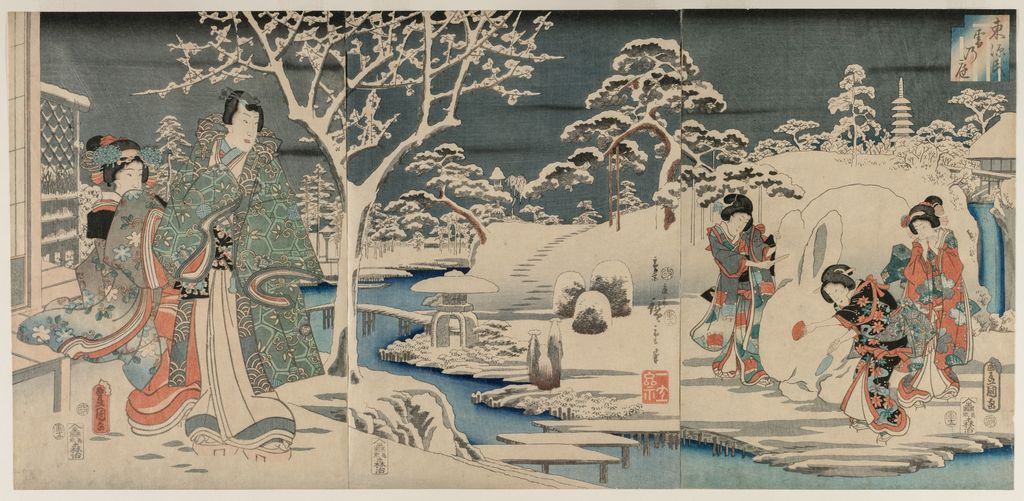
Cleveland's The Snowy Garden, dated 1854, is a wide triptych catalogued with both Hiroshige and Kunisada as creators. It offers a visible later collaboration and a format suited to scanning a scene across joined sheets. Its museum record does not assign it to Sōhitsu gojūsan-tsugi, so the two facts must not be collapsed. The biography can use the triptych to describe professional coexistence and shared authorship, while the exact production of the Tōkaidō set belongs in a separate, object-specific study. [26] [25]
A studio and its successors
An artist who supplied a print market for so long worked within a network, and later accounts name pupils as well as publishers. The Rijksmuseum's record for the 2016 exhibition catalogue Kunisada: Imaging Drama and Beauty describes him as head of a successful studio and identifies Toyohara Kunichika among its students. A Fitzwilliam exhibition note identifies the later Kunisada II as both pupil and son-in-law. These statements establish continuity beyond the master's own hand, but they do not make every sheet signed with a related name an output supervised by him. Individual attribution still matters. [6] [10]
The National Diet Library gives a rare view of work that did not reach the normal print market. Its exhibition describes Sugata-mi hayageiko, a manuscript actor book with twenty-eight half-length likenesses, one on each half-page, accompanied by poems. The publication of an edition has not been confirmed. The book is unsigned, and the library attributes it to Kunisada cautiously from a preface referring to an elder painter in Kameido. Many pictured performers relate to an August 1854 stage production, suggesting a date around then. Such layered reasoning—an unsigned object, a contemporary clue and a performance date—is more valuable than simply calling it a signed late masterpiece. It shows an artist continuing to work with actor likenesses while preserving the uncertainty of attribution and publication. [31]
The same NDL note says many late works are thought to involve division of labour with pupils. That is a general assessment, not proof that a particular Cleveland sheet was designed by an unnamed assistant. It does, however, change how the late studio should be described. A famous signature could front a collective enterprise, and drafts might remain unfinished or unpublished. If the biography treats every product of the studio as a solitary act of the senior artist's brush, it loses the working conditions that made his enormous output possible. The unsigned actor-book manuscript is especially instructive because it lets the account address process and attribution together. [31] [6]
Ōta's account of late Kunisada brings a particular working relationship into focus. It reports research on the wealthy patron Kinokuniya Chōzaburō, the publisher Ebisuya Shōshichi and a group of actor portraits associated with 嘉無路喜久. A patron, publisher, cutter, printer, artist and pupil did different jobs even where their interests converged in a luxurious print. The museum presents the patronage story as a result of newer research. It is therefore better to attribute that relationship to Ōta than to claim that the exact financial terms of every commissioned sheet have been recovered. [4]
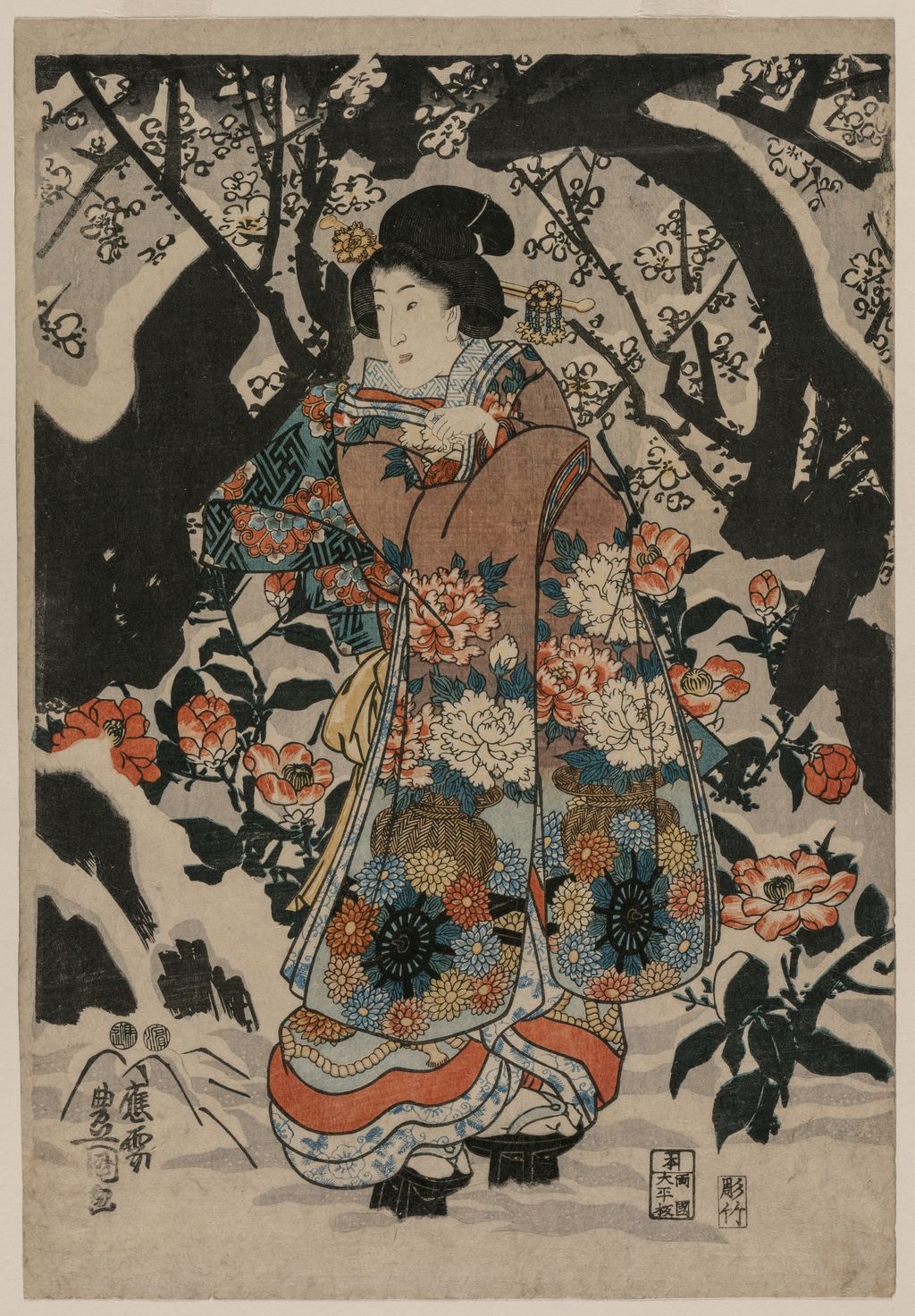
The 1850s and 1860s offered no neat late-style endpoint. The Cleveland Woman Standing Beside a Plum Tree is broadly dated around 1850; its title tells us what a viewer sees, not a particular commission. Ōta describes a final group of drawings for Edo bijin-zukushi: designs prepared but not issued as prints. The distinction between an unpublished design and a published sheet is essential when trying to say what the public saw during Kunisada's lifetime. Late work may survive in the studio without having reached the stalls. [27] [1]
Death, memorials and the name left behind
The National Museum of Japanese History holds two memorial print records for Kunisada. Both give the fifteenth day of the twelfth month of Genji 1 as his death date. Their inscriptions and catalogue descriptions record his Buddhist name and a burial association with Kōmyōji in the Kameido area. One memorial was designed by the successor Kunisada II; the other catalogue names Toyohara Kunichika as designer and specifies a cutter and publisher. These are material witnesses to how a professional network commemorated its senior artist. They do not give us his private final words as a stenographic transcript. [2] [28]
The memorials also expose why a single unqualified number can be misleading. One record gives age eighty, the other seventy-nine. Both state the same Japanese death date. The discrepancy may reflect different ways of reckoning age or particulars of the printed inscriptions, but the sources checked here do not resolve it. It is more accurate to report the shared death date than to calculate a birth day backwards from either memorial. The Metropolitan Museum's Tale of Genji publication converts that Japanese date to 15 January 1865; Ōta's “1786–1864” uses the Japanese historical year. Other Western conversions circulate, so the exact Gregorian day should be attributed when given. [2] [28] [21]
A memorial print of a print designer is itself noteworthy. The National Museum of Japanese History describes such portraits as less usual than memorial images of Kabuki actors. The later artist is shown at a desk or seated with attributes of work; poems and names surround the image. These conventions speak about public standing and the circles that made and sold the memorial. They do not supply a photographic likeness. A viewer who knows Kunisada only through his images of actors can see that the same print culture could turn toward its maker at his death. [2] [28]
The records also identify different agents behind those portraits. In F-320-529, Kunichika is named as designer, Matsushima Horimasa as cutter and Ebisuya Shōshichi as publisher. In F-320-576, Kunisada II is named as designer and Iseya Kanekichi as publisher. The variation is not a small bibliographic nuisance: it records at least two commemorative responses made by different teams. The son-in-law successor and a former pupil appear within a network that continued to produce images after Kunisada's death. Their memorials are evidence of that network's public work, while the printed ages and verses still need to be read as memorial conventions rather than unfiltered diary testimony. [2] [28] [10]
The two memorial records currently display CC BY-SA 4.0 image rights. That is promising for a future production image, but an exact file, its credit, attribution and any share-alike obligations for a crop must be recorded before placing it on the site. Until then, the biography can cite the transcriptions and use the cleared Cleveland images in the article. A rights statement attached to a record is a research lead, not a substitute for an asset ledger. [2] [28]
How to read the life in the work
The most useful chronological line is not a parade of titles. It moves from a young designer trained under Toyokuni, through a distinct actor-print practice, into books and wider subjects, then across a disputed name succession and a later studio. Each stage rests on different kinds of evidence: signed impressions, museum catalogues, an illustrated book's publication sequence, a successor's memorial image. None grants direct access to every motive. The point of a biography is to make those evidence changes legible. [3] [5] [19] [28]
Readers can now move back to the Kunisada overview to compare the genres and close-looking examples, or to the Hiroshige overview for the landscape collaborator's own career. The proposed Rustic Genji and separate Tōkaidō pages need their own exact-volume, series and image gates. Keeping those subjects distinct protects what is most interesting in Kunisada's long life: he did not perform one task over and over. He supplied designs for changing audiences and worked with people whose names sometimes survive on the same paper. [25] [19] [6]
Frequently Asked Questions
He was born in 1786. Two Japanese memorial-print records give his death as the fifteenth day of the twelfth month of Genji 1. The year is commonly written 1864 in Japanese chronology and January 1865 in the Western calendar. [2] [21]
Utagawa Toyokuni I was his teacher and gave him the professional name Kunisada. The checked sources do not establish the exact day he entered the studio. [3] [4]
He assumed his teacher's name in the 1840s and initially called himself Toyokuni II. Most modern catalogues count an earlier bearer, Toyoshige, as Toyokuni II, making Kunisada Toyokuni III. [3]
No. Ryūtei Tanehiko wrote 偐紫田舎源氏 and Kunisada supplied illustrations. Later independent prints also drew on its characters and should not be confused with bound book pages. [19] [22]
Discussion
Compare what a signed impression, an unpublished manuscript and a memorial print can tell us about Kunisada’s life.
Reader Insights
What does Ōta establish about Kunisada’s study of the Hanabusa school?
Why could a print call him Toyokuni II while a museum calls him III?
What remains uncertain about the NDL actor-book manuscript and the two memorials?
Join the Conversation
Share a documented example or reliable source below, keeping observation separate from inference.
References
- Ōta Memorial Museum of Art, “Utagawa Kunisada: 150 Years After His Death” (2014).
- National Museum of Japanese History, F-320-576 object record and inscription.
- Fitzwilliam Museum, “Kunisada's Names”.
- Ōta Memorial Museum of Art, “Kunisada, Kuniyoshi, Hiroshige and Their Times” (2008).
- Fitzwilliam Museum, “Introducing Kunisada and Kabuki”.
- Rijksmuseum Research Library, Kunisada: Imaging Drama and Beauty, catalogue record and summary (Hotei, 2016). The book's interior has not been read.
- Cleveland Museum of Art, 1985.333, Ichikawa Danjūrō VII as Kan Shōjō.
- Fitzwilliam Museum, “How to Read an Actor Print”.
- Odawara City Digital Archive, artist note on Kunisada.
- Fitzwilliam Museum, “Tale of Eight Dogs” exhibition group.
- Fitzwilliam Museum, “Actors' Names and Crests”.
- Fitzwilliam Museum, “Ichikawa Danjūrō VII”.
- Fitzwilliam Museum, “True Likenesses (nigao)”.
- Fitzwilliam Museum, “The Reuse of Printing Blocks”.
- Cleveland Museum of Art, 1930.201, Woman Putting Out a Light.
- Cleveland Museum of Art, 1940.711, Woman Leaving a Bath House.
- Cleveland Museum of Art, 1916.1131, Woman with a Hand Mirror.
- Cleveland Museum of Art, 1916.944, Abalone Divers off the Coast of Ise.
- National Diet Library Reference Service, “On Nise Murasaki Inaka Genji” (2013).
- Ōta Memorial Museum of Art, “Genji Pictures in Ukiyo-e” (2008).
- Metropolitan Museum of Art, The Tale of Genji: A Japanese Classic Illuminated, “Note to the Reader” and “Genji and Print Culture” chapter (2019).
- Cleveland Museum of Art, 1985.334, Muraogi.
- Tikotin Museum of Japanese Art, “Toyokuni, Toyokuni, Toyokuni” (2005). Museum interpretation of the succession; verify the full chronology independently before citing any proposed motive.
- Masae Kurahashi, Ritsumeikan University, “A List of Kunisada's Signatures: Its Usefulness and Problems”, pp. 1–2.
- Ōta Memorial Museum of Art, “The World of the Fifty-three Stations: Hiroshige and Kunisada” (2012).
- Cleveland Museum of Art, 1940.989, The Snowy Garden.
- Cleveland Museum of Art, 1916.1172, Woman Standing Beside a Plum Tree.
- National Museum of Japanese History, Toyokuni III memorial print F-320-529.
- Fitzwilliam Museum, “Surimono and Special Printing Effects”.
- Fitzwilliam Museum, “Fan Prints: Examples”.
- National Diet Library digital exhibition, Sugata-mi hayageiko and Kunisada III note, item 170 and catalogue call number 本別7-570. The library treats the attribution and publication status as qualified.
- Cleveland Museum of Art, 1940.1013, First Bonito of the Year.