


 by Tom Gurney
Tom Gurney BSc (Hons) is an art history expert with over 20 years experience. Updated September 24, 2026.
Introduction
Ogata Kōrin (尾形光琳, 1658–1716) was born into a Kyoto family whose luxury textile business served elite buyers. He became a painter of celebrated screens, but the phrase “textile merchant turned artist” conceals decades in which household money, courtly connections, patrons, travel and changing fortunes shaped what he could make. A white silk kimono painted with autumn grasses survives from his Edo period; a two-panel wave screen bears a seal that helps date it; his younger brother Kenzan's ceramic dishes carry Kōrin's painted figures. These objects locate his art in relationships and materials. The Kyoto National Museum's overview of Rinpa [4] and Kyoto City's account of the Kariganeya [3] give the household and urban setting, while the objects test the chronology.
The most valuable surviving evidence for his life is not a single romantic memoir. A group of about 530 Konishi-family items [2], designated an Important Cultural Property and associated with Kyoto National Museum, includes Kariganeya business documents, Kōrin's designs and studies, family correspondence and records related to Kenzan and later relatives. Kyoto National Museum's catalogue [1] says the collection descended through the family of Kōrin's son Jūichirō, adopted into the Konishi household. It has losses, but its papers make it possible to move beyond legend. This biography does not claim to have transcribed every archival sheet. It identifies the archive's scope and relies on published museum interpretations and individual objects for the dated claims below.
Contents
- Introduction
- The Kariganeya: clothing, status and education
- A painter with patrons and a title
- Edo from 1704: a change of place and surface
- Returning to Kyoto and working with Kenzan
- The Shinmachi house and late Kyoto work
- The archive and the limits of a life story
- After 1716: how a “school” formed
- Following the evidence
The artist home compares ten cleared museum views across screens, ink, textile and lacquer. The iris study will distinguish the Nezu and Met screen pairs; the plum-screen study will handle the MOA National Treasure and its materials. Here the question is how a Kyoto textile household's son became a named artist working between Kyoto and Edo, and how his practice was later organised as a “Rinpa” lineage. His life is more interesting when exact evidence and uncertainty appear together.
Chronology and source confidence
| Date | Event or object | What the date can support |
|---|---|---|
| 1658 | Kōrin's birth in Kyoto, recorded in Kyoto National Museum's archive description [1] and Met object biographies [14] | Secure life year; few dated childhood works survive. |
| 1678 | Death of the Kariganeya's important customer Tōfukumon'in, in Kyoto City's history [3] | Municipal explanation for a loss of business; it does not quantify every account. |
| 1687 | Death of father Sōken, in Kyoto City [3] and the Agency for Cultural Affairs [5] | Household turning point and inheritance, not an instant professional conversion. |
| 1701 | Receipt of the honorary title hokkyō, in Kyoto City's account [3] | Public recognition; its suggested court recommendation is reported cautiously. |
| 1704 | Kōrin travels to Edo, in Tokyo National Museum's kosode record [9]; a 1704 portrait of Nakamura Kuranosuke [7] is in Kyoto museum's exhibition list | Named journey and patron connection; the kosode patron story remains a tradition. |
| ca. 1704–9 | Met Rough Waves, 26.117 [14] | Estimated from the Dōsū seal adopted in 1704 and research on the Edo stay. |
| 1709 | Return to Kyoto by around March, in the Agency's Kenzan-dish explanation [5] | A scholarly chronological anchor for later brotherly ceramic collaborations. |
| 1709–16 | Kōrin and Kenzan's square dishes [6] | Scholarly date range, not a year for every dish. |
| 1711 | Purchase of land and construction of a Shinmachi-dōri Kyoto home, in Kyoto City's account [3] and the Konishi archive [1] | An architectural and documentary anchor for the late Kyoto years. |
| 1716 | Kōrin's death, in Kyoto National Museum [1] | End of his own life; Hōitsu's 1815 publications belong to later reception. |
The Kariganeya: clothing, status and education
Kōrin's father Ogata Sōken (1621–87) owned the Kariganeya, a Kyoto supplier of fine textiles. The Agency for Cultural Affairs' account of Kenzan's ceramic dishes [5] names Sōken as the shop's head and says that the household served Tōfukumon'in, a major imperial customer. Kōrin was the second son; Kenzan, born in 1663, was the third. Kyoto National Museum says the family was linked by marriage or kinship to Hon'ami Kōetsu's circle, and the brothers probably grew up near works and practices associated with Kōetsu and Sōtatsu. “Probably” matters: shared social environment does not identify a specific childhood lesson or prove that the much earlier Sōtatsu personally taught Kōrin.
The business belonged to a district where textile production, court demand and money met. Kyoto City's local history [3] explains that upmarket clothing suppliers operated near the imperial palace, Nijō Castle and the Nishijin weaving area. It names Kariganeya among families that rose through elite commissions and later suffered the risks of credit and lending to powerful customers. This was not an anonymous artisan childhood. Clothes specified season, rank, taste and social occasion; choices of cloth and pattern were part of the family's work. A painter who later made gold screens and designed a silk garment had first lived among such decisions. That context supports a question about design across materials; it does not prove that each screen began as a textile draft.
It is worth pausing over the word merchant. In this context it did not imply that a family merely resold cloth made elsewhere, detached from its design. A high-end Kyoto textile supplier had to mediate among costly materials, labour, court taste and the demands of a named client. The municipal history's account of Kariganeya's elite customers and the Konishi archive's pattern and business papers [1] make that mediation visible. It would still be misleading to assign a surviving Kariganeya pattern to the young Kōrin without its own record. The connection is environmental and institutional: he grew up in a household in which the placement of colours, motifs and materials was part of paid work. The later Fuyuki Kosode gives the strongest specific evidence that he himself worked directly on a garment, decades after that upbringing.
The Kyoto museum exhibition [4] says the brothers received education in painting, calligraphy and Noh within a cultured household. The Met's Designing Nature museum publication page [25] describes the broad Genroku setting in which Kōrin came of age. These institutional interpretations are stronger when held beside the documented Konishi archive. Its business records, pattern drafts and letters show what kinds of material survived. A biography should not turn a later label such as “Rinpa” into the name of a school he enrolled in as a boy.
Kyoto City reports that Tōfukumon'in died in 1678 and that Kariganeya's fortunes subsequently worsened, with loans to lords proving hard to recover. Sōken died in 1687. The municipality also says Kōrin received substantial property before gradually reducing his inheritance. That account offers a plausible economic setting for increased professional painting. It does not provide a ledger proving that a single expenditure “made” a particular screen or that financial trouble was the sole cause of his art. It is better to say that money and changing patronage affected the conditions in which he painted, while the surviving works and titles establish the career's visible stages.
A painter with patrons and a title
By 1701, Kyoto City says, Kōrin had obtained the honorary Buddhist-derived rank hokkyō, widely given to accomplished artists. The account suggests the recommendation of the courtier Nijō Tsunahira, but expresses that relationship cautiously. The title signalled standing and appears in many later signatures; it cannot date every unsigned painting by itself. Nor was Kōrin's success the solitary discovery of genius. A network of court, merchant and official patrons bought, commissioned, housed, introduced and interpreted artists. The Konishi papers [1] are important precisely because they preserve documents alongside pictures.
Kyoto City's history names Nakamura Kuranosuke, an official associated with the Kyoto silver office, as a supporter. Its account of their closeness includes the reported care of Nakamura's daughter for several years; that family story requires a different level of certainty from a dated portrait. A Kyoto National Museum exhibition checklist [7] records a portrait of Nakamura painted by Kōrin in 1704 and held by Yamato Bunkakan. The same checklist records a Daikokuten with an inscription by Nakamura. These are exact object entries demonstrating an artistic relationship; they do not establish every private detail of it. Japan's Cultural Heritage Online [8] independently identifies the Nakamura portrait as an Important Cultural Property.
This distinction between an object and a story recurs throughout the biography. A painted face, its accession and its dated exhibition entry can place two named people in a cultural relationship. It may not reveal who paid, what words were exchanged or how long an arrangement lasted. Likewise, many Kōrin works carry the hokkyō signature but the title alone does not explain the sequence of commissions. The strongest biography names the patrons who appear in records, notes the social position of the artist and avoids making every episode more precise than the sources allow.
The 1704 portrait also provides a rare counterweight to a biography written entirely from landscape and floral screens. Its sitter has a name, position and relationship to Kōrin's support network. The Kyoto exhibition list [7] further distinguishes Kōrin's painting from inscriptions by Nakamura Masanao and others. That division is a reminder that a finished hanging scroll could bring together painter, sitter and multiple writers. If the image is encountered later, its inscriptions need to be assigned to their named contributors rather than all put into the artist's mouth. The portrait's image rights have not been established for site production, so the article uses it as a documented object in the chronology and sends readers to the holding record. The lack of a picture on our page should not erase the sitter from the story.
Edo from 1704: a change of place and surface
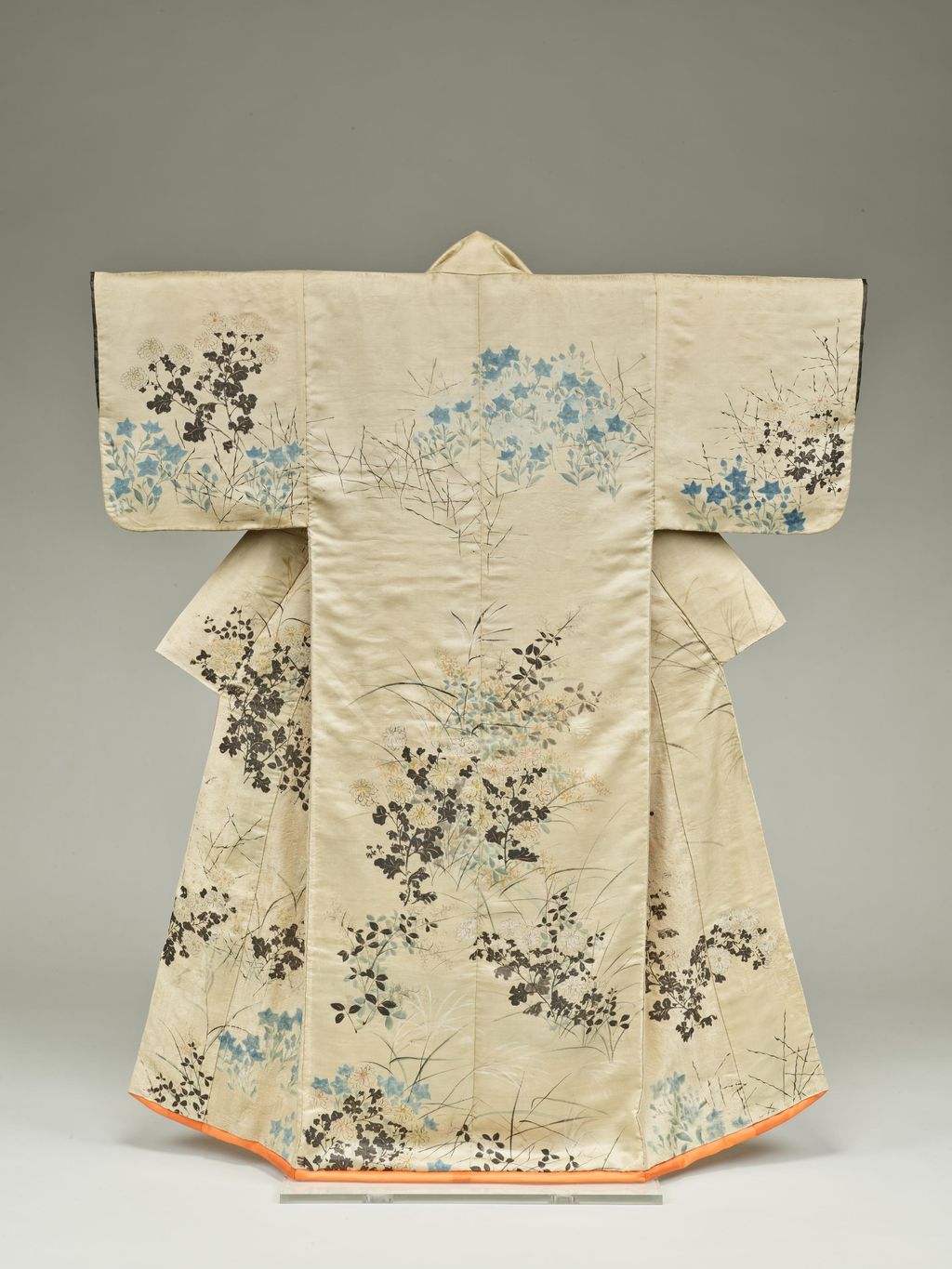
The Tokyo National Museum's collection account for the Fuyuki Kosode [9] says Kōrin left Kyoto for Edo in 1704 and first lodged with the Fuyuki family, timber merchants in Fukagawa. That is a concrete place and household, not a vague “Edo period” in an artwork label. The museum records a tradition that Kōrin painted the white silk kosode with autumn grasses for the wife of the family. It catalogues the garment as an Important Cultural Property, I-721, hand-painted on silk twill. A ColBase photograph of this exact object [11] can therefore illuminate both design and Edo lodging, with the source and web resizing explicitly credited. The traditional commission story should still be called a tradition.
The garment is not a painted canvas cut into clothing after the fact. Autumn grasses are distributed over sleeves and body so that they make sense on a worn, moving object. Tokyo National Museum's conservation report [10] examines attached documentation and locates it broadly in the Hōei years, 1704–11. The report's measurements before and after repair differ because conservation changes the supported textile, not because two separate garments are being described. The collection record's current dimensions and accession should be used for captions. A biography gains more from this physically specific survival than from a generic assertion that a textile family made him “naturally decorative.”
The kimono photograph should also be read as a conservation view. Its sleeves are extended and the body is displayed flat against a neutral field so that the visible painted surface can be studied. A wearer would have brought the upper and lower clusters into changing alignments. Flowers painted on pale silk do not sit against the fixed, brilliant gold of a folding screen; their contrasts depend on cloth, seams, fold and movement. These are observations of format, not evidence that Kōrin designed a specific woman's entire wardrobe. The museum's report follows recent repairs to the same important cultural property, a useful reminder that a three-century-old garment reaches us through storage, mounting and skilled conservation. The ColBase derivative on this page is a web-size view of that surviving object, not a reconstruction of how it looked when new.
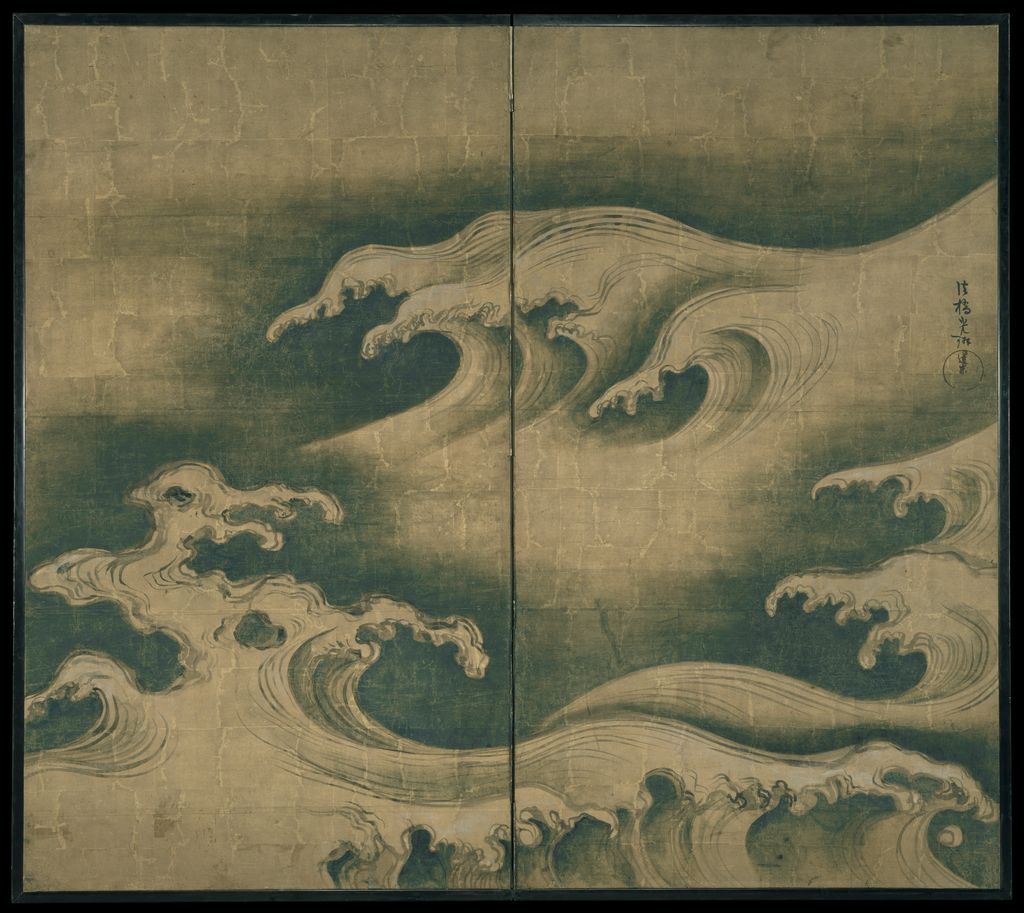
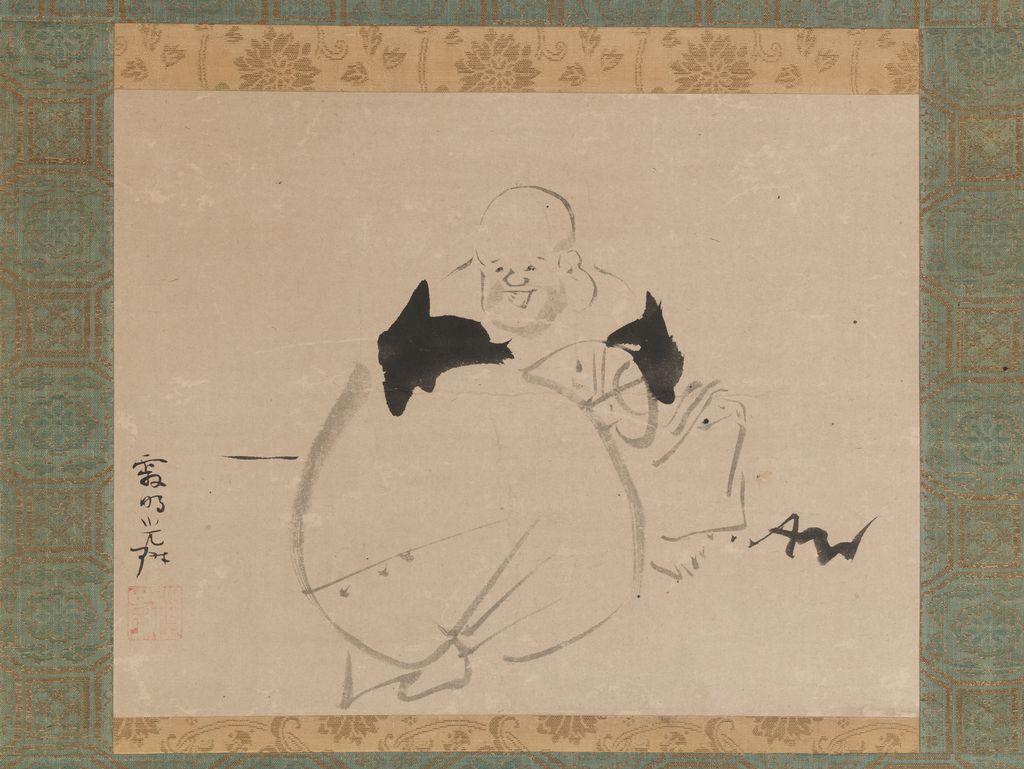
The Met's Rough Waves [14], accession 26.117, provides another possible Edo-period object. Its “Dōsū” seal belongs to a name Kōrin adopted in 1704; the museum cites research suggesting execution between 1704 and 1709 while he lived in Edo. The qualifier “suggesting” is essential. A seal and stylistic research give a defensible date range, not a bill of sale or a dated statement that this screen was painted at the Fuyuki house. Its dark water and clawlike foam show a different use of screens from the irises. Hotei at the Met [15] is likewise dated after 1704 by museum evidence and offers an ink-on-paper figure alongside the broad screen format.
Kōrin's Edo years are often made into a simple tale of discomfort outside Kyoto. The surviving objects suggest a more productive and varied interval: a named place of residence, a garment linked to his host household, a possible wave screen and work with ink figures. The evidence is still partial. The precise duration of each stay, all patrons who supported him, and the location in which each screen was completed are not supplied by the museum records above. Kyoto and Edo were connected by people and commissions, but a biographer should not fill archival gaps with psychology.
Returning to Kyoto and working with Kenzan
The Agency for Cultural Affairs' detailed explanation of the brothers' ceramic dishes [5] uses Kōrin's return to Kyoto around March 1709 as the beginning of a collaborative period that lasted to his death in 1716. Its dates derive from research on the objects, not a dated signature on every surviving dish. Kenzan had opened a kiln at Narutaki in 1699 and moved to a central Kyoto workshop in 1713, according to the same official account. These are Kenzan's career milestones, not Kōrin's own pottery-kiln ownership. Their overlap explains opportunities for cooperation without making the younger brother a mere technician for Kōrin's design.
Kyoto National Museum's pair of square dishes with Hanshan and Shide [6], G甲802, makes the division of labour unusually plain: Kōrin painted the figures and Kenzan added poetic inscriptions. The dishes have moulded square bodies, white slip and iron-based and red decoration. The official cultural-property account explains that the format let painting and poem inhabit a ceramic plane. That is a historically named collaboration, not a licence to attribute every Kenzan pot to Kōrin. The brothers could both contribute to a single object while retaining different skills and visual decisions. Their relative birth order also matters: Kenzan was the younger brother, yet his ceramic expertise supplied the support and firing process that made the painted figures into durable vessels.
The collaboration also places Kōrin's interest in historic literary and religious figures beyond paper. The Hanshan and Shide images can be considered with his Met Hotei scroll [15], but one is painted and fired onto ceramics with Kenzan's calligraphy and the other is ink on paper. Their similarity of subject does not collapse their making. Museum records and Japanese government designations let the biography describe each surface and collaborator instead of offering a loose claim that “Kōrin made ceramics.” The photographs on Kyoto National Museum's site require their own image-use process; they are linked as research evidence, not copied into this page.
There is also a chronological reason to resist the expression “the Kōrin–Kenzan style” as if it were fixed from childhood. The official account [5] sets Kenzan's Narutaki kiln opening in 1699 and the brothers' documented category of joint dishes after Kōrin's 1709 return. Kenzan's move within Kyoto in 1713 further changed the workshop setting. The brothers shared family background, but they did not share a single undifferentiated craft career. On the dishes, writing can be read beside image and the clay's bounded square replaces the broad, folding paper field of a screen. Such differences explain why collaboration is an art-historical event rather than a footnote to either brother's individual fame.
The Shinmachi house and late Kyoto work
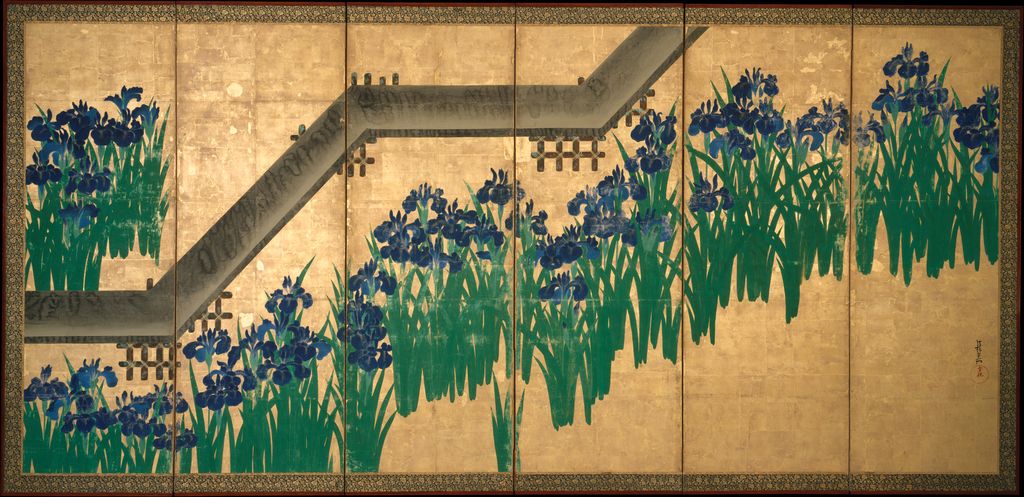
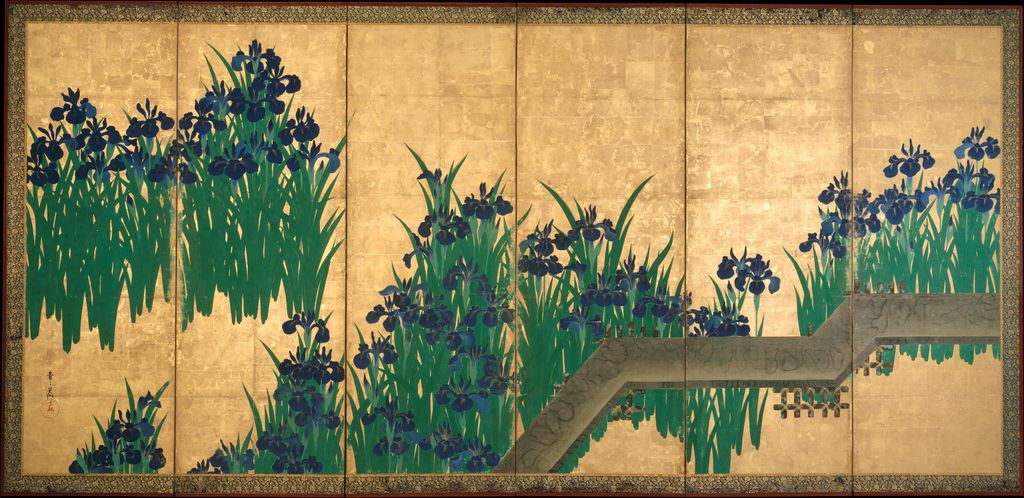
Kyoto City says Kōrin bought land on Shinmachi-dōri south of Nijō in 1711 and built a house to his design. The Konishi-family archive entry [1] lists drawings and specifications for the Shinmachi house among its materials. A surviving plan is much more specific evidence than a modern claim that every nearby street corner remains unchanged from Kōrin's day. Kyoto City's history illustrates a house plan; the drawing on its website has not been added to the production page without image-rights review. A text location feature can still connect the father's Kariganeya world, the Edo lodging and the later Kyoto house while explicitly stating what the documents do and do not locate.
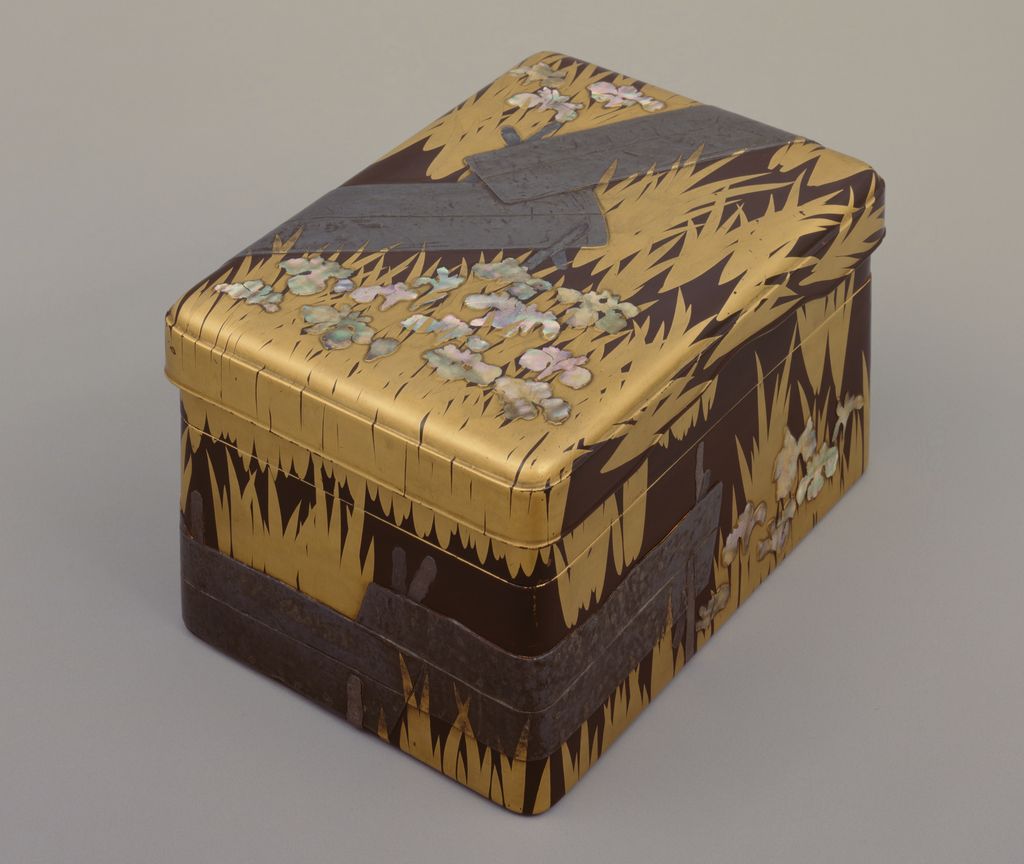
In the later Kyoto years, Kōrin's work continued to cross media. The Nezu Museum's National Treasure Irises [17], without a painted bridge, and the Met's later Irises at Yatsuhashi [18], dated after 1709 with bridge planks, are two distinct pairs. The Tokyo National Museum's Writing Box with the Yatsuhashi Bridge, H-86 [19], moves the literary design into lacquer, shell and lead over a three-dimensional object. An exact ColBase image [12] can be used with credit. The museum's longer explanation stresses that specialist craftspeople worked under Kōrin's design. His authorship of the writing-box concept should not be recast as solitary manual execution of every material.
MOA Museum's National Treasure Red and White Plum Blossoms [20] belongs in any account of the mature painter. Its two differently shaped trees flank a central stream, an arrangement of contrasts that rewards comparison with his other water and plant designs. The exact chronology and material history need their own careful discussion in the dedicated article. An MOA website photograph is not reused on this biography page because its image FAQ [21] restricts public reproduction; a different plum screen would be an incorrect substitute. Kōrin died in 1716. A late masterpiece is part of the final span of his work, but no source here proves that it was literally his last painting.
The archive and the limits of a life story
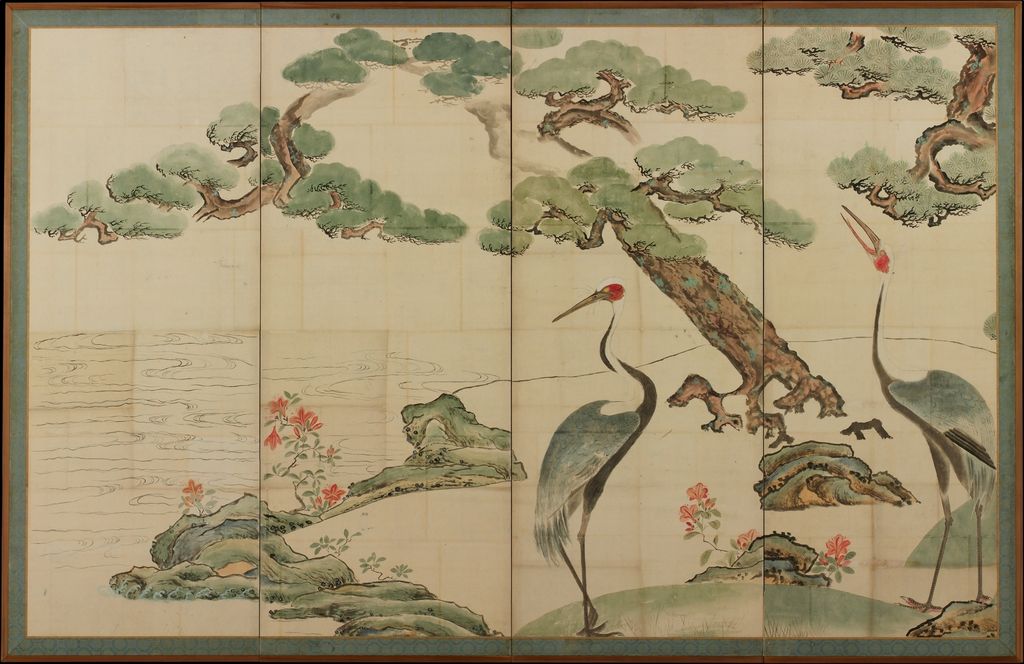
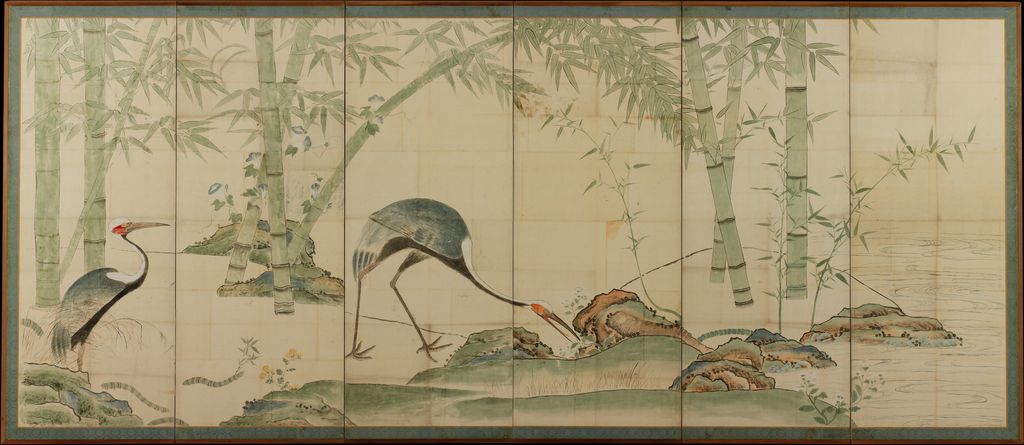
The Konishi-family Kōrin archive [22] is itself a biographical subject. It includes art studies and patterns alongside documents concerning family money and life, though some material has been dispersed. The government heritage description [2] counts about 530 designated items and names studies of birds and animals, drafts, correspondence, Kariganeya documents and records concerning relatives. That corpus means a claim such as “we know nothing of the working life” would be false. Equally, a catalogue summary does not permit this page to invent the contents of a particular private letter without reading it. The page points readers to the holding museum record and distinguishes the archive's documented existence from an interpretation of a named document.
Archival survival also complicates the popular myth of the effortless decorator. Preparatory Cranes, Pines, and Bamboo drawings now at the Met [16], once held by Konishi descendants and later remounted as unequal folding screens, preserve provisional colour instructions. They show a designer still deciding how branches, stream and birds should relate. That object is not a finished matched six-panel pair; the present mount is part of its later history. The archival studies and surviving preparatory drawings together help us ask how finished gold-ground patterns were planned rather than explaining them as an instant stroke of genius.
The archive's own trajectory deserves notice. It came through descendants and an adoption, not by chance from a sealed artist's studio left untouched since 1716. Cultural Heritage Online [22] states that some of the original family material has dispersed. The protected group is therefore a historically selected survival. If a drawing appears in one museum and a related family document in another, their present locations should not be projected back onto the artist's working room. A page can use the protected 530-item count as a sign of research depth while acknowledging that the archive's catalogue and the biographies built from it are shaped by what families, collectors and institutions kept.
There are limits. The Konishi group is not a complete diary. Kyoto City's story of inherited wealth and patron relations may draw on a mixture of records and later local interpretation; some phrases are explicitly tentative. The Met's 1704–9 dating of Rough Waves is a research estimate. The Fuyuki commission is described by Tokyo National Museum as a tradition. The Yatsuhashi writing box's maker label does not identify every specialist hand. A reliable biography names those differences. It can be vivid without making uncertain motives, private conversations or precise commissioning days seem established.
After 1716: how a “school” formed
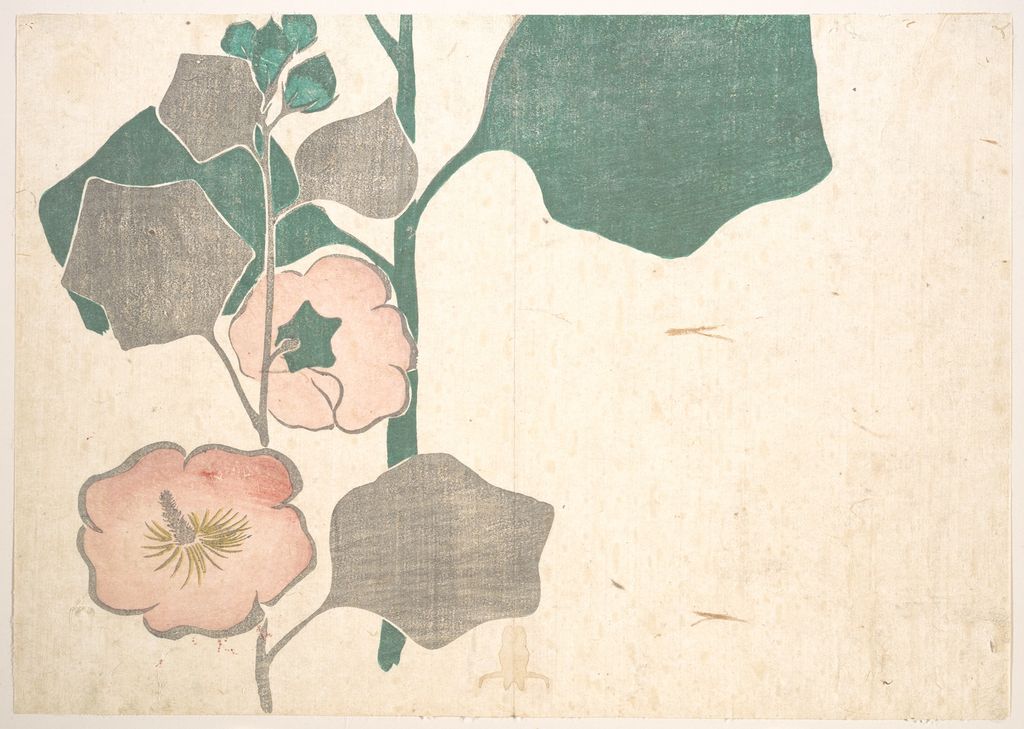
Kōrin's death did not end the movement of his designs. The Kyoto National Museum [4] describes a loose connection from Kōetsu and Sōtatsu through the Ogata brothers to Sakai Hōitsu. It identifies Hōitsu's Kōrin hyakuzu and Ogataryū ryakuinpu, both published in 1815, as a decisive act of collecting Kōrin's images and seals and framing an “Ogata school.” Hōitsu did this a century after Kōrin's death. The books are evidence of admiration and later editorial construction, not works Kōrin authorised or a complete first-hand inventory of his studio.
The later term Rinpa derives from the “rin” of Kōrin, even though artists associated with it were not all his direct pupils. The Met's Rinpa essay [23] makes that historical point and places the early nineteenth-century revival in Edo. Kyoto museum's display of Sōtatsu, Kōrin and Hōitsu Wind and Thunder Gods screens shows how a subject could move between makers and institutions. A painter in 1700 could learn from an earlier screen without belonging to a formal line of studio succession; one in 1815 could publish and reinterpret Kōrin's work without ever meeting him. These distinctions make influence a traceable historical relationship rather than a mystical family resemblance.
The old textile world also outlived him through “Kōrin patterns” and later lacquerware, not always made by his family. Kyoto National Museum's discussion of Edo kimono design [24] describes the spread of the name in fashion. Such afterlives show recognition, copying and marketing. They should not be counted as autograph works. On this biography page, his life ends in 1716, while the afterlife explains why museums and publishers today use his name as a centre of a much wider visual category.
Following the evidence
The life can be revisited through four kinds of surviving thing. Business and family papers from the Konishi group locate the Kariganeya and later household. The Nakamura portrait [8] and the Fuyuki Kosode [9] anchor named relationships in the years around 1704. The Rough Waves seal [14], Met irises [18] and Kyoto ceramic pair [6] show how a plausible date range is assembled from inscriptions, records and material history. Finally, the 1711 house plan and Hōitsu's later books separate Kōrin's own last years from the longer process of turning him into an exemplar.
The range of evidence is a reason to write a full biography alongside object pages. A single iris screen cannot tell the story of the textile house, Kyoto's patrons, an Edo lodging, ceramic collaboration and a late Kyoto home. Conversely, family documents cannot replace looking at how the painted sleeve, folded screen or lacquer box was made. Kōrin's life and his works illuminate one another when the source for each claim remains visible, and when the gaps remain gaps rather than invitations to invent an appealing artistic personality.
Reader insights and discussion
Choose an exact Kōrin object and share how its fold, material or open space shapes your view.
Reader Insights
How does the literary place change when the bridge is visible in one pair but absent in the other?
What does water do in the crane drawings compared with Rough Waves?
How does a bridge change when it moves from a screen to a lacquer box?
Join the Conversation
Include the museum accession that prompted your observation.
References
- Kyoto National Museum, Konishi-family Kōrin archive A甲1337. Provenance, family papers, designs and Shinmachi-house documents.
- Agency for Cultural Affairs, Konishi-family Kōrin material. About 530 designated items and the kinds of surviving records.
- Kyoto City, “Edo-period merchants and Kōrin's life”. Kariganeya, business fortunes, patrons, honorary title and 1711 house; tentative claims retain their qualifiers.
- Kyoto National Museum, 2015 Rinpa exhibition. Family context and later Rinpa reception.
- Agency for Cultural Affairs, Important Cultural Property Kōrin–Kenzan dishes. Kenzan's chronology, 1709 return and brotherly collaboration.
- Kyoto National Museum, Hanshan and Shide square dishes, G甲802. Named parts of the collaboration.
- Kyoto National Museum, 2015 Rinpa exhibition checklist. Dated 1704 Nakamura portrait and other exact object entries.
- Cultural Heritage Online, Nakamura Kuranosuke portrait. Designated exact object; image rights are not presumed.
- Tokyo National Museum, Fuyuki Kosode, I-721. Garment, material, Kyoto–Edo travel and household tradition.
- Tokyo National Museum, conservation account of the Fuyuki Kosode. Attached evidence and Hōei-era range.
- ColBase, Fuyuki Kosode, I-721. Exact image source and credit.
- ColBase, Yatsuhashi writing box, H-86. Exact image source and credit.
- National Center for the Promotion of Cultural Properties, ColBase reuse FAQ. Commercial use, source citation and edited-image disclosure.
- Metropolitan Museum of Art, Rough Waves, 26.117. Dōsū seal and approximate Edo-period date.
- Metropolitan Museum of Art, Hotei, 2015.300.89. Ink scroll after 1704.
- Metropolitan Museum of Art, Cranes, Pines, and Bamboo, 1975.268.62, .63. Preparatory drawings and Konishi-descendant provenance.
- Nezu Museum, National Treasure Irises, 10301. Bridge-free screen pair; research record only for this page.
- Metropolitan Museum of Art, Irises at Yatsuhashi, 53.7.1, .2. Different, later screen pair.
- Tokyo National Museum, Yatsuhashi writing box, H-86. National Treasure, material and object identity.
- MOA Museum, National Treasure Red and White Plum Blossoms. Exact work, linked without reproducing its website image.
- MOA Museum, image-use FAQ. Image reproduction limit.
- Cultural Heritage Online, Konishi-family Kōrin archive. Son's adoption into Konishi family and collection provenance.
- Metropolitan Museum of Art, Rinpa painting essay. Name, chronology and Hōitsu revival.
- Kyoto National Museum, Edo kimono-design note. Later Kōrin patterns and fashion context.
- Metropolitan Museum of Art, John T. Carpenter, Designing Nature. 2012 published book recommendation; the full book is not cited as if read.
