


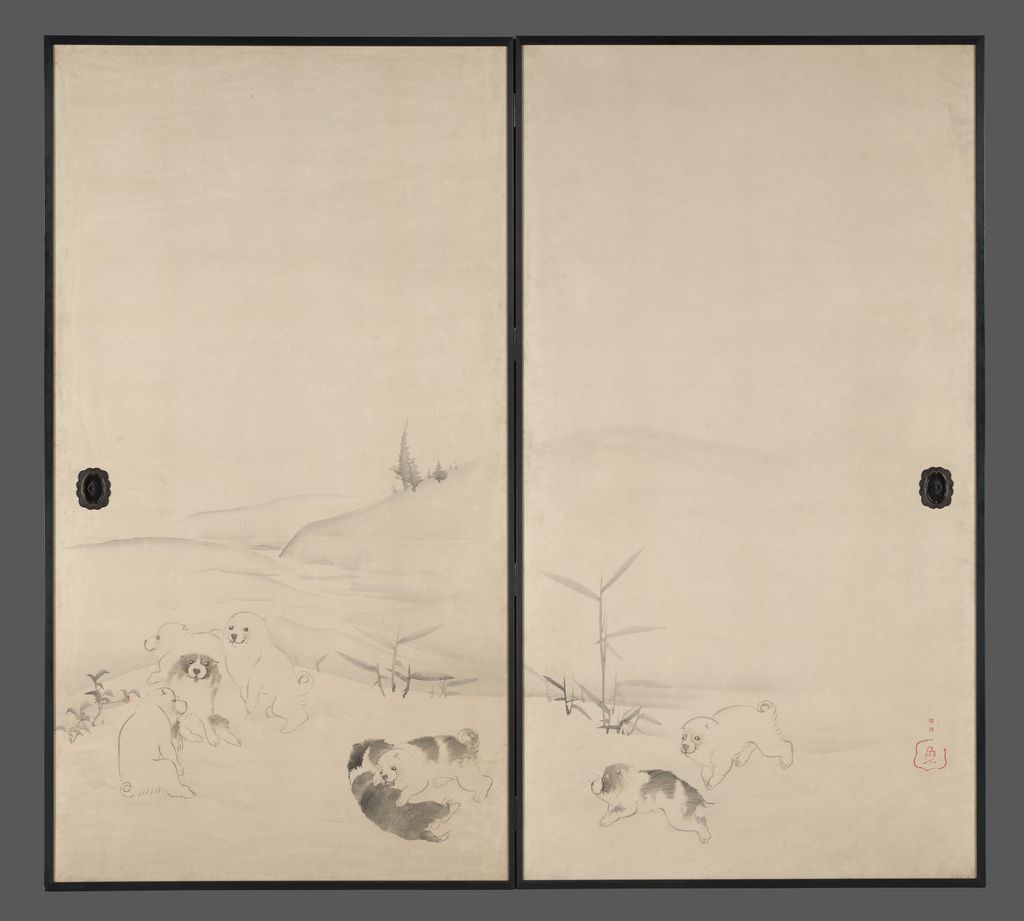
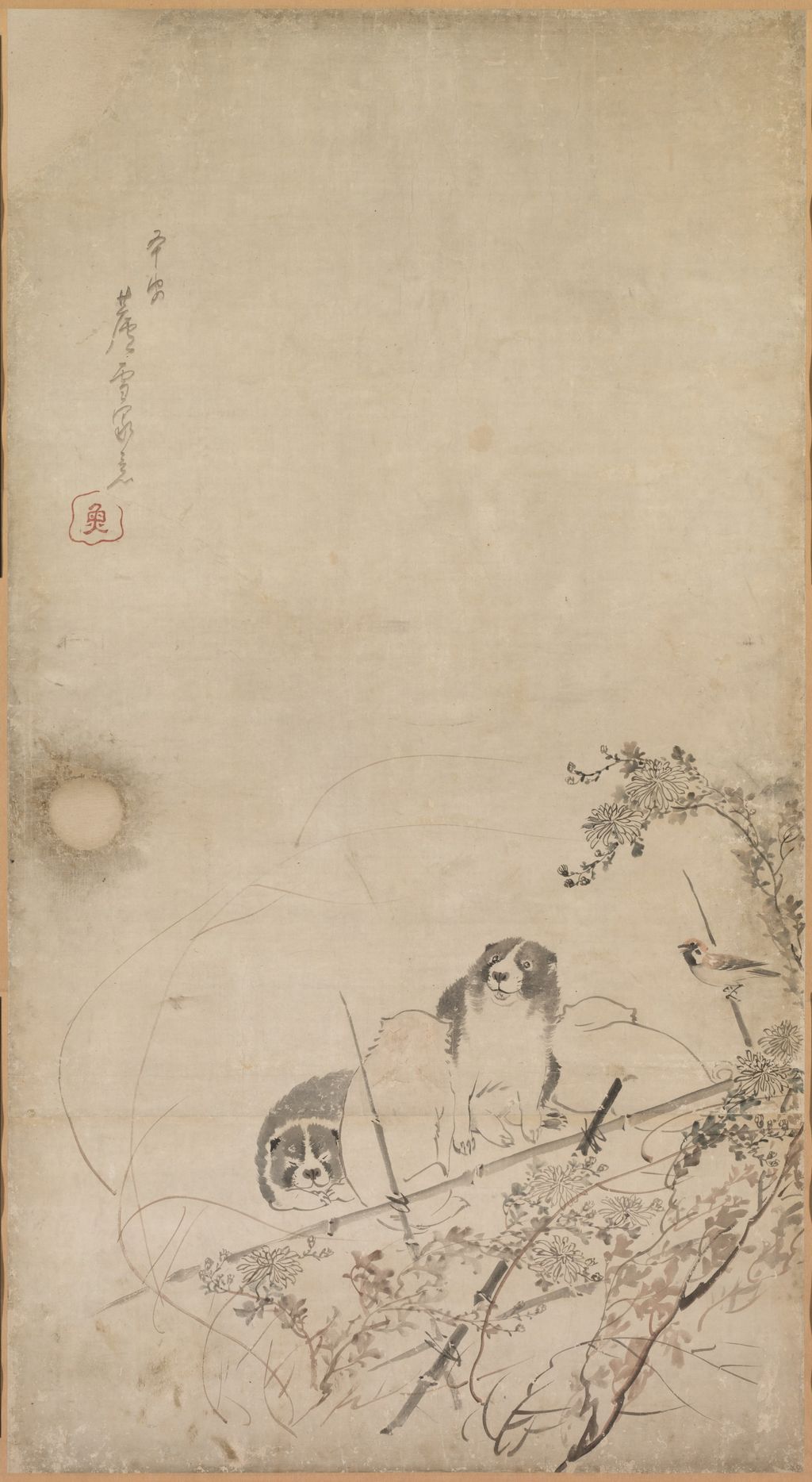
Nagasawa Rosetsu, Puppies in the Snow, right two panels of four former sliding doors. The Metropolitan Museum of Art, 2015.300.203.1, .2. Museum object record.
 by Tom Gurney
Tom Gurney BSc (Hons) is an art history expert with over 20 years experience
Published on September 25, 2026 / Updated on September 25, 2026
Email: tomgurney1@gmail.com / Phone: +44 7429 011000
A life with dates, rooms and stories
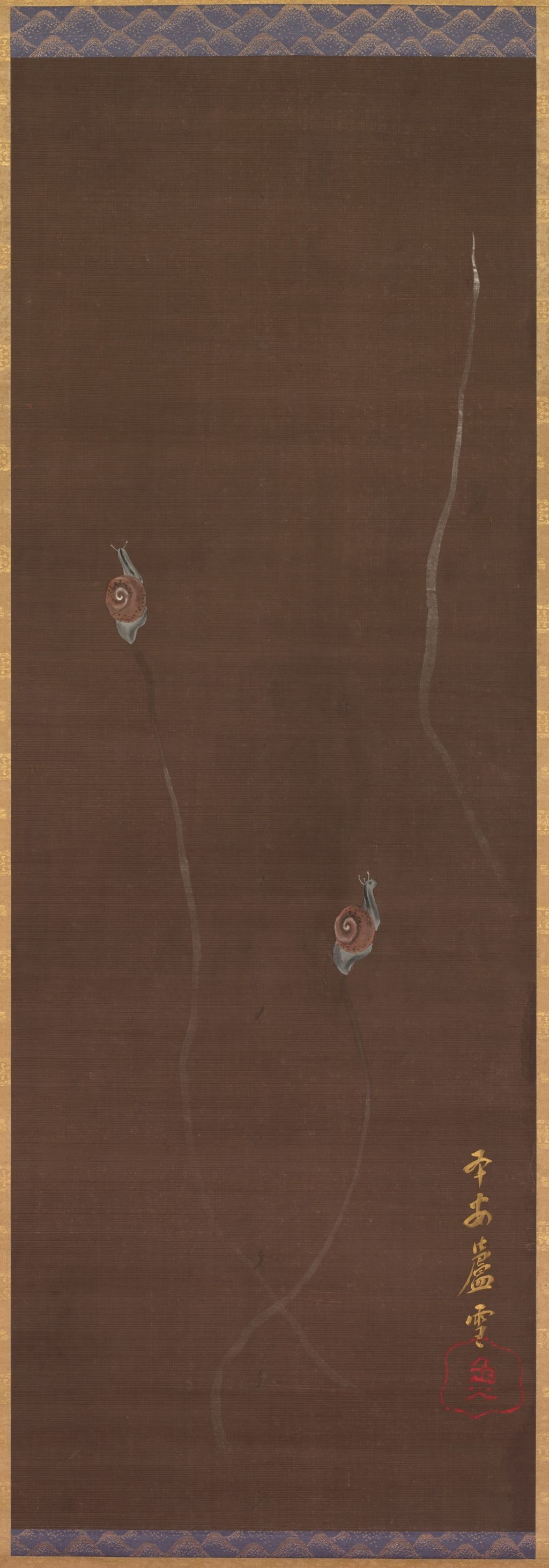
Nagasawa Rosetsu lived from 1754 to 1799. In those forty-five years he became a painter whose work could fill a temple room, unfold along a handscroll or draw attention to a snail's silver track. The large Tiger and Dragon doors at Muryoji have made his journey to southern Kii the most frequently told episode of his life. Yet surviving evidence puts him at work in Kyoto before that journey and follows him to imperial and princely commissions, Aki and Itsukushima, and a later temple programme in Tajima. An account built only around an escape from his teacher and an extraordinary Nanki breakthrough would lose most of that geography and much of the documentary record. [1] [2] [3]
Explore Rosetsu’s dog paintings
Contents
- A life with dates, rooms and stories
- Family, names and entry into Kyoto painting
- Before Nanki: a handscroll and Zen connections
- A Kyoto commission before the famous southern journey
- South to Kii: a network of temple rooms
- Court and princely rooms after Kii
- A seal as a clock with limited precision
- Westward to Aki and a new group of pictures
- Daijōji, the final years and a disputed death
- The record we can follow
- Books on Japanese Art
The evidence comes in different forms. A 1782 printed directory gives a name and Kyoto address. A scholar's study of Myōhō-in's daily records identifies a March 1786 painting commission, with a return visit about payment in May. The dates attached to paintings, inscriptions and seals supply other anchors. Modern temple narratives keep stories of his drinking, a break with Maruyama Ōkyo and disputed causes of death, but even the temple that preserves his most famous doors warns that these tales are uncertain. This biography asks what each source can actually establish. Rosetsu's private thoughts are not recoverable simply because a late painting feels melancholy or a tiger looks bold. [2] [4] [5]
Family, names and entry into Kyoto painting
Muryoji's museum identifies Rosetsu as a son of Uesugi Hikoemon, associated with the Sasayama domain, and says that his family later served Yodo. It gives 1754 as his birth year and describes a samurai background unusual among many of Ōkyo's pupils. It also records adoption into a Nagasawa household. Those statements give a starting social setting, but they do not make the place and day of every family move certain. The temple's own caution about his incomplete biography applies to childhood as much as to the more colourful stories of adulthood. This page therefore distinguishes an institutional reconstruction from a birth certificate or a contemporary memoir we have actually read. [2]
At a glance
- Life1754–1799
- TeacherMaruyama Ōkyo
- FormatsSliding doors, hanging scrolls and handscrolls
- Object careDistinguish originals, facsimiles and later remounting
Several names complicate searches. Institutional records use 長沢芦雪 and 長澤蘆雪, while the early handscroll bears the seals 長澤政勝 and 蘆雪. A Minato City museum record says he was also known as 魚, with 氷計 among his style names. The spelling and seal variants are not a succession of separate people. They may, however, help date or identify an individual object, provided the mark is read on that work and not copied from a different picture. The artist's biographical name and a catalogue title both require that object-level care. [4] [7]
There is no securely established year for Rosetsu's entry into Ōkyo's workshop in the sources checked here. Kyoto National Museum identifies the teacher; Nakanoshima Museum of Art describes Rosetsu as a senior pupil. A later application for imperial painting work, discussed in Yoshihisa Sugimoto's study, explicitly presents him as a pupil of “Maruyama Mondo”, Ōkyo's name in that document. These different records make the relationship substantial without resolving every year of training or endorsing a subsequent expulsion. A pupil could learn careful observation, brush control, workshop practice and how to respond to patrons, then choose different visual effects. Later stylistic independence does not in itself document a quarrel. [1] [3] [5]
The 1782 edition of the Heian Jinbutsushi (平安人物誌), transcribed in Minato City's object essay, lists Rosetsu with an address at 御幸町御池下ル町 in Kyoto. It places a professional name in a particular printed directory and neighbourhood. It does not tell us when he first crossed the city boundary, how many clients he had, or what he earned. Even so, it is an important check on a legend that pictures him as unknown until a single journey transformed him. He was legible to a Kyoto compiler before the commission that later made his reputation. [4]
Before Nanki: a handscroll and Zen connections
Kyoto National Museum's People and Birds/Animals Scroll (人物鳥獣画巻) is 31.1 centimetres high and more than sixteen metres long. The museum places it around Rosetsu's late twenties or early thirties, noting both Ōkyo's influence and an already individual world of gods, animals and immortals. The inscription 平安蘆雪寫意 and two named seals are documented in its catalogue. The scroll offers more than a claim that the young pupil had technical skill. Its sequence uses the act of opening a roll to produce surprise and visual humour before the famous Nanki temple doors. Yet its age range is an art-historical judgement, not a written 1783 or 1784 on the work. [7]
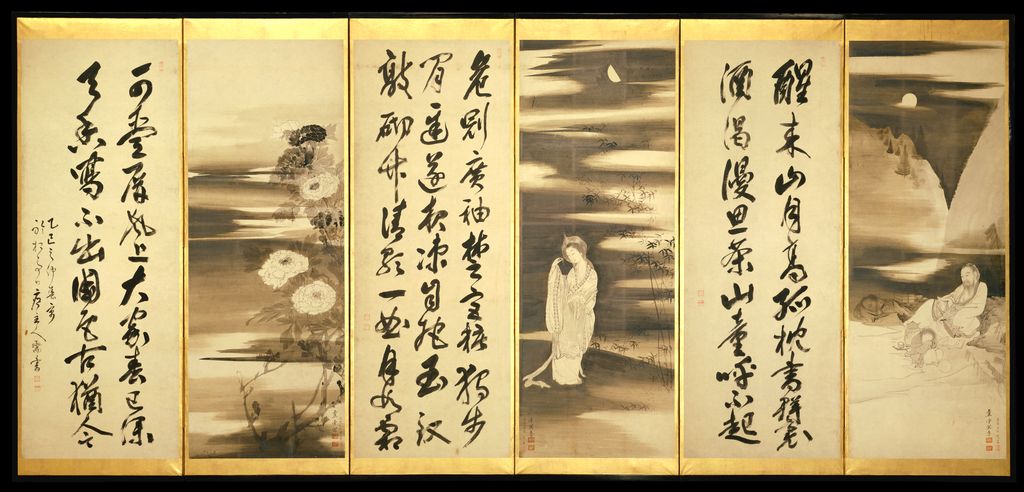
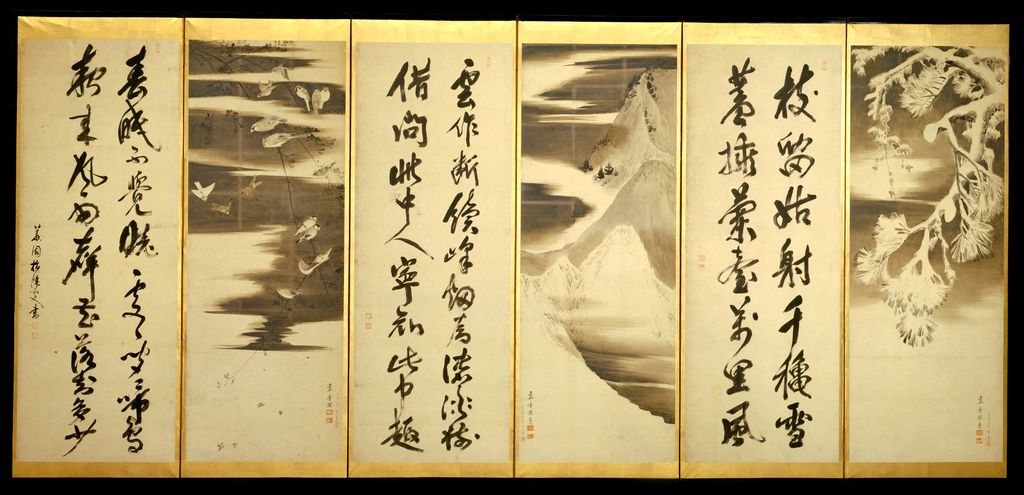
The Met holds an early pair of six-panel screens that makes the pre-Nanki scale visible. Rosetsu's painted sheets are mounted alongside poems in the hand of the monk-calligrapher Shishin Sōgin; the paired object is catalogued as Miscellaneous Paintings and Calligraphy (1975.268.72, .73). One poetic panel has a cyclical date corresponding to the second month of 1785. The Met identifies Rosetsu's early signature and calls this the only surviving monumental-scale example from his early career. The written date belongs to Sōgin's calligraphy, not to a declaration that Rosetsu painted every sheet on that same day. Yet this material combination, preserved on two large screens before the Nanki trip, is a much firmer basis for discussing early scale and social collaboration than a later tale of sudden discovery. [25]
Sōgin was abbot of Hantō'in, a Myōshin-ji subtemple, and the Met says that he taught Ōkyo Zen and calligraphy while learning painting from him. That documented relationship is a concrete example of overlap between the teacher's circle and a Zen institution; it does not prove that every pre-Nanki Rosetsu commission came through Sōgin. Read from right to left, the paired screens place landscape, birds, figures and flower paintings among handwritten poems. The audience had to move across six panels rather than wait for the single spectacular animal familiar from the later temple doors. [25]
The two photographs show why the object should be read as a collaboration rather than as a seamless landscape. A painted panel and a written panel can sit side by side, inviting a viewer to shift between image and language. Birds cross one painted sheet, a mountain fills another and figures inhabit a different space. Their separation is visible even in a reduced overall photograph: margins, panel divisions and changes in scale interrupt any attempt to treat the pair as one continuous scene. We do not need to translate every character of Sōgin's poems to see that the display made reading an activity alongside looking. A more detailed translation would need to be checked against a scholarly transcription, not guessed from the 1024-pixel publication file. [25]
This mounted arrangement also complicates the word “monumental.” The screens are large; the individual Rosetsu pictures are separate sheets attached to them, rather than one uninterrupted brushstroke across twelve panels. That differs from a sliding door painted as an architectural surface and from the handscroll's sequential unveiling. It gives an early example of Rosetsu working at a scale that could command a room while remaining part of a combined poetic and visual object. The Met's catalogue states that a signed early Rosetsu contribution survives here. It does not say he chose the exact final order of all the pasted sheets or that he invented the old poems Sōgin copied. Keeping the maker of each component in view makes the object more interesting than assigning every visible mark to the painter alone. [25]
At a workshop reported by the Tokyo National Research Institute for Cultural Properties, Columbia art historian Matthew McKelway proposed that Rosetsu had relationships with Zen monks connected to Myōshin-ji before his southern journey, based on inscriptions, collaborative work and overseas collections. He also suggested that a Myōshin-ji panel may have informed a later motif. This is worth investigating because it places Nanki within a network rather than treating it as a spontaneous detour. It remains a reported scholarly hypothesis. The short institutional workshop summary is not the full underlying paper, and a possible visual source is not proof that a particular Rosetsu panel was copied from a named original. [9]
A Kyoto commission before the famous southern journey
Sugimoto's study of Myōhō-in and Ōkyo's pupils reads the institution's daybook, 妙法院日次記, at a level of detail that changes the familiar chronology. He records Rosetsu's attendance on 25 March 1786 in connection with paintings for the study, another visit on 27 March when work was undertaken, and a 10 May return concerning the commission and reward. The dates precede the late-1786 trip to southern Kii. A painter entrusted with a prince's institutional room did not first discover large-scale professional painting when he met the Muryoji abbot. This does not make the Nanki work less inventive; it establishes that Rosetsu already moved in demanding Kyoto commissions. [5]
The daybook helps identify patronage as a practical relationship. Rosetsu was called to the site, shown a room, worked there and received a recorded reward. A sentence about his “genius” cannot tell us those actions. Sugimoto also distinguishes where the study once stood from later rooms, which have been altered. We can say that a documented Myōhō-in commission took place; we cannot point at a current photograph and guarantee that its surviving painted surface is the same March 1786 job. Nor does the daybook disclose what Rosetsu privately felt about Ōkyo's reputation. The evidence is strong because it is specific, and its limits should remain specific too. [5]
Nakanoshima Museum's later chronology places Rosetsu's emergence as an independent painter near this period, and Aichi Prefectural Museum describes a youthful technical command alongside a flexible, entertaining visual intelligence. These are interpretive summaries of a long career. The handscroll and daybook give the safer early sequence: training, professional visibility by 1782, a substantial institutional job by spring 1786, then a documented southern journey. A story in which all originality began the moment he saw the sea in Wakayama contradicts the museum's own assessment of the earlier scroll. [3] [7] [10]
South to Kii: a network of temple rooms
Muryoji preserves the account that its abbot Gukai sought paintings from Ōkyo for a rebuilt temple, and that Ōkyo supplied works and sent Rosetsu south. Wakayama Prefectural Museum and the Agency for Cultural Affairs place the southern campaign around late 1786 to early 1787. The core named temples are Muryoji, Jōjuji and Sōdōji, with work at Takayama-ji also appearing in regional accounts. Rosetsu's movement was thus connected to teacher, abbot and more than one religious building. The patronage story explains why a Kyoto pupil painted far from the city, although the temple's dramatic details about daily behaviour should be treated separately from the documented works. [2] [12] [13]
The Muryoji Tiger and Dragon are paired room paintings, not two animals on one portable sheet. The Nakanoshima exhibition list dates its distinct 虎図襖 and 龍図襖 to 1786. Their facing arrangement is crucial to why the commission mattered: visitors entered a space planned through large, opposing images. The room's other panels and the neighbouring temple programmes are not merely appendices to a sensational tiger's face. They show the scale of organisation and the kinds of surfaces Rosetsu was asked to supply. A 2026 Wakayama exhibition brought together 180 displayed panels across five temples; Muryoji's own group was 55 panels, while an older cultural-property summary counts more than 180 from three core Nanki temples. Those tallies have different scopes and cannot be freely exchanged. [12] [13] [14]
Muryoji's room now contains digital facsimiles, installed in 2009 according to a Japanese government visitor account, while the originals are preserved separately. A photograph of the restored room can show how a body meets the opposing walls; it does not show untouched eighteenth-century pigment or even necessarily an original panel. The temple's museum and the Wakayama exhibition have different display functions. Current opening arrangements belong to their present visitor notices. The biography's point is historical: work in rooms contributed to a painter's professional identity, and remounting or protected storage changes what survives for later viewers. [15]
The temple's story that Rosetsu drank for days and then completed a tremendous number of pictures in a rush makes him vivid, but it does not provide a checked count of individual surviving works. Its figure of about 270 in ten months also should not be collapsed with the 180 panel tallies, which refer to particular temple works or a later exhibition selection. A painting schedule cannot be reconstructed by dividing those numbers by days. The paintings themselves, their institutional dates and their sites are more reliable measures of the campaign. The stories can be described as part of his later reputation, without making them the cause of every surprising brushstroke. [2] [12]
Court and princely rooms after Kii
Rosetsu's later career was not a withdrawal into animal pictures after one successful temple trip. Nakanoshima's chronology places him among painters of the Imperial Palace around 1790, following the late-1780s reconstruction. Sugimoto's study records Rosetsu and the fellow Ōkyo pupil Genki at Myōhō-in again on 23 September 1791, called to paint a princely room. These were different projects: the 1786 study, the imperial painting assignment, and the 1791 Myōhō-in room. They should not be merged into one vaguely described “Kyoto palace commission”. Each had its own patron, location and date, although the sources do not preserve every original panel for our inspection. [3] [5] [3]
The recurrence of Rosetsu's name beside Genki also gives the teacher's workshop a human shape. Ōkyo taught painters who could take commissions, work together or appear in the same institutional record. The evidence resists a tidy break between a disciplined pupil and an isolated eccentric master. Even if patrons valued Rosetsu's unusual pictures, a professional network remained necessary to secure rooms, supply materials, negotiate access and receive payment. No source here lets us assign all those tasks to Rosetsu personally, but the documented room appointments make the social structure visible. A reader can understand originality more clearly when it is set against the actual organisations in which the paintings were made. [5]
The court work also belongs to a particular civic disruption. Sugimoto sets the Kansei reconstruction of Kyoto's imperial palace after the catastrophic 1788 fire, which destroyed an enormous portion of the city. New or repaired buildings needed painters, and the selection of makers involved questions of skill and status. This context does not mean the fire “caused” Rosetsu's career. It does explain why an artist trained in a successful workshop might be evaluated for rooms far beyond a private collector's scroll. It also helps separate two kinds of evidence: a document naming him among court painters and a particular surviving painting that we can inspect today. One cannot automatically stand for the other. [5] [3]
In Myōhō-in's records the work was tied to named rooms and occasions of attendance, while the imperial project was a broader rebuilding campaign. A twenty-first-century label may simply say “palace painting” or “temple doors”; the historical records let us ask which patron and which room were meant. They also warn against attaching all paintings in a later remounted ensemble to one artist without checking workshop attribution. Rosetsu's biography is therefore not only a route between cities. It is a sequence of different professional settings, each with its own obligations and ways of being seen by patrons. [5]
A seal as a clock with limited precision
Some Rosetsu paintings are not dated in words, so scholars have used the marks he left on them. The Minato City History Museum describes a two-panel Scholar Viewing a Painting screen signed 蘆雪写 and bearing the red 魚 seal. The shape of that seal, specifically a later damaged corner, lets the museum place the screen after May 1792; its style points broadly to the Kansei era rather than one exact year. Shizuoka Prefectural Museum also notes the damaged seal as a dating tool. An impression can therefore do more than decorate a corner: it can set a terminus after which an object must have been stamped. [4] [18]
The method has limits. A damaged seal does not mean every image with the word “fish” was painted in 1793; it applies to a checked impression of a particular matrix. A copy, later attribution or an image too small to read cannot borrow its date. Nor does a post-May-1792 boundary disclose why a painter chose a scholar and attendants. The Minato museum also says its screen is not publicly displayed. Its object essay is a strong source for biography and connoisseurship, but its photograph has no verified production-use licence in this project. The cleared pictures near this phase can be captioned on their own terms while the dated seal evidence is explained in text. [4] [18]
The seal is a useful example of how a small physical event can matter more to a chronology than a broad stylistic resemblance. If one corner of a matrix was damaged at a known point, impressions made before and after can be compared. That is narrower than claiming the whole painting style changed in May. It can also meet evidence from an inscription, a documented commission or an owner's record without replacing them. For Rosetsu, this method helps sort undated objects of the 1790s, a period when the artist worked for varied patrons and in varied forms. A biography can explain the test in plain language and point to the exact Minato object, rather than presenting a precise year for every undated puppy or bird as if all carried the same clock. [4] [18]
Westward to Aki and a new group of pictures
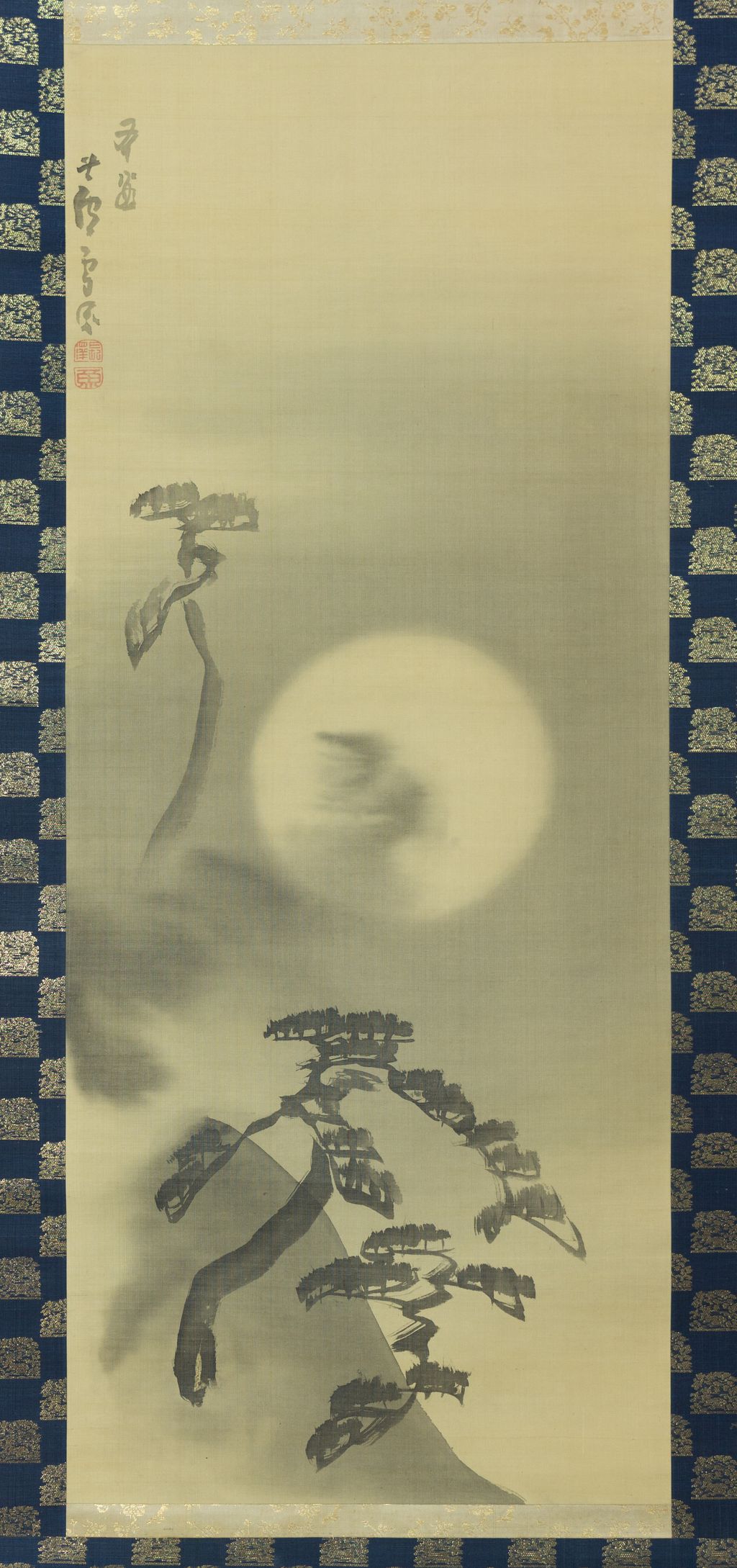
By 1794 the institutional trail points west. Nara Prefectural Museum says Rosetsu painted Eight Views of Itsukushima (厳島八景図) in Aki that year. The Met places his journey to Hiroshima and Itsukushima in the period when he returned repeatedly to moonlit landscapes. Its Moonlit Landscape, dated 1794–95, gives a securely identified example of that theme, with a reserved moon and washes formed in stages. It is not a named view of the shrine or a map of the journey. The travel is part of the documented context; the photograph is evidence for how one hanging scroll was painted, not proof of the exact hill from which Rosetsu looked. [19] [20]
Nara's Ghost (幽魂の図) offers a different late subject. A poem on the scroll was written by the monk Genga, connected with Aki. The museum places the painting near the 1794 journey on stylistic and inscriptional grounds, and cautiously wonders about a connection between that travel and the poem. That is a question posed by its curator, not a documented scene of the monk greeting Rosetsu on a given day. The spectral woman can be studied as an image with a poem, pale face and restrained colour. It need not become evidence that the painter was psychologically tormented. Her photograph remains rights-uncleared for this site's article; the exact Nara accession and source link carry the research. [19]
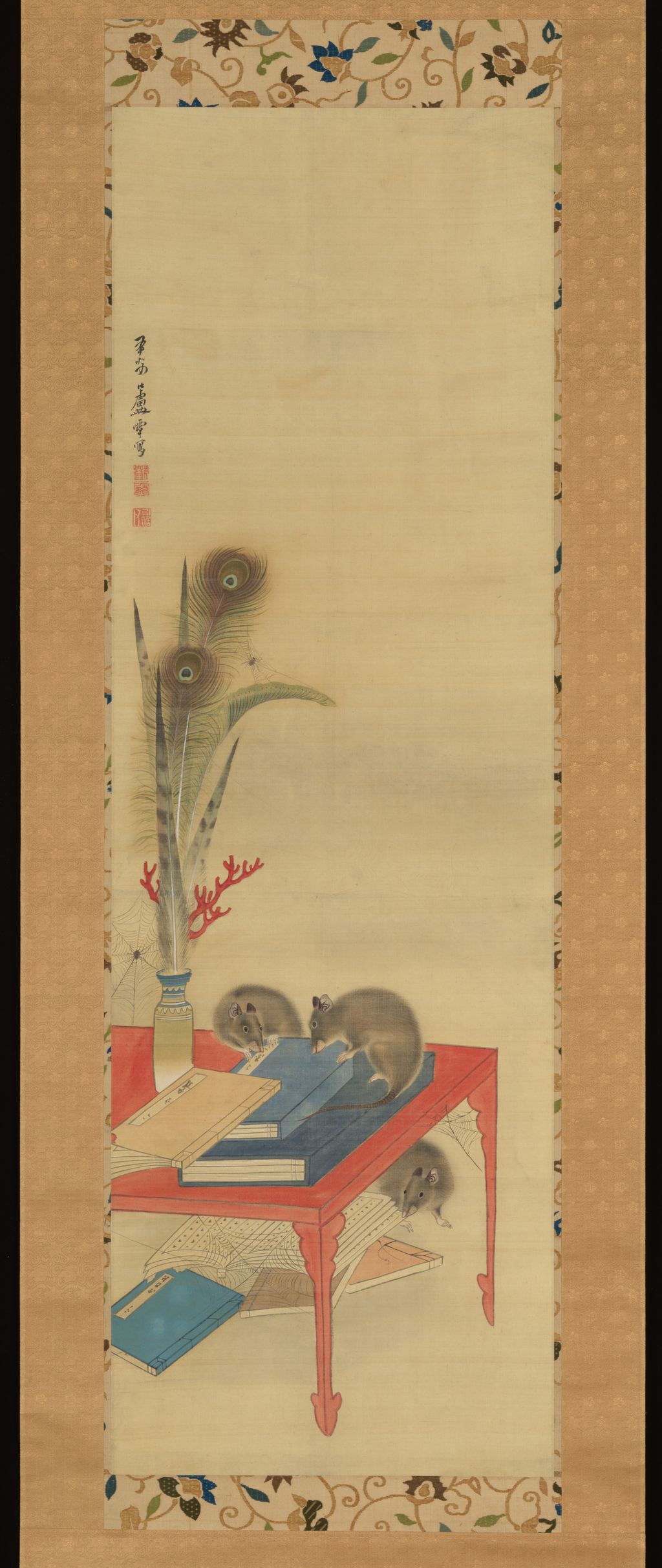
The Met's desk painting is associated in its curatorial note with colourful work of Rosetsu's Hiroshima period. The proposed relation to images transmitted through Nagasaki is a comparison, not a documented print in his possession. It shows how travel and collecting routes may inform stylistic questions while leaving individual influence open. A person moving across Kyoto, Kii, Aki and Tajima encountered different patrons and subjects; the records confirm the movement more securely than they reveal which foreign or Chinese models were before his eyes at each stop. The biography can mark this gap rather than fill it with an attractive but unsupported map of influences. [21]
The monk's poem on Nara's ghost provides another kind of social trace. A painting and a later inscription can bring two people into one surviving object without telling us the exact moment they spoke, or whether they met at all. It is tempting to make such a poem a scene in a travel biography, especially when the painter was in the same region around 1794. Nara's own account poses that link as a possibility. The safer story is richer than a fabricated meeting: Rosetsu's painting could attract a learned response, and the combination of image, poem and later ownership altered what a viewer encountered. That tells us something about the circulation of his work while keeping personal acquaintance an open question. [19]
Daijōji, the final years and a disputed death
Daijōji in present-day Hyōgo dates Rosetsu's Monkeys (群猿図) room painting to 1795. This was a temple programme outside the earlier Nanki group, undertaken in the period after Ōkyo's death. The Nakanoshima exhibition list independently names the Daijōji work and Kansei 7 date. Its exact room and monkey subjects deserve a later object study with rights-cleared pictures; the local temple's digital images are not automatic production assets. For a biography, the documented commission matters because it shows that Rosetsu continued to work at architectural scale, not just on portable puppy and moon scrolls. [22] [23]
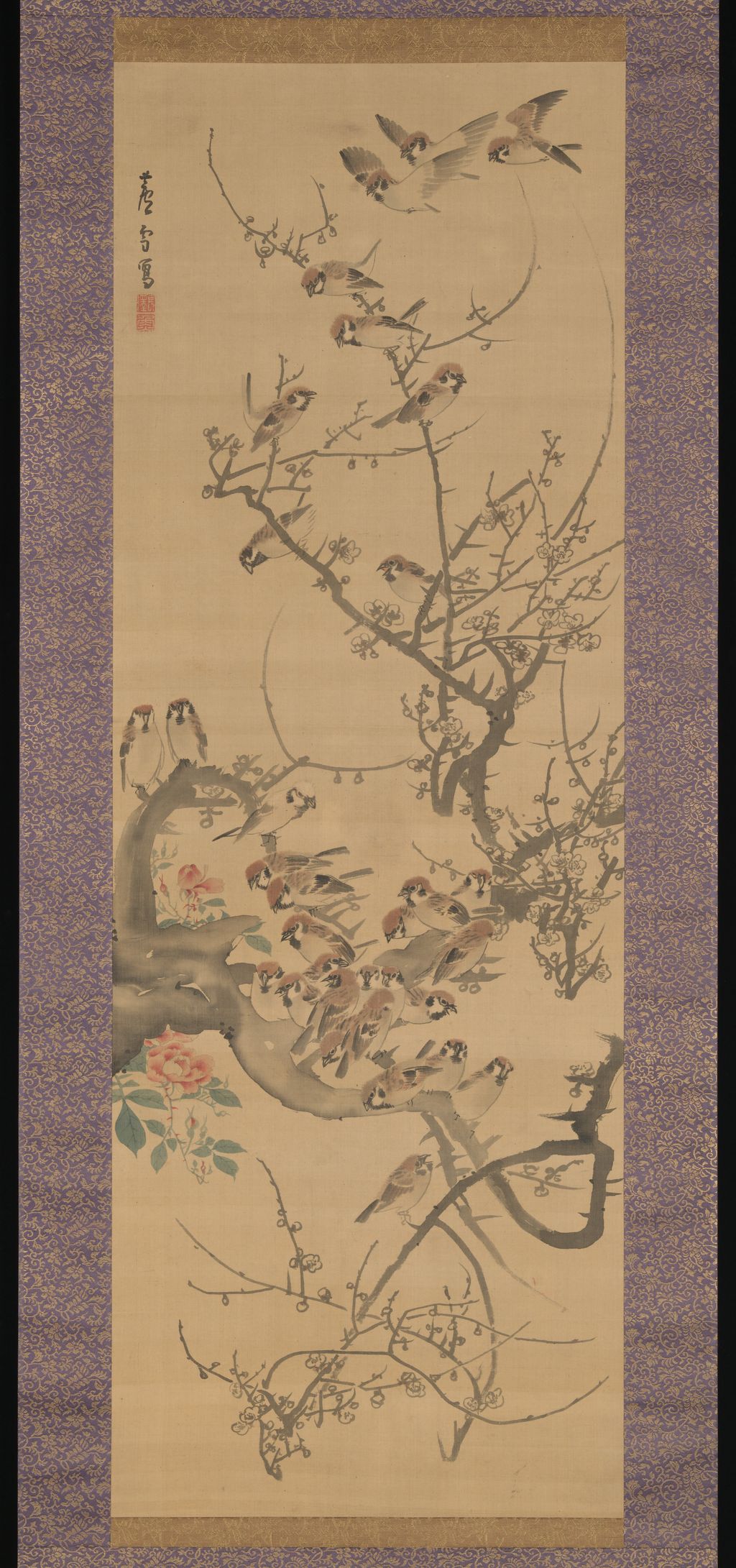
Late objects also resist a single story of decline. The Met dates Sparrows in a Plum Tree to the second half of the 1790s; its twisting branches and alert birds show decorative density and control. The moonlit scroll offers measured washes, while Nara's ghost has a very different register. Their variety is a fact of distinct surviving objects. A biographer may ask how tastes and commissions changed after 1795, but a dark subject alone cannot disclose illness, financial trouble or a fatal quarrel. The same restraint applies to anecdotal comments about temperament in later temple narratives. [19] [20] [24]
Rosetsu died in Osaka in 1799; Muryoji's chronology gives 8 June. The temple introduces poisoning and suicide as theories. Sugimoto's article cites an older painter who reported suicide and linked it to personal misfortune. That citation is evidence that a story circulated, not a death certificate or independent verification of motive. The secure biographical endpoint is the date and place supported by institutional chronologies. When a life is short and its final works arresting, later writers may join the images to a dramatic death. Our source record does not license that ending as fact. [2] [3] [5]
This difference between a dated death and a story about its cause matters for the pictures. A ghost painted around the Aki period, a later yamauba subject, and a moonlit landscape have all invited accounts of a troubled final mind. But their attributions and dates do not establish a mental diagnosis, and the stories of poison or suicide do not supply an artist's explanation of those works. Rosetsu made playful subjects late in life as well as spectral ones. Each painting may be analysed through its format, inscription, patron or image, while the private cause of his death remains uncertain. That leaves readers with a more accurate sense of the limits of the record and more space to study the works themselves. [2] [19] [24]
The years after death are part of his biography in another sense. Paintings once fitted to rooms were removed, preserved, dispersed or remounted. Temples, private collectors and museums in Japan, Britain and the United States now hold different pieces of the story. The Met's snow puppies became screens, Cleveland's three puppy doors became scrolls, and Muryoji's original panels are conserved away from a room fitted with facsimiles. These changes explain why a modern gallery of “Rosetsu paintings” cannot by itself reproduce the settings in which the painter and patrons worked. The later reputation for surprise is real, but it has been formed by exhibitions, photographs and reassembly as well as by brushwork made in the eighteenth century. [6] [15] [17]
The record we can follow
The strongest line through Rosetsu's life is not a legend of unruliness. It runs from a samurai-associated family and Ōkyo's teaching to a Kyoto professional listing, a documented Myōhō-in job, the Nanki temple campaign, imperial and princely rooms, objects dated partly through a changing seal, western travel, and late work at Daijōji. Each point comes from a record with its own limits. Some paintings remain securely identified but unillustrated here because their custodians require image requests. Others can be shown in high resolution but are broadly dated and do not answer every biographical question. That difference is not a failure of the life story; it is how responsible art history proceeds. [2] [4] [5] [12] [22]
From the biography, a reader can return to the artist home for the shift in scale from architectural Tiger and Dragon to intimate snail and moon. The dog-paintings page will compare three distinct settings and the problem of the Met/Brooklyn door reverses. None of those routes should replace the archive or museum catalogue for a disputed attribution. What they can do is make a clear pathway: a name and date, an exact work, its original and present format, and the source behind each claim. Rosetsu's inventiveness is more remarkable when the painter remains a working person in actual institutions and places, not a character invented to explain every unexpected animal. [5] [6] [17]
Frequently Asked Questions
He was born in 1754. Muryoji's museum connects his father with the Sasayama domain and the family's later service in Yodo. The exact early movements are less firmly documented than the later Kyoto address. [2] [4]
Rosetsu's apprenticeship is supported by museums and a later painter application. Muryoji itself warns that the expulsion story belongs to a body of uncertain tales; the sources checked here do not establish it as a dated event. [1] [2] [5]
Yes. He was listed with a Kyoto address in 1782, and Sugimoto's study of Myōhō-in's daybook records his painting commission there in March–May 1786, before the southern journey later that year. [4] [5]
Muryoji preserves an account of its abbot requesting work from Ōkyo, who sent Rosetsu. The temple works and Japanese cultural-property records document the trip and its paintings, while the account's personal anecdotes require separate caution. [2] [12] [13]
Discussion
Compare dated records, individual objects and later stories as different kinds of evidence for Rosetsu’s life.
Reader Insights
What does Myōhō-in’s daybook establish before the Nanki journey?
How do the three-temple panel count and a five-temple exhibition tally differ?
What can a ghost painting tell us about an object, and what can it not prove about a death?
Join the Conversation
Share a documented example or reliable source below, keeping observation separate from inference.
References
- Kyoto National Museum, 2019 Rosetsu exhibition and object list.
- Muryoji/Kushimoto Ōkyo Rosetsu Museum, About Rosetsu and chronology.
- Nakanoshima Museum of Art, 2023 Rosetsu retrospective and English biography.
- Minato City History Museum, signed Scholar Viewing a Painting screen and 1782 directory transcription.
- Yoshihisa Sugimoto (杉本欣久), 「妙法院門跡・真仁法親王と円山応挙の門人たち―円山応瑞・呉春・中村則苗・長沢芦雪・源琦―」, 『古文化研究』16 (2017), 99–170, especially 130–31 (PDF pp. 38–40). Tohoku University publication record.
- Metropolitan Museum of Art, Puppies in the Snow, 2015.300.203.1, .2.
- Kyoto National Museum, People and Birds/Animals Scroll, A甲1657.
- Metropolitan Museum of Art, Two Women and a Puppy, 2015.300.205.
- Tokyo National Research Institute for Cultural Properties, report on Matthew McKelway's pre-Nanki workshop.
- Aichi Prefectural Museum of Art, 2017 Nagasawa Rosetsu: Entertainer of Kyoto exhibition.
- Metropolitan Museum of Art, Cranes, 2011.572.2a,b.
- Wakayama Prefectural Museum, 2026 Rosetsu exhibition and temple-group details.
- Agency for Cultural Affairs, Nanki temple works cultural-property record.
- Nakanoshima Museum of Art, 2023 press PDF, Muryoji work list and restrictive image terms on p. 6.
- Kinki Regional Development Bureau, Muryoji original room and digital facsimiles.
- Cleveland Museum of Art, Snails, 1998.5.
- Cleveland Museum of Art, Puppies, Sparrows, and Chrysanthemums, set panel 1970.71.1, panel .2, panel .3.
- Shizuoka Prefectural Museum of Art, Rosetsu artist entry and seal chronology.
- Nara Prefectural Museum of Art, Ghost /
幽魂の図, 00075. - Metropolitan Museum of Art, Moonlit Landscape, 2020.392.
- Metropolitan Museum of Art, Rats on a Scholar's Desk, 2020.396.34.
- Daijōji temple, Monkeys (
群猿図), Kansei 7 / 1795. - Nakanoshima Museum of Art, 2023 exhibition object list, Daijōji Monkeys entry.
- Metropolitan Museum of Art, Sparrows in a Plum Tree, 2015.500.9.54.
- Metropolitan Museum of Art, Miscellaneous Paintings and Calligraphy, signed Rosetsu sheets with Shishin Sōgin, 1975.268.72, .73. The 1785 cyclical date is in Sōgin's calligraphy.