


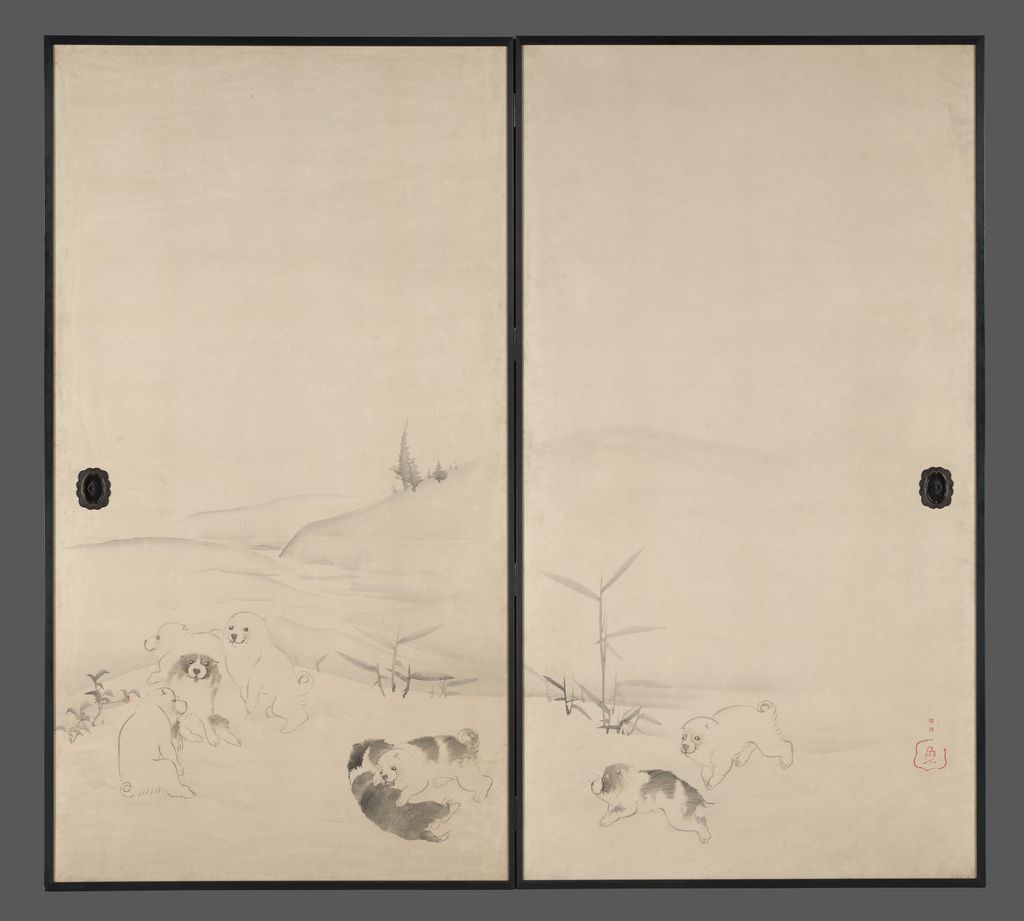
Nagasawa Rosetsu, Puppies in the Snow, right two panels of four former sliding doors. The Metropolitan Museum of Art, 2015.300.203.1, .2. Museum object record.
 by Tom Gurney
Tom Gurney BSc (Hons) is an art history expert with over 20 years experience
Published on September 25, 2026 / Updated on September 25, 2026
Email: tomgurney1@gmail.com / Phone: +44 7429 011000
A painter who changes the scale of attention
Nagasawa Rosetsu (1754–1799) could make an animal fill an architectural surface and then ask us to stop for a snail's nearly invisible trail. His best-known temple paintings at Muryoji in Wakayama set a tiger opposite a dragon. Elsewhere, puppies are scattered among chrysanthemums, cranes stand without landscape, a moonlit mountain dissolves into washes, and rats investigate a scholar's neglected desk. The subjects are striking, yet the common feature is how each picture controls a viewer's distance. At a door, the creature can confront someone crossing a room. On a hanging scroll, a tiny movement can reward a long look. An introduction to Rosetsu should move between those settings rather than turn the whole career into a collection of eccentric animals. [1] [2] [3]
Explore Rosetsu’s dog paintings
Contents
- A painter who changes the scale of attention
- Ōkyo's pupil, and a biography with gaps
- The Nanki rooms: Tiger and Dragon
- Puppies, original rooms and remounted pictures
- Cranes, sparrows and the eyes of an animal
- A snail trail and a dusty scholar's table
- A moon without a painted circle
- A scroll that unfolds into another kind of world
- How to read Rosetsu's changing formats
- Where to begin
- Books on Japanese Art
Rosetsu learned with Maruyama Ōkyo, a painter associated with close study of living things and a powerful Kyoto workshop. The Met sees that training in Rosetsu's creatures; its crane record even asks us to look at the precise placement of the birds' feet. But a useful account of the pupil cannot stop at a borrowed style. Rosetsu could make natural observation serve wit, staged encounter, broad ink movement or delicate atmosphere. A painted puppy can look toward a sparrow; a red-crowned crane can seem to face its human audience; the spiders among the books can turn an elegant scholar's table into a joke about disuse. Those are decisions about composition and meaning, not simply proof that he liked animals. [4] [5] [6]
His surname and art name appear in several forms. The English museum catalogue commonly uses Nagasawa Rosetsu; Japanese records include 長沢芦雪 and 長澤蘆雪. A spelling difference is not a second artist. The alternative forms matter when searching Japanese collections, where individual object titles and seals may preserve older or institution-specific usage. They also warn us against assuming two similar English translations name the same puppies, dragon or tiger. This overview introduces the exact works we can identify, and the linked object records let a reader check what is actually pictured. [1] [4] [7]
At a glance
- Life1754–1799
- TeacherMaruyama Ōkyo
- FormatsSliding doors, hanging scrolls and handscrolls
- Object careDistinguish originals, facsimiles and later remounting
Ōkyo's pupil, and a biography with gaps
Kyoto National Museum dates Rosetsu's life to 1754–1799 and identifies him as a pupil of Ōkyo. Muryoji's museum places the family in a domain-connected milieu and records his name in a 1782 Kyoto listing, while the Nanki journey provides a much firmer geographical anchor for the middle of the 1780s. Those pieces support a painter active within a professional network, not a solitary genius suddenly appearing at a southern temple. They do not fill every year. A date attached to a work, a record of travel and a later story about personality are different kinds of evidence; they should be labelled as such. [1] [2] [8]
Stories of a volatile temperament, expulsion from Ōkyo's school and an extraordinary death have followed Rosetsu for generations. Muryoji's own biographical essay warns that many such accounts are uncertain, even as it recounts them. This home should neither suppress the stories nor repeat them as established events. They help explain why later viewers have framed his paintings as daring departures, but a legend cannot date a brushstroke or prove a teacher broke with a pupil. The biography page can examine the earliest source for each claim and set it beside the dated record. Here the works themselves show range without needing a dramatic plot to make them interesting. [2] [8]
Nakanoshima Museum of Art organised its 2023 retrospective around an early relationship with Ōkyo, the 1780s development of Rosetsu's individual expression, the southern temple journey and later changes. That chapter structure is a museum's interpretation of a career, useful as a guide but not an exact stylistic clock for undated paintings. Surviving works were remounted, dispersed and sometimes placed in collections far from their original setting. The chronological gaps are one reason the article uses confirmed object dates and institutional descriptions, then distinguishes a visual comparison from a historical fact. [7]
The retrospective calls Rosetsu one of the “eccentric painters”, grouping him with Itō Jakuchū and Soga Shōhaku. That label describes a later way of seeing bold compositions and surprising subjects, not a documented artists' society with shared rules. Ōkyo's nature study, Rosetsu's temple work and Jakuchū's very different bird paintings can all be discussed without claiming that the painters pursued one programme. In particular, the carefully balanced crane scrolls and gradual ink washes of Moonlit Landscape show deliberation as well as surprise. “Eccentric” is most helpful when it opens a question about a specific choice; it is least helpful when it turns close craft into a vague story of rebellion. [7] [6] [14]
The Nanki rooms: Tiger and Dragon
Rosetsu's journey to Nanki, the southern Kii region, is central to his public identity. Wakayama Prefectural Museum traces his visits to Muryoji, Jōjuji and Sōdōji during a period when temples needed paintings for rebuilt or repaired spaces. Muryoji's paired Tiger and Dragon sliding doors are dated 1786 in the Nakanoshima exhibition list. The animal is therefore more than a free-floating image on a screen: it belonged to a room, answered an opposing painting and met people at human scale. When a visitor crosses a doorway, the relation between painted figures and body changes. That architectural encounter is part of the work's meaning, even though the original panels have since moved into a protected museum context. [3] [8] [9]
The Nakanoshima press list also records a different Dragon fusuma at Saikōji, dated before 1786. Kyoto National Museum lists a separate Tiger hanging scroll. Neither can be treated as an interchangeable photograph of the Muryoji pair. This is especially important in an illustrated article: a cropped tiger head that feels familiar may come from another support, owner or moment in the painter's career. The local Muryoji room has housed digital facsimiles since 2009 while the originals are kept separately. A photograph of a replica in situ can explain arrangement, but it cannot show the untouched eighteenth-century painting surface. Our production page will use a Muryoji image only after the specific file and permission are cleared. [1] [8] [9]
Wakayama's 2026 exhibition brought together works from five regional temples, while its Muryoji discussion refers to 55 panels from that temple. Those are two different scopes; a combined exhibition count must not be assigned to Muryoji alone. The show ended in September 2026, so this is historical research rather than a current visitor notice. It demonstrates how much of the painter's southern activity survives beyond one famous facing pair, and why a later standalone page could compare door programmes rather than simply describe the tiger's expression. For now, the artist home gives the architectural context and links the holding institution's record. [3]
The conservation and display history makes a more useful visitor question than “where is the tiger today?” alone. An original sliding door has an architectural purpose and a fragile painted support. Showing a facsimile where the door once moved can restore the bodily relation to the room; displaying the original under controlled conditions can preserve the brushwork. Both experiences teach something, provided the caption states which is being seen. The government description gives the 2009 facsimile installation, while the Wakayama source describes the original group and its temporary 2026 exhibition. Neither is a promise that all 55 panels will be simultaneously available on a visitor's chosen day. A historic photograph of the temple, should an exactly dated reusable image be found, could show the site and its changing architecture; it would not replace a photograph of the painted door. [3] [9]
Puppies, original rooms and remounted pictures
The Met's Puppies in the Snow is identified in Japanese as 雪中狗子図襖. Its catalogue dates the painting to 1792–99 and says that four sliding-door panels were later hinged as a pair of two-panel screens. The cleared primary photograph shows the right pair. The difference between doors and screens matters: a puppy once belonged to a sequence that could open and close; in the museum it is read as a portable framed composition. The Met says the reverse sides, with seven puppies and bamboo, are at the Brooklyn Museum. Until Brooklyn's exact records and their rights are checked, this page should not illustrate those reverses or guess their original order. [4]
The dogs are easy to call cute, but their placement and movement deserve more. Different directions of gaze and curling tails make the ground appear busy despite the broad field of pale snow. Ink marks give the fur lively edges while largely unpainted paper makes the weather legible. The animal group can be understood at a glance and still reward attention to each body. These observations come from the identified Met photograph; they do not tell us who commissioned the doors, the precise building or what visitors originally thought of the puppies. The dedicated dog page can examine the individual poses and the reverse-panel problem in detail. [4]
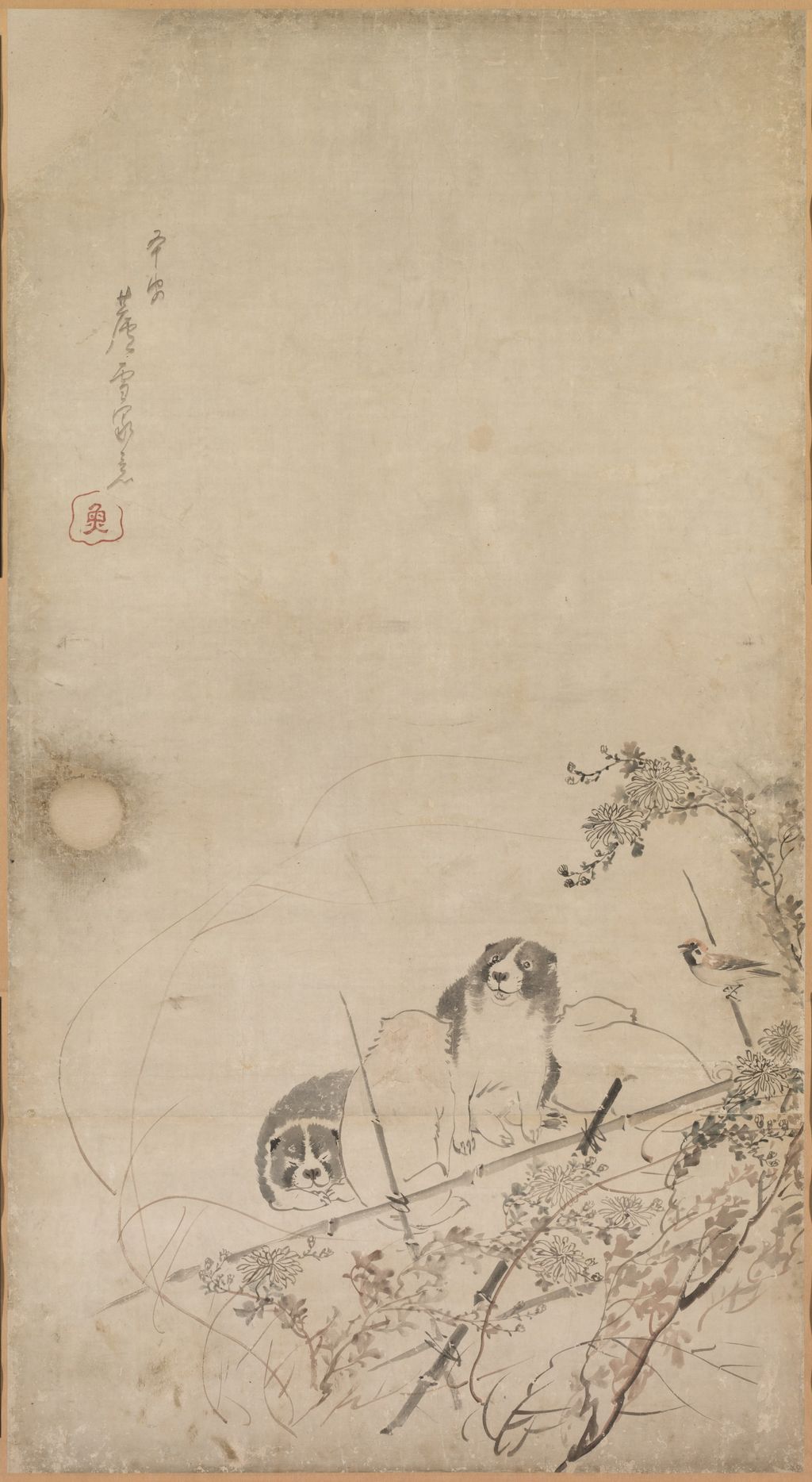
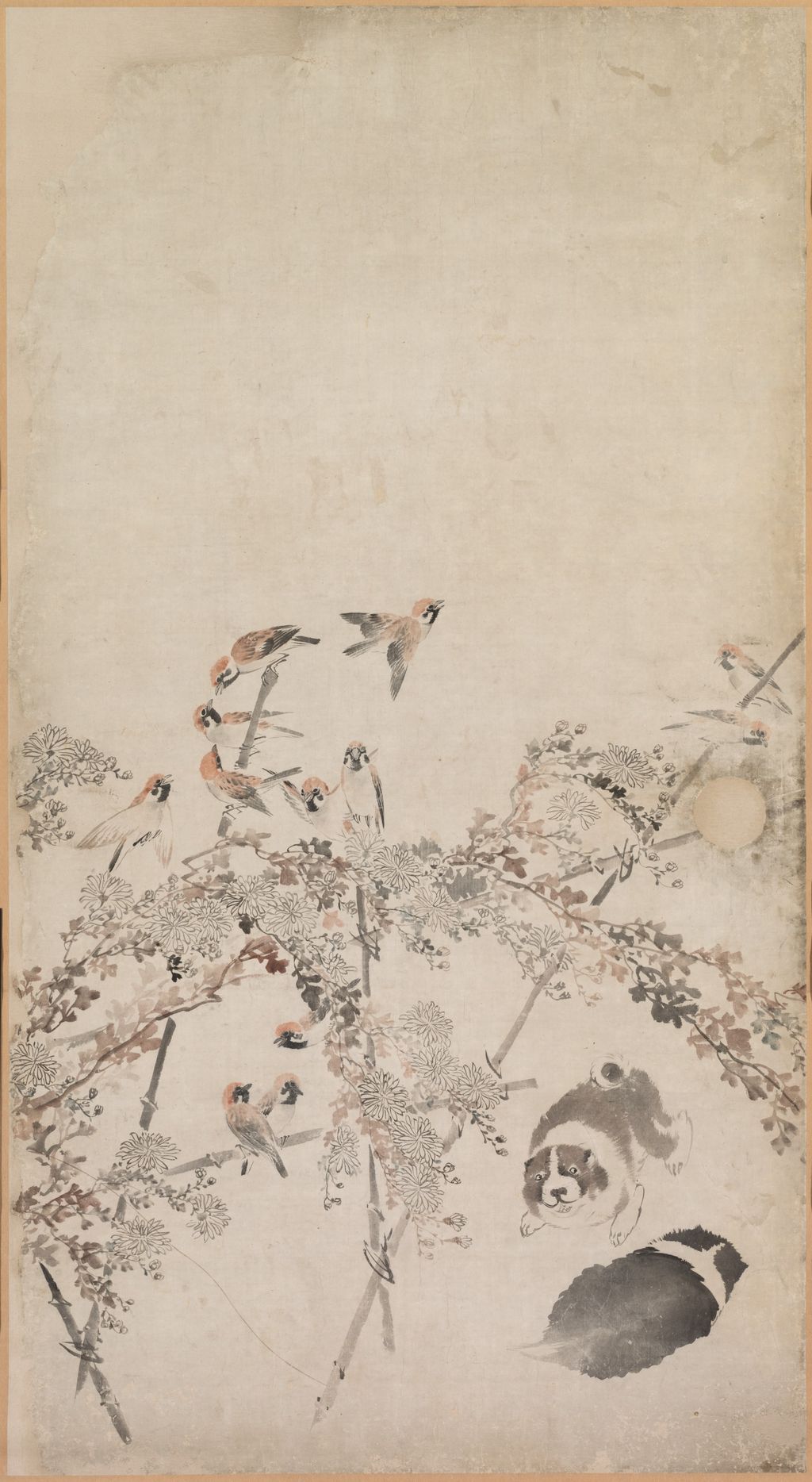
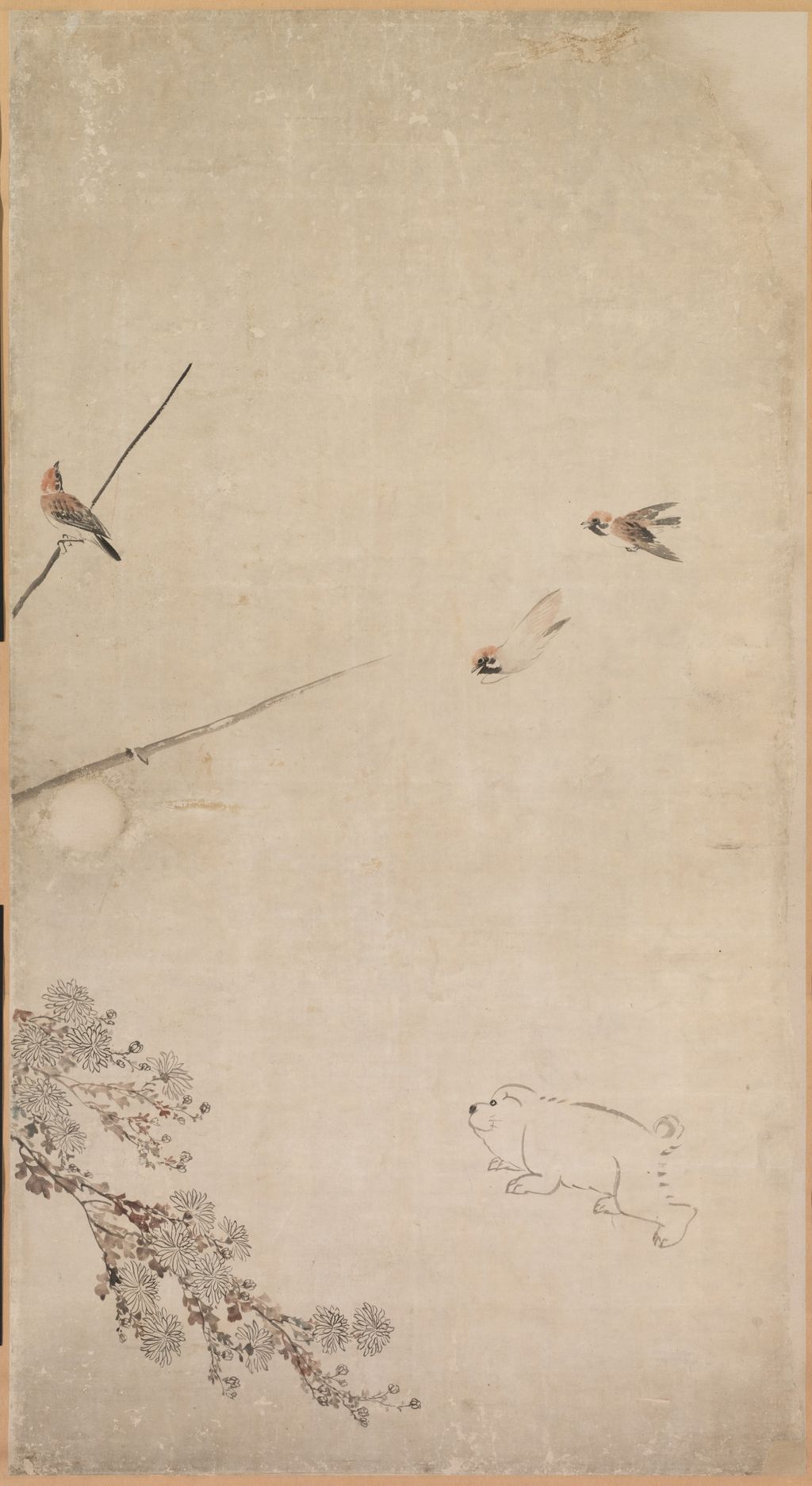
Cleveland holds another former door ensemble, Puppies, Sparrows, and Chrysanthemums (子犬に雀、菊図), dated about 1792–94. The museum catalogues three panels, each now remounted as a hanging scroll, and notes faint circles where door pulls once sat. Puppies occupy the lower field while sparrows gather on a trellis above. One dog lifts its head towards a calling bird, joining what might have been two separate decorative zones into one little encounter. Three accession photographs show three portions of one ensemble. Presenting them as three independent masterpieces would erase the continuity of the room decoration and inflate the catalogue. [5]
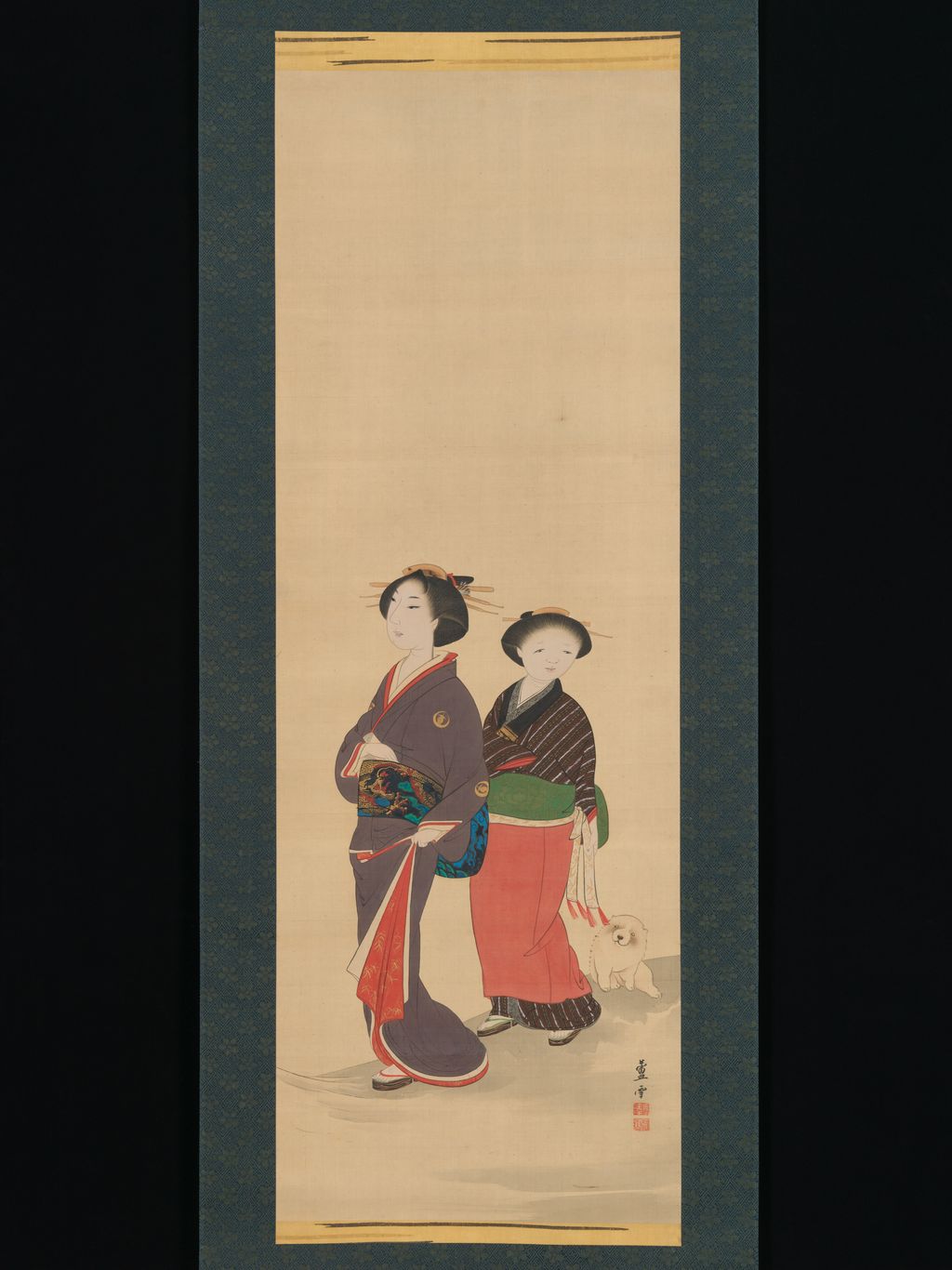
A third identified dog appears in the Met's Two Women and a Puppy, a silk hanging scroll dated 1787–88. The two women dominate the tall field; the dog observes them from below. The museum sees humour in the contrast between the elaborate clothing and the unselfconscious animal. That is a different pictorial job from the many puppies on doors. A dog can mark scale, add a witness or interrupt expectations about a portrait-like scene. It would be misleading to make every dog picture evidence of one fixed sentimental personality. The medium, date and human company change what the animal does. [10]
The comparison also changes how to use Japanese search demand responsibly. A query for Rosetsu and dogs may lead a reader to the Muryoji commission, an Itsuō snow scene, the Met doors or a cropped puppy copied online without its neighbour. The subject hub should help the reader identify which work they are seeing, beginning with Japanese title, accession or holding institution. Only then can it ask what the puppies communicate. The Met's Japanese title explicitly contains 雪中狗子図襖; the Itsuō work in the Nakanoshima list is 降雪狗児図. Similar words for snow and puppies do not collapse different supports, owners or compositions. This is a real service for a bilingual cluster: it connects reader language to a verified object rather than sending every query to the most famous picture. [4] [8]
Cranes, sparrows and the eyes of an animal
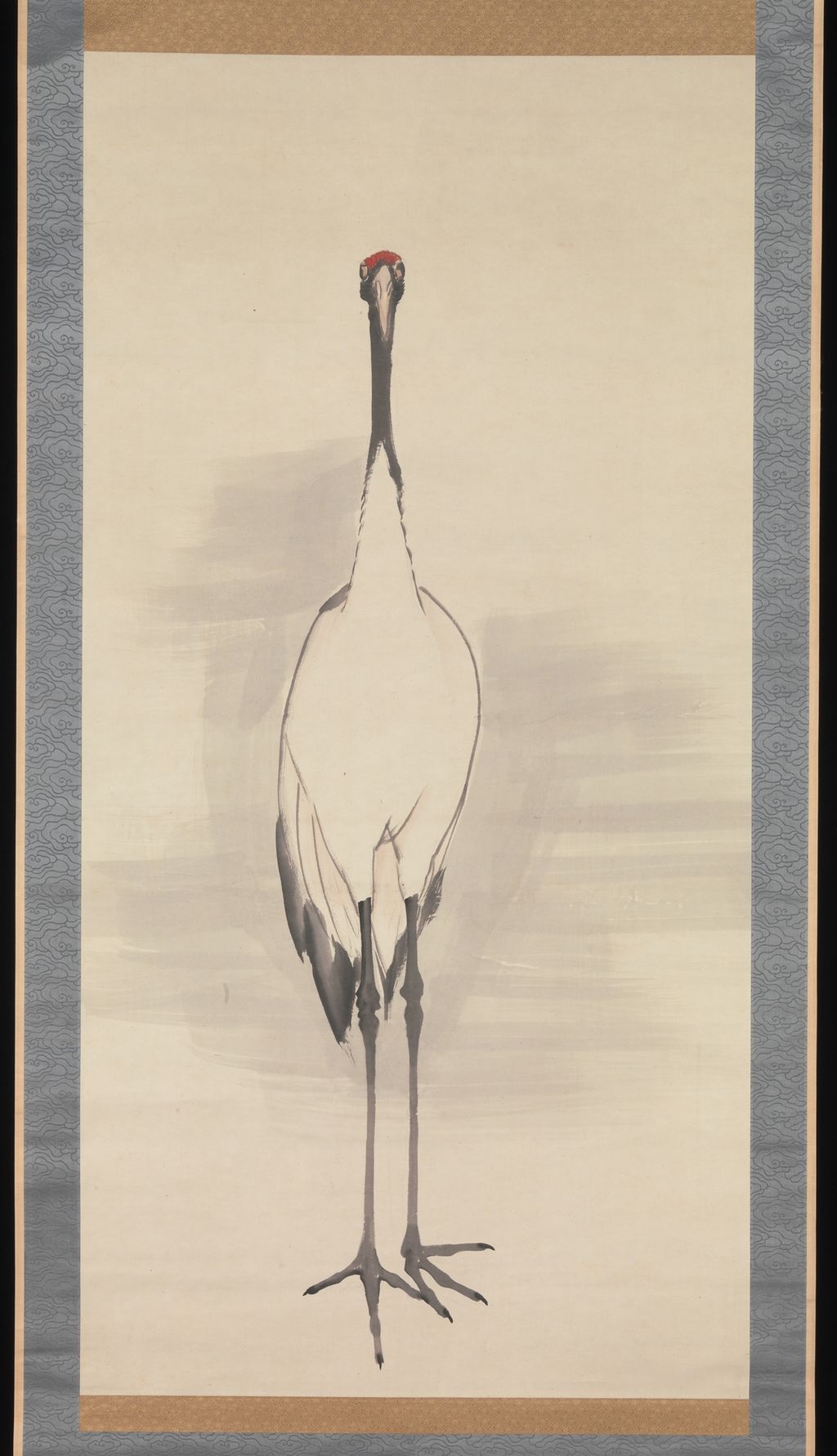
The Met's pair of Cranes hanging scrolls, dated to the late 1780s, pares away setting almost completely. Three red-crowned cranes take different poses. A white body may be made as much by the unpainted paper as by ink; black feather ends and thin legs place each bird with unusual assurance. The small red crowns give a visual accent without turning the whole pair into bright colour painting. The museum relates their precisely handled feet to Ōkyo's practice. This is a more instructive point of comparison between teacher and pupil than the general claim that both painted birds. [6]
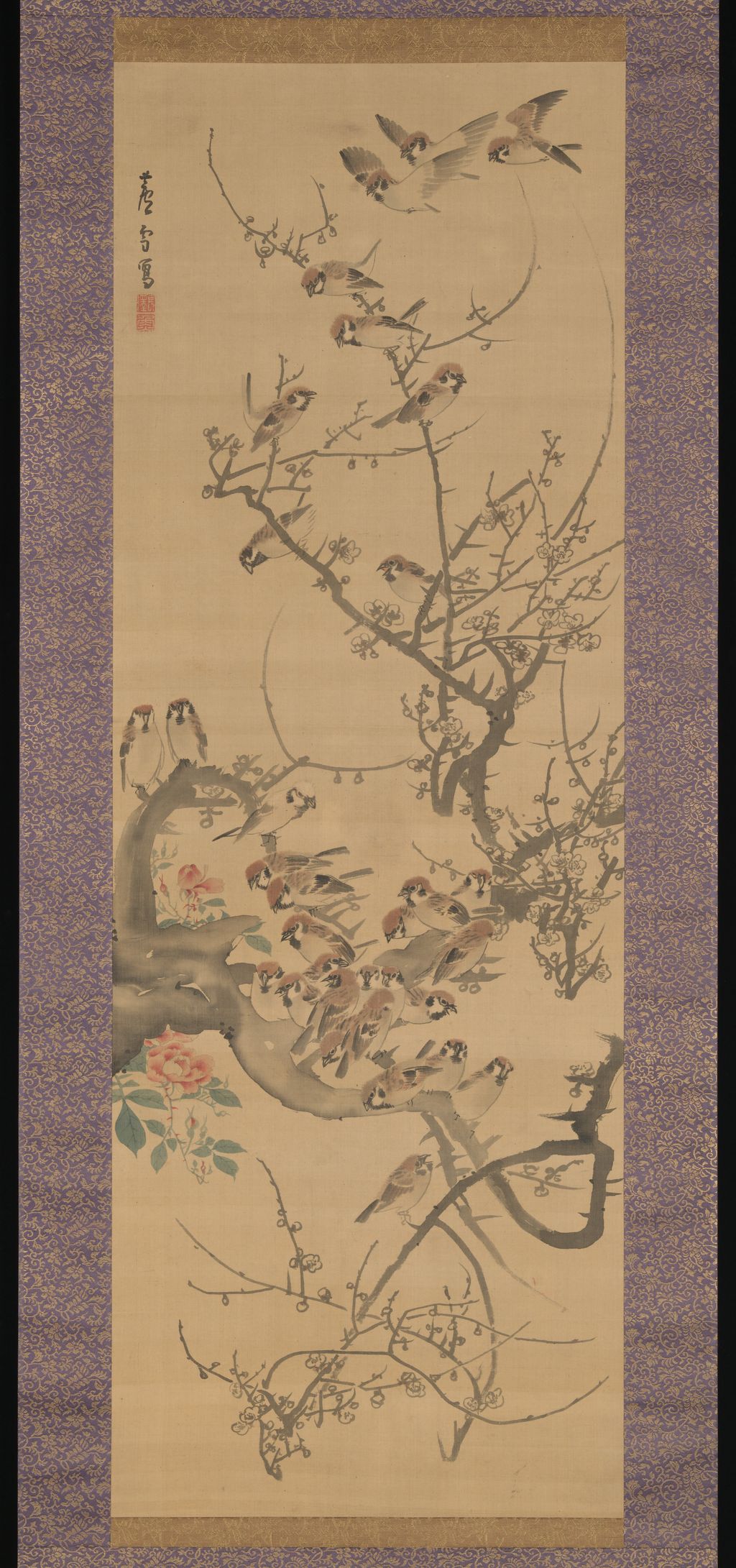
By the second half of the 1790s, the Met's Sparrows in a Plum Tree shows a very different density. Twigs turn abruptly, sparrows repeat with variation, and a rose bush appears among the expected spring signs. The Met notes that some birds look out toward us. In the crane pair, a large white body can command the page; in the plum scroll, multiple small bodies ask the eye to search the branches. That comparison is not a simple development from “realism” to “eccentricity”: both works depend on observed anatomy and planned address to a viewer, adapted to two different sizes and subjects. [6] [11]
A snail trail and a dusty scholar's table
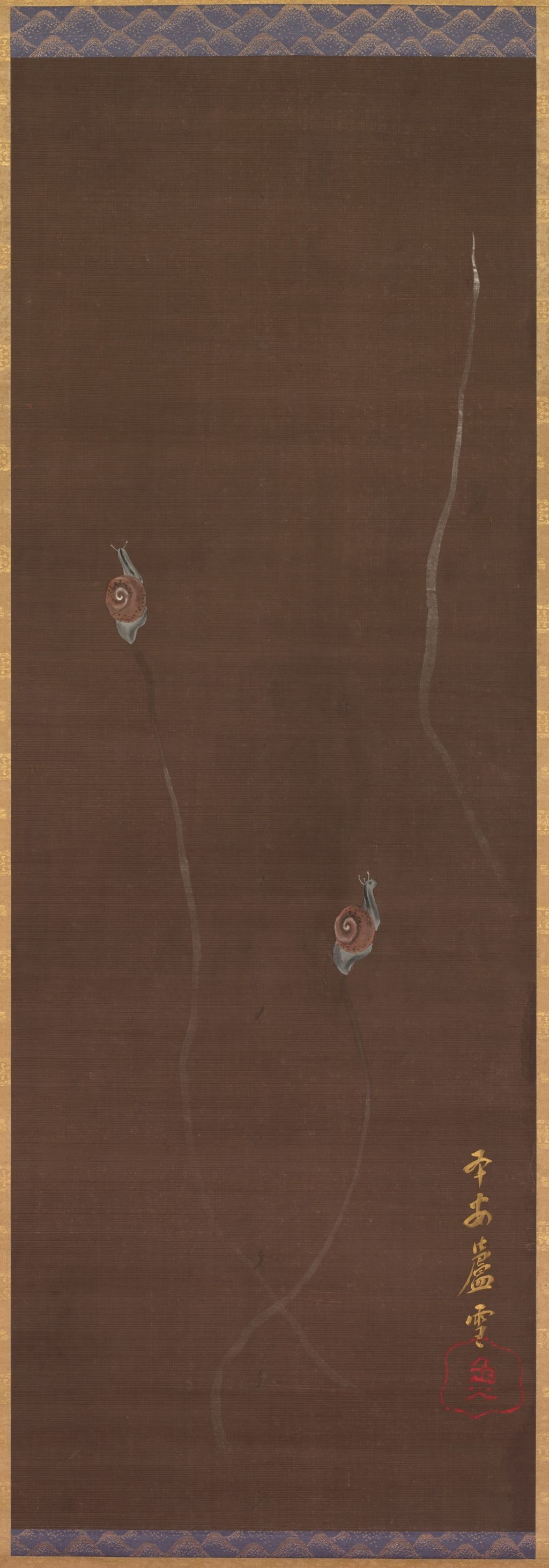
Cleveland's Snails (カタツムリ図), dated around 1788–89, compresses a small event into a tall scroll. The museum identifies an “earth painting” technique with pigments built up using crushed white shell, while silver material marks the tracks. Two snails are present, but a third trail lacks a visible maker. The absent body makes the viewer ask what happened just outside the pictured instant. Such wit depends on unusually close looking, the opposite of meeting a room-sized tiger from a doorway. Cleveland's identification is snails, not slugs; the Japanese query なめくじ may point to another work or an imprecise online label and cannot settle object identity. [12]
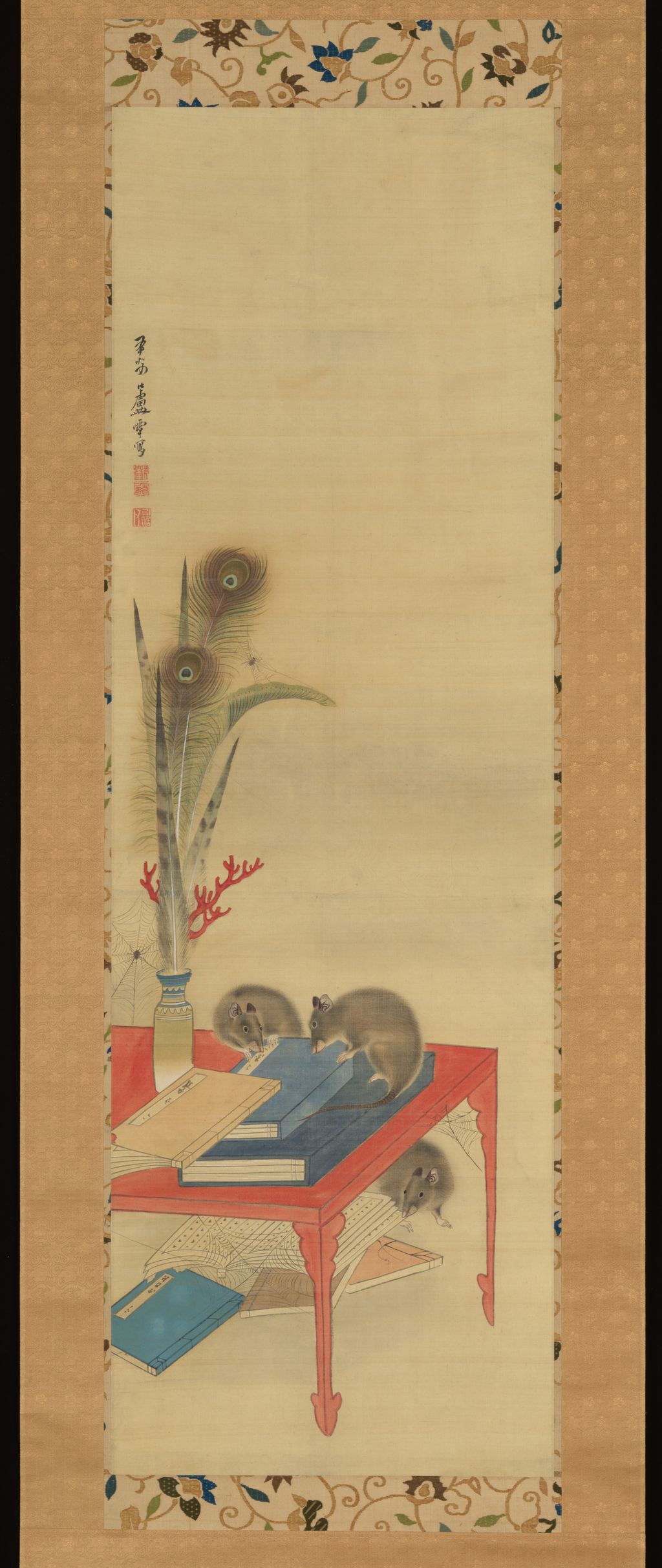
The Met's Rats on a Scholar's Desk, about 1794–95, makes a larger inventory into another small drama. Three rats move on and below a red lacquer table. Books lie scattered, feathers and red coral decorate the arrangement, and spider webs suggest that the scholarly equipment has not been used for some time. The museum links the colourful design to Rosetsu's Hiroshima-period work and proposes connections with images circulating through Nagasaki; the latter is a curatorial comparison, not proof of a specific print on his worktable. The scholarly ideal is still recognisable, but the active inhabitants are rats. Rosetsu's joke becomes clearer because the objects are painted carefully enough for a reader to understand what is being neglected. [13]
A moon without a painted circle
Moonlit Landscape at the Met, dated 1794–95, gives a quiet counterweight to puppies and jokes. The moon is a reserved area, made apparent because the surrounding wash darkens. Broad brush movements indicate mountain sides without outlining every contour, while pines cut across paler forms and cloud softens the boundary between sky and land. The Met discusses a long flexible brush and staged drying of ink layers. Those technical observations show the control behind a seemingly spontaneous atmosphere. They also help explain why “eccentric” can be an inadequate description of the painter's craft. [14]
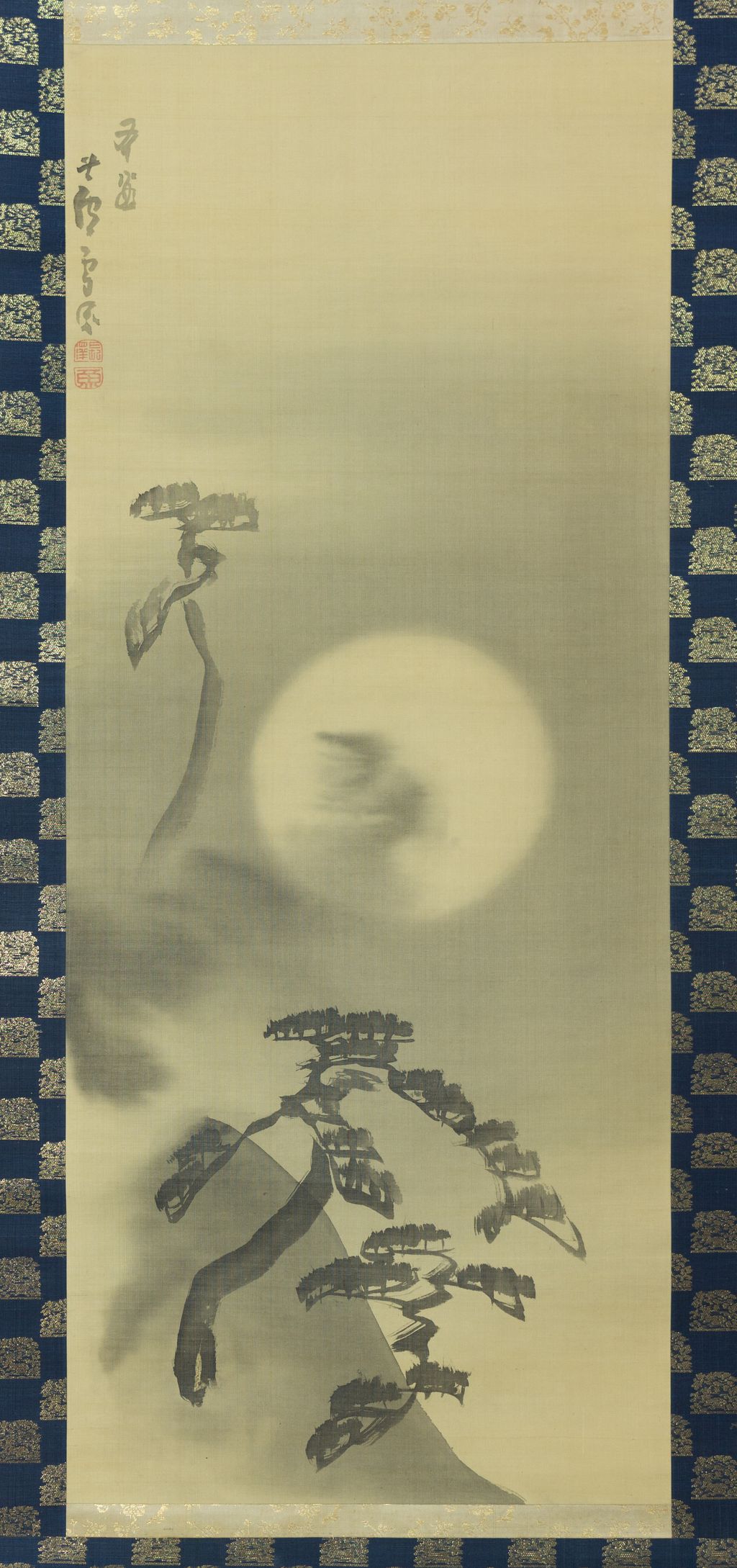
The Met points to other moonlit paintings at different stages of the career, including work associated with his 1794 travel toward Hiroshima and Itsukushima. The object record can support a comparison of recurring theme; it does not mean this landscape depicts a securely identified shore or mountain. A historic photograph of Itsukushima, if later sourced with rights, could explain a documented destination rather than pretend to be this invented moonlit view. On this page the vertical scroll should stand as an atmospheric painting in its own right, not an illustration for a travel narrative stronger than the evidence. [14]
A scroll that unfolds into another kind of world
Kyoto National Museum's People and Birds/Animals Scroll (人物鳥獣画巻) is over sixteen metres long but only 31.1 centimetres high. The museum describes auspicious figures, animals and immortals revealed through a sequence that uses the handscroll's distinctive way of being viewed. This is an important contrast with the fixed vista of a hanging scroll or a facing pair of temple doors. A handscroll is seen bit by bit. A surprise can be held back until the viewer moves further along, and a small figure can appear after a pause or a change of scene. Rosetsu's humour here depends on time as well as on the drawing of any one creature. The museum places the work around his late twenties or early thirties, already showing his individual expression alongside Ōkyo's influence; it does not assign an exact year. [15]
The record gives a useful material and identity anchor: one colour-on-paper scroll, Kyoto National Museum ledger A甲1657, with the inscription 平安蘆雪寫意 and seals 長澤政勝 and 蘆雪. Its length is not a reason to turn the dozens of database photographs into dozens of separate works. Nor should an arbitrary web crop be used in place of a licensed sequence: the museum links its image request process and does not provide the open-access terms of the Met or Cleveland files. The artist home can explain the handscroll in text and send interested readers to the exact museum record. A future illustrated feature would require an approved group of images and a careful plan for their order, perhaps an interactive reveal that respects how the scroll unfolds. [15]
This scroll also checks an easy simplification about Rosetsu's development. If we called every playful animal of the 1790s a break from a sober Ōkyo apprenticeship, the museum's earlier handscroll would already complicate the story. Its descriptive claim is that a distinctive pictorial world is visible while his teacher's style is still present. That allows overlap: learning careful observation and exploring surprise need not belong to separate, sealed periods. The exact scroll is better evidence for this point than a loose comparison of signature styles made from unlabelled search images. [15]
How to read Rosetsu's changing formats
Set the Muryoji room beside these portable works and the artist's range becomes more precise. A fusuma is not just a large sheet: its seams, handles, opening action and neighbouring panels structure what a person sees. A hanging scroll can be unrolled for a different occasion, isolated against a wall and approached closely. Later remounting can change which of those relationships survives. The Met's snow-puppy panels became two screens; Cleveland's three puppy panels became separate scrolls. Both museums document those histories. An article that calls all five photographs “scroll paintings” or “screens” because that is how they look today would lose the original room function. [4] [5]
The same care applies to age and authorship. A museum's c. 1792–94 is an attribution of period, not a day Rosetsu wrote on the work. A title in Japanese may be a catalogue convenience rather than an original inscription. Collections record attribution, support, dimensions and later mounting; those details are part of the evidence that lets us compare pictures responsibly. They prevent an attractive slideshow from inventing a neat story of steady progress toward ever wilder animals. The dated Nanki works, the late 1780s cranes and snails, the early 1790s puppy doors, and the mid-1790s landscape and desk scroll offer meaningful points, while leaving room for uncertainty between them. [3] [4] [6] [12] [14]
There is also more to investigate outside this first cleared image set. Kyoto National Museum's long People and Birds/Animals Scroll has its own exact record and inscription, but requires image permission. The British Museum holds a signed painting of a sage catching a tortoise with a woven hat, accession 1913,0501,0.521; its photograph is likewise research-only for now. These works indicate subjects beyond the current production gallery without inviting us to borrow files under unverified terms. The Muryoji paintings deserve their own close account if an exact original image can be secured. One source can extend the interpretation even when its photograph cannot legally or responsibly be published here. [15] [16]
The cleared gallery itself is shaped by collecting history. Two major American museums supply the reusable photographs in this first build, while Japanese institutions supply crucial evidence for the temple commission, early handscroll and exhibition chronology. That difference is about present file permissions, not an assertion that the American collections own the defining portion of Rosetsu's achievement. It would be misleading to rank the artist's work solely by what can be reproduced without a request. The article should keep Japanese originals and scholarship central even when their pictures remain linked rather than embedded, and update its visual balance when exact rights allow. [1] [3] [15]
Where to begin
Begin with the Met snow puppies and Cleveland's three connected door panels to see how an animal picture changes when a room becomes a museum object. Then step back to the two women and their dog: the animal now acts as an observer of people. Compare the Met cranes with the crowded plum branches; both ask whether a bird looks back at us, at different scales. Examine the Cleveland snails and the rat-filled desk for forms of visual humour, then finish with the reserved moon. The Muryoji Tiger and Dragon provide the architectural counterpoint, supported here by named Japanese institutional accounts until a production image is cleared. This route uses known objects, and it leaves the visitor with ways of looking rather than a forced list of “top ten” pictures. [3] [4] [5] [12] [14]
The separate biography will examine the dated training and Nanki journey, later travel, clients and death stories. The dog-paintings article will use high-resolution details to compare three independent dog settings and check the Met/Brooklyn door relationship. This home remains the map between them: works, formats, Japanese place and exact collecting records. As new image rights or object scholarship are established, it can grow without blurring two animals, two institutions or an original and a facsimile into one convenient picture. [2] [4] [5]
Frequently Asked Questions
Rosetsu (1754–1799) was a Japanese painter who trained with Maruyama Ōkyo and worked on hanging scrolls, screens and architectural sliding doors. His subjects include the Muryoji Tiger and Dragon, puppies, birds, landscapes and figures. [1] [3]
The facing Tiger and Dragon fusuma at Muryoji are especially prominent in Japanese museum accounts. His playful puppy paintings are also widely reproduced, but they exist as several distinct works at different institutions. [3] [4] [5]
Yes. Kyoto National Museum and the Met identify Ōkyo as his teacher. Stories of a later expulsion or personal rupture need qualification because the temple museum itself warns that the surviving biographical stories are uncertain. [1] [2]
No. The Met has Puppies in the Snow, four former sliding panels now mounted as a pair of screens. Cleveland has three panels of Puppies, Sparrows, and Chrysanthemums, now remounted as scrolls. Their dates overlap but the object records, settings and compositions differ. [4] [5]
The room has displayed digital facsimiles since 2009, according to the Japanese government site; the original panels are held separately. Current access to originals should be checked with their holding institution before travel. [9]
Discussion
Compare Rosetsu’s original formats, later remounting and the distance each painting asks you to take.
Reader Insights
How does remounting the puppy doors alter the way their animals meet a viewer?
What changes between the open crane pair and the crowded plum branches?
What do the reserved moon and a snail trail without a snail leave you to imagine?
Join the Conversation
Share a documented example or reliable source below, keeping observation separate from inference.
References
- Kyoto National Museum, Nagasawa Rosetsu exhibition and object list.
- Muryoji/Kushimoto Ōkyo Rosetsu Museum, About Nagasawa Rosetsu.
- Wakayama Prefectural Museum, Rosetsu Seidō: A Journey to Muryoji in Nanki.
- Metropolitan Museum of Art, Puppies in the Snow, 2015.300.203.1, .2.
- Cleveland Museum of Art, Puppies, Sparrows, and Chrysanthemums, set record 1970.71.1; see also panel .2 and panel .3.
- Metropolitan Museum of Art, Cranes, 2011.572.2a, b.
- Nakanoshima Museum of Art, 2023 Rosetsu retrospective.
- Nakanoshima Museum of Art, 2023 exhibition press PDF, legible object/rights list on p. 6.
- Kinki Regional Development Bureau, Muryoji and the digital room facsimiles.
- Metropolitan Museum of Art, Two Women and a Puppy, 2015.300.205.
- Metropolitan Museum of Art, Sparrows in a Plum Tree, 2015.500.9.54.
- Cleveland Museum of Art, Snails, 1998.5.
- Metropolitan Museum of Art, Rats on a Scholar's Desk, 2020.396.34.
- Metropolitan Museum of Art, Moonlit Landscape, 2020.392.
- Kyoto National Museum, People and Birds/Animals Scroll, exact object record.
- British Museum, sage catching a tortoise with a woven hat, 1913,0501,0.521.