


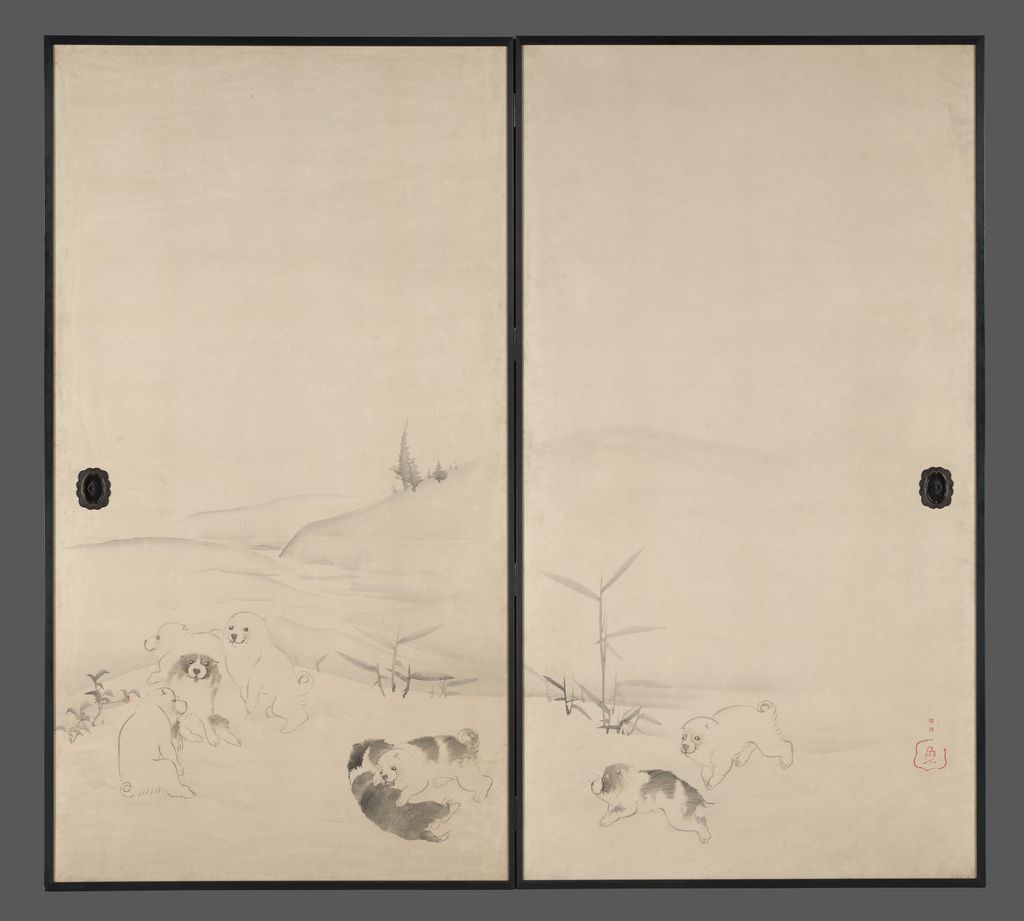
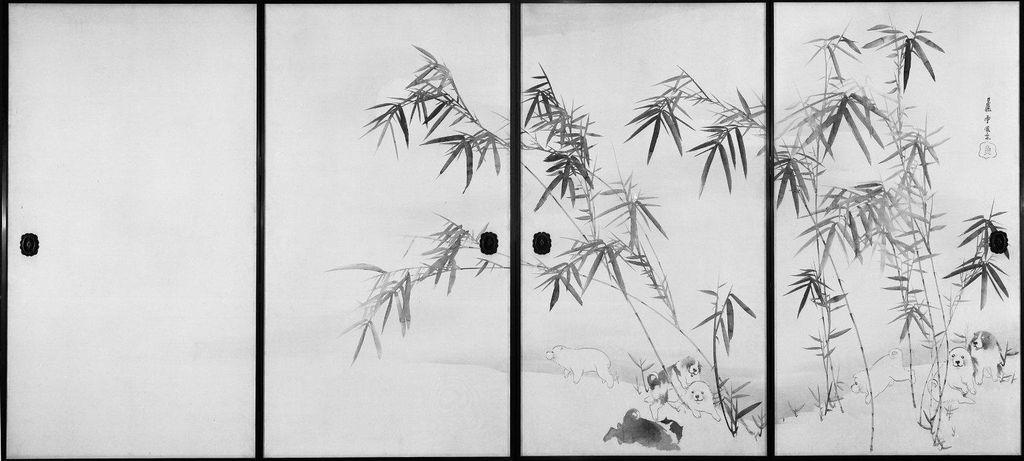
Nagasawa Rosetsu, Puppies in the Snow, right two panels of four former sliding doors. The Metropolitan Museum of Art object record 2015.300.203.1, .2.
 by Tom Gurney
Tom Gurney BSc (Hons) is an art history expert with over 20 years experience
Published on September 25, 2026 / Updated on September 25, 2026
Email: tomgurney1@gmail.com / Phone: +44 7429 011000
Dogs that belong to rooms, scrolls and a fan
Nagasawa Rosetsu's puppies are easy to recognise and surprisingly hard to describe accurately. A modern search returns small animals isolated against white, often as cropped square images. But the paintings discussed here were made for different physical experiences. The Metropolitan Museum of Art's Puppies in the Snow (雪中狗子図襖) began as four sliding doors. Cleveland's Puppies, Sparrows, and Chrysanthemums (子犬に雀、菊図) was another door ensemble, now divided into hanging scrolls. A puppy at the feet of two women belongs to a silk figure scroll. A small fan in a Japanese museum takes the subject to a hand-held scale. Treating all of these as interchangeable pictures of a cute dog obscures the most inventive part of Rosetsu's work: the way an animal changes the space in which it appears. [1] [2] [3] [4]
The surviving objects also challenge a familiar story about influence. Rosetsu studied with Maruyama Ōkyo, whose attentive animal pictures made the puppy a compelling subject. The Met explicitly connects Rosetsu's early practice with Ōkyo's naturalistic depictions. Homma Museum, discussing a small Rosetsu puppy fan, describes a further loosening and humanising of that model. Yet the claim that a later student simply drew looser versions of his teacher's dogs does not explain the difference between a little body on a fan, a litter spread across a working door, and a puppy placed beneath a procession of women. The comparison has to follow the object, not only the animal's round face. [1] [4] [5]
Contents
- Dogs that belong to rooms, scrolls and a fan
- The snowy doors: a large field and very small actors
- The left pair changes the rhythm
- Look closely at both snowy fronts
- Another painting on the back
- Cleveland: three panels that once had handles
- A puppy can change a picture of people
- Japanese records broaden the subject without multiplying images
- Looking closely without losing the object
- Why the puppies still hold attention
- Books on Japanese Art
The exact titles help. The Met gives the Japanese title 長澤蘆雪筆 雪中狗子図襖 for its doors and dates them broadly to 1792–99. Its English Puppies in the Snow names a visual setting, while 襖 keeps the original architectural form in view. Cleveland dates its different set to about 1792–94 and identifies traces of the former door pulls. Neither object is the Itsuō Museum's 降雪狗児図 or the Tsuruga Museum's 紅葉狗子図. A name such as “Rosetsu puppies” can be a search topic; it cannot serve as an accession-level identification. [1] [3] [6] [7]
At a glance
- ArtistNagasawa Rosetsu
- Key worksPuppies in the Snow; Puppies, Sparrows, and Chrysanthemums
- Original formsSliding doors, scroll and fan
- Object careDistinguish fronts, reverses and later remounting
The snowy doors: a large field and very small actors
The Met's primary photograph shows the right pair of the four former doors. Near the lower edge, a scattering of puppies meets a broad expanse of lightly worked paper. The winter setting is made by reserve as much as by pigment. Slight banks, bare stems and a few distant marks are enough to orient the animals; heavy white paint is unnecessary. A viewer who first notices an almost empty upper half is already experiencing Rosetsu's decision about scale. The image makes the little figures conspicuous precisely because it refuses to fill every available part of the door. These are observations from the high-resolution Met photograph, while the identification, broad date and present mount come from the museum's catalogue. [1]
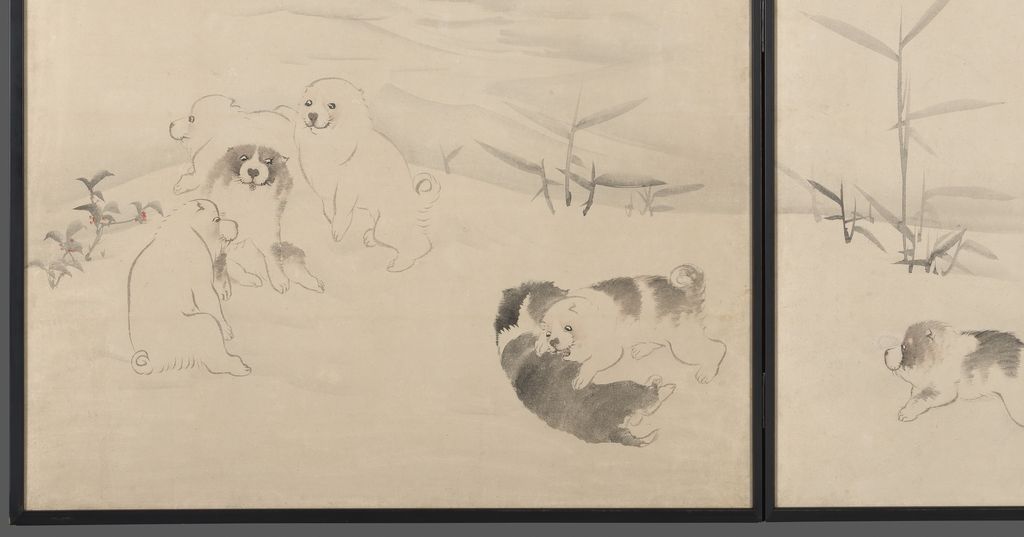
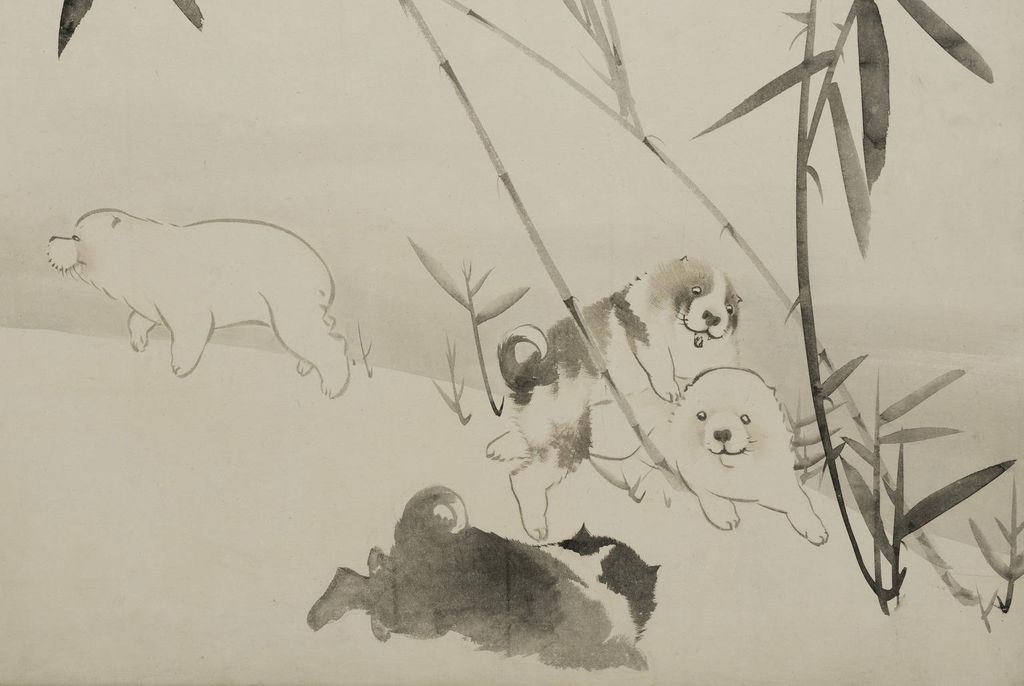
The right pair is not a row of identical puppies. One turns, another bunches into a compact dark mass, and a pale outline almost disappears into the paper. Fur can be suggested by a blurred or broken edge; a tail and a small change in head direction make another animal seem suddenly alert. At normal article width some of those gestures nearly vanish. That is why an annotated detail is useful here: enlargement allows a reader to examine how ink varies across neighbouring bodies rather than merely receiving the caption's promise that the scene is lively. An enlargement should still name its original panel and show the same work's full photograph nearby. [1]
The two dark circular door-pull areas remain visible in the modern screen view. They should interrupt any illusion that this was originally a neutral rectangle designed for a gallery wall. A hand once approached these surfaces to open or close a partition. The panels would have formed part of an architectural arrangement, while lighting and a person's position changed as a room was used. We do not have a secure original room plan for this four-door work in the sources checked here, so it would be false precision to reconstruct a particular route through a specific house. The visible pull positions and the Met's medium description establish the architectural purpose without a speculative floor plan. [1]
Dating also needs restraint. The Met's 1792–99 range covers several years near the end of Rosetsu's life; it does not identify one winter day or an exact age for the artist at the moment of painting. A viewer can compare the doors with Cleveland's roughly contemporary ensemble, but similarity of subject is not evidence that they were painted together, installed in the same building or addressed to the same patron. Even a confident attribution is a different kind of statement from a dated commission. The museum's catalogue supplies the present object facts; the compositions allow a close visual comparison; neither supplies the missing patron record. [1] [3]
The left pair changes the rhythm
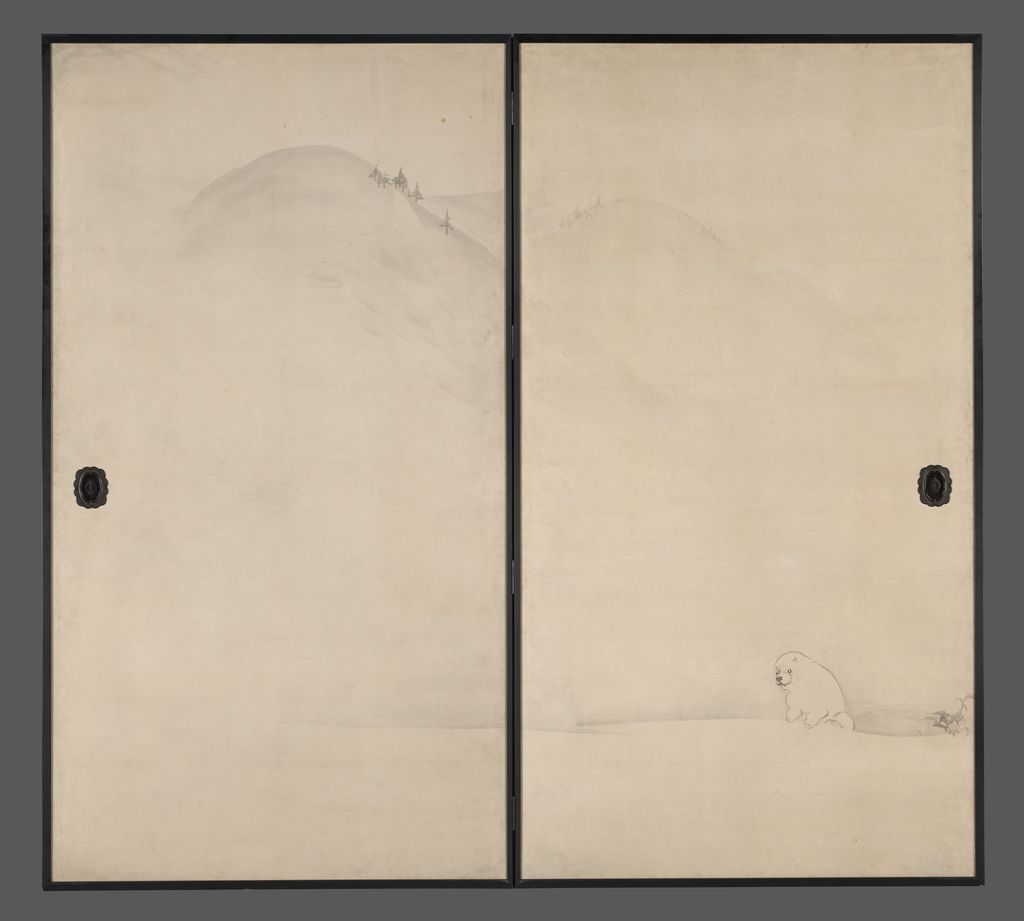
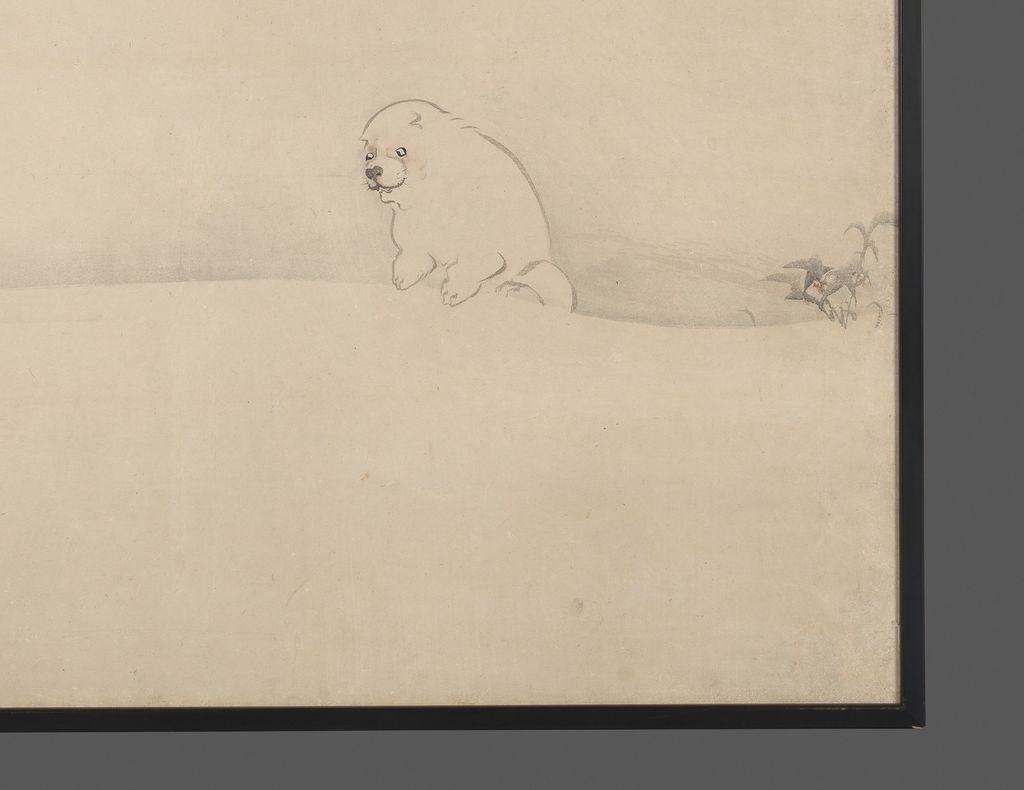
The first additional photograph in the Met record shows the left two-panel front, which is easy to miss if one stops at the default right-pair image. This second half changes the reading of the complete work. A low solitary puppy appears far across an expansive sheet of pale winter ground. There are distant hills or tree marks above, but neither a crowded litter nor a balanced counterpart to every animal on the right. Rosetsu makes the viewer move between density and scarcity. Placed together in thought, the four former doors give more time and room to a small animal than any cropped social-media image could preserve. The Met identifies both modern screens as the one former four-door set. [1]
The nearly empty left pair matters because it changes the unit of comparison. If we compare only the puppies on the right with another artist's puppy group, the question is how convincingly fur and motion were painted. If we consider the left pair too, the question becomes how a small form anchors a wide surface. A single low mark makes the eye travel along a snowline and then back toward more active neighbours. Empty paper ceases to be spare background and becomes a way of pacing the viewer's attention. This is a reading of the surviving photographs, not a claim that Rosetsu wrote down a programme for the four panels. [1]
Look closely at both snowy fronts
Open details cropped from retained 4000-pixel Met photographs saved as 300dpi working masters. Explanations also appear below.
Annotated image details
Puppies on the right front
Compare the dark, soft and reserved outlines. This is an editorial crop of the same right front, not another painting.
The Metropolitan Museum of Art object record 2015.300.203.1, .2; editorial crop and resize.
The solitary puppy on the left
One puppy sits low in a broad snowy field. Its apparent scale changes when the surrounding blank paper is cropped away.
The Metropolitan Museum of Art object record 2015.300.203.1, .2; editorial crop and resize.
Photography can mislead here in both directions. The complete left pair at 1024 pixels makes the dog almost disappear, but a close crop makes the same dog look like a stand-alone miniature painting. Both views are useful when their relationship remains explicit. The cropped popup should return to its full left-pair base, and its caption should say that it enlarges one part of the Met's former door front. It should never acquire a different invented title or date. A publication image is also not the same as the original sheet: tonal gradations depend on lighting, camera capture, export and the reader's screen. Thus the close-looking account describes what can be checked in the retained original museum file and avoids claiming a microscopic analysis of paper fibres. [1]
The comparison of both fronts is more instructive than a forced census of pups. The Met's short essay speaks of puppies frolicking, curved tails and wild fur. Across the pair of fronts, the distribution of bodies is uneven enough that one should identify a figure only when its contour is legible rather than turning every ink patch into a separate dog. Rosetsu's achievement is the tension between individual gestures and a shared snowy environment. It is also an argument for keeping the pair of screens together editorially: the left image cannot be relegated to an unrelated thumbnail just because its visible action is quiet. [1]
Another painting on the back
The Met states that the reverse of the former doors depicts seven puppies and bamboo and is in the Brooklyn Museum. The connection is unusually valuable because it makes a familiar gallery habit impossible: a viewer cannot assume the photographed front is the entire painting programme of the original partition. The snowy fronts and the bamboo reverses occupied different sides of a usable object. A door's face could be directed into one space while its reverse addressed another. We can speak about that two-sided function, but we cannot recover the exact original rooms, which side faced which named room, or the order in which individual visitors saw them from these museum records alone. [1] [2]
Brooklyn catalogues its work as Puppies and Bamboo in Moonlight, object 77.202a-b, a pair of two-panel sliding doors in ink and light colour on paper, dated to the early 1790s. The complete four-panel black-and-white photograph establishes the overall disposition, while the colour photographs clarify local ink and colour. Its present catalogue description should not be silently collapsed into the Met's current mounting: the Met's snowy fronts are hinged as two-panel screens; Brooklyn still names the reverse as sliding doors. Both records point back to the original front/reverse relationship, but they document different surviving material states and holdings. That is a more interesting story than treating the Brooklyn photographs as an additional Rosetsu “puppy screen.” [1] [2]
The Met reads the seven puppies among bamboo as an allusion to the ancient Chinese Seven Sages of the Bamboo Grove. The number and vegetation make the comparison possible; it remains a curatorial interpretation rather than a statement by Rosetsu found in an inscription. The borrowing is playful: a gathering of lively pups stands where learned human eccentrics might be expected. If we read the picture only as a joke, however, we lose the physical fact that these animals occupied the reverse of a snowy scene. Movement between winter reserve and bamboo density was built into one object before collectors and museums separated the surfaces. The historical audience's exact route is unknown, but a two-sided design is secure. [1] [2]
The Brooklyn colour detail shows dogs and the stalks around them at a much more intimate scale than the complete black-and-white record. It earns a second placement because the overall image explains arrangement and the detail supports looking at a dog's contour and a bamboo stem. It does not earn a second accession or an assumption that the photographed detail preserves the colour of all four panels identically. The file Brooklyn supplies is modest in pixel dimensions, so we can present it as a figure but cannot responsibly claim the high-resolution, 300dpi annotation workflow used for the Met crops. The caption must also retain the museum's attribution and CC BY 3.0 terms, including that the site resized the supplied photograph. [2] [15]
There is a further limit to reconstruction. The Met record describes a painting on the reverses and Brooklyn supplies a complete overall photograph, but a published front and a published back do not automatically tell us which surviving photographed panel originally matched the reverse of which photographed front. Hinges, door-pull positions, later remounting and photographic orientation complicate a one-to-one diagram. A four-door front/reverse graphic could help, provided it labels only the certain relationship: snowy fronts on one side and bamboo-and-puppy paintings on the other. A numbered arrow joining an individual front puppy to an individual reverse puppy would require conservation or provenance evidence beyond these public entries. Here the image pairing is presented as an object-level relation, not a solved panel-by-panel puzzle. [1] [2]
The original double-sided arrangement also changes the idea of narrative. Snow and moonlight are not successive chapters in a book simply because photographs of the two sides can now be placed one above the other on a web page. They would have been experienced through particular rooms and movements, possibly by different viewers. The snowy side uses broad reserve and a low line of action; the bamboo side is denser and invokes an established literary gathering in the Met's reading. That contrast is available for comparison, while a claim about what an eighteenth-century owner wanted guests to think would be conjecture. The page should permit a reader to compare the two documented sides and understand what the original architectural relation makes possible without scripting an undocumented owner's intentions. [1] [2]
Cleveland: three panels that once had handles
Cleveland's Puppies, Sparrows, and Chrysanthemums is another former sliding-door programme, but it must remain separate from the Met/Brooklyn object. The museum catalogues three related panels, 1970.71.1, .2 and .3, around 1792–94, each now mounted as a hanging scroll. They form a single original ensemble, not three unrelated paintings that happen to share a title. Cleveland explicitly points to circular traces where door pulls once lay. These physical reminders make the changed format something a reader can see rather than simply take on trust from a label. [3] [8] [9]
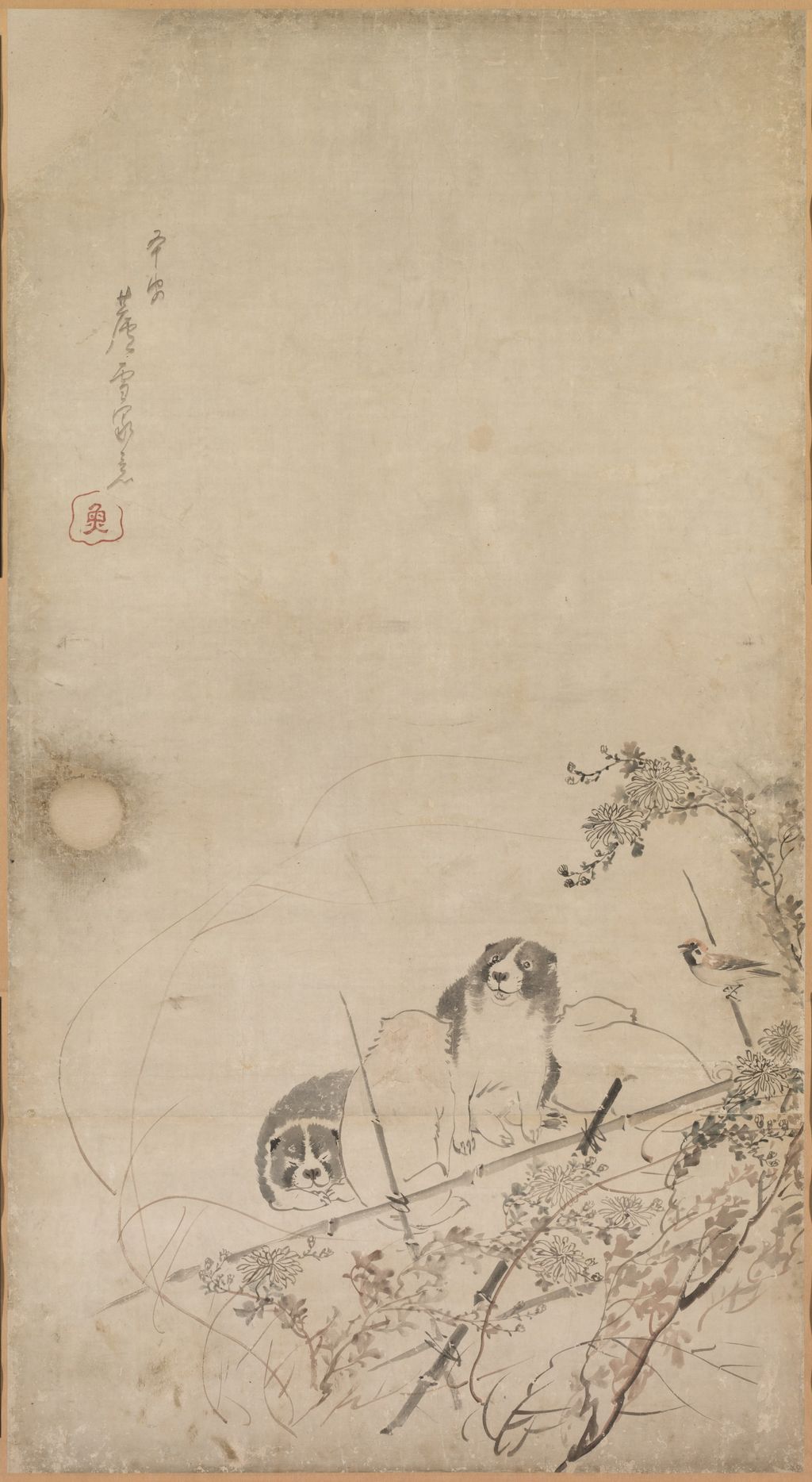
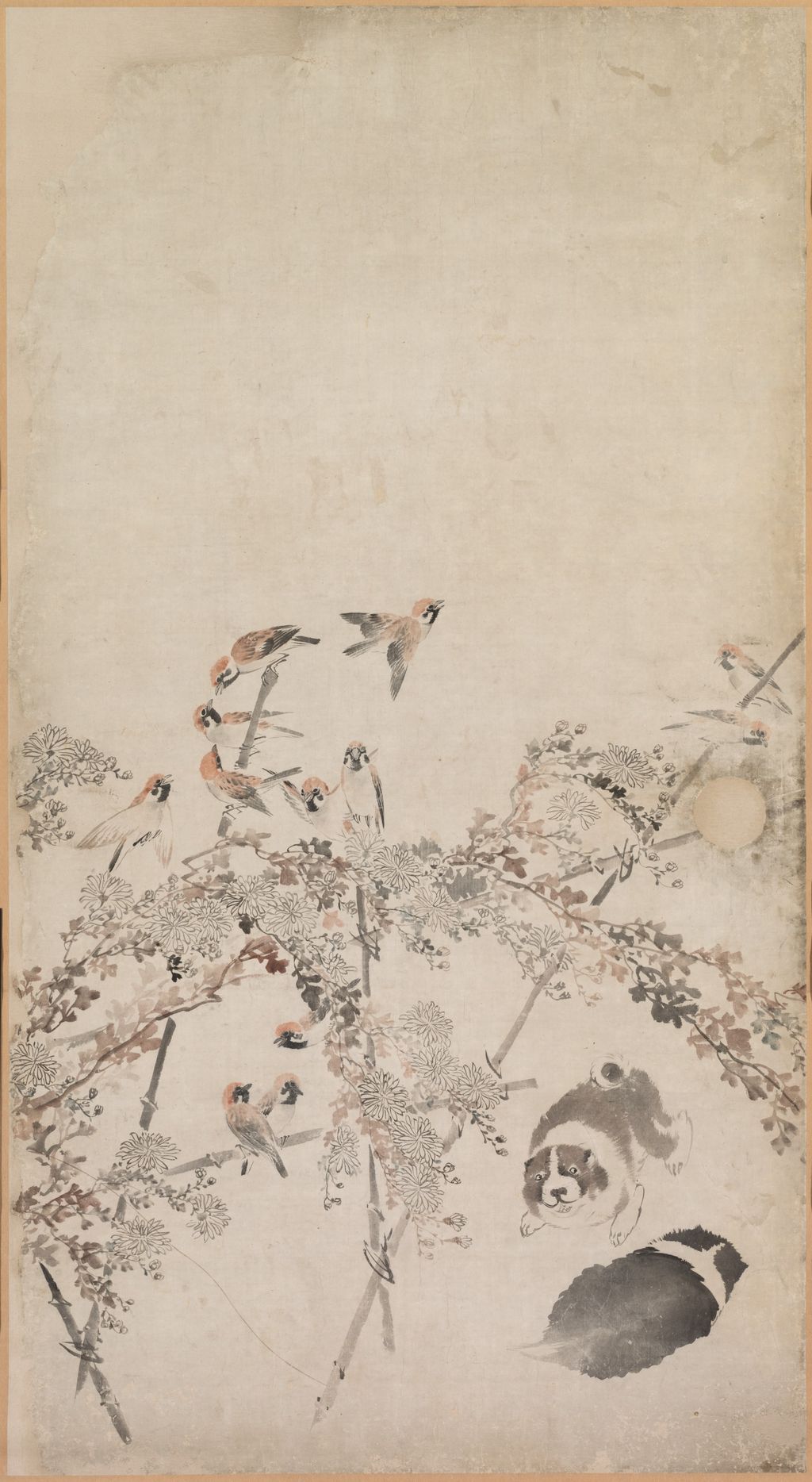
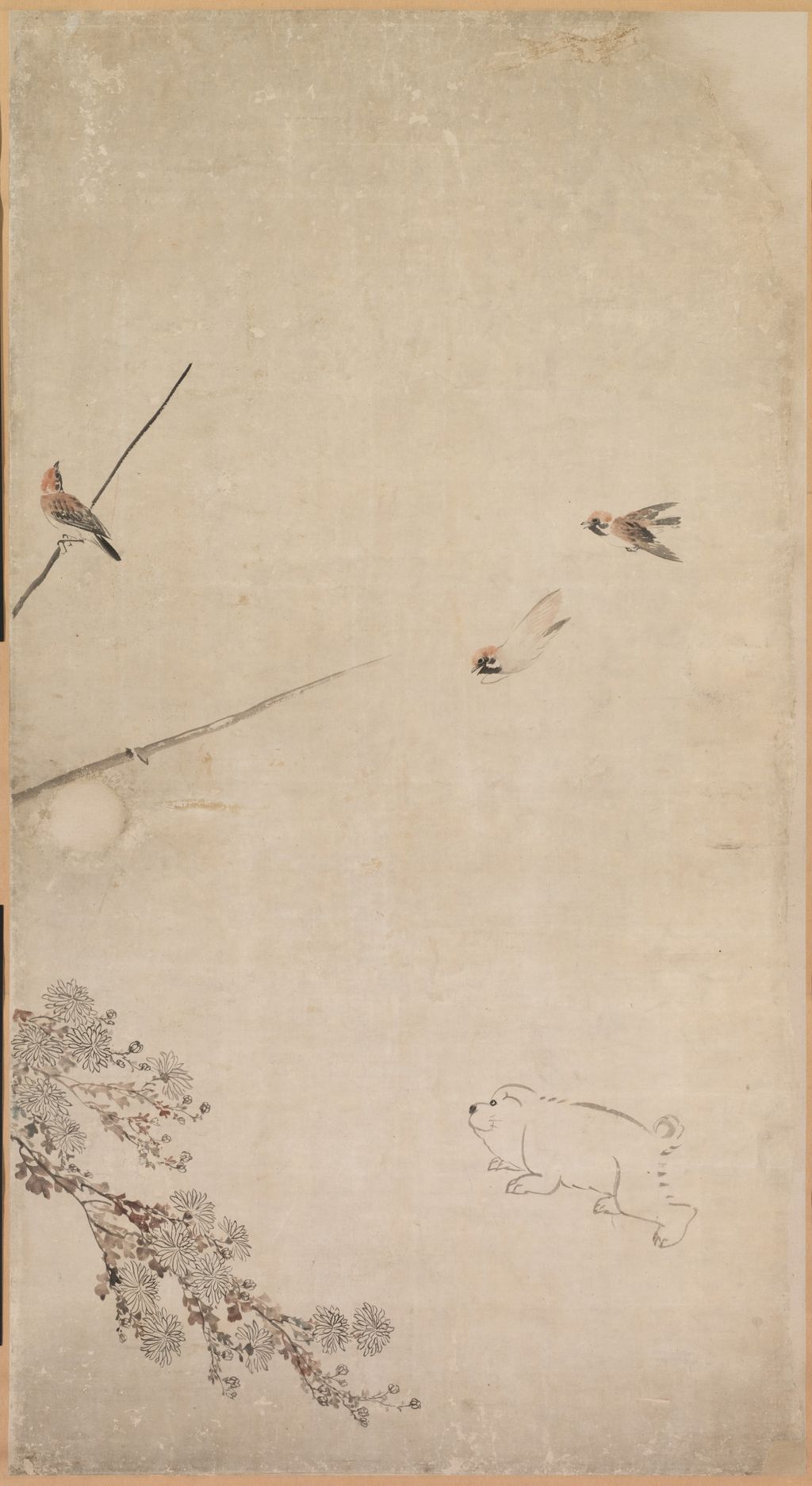
The work's action is distributed vertically as well as laterally. Cleveland describes sparrows gathering on a trellis supporting flowering chrysanthemum above puppies that cavort or nap below. The branches and support lines carry the eye up from the low animals. A particular puppy looks toward the persistent call of a bird, tilting its head as though listening. The museum uses that encounter to describe Rosetsu's tender story. The observable relation of a small lifted face to the bird matters more than assigning the animal a human sentence. Its expression can invite a viewer to imagine curiosity, but the picture does not preserve a written dialogue. [3]
The three-panel form gives Rosetsu a different visual problem from the snowy four-door work. Here the puppy group is not left alone against such a vast field. It converses with botanical structures and a flock above, so the intervals between figures must carry attention across the panel joints. As we move from one Cleveland photograph to the next, sleeping and alert postures make different amounts of visual noise. A low cluster can feel close to a person standing at a door, while birds and blossoms draw the eye higher than the body's level. The difference is not a simple change from “realistic” to “comic.” It is a change in the way a room surface stages several kinds of life at once. [3] [8] [9]
Present mounting can conceal this horizontal relationship. A visitor encounters three hanging scrolls with independent top and bottom boundaries, often spaced for a museum wall. The former door-pull circles and Cleveland's original-set designation help recover a working partition. They do not, by themselves, establish the precise historic width of its doorway or the placement of all surrounding paintings. It is tempting to place an imagined figure walking between these puppies and the Met snow scene, but the two ensembles had different histories. They can be compared as evidence for Rosetsu's use of doors without being assigned to the same architecture. [1] [3]
The near date range also needs care. Cleveland's circa 1792–94 sits inside the Met's broader 1792–99 estimate, but overlap is not a proven sequence. One cannot show that Rosetsu tried the sparrow motif first and then “advanced” to a nearly empty snowfield, or the reverse, without firmer dating. The better comparison asks what survives visibly in each set: the Cleveland trellis connects high and low zones, whereas the Met lets a little snowy path or hill line do most of the connective work. Both make room for an animal's tiny decision or change in posture, and both have changed format since their creation. [1] [3]
A puppy can change a picture of people
The Met's Two Women and a Puppy (天明美人図) puts a dog in a very different job. The museum dates this silk hanging scroll to 1787–88, earlier than the dated ranges of the two door ensembles. A richly dressed woman and an attendant move across the narrow field. The little animal watches them from below. It is not one of a pack and does not occupy an architectural surface. Its scale lets it serve as both a visual punctuation mark and a possible comment on the two human figures. Rosetsu's range includes this kind of socially observant figure scene as well as puppy groups in landscapes and plant settings. [10]
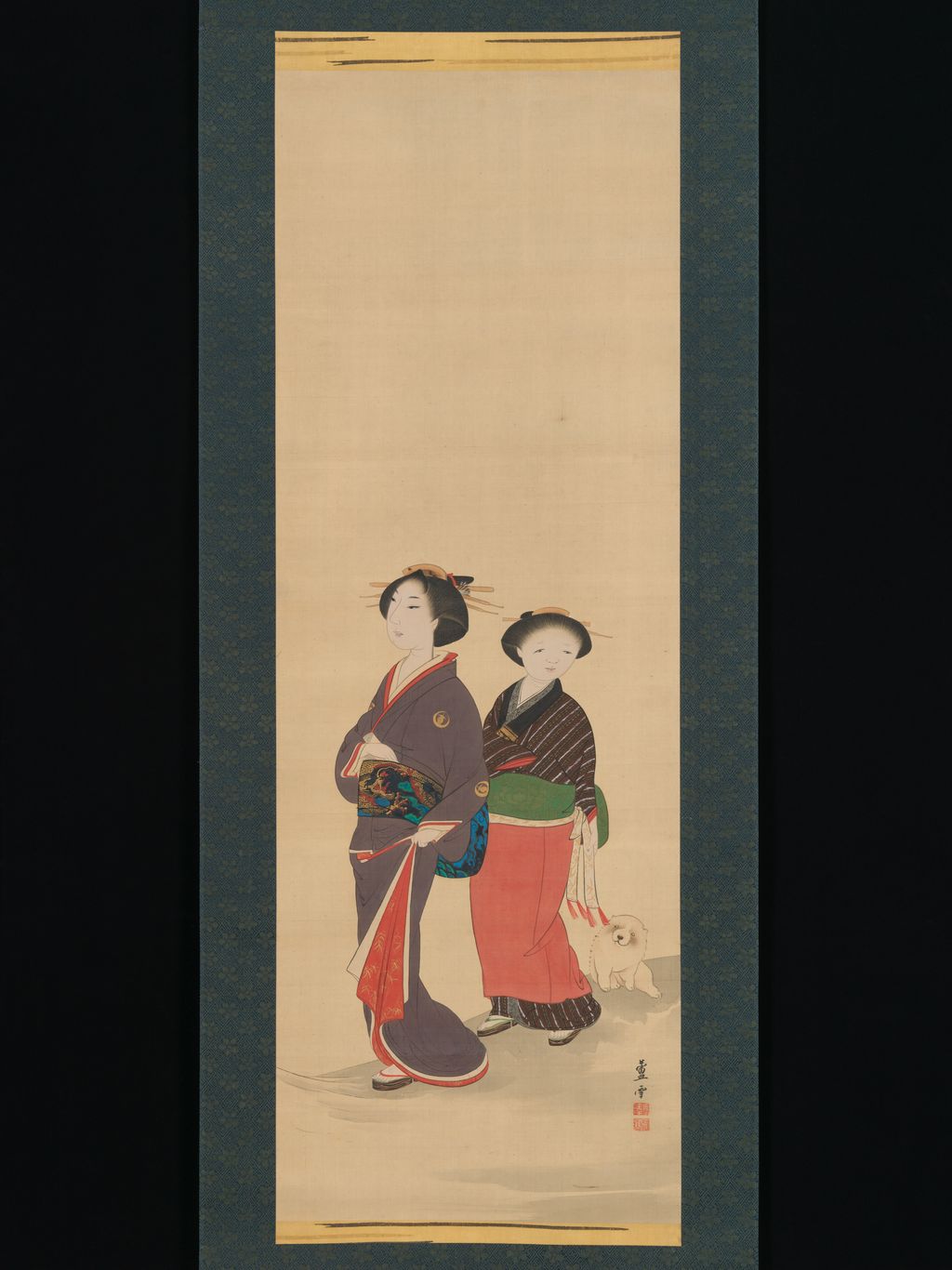
The Met describes the two women in considerable detail: a purple kimono with a spiderweb pattern, a decorated sash and a striped garment. It suggests that Rosetsu's handling of the beautiful-woman genre has humour, and that the little dog's amused expression might reflect a response to vanity. That last suggestion is a museum curator's possible reading, not a statement of what the puppy “means” supplied by the artist. A safer close description is that the animal looks on while the humans pass. The space between the dog's stillness and their display leaves room for wit without locking the work into a single moral. [10]
This scroll also checks any claim that Rosetsu's puppy motif appeared only after the 1790s. Its Met date of 1787–88 indicates an earlier dog in a figure composition, although it does not prove the artist had already devised the later snowy-door arrangement. Nor should the painted women be used as an illustration of Rosetsu's wife or family; the record provides no such identity. The apparent simplicity of the pup can lure a writer into using it decoratively. In this page it does specific work: it shows how animal attention can alter a human scene without making a litter the painting's main event. [10]
Japanese records broaden the subject without multiplying images
The Homma Museum in Sakata holds 狗児図, a paper-and-ink fan painting dated broadly to the later Kansei era. Its listed size, 18.4 by 49 centimetres including the mount, is enough to tell us that this was handled and viewed very differently from a full-height fusuma. The museum describes Ōkyo's ability to condense a real puppy's appeal and Rosetsu's freer, more humanised variation. Those are the museum's interpretive words, useful for framing a comparison, but the image still has its own accession B000009-1954 and material identity. It must not be silently substituted for the Met's snow puppy or the Brooklyn reverses merely because a reproduced fan photograph has a more dramatic expression. The Homma image needs permission for publication, so the research can inform prose without being embedded here. [4]
Tsuruga Municipal Museum's 紅葉狗子図 provides another distinct setting: a silk hanging scroll, 113.5 by 39.8 centimetres, with three pups playing under autumn leaves and a sparrow nearby. The museum links the subject to Rosetsu's teacher and describes the bird in a contemplative relation to the dogs. This is enough to prevent a catalogue mistake: a puppy plus sparrow is not necessarily Cleveland's door ensemble. Title, material, format, dimensions and holding institution separate them. The museum forbids unauthorised reuse of its photograph and offers an application route. That restriction does not make its catalogue invisible; it means the page should link the object record and refrain from copying the photograph. [7]
Fuchū Art Museum's 2026 retrospective made the “history of puppy paintings and Rosetsu” one of its interpretive sections, showing the artist beside Sōtatsu and Ōkyo. It also listed the Homma fan. The exhibition has ended, but its published programme illustrates why a multi-object puppy page has genuine art-historical work to do. Puppies are a thread through the artist's oeuvre and through the reception of earlier painting, not a single novelty. The catalogue issued with that exhibition is a separate 224-page Tokyo Bijutsu book; the museum's public details can establish its bibliographic existence, but its unread text cannot be mined for claims about individual objects. [5]
The programme's historically ordered comparison offers a more useful route than a gallery of faces. A fan is close to the hand and admits a concentrated outline; a hanging scroll opens vertically and can set the dog near human figures or seasonal foliage; a door panel operates at body scale and shares a surface with handles, frame and neighbouring panels. The Tsuruga autumn scroll and the Homma fan cannot yet be illustrated under their institutions' image terms, but their catalogue descriptions extend the formal map. A serious visitor should be able to recognise a dog painting's support and present mount before relying on adjectives such as charming, odd or natural. Those adjectives may describe a response; support and mount explain some of the choices that prompted it. [4] [5] [7]
A Tama Art University synopsis of Midori Katō's research asks how Rosetsu's puppy images relate to Ōkyo's model and the expression of 気, or vital presence. This is evidence of a serious research question, not a warrant to assert the thesis's unexamined conclusions. Similarly, the Smithsonian National Museum of Asian Art's teaching project compares a different private-collection Rosetsu Puppies scroll with Ōkyo and Mori Sosen. That private work has another identity and should not become a substitute illustration for the Met fronts. These resources expand the conversation from “which artist drew the cutest puppy?” to what inherited visual devices Rosetsu used and how he changed them across formats. Their limits must stay attached to any claim drawn from them. [11] [12]
Looking closely without losing the object
The approved annotation module gives the reader two linked views: a full Met front with a numbered hotspot and a popup enlargement with a written explanation below. On the right it reveals a group whose different ink densities can be mistaken for one dark shape at article width. On the left it rescues a solitary low animal from near-invisibility. The details were cut from original 4000-pixel museum photographs retained as 300dpi working files, then exported at the site's standard width, quality and resolution. The crop coordinates and hashes are saved in the image ledger. The popup is thus a reproducible editorial view of an identified source photograph, not a new work, restoration, invented reconstruction or claim to have examined the paper in person. [1]
The separation between original, photograph and page matters for colour too. The Met fronts use sparse ink and colour; Brooklyn's available complete view is black and white, while selected details are in colour. If those files are shown together without explanation, a reader might conclude that Rosetsu made an entirely monochrome reverse and a colour front. The difference in the available photographs cannot safely prove that. Cleveland's CC0 images and the Met's CC0 files can be resized and discussed under their institutional open-access rules, but Brooklyn's CC BY 3.0 record calls for an attribution and licence link. These are practical editorial facts that shape the gallery as surely as image selection does. [1] [2] [3] [15]
The same care applies to the relation between a digital image's metadata and the historical object. Setting a retained full-size file to 300dpi creates an accountable working master for the site's crop procedure; it does not prove that the eighteenth-century drawing contains three hundred discrete points per inch. A 1024-pixel export can retain the composition for reading but will reduce subtle strokes that a museum zoom tool might reveal. The annotation therefore concentrates on clear differences that survive both the original photograph and the exported popup. It should invite the reader back to the linked museum record for the larger file, not claim to replace it. A short caption giving the accession and crop disclosure keeps that chain of evidence visible without forcing rights language into the prose of every paragraph. [1] [14]
It also matters what the page leaves unillustrated. Nakanoshima Museum's exhibition list names an Itsuō 降雪狗児図 and other Rosetsu dog pictures. Kyushu National Museum lists a Muryoji 布袋・雀・犬図 as well as the Itsuō work. These are valuable signposts for further comparison, but they are neither the Met screens nor automatically cleared production images. Leaving an exact text link while waiting for image permission is better than passing off a similar-looking work from an open collection. Object identity is the foundation of a strong visual page: a reader should be able to follow every reproduced file back to the holding record, accession, format and terms. [6] [13]
Why the puppies still hold attention
Rosetsu's dogs are often described as cute, and there is little value in pretending viewers do not notice that appeal. Fuchū Art Museum has argued that the contemporary reception of Rosetsu gives renewed attention to his small and endearing subjects. Yet the best paintings do more than display a lovable face. The Met right front sets bustle low against winter stillness; its left front almost withdraws the animal into the field. The Brooklyn reverses supply a different social grouping amid bamboo. Cleveland makes a puppy attend to a bird above. The silk figure scroll lets a dog observe two people. Each setting changes the direction, duration and scale of looking. That range is what makes the subject worth a page of its own within Rosetsu's cluster. [1] [2] [3] [5] [10]
It would be tempting to finish with a tidy claim that the puppies express one philosophy or one stage of life. The institutional records support a more precise conclusion. They preserve different forms, dates and locations; some explain an iconographic possibility or a curatorial interpretation; none contains Rosetsu's full statement of intent for all the puppies. The pictures' inventiveness survives that uncertainty. A small creature can reorganise a large door, question a figure scene or create a conversation with a sparrow. Later remounting has changed the works, and modern cameras flatten them again, but the exact records and paired views make those changes visible. From here a reader can move to the artist home for Rosetsu's wider scale of subjects or to the biography for the documented commissions and journeys behind his short career. [1] [3] [10]
Frequently Asked Questions
They are related faces of former sliding doors: the Met identifies Brooklyn's seven-puppy-and-bamboo paintings as the reverses of its snowy panels. They are held and catalogued separately today, and the Met's fronts are now hinged as screens. [1] [2]
The Met's catalogue describes puppies on four former snowy fronts but does not make a reliable total count in its short text. The seven puppies it mentions belong to the bamboo reverses in Brooklyn. Count only clearly legible animals in each front photograph; do not transfer the reverse's seven to the snow scene. [1]
No. He trained with Ōkyo, whom museums identify as a major model for affectionate animal pictures. Fuchū Art Museum has situated Rosetsu's puppies within a longer history that includes Sōtatsu and Ōkyo. Rosetsu's contribution lies in how he reshaped the subject across particular works and formats. [4] [5]
The Met's former four doors were mounted as two screens, while Cleveland's three door panels became hanging scrolls. Door-pull traces on Cleveland's works help identify their former use. Present gallery form is not necessarily original form. [1] [3]
Discussion
Compare the snowy fronts, bamboo reverses and remounted doors. How does each use the scale of a small dog?
Reader Insights
How do snow and bamboo change the two sides of the former doors?
How does the isolated puppy on the left alter the broad white field?
What can a surviving door-pull trace tell you about the present scroll?
Join the Conversation
Share a documented example or reliable source below, keeping observation separate from inference.
References
- Metropolitan Museum of Art, Nagasawa Rosetsu, Puppies in the Snow /
雪中狗子図襖, 2015.300.203.1, .2. Four former doors now a pair of two-panel screens, 1792–99; the record links the Brooklyn reverses and marks the Met image public domain. - Brooklyn Museum, Nagasawa Rosetsu, Puppies and Bamboo in Moonlight, 77.202a-b. Pair of two-panel sliding doors, early 1790s; the image record states Creative Commons BY and links CC BY 3.0.
- Cleveland Museum of Art, Puppies, Sparrows, and Chrysanthemums /
子犬に雀、菊図, 1970.71.1. Museum description of the original doors, round pull traces, sparrows and the listening puppy; the record links the three-panel set. - Homma Museum of Art,
狗児図, B000009-1954. Fan, late Kansei, size and the institution's Ōkyo/Rosetsu comparison; photograph requires permission. - Fuchū Art Museum, 2026 Nagasawa Rosetsu retrospective and “history of puppy paintings” section. Includes the Homma fan and the bibliographic details of the Tokyo Bijutsu catalogue.
- Nakanoshima Museum of Art, 2023 Rosetsu exhibition press list. Names the separate Itsuō
降雪狗児図and other Rosetsu puppy works; press photographs are application-only. - Tsuruga Municipal Museum,
紅葉狗子図, ID 48. Separate silk hanging scroll with three puppies and sparrow; catalogue prohibits unauthorised image reuse. - Cleveland Museum of Art, Puppies, Sparrows, and Chrysanthemums, 1970.71.2.
- Cleveland Museum of Art, Puppies, Sparrows, and Chrysanthemums, 1970.71.3.
- Metropolitan Museum of Art, Two Women and a Puppy /
天明美人図, 2015.300.205. Silk hanging scroll, 1787–88; the museum presents the dog's possible humorous role as an interpretation. - Tama Art University, Midori Katō, synopsis/comments for research on Rosetsu's puppies and
気. The full thesis has not been read. - Smithsonian National Museum of Asian Art, Edo Avant Garde teaching project, private-collection Puppies and teaching plan. Separate object and pedagogical comparison, not a source for the Met/Brooklyn door provenance.
- Kyushu National Museum, 2024 exhibition list. Lists Muryoji
布袋・雀・犬図and Itsuō降雪狗児図as distinct objects. - Metropolitan Museum of Art, Open Access policy. The Met object pages designate the reproduced files public domain.
- Creative Commons, Attribution 3.0 Unported terms. Applied to the Brooklyn object photographs according to the Brooklyn record; attribution, licence link and change indication are required.