by Tom Gurney
Tom Gurney BSc (Hons) is an art history expert with over 20 years experience
Published on June 19, 2020 / Updated on October 2, 2026
Email: tomgurney1@gmail.com / Phone: +44 7429 011000
Alfred Sisley rests against the back of a light bamboo-style chair. One hand supports his face; the other hangs behind the chair’s curved rail. He is dressed for a visit, but Renoir has set aside the upright pose and polished setting of a conventional formal portrait. The painting offers a close look at a colleague thinking rather than an announcement of rank. It is Renoir’s Alfred Sisley, made around 1876 and now in the Art Institute of Chicago. Art Institute collection record [1]; Art Institute scholarly catalogue. [2]
The sitter was himself a painter. Renoir and Sisley had met in Charles Gleyre’s Paris studio in 1862, alongside Claude Monet. Their shared work and discussions helped shape the independent exhibitions later called Impressionist. This portrait belongs to that relationship, but the picture is more than a souvenir of friendship. Its informal pose, textured paint and uncertain expression make a case for portraiture as an experimental art. The painting appeared at the third Impressionist exhibition in 1877 as Portrait de M. Sisley. Art Institute catalogue. [2]
At a glance
- ArtistPierre-Auguste Renoir
- SitterAlfred Sisley (1839–1899), painter
- Date1876, the Art Institute’s scholarly dating of an undated canvas
- MediumOil on canvas
- Dimensions66.2 × 54.8 cm
- CollectionArt Institute of Chicago, 1933.453
- First recorded exhibitionThird Impressionist exhibition, Paris, April 1877, catalogue no. 190
Watch: Pierre-Auguste Renoir
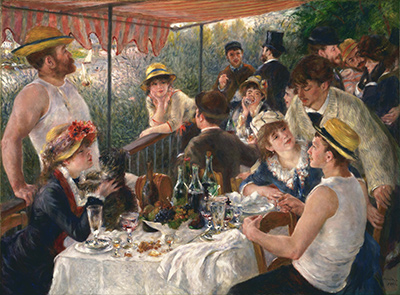
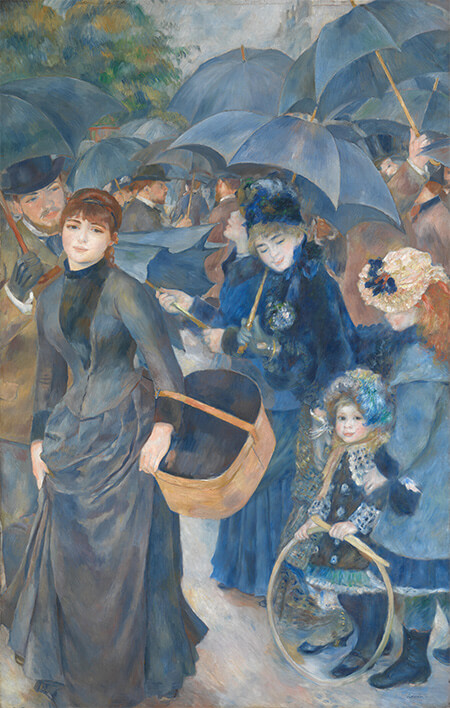
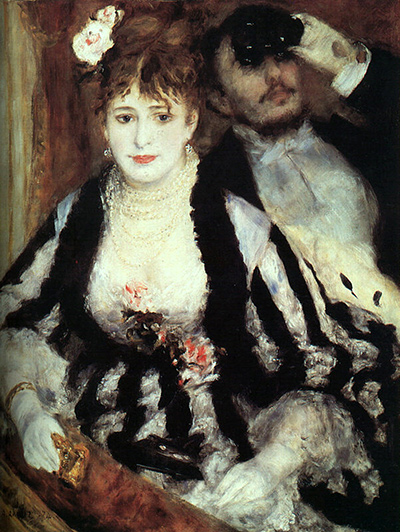
Explore a Montmartre dance, a gathering beside the Seine and the drawings behind Renoir’s paintings.
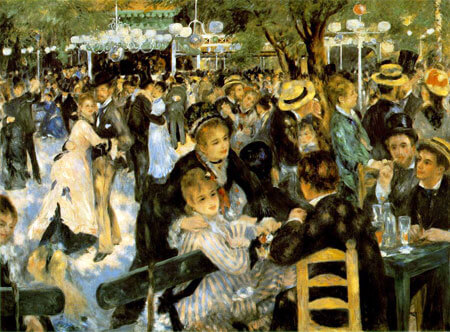
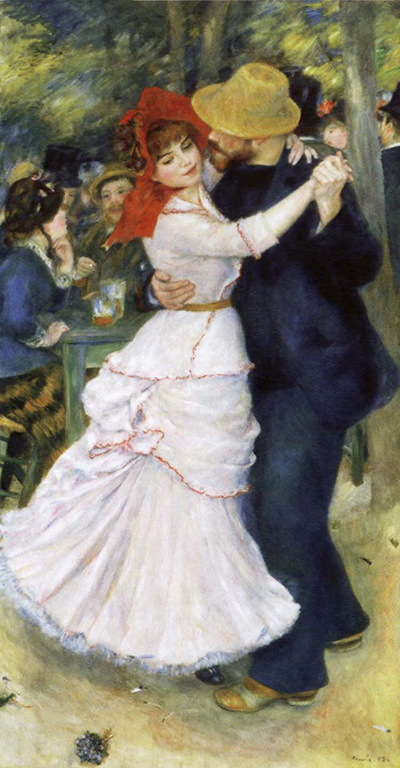
Renoir, Bal du moulin de la Galette
Dr. Beth Harris and Dr. Steven Zucker discuss Renoir’s 1876 Montmartre dance scene, its light and its crowds.
Watch on YouTubeA friend seen through a chair
Renoir brings the chair close to the picture’s lower edge. Its warm, bright rails stand out against Sisley’s almost-black coat and the shadowed room. The chair separates us from him while also making his pose feel unusually near. His body turns towards us, but his eyes drift away; his raised hand and slightly bowed head suggest a pause in conversation. It would go too far to name his exact thought. The painting gives posture and expression, not a written account of Sisley’s mood.
The white cuff at Sisley’s face and the small light area near his hanging hand interrupt the dark clothing. Above them, Renoir lets green, blue and yellow marks carry the hair, beard and surrounding wall. The head remains legible, but its surface does not conceal every brushstroke. The Art Institute’s technical study describes the distinctive short, loaded strokes as a feature Renoir also used in other portraits of 1876–77. That comparison helps explain the museum’s date for a canvas without a written year. Art Institute technical and dating study. [2]
The chair is a deliberate compositional tool. Its open spindles let us see the dark coat behind them; the curved rail pulls attention back towards the hands and face. Renoir placed Sisley across its back, a relaxed arrangement quite different from a sitter seated squarely with hands arranged for display. The visible design is persuasive, but it was not reached in one untouched session.
What the technical study changes
X-radiography and infrared examination at the Art Institute show Renoir revising the arms, cuffs, shoulder and chair. The right shoulder was raised, both sleeves were broadened, and the position of the hands appears to have changed. The museum treats the earliest arrangement of the arms as a possibility, not a fully recovered pose: the images may indicate that both hands were once nearer the top of the chair. Paint analysis also records different kinds of strokes in the beard and small final touches of bright colour in the eyes and chair. Art Institute technical report. [2]
These findings matter to the viewer because the finished portrait can feel direct and unforced. The research shows a painter testing how a person should occupy the canvas. Renoir adjusted the body’s outline, the interval between sitter and chair, and the points of light that hold the darker passages together. That does not make the expression false; it makes the apparent ease the result of choices. The museum’s X-ray and infrared images are research evidence here, not image assets reproduced on this page.
At Monet’s house: a remembered setting
Decades after the painting was made, Monet remembered Renoir painting Sisley at his house in Argenteuil, with Sisley astride a chair. The Art Institute cites that recollection and connects it to Monet’s second Argenteuil home, the Pavillon Flament. Because Monet spoke in 1926, the recollection is useful testimony but should not be treated as a contemporary diary entry. It supports the setting without proving every detail of the sitting. Art Institute catalogue discussion. [2]
The three artists’ connection was older. They met in Gleyre’s studio, and Renoir and Sisley painted landscapes together around Fontainebleau in the 1860s. Sisley had also appeared in earlier Renoir compositions. The Art Institute contrasts this portrait with Renoir’s earlier, more conventional depictions of Alfred and his father William. Here the sitter’s informal position and the canvas’s visible handling align his portrait with the painters’ shared experiments, while keeping him recognisably an individual. Art Institute scholarly catalogue. [2]
The portrait should not be read as proof that their friendship remained unchanged. Both painters had to decide how to balance independent exhibitions with the official Salon and the search for buyers. The Art Institute records later tensions and gaps in the evidence about their relationship. Their early collaboration and this 1876 sitting are secure; a simple story of lifelong harmony is not. For the broader relationship, see the Renoir biography and the separate portrait of Claude Monet.
Their decisions in 1879 show the practical stakes. Both men submitted work to the Salon rather than joining the fourth Impressionist exhibition. Renoir's Charpentier portrait was accepted; Sisley's submission was refused. The Art Institute records a June letter in which Renoir urged Georges Charpentier to arrange a show for Sisley at La Vie moderne, although that exhibition did not take place until November 1881. The failed Salon submission and the attempt to help a friend sit alongside the catalogue's account of later estrangement. They establish neither a sudden rupture in 1879 nor an uninterrupted partnership. Art Institute, Alfred Sisley scholarly catalogue. [3]
A portrait shown with modern-life paintings
The 1877 Impressionist exhibition placed this portrait before a public audience alongside other Renoir works, including Dance at Le Moulin de la Galette. Renoir displayed several portraits rather than treating the genre as a retreat from experimental painting. The Chicago catalogue situates the Sisley picture among likenesses of patrons and public figures shown at the same exhibition. The group could present portraiture as an arena for new paint handling and new ways of describing a person. Art Institute exhibition and curatorial record [2]; Musée d’Orsay, Bal du moulin de la Galette. [4]
A contemporary supporter, Georges Rivière, singled out the likeness and its artistic value. The point is not that every viewer agreed. His response shows that a friend’s portrait was discussed as a work of art in its own right, not only as a record of who belonged to Renoir’s circle. The original 1877 catalogue called it Portrait de M. Sisley; the Art Institute’s shorter title identifies the same sitter and object. Art Institute catalogue, reception and title record. [2]
From Murer’s collection to Chicago
The collector Eugène Murer acquired the Sisley portrait among a group of Renoir paintings, apparently after the 1877 exhibition. The Art Institute’s account qualifies the transaction because the surviving evidence does not pin down every detail. By early 1883 the picture was associated with Murer when Renoir sought to borrow it for a retrospective arranged by Durand-Ruel. The catalogue does not establish that it was actually displayed there. This distinction prevents an intended loan from being turned into an exhibition fact. Art Institute provenance discussion. [2]
The work later passed through other collections and entered the Art Institute of Chicago as part of the Mr. and Mrs. Lewis Larned Coburn Memorial Collection, accession 1933.453. Its Chicago home gives the portrait a public setting far from the room where Renoir and Sisley sat. The museum’s detailed catalogue traces that route, the early exhibition, the changing titles and the physical history of the canvas separately. Art Institute object and provenance record. [2]
Looking again
Begin at the chair rather than the face. Follow its orange-gold rails to the hanging hand, then to the white cuff and the hand against Sisley’s cheek. Look at the dark coat next to the cooler wall and the small bright flecks in the beard and eyes. The informal pose seems settled; the technical record says it was worked out. The result shows how Renoir used a familiar sitter to test what an Impressionist portrait could do.
Renoir artworks directory
Questions about Alfred Sisley
He is Alfred Sisley, Renoir’s fellow painter and friend from their student years in Charles Gleyre’s studio. This is the 1876 Chicago portrait, not an earlier Renoir likeness of Sisley.
The Art Institute dates it to 1876. The canvas is undated, so the museum draws on the 1877 exhibition record and comparisons with Renoir’s painting technique of the period.
Monet later remembered the sitting at his house in Argenteuil. His recollection was recorded decades later; it is meaningful evidence, with that timing kept in view.
The picture belongs to the Art Institute of Chicago, inventory 1933.453. Consult the museum’s current object page for display information.
Discussion
What do you notice when you return to Alfred Sisley?
How do the chair and Renoir’s changes to the arms shape Sisley’s pose?
Reader Insights
How do the chair and Renoir’s changes to the arms shape Sisley’s pose?
The Art Institute dates the undated canvas through its 1877 exhibition and technical comparison.
How much can a later memory of a sitting at Monet’s home tell us about the finished picture?
Join the Conversation
Share a close observation or a source-backed question about Renoir’s portrait of Alfred Sisley.
References
- Art Institute of Chicago, Alfred Sisley, 1933.453, collection record View source.
- John Collins, “Alfred Sisley, 1876,” Renoir Paintings and Drawings at the Art Institute of Chicago, scholarly catalogue with technical report, 1877 exhibition, historical titles and provenance. The technical images are cited for research only View source.
- Art Institute, Alfred Sisley scholarly catalogue View source.
- Musée d’Orsay, Bal du moulin de la Galette, identification of the distinct 1876 canvas shown in 1877 View source.
- Musée d'Orsay exhibition database, Renoir's entries in the 1877 catalogue, including Portrait de M. Sisley at no. 190 View source.
- Whole-work reproduction for this page: Art Institute-derived file on Wikimedia Commons, CC0/Public Domain Mark. The Art Institute’s research X-rays and infrared images are cited as evidence but are not reproduced here View source.