by Tom Gurney
Tom Gurney BSc (Hons) is an art history expert with over 20 years experience
Published on June 19, 2020 / Updated on October 2, 2026
Email: tomgurney1@gmail.com / Phone: +44 7429 011000
A young woman in a pale dress cradles a striped cat close to her cheek. Her eyes turn toward it while its paws extend across her arms. In Woman with a Cat, Pierre-Auguste Renoir makes the meeting of two faces the centre of a small domestic image. The red chair, green wall and flashes of colour at the edges support that exchange without fixing a detailed room around them. The painting belongs to the National Gallery of Art in Washington, which dates it about 1875 and catalogues it as 1950.12.1. National Gallery of Art object record. [1]
The woman's name is not identified in the Gallery's record. It would be tempting to turn her into a member of Renoir's circle on the strength of her expression or clothing, but neither provides a reliable name. The same applies to the cat. This article can describe the visible relationship without inventing a household biography. National Gallery of Art. [1]
At a glance
- ArtistPierre-Auguste Renoir
- Museum titleWoman with a Cat
- Datec. 1875, the Gallery's approximate date
- Medium and sizeOil on canvas, 56 × 46.4 cm
- Signature“Renoir.” at lower left, according to the museum
- CollectionNational Gallery of Art, Washington, 1950.12.1
- AcquisitionGift of Mr. and Mrs. Benjamin E. Levy, 1950
Watch: Pierre-Auguste Renoir
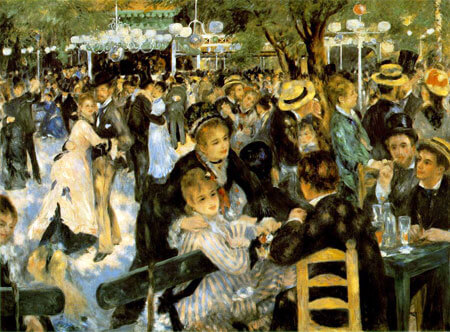
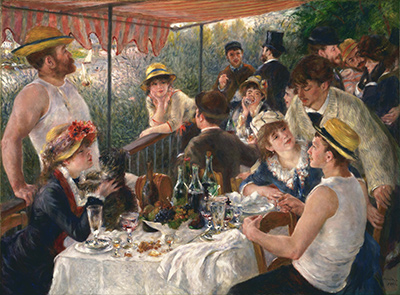
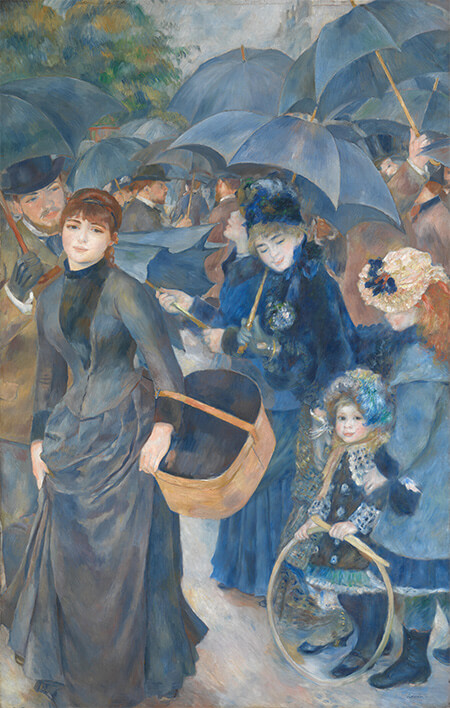
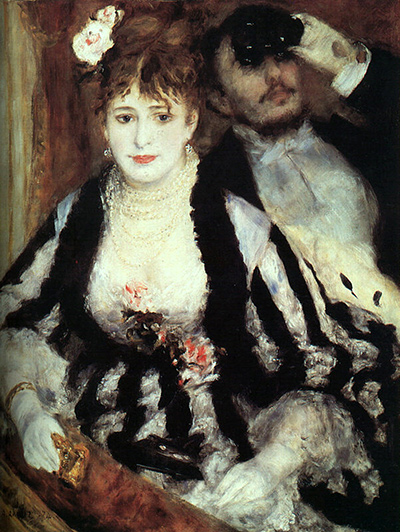
Explore a Montmartre dance, a gathering beside the Seine and the drawings behind Renoir’s paintings.
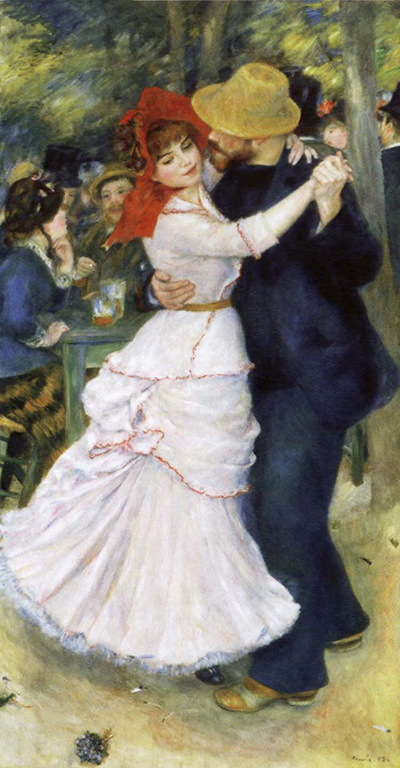
Renoir, Bal du moulin de la Galette
Dr. Beth Harris and Dr. Steven Zucker discuss Renoir’s 1876 Montmartre dance scene, its light and its crowds.
Watch on YouTubeThe museum currently lists the painting as not on view. That is a changing display status, not a statement about its ownership. Its object page offers an official public-domain image, allowing a close look at the soft paint and bright small details. National Gallery of Art object page and Open Access note. [1]
Two faces brought together
The woman's gaze directs ours to the cat. She does not face the viewer, and the animal is held upright beside her head. Renoir sets their eyes at different levels and paints their bodies as a linked group. Her right hand supports the cat near its chest, while her left arm holds its lower body. A bright green ring on her hand catches the light between pale skin and striped fur.
The cat is substantial, not a small decorative accessory. Its back and hind legs fill much of the right side. Dark stripes define the head and paws, but other marks of brown, grey and black run together in the fur. The paws extend rather than fold neatly, giving the animal a slightly awkward, living weight. The woman's arms have to carry that weight, which makes their contact convincing.
The National Gallery's visual description calls the cat brown and black and notes its head pulled back. That is more precise than describing the animal as simply content or affectionate. We cannot know whether it enjoyed the pose. What Renoir gives us is the visible act of holding it and the woman's attentive look. National Gallery of Art visual description. [1]
A pale figure in a colourful room
The woman's white dress is not painted with a single white. Cream, blue and grey strokes turn around the shoulders and sleeves. A narrow kerchief at the neck brings more blue into the central figure. The dress, skin and light hair make a broad pale shape against the muted burgundy chair. Renoir uses that contrast to keep her body readable without outlining every fold.
Behind them, a seafoam-green wall gives the heads a quiet field. At left is a thin band of patterned material, described by the Gallery as a floral curtain. At right, energetic red, orange, white and green strokes may represent flowers. The institution leaves that detail open in its visual description; the old page's confident “embroidery” label is not established by the image. The purpose of these peripheral colour patches is clear even if their exact objects are not: they stop the setting from becoming an empty studio backdrop. National Gallery of Art visual description. [1]
The composition is close. The woman's hair approaches the upper edge, while the cat's body and the arm beneath it occupy the lower right. There is little view into the room. This intimacy differs from a full-length portrait that identifies a sitter through furnishings or status. Here the shared space between two faces is enough to hold our attention. That reading comes from the canvas; the museum does not identify a particular home or owner of the cat.
Date, signature and an unnamed sitter
The Gallery dates the canvas c. 1875, with the “c.” indicating an estimate. It records a lower-left signature “Renoir.”, but does not give a year in the inscription. Thus “1875” should not be written as if it appears beside Renoir's name on the picture. The date comes from the museum's cataloguing of the work. National Gallery of Art object details. [1]
The institution names the subject only in the title Woman with a Cat. A title can identify what we see without resolving the sitter's personal identity. Her bright ring, fashionable hair and pale dress may invite stories about her life, but they cannot establish her name, social class or relation to the artist. Likewise, the painting's first recorded owner, Ernest Hoschedé, is part of the work's provenance, not evidence that the sitter belonged to his family. National Gallery of Art provenance. [1]
Renoir later painted another young sitter with a cat: Julie Manet of 1887, now at the Musée d'Orsay, inventory RF 1999 13. That work has a named child and a documented commission from her parents, Berthe Morisot and Eugène Manet. It is not this Washington painting, nor evidence that the unnamed woman here was Julie or connected to the same household. The comparison is useful precisely because the later portrait has sitter documentation that the earlier canvas lacks. Musée d'Orsay, Julie Manet. [2]
From a private collection to Washington
The National Gallery traces the painting to Ernest Hoschedé in Paris. It appeared in his sale of 6 June 1878, where Count de Rasty bought it. The museum then records Countess de Rasty's sale in 1925 or 1926 to dealer Paul Rosenberg. By 1932 it had been sold to Benjamin E. Levy. Mr. and Mrs. Levy gave it to the National Gallery in 1950. The owner record supports these steps; it does not say where Renoir painted the picture or how Hoschedé first obtained it. National Gallery of Art provenance. [1]
The 1878 sale is especially useful because it shows the painting circulating only a few years after its approximate creation. Its later dealer and collector path explains how an intimate French canvas reached a Washington museum. Provenance concerns the object's passage between owners, however; it does not tell us whether the woman and cat belonged to any of them.
The Gallery's exhibition history includes a possible appearance at Durand-Ruel in 1899, followed by a documented listing at the 1900 Exposition universelle and later twentieth-century exhibitions. The word “possibly” is important for the 1899 match. It would be unsound to describe every catalogue mention as proof that this exact canvas was displayed, or to treat a past tour as its present location. National Gallery of Art exhibition history. [1]
How to look at the painting
Begin at the woman's downturned eyes. Follow her glance to the cat's face, then trace the paw stretching across her wrist. Look for the green ring, the blue in the white dress and the small bursts of warm colour at each side of the green wall. These details show Renoir's care with contact, colour and the texture of fur. The official record lets us date the work cautiously, identify its museum and trace its owners, while leaving the sitter's name open.
Renoir artworks directory
Questions about Woman with a Cat
Her identity is not given in the National Gallery of Art's object record. The canvas shows a young woman holding a cat; neither a sitter name nor a precise setting is documented there.
The museum dates it about 1875. It records Renoir's signature at lower left, but no dated inscription, so the year remains approximate.
It belongs to the National Gallery of Art, Washington, accession 1950.12.1. The museum currently lists it as not on view; check its object page before visiting.
No. Renoir's Julie Manet was painted in 1887 and belongs to the Musée d'Orsay. Its named child and commission are documented separately from the unnamed woman in the Washington canvas.
Discussion
What do you notice when you return to Woman With A Cat?
How does the woman’s glance connect her face with the cat’s?
Reader Insights
How does the woman’s glance connect her face with the cat’s?
The NGA identifies the canvas as c. 1875 but does not name its female sitter.
Which touches of colour stand out around the pair and their green background?
Join the Conversation
Share a close observation or a source-backed question about Renoir’s woman with a cat.
References
- National Gallery of Art, Renoir, Woman with a Cat, 1950.12.1: title, approximate date, medium, dimensions, signature, visual description, provenance, exhibition history and display status View source.
- Musée d'Orsay, Renoir, Julie Manet, RF 1999 13: separate 1887 child-and-cat portrait and its documented family commission View source.
- National Gallery of Art, Open Access policy: terms for the museum's public-domain image View source.
- Whole-work image: National Gallery of Art official public-domain download, 3454 × 4096 pixels, reduced for the local page to a 1024-pixel longest side View source.