by Tom Gurney
Tom Gurney BSc (Hons) is an art history expert with over 20 years experience
Published on June 19, 2020 / Updated on October 2, 2026
Email: tomgurney1@gmail.com / Phone: +44 7429 011000
A child stands in a garden with a green watering can in one hand and two daisies in the other. Her dark blue dress is edged with pale lace; a red bow is tied in her blond hair. Pierre-Auguste Renoir made A Girl with a Watering Can in 1876, signing and dating it at the lower right. The National Gallery of Art, Washington, owns the painting as 1963.10.206. National Gallery of Art object record. [1]
Her expression is mild and attentive, but the surrounding garden is less firmly described. The path and flowers break into small touches of colour; the face has smoother modelling. This balance between a recognisable child and an atmospheric setting is central to the painting. It is also a reason to look at the objects she carries. The watering can and daisies give her a small activity, while her neat clothes and still pose remind us that this is a carefully arranged picture rather than a candid record of gardening. NGA object essay. [1]
At a glance
- ArtistPierre-Auguste Renoir
- Holder titleA Girl with a Watering Can
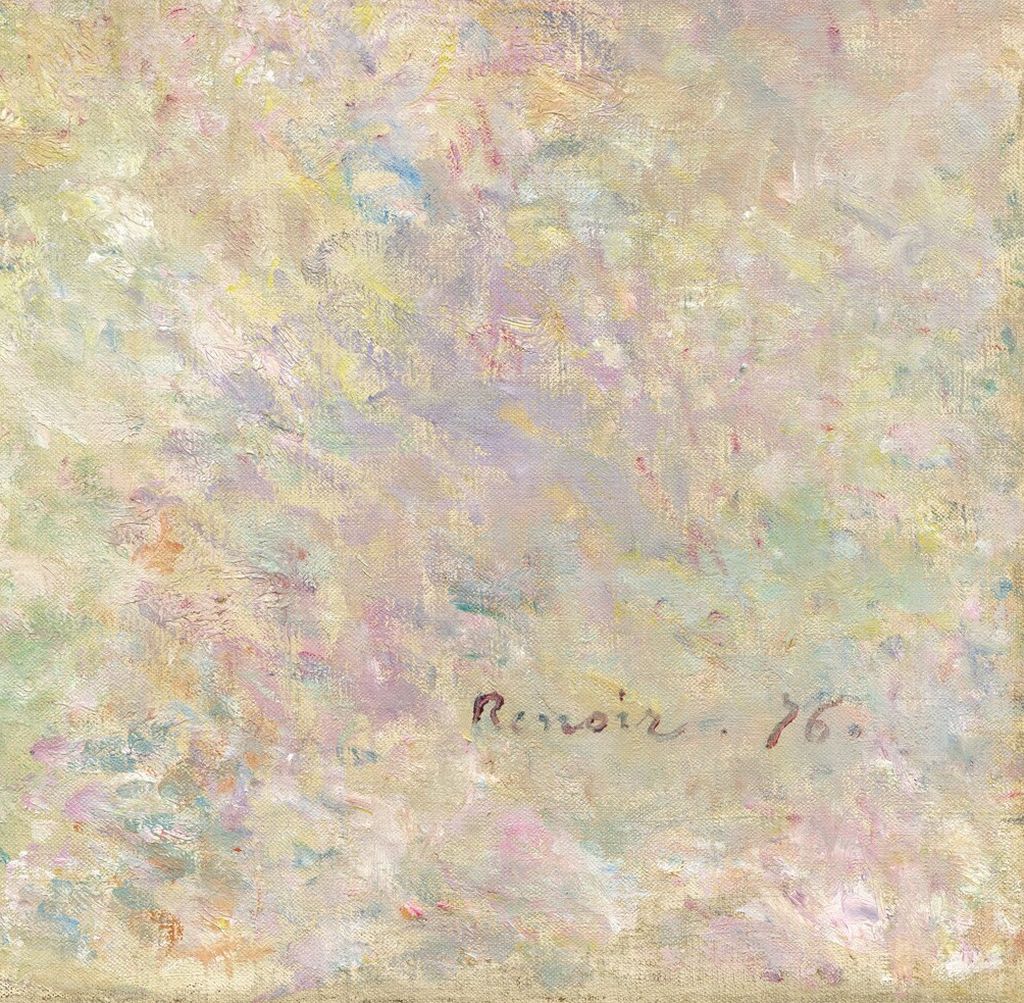
- Date1876, signed “Renoir. 76”
- MediumOil on canvas
- Dimensions100 × 73 cm
- CollectionNational Gallery of Art, Washington, 1963.10.206, Chester Dale Collection
The local page address abbreviates the title to “Girl with a Watering Can.” The museum uses A Girl with a Watering Can. That small difference does not indicate another version; this article follows the NGA canvas, title and accession record. NGA object record. [1]
This work in Renoir’s career
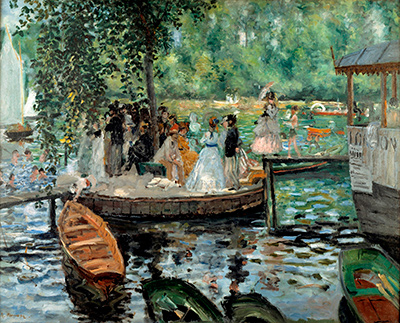
La Grenouillère
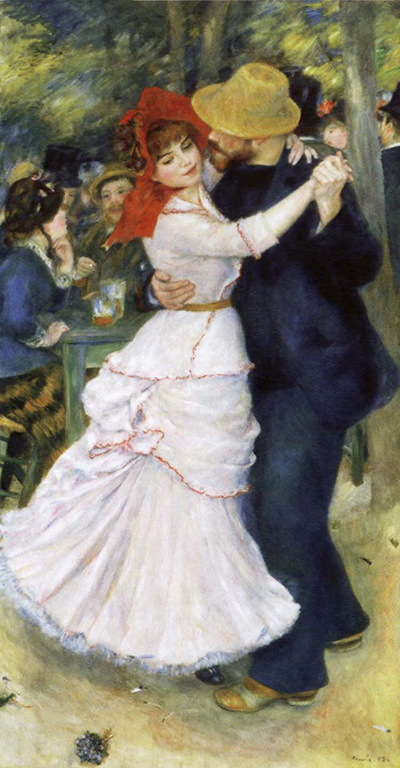
1869La Loge
1874The Umbrellas
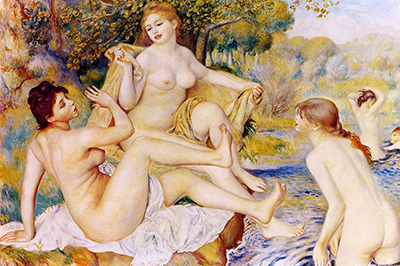
c. 1881–86The Great Bathers
1884–87The Bathers
1918–19Contents
- Annotated details of the painting
- What the child holds
- Blue dress, red bow and the turning path
- A sharply noticed face in a loose garden
- Can we name the girl?
- 1876 in Renoir's work
- Compare a stage figure and a crowd
- What is known of its ownership?
- Looking again
Annotated Details from A Girl with a Watering Can
The child is unidentified, but Renoir gives us precise things to see: a face, blue dress, red bow, watering can and daisies amid the loose garden.
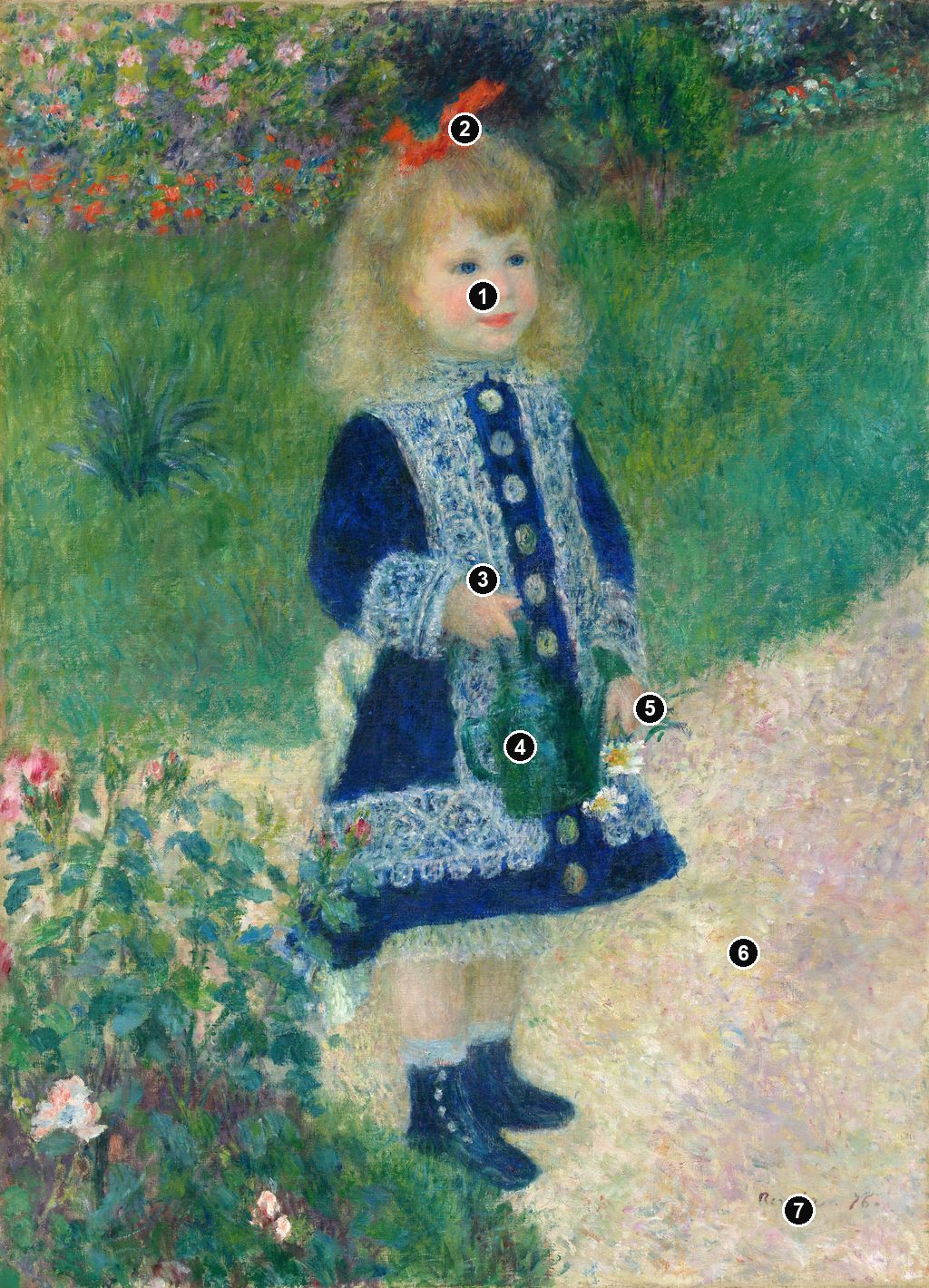
Details from A GIRL WITH A WATERING CAN
Follow the contrast between carefully modelled figure and freer flowers and path. The National Gallery of Art does not accept any proposed personal identification of the child.
The child's face
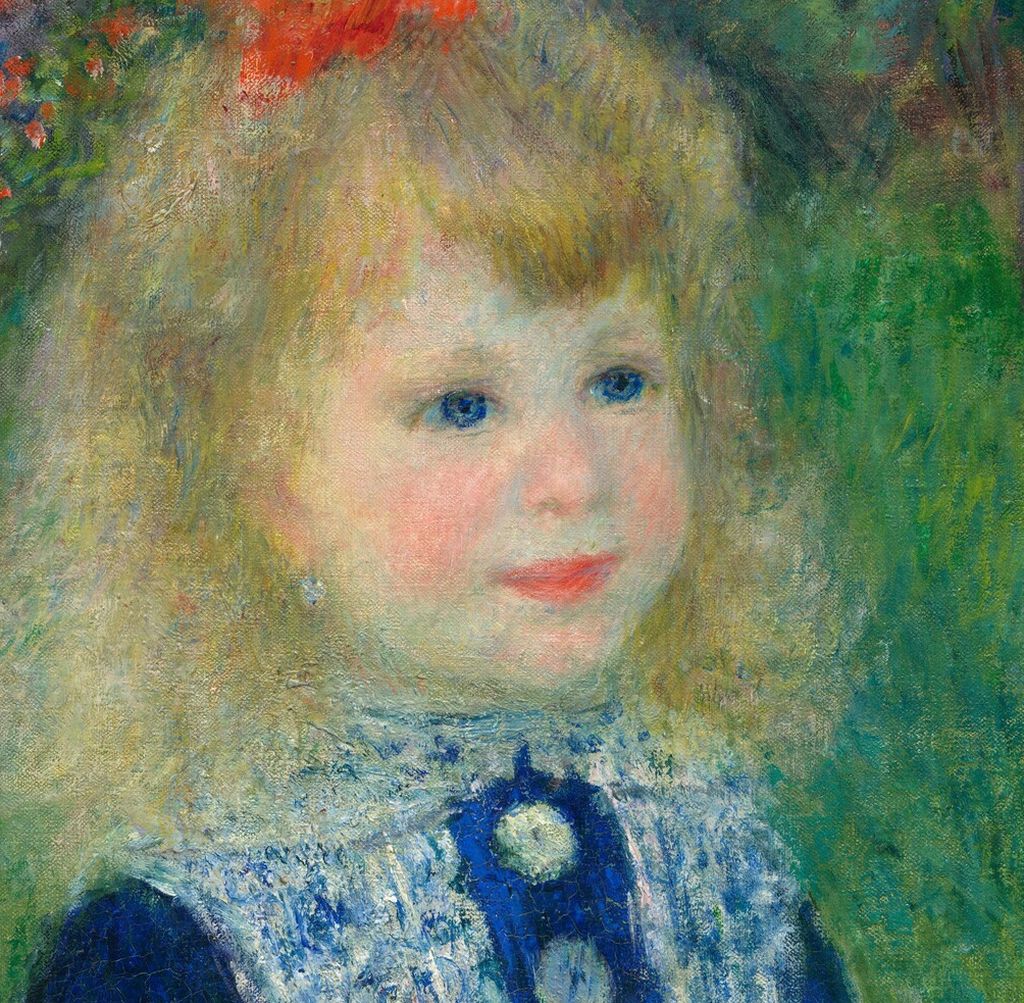
Small, even touches model the child's face more firmly than the surrounding plants. Her personal identity remains unverified.
Red hair bow
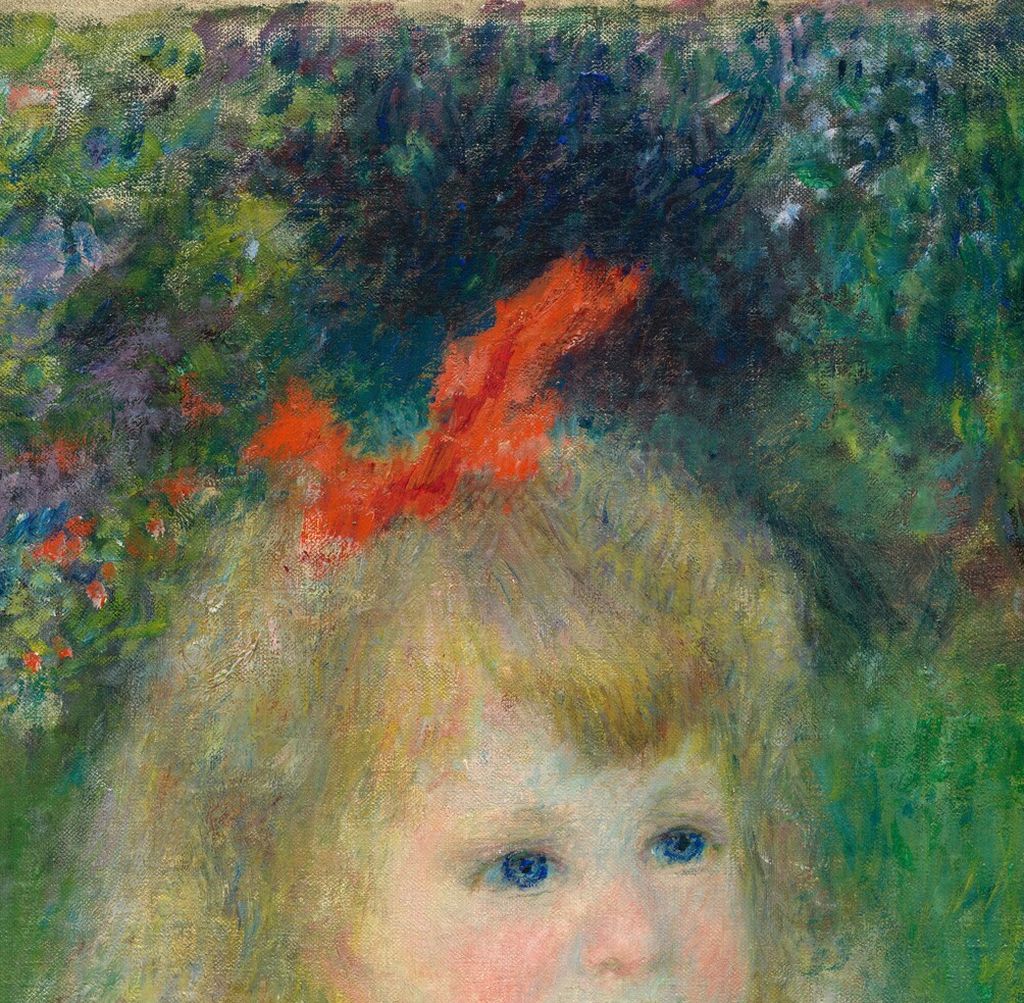
A red bow answers the warm flowers across the upper garden border.
Blue dress and lace
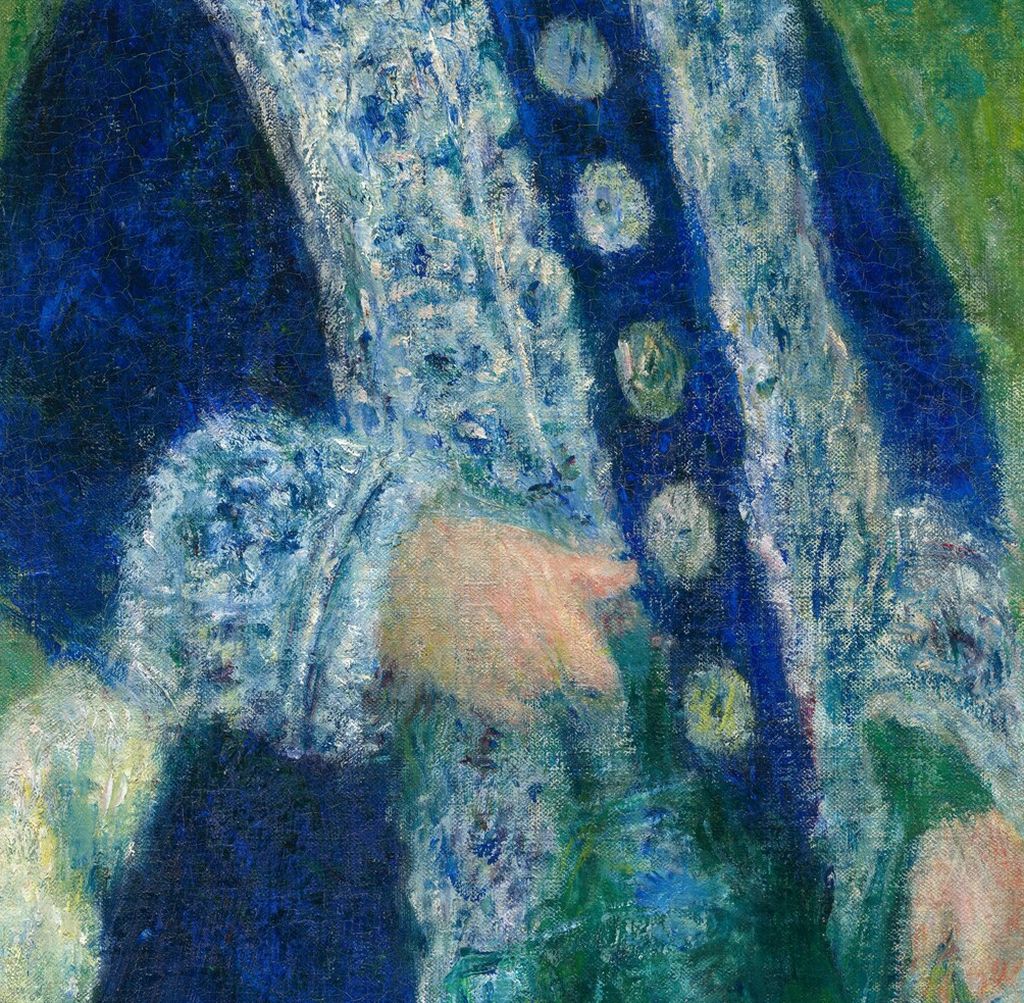
Pale lace along the child's dark blue dress makes a clear pattern against the green garden.
Green watering can
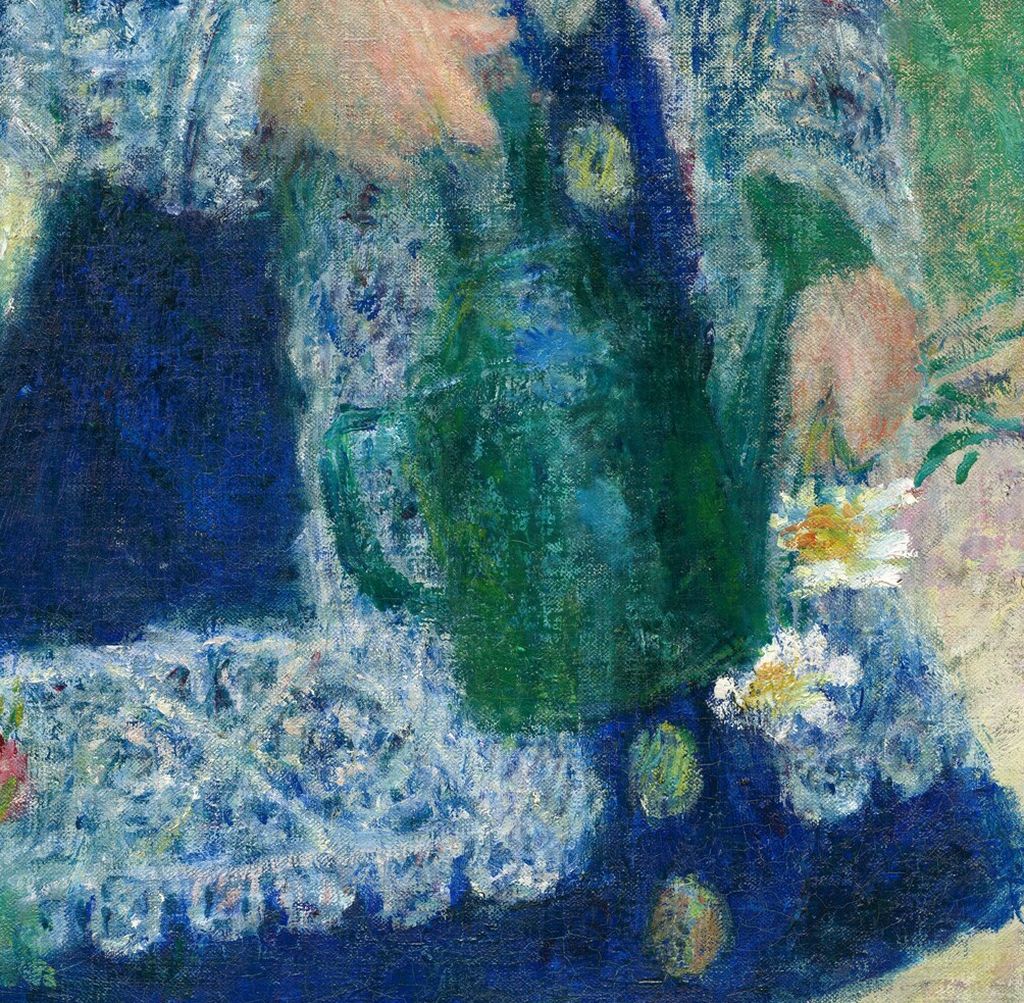
A finger hooks through the watering can's handle. The object suggests garden work without showing water being poured.
Two daisies
The child carries small white daisies in her other hand, a quiet counterpart to the broader flower beds.
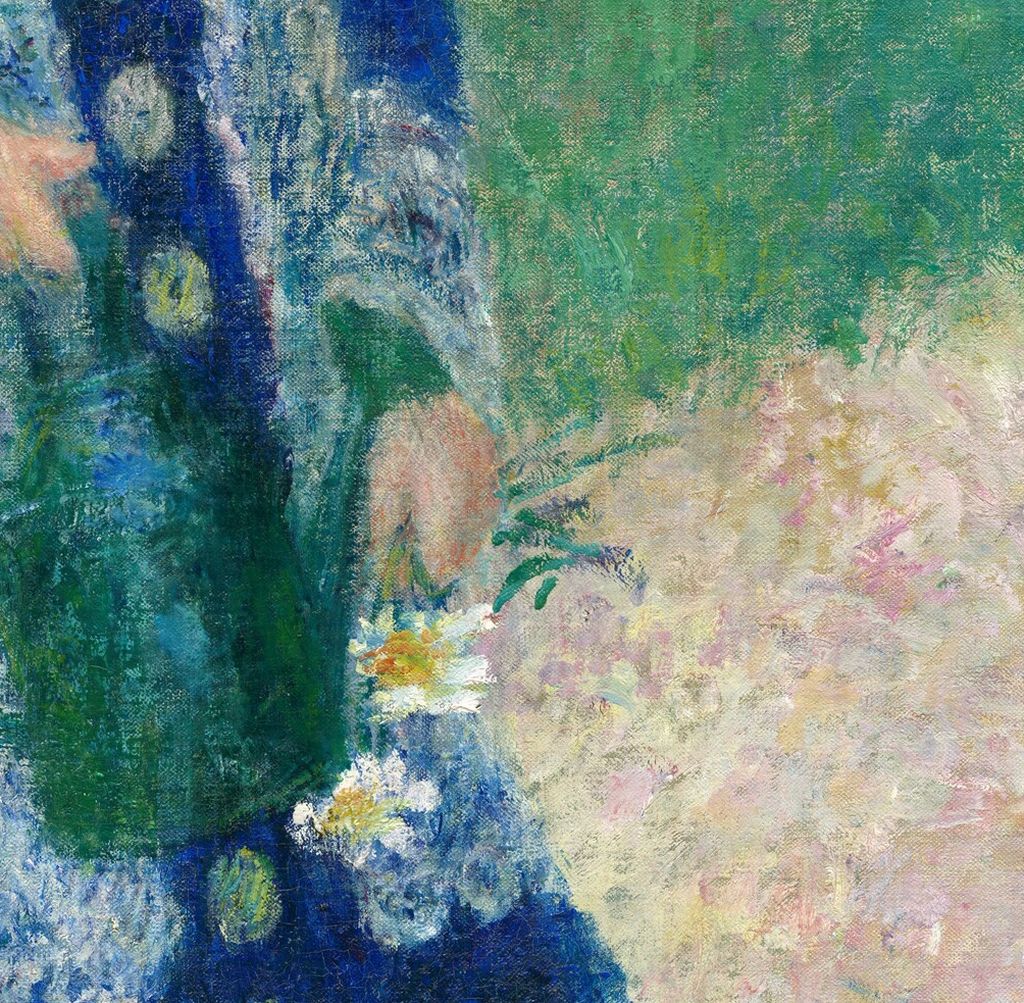
Flowers and path
Pale pink, green and white touches build the curving path, whose edges soften into plants.

Signed in 1876
Renoir signed and dated the lower right of the canvas, anchoring the picture to 1876.
Watch: Pierre-Auguste Renoir
Explore a Montmartre dance, a gathering beside the Seine and the drawings behind Renoir’s paintings.
Renoir, Bal du moulin de la Galette
Dr. Beth Harris and Dr. Steven Zucker discuss Renoir’s 1876 Montmartre dance scene, its light and its crowds.
Watch on YouTubeRenoir artworks directory
What the child holds
The girl's raised hand hooks a finger through the handle of a green watering can. Its dark body sits against the blue of her dress. In the other hand she holds two small daisies at her side. Renoir could have made the flowers and can the centre of a narrative about work in the garden, but the child is poised rather than busy. No water pours from the spout. The garden activity is suggested by the objects, not illustrated as a sequence of actions. NGA visual description. [1]
The path curves behind her through colour broken into pale white, green, pink and violet. At the lower left, plants rise toward the dress; a border of red and pink flowers runs across the upper part. These bands place the child in a planted space without giving a precise address or a gardener's plan. The National Gallery's description identifies the forms but gives no documented location for this particular garden. It would be tempting to name a Paris suburb from Renoir's broader work; the picture's own record does not support doing so. NGA object record. [1]
The red bow and flower border answer one another across the canvas. The pale lace at the child's neckline and hem links her costume with light touches along the path. Her blue shoes echo the dress, bringing the colour from head level toward the ground. These repetitions keep a tall picture unified even though the background is loosely treated. The watering can is a quieter green accent among the brighter garden colours.
Blue dress, red bow and the turning path
The girl stands near the centre, but Renoir keeps the pose from becoming rigid. Her body turns slightly while her face looks to the side. The raised arm holding the can makes one small outward movement; the other hand, with daisies, hangs low. Those unequal arms give the portrait a gentle rhythm. The objects are light enough for a child to hold, yet they do not turn her into a tiny worker at a specific task.
Her dress supplies the largest block of colour. Dark cobalt blue is interrupted by pale lace at the neck, front and hem. Small white buttons run down the bodice, and white socks show above blue ankle boots. These details give the outfit enough structure to stand against the scattered garden marks. The red bow is the brightest point near her face; it answers the flower border beyond her without making the two areas identical. NGA visual description. [1]
The path curls behind the child rather than heading straight to a vanishing point. Its pale touches recur at her lace and in the two daisies. At the lower left, a leafy bush rises toward the skirt, while farther back pink and purple flowers form a soft horizontal band. The child is placed between these near and far plants. Renoir has made a garden that feels full of light and growth without giving enough fixed landmarks to locate it precisely.
A sharply noticed face in a loose garden
The face is carefully modelled. The eyes, cheeks and small smile are built with even, delicate touches. The National Gallery contrasts this controlled handling with the freer marks of the landscape. Renoir did not need to choose between an exact outline everywhere and a dissolved surface everywhere. He could let a child remain vivid while light in the surrounding garden was rendered with less definite edges. NGA object essay. [1]
This difference also guides the viewer's attention. From a distance, the blue dress makes one large shape against the green ground. Coming closer, the texture of its lace and the child’s face slow the eye. The flowers and path then pull it outward into repeated patches of colour. Renoir gives different jobs to different kinds of brushstroke. It is an Impressionist picture attentive to changes of light, yet its figure does not disappear into the atmosphere.
The girl's stillness may contribute to the painting's lasting popularity, but it can hide the decisions behind its apparent ease. Renoir placed the child almost centrally, turned her body slightly, and used her two hands to balance can and daisies. Her foot position and the curve of the path give the image a gentle direction. None of those arrangements proves a spontaneous moment; they are visible compositional choices.
Can we name the girl?
The National Gallery of Art says that no proposed specific identification is convincing. It suggests she may have been a neighbourhood child whose appearance Renoir liked, and notes a girl with similar blond hair, blue eyes and costume in other works. A resemblance across pictures does not provide a secure name. This canvas should therefore be described as a painting of an unidentified child, not as a confirmed portrait of a patron's daughter or one of Renoir's own children. NGA object essay. [1]
This uncertainty changes how we read the painting. The child is intensely present in colour and expression, but the museum record cannot tell us her personal history. We can see her clothes and props; we cannot know whether the watering can was hers or selected for the pose. Calling the picture an anecdotal child study describes its effect, not a recovered biography. The limit is worth keeping because an attractive story can quickly become an unsupported fact in repeated retellings.
Renoir's interest in children and women grew in works around this time, according to the NGA. The painting is one example of how he combined a pleasing subject with formal experiment. Its appeal does not rely on a sitter name. It comes from the relation between a small figure, a carefully controlled face and a garden that feels larger than the canvas. NGA object essay. [1]
1876 in Renoir's work
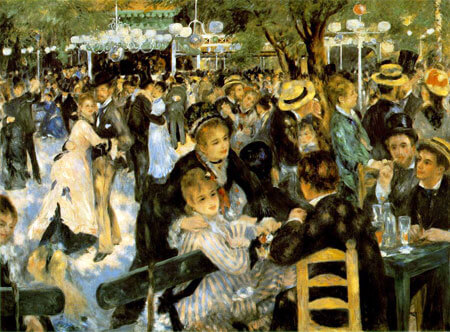
Renoir painted this canvas in the same year as Dance at Le Moulin de la Galette. The subjects are very different in scale: one child in a garden and a crowded Montmartre dance venue. Both, however, place figures within light and colour rather than setting them against a neutral backdrop. Comparing them helps prevent the small painting from being treated as a sentimental exception to Renoir's work on modern life.
The museum's account calls the child's treatment a mature Impressionist approach adjusted to figure painting. That is more precise than a claim that Renoir simply applied landscape technique to a portrait. The face has coherence, while the garden's forms loosen around it. Such variation is a feature of the canvas itself, not a label placed on every picture Renoir made in the 1870s. NGA object essay. [1]
Compare a stage figure and a crowd
The same National Gallery holds Renoir's The Dancer, dated 1874. A young performer stands almost full length in pale blue costume against a quiet green backdrop. The gallery describes delicate attention to her face and freer handling of her gauzy skirt and setting. That makes it a close formal comparison to A Girl with a Watering Can: both isolate one figure in a tall canvas and vary the detail between face and surroundings. The Dancer was among Renoir's seven works at the first Impressionist exhibition in 1874. The NGA judges its model almost certainly Henriette Henriot, while noting that Renoir did not identify her himself. That proposed sitter is not an identity for the later garden child: the two paintings have different dates, subjects and models. NGA, The Dancer, 1942.9.72. [2]
 Pierre-Auguste Renoir.jpg)
The comparison is especially clear at the edges of the clothing. The dancer's pale tutu blends gently into the green surrounding paint, while the watering-can girl's deep blue dress holds a stronger silhouette against her garden. The dancer looks towards us; the younger child looks away. Renoir adjusted the balance between a precise face, a readable garment and a softer environment to suit each picture rather than following one formula.
The 1876 Bal du moulin de la Galette makes a different comparison. There the same painter fills a wide scene with people moving beneath trees, and patches of light fall across clothing and ground. A Girl with a Watering Can is quieter and more concentrated, but its flecked path and flower border show Renoir giving the single child an environment rather than a blank portrait backdrop. The paintings share a date and an interest in figures surrounded by changing light; no evidence makes the garden a study for the Montmartre dance or places the two scenes at one site. Musée d'Orsay, Bal du moulin de la Galette. [3]
What is known of its ownership?
The NGA's provenance begins with uncertainty. It says the painting was possibly commissioned around 1876 for the Sellière Collection in Paris. “Possibly” matters: the entry does not establish that commission as a fact. The later record includes several owners and dealers, among them banker and Renoir patron Paul Bérard and the Prince de Wagram, but the precise early chain has gaps. NGA provenance. [1]
The later sequence is clearer. Dealer records cited by the gallery place a sale to Chester Dale in September 1931. Dale's 1963 bequest brought the painting to the National Gallery of Art. Its accession number, 1963.10.206, belongs to that museum acquisition, not to the year Renoir made the painting. The distinction is small but useful: the 1876 object circulated through collections long before it became a public American work. NGA provenance. [1]
Looking again
Begin with the can's handle, where the child's finger hooks over it. Follow the arm upward to the pale lace at her shoulder and then to her face. Move from the red bow across the flower border, then down the path to the daisies. The route makes the painting's structure clear: strong blue and green shapes carry a pattern of small red and pale accents. Its subject is a child in a garden, but its effect depends on how Renoir made her stand between precise observation and loose colour.
Questions about A Girl with a Watering Can
She is unidentified. The National Gallery says that proposed names have not been convincing. A similar child appears in other Renoir paintings, but that resemblance is not a documented identity.
Renoir signed and dated it 1876. It is an oil painting on canvas, 100 × 73 cm.
A green watering can in one hand and two daisies in the other. The can suggests gardening, although she is posed rather than shown pouring water.
In the National Gallery of Art, Washington, accession 1963.10.206, part of the Chester Dale Collection. Check the museum's current record for display information before visiting.
Discussion
Look closely at Girl with a Watering Can and use the questions below to compare what you see with the documented history.
Reader Insights
How do the flowers, path and watering can frame the child?
The NGA identifies the object while treating the sitter cautiously.
Does the picture need a named sitter to be a compelling portrait?
Join the Conversation
Share a close observation or a source-backed question about Girl with a Watering Can. The prompts above are starting points for discussion.
References
- National Gallery of Art, Washington, A Girl with a Watering Can, 1963.10.206, object essay, visual description, dimensions and provenance View source.
- National Gallery of Art, Washington, The Dancer, 1942.9.72, distinct 1874 painting and public-domain media View source.
- Musée d'Orsay, Bal du moulin de la Galette, RF 2739, distinct 1876 crowd painting View source.
- Whole-work reproduction from the museum's official public-domain IIIF image. Credit National Gallery of Art, Washington, Chester Dale Collection, 1963.10.206 View source.