 by Tom Gurney
Tom Gurney BSc (Hons) is an art history expert with over 20 years experience
Published on June 19, 2020 / Updated on October 2, 2026
Email: tomgurney1@gmail.com / Phone: +44 7429 011000
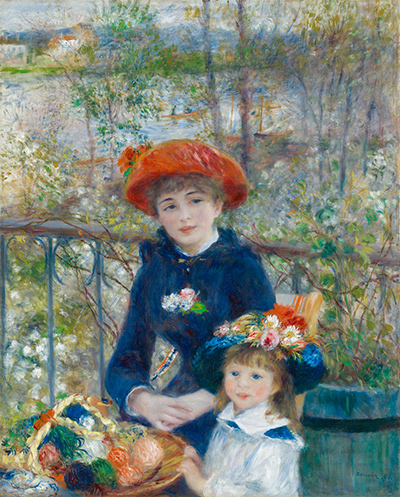
Two figures sit close together on a terrace above the Seine. A young woman in dark blue, under a broad red hat, faces us. A small girl with an enormous flowered hat stands beside her and rests a hand near a basket of bright yarn. In Pierre-Auguste Renoir's Two Sisters (On the Terrace), the people look carefully composed while the river and spring foliage behind them seem to move in light. The Art Institute of Chicago owns the 1881 canvas as 1933.455. Art Institute scholarly catalogue. [1]
The title invites a family story, but the two models were not sisters. The seated woman was Jeanne Darlaud, an eighteen-year-old aspiring actress; the younger child's identity has not been established. The dealer Paul Durand-Ruel applied the French title Les deux soeurs for the seventh Impressionist exhibition in 1882. Holding that title and the model evidence apart makes the painting more interesting: Renoir constructed a convincing pair without documenting a real sibling relationship. Art Institute catalogue, “The Models” and exhibition history. [1]
At a glance
- ArtistPierre-Auguste Renoir
- Current titleTwo Sisters (On the Terrace)
- Date1881, signed “Renoir. 81.”
- MediumOil on canvas
- Dimensions100.4 × 80.9 cm
- CollectionArt Institute of Chicago, 1933.455, Mr. and Mrs. Lewis Larned Coburn Memorial Collection
- Early exhibitionSeventh Impressionist group exhibition, Paris, March 1882, catalogue no. 138, as Les deux soeurs
The scene is set at the Restaurant Fournaise in Chatou, a riverside place Renoir returned to for views of leisure and boating. A balcony rail separates the figures from the Seine. Through the branches we glimpse water, boats and the opposite bank. This is also the setting of Luncheon of the Boating Party, but it is a different painting, with a smaller group and a more upright composition. Art Institute catalogue. [1]
This work in Renoir’s career
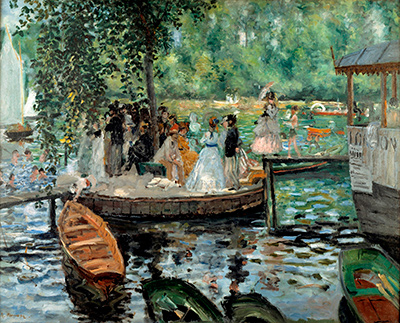
La Grenouillère
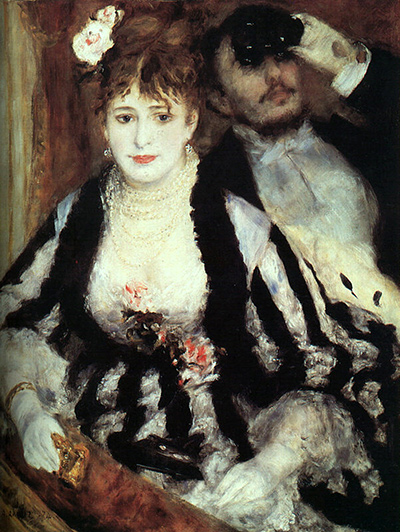
1869La Loge
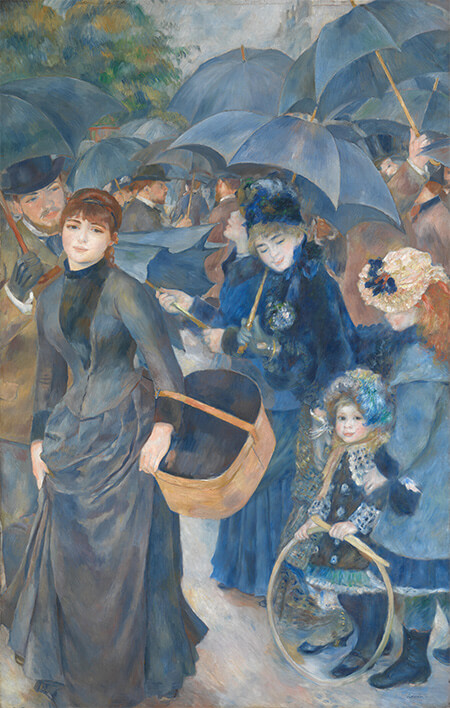
1874The Umbrellas
c. 1881–86The Great Bathers
1884–87The Bathers
1918–19Contents
- Annotated details of the painting
- A terrace in spring
- Who are the models?
- Several names for one picture
- How Renoir revised the composition
- Chatou and a family portrait
- Dealer, exhibition and collection
- Looking again
Annotated Details from Two Sisters (On the Terrace)
Two unrelated models stand together above the Seine. Follow the numbered details from their hats and faces to the basket, rail and light river background.
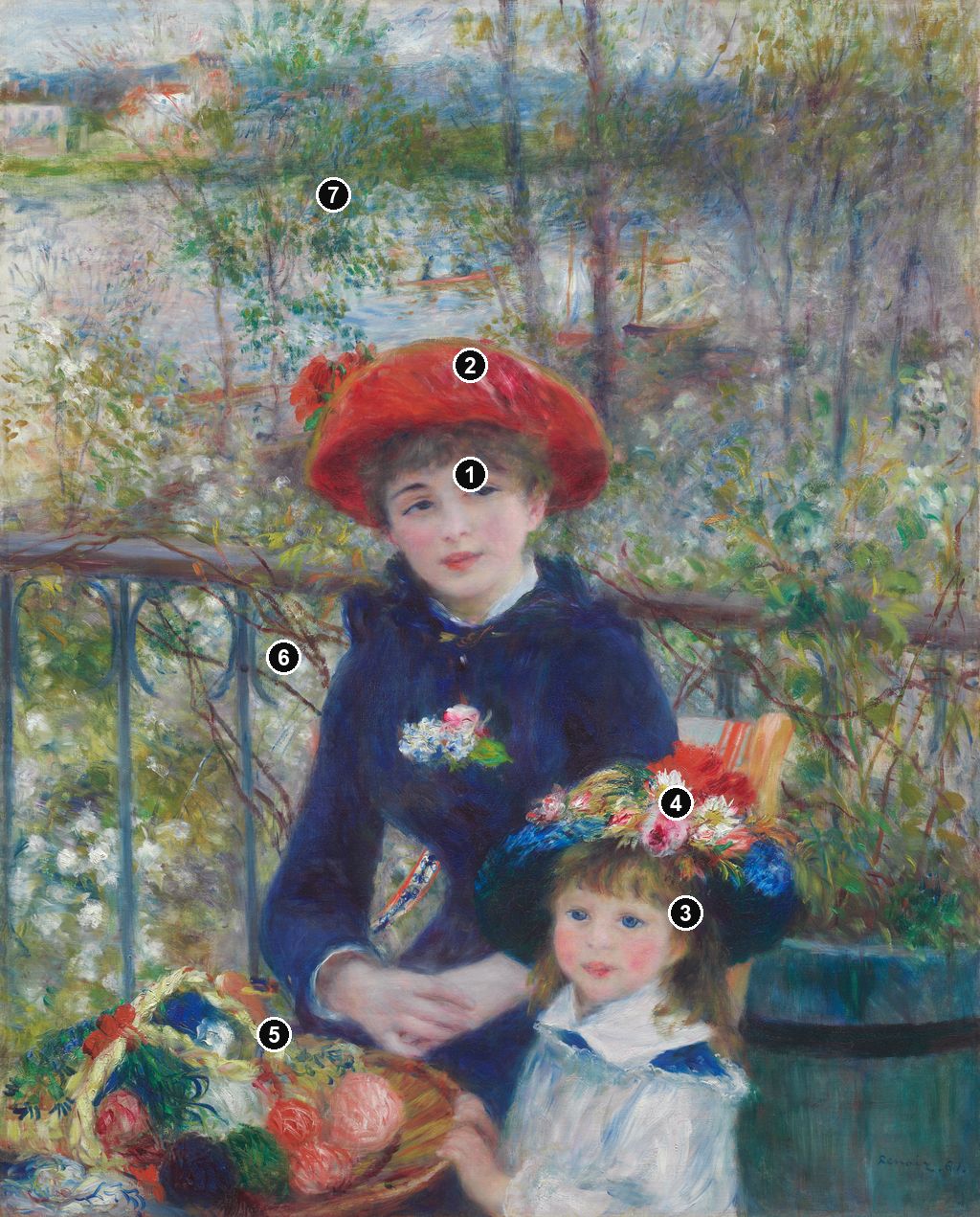
Details from TWO SISTERS (ON THE TERRACE)
The title came from Durand-Ruel's 1882 exhibition, not documented kinship. The Art Institute's research also records changes hidden under the visible surface.
Jeanne Darlaud
The seated model is identified by the Art Institute as Jeanne Darlaud, an aspiring actress. Her face is modelled more firmly than the light landscape behind.
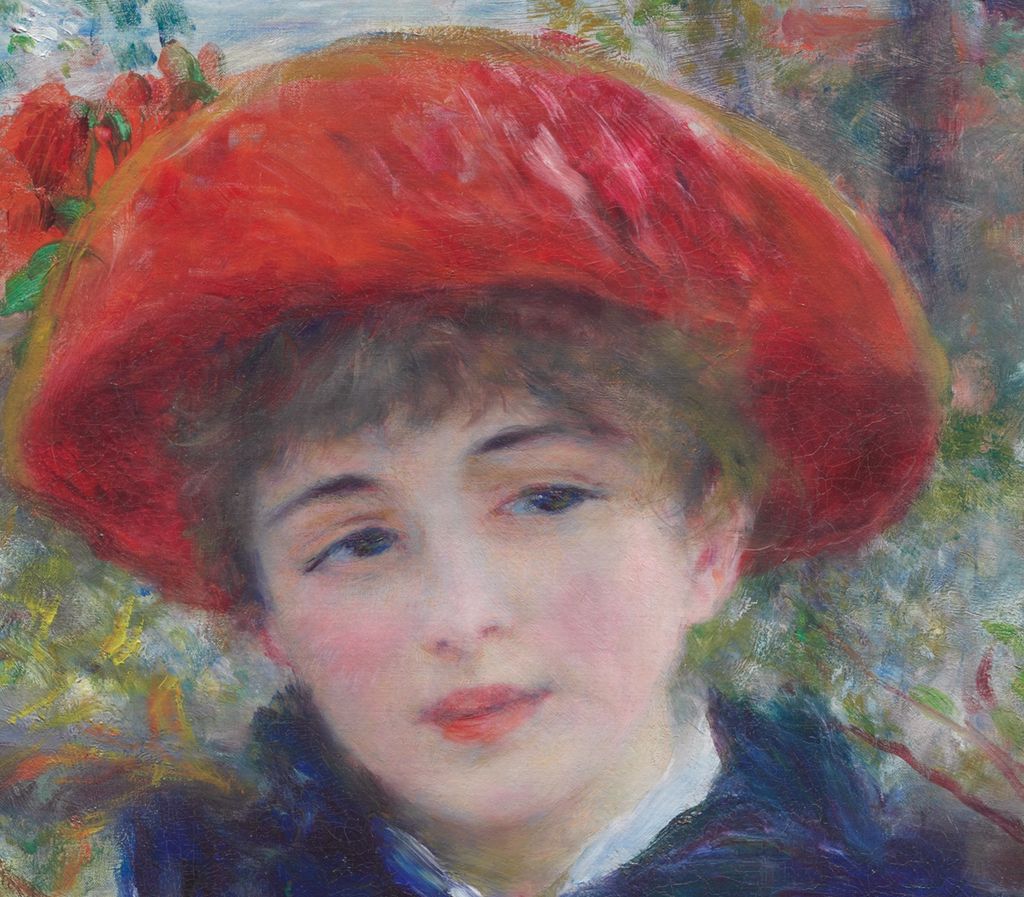
The red hat
A broad red hat holds the centre of the picture. Technical examination found revisions to its contour and brim.
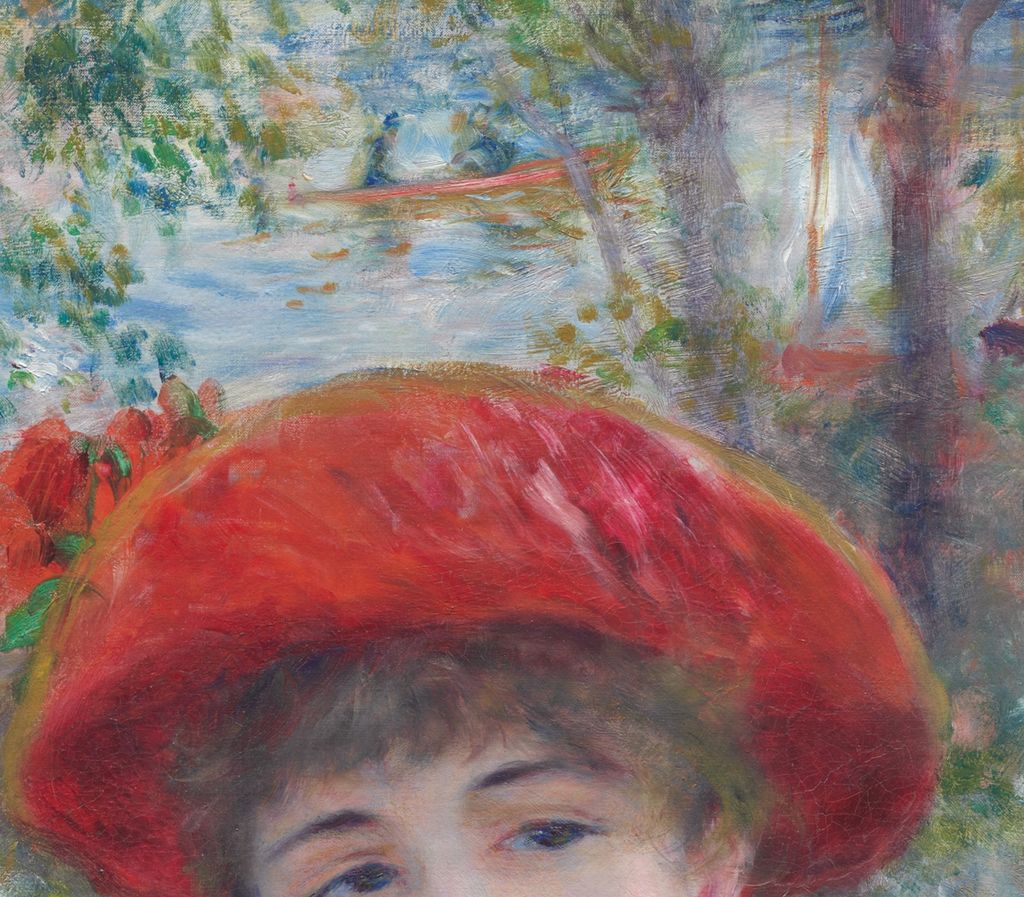
Unidentified child
The younger child's identity has not been established. Her face appears beneath an oversized flowered hat; the apparent sibling bond is a pictorial construction.
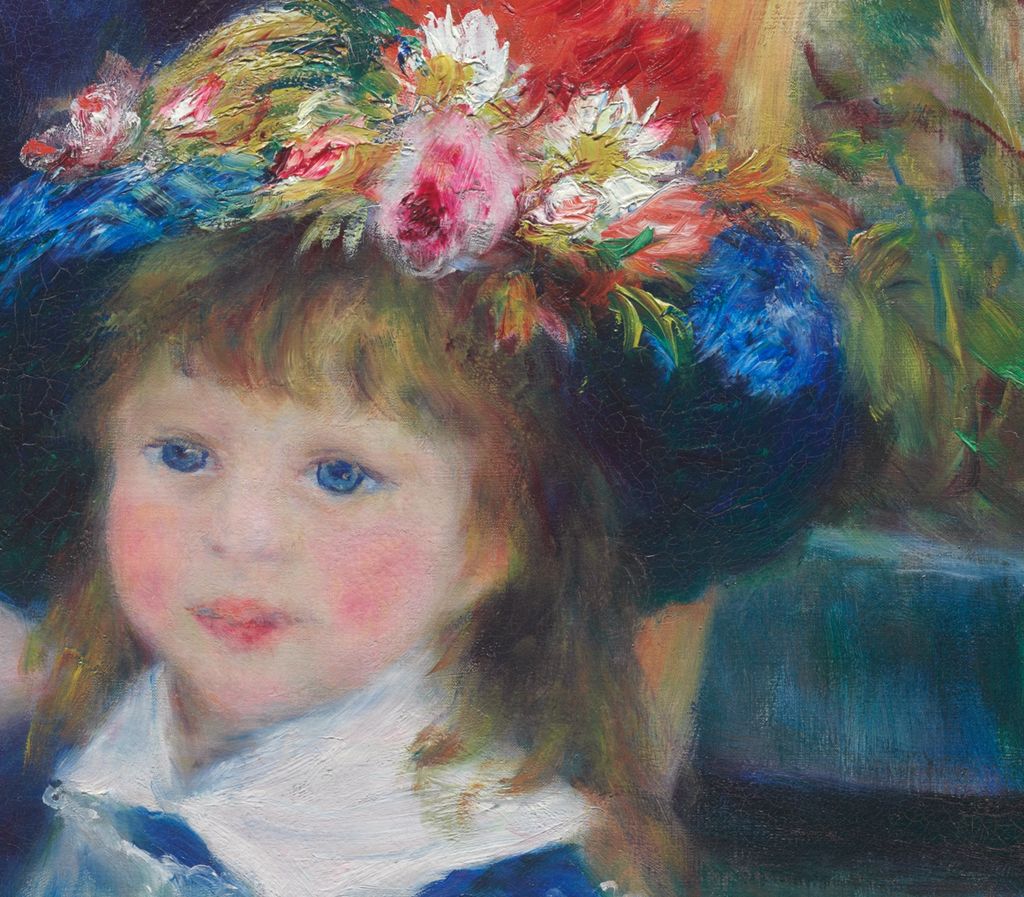
Flowers on the child's hat
Bright flowers widen the child's hat. The Art Institute's X-ray study found additions to its decoration during painting.
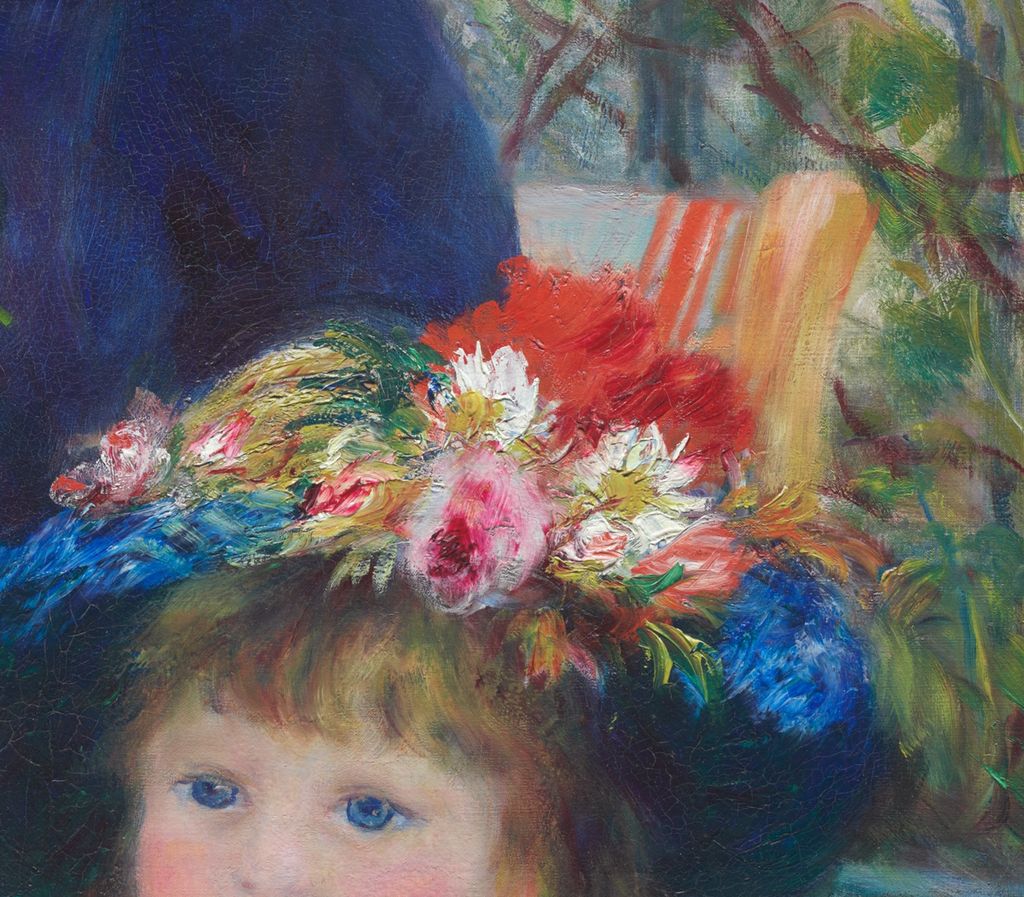
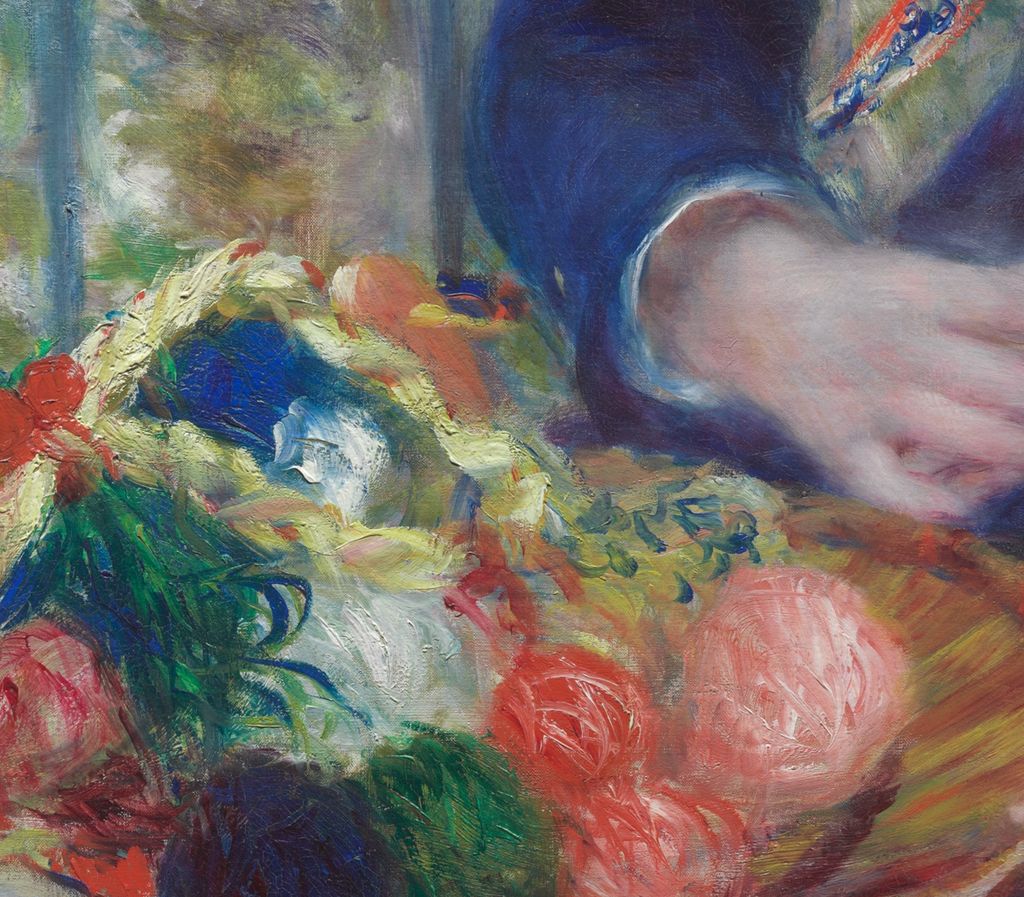
Basket and yarn
Colourful skeins of yarn and flowers fill the lower foreground. Their reds and blues repeat accents in the models' clothes and hats.
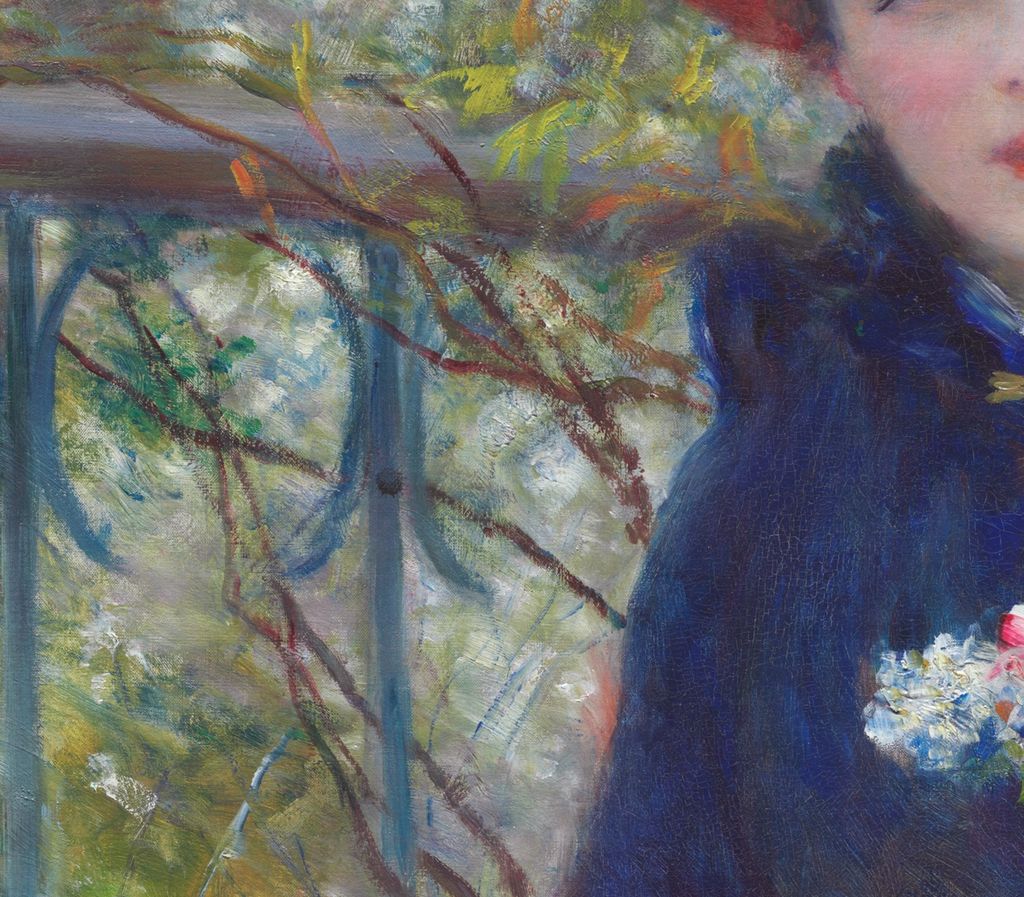
The terrace railing
The rail separates the models from the riverside view. Infrared imaging showed that Renoir simplified earlier decorative curves within it.
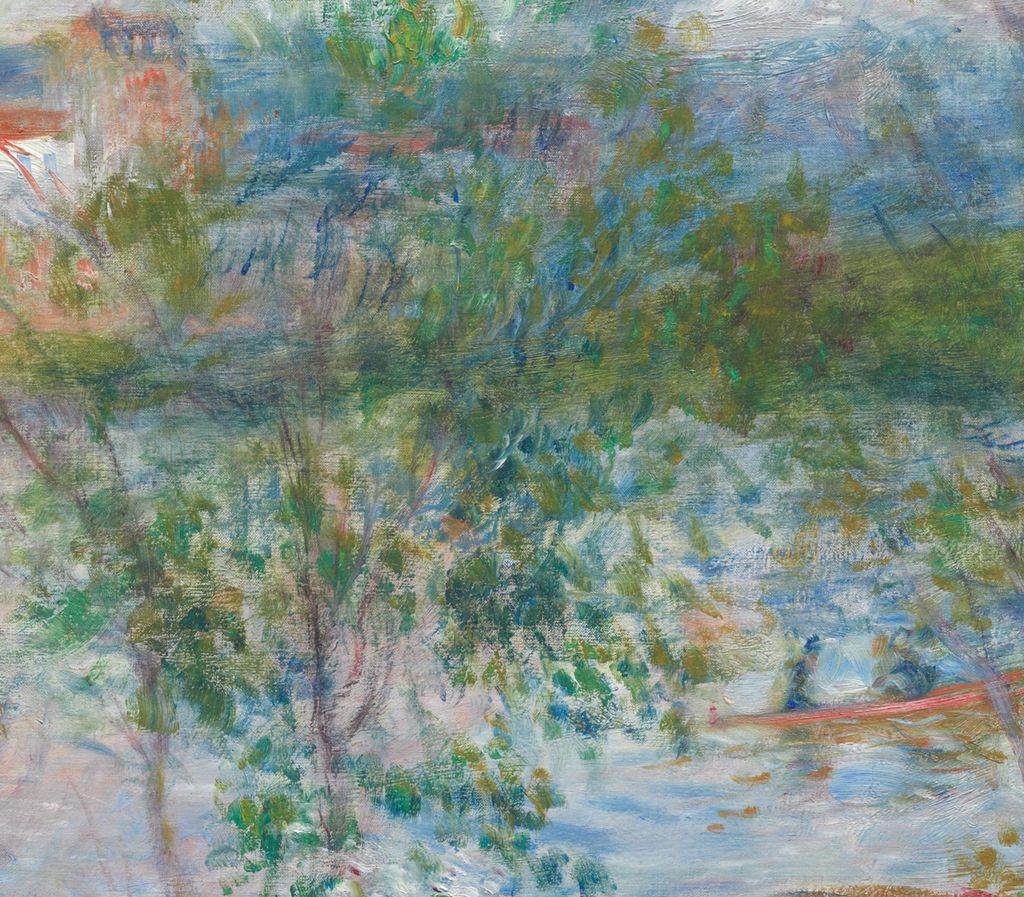
Seine and boats
Small boats and pale water emerge through fine branches. Imaging revealed painted-out walking figures in an earlier version of this background.
Watch: Pierre-Auguste Renoir
Explore a Montmartre dance, a gathering beside the Seine and the drawings behind Renoir’s paintings.
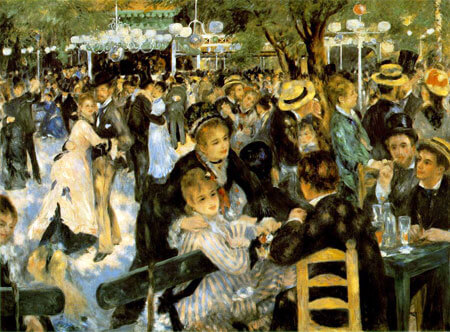
Renoir, Bal du moulin de la Galette
Dr. Beth Harris and Dr. Steven Zucker discuss Renoir’s 1876 Montmartre dance scene, its light and its crowds.
Watch on YouTubeRenoir artworks directory
A terrace in spring
The balcony creates a firm horizontal behind the models, while the river scene loosens into blue, green and pink touches. The red hat sits just below that change of space. Its saturated colour makes the seated woman's face a focal point even before we notice the small girl's flowered headwear. A basket in the near foreground repeats the flowers' colours as strands of yarn. The bold circle of the red hat and the smaller bright clusters below connect the two figures to their setting.
The young woman wears a dark blue boating outfit. Against it, her face and hands are pale and comparatively smooth. The girl's white clothing has a similar brightness, but her face and hat compete for attention with the basket. Renoir positions her in front of the seated model rather than making a symmetrical double portrait. One figure is stable and central; the other draws our gaze downward and to the right. Art Institute catalogue. [1]
In the background, a sailboat's mast and river traffic are half-lost among branches. Renoir does not supply a detailed map of Chatou. He uses the terrace as a platform from which people, railing and landscape can be painted together. The distance looks airy because the brushwork is thinner and more broken than the paint of the figures. The Art Institute's technical catalogue describes a contrast between controlled modelling in the people and a feathered, lightly worked landscape. That distinction makes the two girls seem present even as the world behind them dissolves into light. Art Institute scholarly catalogue, technical examination. [1]
The painting asks the eye to move through several kinds of edge. The blue costume has a comparatively firm outline at Darlaud's shoulders and sleeves. The red hat is a broad, rounded shape, with flowers at one side. Behind it, tree branches and blossom marks nearly melt into the pale river. A viewer can find the terrace rail, boat and opposite bank, yet none has the precision of her face. The contrast creates depth without turning the figures into cutouts placed before a separately finished landscape.
At the bottom, the wool basket is more than a convenient splash of colour. The Art Institute's curatorial essay notes that its skeins seem to interest neither model, and there is no evidence that a basket of wool belonged to the boating restaurant. It gives the foreground colour and weight, balancing the red hat above. We can describe its compositional function without inventing a story in which either figure has just been knitting. Art Institute catalogue, “An Innovative Impressionist Painting”. [1]
Who are the models?
The older figure was Eugénie Marie Darlaud, known as Jeanne Darlaud, then eighteen and preparing for a stage career. The Art Institute's research identifies her and traces how she was once confused with her younger sister Anne, who also posed for Renoir in another painting. The little girl in this canvas remains unidentified. The title Two Sisters did not describe two documented siblings; it was a later exhibition name that made their apparent relationship legible to visitors. Art Institute catalogue, “The Models”. [1]
Darlaud's clothing suggests a canotière, a woman associated with boating life along the Seine. This is a pictorial role, not proof that the actress regularly went rowing in this costume. She and the child posed for Renoir. The painting leaves their imagined relationship open. The younger girl stands very near her, yet the pair do not make emphatic eye contact or embrace. Viewers may feel intimacy, reserve or simply the stillness of a posed moment. None of those responses establishes kinship. Art Institute catalogue. [1]
The distinction also matters when comparing Renoir's commissioned portraits. In Madame Georges Charpentier and Her Children, identifiable family members and a patron's household are central to the picture's purpose. Two Sisters works more like a modern-life scene constructed from paid models, costume and setting. Its title suggests one possible story, but the physical canvas does not require it. Art Institute catalogue, comparison of the models. [1]
Several names for one picture
The Art Institute's research follows the painting through dealer and exhibition records. When Durand-Ruel bought it from Renoir in July 1881, his stock book called it Femme sur une terrasse au bord de la Seine, “Woman on a terrace by the Seine.” For the 1882 Impressionist exhibition it became Les deux soeurs, “The Two Sisters,” catalogue no. 138. At Durand-Ruel's Renoir exhibition in 1883, catalogue no. 30, it was Femme sur une terrasse (Chatou). The 1886 New York Impressionist exhibition listed it as On the Terrace. That exhibition opened at the American Art Galleries in April and moved to the National Academy of Design in May; the painting appears as no. 181 in both catalogues. These are two venues in one exhibition's history, not two different paintings. Art Institute catalogue, title and exhibition history. [2]
These names emphasize different things. The 1881 stock-book title describes a woman and place. The 1882 exhibition title supplies a human relationship. The 1883 title returns to the location. The English title used today holds both the older “sisters” convention and the terrace setting together. None of this means Renoir himself wrote a definitive narrative for the pair. Museum catalogues can preserve historical titles while explaining why their literal implication is inaccurate.
The 1882 show is also a useful correction to a simplified account of Renoir's exhibition career. He had participated in Impressionist group displays in 1874, 1876 and 1877. His paintings returned to the seventh show in 1882, but he told Durand-Ruel that the dealer could dispose of works he owned while Renoir himself would not exhibit. The Art Institute counts twenty-five Renoirs contributed from the dealer's stock; the French Ministry of Culture says he lent twenty-nine. The records differ on the count, but both place Durand-Ruel at the centre of the loan. Two Sisters appeared there alongside Luncheon of the Boating Party. Its presence in the exhibition does not mean Renoir selected or arranged it. Art Institute catalogue, “A Jewel in the Collection of Paul Durand-Ruel” [2]; French Ministry of Culture, seventh exhibition of 1882. [3]
How Renoir revised the composition
The picture looks poised, but the Art Institute's X-ray and infrared examination show many changes. The background once appears to have included two walking figures along the shore to the left of Darlaud's head. Renoir painted over them and set a small skiff with a rower in the river instead. He also revised branches, balcony decoration and other background forms to make the setting lighter and less crowded. Some of the major alterations are hidden beneath the present paint; we know them from imaging, not from a normal reproduction. Art Institute catalogue, technical examination. [1]
The figures changed too. The seated woman's red hat was adjusted in profile, and researchers find evidence of changes around her face and shoulders. The child's hat shifted in colour, shape and floral decoration. Renoir moved her hands and worked back some paint from her face before applying thin pink colour. The Art Institute describes these findings with care: not every buried line can be reconstructed as a complete earlier version. The revisions show him solving the relationship of two models to the terrace, rather than recording a perfect arrangement at a single sitting. Art Institute catalogue, paint-layer section. [1]
The technically examined background helps explain its apparent spontaneity. Thin blues and pinks underlie the water; short, denser strokes create ripple and light. Fine branches and leaves sit above those passages. Renoir used firmer, fuller paint for the people. This choice is visible in broad terms when we compare the faces with the river, while the museum's microscopic analysis explains how the surfaces were made. Art Institute catalogue. [1]
The material evidence also sets a limit on confident reconstructions. The Art Institute found no known preparatory sketches for this composition, and its technical report says possible early outlining remains ambiguous. X-ray, infrared and transmitted-light images reveal paint that was moved, scraped or covered. They do not amount to a complete photograph of an earlier picture. For example, Renoir brought the woman's right arm closer to her body and changed the child's face, but we cannot give every altered gesture a finished earlier pose. The visible image is the result of those choices, not a transparent record of the first sitting. Art Institute catalogue, technical report. [1]
Chatou and a family portrait
Renoir was working at the Fournaise terrace in spring 1881. The Art Institute cites an 18 April letter to critic Théodore Duret in which he said he was occupied with flowering trees, women and children and had his models with him. That letter fits the subject and season of Two Sisters. It does not identify the little girl or document a particular day's posing. The same catalogue places this painting near the end of Renoir's years of work at the restaurant, and notes that we do not know why he stopped returning there. Art Institute catalogue, Chatou account and letter note. [1]
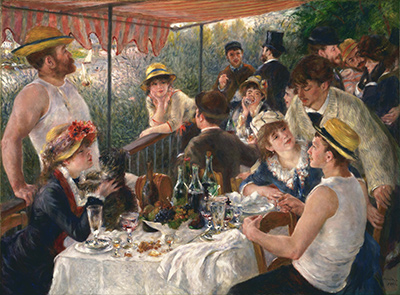
The earlier Luncheon of the Boating Party makes the shared setting legible. The Phillips Collection's wide canvas fills the Fournaise terrace with a table, boaters and conversation; some models are identified by the museum. Two Sisters uses a much narrower upright view and lets the railing open onto spring foliage and the river. The two works do not depict one continuous meal. The comparison shows Renoir adapting the same location to a crowded social scene and to a posed pair with ambiguous ties. Phillips Collection, Luncheon, 1637 [4]; Art Institute catalogue. [1]
For a different kind of comparison, the Met's Madame Georges Charpentier and Her Children is a commissioned family portrait from 1878. Marguerite Charpentier sits in her furnished room beside her son Paul, then three; his sister Georgette perches on the family dog. The Met notes that Paul wears his hair and clothes in a style that can make him look like another little girl. Here the children's documented names correct a possible visual misreading, while the child in Two Sisters remains unidentified. The Art Institute contrasts that named household with the open-ended pair on the terrace. Met object record, 07.122 [5]; Art Institute catalogue, model comparison. [1]
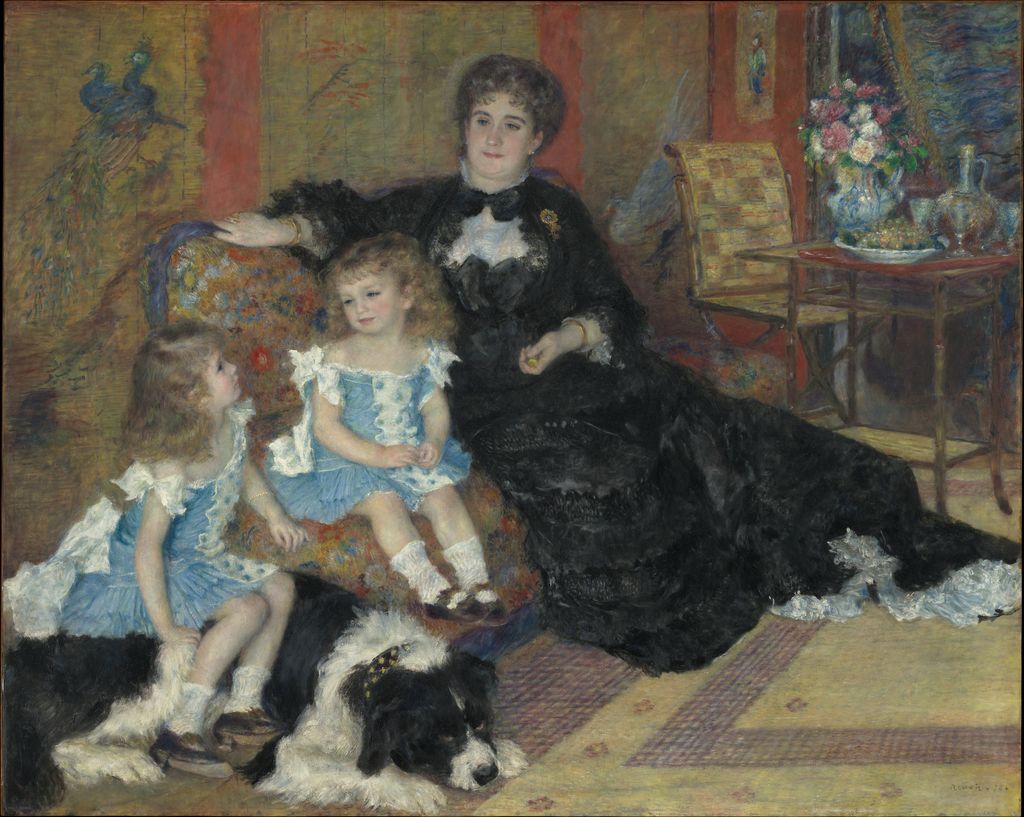
Neither comparison supplies missing biographical facts about the small girl in Two Sisters. A familiar venue does not make her one of the Fournaises, and a family portrait elsewhere does not make her Darlaud's relative. The Art Institute's object research is explicit that her identity is unknown. The pictures instead help us notice the decisions Renoir made: group versus pair, busy terrace versus airy river view, named family versus suggestive title.
Dealer, exhibition and collection
Durand-Ruel bought the canvas directly from Renoir on 7 July 1881 for 1,500 francs, according to the dealer record cited by the Art Institute. He included it in the 1882 and 1883 Paris displays and, later, the 1886 New York exhibition of Impressionist paintings that changed venues. During the dealer family's ownership the work was shown and reproduced repeatedly, helping it become a familiar image of Renoir's art. Art Institute catalogue, provenance and exhibition history. [2]
It went to Durand-Ruel's New York branch in 1922. According to the dealer archive cited in the Art Institute's published catalogue, Annie Swan Coburn bought it on 4 February 1925 for $100,000. Her bequest brought it to the Art Institute of Chicago in 1933. The figure records this particular sale in dollars; it is not directly comparable with the 1881 price in francs without more economic context. The museum's accession number refers to its arrival in the collection, not the year Renoir painted it. Art Institute catalogue, provenance. [2]
The painting circulated as an image before it left Durand-Ruel's family. The Art Institute records a colour reproduction in L'art de la mode in late 1881, soon after its completion, and an etched reproduction in Georges Lecomte's 1892 account of the dealer's collection. Lecomte admired the landscape colour but also read flirtation into the young woman's expression. His response shows how a viewer could turn the model's gaze into a character, while the dealer's continued ownership and repeated display kept the picture visible. These are parts of its reception history, not evidence that the two figures were actually related. Art Institute catalogue, reception and exhibition history. [1]
The painting is sometimes treated as a straightforward celebration of childhood or sisterhood. Its recorded history gives a more precise account. An actress and an unidentified child posed in Renoir's riverside setting; the artist revised their surroundings and appearances; a dealer's memorable title shaped how audiences read their connection. The work retains the pleasure of its colour and spring light, but its title and surface also reveal the choices behind that pleasure.
Looking again
Start at the red hat, then follow its edge to Darlaud's face and the deep blue shoulder below. Move to the child's flowers and down to the basket's coloured wool. These bright clusters make a loose diagonal through the figures. From the basket, follow the railing left and up into the branches, where the river and boats almost disappear. Renoir has made the models firm enough to hold our attention while allowing the setting to breathe around them.
The technical study invites a second circuit. Look for the little skiff behind the figures and imagine the two walkers that imaging suggests were once painted there. Notice how little of that buried decision is readable at ordinary viewing distance. The picture's calm is the outcome of alteration as well as observation. Its title's claim about sisterhood should remain a question posed by a dealer, not an answer supplied by the models.
Questions about Two Sisters
No. The seated model was Jeanne Darlaud; the child is unidentified. Durand-Ruel used the title Les deux soeurs for the 1882 Impressionist exhibition, and it remained attached to the picture.
The depicted terrace is at the Restaurant Fournaise in Chatou, above the Seine. Museum research connects the scene with Renoir's work at that riverside venue. The composition contains revisions and should not be read as a single unaltered outdoor snapshot.
Both paintings use the Fournaise setting, but they are separate works. Two Sisters concentrates on two posed figures against the river; Luncheon is a much larger group scene on the restaurant terrace.
It belongs to the Art Institute of Chicago, accession 1933.455, through Annie Swan Coburn's bequest. Consult the museum's current object record for display status.
Discussion
Look closely at Two Sisters on the Terrace and use the questions below to compare what you see with the documented history.
Reader Insights
How do the figures relate to the river and terrace behind them?
The Art Institute distinguishes the title from a literal claim of kinship.
What does a staged scene retain of an outdoor encounter?
Join the Conversation
Share a close observation or a source-backed question about Two Sisters on the Terrace. The prompts above are starting points for discussion.
References
- John Collins, “Two Sisters (On the Terrace), 1881,” Art Institute scholarly catalogue, curatorial essay, technical examination, title, provenance and exhibition history View source.
- Art Institute catalogue, title and exhibition history View source.
- French Ministry of Culture, the seventh Impressionist exhibition of 1882, Renoir's participation, Durand-Ruel's loans and the exhibition's works View source.
- Phillips Collection, Luncheon of the Boating Party , 1637 View source.
- Phillips Collection, Madame Georges Charpentier and Her Children , 07.122 View source.
- Art Institute of Chicago, Two Sisters (On the Terrace), object 14655, collection record and open-access image View source.
- Whole-work reproduction from the Art Institute's public-domain object image, official IIIF rendition. Image credit: Art Institute of Chicago, Mr. and Mrs. Lewis Larned Coburn Memorial Collection, 1933.455 View source.