by Tom Gurney
Tom Gurney BSc (Hons) is an art history expert with over 20 years experience
Published on June 19, 2020 / Updated on October 2, 2026
Email: tomgurney1@gmail.com / Phone: +44 7429 011000
A woman seen from behind gathers a white cloth around her hips. A blue curtain hangs at left, a narrow doorway or screen opens behind her, and red marks cross the floor. The inherited image on this route is commonly reproduced as Pierre-Auguste Renoir’s The Bathrobe, dated 1889 in illustrated secondary listings. Those listings match the composition shown here, but an accessible museum, auction or catalogue raisonné entry for the exact canvas has not been located. This guide therefore treats the date as a published attribution and leaves its size, sitter and present owner open.
The picture makes a private action visible without explaining the woman’s thoughts or identity. She is turning slightly to her left, head inclined down, one hand controlling the cloth. Renoir gives the room a strong vertical structure—curtain, doorframe and wall—then sets the body’s curve and the robe’s folds against it. The composition is as much about the movement of fabric and light as about the figure.
Contents
- The work at a glance
- A turning figure
- Curtain, wall and patterned floor
- Renoir’s bathers and interior figures
- Seeing an intimate scene responsibly
Watch: Pierre-Auguste Renoir
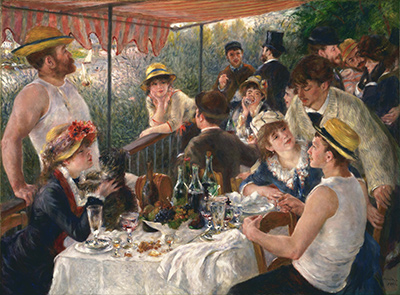
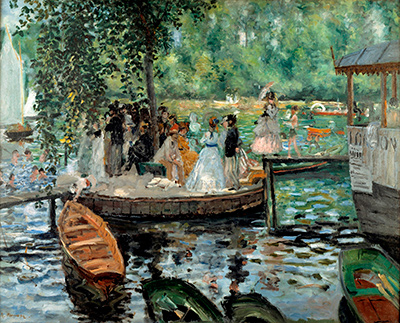
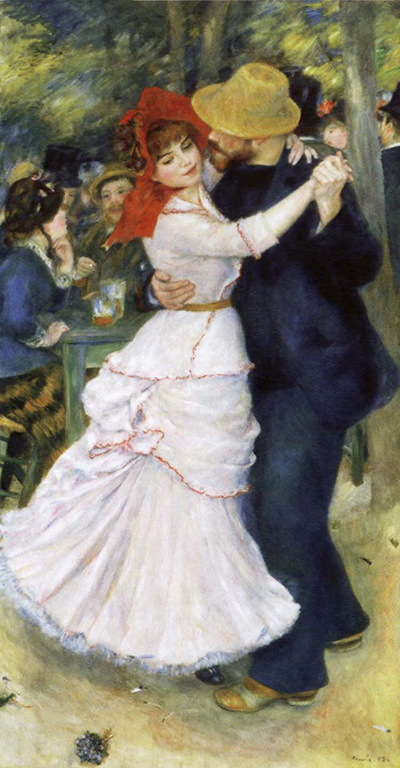
Explore a Montmartre dance, a gathering beside the Seine and the drawings behind Renoir’s paintings.
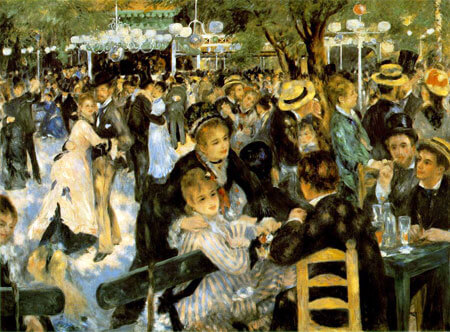
Renoir, Bal du moulin de la Galette
Dr. Beth Harris and Dr. Steven Zucker discuss Renoir’s 1876 Montmartre dance scene, its light and its crowds.
Watch on YouTubeAt a glance
- ArtistPierre-Auguste Renoir (1841–1919)
- Inherited titleThe Bathrobe
- Date in illustrated secondary listings1889; exact-object verification still needed
- Medium in secondary listingsOil on canvas; exact-object verification still needed
- DimensionsNot reliably established from an exact-object record
- SitterNot identified in reliable accessible records
- Present collectionNot independently verified
The illustrated Gallerix listing [1], Artchive reproduction [2] and Wikimedia Commons file [3] show the same back-view woman, blue curtain, white wrap and patterned floor as the local image. They are useful for matching a reproduction. They do not supply a lender’s object number, historical sale record or dated proof of current ownership. The repeated “private collection” label is therefore not asserted here as a present fact.
A turning figure
The woman occupies the central third of the canvas. Her head, with reddish-brown hair gathered up, bends toward her left shoulder. Her face is mostly hidden; what we see is the side of the cheek, neck, back and legs. The turned pose avoids direct eye contact. It makes viewers attend to the shifting weight of the body and to the work of holding the fabric in place.
Her right arm drops toward the cloth, while the other side is partly obscured by her turning torso. The white wrap is bunched at the waist and spreads downward in angled folds. One leg is more clearly visible beneath it, with a foot placed near the bright floor; the other is lost more deeply in shade. The pose suggests a pause in movement, but it cannot tell us whether she is putting the garment on, taking it off or simply adjusting it.
The word “bathrobe” can make the object sound like a tailored modern garment. The image shows broad white fabric wound around the body. It is safer to describe that visible wrapping than to claim a precise item of dress, its material or its purpose. There is no bath or washbasin clearly visible in the inherited small reproduction. The title guides the reading, but should not replace observation.
Renoir models the back with pale cream, pink and cool violet touches. The shoulder blades and curve toward the waist are legible without hard dark outlines. The cloth has a different rhythm: crumpled blue-grey lines race across its white folds. These two treatments make skin appear continuous and fabric more mobile. Their contrast is most vivid where her hand gathers the cloth at the hip.
Curtain, wall and patterned floor
The blue curtain at left is a broad vertical counterweight to the figure. Its folds range from deep indigo to pale lavender. It provides a cool background for the warm skin and auburn hair. Along its right edge, a yellow-brown doorframe or panel begins; behind the figure, darker paint deepens the recess. These elements create a room without describing it as an exact address or studio.
At the right, a pale wall or sheer screen catches light. Lower down, a blue-and-white patterned band is set into a reddish-brown panel. The pattern is suggestive, not precise enough in the local image to name a particular tile type or national style. The floor is warmer and more broken, marked with red shapes that recede diagonally. A pair of small reddish forms near the woman’s feet could be slippers, but their exact relation to her feet is difficult to settle at this resolution.
The architecture divides the canvas into strips, while the body curves across them. The woman’s back and the descending cloth soften the strict verticals. The curtain and light wall also frame her without forming a literal niche. We look into a shallow interior, with just enough depth to sense a threshold beyond her.
The strongest light sits on the upper back and the white wrap. It is not possible to identify a window or exact light source from the visible image. Renoir uses bright paint at right and cool shadow at left to give the scene a changing temperature. The figure seems to turn through those zones, and the eye follows her movement down toward the floor.
Renoir’s bathers and interior figures
Renoir returned repeatedly to women bathing, dressing and holding cloth during the 1880s. The National Gallery, London’s A Bather [4] explains how he combined a contemporary towel and hairstyle with a pose connected to the older tradition of the nude. Its painting is a different work: a seated model outdoors by suggested water. The institutional account is useful context for Renoir’s interest in the subject, not a source for this Bathrobe canvas’s sitter, date or provenance.
The National Gallery of Art’s Bather Arranging Her Hair [5] also shows a woman with garments in a landscape, but it has a different pose and a documented museum history. The image on this route is an interior with a blue curtain and a figure seen mostly from behind. Such comparisons show how Renoir could revisit a gesture without repeating a composition.
A similarly titled Le Peignoir at the Musée d’Orsay [6] is by Pierre Bonnard, not Renoir. A search result for that title must not be used to date or locate the work shown here. The title The Bathrobe is unusually vulnerable to confusion because it can name a garment, a motif or another artist’s painting. Image composition and artist attribution have to travel together.
The late 1880s were a period of sustained experiment in Renoir’s treatment of figures. Some paintings make contours firm and sculptural; others let fabric and surroundings dissolve into colour. The local image seems to hold both impulses: a relatively clear back and shoulder against swiftly painted curtain and floor. Calling it simply “Impressionist” says less than describing that particular balance of form and loose marks.
Seeing an intimate scene responsibly
The pose can feel unguarded because the figure is turned away. That effect is made by the painting’s viewpoint; it does not establish whether the sitter knew she was being observed, how the work was commissioned, or whether it represents a specific daily routine. Nor should an unidentified model be named from resemblance alone. The visible body and setting give plenty to discuss without inventing a biography.
One can read the doorway as a passage from one room to another, but the canvas holds the moment before any action is completed. The woman is almost a pivot between dark curtain and pale wall. Her downward gaze and the gathered white cloth concentrate the scene on a small gesture. The floor, especially its red rectangular strokes, suggests where her next step might fall. That is a visual invitation, not a documented narrative.
At this scale, we cannot assess the brushwork’s physical texture, the signature, an underdrawing or later changes. A high-quality object image and reliable catalogue would allow us to establish dimensions, perhaps a French title and a more secure date. It would also help distinguish original paint from any reproduction colour shifts. The inherited image remains useful for reading the composition.
Look once more at the meeting of the woman’s hand and white cloth, then follow the folds down toward the feet. Trace the blue curtain upward and cross the painting to the bright wall. The figure sits between these contrasting planes, her rounded back and moving fabric interrupting their vertical order. That relationship is the painting’s strongest visible idea, whatever further object history may eventually be documented.
Renoir artworks directory
Questions about The Bathrobe
It shows a woman from behind, turning as she gathers a white wrap around her hips in a room with a blue curtain and reddish patterned floor.
Illustrated secondary listings give 1889. An exact-object institutional or auction record is still needed to confirm the date.
No reliable identification of the sitter has been found for this specific image. Her pose and clothing do not establish her identity.
No. The Musée d’Orsay’s Le Peignoir is a different painting by Pierre Bonnard. This route’s image is reproduced as a Renoir work.
Its current owner has not been independently verified. “Private collection” appears in secondary image listings, but is not a dated present-location record.
Discussion
What do you notice when you return to the figure between curtain and doorway?
How does the blue curtain change the light on the figure?
Reader Insights
How does the blue curtain change the light on the figure?
The commonly reproduced 1889 date still needs an exact-object catalogue record.
How do the white fabric folds lead your eye toward the floor?
Join the Conversation
Share a close observation or a source-backed question about this interior figure.
References
- Gallerix, Gallerix, The Bathrobe View source.
- Gallerix, Artchive, The Bathrobe View source.
- Gallerix, Wikimedia Commons reproduction View source.
- National Gallery, National Gallery, London, A Bather View source.
- National Gallery, National Gallery of Art, Bather Arranging Her Hair View source.
- Musée d’Orsay, Pierre Bonnard’s Le Peignoir: a differently attributed picture, included to prevent title confusion View source.
- Image: inherited 400 × 539 legacy reproduction, visually matched to the cited Bathrobe reproductions and retained under the owner’s public-domain declaration.