by Tom Gurney
Tom Gurney BSc (Hons) is an art history expert with over 20 years experience
Published on June 19, 2020 / Updated on October 2, 2026
Email: tomgurney1@gmail.com / Phone: +44 7429 011000
Water fills the foreground, a bridge spans the Seine, and a line of houses closes the far bank. Pierre-Auguste Renoir's The Bridge at Chatou makes a suburban crossing its subject rather than using a bridge as a small detail in a rural view. The original belongs to the Clark Art Institute in Williamstown, Massachusetts, accession 1955.591. The Clark's scholarly catalogue dates it about 1875 and identifies the viewpoint as near the Maison Fournaise, the riverside restaurant and boat-rental place associated with Renoir's later scenes of leisure. Clark collection catalogue, cat. 265. [1]
The older site's name is useful, but there is more than one “bridge at Chatou” in Renoir's work and in pictures by other artists. This is the Clark canvas with a built-up riverside, a dark bridge at the right and blue water across the bottom. It is distinct from Renoir's railway-bridge landscape at the Musée d'Orsay and from Oarsmen at Chatou, which shows people on a riverbank. Identifying the collection and inventory number keeps those views apart. Clark catalogue [1]; Musée d'Orsay, Pont du chemin de fer à Chatou [2]; National Gallery of Art, Oarsmen at Chatou. [3]
At a glance
- ArtistPierre-Auguste Renoir
- TitleBridge at Chatou / Le Pont de Chatou
- DateAbout 1875; the Clark relates it to Renoir's dated Chatou pictures that summer
- MediumOil on canvas
- Dimensions51.1 × 65.4 cm
- CollectionClark Art Institute, Williamstown, Massachusetts, 1955.591
- ViewpointFrom beside the Maison Fournaise, towards the village and bridge then north of the restaurant
- EvidenceClark's collection catalogue, historical photographs cited there, provenance and technical report
Watch: Pierre-Auguste Renoir
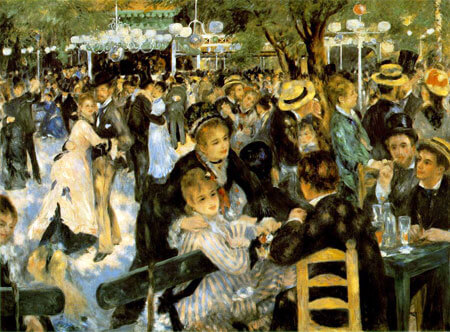
Explore a Montmartre dance, a gathering beside the Seine and the drawings behind Renoir’s paintings.
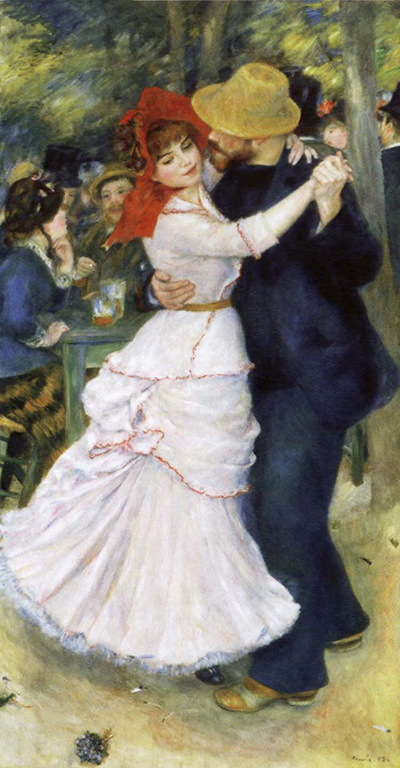
Renoir, Bal du moulin de la Galette
Dr. Beth Harris and Dr. Steven Zucker discuss Renoir’s 1876 Montmartre dance scene, its light and its crowds.
Watch on YouTubeFrom the water into the town
Start with the strong blue of the Seine. The water rises almost to the middle of the canvas, where its broken reflections meet a narrow, greenish strip of bank. At left, low floating structures sit near the shore. Small people and a boat are suggested with quick marks rather than carefully outlined bodies. Across the river, pale façades climb behind the bridge and a warmer reddish building draws the eye to the centre. The scene feels full of construction, movement and colour, even though there are few figures to follow individually.
The bridge enters from the right and reaches towards the middle of the picture. Its two visible arches and heavy piers give the busy town a simple structure. Renoir sets their dark blue against the light buildings and yellow-green bank. A sliver of grass in the near left corner gives the viewer a place to stand visually; otherwise the foreground is all water. The Clark catalogue describes this bridge and strip of grass as compositional anchors. Clark catalogue, cat. 265. [1]
The water does not behave like a measured architectural diagram. The Clark's author notes that its reflected shapes do not line up closely with every building and pier above. Renoir seems more interested in the contrast of yellow and blue than in tracing an exact mirror image. That is a catalogue interpretation grounded in the visible paint, not evidence that the river itself looked a particular way at a particular hour. Clark catalogue, cat. 265. [1]
A real crossing, seen from a changed site
The Clark places Renoir beside the Maison Fournaise on an island in the Seine. The bridge shown here crossed to Chatou just north of the restaurant. Late nineteenth-century photographs, cited by the museum, support the identification of the village entrance as the rue de Seine. The present-day bridge is farther south, and the buildings Renoir painted have disappeared. A modern photograph of the current crossing would therefore be a poor test of each roof and arch in this canvas. Clark catalogue, cat. 265. [1]
The restaurant linked a working river to a leisure destination. People came to this stretch of the Seine for boating, fishing and meals, while the built-up town and river traffic remained close at hand. The Clark quotes an 1886 writer, Louis Barron, on Chatou's position between the suburbs of Paris and a more recreational countryside. His description came after Renoir made the painting; it offers context, not a transcript of what Renoir saw or intended in about 1875. Clark catalogue, cat. 265. [1]
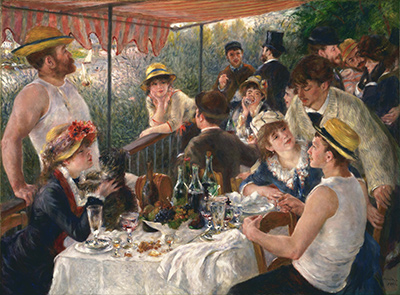
That balance looks different from Luncheon of the Boating Party. The later painting centres diners at the Maison Fournaise. Here the restaurant remains outside the frame and the river crossing dominates. Even the boaters are small. Renoir is looking at the infrastructure and ordinary buildings that made the place accessible, not simply at its pleasures.
Why the date is approximate
The Clark catalogue calls the work c. 1875, not a signed and precisely dated record of a sitting. Renoir's portraits of Alphonse Fournaise and his daughter Alphonsine are dated 1875; the museum judges the bridge view likely to belong to the same summer. That relationship supports the dating while leaving room for uncertainty. The canvas's location beside the restaurant helps, but it does not establish an exact month or day. Clark catalogue, cats. 264–265. [1]
The museum also compares it with Claude Monet's 1874 paintings of the road bridge at Argenteuil. These are views of a different bridge and town. The comparison concerns a way of organising water, bridge and riverside buildings. The Clark's author proposes that Renoir was following Monet's example; the similarity is substantial, but the proposal should not be turned into proof that they stood side by side to paint these particular canvases. Clark catalogue, cat. 265 [1]; National Gallery of Art, Monet's The Bridge at Argenteuil. [4]
Colour, surface and their limits
The orange-red building beyond the bridge is a small but important centre of warmth. The façades around it are pale and the water is mostly blue. The Clark catalogue treats that warm building as a pivot in the painting's colour arrangement. Its technical report, however, raises a caution: sheltered edges of the canvas suggest that some original purplish-red colour may have faded elsewhere. The exact original balance of cool and warm tones may therefore be different from what the current image shows. We can describe the surviving appearance without claiming that it records every colour as Renoir first laid it down. Clark catalogue and technical report, cat. 265. [1]
The paint varies across the surface. Wide marks sweep through the water; shorter, scattered touches indicate the buildings, greenery and tiny people. According to the Clark's technical report, the ground is a thin, commercially prepared cool white and there is no confirmed underdrawing. A blue preparatory sketch may be visible in parts of the bridge and shore buildings, but the report leaves that identification tentative. Some strokes were worked wet into wet, while others appear to have been laid over drier paint. Clark technical report, cat. 265. [1]
These observations help explain why the bridge remains legible without hard, continuous outlines. Broad strokes establish its structure; smaller accents let the city appear amid light and movement. A high-resolution image can reveal some of that handling, but it cannot replace conservation examination of the canvas itself.
A route through early collectors
The Clark's provenance begins with Ernest Hoschedé, who probably bought the painting directly from Renoir. After Hoschedé's bankruptcy, the work was sold at a 6 June 1878 Drouot auction, lot 74, to Georges de Bellio for 42 francs. It later passed by descent through de Bellio's family, then through other ownership and the dealer Knoedler to Robert Sterling Clark on 13 October 1925. The painting entered the Clark Art Institute collection in 1955. The museum qualifies the first transaction as probable; the 1878 auction and later chain are separately recorded. Clark provenance, cat. 265. [1]
That history places this now-public picture among the collectors who supported Renoir when his new landscapes could be difficult to sell. The modest auction price is a documented transaction, not a measure of the painting's artistic quality. The route to Williamstown also explains why the canvas can be studied today through a detailed catalogue rather than only through reproductions and changing market titles.
Looking again
Move from the grass at lower left across the blue water, up the bridge piers and along the houses. Notice how little unbuilt landscape remains in the upper half. Renoir's view of Chatou is colourful, but it is a view of a working river crossing and a town. The bridge, boats, façades and reflected light belong together. The museum's catalogue gives the site, collection history and technical evidence; the painting offers the particular visual choices that make this ordinary crossing worth prolonged attention.
Renoir artworks directory
Questions about The Bridge at Chatou
The Clark identifies the former bridge north of the Maison Fournaise, seen from beside the restaurant towards Chatou. The present bridge is in a different position.
The Clark dates it about 1875, relating it to Renoir's dated Chatou portraits from that summer. There is no exact day established in the catalogue.
No. Renoir made a different picture historically titled The Railway Bridge at Chatou, now called Les Marronniers roses by the Musée d'Orsay. This is the Clark's view of the road bridge and village.
It belongs to the Clark Art Institute in Williamstown, Massachusetts, inventory 1955.591. Check the museum for its current display status.
Discussion
What do you notice when you return to Bridge At Chatou?
How do the bridge piers, riverside houses and small boat organise your view?
Reader Insights
How do the bridge piers, riverside houses and small boat organise your view?
The Clark catalogue locates the former road bridge near Maison Fournaise and notes that the crossing later moved.
Where do the water reflections favour colour rhythm over a literal mirror of the town?
Join the Conversation
Share a close observation or a source-backed question about Renoir’s bridge at chatou.
References
- Clark Art Institute, Nineteenth-Century European Paintings, catalogue no. 265, Bridge at Chatou, pp. 633–635: object identity, dating, viewpoint, comparison, provenance and technical report. The separate cat. 264 discusses the dated Fournaise portrait View source.
- Musée d'Orsay, Les Marronniers roses, the separate 1881 painting, historically titled Le Pont du chemin de fer à Chatou View source.
- National Gallery of Art, Oarsmen at Chatou, a different Renoir scene at the same river town View source.
- National Gallery of Art, Monet's The Bridge at Argenteuil View source.
- Clark object page, Bridge at Chatou, 1955.591, collection identification; the accessible scholarly PDF above supplies the detailed evidence View source.
- Whole-work image: Clark-derived Commons file, marked public domain as a faithful reproduction. The local web image is cropped within the original 6602 × 4898 pixels to exclude the archival colour chart and modern credit border; the untouched file is retained in the research intake View source.