by Tom Gurney
Tom Gurney BSc (Hons) is an art history expert with over 20 years experience
Published on June 19, 2020 / Updated on October 2, 2026
Email: tomgurney1@gmail.com / Phone: +44 7429 011000
A woman in a dark blue dress sits at the front of a small café scene. A man in a black top hat is just behind her, another man leans in from the right, and loosely painted figures and reflections fill the background. The local image on this page matches Pierre-Auguste Renoir’s Au café, titled In the Café in English by the Kröller-Müller Museum. [1] Its museum identifier is KM 104.427.
The museum dates the oil on canvas to about 1877 and gives its size as 35.7 × 27.5 cm. That exact record corrects the inherited page’s unsupported 1874–75 date. It also makes the route’s broad English title more useful: this is a particular small canvas in Otterlo, not a generic Renoir café image or a record of every painting he made in such a setting.
Contents
- The painting at a glance
- A table near the viewer
- The room behind them
- Colour, blur and movement
- A café scene without named sitters
- Which Au café ?
- Looking again
Watch: Pierre-Auguste Renoir
Explore a Montmartre dance, a gathering beside the Seine and the drawings behind Renoir’s paintings.
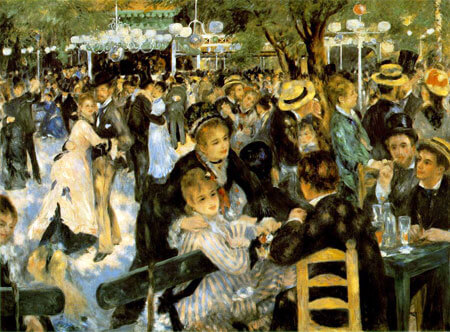
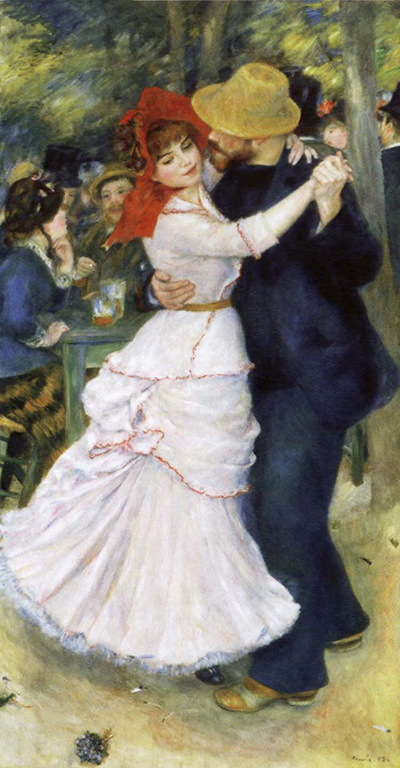
Renoir, Bal du moulin de la Galette
Dr. Beth Harris and Dr. Steven Zucker discuss Renoir’s 1876 Montmartre dance scene, its light and its crowds.
Watch on YouTubeAt a glance
- ArtistPierre-Auguste Renoir (1841–1919)
- Museum titleAu café / In the Café
- Local route titleThe Café
- Datec. 1877, according to the Kröller-Müller Museum
- MediumOil on canvas
- Size35.7 × 27.5 cm
- CollectionKröller-Müller Museum, Otterlo, Netherlands
- IdentifierKM 104.427
- Current displayCheck the museum’s current collection or visit information before travelling
The museum’s object page [1] identifies the painting through its image, title, date, medium, measurements and collection number. The locally inherited reproduction has a warmer, darker cast and much less detail than the museum image, yet the placement of the foreground woman, top hat, leaning man and mirror is the same. The composition is a stronger identifier than a general title such as “The Café.”
A table near the viewer
Renoir places the near edge of the table at the lower right. The woman’s blue sleeves and dress occupy much of the bottom half of the canvas. Her pale face turns towards the man at right, while her hands rest near the tabletop. The white of her collar and the small light touches around her hands lead the eye through an otherwise deep blue foreground.
The man in the top hat sits farther back on the left. His dark clothes and hat are recognisable, but he is partially hidden by the woman’s shoulder. The man leaning in from the right has a beard and a dark jacket. His bent posture brings his face closer to the seated woman’s level. This makes the foreground feel like a conversation, although the picture does not give us their words or a certain relationship among them.
The tablecloth and objects on it are painted with broken patches of pale cream, yellow and blue. Some forms may suggest a glass or café service, but the low-resolution legacy image does not support an inventory of every object. The attention is on proximity, gestures and colour rather than a fully specified meal or drink.
The room behind them
The background is busy without becoming a second sharply defined scene. A reflective surface rises behind the seated figures. In the Kröller-Müller Museum’s description [1], other café-goers are reflected in the mirror, while nearby figures are sketched quickly. The image’s light and dark marks can make it difficult to distinguish every person from a reflection. That uncertainty is part of the painting’s effect: the small table seems to be in an occupied, moving room rather than set against a neutral backdrop.
Warm ochre and gold marks on the left suggest fittings or lights. Cooler blues, gray-violets and whites spread through the upper right. The foreground woman’s dress then gathers the blue into a large stable shape below. Renoir gives us a place to start looking and a lively interior to move into from there.
The mirror also complicates depth. What looks at first like another opening may be an image of space behind the viewer. Instead of carefully mapping the café, Renoir lets reflections and blurred figures make the room feel fuller than the small canvas can literally show.
Colour, blur and movement
The museum calls the painting a subtle contrast of bright and dark blues. Its account stresses the lack of clear outlines and the quick, rough brushwork that helps the café feel animated. These observations fit the image: the woman’s dark dress sits beside lighter blue and cream, and background bodies emerge from strokes rather than from firm contours.
The painting is small, only 35.7 cm high. Renoir does not need to describe every chair, face or fixture to suggest a crowded evening. The man’s top hat and the near woman’s profile are enough to establish people at different depths. The mirror and scattered touches of light then suggest activity beyond their table.
The woman’s face is more legible than the faces behind her. The nearer men are also easier to separate from their surroundings than the reflected and distant figures. That gradual loss of definition sends attention from a particular encounter towards the broader social space. The museum describes the result as a lively snapshot of Parisian café life; that is an interpretation of how the painting works, not proof of a named café or identified patrons.
A café scene without named sitters
The museum record [1] does not identify the seated woman, the man in the hat or the bearded man. Their clothing and gestures invite questions, but the available object record does not settle who they are or what they are saying. Calling the woman a particular model or assigning the top-hatted man a biographical name would require separate evidence.
The scene also should not be treated as a literal report of an event. Renoir observed public life closely, yet the picture is built as a painting: the large blue figure at front, the darker hat at left, the leaning form at right and the unstable reflections behind them are arranged to make a dense image readable. The relationship between those parts is visible even when the identities of the people are unknown.
The museum notes that Renoir liked painting everyday life and frequently worked with café subjects. Here the ordinary interior becomes an opportunity to explore how figures share space. Nobody looks directly out at us. We are close to the table, but remain outside the exchange.
Which Au café?
Several nineteenth-century pictures use café titles, and even Renoir images are circulated online under broad names such as The Café, In the Café and Au café. This page’s local image is the composition with a blue-clad woman filling the foreground, a man in a top hat to the left and a bearded man at the right. It matches the Kröller-Müller Museum’s KM 104.427 [1], dated about 1877.
The museum’s 35.7 × 27.5 cm measurements and collection number belong to that canvas. They should not be transferred to a different three-person café painting on the strength of a shared French title. The title on this route is retained for continuity, while the museum’s own Au café and In the Café names identify the exact work in the article.
The museum’s object page provides a clearer view of the composition and colour than the small reproduction shown here.
Looking again
Start with the woman’s blue dress, the largest continuous area of colour. Follow her profile to the bearded man, then return to the top hat behind her left shoulder. Finally look above them into the reflected crowd. Each step moves farther from the clearly described foreground into less certain space.
Renoir’s café is neither empty nor completely legible. Its small scale, shifting contours and mirror make the people feel present without turning them into a fixed anecdote. The painting asks us to watch how a room gathers around a table.
Renoir artworks directory
Questions about The Café
The Kröller-Müller Museum dates its exact canvas, Au café (KM 104.427), to about 1877. The inherited 1874–75 date is not supported by that museum record.
It belongs to the Kröller-Müller Museum in Otterlo, the Netherlands. Check the museum’s current display information before visiting, since collection ownership does not guarantee that a painting is on view.
The museum gives 35.7 × 27.5 cm. It is an oil painting on canvas.
The museum’s object record does not name the seated woman or the men beside her. Their identities and conversation should remain open without a supporting source.
The Kröller-Müller Museum describes other café-goers reflected in a mirror behind the main figures. Renoir paints the reflections and nearby patrons loosely, making the small interior feel crowded and active.
Discussion
What do you notice when you return to this Renoir café?
How does the mirror make the small room feel busier?
Reader Insights
How does the mirror make the small room feel busier?
The Kröller-Müller Museum identifies the exact image as Au café, about 1877, inventory KM 104.427.
Where does your eye move after the woman in blue?
Join the Conversation
Share a close observation or a source-backed question about Renoir’s café scene.
References
- Kröller-Müller Museum, Au café / In the Café, KM 104.427: exact image, c. 1877 date, oil medium, 35.7 × 27.5 cm dimensions, owner and the museum’s reading of colour, mirror and café life View source.
- Image: inherited 400 × 518 legacy reproduction, visually matched to the museum’s exact painting and retained under the owner’s public-domain declaration.