by Tom Gurney
Tom Gurney BSc (Hons) is an art history expert with over 20 years experience
Published on June 19, 2020 / Updated on October 2, 2026
Email: tomgurney1@gmail.com / Phone: +44 7429 011000
Three people sit at a white-covered table beneath a leafy trellis. Beyond them, narrow rowing boats move across the Seine. The small scene once called The Canoeist's Luncheon on this site is Pierre-Auguste Renoir's Lunch at the Restaurant Fournaise (The Rowers' Lunch), painted in 1875 and owned by the Art Institute of Chicago, accession 1922.437. It predates the much larger Luncheon of the Boating Party at the Phillips Collection by about five years. The two pictures share the Maison Fournaise setting at Chatou but are separate paintings with different figures and histories. Art Institute of Chicago scholarly catalogue. [1]
The Chicago catalogue does more than match the image. It identifies the picture with Déjeûner chez Fournaise shown at the second Impressionist exhibition in April 1876. That identification, established in the 1980s, moved the accepted date back from the often repeated 1879 to 1875. The canvas is a useful case in how an exhibition record and the painting itself can correct an inherited title or date. Art Institute of Chicago, dating discussion and exhibition history. [1]
At a glance
- ArtistPierre-Auguste Renoir
- Museum titleLunch at the Restaurant Fournaise (The Rowers' Lunch)
- Date1875, Art Institute catalogue date
- Medium and sizeOil on canvas, 55 × 65.9 cm
- Signature“Renoir.” at lower left in warm-black paint
- CollectionArt Institute of Chicago, Potter Palmer Collection, 1922.437
- Early exhibitionSecond Impressionist exhibition, Paris, April 1876, catalogue no. 221 as Déjeûner chez Fournaise
Watch: Pierre-Auguste Renoir
Explore a Montmartre dance, a gathering beside the Seine and the drawings behind Renoir’s paintings.
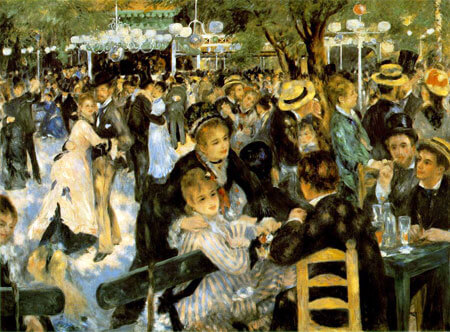
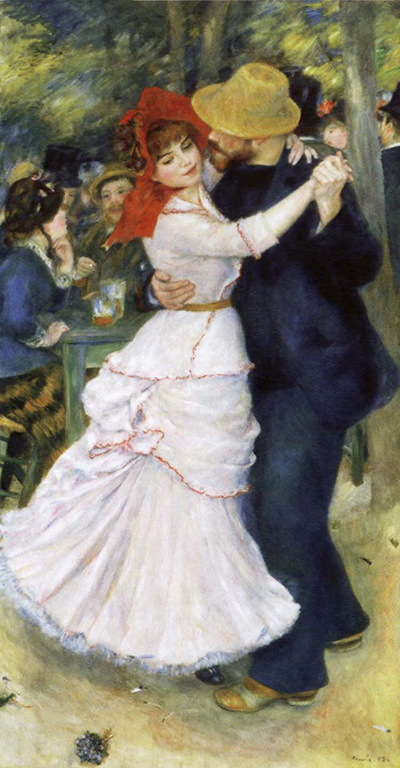
Renoir, Bal du moulin de la Galette
Dr. Beth Harris and Dr. Steven Zucker discuss Renoir’s 1876 Montmartre dance scene, its light and its crowds.
Watch on YouTubeThe old local title is a reasonable description of boating people at lunch, but it is not the owner museum's preferred title. The museum's object and technical records control the date, medium and identity here. Art Institute catalogue. [1]
Lunch beside the river
The diners occupy the foreground, filling nearly the lower half of the canvas. At left is a bearded man in light clothing; in the centre, a woman in dark blue faces mostly away from us; at right, another man leans back in a pale blue-white shirt, apparently smoking. Their bodies frame the table, where a bottle, slender glasses and a small dish of fruit catch the light. The arrangement is compact, with little empty space between the figures.
The trellis makes a loose room outdoors. Its crossing blue-green lines and leaves surround a central opening onto the river. A long orange boat cuts horizontally behind the group, with smaller people and craft farther away. This is more than decorative scenery: the open water establishes the diners as part of a boating destination, while the lattice keeps the immediate meal sheltered from the activity beyond it.
The Art Institute locates the restaurant on the Île du Chiard at Chatou, upstream from Bougival. Its catalogue places the arbors like this one below the upper terrace that Renoir later used for his larger Luncheon of the Boating Party. That architectural relationship helps explain how two pictures made at the same business could show very different views: this meal looks through a lattice from a sheltered lower level, while the Phillips painting opens onto the upstairs terrace. The railway had helped make Chatou a boating destination before Renoir painted here. These are documented features of the venue, not evidence that the two canvases depict the same sitting. Art Institute, site and boating history. [1]
The Art Institute describes the diners as two oarsmen and a female companion, noting that her blue flannel dress was suitable for the water. The museum's discussion observes the contrast between this sheltered meal and the active movement on the river. We can infer a pause in a day of boating from the boats, clothes and setting, but the image does not tell us what anyone ordered, what was said or how long they stayed. Art Institute, subject and setting. [1]
Why it is dated 1875
For decades this lunch was placed near Renoir's later work at the same restaurant, particularly the 1880–81 Phillips Collection Luncheon of the Boating Party. In the Chicago catalogue's account, the shared subject and setting helped sustain an 1879 date. The identification of this canvas with the work shown in 1876 gives a firmer earlier anchor: a painting exhibited that April had to have been completed by then. The catalogue relates it to Renoir's summer 1875 stay at the Maison Fournaise. Art Institute, dating history. [1]
The contemporary exhibition title was Déjeûner chez Fournaise. A critic's 1876 description of rowers in an arbor without visible legs also helped researchers match the entry to this picture: the diners' lower bodies disappear behind the table and foreground. This is an identification built from a period title and visual evidence, rather than a date written into the signature. The museum records “Renoir.”, not “Renoir 75,” at lower left. Art Institute, catalogue and signature. [1]
The earlier date changes the painting's place in Renoir's development. It belongs to his first sustained Chatou boating campaign, alongside portraits of the Fournaise family and other nearby scenes, not to a short prelude just before the Phillips luncheon. It also makes the 1876 exhibition an early public context for the work. Art Institute, Renoir at Chatou. [1]
Who are the three diners?
The Art Institute discusses proposed names but does not present all three as securely identified. The bearded man at left has been called “Monsieur de Lauradour” by scholar François Daulte, who connected him to other Renoir boating pictures. The sunburned man in white at right has not been identified; the museum says he may have been inspired by Renoir's younger brother Edmond. “May have” is important: a resemblance or familial model possibility is not a documented sitting. The woman is described by her position and blue boating dress rather than given a certain personal name. Art Institute, models and boating fashion. [1]
Renoir repeated some of these models and the Fournaise setting in another Luncheon, now at the Barnes Foundation. The Art Institute considers whether the two pictures might have been conceived as companions, while treating that as a question. The Barnes canvas is again a different object: its interior scene, two main sitters and dimensions must not be merged with the Chicago painting's catalogue record. Art Institute comparison [1]; Barnes Foundation, Luncheon. [2]
The colour that holds the scene together
The blue dress at the centre anchors the near side of the table. Across from it, Renoir sets the right-hand man's shirt in cool blue light; the left-hand man's clothing has warmer yellow highlights. Yellow returns in the tablecloth, glassware, flowers and far bank. The boat's orange line gives the upper opening a strong horizontal counterweight to the trellis verticals. This is a deliberate distribution of colour across people, objects and river rather than three separate zones. Art Institute, colour analysis. [1]
The museum's technical report supports a close look at the paint. Renoir often applied two or more colours with a brush so they remain partly distinct on the canvas, and in places worked a new stroke into still-wet paint. The flower spots and highlights on bottles appear among the final touches. Such details help explain why a relatively small painting feels both rapidly observed and carefully organized. Art Institute, technical summary. [1]
What lies beneath the visible lunch
X-rays and raking-light photographs show significant revisions on the left side. The Art Institute's conservators describe an earlier profile figure in the space between the two figures now visible there. The original arrangement may have had only a person on the left and the man on the right. Renoir altered the left group and brought the woman nearer the centre, producing the final three-person arrangement. The technical evidence shows forms and paint layers, but cannot identify that earlier figure with certainty. Art Institute, X-ray findings. [1]
The right side was revised too. The museum sees an abandoned curving form that may have belonged to a chair, and notes changes to the right-hand man's arm and elbow. These are useful reminders that a seemingly spontaneous lunch was worked through as a composition. They do not prove how many days Renoir spent on it: the conservators describe a limited number of wet-in-wet painting sessions separated by drying, without a documented daily schedule. Art Institute, technical examination. [1]
The changes are most valuable when they bring us back to the finished picture. Moving the woman inward created a stronger triangle of heads and bodies. That shape guides the eye from the bearded man through the blue dress to the relaxed man in white, then out toward the river. The picture's balance is an achieved result, not merely a record of three people sitting where they happened to be.
From Renoir to Chicago
The museum's provenance says Renoir sold the painting to Durand-Ruel in 1881. It passed through dealers and collectors, including a documented transaction handled by Boussod, Valadon & Cie when Theo van Gogh worked there. Durand-Ruel's New York branch sold the canvas to Potter Palmer in April 1892. Palmer's family gave it to the Art Institute in 1922. These dates trace ownership; they do not alter the evidence that the painting was already exhibited in 1876. Art Institute, provenance. [1]
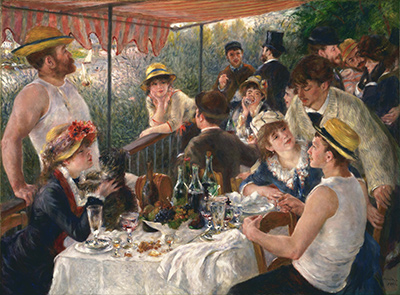
The Chicago and Washington luncheons have sometimes been confused because both were at Fournaise and both attracted “boating lunch” titles. The Chicago work is 55 × 65.9 cm, shows three foreground diners, was exhibited in 1876, and belongs to the Art Institute. The Phillips work is 130.2 × 175.6 cm, has a much larger group, dates to 1880–81, and belongs to the Phillips Collection. Their related setting makes comparison worthwhile; their object records must remain separate. Art Institute catalogue [1]; Phillips Collection, Luncheon of the Boating Party. [3]
Looking again
Find the white table first, then follow its diagonal toward the bright gap in the lattice. Compare the warm yellow on the left-hand man with the cooler shirt at right, and notice how the woman's blue back holds them apart. Through the trellis, rowing continues on the Seine. The museum's exhibition and technical records show how Renoir turned a small meal into a carefully revised picture of leisure at Chatou.
Renoir artworks directory
Questions about the rowers' lunch
No. This is the 1875 Art Institute of Chicago painting, with three foreground diners. The larger 1880–81 Phillips Collection painting is a separate work at the same restaurant.
An older dating linked it closely with Renoir's later Fournaise painting. The Art Institute identifies the Chicago work with Déjeûner chez Fournaise shown at the second Impressionist exhibition in 1876 and dates its making to 1875.
Only tentatively. A scholar called the left-hand man Monsieur de Lauradour. The man at right remains unidentified, although the Art Institute discusses Edmond Renoir as a possible model. The woman has no secure name in that catalogue.
The Art Institute found evidence of an earlier figure on the left and revisions to the right-hand man's pose. Renoir changed the composition before reaching the visible three-person arrangement.
Discussion
What do you notice when you return to Canoeists Luncheon?
How does the trellis divide the sheltered meal from the boating on the Seine?
Reader Insights
How does the trellis divide the sheltered meal from the boating on the Seine?
The Art Institute ties this canvas to the 1876 exhibition and dates it to 1875.
Which changes revealed by X-rays help explain the finished group of three?
Join the Conversation
Share a close observation or a source-backed question about Renoir’s canoeists luncheon.
References
- Art Institute of Chicago, Lunch at the Restaurant Fournaise (The Rowers' Lunch), catalogue entry for 1922.437: date, exhibition identification, sitters, colour, technical findings and provenance View source.
- Barnes Foundation, Barnes Foundation, Luncheon (Le Déjeuner) View source.
- Barnes Foundation, Phillips Collection, Luncheon of the Boating Party View source.
- Art Institute of Chicago Open Access API, artwork 81555: current image identifier and public-domain status of the object View source.
- Whole-work image: Wikimedia Commons, Art Institute of Chicago source of the exact 1922.437 canvas, 3000 × 2488 pixels, marked Public Domain and CC0 on its file page. The museum's current API reports the work's image as public domain. The local web copy is reduced to 1024 pixels on its longest side and was visually checked against the catalogued composition View source.