Pierre-Auguste Renoir.jpg)
 by Tom Gurney
Tom Gurney BSc (Hons) is an art history expert with over 20 years experience
Published on June 19, 2020 / Updated on October 2, 2026
Email: tomgurney1@gmail.com / Phone: +44 7429 011000
The child in Renoir's Child with Cat is Julie Manet, daughter of the painter Berthe Morisot and Eugène Manet. She sits in a pale dress with a cat gathered into her lap, looking out of the picture while one hand rests around the animal. Renoir painted the portrait in 1887, when Julie was nine. The Musée d'Orsay, which owns the work, uses Julie Manet as its primary title and L'Enfant au chat (“The Child with the Cat”) as an alternate title. Musée d'Orsay object record [1]; Musée Marmottan Monet exhibition dossier. [2]
The cat gives the portrait its familiar name, but the painting has more to hold the viewer than an appealing pet. It records a particular child, a family friendship and Renoir's careful experiment with line and surface in the 1880s.
At a glance
- ArtistAuguste Renoir (1841–1919)
- Museum titleJulie Manet; alternate title L'Enfant au chat
- Date1887
- MediumOil on canvas
- Size65.5 × 53.5 cm
- CollectionMusée d'Orsay, Paris
- AccessionRF 1999 13
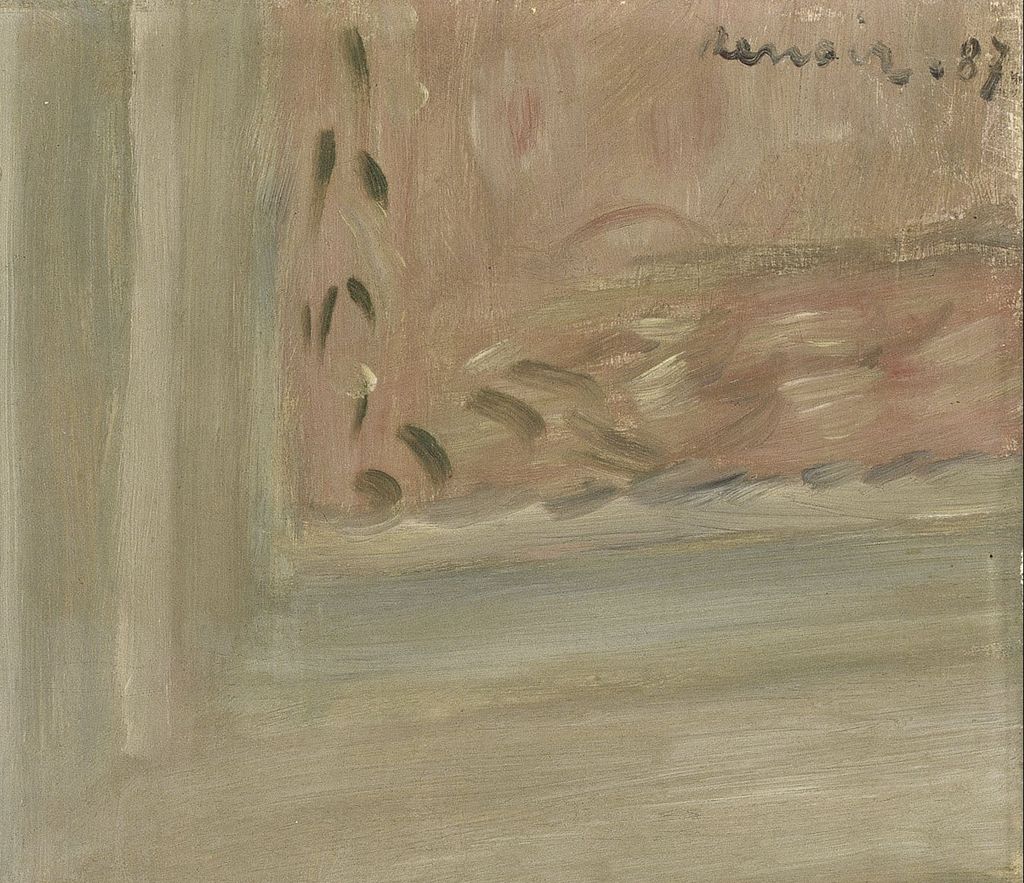
Renoir signed and dated the canvas at the upper right. The Orsay's record describes the signature as “Renoir 87.”
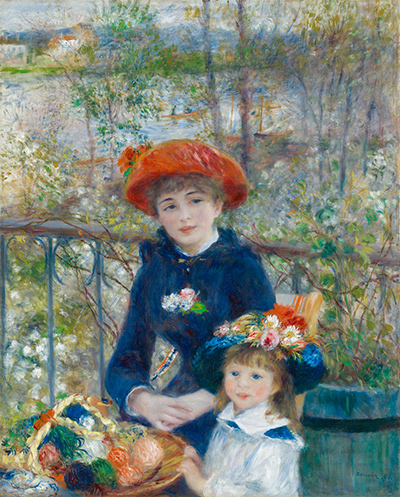
This work in Renoir’s career
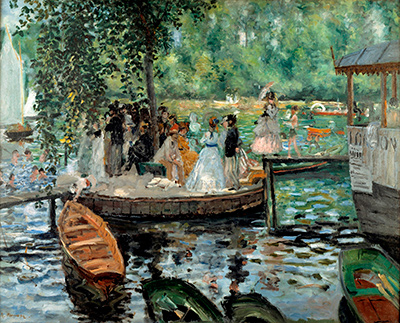
La Grenouillère
1869La Loge
1874The Umbrellas
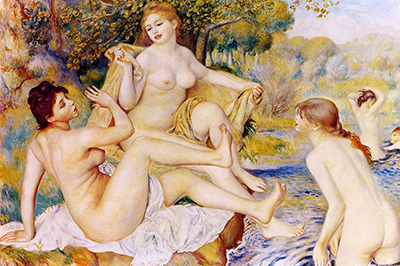
c. 1881–86The Great Bathers
1884–87The Bathers
1918–19Contents
- Annotated details of the painting
- Looking at Julie and the cat
- Why Renoir painted Julie
- Drawings before the finished canvas
- Morisot's response in print
- A different Renoir surface
- From Julie's family to the Musée d'Orsay
Annotated Details from Julie Manet (Child with Cat)
Renoir's 1887 portrait holds together a precise likeness of Julie Manet and a lively range of textures in her dress, the cat and the room around her. The numbered details encourage close looking at the finished painting; they are not claims about the preparatory drawings.
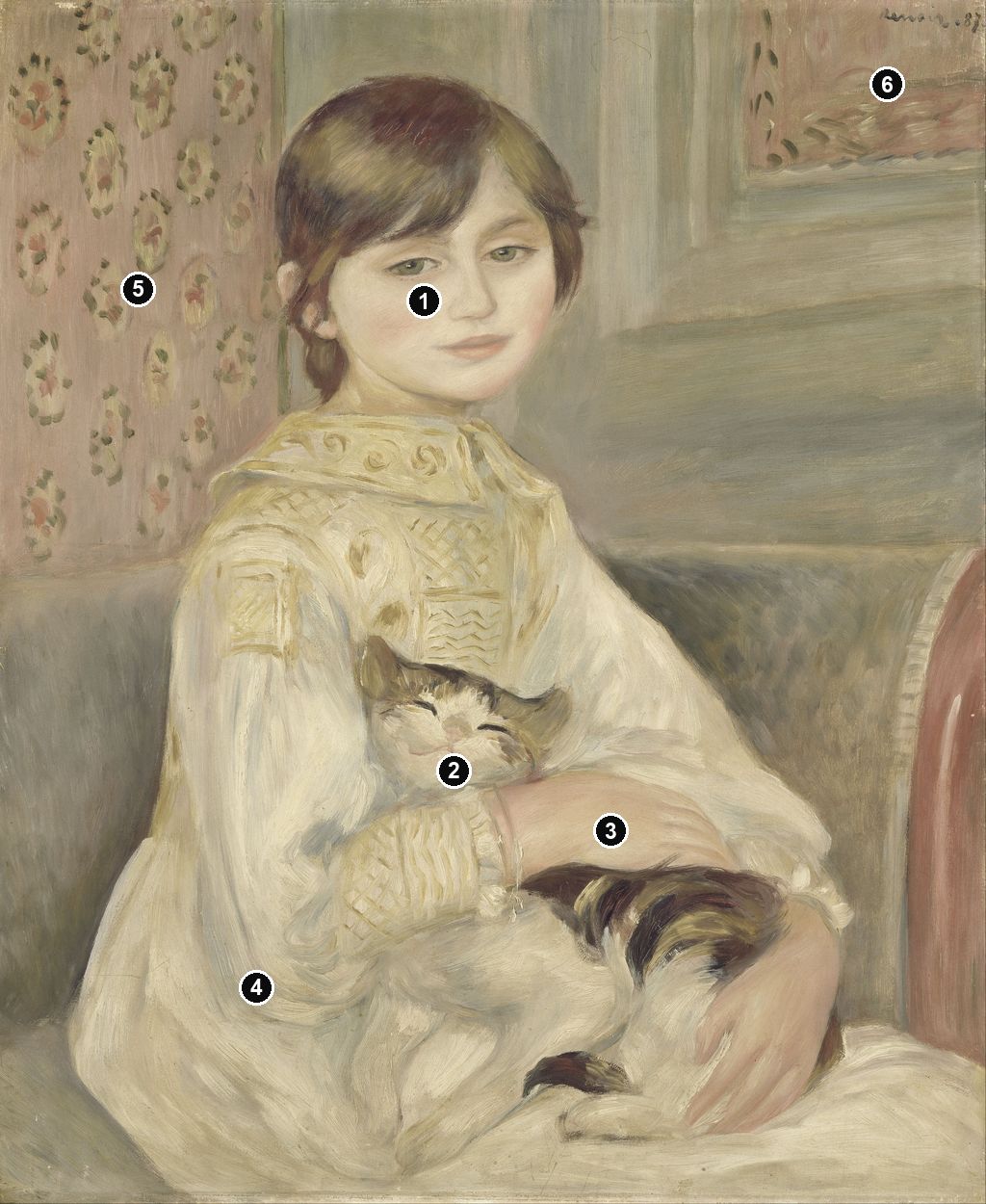
Details from JULIE MANET (CHILD WITH CAT)
Follow Julie's gaze down to the cat and across the pale fabric, then notice how the background separates her face from the room.
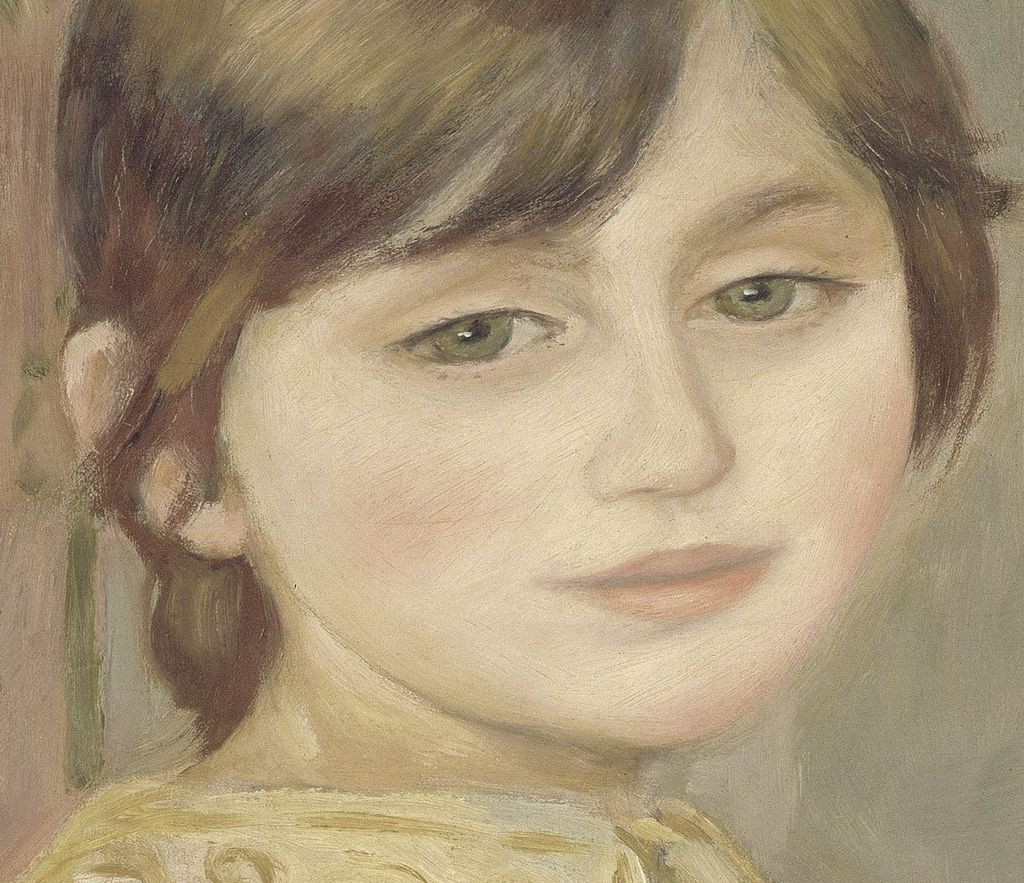
Julie's face and gaze
Renoir gives Julie's features firm placement while the surrounding hair and paint remain softer. Her gaze meets the viewer without a dramatic expression.
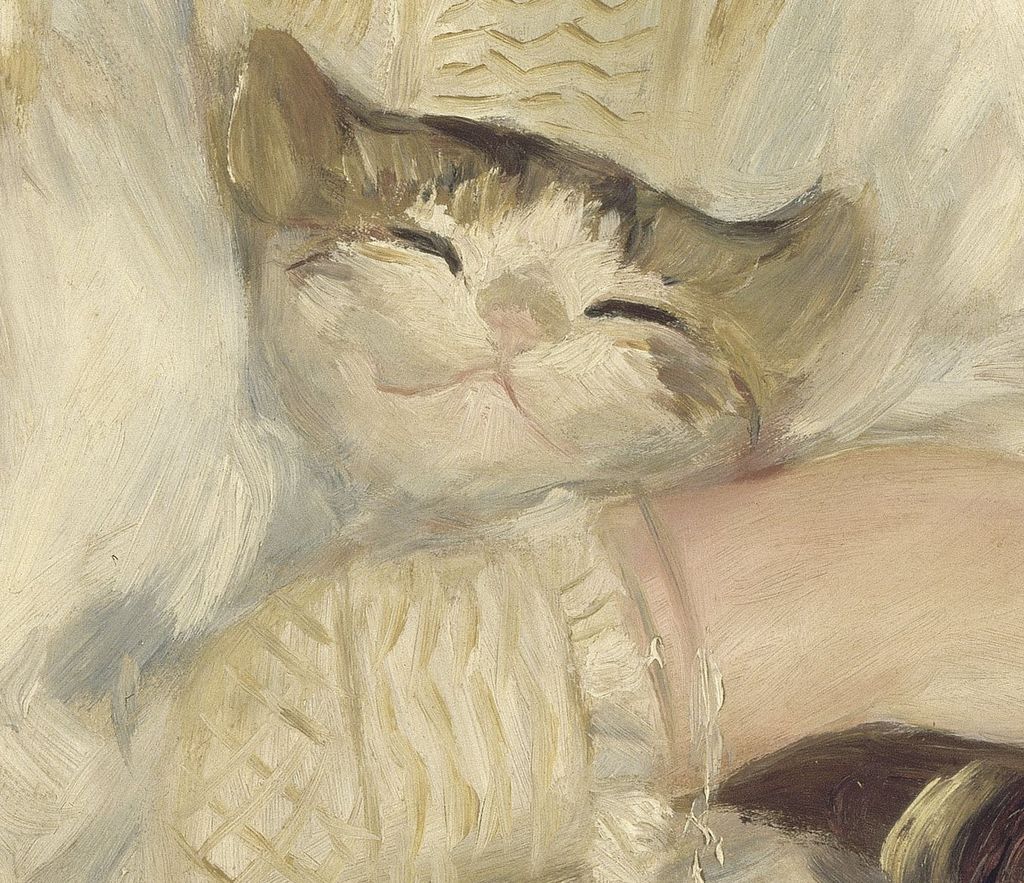
The cat in her lap
The cat's face emerges from folds of pale fabric. Darker stripes distinguish its body from Julie's dress and make the animal a second focus beneath her face.
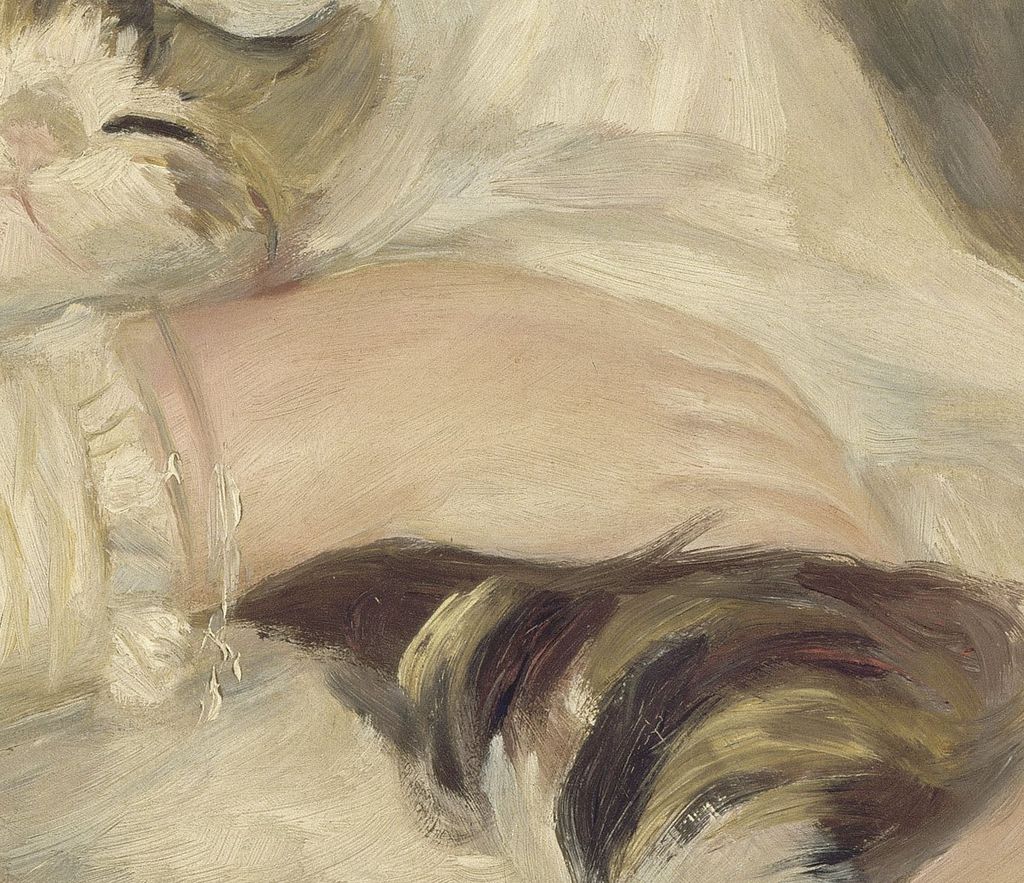
The hand around the cat
Julie's arm curves around the animal, joining her pose to the cat's body. The contact gives the portrait its quiet sense of companionship.
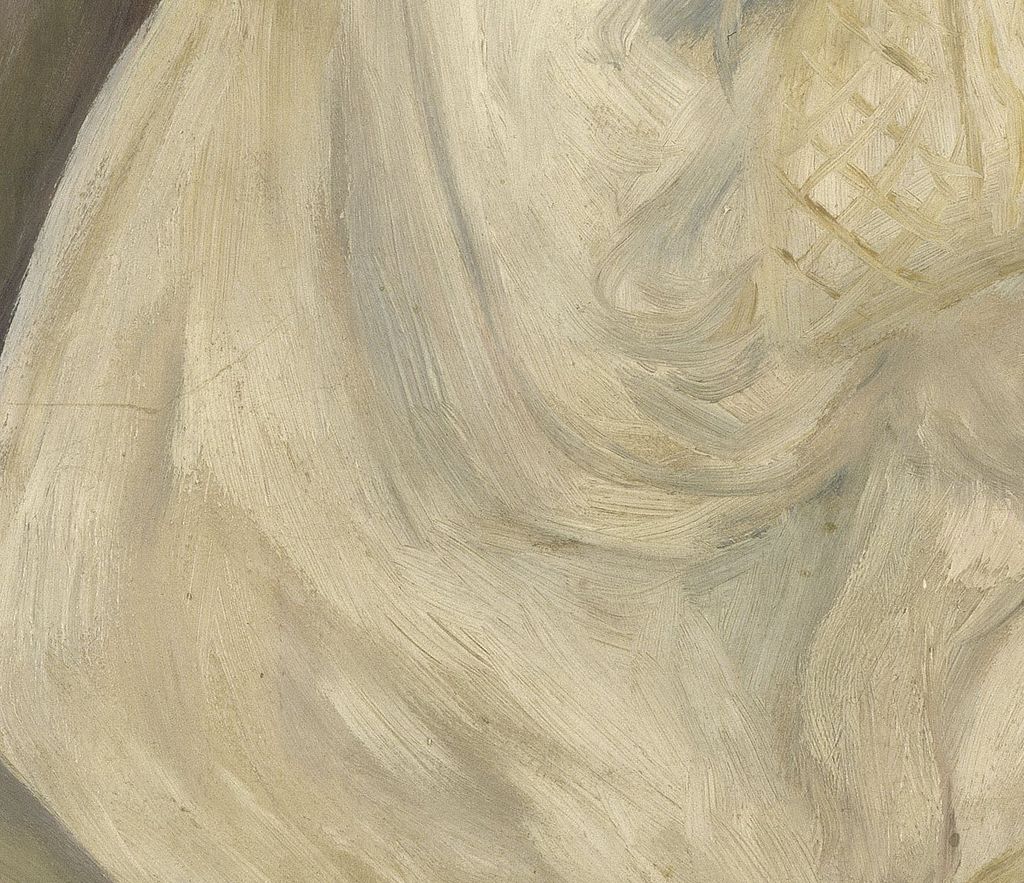
Pale dress and changing brushwork
What reads as a light, unified dress from a distance contains shifting strokes and warmer shadows. Renoir uses these variations to give the fabric volume.
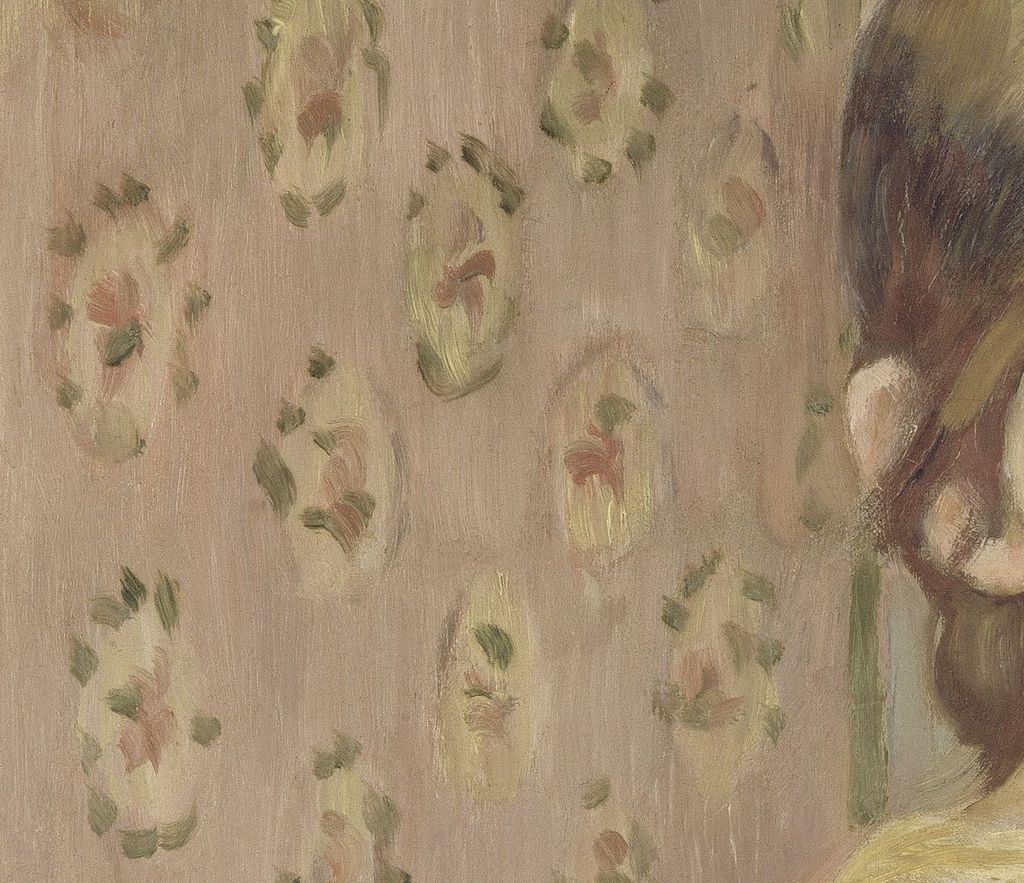
Patterned wall
Small repeated motifs on the left create a different rhythm from Julie's face and hair. They suggest an interior without competing for the portrait's centre.
Signature and date
The signed date at the upper right corresponds to the museum's 1887 object record. It anchors this particular portrait within Renoir's work of the decade.
Watch: Pierre-Auguste Renoir
Explore a Montmartre dance, a gathering beside the Seine and the drawings behind Renoir’s paintings.
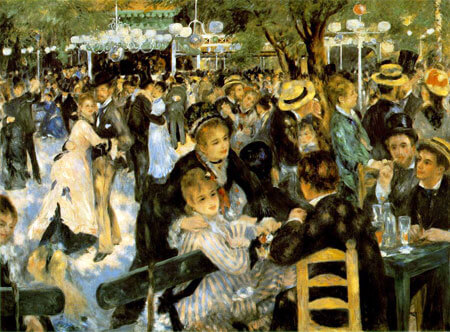
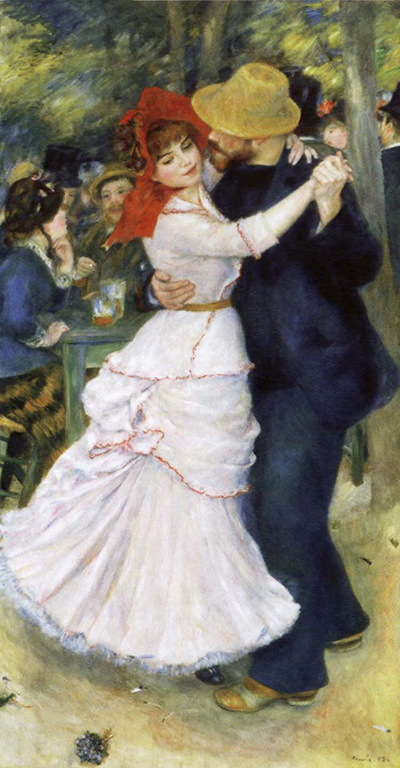
Renoir, Bal du moulin de la Galette
Dr. Beth Harris and Dr. Steven Zucker discuss Renoir’s 1876 Montmartre dance scene, its light and its crowds.
Watch on YouTubeRenoir artworks directory
Looking at Julie and the cat
Julie is shown from roughly the knees upward, seated at an angle but turning her face towards the viewer. Her hair falls to either side of her forehead, and her gaze is calm rather than emphatic. A cat lies across her lap, its head resting against her arm. Julie's arms and the animal's body make a compact group within the larger shape of her pale dress.
The painting's quietness is carefully made. The low contrast between the dress, the cat's lighter fur and Julie's skin brings these forms together. Darker passages in her hair and the cat's striped back keep them from merging completely. Renoir has placed the two faces at different heights: Julie's carries the portrait, while the animal gives the lower part of the canvas a second point of attention.
The longer one looks, the less the pale dress behaves like a single plain white area. Curving strokes follow its broad sleeve; tighter marks form its collar and patterned shoulder. Julie's left hand is easier to find because it rests against the darker stripes of the cat. Renoir used the animal's body to make the girl's gesture readable without placing her hands stiffly in front of her. At the top, his small black “Renoir 87” signature sits on the right-hand background. The museum records that inscription, and its placement is visible in the reproduction. Musée d'Orsay object details. [1]
Behind her, the patterned wall at left differs from the broad, softly painted furniture or panelling at right. These surfaces locate her indoors without turning the room into a detailed inventory. Renoir gives the most attention to the face, hair, hands, clothing and animal. The result is a portrait with a recognisable sitter, not simply a generic image of childhood.
It is possible to see affection in Julie's hold on the cat, but the picture does not tell us what she thought during the sitting. The safer claim is visual: the animal lets Renoir arrange the hands and folds of fabric into a close, stable group while keeping the pose natural enough to suggest a child's ease with a pet.
Why Renoir painted Julie
Julie was the only child of Berthe Morisot and Eugène Manet, who was the brother of Édouard Manet. The Orsay records that the family had known Renoir for years and grew closer to him during the second half of the 1880s. In 1887, Morisot and Eugène commissioned him to paint their daughter. This was therefore a portrait made within a network of artists and friends, not an anonymous child study.
The Musée Marmottan Monet, in a dossier for its exhibition on Julie Manet, contrasts Morisot's images of her daughter with Renoir's commission. Morisot repeatedly pictured Julie at different ages and often sought a passing attitude or moment of childhood. Renoir was asked to produce a likeness that could stand as a portrait. The comparison helps explain why this painting feels both personal and deliberately composed. It should not be used to suggest that Morisot's images were less serious, or that the two artists had only one way of painting Julie.
Drawings before the finished canvas
The Orsay notes at least four preparatory drawings for the painting. Renoir tried a more frontal presentation before settling on the finished arrangement, although Julie's basic pose changed relatively little. A drawing discussed by the Orsay and the Marmottan dossier, in charcoal and pencil on blue paper, makes the planning behind the apparently effortless image especially clear. Orsay object essay [1]; Marmottan dossier [2], p. 10.
These studies matter because the final portrait can look like a single comfortable sitting. In fact, Renoir considered how directly Julie should face the viewer and how her body would fit within the rectangle. The cat adds another shape to that arrangement. The surviving studies show that the composition was chosen, not merely caught.
Julie later remembered the sittings and said Renoir worked on the painting in small areas, unlike his usual method. Her recollection, quoted in the Orsay's account, offers insight into the process while remaining a later memory rather than a note made during the sittings. The Morgan Library's Renoir drawings exhibition gives a fuller account: it identifies five preparatory sketches and reports Julie's later memory that Renoir traced a final study and transferred it to the canvas. Orsay's “at least four” and the Morgan's five are counts stated at different levels of precision, rather than evidence for two separate portraits. The Morgan points to the strong contour of Julie's face as one visible result of this deliberate planning. Morgan Library and Museum, Julie Manet. [3]
Her later memory also records a difference of opinion. She thought the likeness good, while Degas objected to Renoir's rounded treatment of faces. The account comes through Julie's recollection, not a written review by Degas. It shows that even people close to the family did not have a single view of Renoir's 1880s style. Morisot's own approval, which the Orsay also records, makes the disagreement more precise than a general claim that Renoir's friends rejected the portrait. Musée d'Orsay essay. [1]
Morisot's response in print
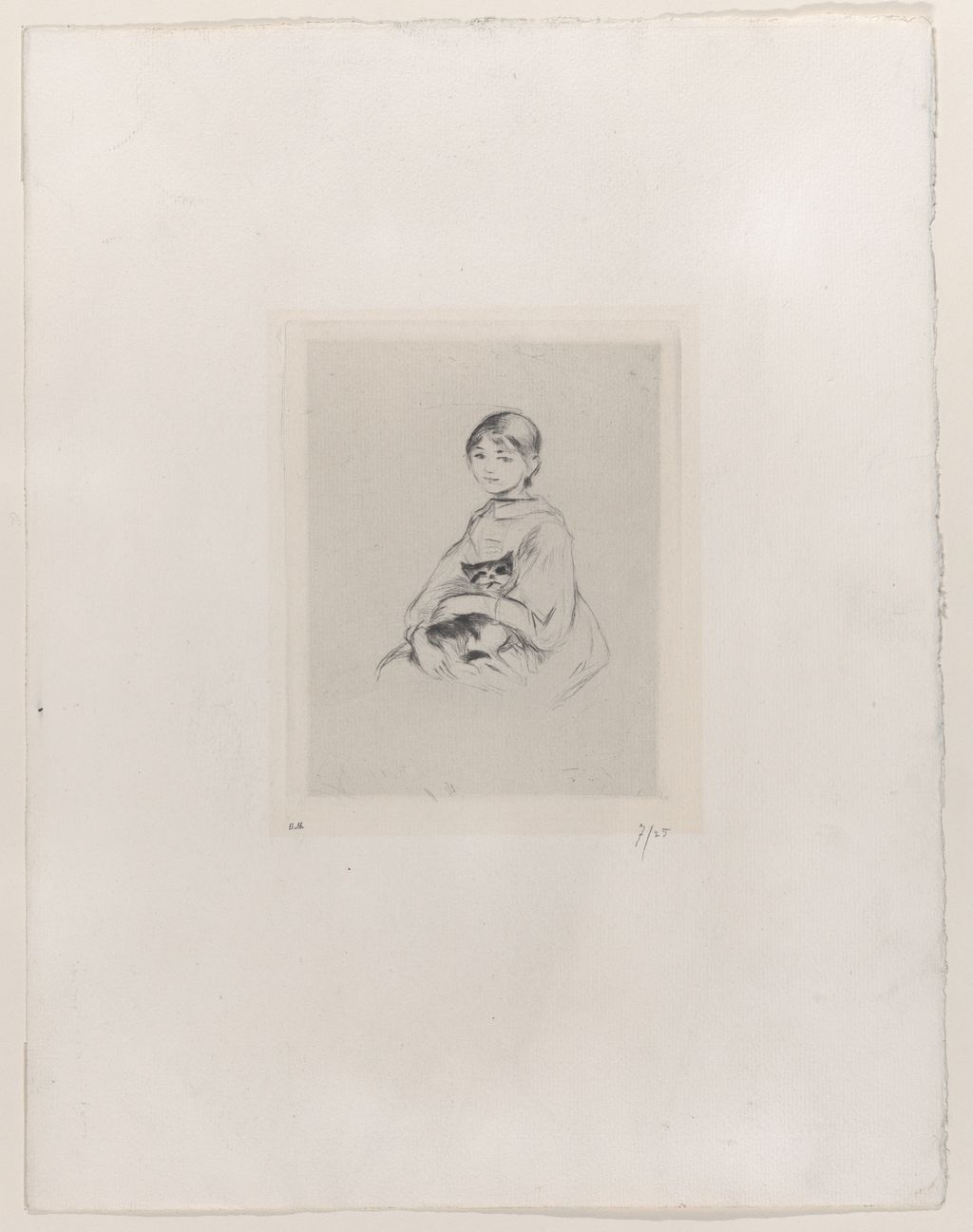
Two years after Renoir's canvas, Berthe Morisot made an 1889 drypoint after the portrait. The Metropolitan Museum of Art titles its impression Young Girl with a Cat, after a portrait of Julie Manet by Renoir and identifies Morisot as the printmaker, Renoir as the artist followed, and Julie as the sitter. The result is neither a preparatory drawing by Renoir nor a second oil portrait. It is an artwork made by Julie's mother in a different medium. Metropolitan Museum of Art, 22.60.94. [4]
In the Met impression the cat and girl still form one compact group, but the room and the broad textures of Renoir's dress have largely fallen away. Fine dark lines describe Julie's hair, face and collar; a few stronger strokes pick out the cat. The little image sits within a much larger pale sheet. That change of scale and material makes the familiar pose feel more like a remembered likeness than a furnished interior. It would be too much to infer exactly why Morisot made the print, but its existence shows that she returned to Renoir's image and translated it into her own practice.
Another Morisot print sets a different relationship before the viewer. In The Drawing Lesson (Berthe Morisot and her Daughter Julie Manet), the mother and daughter lean toward the same sheet. The National Gallery of Art dates the drypoint 1889, with this impression printed in 1921. Compared with Renoir's solitary seated sitter, Julie now appears beside the artist who was teaching and representing her. The work cannot tell us whether this scene records a particular lesson, but it places Julie within a household where making images was an activity as well as a subject for portraits. National Gallery of Art, 1953.6.98. [5]
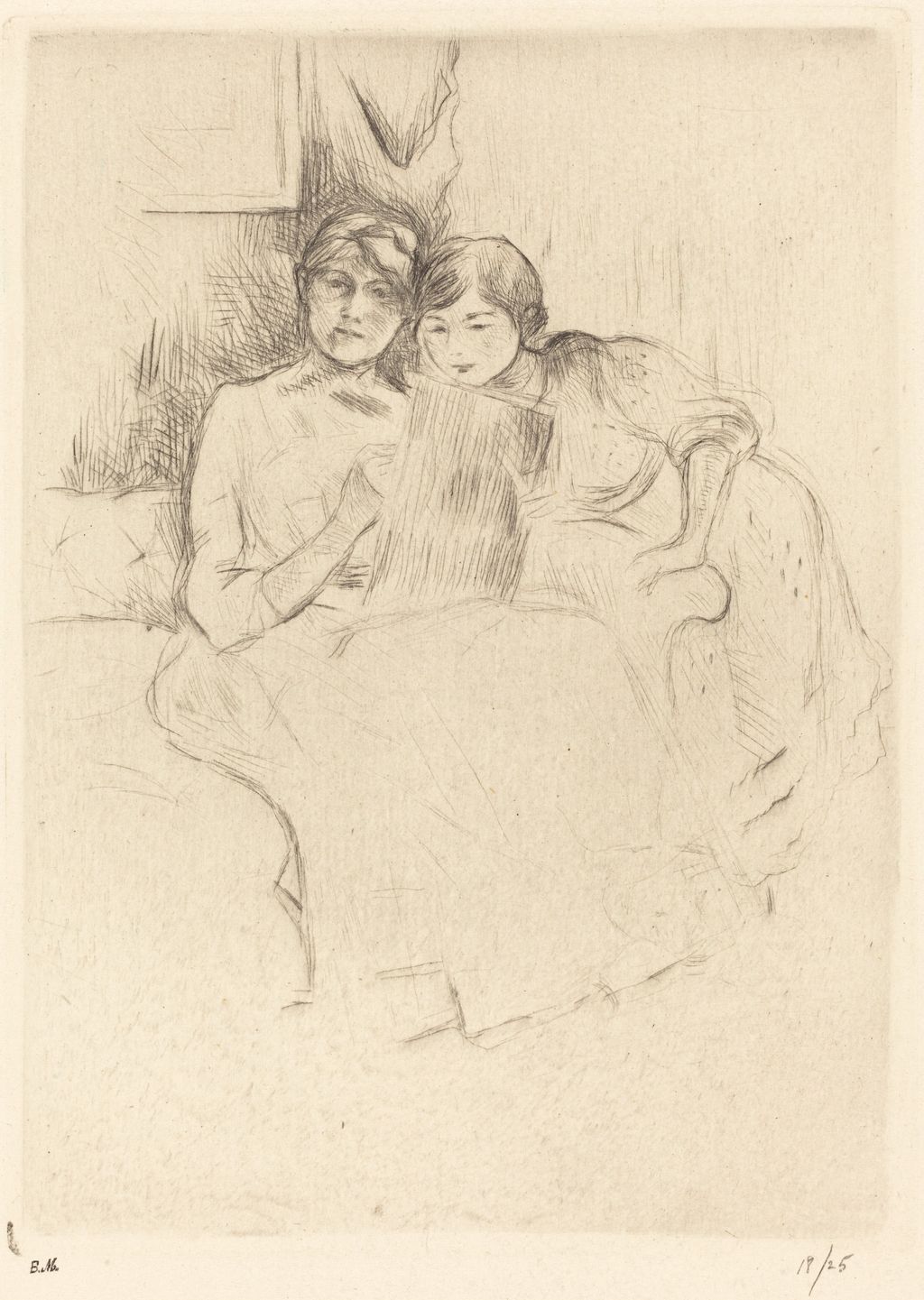
These prints sharpen the distinction between two kinds of family image. Renoir's commission presents Julie as a recognisable sitter with a cat. Morisot's drypoint after it retains that pose but edits its setting; The Drawing Lesson makes Julie a participant beside her mother. The three works should be read in their own media and dates, not treated as interchangeable versions of one painting.
Julie also copied the cat portrait herself. The National Gallery of Art catalogues a small watercolour on paper, dated about 1887, as Copy of “Julie Manet Holding a Cat” by Auguste Renoir and Other Sketches. It attributes the copy to Julie, with Renoir named as the artist she followed; the reverse bears a possible self-portrait at the piano. The sheet passed through Julie's descendants and entered the Gallery in 2025. Unlike Renoir's preparatory drawings, it is a work attributed to the child who sat for the portrait. The record does not establish exactly when she made it in relation to the sittings, so it cannot serve as a plan for Renoir's canvas. Its image is not available for download from the Gallery, but the object record documents another way Julie engaged with the portrait. National Gallery of Art, 2025.84.7. [6]
A different Renoir surface
The polished effect of Julie Manet differs from the broken colour and crowded movement of Renoir's 1876 Bal du moulin de la Galette. In the portrait, the face is more firmly held, and much of the dress and background has a smooth, controlled appearance at normal viewing distance. Yet close inspection still reveals varied strokes, especially in the fabric and cat. “Finished” does not mean mechanically flat.
The Orsay connects the portrait with Renoir's renewed attention to drawing and outlines during what is often called his Ingresque period. It also points to the painting's enamel-like surface and vivid palette. Those terms describe a direction in his work, not a rule that every canvas from the decade must follow. Here, the sharpest evidence is the painting itself: Julie's features are carefully set, while the surrounding material is allowed to remain more mobile.
The Orsay also records that Berthe Morisot admired this phase of Renoir's painting, even though some of his friends were unsettled by the change. That response complicates the idea of a neat break between “Impressionist” and “later” Renoir. The portrait belongs to a career in which he was adjusting how strongly line, colour and brushwork should carry a figure.
The Morgan names the dealer Paul Durand-Ruel among those who criticised Renoir's firmer style, alongside the objection Degas made in Julie's recollection. This matters because Durand-Ruel had championed Renoir's earlier work: the divide was visible even within his established circle, not only among hostile outsiders. The same Morgan account says Renoir later gave Julie and a cousin drawing and painting lessons. It therefore connects the girl in the commissioned portrait with Julie's own later work as an image-maker, without turning the 1887 canvas into a prediction of her future. Morgan Library and Museum, Julie Manet. [3]
The comparison with Morisot's prints makes this issue tangible. Where Renoir built large pale passages around a sharply held face, drypoint depends on the pressure and direction of an incised line. The likeness survives the move into print, yet much of the canvas's colour and furniture does not. That does not make either artist's method more faithful to Julie; it shows how the same sitter can be shaped by the means of representation.
From Julie's family to the Musée d'Orsay
The painting remained in Julie Manet's collection and later passed to Julien Rouart, according to the Orsay's provenance. In 1999 France accepted it as a payment of inheritance tax and assigned it to the Musée d'Orsay. The museum's exhibition history also lists it at the Durand-Ruel gallery in 1888, catalogue no. 18. The record does not provide that exhibition's exact catalogue title, so the current title should not be projected backwards without checking the original catalogue.
The work is currently listed by Orsay as not on view; visitors should check the museum's current record before planning a visit. Its survival through Julie's family gives the portrait a particular continuity: the person pictured later kept the image made of her as a child.
The relationship did not end with the childhood commission. The Marmottan's exhibition dossier identifies a separate 1894 Renoir Portrait de Julie Manet, now in its collection. By then Julie was a teenager. The later portrait should not be confused with the cat picture, or used to backdate details of its sittings, but it shows that Renoir returned to Julie as a sitter within the long friendship described by both museums. Musée Marmottan Monet, exhibition dossier [2], pp. 10 and 48.
Questions about Child with Cat
Yes. Orsay identifies her as the daughter of Berthe Morisot and Eugène Manet. The museum's preferred title is Julie Manet, and L'Enfant au chat is an alternate title.
She was nine when she posed for the 1887 portrait, according to the Musée Marmottan Monet's exhibition dossier.
Yes. Orsay records at least four preparatory drawings, including an earlier idea in which Julie faced the viewer more directly.
It belongs to the Musée d'Orsay in Paris, accession RF 1999 13. Its display status can change, so consult the museum's object page before visiting.
Discussion
Look closely at Child with Cat (Julie Manet) and use the questions below to compare what you see with the documented history.
Reader Insights
How do Julie Manet and the cat share the centre of the portrait?
Julie’s identity is documented; consider what the setting adds beyond a likeness.
How might the portrait read differently without its sitter’s known family connection?
Join the Conversation
Share a close observation or a source-backed question about Child with Cat (Julie Manet). The prompts above are starting points for discussion.
References
- Musée d'Orsay, Julie Manet, RF 1999 13, object record, provenance and curatorial essay View source.
- Musée Marmottan Monet, Julie Manet: La mémoire impressionniste exhibition dossier, 2021, especially p. 10 and the object checklist View source.
- Morgan Library and Museum, Julie Manet, Renoir drawings exhibition, preparatory sketches, Julie's later account and response to Renoir's style View source.
- Metropolitan Museum of Art, Berthe Morisot, Young Girl with a Cat, after a portrait of Julie Manet by Renoir, 22.60.94, 1889. The Met labels the object and image Public Domain; its official Open Access photograph supplies the first inline comparison View source.
- National Gallery of Art, Berthe Morisot, The Drawing Lesson (Berthe Morisot and her Daughter Julie Manet), 1953.6.98, 1889, this impression printed 1921. NGA marks the media public domain; its official download supplies the second inline comparison View source.
- National Gallery of Art, Julie Manet, Copy of “Julie Manet Holding a Cat” by Auguste Renoir and Other Sketches, 2025.84.7, ca. 1887 watercolour with another work on the reverse; object record only, no image reproduced here View source.
- Lead and annotated-detail reproduction: Commons Google Art Project file, Public Domain Mark, after Musée d'Orsay RF 1999 13. This is the Commons reproduction, distinct from the separately credited Orsay/RMN photographs View source.