by Tom Gurney
Tom Gurney BSc (Hons) is an art history expert with over 20 years experience
Published on June 19, 2020 / Updated on October 2, 2026
Email: tomgurney1@gmail.com / Phone: +44 7429 011000
Claude Monet bends over an open book, a pipe between his lips and his forearms resting on a table. He does not look out to meet the viewer. Pierre-Auguste Renoir has made another painter the subject of a portrait, yet the picture shows no easel, brush or canvas. Its action is reading. The painting belongs to the National Gallery of Art, Washington, which titles it simply Claude Monet and dates it 1872. “The Reader” is a useful historical name: the gallery records its display as Le Liseur in 1892. National Gallery of Art, 1985.64.35. [1]
The older title can also lead to confusion. This is Renoir's portrait of Monet, not a painting by Monet. It is distinct from Renoir's portrait of Monet working in his Argenteuil garden and from the separate standing portrait of Monet on this site. The seated reader is the National Gallery canvas, accession 1985.64.35.
At a glance
- ArtistPierre-Auguste Renoir
- SitterClaude Monet (1840–1926), painter
- Current museum titleClaude Monet
- Historical titlesLe Liseur; Portrait of Monet; previously misidentified in some records as Sisley
- Date1872 on the current NGA object page; the NGA's 2000 Argenteuil catalogue describes it as c. 1873
- MediumOil on canvas
- Dimensions65 × 50 cm
- CollectionNational Gallery of Art, Washington, Collection of Mr. and Mrs. Paul Mellon, 1985.64.35
- ImageOfficial NGA public-domain reproduction
Watch: Pierre-Auguste Renoir
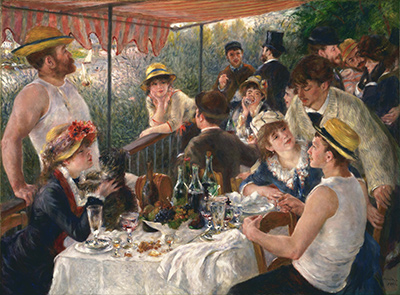
Explore a Montmartre dance, a gathering beside the Seine and the drawings behind Renoir’s paintings.
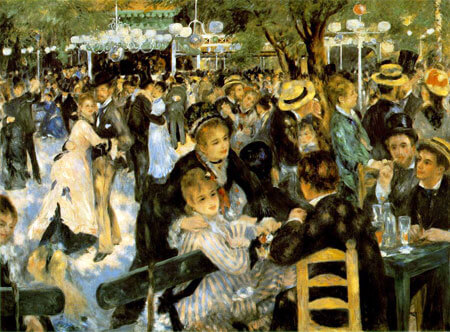
Renoir, Bal du moulin de la Galette
Dr. Beth Harris and Dr. Steven Zucker discuss Renoir’s 1876 Montmartre dance scene, its light and its crowds.
Watch on YouTubeLook at the book first
The open pages form the lightest large shape in the painting. They sit across the bottom of the composition like a broad white wedge. Monet's bowed head, beard, hand and pipe lead the eye down towards them. Renoir lets the book organise the portrait without showing what its printed words say. We can see a reader absorbed in a task; we cannot identify the text or recover what Monet thought about it. NGA visual description. [1]
The book rests on a plain ochre and green table. A black, curved form enters from the lower left. The NGA's Impressionists at Argenteuil catalogue [2] asks whether this is cloth, a shadow or something else, and leaves the question open. It has a useful visual role whatever its identity: the dark shape interrupts the table, balancing the bright pages and the dark coat above them. Giving it a confident name would claim more than the painting or the catalogue supports.
The pipe offers a second point of light. Renoir picks out the hand, white cuff and pale stem against Monet's jacket. Smoke curls towards his shoulder. The NGA catalogue reads the inexpensive clay pipe and the simple surroundings as signs of an informal, working identity rather than a formal professional portrait. That is a historical interpretation, not a fact that can be extracted from the pipe alone. The picture lets its sitter occupy an ordinary moment without the usual props of artistic fame. NGA catalogue, cat. 15. [2]
How Renoir holds the figure together
Monet fills most of the vertical canvas. His dark sleeves spread across it, while his head approaches the upper edge. Renoir gives very little room to a surrounding interior. A cooler blue-gray ground presses close behind the sitter, with a dark diagonal at the right that could be read as a shadow. The catalogue cautions that even the depth of this space is hard to establish. There are no clear floorboards or furnishings to measure the distance from Monet to the wall. NGA catalogue, cat. 15. [2]
The near-black coat does not become one flat mass. Broad, loaded marks give weight to the sleeves and shoulders. Shorter, thinner touches make the background feel less solid. Bright strokes in Monet's face, beard and hand sit between these extremes. The NGA author argues that the large outline makes the sitter appear substantial even as the setting stays uncertain. The contrast is visible without needing to decide that Renoir intended any single psychological message. NGA catalogue, cat. 15. [2]
Follow the pale cuff upwards and it meets the lapel, the beard, the pipe smoke and the shoulder. The catalogue traces this chain across the portrait, alongside a counter-diagonal joining the lower-left dark form to the dark patch behind Monet. These links help the image work as a composition rather than as a collection of head, hands and book. Some shapes remain unresolved, but Renoir gives the viewer routes through them. NGA catalogue, cat. 15. [2]
What kind of portrait is it?
A conventional portrait of a successful painter might identify the sitter through his studio and tools. Renoir instead shows Monet doing something shared by many people. His posture and attention make the reading activity more important than a display of status. The catalogue interprets this as an image of thought as work, a useful challenge to the old notion that Impressionist painting was only quick or spontaneous. We should keep the claim at the level of interpretation: the open book is visible; the contents of Monet's mind are not. NGA catalogue, cat. 15. [2]
Renoir and Monet had known one another since their student years. They later worked on related outdoor subjects, including the Seine and its leisure sites. The NGA's account of Argenteuil [3] places Monet in the town from late 1871 and describes the visits and collaborations of fellow painters. Yet the seated portrait's spare background does not locate this particular sitting in an identifiable room. The catalogue places the picture in Monet's early Argenteuil period; it does not turn the painted wall and table into a documented address.
Date, title and the name “Sisley”
The current NGA object page gives 1872, while the museum's 2000 exhibition catalogue printed c. 1873. Both place it early in Monet's Argenteuil years. A reader looking for an exact day or an agreed single year will not find one in these museum sources. We use the current collection date in the at-a-glance record and keep the catalogue's different dating visible rather than silently harmonising them. NGA object record [1]; NGA catalogue, cat. 15. [2]
The museum's provenance and exhibition history show how the sitter's identity was described over time. At a 1912 Paris sale the work appeared as Le liseur, portrait de Sisley. The older error endured well into the twentieth century: the NGA lists a 1953–54 exhibition and a 1957 exhibition that still used Sisley’s name. The NGA now identifies the reader as Claude Monet. The shift is a warning against treating every older catalogue title as a reliable new object identity. This canvas is also distinct from Renoir's separate portrait of Alfred Sisley, owned by the Art Institute of Chicago. NGA provenance and exhibition record [1]; Art Institute, Alfred Sisley. [4]
The 1876 second Impressionist exhibition is another point where certainty matters. The NGA says this picture was possibly one of the Renoir portraits of Monet lent by Jean Dollfus, and labels its 1876 exhibition entry “possibly.” The later records are firmer: the gallery lists the work in Renoir shows in 1883 and 1892, and the latter used the title Le Liseur (Portrait de M. Claude Monet). A possible 1876 showing should not be stated as settled fact. NGA exhibition history. [1]
From private ownership to Washington
The NGA traces the painting through Jean Dollfus, later Paris owners and dealers, Arthur Sachs, and finally Paul Mellon, who gave it to the National Gallery in 1985. The record qualifies Dollfus's earliest ownership date: it may go back to 1876 but is secure by 1892. It also documents changing labels and exhibitions without claiming that every appearance had the same title. NGA provenance. [1]
The painting belongs to a public collection; the NGA object page gives its current display status. Its official digital reproduction makes small decisions legible: the uneven edges of the pages, the touch of white at the cuff, the loose blue-gray around the head and the ambiguous mark on the table. Compare those details with Renoir's Monet painting in his garden. The two portraits show a painter thinking over a book and a painter looking towards flowers; neither needs to stand in for the other. NGA object record [1]; NGA catalogue, cats. 15 and 19. [2]
Renoir artworks directory
Questions about Claude Monet the Reader
Pierre-Auguste Renoir painted the portrait. Claude Monet is the sitter. The current National Gallery title is simply Claude Monet.
The NGA describes an open book. The pictured pages are not legible enough to identify a title, and the museum does not identify a newspaper.
The current NGA object page dates it 1872. The museum's 2000 Argenteuil exhibition catalogue used c. 1873. Both dates belong to the early Argenteuil period; no precise sitting date is documented in those records.
No. The NGA now identifies Monet. Older sale and exhibition records sometimes called the reader Sisley. Renoir made a distinct portrait of Sisley in the Art Institute of Chicago.
It belongs to the National Gallery of Art, Washington, accession 1985.64.35. Check the museum's object page for current display status.
Discussion
What do you notice when you return to Claude Monet The Reader?
How do the bright book and pipe lead your eye through Monet’s dark jacket?
Reader Insights
How do the bright book and pipe lead your eye through Monet’s dark jacket?
The NGA now identifies Monet, while some older sale and exhibition records called the sitter Sisley.
Which parts of the table and background remain hard to identify even in the museum image?
Join the Conversation
Share a close observation or a source-backed question about Renoir’s claude monet the reader.
References
- National Gallery of Art, Claude Monet, 1985.64.35, current title, date, medium, dimensions, ownership, visual description, provenance, exhibition history and public-domain media status View source.
- Paul Hayes Tucker, The Impressionists at Argenteuil, National Gallery of Art, 2000, catalogue no. 15, pp. 78–79; the curatorial analysis and c. 1873 date are attributed as such View source.
- National Gallery of Art, The Impressionists at Argenteuil overview, historical setting and Monet's arrival View source.
- Art Institute of Chicago, Alfred Sisley, 1933.453, a different Renoir portrait of a different sitter View source.
- Whole-work reproduction: NGA open-access image, supplied for this page from the museum's public-domain object media; exported without enlargement to the old local splash filename View source.