by Tom Gurney
Tom Gurney BSc (Hons) is an art history expert with over 20 years experience
Published on June 19, 2020 / Updated on October 2, 2026
Email: tomgurney1@gmail.com / Phone: +44 7429 011000
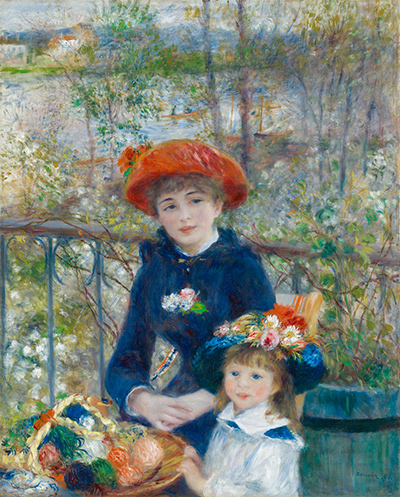
Two girls sit together on a garden bench, their white dresses broken into flickering colours by the light around them. The girl at the left wears a broad straw hat and holds flowers; her younger sister turns directly towards the viewer. Renoir painted The Daughters of Durand-Ruel, Marie-Thérèse and Jeanne in 1882 for the family of his dealer Paul Durand-Ruel. The original is at the Chrysler Museum of Art, Norfolk, Virginia, accession 71.518. Its present museum title supplies the daughters' names and the precise spelling of Marie-Thérèse, which the older web address lacks. Chrysler object record. [1]
At a glance
- ArtistPierre-Auguste Renoir
- Date1882, signed and dated at lower right
- MediumOil on canvas
- Size81.3 × 65.4 cm
- SittersMarie-Thérèse and Jeanne Durand-Ruel
- CollectionChrysler Museum of Art, 71.518
Watch: Pierre-Auguste Renoir
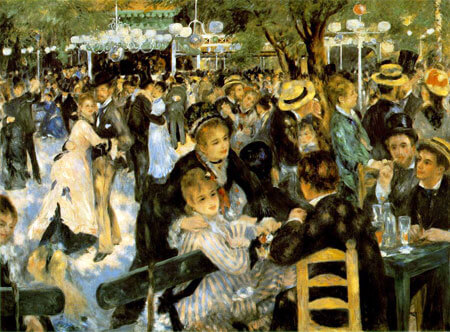
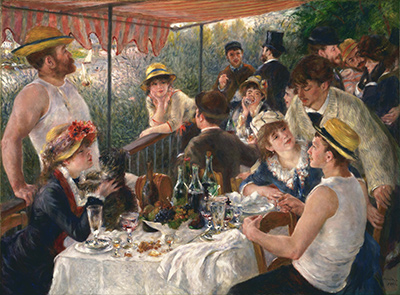
Explore a Montmartre dance, a gathering beside the Seine and the drawings behind Renoir’s paintings.
Renoir, Bal du moulin de la Galette
Dr. Beth Harris and Dr. Steven Zucker discuss Renoir’s 1876 Montmartre dance scene, its light and its crowds.
Watch on YouTubeA portrait made among the family
The picture was part of a larger undertaking. A Musée du Luxembourg account [2] uses letters from Durand-Ruel to Claude Monet in July 1882 to reconstruct the setting. The dealer sought a house near Dieppe for his family and Renoir, then reported finding one in Dieppe with a small garden behind it. He expected Renoir to work there out of the public eye. The account says the resulting family portraits were painted in Dieppe. That documented garden context is more useful than guessing the exact plants or hour of day from the canvas.
Durand-Ruel commissioned portraits of his children around ten years after meeting Renoir. His eldest son Joseph received a single portrait; the other siblings were painted in pairs. The sisters Marie-Thérèse and Jeanne appear together here, Charles and Georges in another outdoor portrait, and Renoir also depicted Marie-Thérèse sewing. These works record a relationship between dealer, artist and family, not just a commercial transaction. The Luxembourg account interprets them as signs of respect and friendship; its quoted letters establish the practical arrangements behind that interpretation. Musée du Luxembourg. [2]
Light on white dresses
Both sisters wear pale dresses, but Renoir avoids painting them as blank white areas. Lilac, blue, rose and yellow touches move across the fabric. The Chrysler Museum's label points to this many-coloured treatment of sunlight and notes that he retained small details amid the quick strokes: the girls' bootlaces, Jeanne's dark ribbon necklace and the flower on Marie-Thérèse's hat. The contrast between lively surface and precise accents is visible throughout the picture. Chrysler museum label. [1]
In its account of a 2012 exhibition, the Chrysler Museum describes the portrait as painted outdoors beneath chestnut trees. That gives the broken light a specific setting, while the Luxembourg letters explain why Renoir was working with the family in a Dieppe garden. The Chrysler points out that the purple, blue, pink and yellow shadows are interrupted by small touches of thicker white paint. Seen together, the varied shadows and raised highlights give the sisters' dresses form without replacing their white fabric with a single flat tone. Chrysler Museum exhibition account. [3]
The hat makes a warm red-orange shape above the left figure. Another red band crosses her waist, while the flowers bring small warm notes down towards her lap. Jeanne's dark hair and necklace provide a different centre on the right. Their bench is partly visible behind them, and the greenery rises in a busy screen rather than opening into a distant landscape. Renoir keeps the girls close, yet gives each a distinct silhouette, gaze and set of accessories.
Look at how the sisters sit together. Jeanne reaches towards her sister's arm near the middle of the canvas, giving the double portrait a point of contact. Marie-Thérèse faces us more frontally beneath the wide brim; Jeanne turns her body towards her sister while looking out. The shared dresses and garden hold them as a pair, but their different poses keep the image from reading as two interchangeable children. The Luxembourg account identifies the older Marie-Thérèse, born 1868, and Jeanne, born 1870. Their age difference is part of the historical identification, not something that must be estimated from the painted faces. Musée du Luxembourg. [2]
The dealer's home and the painting's later life
The Chrysler's provenance starts with Paul Durand-Ruel, who held the picture from 1882 to 1921. It then passed within the family, including Marie-Thérèse and her daughter Madeleine Aude, Comtesse de Brécey. Wildenstein & Co. purchased it in 1938. The museum records its subsequent passage through the Foy and Chrysler collections before Walter P. Chrysler Jr. gave it to the museum in 1971, in memory of Thelma Chrysler Foy. These records establish a family picture that stayed with its first sitters' relatives for decades before entering the American collection. Chrysler provenance. [1]
The painting's early display history is also documented. The Chrysler lists it in Renoir exhibitions at Galerie Durand-Ruel in Paris in 1883 and 1892, and in a later 1899 show of Renoir, Monet, Pissarro and Sisley. Those entries show that the dealer's private family commission also became a public example of Renoir's work. They do not, by themselves, establish how contemporary viewers responded to it. Chrysler exhibition history. [1]
The dealer's role matters to the portrait. Durand-Ruel supported Impressionist artists through purchases and exhibitions; here he also entrusted Renoir with portraits of his children. The girls' white dresses and garden let Renoir paint a recognisable family likeness in shifting outdoor light. The result belongs at once to a household history and to the artist's continuing experiment with figures in colour. Chrysler label [1]; Musée du Luxembourg. [2]
Looking again
Begin at the red hat and follow its colour to the waist ribbon, then the flowers. Move to Jeanne's dark hair and necklace, and finally compare the marks across the two white dresses. The painting asks us to see both named sisters and the changes of colour that make the garden light tangible. The small details cited by the Chrysler Museum show that Renoir's quick strokes did not mean indifference to the children he portrayed.
Renoir artworks directory
Questions about The Daughters of Durand-Ruel
They are Marie-Thérèse and Jeanne Durand-Ruel, daughters of the art dealer Paul Durand-Ruel. The Musée du Luxembourg identifies Marie-Thérèse as the elder sister.
The Musée du Luxembourg links the family commission to Dieppe in 1882. Durand-Ruel's July letters to Monet describe a rented house with a small garden where Renoir could work.
Renoir signed and dated the canvas 1882. It is in the Chrysler Museum of Art, Norfolk, accession 71.518; check the museum's current record for display status.
Renoir used varied colour touches to suggest light moving across white fabric. The Chrysler Museum notes that he also painted specific details, including bootlaces, a ribbon necklace and a flower on the hat.
Discussion
What do you notice when you return to Daughters Of Paul Durand Ruel Marie Theresa And Jeanne?
How do the touches of colour change the appearance of the sisters’ white dresses?
Reader Insights
How do the touches of colour change the appearance of the sisters’ white dresses?
Durand-Ruel’s July 1882 letters to Monet describe the Dieppe house and garden arranged for Renoir’s work.
Which details distinguish Marie-Thérèse from Jeanne within the paired portrait?
Join the Conversation
Share a close observation or a source-backed question about Renoir’s daughters of paul durand ruel marie theresa and jeanne.
References
- Chrysler Museum of Art, The Daughters of Durand Ruel, Marie-Thérèse and Jeanne, 71.518. Object identity, dimensions, visual label, provenance and exhibitions View source.
- Musée du Luxembourg, Les Filles de Paul Durand-Ruel, Marie Thérèse et Jeanne. Family context and July 1882 Durand-Ruel letters to Monet View source.
- Chrysler Museum of Art, Upstairs/Downstairs exhibition account. Owner's account of the outdoor setting, chestnut trees and white impasto in the dresses View source.
- Page image: inherited site reproduction of The Daughters of Durand-Ruel, Marie-Thérèse and Jeanne, Chrysler Museum of Art 71.518.