by Tom Gurney
Tom Gurney BSc (Hons) is an art history expert with over 20 years experience
Published on June 19, 2020 / Updated on October 2, 2026
Email: tomgurney1@gmail.com / Phone: +44 7429 011000
Two women pause near the water in Auguste Renoir's Figures on the Beach. One sits in the foreground, partly turned towards her companion. The other stands with a basket, her body rising through the middle of the picture. A child plays by the shore, a small white dog lies on the sand, and several sails appear across the water. The scene is quiet, but its figures, boats and bands of colour keep the viewer's eye moving.
The Metropolitan Museum of Art dates the oil painting to 1890 and says Renoir probably made it on the Côte d'Azur in southern France. The exact beach is not identified. That qualification matters: the picture offers enough detail to describe a seaside setting, but not enough evidence to give the figures names or place them at a particular resort.
At a glance
- ArtistAuguste Renoir (1841–1919)
- TitleFigures on the Beach
- Date1890
- MediumOil on canvas
- Size52.7 × 64.1 cm (20¾ × 25¼ in.)
- CollectionThe Metropolitan Museum of Art, New York, Robert Lehman Collection, 1975
- Accession1975.1.198
The Met's record and public-domain image provide the object facts and the basis for the close looking below. Met object record. [1]
This work in Renoir’s career
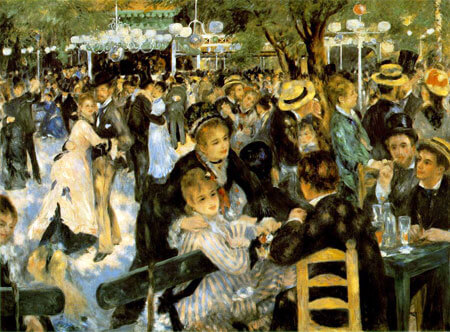
La Grenouillère
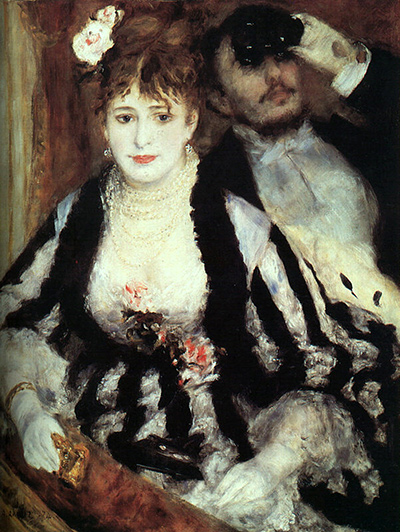
1869La Loge
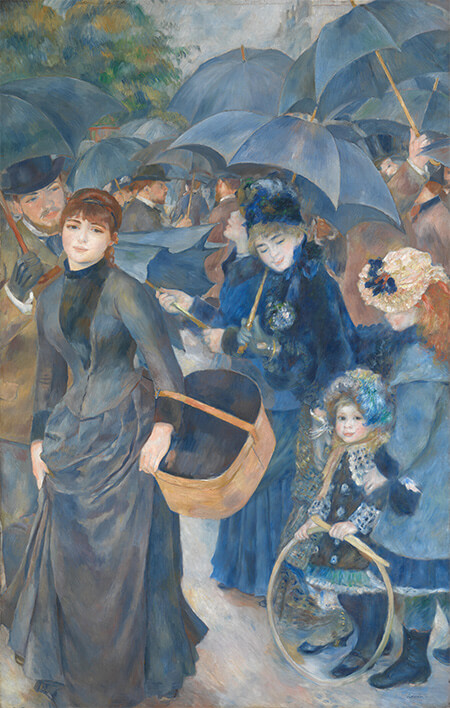
1874The Umbrellas
c. 1881–86The Great Bathers
1884–87The Bathers
1918–19Contents
- Annotated details of the painting
- What is happening on the beach?
- How Renoir builds the view
- A seaside image without a precise address
- How it differs from By the Seashore
- A later beach scene in print
- Where is the painting now?
Annotated Details from Figures on the Beach
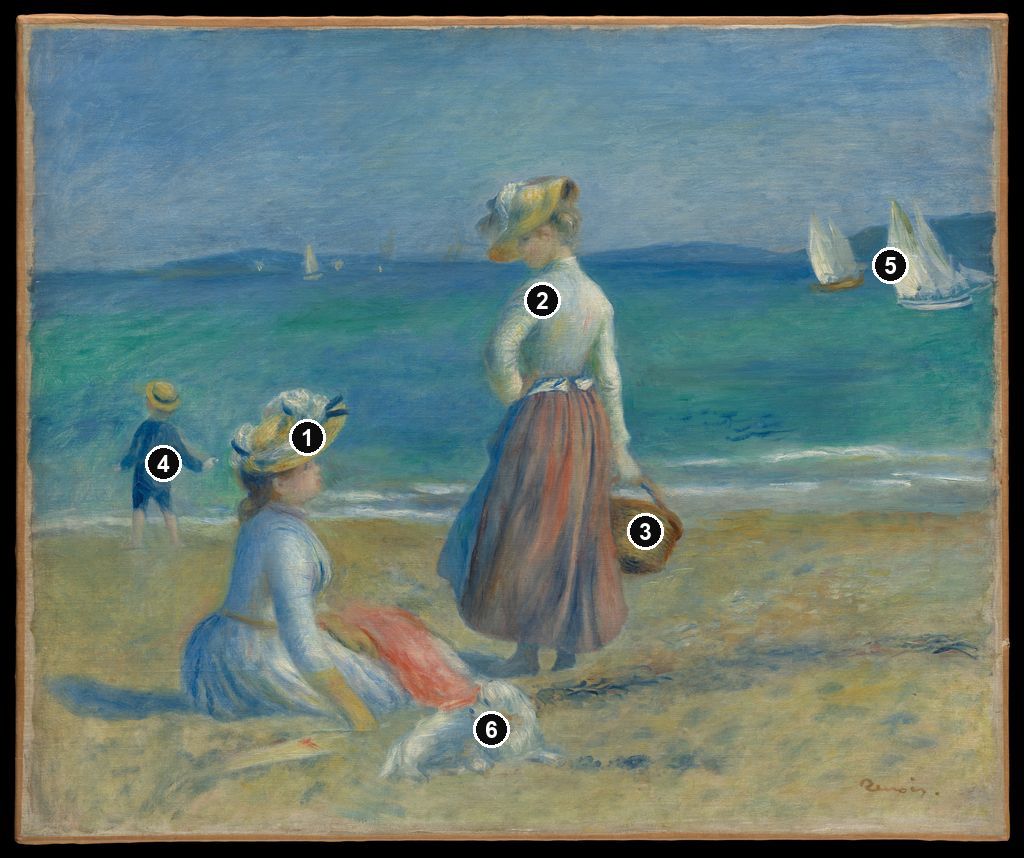
These six details show how Renoir places a quiet group against broad bands of shore, sea and sky. The Met dates the painting to 1890 and considers a Côte d'Azur setting probable; the exact beach and the figures' identities remain unknown.
Details from FIGURES ON THE BEACH
Follow the people, dog, basket and sails across the composition. Each crop comes directly from the Met's full-resolution public-domain photograph.
The seated woman's hat
The broad hat and pale clothing hold the lower-left foreground. Her turned head creates a quiet relationship with the standing figure without specifying a story or naming the sitter.
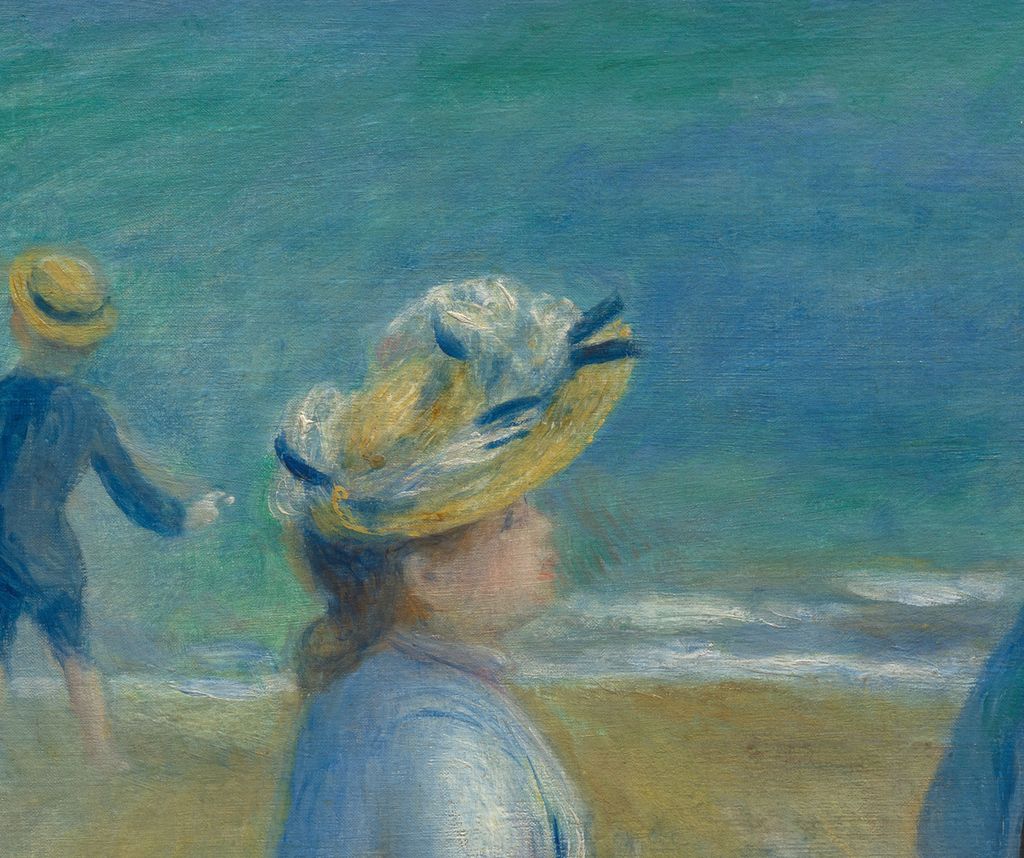
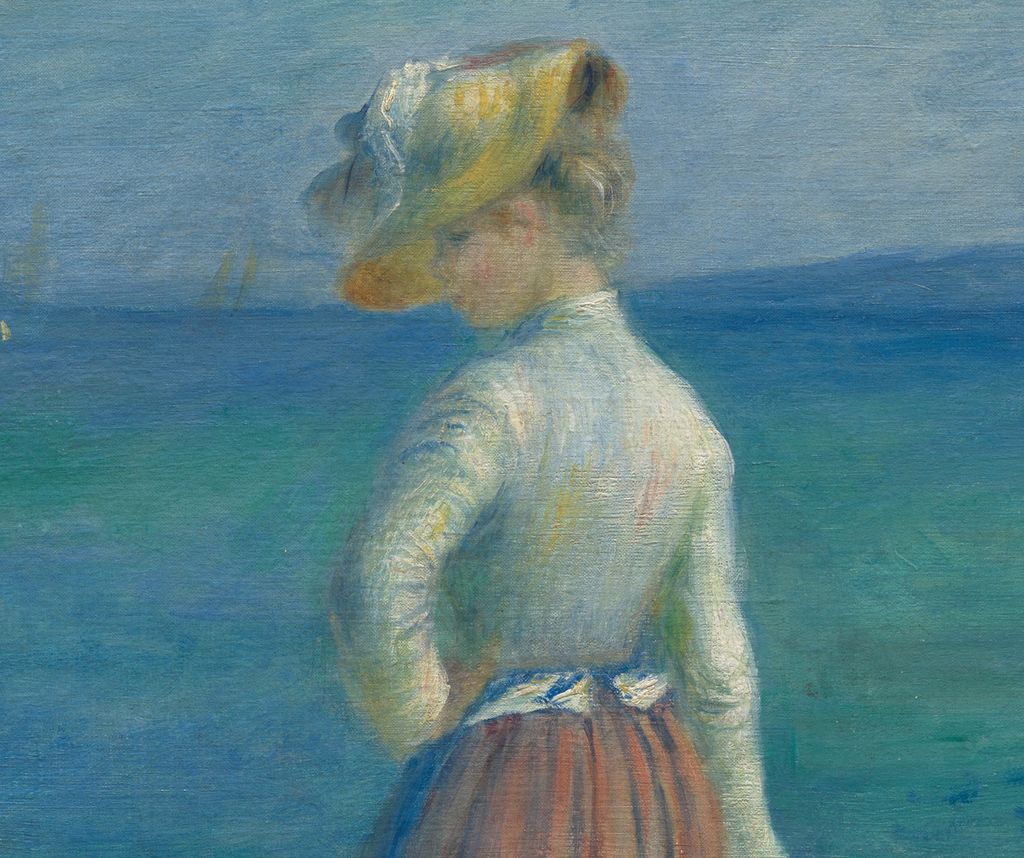
The standing figure
Her hat and blouse rise against the sea and sky. The tall form interrupts the long horizontal colour bands and links the broad landscape to the nearby group.
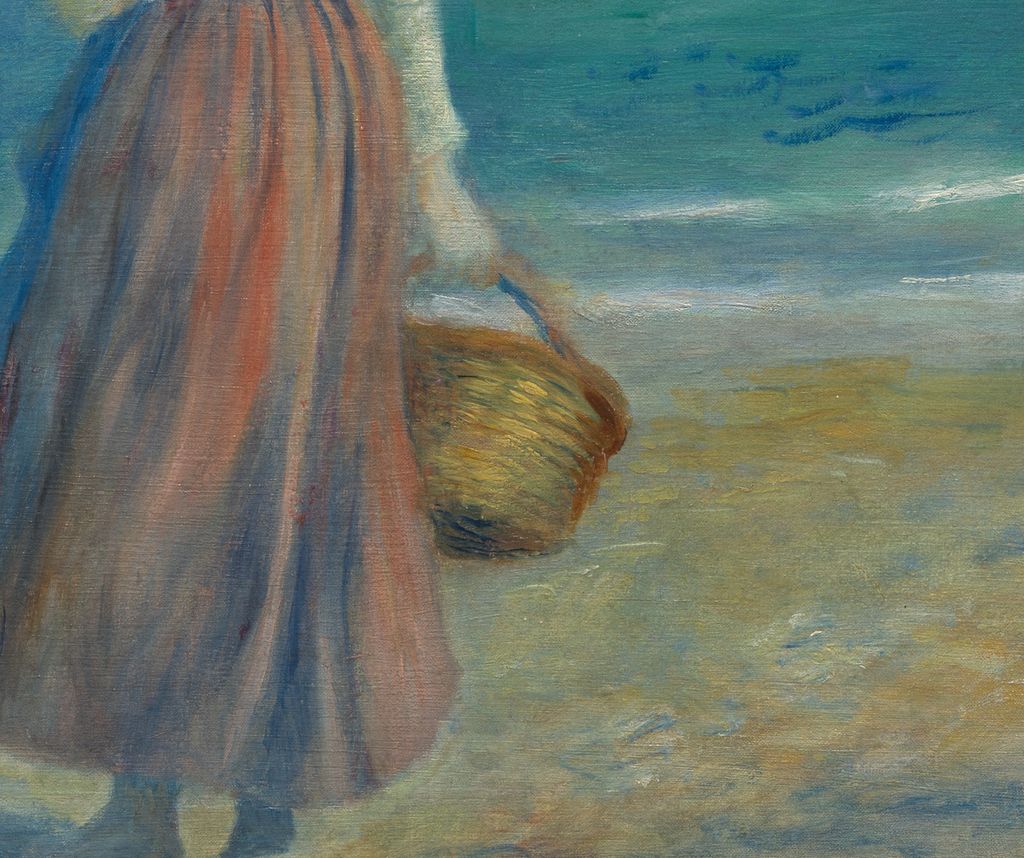
The basket
The basket brings the standing woman's gesture down towards the sand. Its contents are not shown, so it suggests an outing without fixing its purpose.
The child at the water
The small, dark-clothed child stands nearer the water than the adults. Renoir uses the figure's scale to increase the distance between the foreground group and the sea.
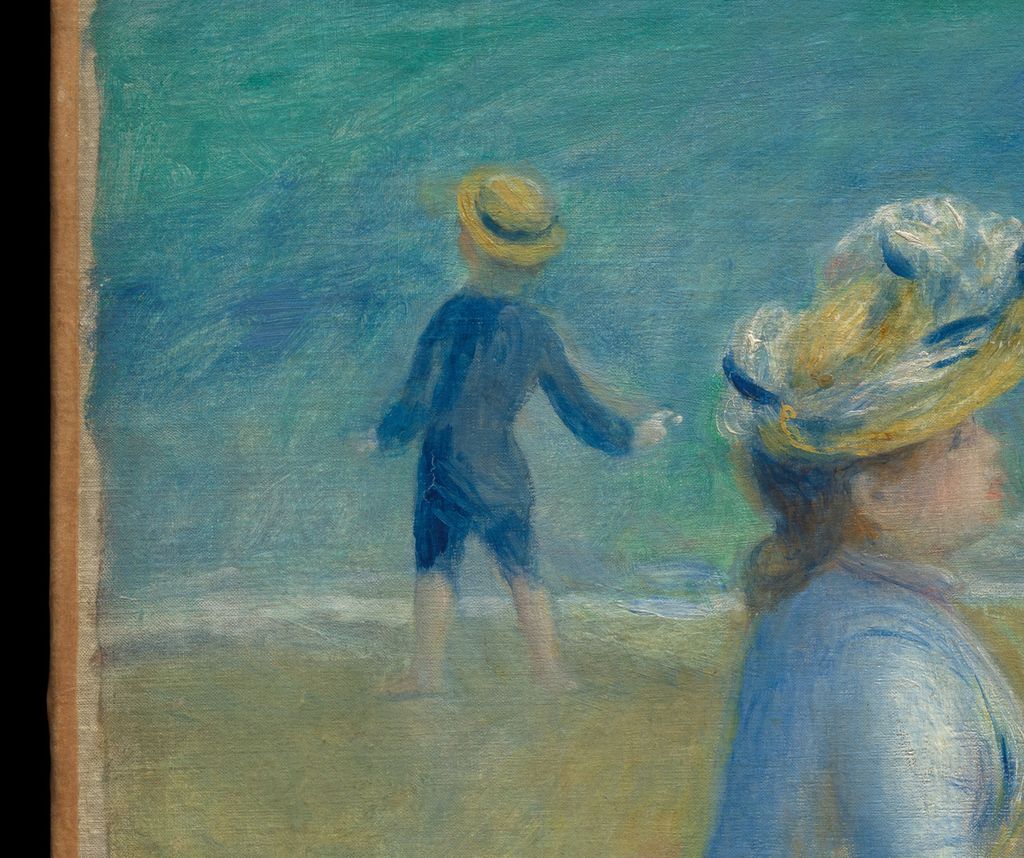
Sails across the horizon
Small pale sails punctuate the far water. They counterbalance the larger figures while leaving the right side of the canvas open.
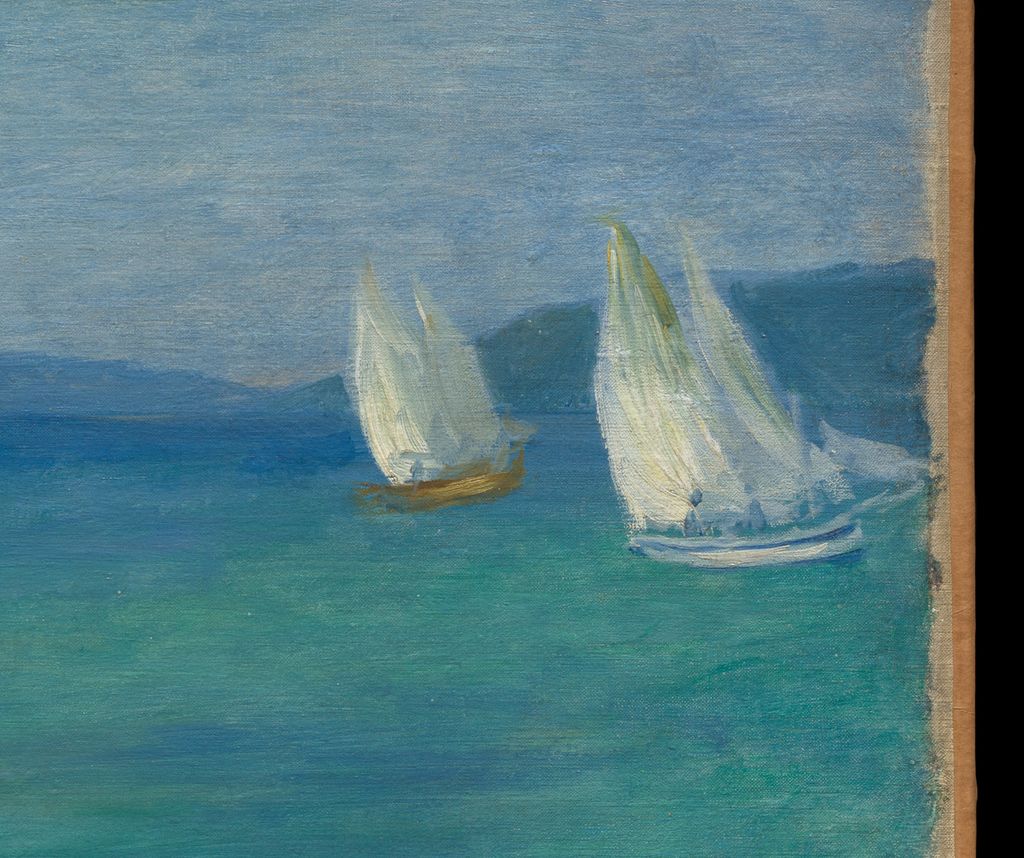
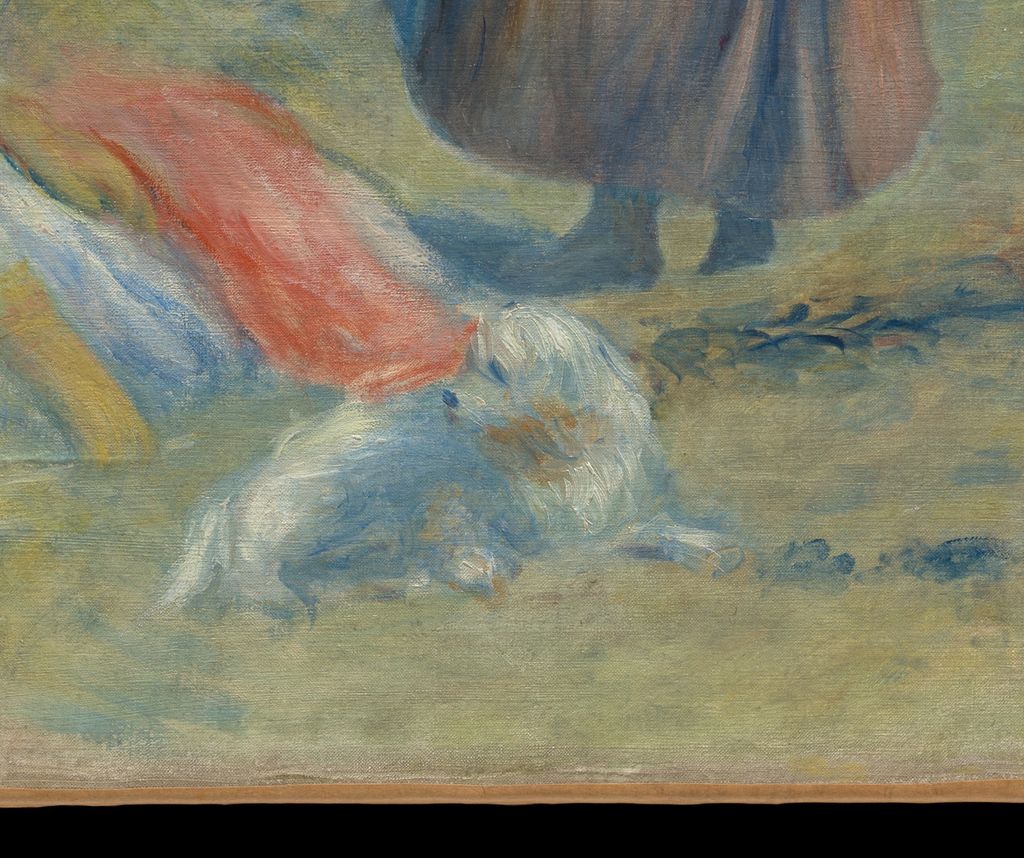
The dog on the sand
The white dog lies closest to the viewer. Its low, still form anchors the foreground below the more upright human figures.
Watch: Pierre-Auguste Renoir
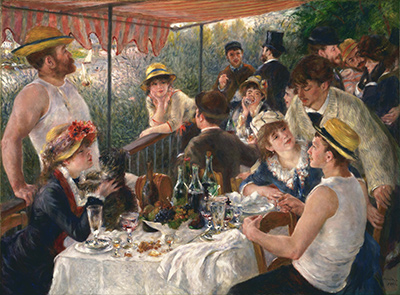
Explore a Montmartre dance, a gathering beside the Seine and the drawings behind Renoir’s paintings.
Renoir, Bal du moulin de la Galette
Dr. Beth Harris and Dr. Steven Zucker discuss Renoir’s 1876 Montmartre dance scene, its light and its crowds.
Watch on YouTubeRenoir artworks directory
What is happening on the beach?
The two women occupy different parts of the shallow foreground. The seated woman is low and near the left edge, with her pale clothing spreading across the sand and a parasol beside her. The standing woman is closer to the centre. Her hat, blouse and skirt make a tall column against the sea, while the basket at her side draws attention back down towards the shore. Their positions allow a viewer to move between the broad view of the coast and the small encounter between people.
Renoir does not spell out that encounter. The seated woman turns towards the other, but neither makes a theatrical gesture. The child is farther away, almost touching the strip of water. The dog is nearer to the viewer than either woman and seems still. These differences in scale and distance create several small intervals of attention rather than one decisive action. The painting is a scene of people sharing a place, not a documented portrait of a named group.
The basket suggests an outing or an errand, but its contents are not visible. It would be tempting to imagine a family relationship between the figures, or to tell a story about their afternoon. The collection record does neither. The stronger reading starts with what the painting actually shows: two adult figures, a child, a dog and a stretch of open shore.
The boy in blue is separated from the women by a band of sand. The Met describes him as seeming to throw something at the water, a careful phrase because the small gesture cannot support a more detailed story. Following the line from him to the standing woman and then down to the seated woman reveals how Renoir distributes attention across three different distances. The dog brings the eye back to the near foreground. Looking in that order gives the scene a gentle rhythm, even though there is no single event that explains everyone’s presence.
The parasol and basket are worth noticing for another reason. Each is a recognizable beach object, but neither fixes the date of an excursion, the occupations of the women or their relationship to the boy. They make the scene specific enough to feel observed while leaving the people unidentified. The painting’s interest lies partly in that gap between visible detail and untold biography.
How Renoir builds the view
Most of the canvas is organised in long, nearly horizontal zones. Pale sand fills the lower part; green-blue water lies behind it; darker distant land and sky rise above. The beach is not a detailed map of a real location. Its broad colour areas establish a setting and make the people legible from a distance.
The standing woman interrupts those horizontal bands. Her figure joins sand, sea and sky in one vertical movement. The Met draws attention to this compositional role in its description of the picture. Look at the pale line of her blouse against the water and then follow her skirt back towards the sand: Renoir makes her both the central figure and a way of measuring the space around her.
The picture balances that centre with activity at its edges. The seated woman's hat and clothing occupy the lower left, while boats sit far to the right and across the horizon. Their small, bright sails punctuate the blue-green expanse. The child's dark clothes make a contrasting accent near the waterline. None of these elements competes with the women for the largest share of the painting, yet each prevents the sea from becoming an empty backdrop.
Renoir also shifts the handling of paint across the canvas. The open sky and water are broad and soft, while the figures are described by changes of colour that give a sense of clothing and posture. The boundaries of the forms are often gentle. From farther away, the shore, people and boats settle into a readable arrangement; up close, their surfaces are more changeable. That difference between the overall structure and local brushwork is central to the painting's effect.
The wide format matters. At 64.1 centimetres across and 52.7 centimetres high, the canvas gives the shore room to extend on either side of the standing figure. The people occupy the lower portion, while much of the upper field stays open for water, distant land and sky. The view feels expansive because Renoir lets these quieter areas remain visible. If the picture were reduced to a crop of the two women, the relation between their pause and the breadth of the coast would disappear.
Try looking first at the pale clothing, then at the child's dark blue, and finally at the light sails. These small colour accents move the eye from foreground to shore to distance. The sea is thus more than scenery behind a group portrait: it supplies the intervals that separate the people and the colour against which their forms register. This is a reading of the visible arrangement, rather than evidence for a particular place or a specific sequence in Renoir's working process.
A seaside image without a precise address
The Met regards a Côte d'Azur location as probable. Its judgement places the picture in southern France, but the record does not name a town, beach or occasion. That is a useful limit to keep in view. The distant shore and boats make a plausible coastal landscape, while Renoir's arrangement keeps the scene open enough to function as more than a record of one site.
The clothing and leisure setting distinguish this scene from a painting of work at sea. The women have space to pause; the child is at play. Yet they remain anonymous. A viewer can see a particular kind of seaside leisure without knowing who these people were or whether they were related. The absence of a named sitter is part of how the picture can direct attention towards posture, light and shared space.
Renoir's title is equally general: Figures on the Beach names the setting and the people without naming either. It is useful as a guide to the subject, but it should not be treated as a hidden place name. The Met's cautious geographical statement is the best available one for this object. Even a plausible match between the painted shore and a modern coastline would need independent documentary support before it could become an identification.
How it differs from By the Seashore
Renoir painted beach subjects in different ways. The Met also owns By the Seashore, a larger portrait dated 1883 (accession 29.100.125). There a single woman sits close to the picture plane in a wicker chair. According to the museum, Renoir probably posed her in his studio and used studies from the Normandy coast for the view behind her. The woman's carefully finished face contrasts with freer strokes in the background. Met: By the Seashore. [2]
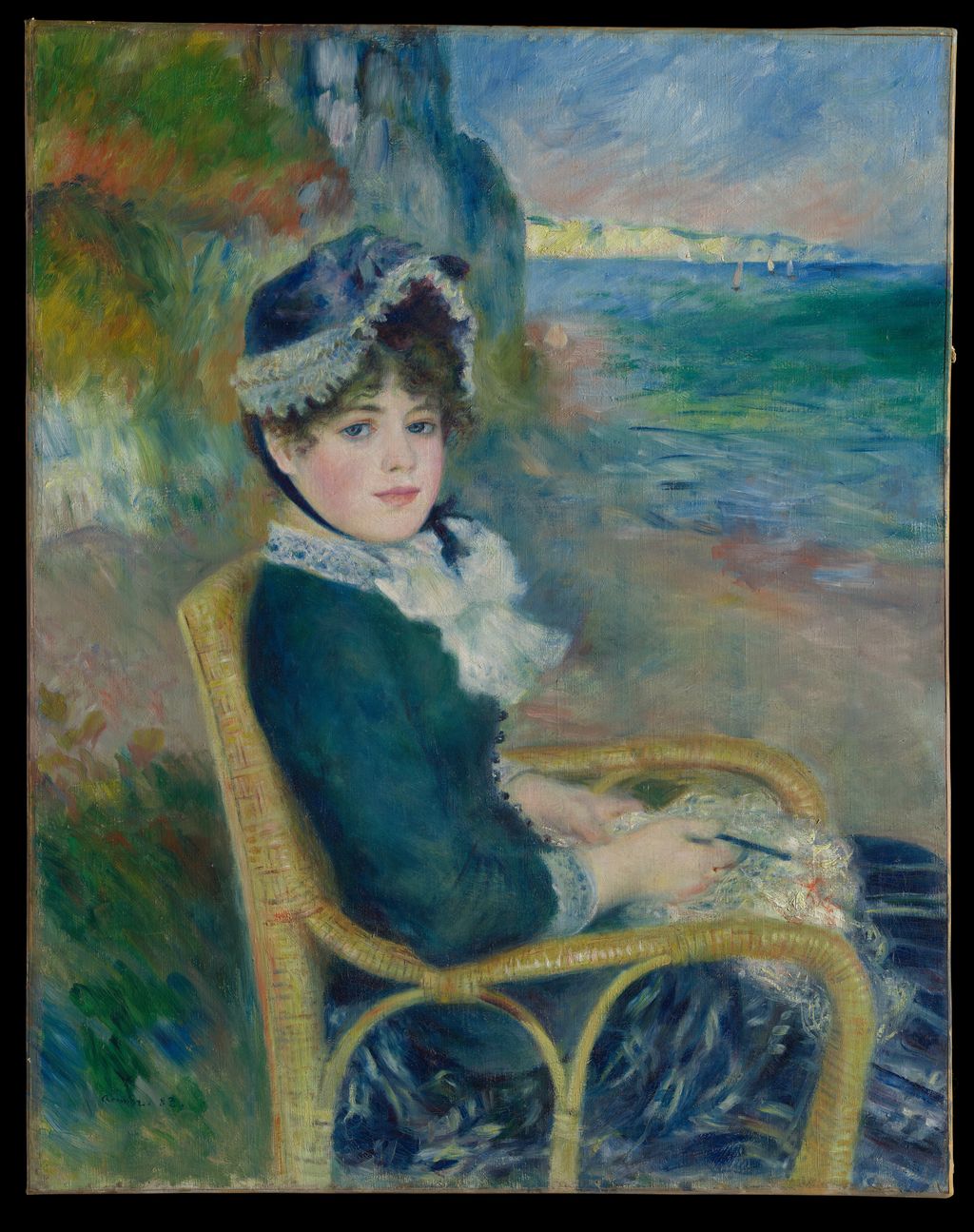
Figures on the Beach is a different work with a different arrangement. Its two women do not dominate the full height of the canvas as the 1883 sitter does. The child, dog, shore and sails are all part of a scene that spreads sideways. The comparison shows that “Renoir at the beach” is not a single pictorial formula. It does not prove that the later picture was painted entirely outdoors, or that the two works belong to a documented series. The Met provides a likely studio explanation for the 1883 portrait but does not give an equivalent production history for the 1890 canvas.
Set the two images side by side and notice where each asks you to look first. In the 1883 portrait, the woman's face and the deep blue of her dress command attention before the viewer reaches the water. In the 1890 canvas, the central standing figure is prominent, but the smaller child and dog ask the eye to travel across a shared setting. The earlier work makes the coast a setting for one sitter; the later one gives the coast and its scattered occupants more equal weight. This difference is visible without assuming that Renoir meant one picture as a revision of the other.
A later beach scene in print
Renoir also explored the shore in printmaking. The National Gallery of Art holds On the Beach—At Berneval, dated 1892, but it is a drypoint, not another oil painting. Two large seated figures seen from behind occupy its lower foreground, with smaller beachgoers beyond. The gallery catalogues this impression as state I of III. NGA object record. [3]
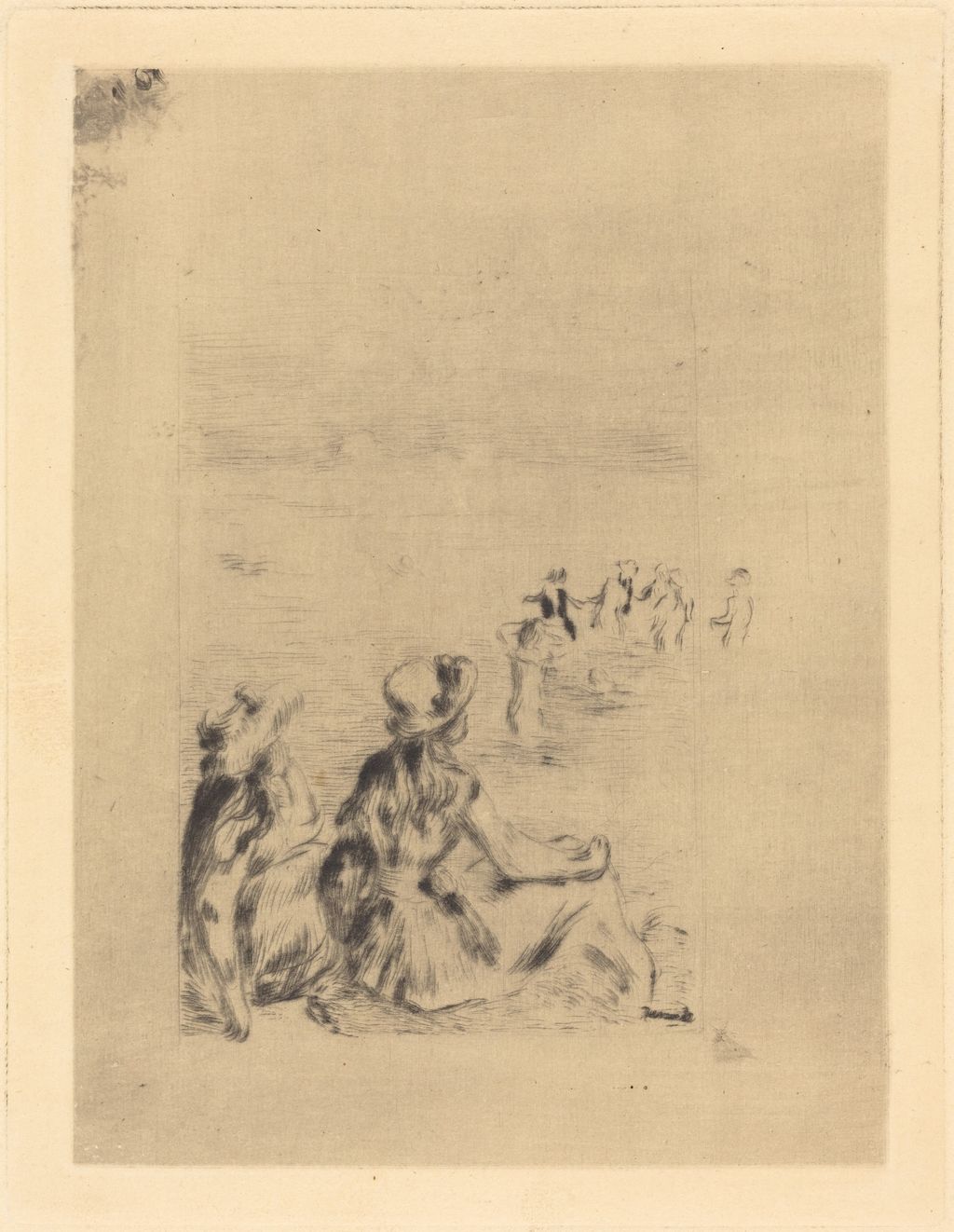
The print reverses the emphasis of the Met canvas. Its two foreground figures are seen from behind, so the viewer looks past them towards the scattered people and the water. In Figures on the Beach, the standing woman turns the viewer back towards the foreground group, and colour helps carry attention across the sea. The drypoint works with etched lines and paper instead of coloured paint. Its pale open areas make the distant beach feel spacious in a different way.
The Berneval title identifies the print's subject, but it does not locate the 1890 Met canvas. Nor does a similar seaside subject establish that the drypoint was made from, or in preparation for, the painting. What the two works do show is Renoir repeatedly testing how near figures can frame a view of people at the water's edge. Their differences of date, medium and composition are as informative as the shared beach setting.
Where is the painting now?
Figures on the Beach is in the Metropolitan Museum of Art's Robert Lehman Collection. The museum lists it under accession 1975.1.198. Visitors should check the museum's current object page for display status before planning a visit. The Met labels the work's image public domain and makes an open-access reproduction available. Met collection record. [1]
Questions about Figures on the Beach
The Met does not identify them. The picture gives their actions and positions, but no reliable names. It is safer to describe them as two women at the shore than to invent a family relationship.
The Met says probably on the Côte d'Azur in southern France. It does not identify a precise beach. The setting should therefore be described as probable rather than certain.
No. By the Seashore is a separate 1883 canvas, also in the Met, centred on one seated woman. Figures on the Beach dates to 1890 and includes two women, a child and a dog within a wider coastal view.
No. That is a separate 1892 drypoint in the National Gallery of Art. The Berneval name belongs to the print and should not be used to identify the location of the Met's 1890 painting.
Discussion
Look closely at Figures on the Beach and use the questions below to compare what you see with the documented history.
Reader Insights
How do the figures, dog and broad shore divide your attention?
The Met’s location and sitter identifications remain qualified.
What does the painting allow us to say about a particular beach or family?
Join the Conversation
Share a close observation or a source-backed question about Figures on the Beach. The prompts above are starting points for discussion.
References
- The Metropolitan Museum of Art, Figures on the Beach, accession 1975.1.198, object record, description and image status View source.
- The Metropolitan Museum of Art, By the Seashore, accession 29.100.125, object record and curatorial description View source.
- National Gallery of Art, On the Beach—At Berneval, accession 1943.3.7355, object record and public-domain image View source.