by Tom Gurney
Tom Gurney BSc (Hons) is an art history expert with over 20 years experience
Published on June 19, 2020 / Updated on October 2, 2026
Email: tomgurney1@gmail.com / Phone: +44 7429 011000
A full bouquet stands in a round blue vase patterned with yellow and white flowers. White clusters, red spikes and large yellow blooms fill the upper part of the canvas, while a dark-to-warm background gives them space. The inherited image on this page exactly matches Sotheby’s illustrated 2024 lot Fleurs dans un vase. [1] Sotheby’s catalogued it as a signed oil on canvas executed circa 1878, 55.8 × 46 cm. Its description adds a rare physical link: the original vase pictured in the painting was sold with the canvas.
That vase is more than a convenient subject. Its large blue body and pale floral patterns are the most legible form below the bouquet. Sotheby’s says it remained with Renoir throughout his life, passed to his great-grandson Emmanuel Renoir and was reunited with the painting before the 2024 sale. The painting and object therefore have related, but different, ownership stories. The auction record does not identify their owners after the sale.
Contents
- The painting at a glance
- A bouquet of changing colour
- The vase that survived
- The documented route of the canvas
- Which Flowers in a Vase ?
- Looking again
Watch: Pierre-Auguste Renoir
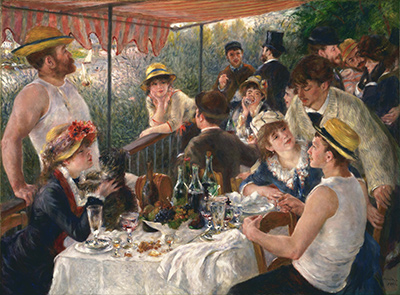
Explore a Montmartre dance, a gathering beside the Seine and the drawings behind Renoir’s paintings.
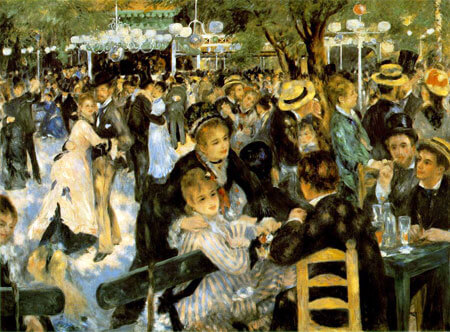
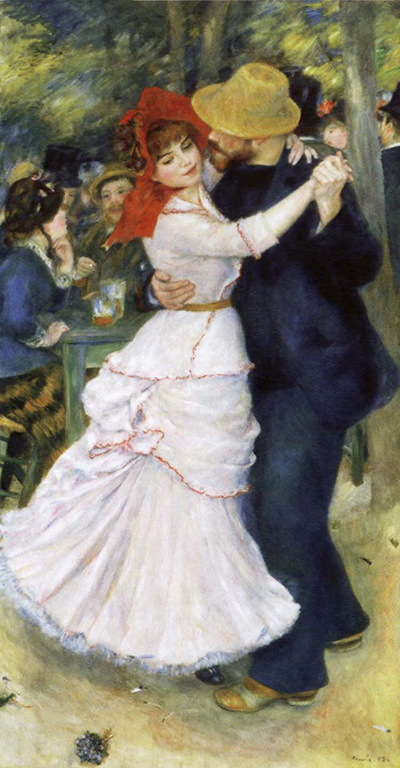
Renoir, Bal du moulin de la Galette
Dr. Beth Harris and Dr. Steven Zucker discuss Renoir’s 1876 Montmartre dance scene, its light and its crowds.
Watch on YouTubeAt a glance
- ArtistPierre-Auguste Renoir (1841–1919)
- Catalogue titleFleurs dans un vase
- Local titleFlowers in a Vase
- DateCirca 1878, according to Sotheby’s 2024 catalogue
- MediumOil on canvas
- Size55.8 × 46 cm
- Signature“Renoir.”, lower right, as catalogued by Sotheby’s
- Current locationNot established by the 2024 sale record
The exact combination of vase decoration, flower positions and signature separates this picture from Renoir’s other works called Flowers in a Vase. It is not the National Gallery of Art’s early bouquet in a red clay jug or the Philadelphia Museum of Art’s later bouquet in a grey-blue vessel. Their similar English titles do not make them interchangeable objects.
A bouquet of changing colour
The flowers do not form a tidy cone. Large green leaves reach upward at the left, and a red-orange spike stands near the centre. Pale rounded clusters fill the middle and right; yellow blooms hang lower at either side. Small red and pink touches appear in the gaps. The uneven outline makes the bouquet feel as if it has grown beyond the limits of a planned arrangement.
Renoir builds the light flowers with quick pale strokes against cool blue and green shadows. Some petals are clear; others seem to turn into colour before we can name them. The dark passage at the upper left makes the high green leaves stand out. On the right, the brown-ochre wall is closer in warmth to the orange and yellow blossoms, so their edges are softer. The background is doing different work on each side of the vase.
The flowers also overlap in depth. A pale cluster near the centre lies before a red spike; a yellow blossom drops across the lower right and partly obscures the leaves behind it. Following these overlaps, rather than trying to count every stem, shows how Renoir created fullness. Sotheby’s catalogue title names flowers broadly. It does not require a complete list of species, and the visible reproduction is not a secure basis for one.
The vase that survived
The vessel is low and globular with a small foot. Its blue glaze carries cream, yellow and orange flower-like motifs. From a distance, the body reads as one blue block. Up close, the painted decoration has a rhythm of round shapes and bright centres that answers the flowers above. The vase is therefore a second floral composition within the larger one.
Sotheby’s 2024 lot record says the original vessel remained in Renoir’s collection during his life and passed by descent to his great-grandson Emmanuel Renoir. It had been reunited with the canvas and was sold with it. This is an unusually tangible connection between a still-life painting and one of its models. It also provides strong identification evidence: the decorated vessel is not just a generic blue pot that could belong to any Renoir flower page.
The auction description does not give the vase’s maker, manufacture date or a technical account of its material. Its visible blue-and-yellow surface can be described, and its documented survival can be reported, without calling it Delft, porcelain or a particular ceramic tradition on this evidence alone. Renoir’s depicted version is also a painting: its colours and shapes are adjusted to fit the bouquet and surrounding tones.
The tabletop is a narrow brown band across the bottom. Unlike the dense flowers, it needs little detail. Its horizontal edge steadies the composition, while the vase’s foot makes a bright boundary against it. A small dark signature appears at lower right in Sotheby’s illustrated image, matching the catalogue’s record of “Renoir.” in that position.
The documented route of the canvas
Sotheby’s states that Galerie Durand-Ruel acquired the painting directly from Renoir on 30 May 1890. It lists Paul Durand-Ruel as holding it by 1913, followed by a private collection in Paris by descent. The work appeared at Drouot Montaigne in Paris on 27 November 1997, lot 36. Later waypoints include Halcyon Gallery in London around 2005, a private collection in Zurich, another private collection and the 2024 seller, who acquired it in 2019.
These entries trace the canvas. They should not be transferred automatically to the physical vase. Sotheby’s separately says the vessel stayed with Renoir and descended through his family before the reunion. The two histories met again by 2024, but the catalogue does not give a complete timeline of that reunion. It would be misleading to place the vase in each of the canvas’s listed galleries and collections.
The painting also has a documented exhibition history. Sotheby’s lists a 1908 Durand-Ruel still-life exhibition, a 1934 Durand-Ruel show, Paris and Munich exhibitions in 1958, and Renoir Intime in Paris in 1969. The 1934 listing dated the painting 1888, whereas Sotheby’s 2024 description uses circa 1878. The older exhibition date should be understood as a historical catalogue label, not silently substituted for the later auction dating. Sotheby’s cites the Dauberville catalogue raisonné, volume I, number 33.
The 2024 entry also said the work would be included in a forthcoming Renoir digital catalogue raisonné under the Wildenstein Plattner Institute’s sponsorship. That is the auction house’s statement at the time of sale. This page does not claim that a later entry has since been published.
Which Flowers in a Vase?
Many Renoir paintings have a title that translates as “flowers in a vase.” The National Gallery of Art’s Flowers in a Vase [2] is dated about 1866 and shows wildflowers in a red clay jug. The Philadelphia Museum of Art’s Flowers in a Vase [3] is catalogued circa 1880 and is another distinct composition. Neither museum record supplies the date, size or provenance for the canvas on this route.
A further nearby title, Vase de fleurs, belongs to a signed 1881 Renoir painting described by Christie’s. [4] Its blue-and-orange globular vessel is related in type and was a recurring studio object, according to that catalogue, but its bouquet and canvas are different. The 1881 Christie’s lot is 65.4 × 54.3 cm, considerably larger than Sotheby’s circa 1878 55.8 × 46 cm painting. This distinction matters because a reused vessel can make two separate flower pictures look related. Shared props are not shared provenance.
The local English title remains useful for readers. The French Fleurs dans un vase and Sotheby’s lot number 61 point to the exact documented work. The image itself confirms the crowded arrangement and distinctive floral vase. Those three pieces of evidence together provide a firmer identification than the common title alone.
Looking again
Start with the blue vase and look at one yellow-centred motif on its front. Move upward to the real yellow flowers at the bouquet’s edge. The painted flowers on the vessel and the cut flowers above it echo one another, but their different scales and brushwork prevent them from merging. Follow the red spike through the middle, then the small white clusters toward the right. The background changes from dark blue-green to warmer brown behind them.
Renoir makes a familiar subject into a study of how colours meet. The 2024 auction record adds the unusual story of a surviving vase reunited with its painted likeness. Together, the canvas and its documented object invite a close look at the difference between a thing in the room and the colour relationships Renoir made from it.
Renoir artworks directory
Questions about Flowers in a Vase
Sotheby’s 2024 lot 61 dates the pictured canvas to circa 1878. A 1934 exhibition listing used 1888, which is a historical alternative date rather than the current auction catalogue date.
Sotheby’s gives 55.8 × 46 cm for the oil on canvas.
Yes. Sotheby’s says the original vase stayed in Renoir’s collection, passed to his great-grandson Emmanuel Renoir and was reunited with the canvas. The vase accompanied the painting in the 2024 sale.
No. Philadelphia’s circa 1880 Flowers in a Vase is a different composition. The work on this page is Sotheby’s 2024 Fleurs dans un vase, lot 61.
The 2024 sale record identifies their sale together but does not verify their present owner or display location.
Discussion
What do you notice when you return to this bouquet and blue vase?
How does the decoration on the vase echo the flowers above?
Reader Insights
How does the decoration on the vase echo the flowers above?
Sotheby’s catalogued this signed oil circa 1878, 55.8 × 46 cm.
How does the background change across the bouquet?
Join the Conversation
Share a close observation or a source-backed question about Renoir’s pictured vase.
References
- Sotheby’s, Fleurs dans un vase, 2024 lot 61: exact illustrated match, circa 1878 date, signature, medium, dimensions, provenance, exhibitions and the original vase’s history View source.
- National Gallery of Art, Flowers in a Vase: separate circa 1866 Renoir painting View source.
- Philadelphia Museum of Art, Flowers in a Vase: separate circa 1880 Renoir painting View source.
- Christie’s, Vase de fleurs, 1881: separate, larger flower painting with a related blue-and-orange vase; used only for distinction View source.
- Page image: inherited site reproduction of Sotheby’s 2024 lot 61, Fleurs dans un vase.