by Tom Gurney
Tom Gurney BSc (Hons) is an art history expert with over 20 years experience
Published on June 19, 2020 / Updated on October 2, 2026
Email: tomgurney1@gmail.com / Phone: +44 7429 011000
Frédéric Bazille sits sideways at an easel, palette in hand, intent on a canvas where the heron is plainly visible. Pierre-Auguste Renoir painted his friend in 1867, inside the Paris studio that Bazille shared with other young painters. The older title Frédéric Bazille Painting the Heron describes the activity; the Musée d'Orsay catalogues Renoir's picture more simply as Frédéric Bazille. Its inventory number is RF 2448. The painting belongs to the Orsay collection but has been on deposit at the Musée Fabre in Montpellier since 2006. Those two museum roles are distinct. Musée d'Orsay object record. [1]
The picture is both a portrait and a record of artistic company. Bazille and Alfred Sisley made separate still lifes of a heron in the shared studio; Renoir chose to show Bazille making his. A snowy landscape on the wall probably refers to a work by Claude Monet. The canvas later passed through Édouard Manet's collection and appeared in the second Impressionist exhibition of 1876. Each connection is supported by the Orsay catalogue, though the identification of Monet's landscape is explicitly tentative. Musée d'Orsay. [1]
At a glance
- ArtistPierre-Auguste Renoir
- Museum titleFrédéric Bazille
- Descriptive titleFrédéric Bazille Painting the Heron / Frédéric Bazille at His Easel
- Date1867; signed and dated A. Renoir 67 at lower right
- Medium and sizeOil on canvas, 105 × 73.5 cm
- CollectionMusée d'Orsay, RF 2448; deposited at Musée Fabre, Montpellier, in 2006
- Musée Fabre deposit numberD2006.3.5
Watch: Pierre-Auguste Renoir
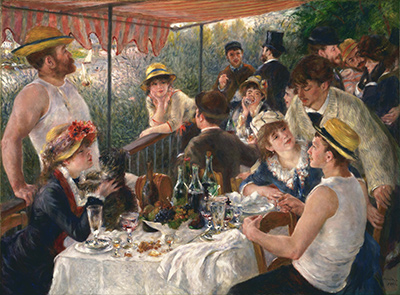
Explore a Montmartre dance, a gathering beside the Seine and the drawings behind Renoir’s paintings.
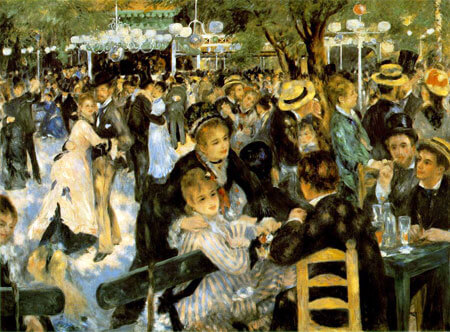
Renoir, Bal du moulin de la Galette
Dr. Beth Harris and Dr. Steven Zucker discuss Renoir’s 1876 Montmartre dance scene, its light and its crowds.
Watch on YouTubeThe museum's signed date makes this a more secure point in Renoir's early career than a picture dated only by later comparison. It does not tell us the exact day of the sitting or whether every part was painted in one session. The visible arrangement and the museum's account place us within the artists' working space, not a formal studio prepared for a patron. Musée d'Orsay, object and inscription. [1]
A painter shown painting
Bazille sits in profile, his attention angled towards the left. His feet rest on a low platform; the narrow red laces of his soft shoes interrupt the grey and beige clothes. The chair, easel and stretched canvas make an angled structure around his body. Rather than turn to acknowledge the viewer, Bazille stays absorbed in his task. Renoir gives us the posture of a working colleague, seen at close range.
The heron is visible on the canvas at left, but Renoir places the other painter, rather than Bazille's finished still life, at the centre. The eye follows Bazille's arm and palette towards the work area, then returns to his head and hands. This is an important distinction: Renoir's portrait is not Bazille's Still Life with Heron. The latter is another painting made during the same studio episode. The Musée d'Orsay says that Sisley, too, painted from the arrangement of a heron and small birds on a white cloth, and that the two resulting still lifes are at the Musée Fabre. Musée d'Orsay [1]; Musée Fabre, Bazille's Nature morte au héron. [2]
The difference between sitter and subject within a subject gives the portrait its energy. Bazille studies the birds; Renoir studies Bazille studying them. The viewer is asked to watch an act of looking rather than only to identify a recognisable face. We cannot infer Bazille's exact thoughts from his pose, but the turned body and work materials make his occupation clear without a label.
The studio as a network of pictures
Paintings hang or lean behind Bazille, some turned towards us and others apparently facing the wall. This clutter matters. It is evidence, in the picture itself, of a working room where canvases accumulate, move and compete for space. Renoir does not isolate Bazille against a neutral backdrop. He embeds the sitter in an environment shared with other artists. The Musée d'Orsay places the scene in Bazille's rue Visconti studio in Paris, which he made available to his peers. Musée d'Orsay. [1]
The landscape high on the wall is often read as a nod to Monet. The Orsay suggests it is probably Monet's Road to Saint Siméon Farm in Winter, now in a private collection. “Probably” is the right degree of certainty: a small painting shown within another painting is difficult to identify conclusively. The proposed identification helps explain the network in the room, but the portrait does not depend on assigning a definite inventory to the snowy scene. Musée d'Orsay. [1]
This arrangement also helps distinguish Renoir's scene from a portrait made chiefly to display wealth or rank. Easel, pictures and palettes establish a professional life. Bazille's relaxed footwear and crossed leg bring that life down to the ordinary scale of time spent at work with friends. It would be easy to romanticise the room as a perfect collective; the record supports shared space and overlapping work, not a complete account of every artist's relationship.
Grey, beige and small colour accents
The large areas of the canvas are subdued. Bazille's clothes, the wall and the studio furniture use greys, beiges and browns. Against them, Renoir lets a few accents register sharply: the red shoe laces, light paint near the edge of the palette and pink in Bazille's face. The Orsay specifically calls attention to these colour notes and compares the largely grey and beige range with Manet. Musée d'Orsay. [1]
The restricted palette does not make the portrait flat. Bazille's pale face emerges from a shadowed side of the room; the chair and work area supply oblique lines that hold him in place. The broad, dark surroundings make the small lit passages feel more decisive. Looking from shoes to face is one way to see how Renoir distributes the scarce strong colour instead of covering the whole surface with it.
It is tempting to define all early Renoir by his later, brighter paintings. This 1867 canvas resists that shortcut. His brushwork can still be lively, but the effect here is intimate and relatively sober. The painting shows a moment in an artist's developing practice, not an absence of a later style that Renoir had somehow failed to reach.
Renoir and Bazille looking at one another
Bazille also painted a portrait of Renoir in 1867. The Musée d'Orsay's separate object record identifies Frédéric Bazille as the artist of Pierre Auguste Renoir, a smaller oil painting of 61.2 × 50 cm. The two portraits make a particularly direct pair: each painter became the other's subject in the same year. We should not claim, without further evidence, that they were exchanged in a single sitting or conceived as matching commissions. Musée d'Orsay, Bazille's portrait of Renoir [3]; Musée d'Orsay, Renoir's portrait of Bazille. [1]
There is a cataloguing trap here. A sentence in the Orsay's narrative for Renoir's Bazille portrait says Monet painted the responding portrait of Renoir. The linked and separately catalogued 1867 portrait of Renoir is attributed by the same museum to Bazille. The object-level artist field is the stronger evidence for that picture, so this article uses Bazille's attribution and does not repeat the narrative sentence. These are also different from Renoir's later portrait of Monet as a reader. Orsay Bazille record [1]; Orsay Renoir record [3]; Renoir's Claude Monet the Reader.
The mutual portraits make friendship visible as artistic labour. Each painter was useful to the other as a model, but each also chose how to represent a colleague. Renoir's choice to show Bazille at his easel turns the portrait into an account of practice. Bazille's own portrait offers another view of Renoir, and neither should be mistaken for a neutral photograph of their friendship.
From Manet's collection to Montpellier
The portrait's later movements are unusually revealing. The Orsay provenance first places it in Manet's collection. In 1876, Bazille's father Gaston acquired it from Manet, giving him a Monet canvas in exchange. The painting then belonged to Bazille's brother Marc until he bequeathed it to the French state in 1924. It went first to the Musée du Luxembourg, was assigned to the Louvre in 1929, then to the Musée d'Orsay in 1986. Since 2006 it has been deposited at the Musée Fabre. This chain explains both the Paris collection number and the Montpellier location. Musée d'Orsay provenance. [1]
The exchange with Manet is a documented movement of a painting, not proof of any private conversation between the artists. It does, however, show the portrait circulating inside the circle to which the studio scene itself points. Manet was not in the room as Renoir pictured it; he entered the work's story as an owner. The distinction between represented people and later owners helps keep the account precise.
The Orsay exhibition list records the portrait at the second Impressionist exhibition in 1876, catalogue no. 224. Bazille had died in 1870, so the showing was posthumous for the sitter. It also preceded the 1924 state bequest. The exhibition record establishes public presentation, while the provenance gives the route through private hands. Musée d'Orsay exhibition and provenance. [1]
Looking again
Begin with Bazille's turned head, then follow the curve of his body to the red laces at his feet. Look back along the easel towards the studio wall. The painting asks us to see several acts of art-making at once: a still life being painted, Renoir's portrait taking shape, and other canvases awaiting attention. Its quiet colours keep those activities in the same room rather than separating them into heroic episodes. The museum records supply the date, collection and companions; the visible choices explain why this modest working moment remains so distinctive.
Renoir artworks directory
Questions about Frédéric Bazille Painting the Heron
The Musée d'Orsay says Bazille was working from a still-life arrangement with a heron and small birds. Sisley made another still life from the arrangement. Renoir's painting shows Bazille at work rather than presenting Bazille's finished canvas as its subject.
The Musée d'Orsay's separate 1867 object record identifies Frédéric Bazille as the painter of Pierre Auguste Renoir. A sentence in the Renoir portrait's narrative names Monet, but the object record for the companion portrait gives Bazille as artist.
It belongs to the Musée d'Orsay collection, inventory RF 2448, and is recorded as deposited at the Musée Fabre in Montpellier since 2006. Check the holding museums for current display arrangements.
The descriptive title is useful for the scene and for this established page address. The Musée d'Orsay's main catalogue title is Frédéric Bazille.
Discussion
What do you notice when you return to Frederic Bazille Painting The Heron?
How does Bazille’s pose lead your eye between his face, palette and heron canvas?
Reader Insights
How does Bazille’s pose lead your eye between his face, palette and heron canvas?
Orsay records the portrait in its collection and at Musée Fabre on deposit since 2006.
Which details make this look like a shared working studio rather than a formal portrait room?
Join the Conversation
Share a close observation or a source-backed question about Renoir’s frederic bazille painting the heron.
References
- Musée d'Orsay, Renoir, Frédéric Bazille, RF 2448: object details, signed date, studio account, interpretation, provenance, 1876 exhibition and current place of conservation View source.
- Musée Fabre, Nature morte au héron: Bazille's still life made in the shared studio View source.
- Musée d'Orsay, Bazille, Pierre Auguste Renoir, DL 1970 3: separate companion portrait and attribution to Bazille View source.
- Musée Fabre, Renoir, Frédéric Bazille peignant le héron, D2006.3.5: deposited work, inventory, dimensions and location in the museum’s reserve View source.
- Whole-work image: Wikimedia Commons, Pierre-Auguste Renoir - Frédéric Bazille.jpg, a 1900 × 2759 faithful reproduction marked Public Domain on its file page. Its listed source is a 2001 Taschen book reproduction; the reproduction shown here is a reduced copy of that book-derived file, distinct from the museum's currently credited photograph View source.