by Tom Gurney
Tom Gurney BSc (Hons) is an art history expert with over 20 years experience
Published on June 19, 2020 / Updated on October 2, 2026
Email: tomgurney1@gmail.com / Phone: +44 7429 011000
A dense bed of pink, white, yellow and red flowers fills the foreground. Behind it, a light path leads toward small figures under a dark canopy of trees. The inherited image matches a Gallerix reproduction called The Garden (also known as In the Park) [1], dated 1875 there. Artchive also reproduces a similarly titled garden [2] and places it around 1875 in a private collection. These secondary listings establish a useful image trail, but no illustrated original-object record has yet confirmed the exact date, dimensions or present owner.
The painting asks the eye to work through colour before finding people. Close up, the flowers are irregular touches of bright paint; farther away, they collect into a broad bed. The figures are small and partly shaded. Rather than telling a story about a named garden visit, the image studies how human forms appear and disappear amid foliage and light.
Contents
- The work at a glance
- Flowers across the foreground
- A path into shade
- Small figures among plants
- Which Renoir garden is this?
- Renoir’s garden light
- Looking again
Watch: Pierre-Auguste Renoir
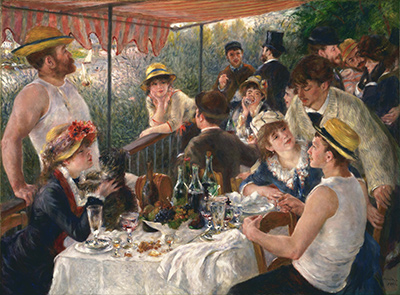
Explore a Montmartre dance, a gathering beside the Seine and the drawings behind Renoir’s paintings.
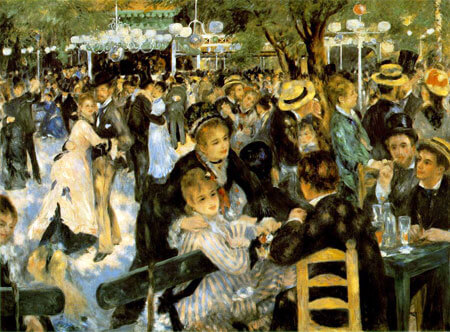
Renoir, Bal du moulin de la Galette
Dr. Beth Harris and Dr. Steven Zucker discuss Renoir’s 1876 Montmartre dance scene, its light and its crowds.
Watch on YouTubeAt a glance
- ArtistPierre-Auguste Renoir (1841–1919)
- Inherited titleThe Garden; matching secondary listing adds In the Park
- Circulated date1875 or circa 1875 in illustrated secondary listings
- MediumOil on canvas in secondary listing; exact-object confirmation needed
- Dimensions and present ownerNot independently verified
- Local imageInherited small landscape-format reproduction
The Gallerix matching image [1] ties the local arrangement to a commonly circulated title and date. The Artchive entry [2] repeats a broad private-collection attribution, but does not supply an owner name or catalogue number. “Private collection” should not be presented as a live, independently checked location. A direct illustrated catalogue is needed before the table can be expanded.
Flowers across the foreground
The lowest half is the painting's brightest area. Blossoms and leaves are made from hundreds of short strokes. Cream, lemon yellow and pink marks are scattered through darker greens and browns. Some flowers suggest separate petals; others are only small bursts of colour. That variation keeps the bed from feeling like a repeated pattern.
The flowers form a wide, shallow band rather than a single bouquet. Their abundance makes the viewer pause close to the picture surface. There is no clear botanical inventory: one cannot securely name every species from the inherited file. The effect depends on the overall density and colour, not on precise identification of each plant.
At lower right, blue-violet marks cool the warmer flowerbed. The eye follows those marks toward the pale path. Red and orange blossoms recur across the foreground, while white touches lead upward to the lighter figures behind. Renoir distributes the brightest tones through the whole composition so that the garden does not divide into a lively front and a dead back.
The brushwork is visible even in a reduced image. Small dabs describe flowers, longer dark marks gather into foliage, and broader pale strokes make the path. These different marks are a way of describing depth without drawing every stem or leaf. The flowerbed seems both a mass of plants and a field of paint.
A path into shade
A light path or open strip begins at the right edge and narrows toward the centre. It creates the main route through the picture. The eye leaves the vivid foreground and travels into a darker space under trees. The path also separates the flowerbed from a greener bank on the right.
Near the middle distance, pale vertical forms frame the shaded opening. They might be sunlit figures, garden ornaments or stems partly obscured by leaves. The local file is too small to settle every contour. Farther back, one darker figure is more legible near the central gap. It is safer to describe the visible pattern of light and shadow than to assign an exact number or identities to the visitors.
The garden feels enclosed. Trees and shrubs meet across the top, leaving little or no open sky. Light reaches the path and flowers in irregular patches. This arrangement makes the foreground bright by contrast with the dark green shelter behind it.
The viewer's position is low enough for flowers to dominate. A straight-on view of a formal garden would show its plan more clearly. Here, the path is partly hidden by plants and the figures are set deep within shade. The garden is experienced as layered colour rather than surveyed as a designed space.
Small figures among plants
The central person appears to wear light clothing with a darker blue or grey area. One or two pale forms nearer the path may be other people, but their boundaries merge with sunlit foliage. The Gallerix description [1] reads a young person with a straw hat. That remains an interpretation of a small image, not a documented sitter identity.
Renoir often placed figures in landscapes so that the two could share the same light. Here, faces and clothes have less definition than flowers. That reverses the usual expectations of a portrait: the garden is the dominant subject, and the people give scale and movement to it.
Even if the figures are walking, the picture does not establish their destination or relationship. They could be visitors, gardeners or models placed for composition. The scene offers no inscription or documented anecdote. Describing the figures as part of the light pattern is more grounded than writing a story about their day.
The bodies also help explain depth. A pale form near the middle stands taller than the blossoms directly below it but far smaller than the whole tree canopy. Its scale locates the path in space. Without the figures, the thick upper foliage could read as a flat wall of green.
Which Renoir garden is this?
The Museo Thyssen-Bornemisza's Woman with a Parasol in a Garden [3] is securely documented as 1875. It also has dense flowers and small figures, but the museum's arrangement centres a woman with a parasol and a bending man within foliage. The inherited image here has a wide flowerbed, a path and figures deeper under a dark canopy. The Thyssen's collection facts should not be transferred to this route merely because the period and subject resemble it.
Sotheby's illustrated Femmes dans un jardin [4] has flowers and a path, but the 2007 lot photograph shows a different garden: the path opens broadly at lower right, tall slender trunks cross the flowerbed, and figures appear deep in the centre. Its catalogue dates the work around 1876 in a cited exhibition and records 55 × 65.5 cm. Those figures, dimensions and provenance belong to that sale canvas, not to the local image.
Other Renoir gardens, including the garden in the rue Cortot, appear in search results under overlapping English titles. A title match is therefore weak evidence. The most useful fingerprint here is the broad close flowerbed, pale path from the right, dark arched foliage and small central figure or figures. An illustrated catalogue entry with that combination would be the right basis for firm object details.
The circulated 1875 date is plausible in relation to Renoir's mid-1870s garden painting, but plausibility does not settle it. The Thyssen and Sotheby's comparisons show how several pictures from nearby years can share a language of small strokes, abundant flowers and people in shade.
Renoir’s garden light
The Thyssen's curatorial account [3] describes Renoir's tiny dabs of colour and the loss of a visible horizon in its own garden canvas. The local image works through a related visual problem. Without a clear skyline, depth must come from overlapping plants, the narrowing path and changes in light.
The darkest colours are concentrated across the top and around the central opening. Bright flowers below seem to glow more strongly against them. The path carries a smaller patch of light into the back, preventing the picture from closing into a simple dark ceiling over a bright carpet.
Renoir lets the eye move repeatedly between near and far. A red blossom at the lower edge recalls a red touch near a figure; a white flower recalls sunlit fabric; a dark green leaf points toward the overhead branches. These echoes hold the image together even where individual objects are hard to distinguish.
The lively surface can suggest a fleeting instant, but the arrangement is carefully balanced. The flowerbed fills the lower left, the path opens the lower right, and the canopy crowns both. The figures sit near the meeting of these zones. That structure makes a crowded garden easy to enter visually.
Looking again
Start with the bright flowers nearest the bottom edge. Move right toward the blue-violet marks, then follow the path into the shade. Look for the central figure before returning through the dark canopy to the flowers. This circuit makes clear how much of the painting's human presence depends on contrast rather than outline.
The visible composition can be described, but an illustrated primary record has not yet confirmed this picture’s date, title, medium, dimensions or present owner. An exact object match would distinguish it from several other Renoir garden paintings with generic titles.
Renoir artworks directory
Questions about The Garden
A broad bed of colourful flowers, a pale path, dense trees and small figures in the shade beyond.
Matching secondary image listings give 1875 or circa 1875. A documented record for this exact canvas is still needed.
A secondary listing says private collection, but the present owner has not been independently verified.
No exact match has been established. The Thyssen's documented picture has a different figure arrangement and its own collection history.
The available image and sources do not securely identify them. Their small scale and partial shade are central to the composition.
Discussion
Where do the bright flowers lead your eye?
How do the trees frame the light around the garden?
Reader Insights
How do the trees frame the light around the garden?
Matching secondary listings give 1875; the exact object record remains open.
Where do you find the small figures in the shade?
Join the Conversation
Share a close observation or a source-backed question about this garden scene.
References
- Gallerix, The Garden (also known as In the Park): matching secondary image and circulated 1875 date View source.
- Artchive, The Garden: secondary image and broad private-collection attribution, not a current owner record View source.
- Museo Thyssen-Bornemisza, Woman with a Parasol in a Garden: documented different garden and contextual discussion View source.
- Sotheby's, Femmes dans un jardin, lot 15, 2007: illustrated different canvas whose catalogue details are not assigned here View source.
The page retains the inherited low-resolution image under the owner-declared public-domain legacy-image policy.