by Tom Gurney
Tom Gurney BSc (Hons) is an art history expert with over 20 years experience
Published on June 19, 2020 / Updated on October 2, 2026
Email: tomgurney1@gmail.com / Phone: +44 7429 011000
A young woman in a white dress sits at the left of the picture, looking toward a black-and-white cat that stands upright at the right. The two occupy the same intimate space, but neither reaches the other. Renoir puts their faces close to the same height and makes the interval between them the subject of the painting. The inherited image on this route is reproduced as Girl and Cat or Jeune fille au chat, generally dated about 1881–82. That title must be handled carefully: an entirely different Renoir canvas, a sleeping girl with a cat in her lap, was exhibited under a similar French title in 1882.
The picture shown here is the awake woman facing the standing cat. It has no verified public collection or complete object record in the sources currently available. Consequently, this article does not attach the exhibition history of the sleeping girl, the identity of a named sitter, or the measurements of any other cat painting to the inherited image. It offers a close reading of the work that readers can actually see.
Contents
- The pictured work and its record
- The woman, the cat and the distance between them
- A setting built from colour and texture
- Why the title causes confusion
- Looking closely without inventing a story
Watch: Pierre-Auguste Renoir
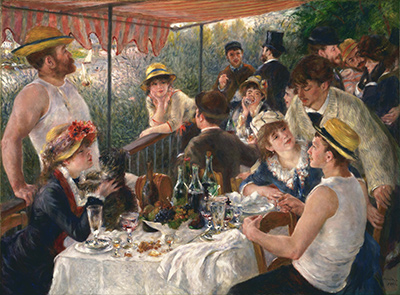
Explore a Montmartre dance, a gathering beside the Seine and the drawings behind Renoir’s paintings.
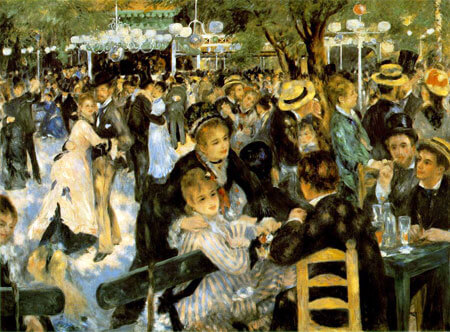
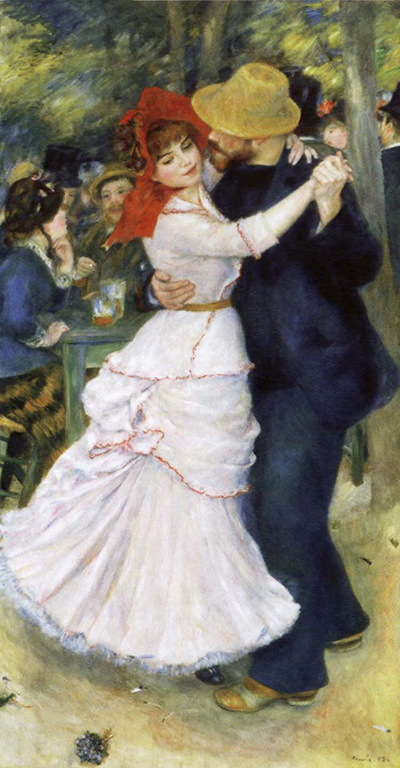
Renoir, Bal du moulin de la Galette
Dr. Beth Harris and Dr. Steven Zucker discuss Renoir’s 1876 Montmartre dance scene, its light and its crowds.
Watch on YouTubeThe pictured work and its record
| Artist | Pierre-Auguste Renoir (1841–1919) |
| Inherited route title | Girl and Cat |
| Reproduced French title | Jeune fille au chat |
| Date in illustrated secondary listings | About 1881–82; exact-object documentation still needed |
| Medium in secondary listings | Oil on canvas; exact-object verification still needed |
| Present collection | Not independently verified |
An image in WikiArt’s illustrated listing [1] and its Wikimedia Commons reproduction [2] matches the local composition: the white-dressed seated figure, upright cat, dark wall and flowers above. These image sources help identify the reproduction, but they do not provide a museum inventory or reliable current ownership. “Private collection” in an image database is not a dated provenance entry, and it may remain unchanged after a sale.
The repeated 1881–82 date is therefore best presented as an approximate published attribution. A signed canvas, catalogue raisonné entry, exhibition label or auction record for this exact composition would let us confirm its support, size and history. Until then, the painting’s visible features provide the secure foundation for analysis.
The woman, the cat and the distance between them
The woman is shown in three-quarter profile. Her head turns right and slightly upward, her brown hair gathered back from her face. White fabric slips over her shoulders and arms, with light blue and lavender shadow in the folds. She appears seated, hands near the lower edge, in a pose that gives the cat her attention without making a dramatic gesture. We cannot tell from the image whether she is calling it, waiting for it, or simply observing it.
The cat balances on its hind legs, reaching toward the seated figure or something near her. Its body is a high vertical shape against a dark patch of foliage and furniture. White paint marks the throat, chest and paws; black and brown strokes make the flanks and head. Because the cat’s face is close to the woman’s eye level, the scene becomes an exchange of looks and movement rather than a portrait with an animal placed at the sitter’s feet.
There is a gap of dark and warm colour between the woman’s hands and the cat’s paws. That gap is active. It makes us imagine what could happen next, while the canvas itself holds the two apart. Renoir often conveyed social interaction through glances and small gestures; here, the other participant is an animal that appears alert and self-directed. The cat is neither curled in the model’s arms nor asleep on a chair.
The woman’s face is comparatively soft and pale; the cat’s markings are sharper. This contrast helps us find each figure within the busy setting. A viewer’s eye moves from the woman’s illuminated shoulder to her profile, crosses the space between them, and climbs the cat’s white chest toward its dark head. The same movement can run back toward her hands and the reddish lower edge.
A setting built from colour and texture
The background is not a neutral studio wall. Above the figures, dark greenery, red-brown leaves and scattered flowers form a canopy. A darker rectangular form behind the woman may be furniture or a wall opening, but the small local reproduction does not resolve it with certainty. Horizontal lines behind the cat can be read as a railing or ledge. What matters pictorially is their darker tone: it lets the pale dress and white patches of fur stand forward.
At the top, small warm blossoms punctuate the green and brown. At the bottom, a red-brown surface anchors the woman’s hands. The whole painting crosses warm and cool colour: auburn hair beside blue-white cloth, amber foliage beside black-green shadow, and a blue-grey cat against a dark brown form. Renoir uses these repeated colour notes to bind the figures to their surroundings.
The strokes are varied. Broad sweeps form the dress and dark background; small quick marks flicker in the upper foliage; thinner touches describe facial features and whisker-like edges. No single finish is imposed on every part. The woman, cat and vegetation share the surface, yet each has enough structure to remain identifiable. The setting feels crowded without losing the simple meeting at its centre.
It is easy to label this a garden scene. Foliage and flowers strongly suggest a planted setting, but the picture also contains dark architectural or furniture shapes. Without a contemporary description, we should not identify a particular garden, house or season. The painting gives us a close, leafy space and an encounter within it; it does not give an address.
Why the title causes confusion
The French Ministry of Culture’s record of the 1882 Impressionist exhibition [3] lists Renoir’s Jeune fille au chat. The Musée d’Orsay’s Salon catalogue transcription [4] identifies that exhibited entry with the Clark Art Institute painting. The Metropolitan Museum of Art’s Clark exhibition caption [5] describes the Clark canvas as a young woman dozing in an armchair with a cat in her lap; it notes that the work appeared at the 1880 Salon and the 1882 Impressionist exhibition.
None of those physical details fits this page’s image. Here the woman is awake, the cat is upright and the encounter unfolds across a gap. The exhibition title alone is not enough to prove that this painting was shown in 1882. Copying the Clark work’s exhibition history, owner or large dimensions onto this image would turn two distinct canvases into one. The title collision is a reason to show the picture clearly and describe its composition in the first paragraph.
Renoir painted other women and cats as well. The National Gallery of Art’s Woman with a Cat [6], dated about 1875, shows a sitter holding a tabby against her body. The Musée d’Orsay’s Julie Manet [7], dated 1887, shows the named child with a cat and has its own documented commission and provenance. Those institutional records are valuable comparisons. Their sitters and dates cannot be borrowed for the awake woman and standing cat pictured here.
Looking closely without inventing a story
The image invites a story: perhaps the cat wants food, perhaps the woman is about to touch it, perhaps they have met before. None of those possibilities is documented by the painting alone. Even the cat’s exact motion is slightly ambiguous in a still image. A responsible reading can explain how Renoir creates suspense with posture and distance while leaving the narrative open.
The woman’s white dress is not just a description of clothing. It gives the composition its broadest light area, balancing the smaller but bright sections of the cat’s fur. The dark rectangular form between them increases that contrast. The warm foliage above softens the meeting, preventing the scene from looking like two cut-out silhouettes. Renoir’s attention lies in the relationships among all three: woman, cat and garden-like setting.
The local 400-pixel reproduction is too small to support claims about tiny markings, exact inscriptions or restorations. A higher-resolution object image would help us inspect whether the upper forms are flowers, leaves or hanging fabric and whether the cat’s paws rest on a ledge. None of those gaps makes this composition identical to a better documented cat painting.
Return to the image by following the line of the woman’s gaze. Notice where it meets the cat and where the paws stop short of her. Then look at the white of her dress and the white of the cat’s chest, and at how the foliage colours pass behind both. This close exchange is the distinctive feature of Girl and Cat. Its exact object history remains an open research task, but its pictorial idea is already visible.
Renoir artworks directory
Questions about Girl and Cat
A seated woman in a white dress faces a black-and-white cat standing upright beside her. Their looks and the space between their hands and paws create the central encounter.
Illustrated secondary listings commonly give about 1881–82. A reliable exact-object record is still needed for a firmer date.
The exhibition included a work titled Jeune fille au chat, but museum records identify that entry with the Clark Art Institute’s different painting of a sleeping girl holding a cat. The exhibition history has not been established for this page’s awake woman and standing cat.
There is no reliable identification of the sitter in this image as Julie Manet. Renoir’s documented 1887 portrait of Julie with a cat is a separate Musée d’Orsay work.
The exact pictured work’s current owner has not been independently verified. A generic “private collection” label in image databases should not be read as a current provenance statement.
Discussion
What do you notice when you return to the woman and the standing cat?
How does the woman’s gaze lead your eye toward the cat?
Reader Insights
How does the woman’s gaze lead your eye toward the cat?
This awake woman and standing cat differ from the Clark’s 1880 sleeping-girl painting.
How do the two white forms balance the darker garden?
Join the Conversation
Share a close observation or a source-backed question about this cat scene.
References
- WikiArt, WikiArt, Girl and Cat View source.
- WikiArt, Wikimedia Commons reproduction View source.
- French Ministry of Culture, French Ministry of Culture, seventh Impressionist exhibition View source.
- French Ministry of Culture, Musée d’Orsay, Salon catalogue entry View source.
- Metropolitan Museum of Art, Clark Brothers exhibition: visual and exhibition description of the different sleeping-girl canvas View source.
- National Gallery of Art, National Gallery of Art, Woman with a Cat View source.
- National Gallery of Art, Musée d’Orsay, Julie Manet View source.