by Tom Gurney
Tom Gurney BSc (Hons) is an art history expert with over 20 years experience
Published on June 19, 2020 / Updated on October 2, 2026
Email: tomgurney1@gmail.com / Phone: +44 7429 011000
Camille Doncieux turns toward us in a dark dress with a pale collar. Her hair rises into a black bow, and a slight smile softens the otherwise formal pose. Pierre-Auguste Renoir's Portrait de Mme Claude Monet belongs to the Musée Marmottan Monet in Paris. The museum dates it around 1873, records it as inventory 5013-bis, and identifies it as one of two early portraits Renoir gave to his friend Claude Monet. This is the painting shown on the site's Madame Claude Monet route, distinct from Renoir's other images of Camille reading or sitting in the garden. Musée Marmottan Monet, object record. [1]
At a glance
- ArtistPierre-Auguste Renoir
- Owner titlePortrait de Mme Claude Monet
- DateCirca 1873, Musée Marmottan Monet
- Medium and sizeOil on canvas, 58 × 48.5 cm, unframed
- CollectionMusée Marmottan Monet, Paris, 5013-bis
- Inscription“renoir” at lower left
- SitterCamille Doncieux, wife of Claude Monet
Watch: Pierre-Auguste Renoir
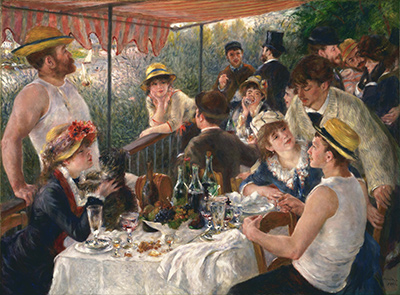
Explore a Montmartre dance, a gathering beside the Seine and the drawings behind Renoir’s paintings.
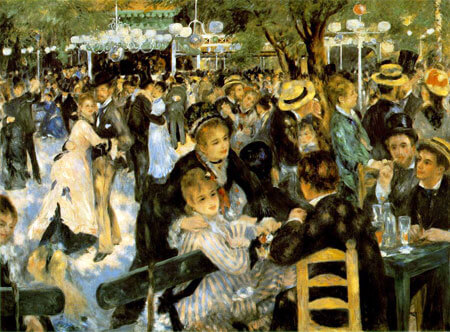
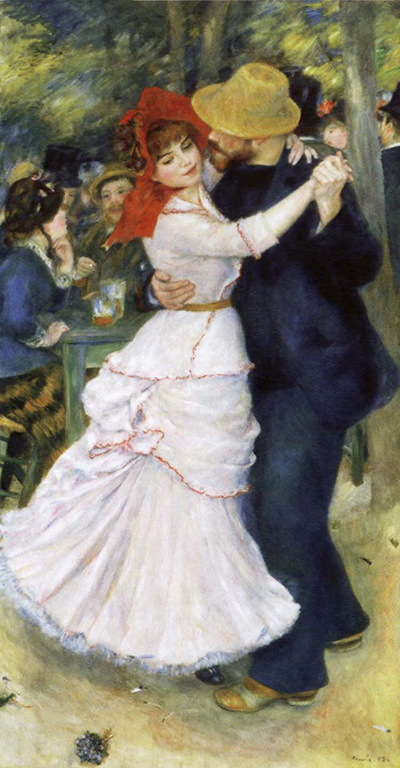
Renoir, Bal du moulin de la Galette
Dr. Beth Harris and Dr. Steven Zucker discuss Renoir’s 1876 Montmartre dance scene, its light and its crowds.
Watch on YouTubeThe museum records an acquisition by Michel Monet's bequest in 1966. That route into the collection is important: Camille's portrait had belonged to the Monet family rather than being merely a later image gathered under Monet's name. The owner record says Renoir originally gave the pair of portraits to Claude Monet. Its identification rests on a named collection, matching dimensions and documented family history, not simply the woman's appearance. Musée Marmottan Monet, provenance and interpretation. [1]
A formal pose with a small turn
Renoir places Camille's head high in a narrow canvas. Her body angles toward the right while the face turns toward the viewer. A dark mass of hair rises above the forehead; a black bow at the back enlarges its silhouette. Against a subdued wall and chair, the pale face and collar receive our attention first. The picture offers no garden or expansive domestic room. It is a bust-length likeness whose interest lies in the small turn of a person within a carefully arranged pose.
Camille's costume is elegant. A high, light collar folds under the chin; darker blue-grey fabric covers the shoulders and arms. Renoir does not describe every seam with a sharp edge. Blues, greys and faint pinks pass through the clothing, while the hands and lap remain less emphatic than the head. The chair's wooden back is only partly visible at the right. Its presence gives the pose a physical support without turning the setting into a detailed narrative.
The face holds several different notes. One cheek is warmer, with rosy touches; the other meets cooler paint. The eyes look slightly to the side of us, and the mouth is gently raised. The Marmottan describes a glimpse of a smiling face in an elegant city outfit. The expression can be observed, but it does not allow us to assign a particular conversation, mood or moment to the sitter. Musée Marmottan Monet. [1]
Camille and Claude as a pair
The Marmottan owns a matching portrait of Claude Monet reading. Renoir painted the two canvases independently, according to the museum, but they have the same dimensions and face toward one another. At one stage they were even mounted in a single frame, making their paired effect explicit. In Monet's portrait, he sits in profile with a pipe and reads L'Événement; Camille's figure turns in the opposite direction. The newspaper belongs to Claude's image, not to the Camille portrait on this page. Musée Marmottan Monet, account of the pendants. [1]
The pair offers an unusually close view of how Renoir pictured the Monet household. It is tempting to imagine a single sitting with the two friends working and talking in the same room. The museum's wording is more precise: the canvases were made independently but were visually related and later displayed together. That leaves room to compare their directional poses and scale without inventing a shared session. The family connection is documented through Renoir's gift to Monet and Michel Monet's later bequest. Musée Marmottan Monet. [1]
The museum places Renoir's visits to the Monet family within their years at Argenteuil, 1871–77, and usually dates these two portraits to around 1873. “Around” is essential: although the picture is signed, its owner does not present a painted year as proof of an exact day or season. Some older pages give 1872 for Camille's portrait. The current owner date is the more reliable public label for this specific canvas. Musée Marmottan Monet. [1]
Distinguishing Renoir's Camille paintings
Camille appears in other Renoir works from the 1870s. The image on this site's Madame Monet Reading route matches the Clark Art Institute's 1955.612, a vertical 61.7 × 50.3 cm canvas dated circa 1874. Camille sits on a patterned sofa reading a paper-covered book, with a blue wall and Japanese fans behind her. These details belong to the Clark work, not the Marmottan bust portrait here. Clark catalogue, no. 262. [2]
The Gulbenkian's Portrait of Camille Monet [3] is a third picture: a horizontal 53 × 71.7 cm canvas, also dated circa 1874 by its owner. There Camille reclines on a sofa and reads Le Figaro beside a Japanese bowl. Similar sitter and sofa do not make the Clark and Gulbenkian paintings the same object. The owner records and visible compositions keep them apart. Museu Calouste Gulbenkian, 2301 [3]; Clark catalogue, 1955.612. [2]
Renoir also painted Camille and Jean in the garden at Argenteuil. That outdoor group is documented by the National Gallery of Art, and it differs again in scale, setting and number of figures. The similar names “Madame Monet” or “Portrait of Madame Claude Monet” can collapse very different scenes when a date or image is omitted. Here, Marmottan 5013-bis fixes the reference. National Gallery of Art, Madame Monet and Her Son. [4]
There is another look-alike title on this site: Portrait of Madame Claude Monet shows a woman looking down against a blue background. That is not the Marmottan image on this route. Its exact owner and object record require separate verification before the two pages can be joined or described as versions of one painting. Distinguishing the visible images comes first; a shared title cannot establish identity.
A gift retained by the Monet family
Renoir gave these two portrait canvases to Claude Monet, the Marmottan says. They therefore served as images of Monet and Camille, and as works by a painter friend. The museum describes them as an early part of the Impressionist collection Monet would assemble. Their later passage through Michel Monet into the Marmottan preserves that personal context. Musée Marmottan Monet. [1]
The bequest date, 1966, should not be mistaken for the date the museum first exhibited the picture or the year Renoir painted it. It is the museum's recorded acquisition event. The current owner entry supplies the picture's size with and without a frame, and the unframed 58 × 48.5 cm measurement is the one used above. The framing history of the paired paintings shows that even their physical presentation has changed over time.
Looking again
Start at the light collar, which links Camille's face to her dark dress. Follow the turn of her head against the quiet wall, then find the chair's narrow back at the right. Her image appears poised but not rigid: small shifts of colour keep the face and clothing lively. Looking at Claude's companion portrait clarifies how Renoir used two separate, equal-sized canvases to bring husband and wife into relation without placing them in a single scene.
Renoir artworks directory
Questions about the Marmottan portrait of Camille Monet
The Musée Marmottan Monet dates it around 1873. The signature does not include a painted year in the museum's record.
No. This is a bust-length portrait in city dress. The Marmottan's Claude Monet portrait shows him reading L'Événement. A separate Clark canvas shows Camille reading a book; the Gulbenkian canvas shows her reading Le Figaro on a sofa.
The museum says the two equal-sized portraits were painted independently. They were later placed together in one frame for a time.
Renoir gave the portrait to Claude Monet; the Marmottan records its acquisition through Michel Monet's 1966 bequest.
Discussion
What do you notice when you return to Renoir’s Portrait of Madame Claude Monet (c. 1873)?
How do the black hair, pale collar and dark dress shape Camille’s pose?
Reader Insights
How do the black hair, pale collar and dark dress shape Camille’s pose?
Musée Marmottan Monet dates this portrait around 1873 and pairs it historically with its separate portrait of Claude reading.
What changes when you compare a bust portrait with Renoir’s other images of Camille at home and in the garden?
Join the Conversation
Share a close observation or a source-backed question about Renoir’s Portrait of Madame Claude Monet (c. 1873).
References
- Musée Marmottan Monet, Portrait de Mme Claude Monet, 5013-bis: owner date, medium, dimensions, inscription, Michel Monet bequest and account of the paired portraits View source.
- Clark Art Institute, Clark Art Institute, Portrait of Madame Monet (Madame Claude Monet Reading) , 1955.612 View source.
- Clark Art Institute, Museu Calouste Gulbenkian, Portrait of Camille Monet , 2301 View source.
- Clark Art Institute, National Gallery of Art, Madame Monet and Her Son View source.
- Whole-work image: Wikimedia Commons, Portrait de madame Claude Monet, par Auguste Renoir.jpg, sourced from the Marmottan collection image. The image here is a reduced copy of the whole-work Commons file; its source is the Marmottan collection photograph View source.