by Tom Gurney
Tom Gurney BSc (Hons) is an art history expert with over 20 years experience
Published on June 19, 2020 / Updated on October 2, 2026
Email: tomgurney1@gmail.com / Phone: +44 7429 011000
Camille Monet leans back among flowered cushions with a book in her hands. Blue fabric frames her dress against a blue wall, while a group of Japanese fans hangs high above the sofa. Pierre-Auguste Renoir's Portrait of Madame Monet (Madame Claude Monet Reading) belongs to the Clark Art Institute. The Clark dates the vertical oil painting circa 1874, identifies it as 1955.612, and explains why the long-used circa 1872 date is less persuasive. This is the picture behind the site's Madame Monet Reading route. Clark Art Institute catalogue, no. 262. [1]
At a glance
- ArtistPierre-Auguste Renoir
- Owner titlePortrait of Madame Monet (Madame Claude Monet Reading)
- DateCirca 1874, Clark Art Institute
- Medium and sizeOil on canvas, 61.7 × 50.3 cm
- CollectionClark Art Institute, Williamstown, 1955.612
- InscriptionSigned “A. Renoir” at lower left
- SitterCamille Doncieux, wife of Claude Monet
Watch: Pierre-Auguste Renoir
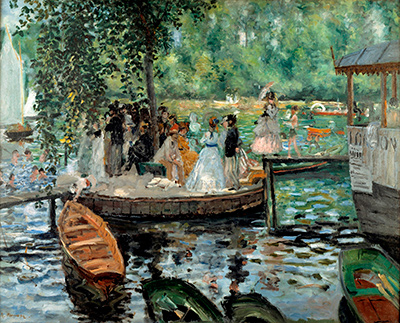
Explore a Montmartre dance, a gathering beside the Seine and the drawings behind Renoir’s paintings.
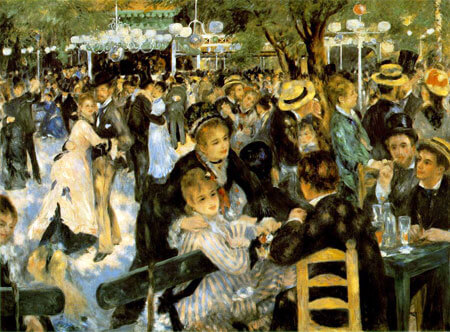
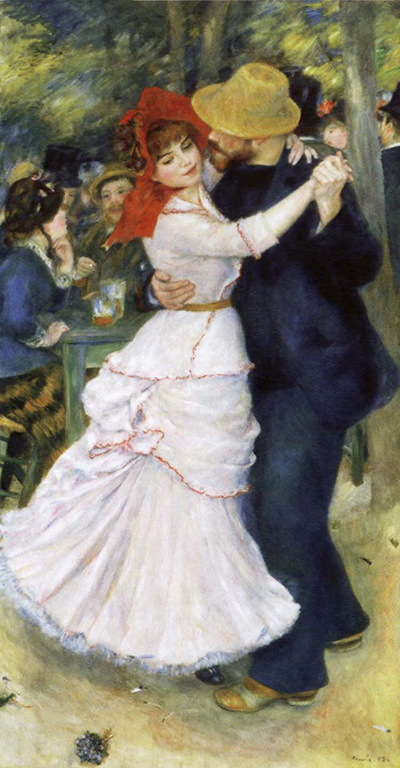
Renoir, Bal du moulin de la Galette
Dr. Beth Harris and Dr. Steven Zucker discuss Renoir’s 1876 Montmartre dance scene, its light and its crowds.
Watch on YouTubeThe exact book matters. Camille holds a paper-covered book, according to the Clark catalogue. She is not reading a newspaper in this painting. A separate, horizontal Renoir picture at the Museu Calouste Gulbenkian shows her reclining on a sofa with Le Figaro. Both images have been called “Madame Monet Reading”; their format, objects and owners distinguish them. Clark catalogue, 1955.612 [1]; Gulbenkian, Portrait of Camille Monet, 2301. [2]
Figure and fabric
Camille reclines along a shallow diagonal. Cushions support her head and back, and another rests beneath her feet. The Clark describes her body as a central pyramidal form even though she leans casually. Renoir keeps that figure visible amid a crowded interior by placing broad blue passages along the outside of her patterned dress. A narrower blue band runs down its front. The surrounding sofa and cushions are light coloured and filled with flowers, leaves and a large bird on the left cushion, perhaps a crane. Clark catalogue, no. 262. [1]
There are repeated patterns everywhere, but they do not all work alike. The sofa's floral upholstery extends across a wide surface; the smaller marks in Camille's dress bring those colours toward her body. Blue sets a boundary between sitter and furnishing, while also linking her to the wall. Renoir does not render a hard outline around each fold. Short, fleck-like touches enliven fabric, face, book and cushions. The catalogue argues that these marks animate the picture as a whole as much as they describe separate textures. Clark catalogue. [1]
The book becomes a small point of concentration. Camille holds it near her chest and tips her head toward its pages. We see enough to know she is reading, but not a title or the text. The picture makes her absorption legible without turning it into a moral lesson about what she reads. The Clark notes that depictions of women reading carried strong nineteenth-century associations, yet Renoir offers no explicit story about a forbidden or approved book. The viewer sees a particular person occupied in her domestic space. Clark catalogue, discussion of reading imagery. [1]
Why the date changed
Earlier labels often put the painting around 1872. The Clark catalogue argues for circa 1874 from the small, fragmented brushwork, interwoven colours and links with Renoir's work alongside Monet at Argenteuil. It does not claim an exact day or a date written on the painting. The year is a reasoned catalogue judgment; the signature at the lower left reads A. Renoir without a year. Clark catalogue, no. 262. [1]
The hanging Japanese fans seem to locate the image in a Monet interior. Claude Monet collected Japanese objects, and the Clark compares the fan display with his later La Japonaise (Camille Monet in Japanese Costume). But Monet moved to a new Argenteuil house in autumn 1874, and the catalogue explicitly says it cannot tell whether this canvas shows that house or an earlier home with similar fans. The fans are a strong visual clue to the Monets' taste, not a secure street address. Clark catalogue. [1]
The Clark also notes that Camille's dress resembles a variation on a Turkish caftan. It appears in other Renoir paintings of her around 1874, including the Gulbenkian canvas. That repeated garment gives the paintings a material link, but it does not make them versions of the same scene. In the Clark picture she sits upright enough to hold a book and the composition is vertical; in Lisbon she lies across a broad, horizontal sofa reading Le Figaro. Clark catalogue, comparison with other Camille canvases [1]; Gulbenkian owner record. [2]
Portrait, interior and the Monets
Camille Doncieux married Claude Monet in 1870, three years after their son Jean was born. She appears throughout Monet's paintings, and Renoir painted her more than once during his visits to the family. Here the sitter is named, but Renoir distributes attention across her body, the upholstery and the wall. The Clark describes the work as lying between portraiture and a domestic subject painting. It presents Camille as a recognisable individual and as a reader absorbed in her own room. Clark catalogue. [1]
At the 1904 Salon d'Automne retrospective of Renoir's work, the canvas appeared as Portrait de Mme M…, no. 20. That abbreviated title allowed a specific sitter to be recognized while giving the public a partly anonymous label. The Clark's current title makes both sitter and activity explicit. The history of names is worth keeping in view because “Madame Monet reading” can point to more than one canvas. Clark catalogue, exhibition history. [1]
The Marmottan's Portrait de Mme Claude Monet is another different image. It shows Camille in dark city dress as a bust-length sitter, paired historically with a portrait of Claude reading. Its owner dates it around 1873 and records inventory 5013-bis. The Clark's sofa picture is larger, fuller length and patterned throughout. Renoir's garden portrait of Camille and Jean is distinct again. Musée Marmottan Monet [3]; National Gallery of Art. [4]
How it reached the Clark
The Clark catalogue traces the painting from Renoir to Durand-Ruel before 1891. The dealer held it until Robert Sterling Clark bought it on 2 February 1933. It entered the Sterling and Francine Clark Art Institute in 1955. This chain is different from the Marmottan pair, which Renoir gave to Monet and which passed through the Monet family. The source therefore supports distinct histories as well as distinct images. Clark catalogue, provenance [1]; Marmottan object record. [3]
The 1904 exhibition and Durand-Ruel's long ownership show that this was neither a forgotten sketch kept solely by Renoir nor an image first seen only after the painter's death. The documented trail still leaves some matters open, including the exact site of the room and the title of Camille's book. Strong documentation on one aspect does not answer every question raised by the picture.
Looking again
Begin with the blue wall, then find the blue strips of Camille's dress. Follow the small floral marks from sofa to gown and see where the scale of pattern changes. Look at her hand and the light book: they form a pause amid the busy upholstery. Finally lift your gaze to the fans. Their place is clear, but the house they belonged to is not. Renoir's portrait stays lively by moving between a private act of reading and a room full of colour.
Renoir artworks directory
Questions about Madame Monet Reading
No. The Clark describes a paper-covered book in this vertical canvas. The Gulbenkian's separate horizontal painting shows Camille reading Le Figaro.
Its catalogue places the fragmented brushwork and related Camille paintings closer to Renoir's work in 1874 than the older circa 1872 label. The date remains approximate.
The Clark links the fans to Monet's Japanese objects but says the picture cannot be fixed to either his newer or earlier Argenteuil residence.
The Clark provenance records a sale from Renoir to Durand-Ruel before 1891. The Marmottan's separate pair of Renoir portraits were gifts to Monet.
Discussion
What do you notice when you return to Renoir’s Portrait of Madame Monet Reading (c. 1874)?
How do Camille’s blue dress and the patterned cushions keep her figure visible?
Reader Insights
How do Camille’s blue dress and the patterned cushions keep her figure visible?
The Clark dates its vertical book-reading portrait circa 1874; a separate Gulbenkian canvas shows her with Le Figaro.
What might the fans tell us about Monet’s interior, and what location remains unproved?
Join the Conversation
Share a close observation or a source-backed question about Renoir’s Portrait of Madame Monet Reading (c. 1874).
References
- Clark Art Institute, European paintings catalogue, no. 262, Portrait of Madame Monet (Madame Claude Monet Reading), 1955.612: owner identity, dimensions, revised date, visual analysis, exhibition history and provenance View source.
- Museu Calouste Gulbenkian, Museu Calouste Gulbenkian, Portrait of Camille Monet , 2301 View source.
- Museu Calouste Gulbenkian, Musée Marmottan Monet, Portrait de Mme Claude Monet , 5013-bis View source.
- National Gallery of Art View source.
- Whole-work image: Wikimedia Commons, Pierre-August Renoir Camille Monet reading.jpg, sourced from the Clark's image and marked Public Domain under a faithful-reproduction rationale. The image here is a reduced copy for close looking View source.