by Tom Gurney
Tom Gurney BSc (Hons) is an art history expert with over 20 years experience
Published on June 19, 2020 / Updated on October 2, 2026
Email: tomgurney1@gmail.com / Phone: +44 7429 011000
Renoir painted his friend Claude Monet at work in a garden at Argenteuil in 1873. Monet stands at a portable easel on the right of the canvas, facing a dense bank of flowers that occupies much of the left. The picture is a portrait of another artist, but it also shows what that artist chose to look at: a cultivated patch of colour, light and leaves close to home.
The Wadsworth Atheneum Museum of Art in Hartford owns the painting under the title Claude Monet Painting in His Garden at Argenteuil. Renoir, rather than Monet, is its artist. That distinction sounds simple, yet it is central to the work: one painter observes another looking and painting. Wadsworth educational publication [1]; National Gallery of Art, The Impressionists at Argenteuil. [2]
At a glance
- ArtistAuguste Renoir (1841–1919)
- SubjectClaude Monet painting in his Argenteuil garden
- Date1873
- MediumOil on canvas
- Size46.7 × 59.7 cm (18⅜ × 23½ in.)
- CollectionWadsworth Atheneum Museum of Art, Hartford, Connecticut
- Accession1957.614; bequest of Anne Parrish Titzell
This work in Renoir’s career
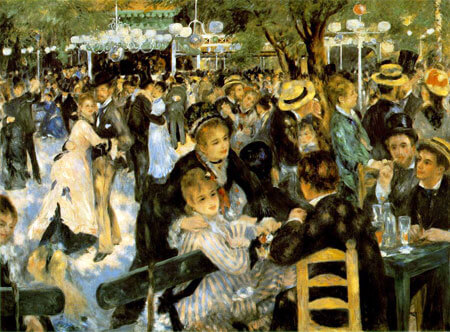
La Grenouillère
1869La Loge
1874The Umbrellas
c. 1881–86The Great Bathers
1884–87The Bathers
1918–19Contents
- Looking across the garden
- Monet's tools and the act of work
- What the fence does
- Why Argenteuil mattered
- Monet's own garden picture
- A related picture by Manet, one year later
- A portrait of painting itself
- Where is the painting now?
Watch: Pierre-Auguste Renoir
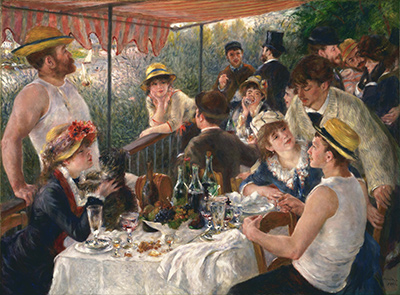
Explore a Montmartre dance, a gathering beside the Seine and the drawings behind Renoir’s paintings.
Renoir, Bal du moulin de la Galette
Dr. Beth Harris and Dr. Steven Zucker discuss Renoir’s 1876 Montmartre dance scene, its light and its crowds.
Watch on YouTubeThe Wadsworth's publication and the Royal Academy's later loan documentation both give this size. Royal Academy loan record. [3]
Looking across the garden
Monet stands near the lower right edge, in a dark jacket and hat. His body forms a vertical against the many short strokes of the flower beds, hedge and nearby trees. Between him and the flowers stands the easel. A low fence crosses the scene, giving the colourful mass of plants a boundary and helping the viewer read the space as a garden rather than open countryside.
The painting asks the eye to cross from the painter to his subject and back again. Monet faces the flowers; the viewer sees both the flowers and Monet attending to them. The architecture beyond the garden, including nearby houses, keeps this from being an image of remote wilderness. It is nature within a lived suburban setting. Renoir gives relatively little detail to the buildings. Their walls and roofs set off the vegetation and show how closely the garden lies to everyday life.
The colours are varied, but the scene is not a simple catalogue of plants. Reds, yellows and pale touches move through a large field of green. Monet's darker silhouette slows the eye at one side of that field. The result is a study of looking as much as a description of a particular flower bed. The National Gallery of Art catalogue identifies dahlias in the view, while questioning whether the flowers across the fence were on Monet's rented plot or his neighbours' land. The title identifies the setting broadly; it does not establish ownership of each plant. Paul Hayes Tucker, The Impressionists at Argenteuil, cat. 19–20. [2]
Monet's tools and the act of work
Renoir gives Monet a small but detailed working station. The NGA's 2000 catalogue entry describes a three-legged easel, an open paint box below it, a palette balanced on Monet's forearm, and spare brushes held in his left hand. His right hand is poised towards the canvas. A pale triangular shape on the ground may be an umbrella used against the sun; the catalogue keeps that identification tentative. These are the means of painting outdoors, shown as practical objects rather than symbols floating around a famous artist. NGA exhibition catalogue, cat. 19. [2]
The stance matters as much as the equipment. Monet stands back from his canvas and faces what is beyond it. His hand moves towards the surface, but his attention appears to be on the garden. Renoir has made a picture of observation in progress: a painter must repeatedly look away from the canvas to decide what to put on it. The NGA catalogue reads this as an image of Monet fully engaged in work. That is its curatorial interpretation, supported by the visible pose, not a record of Monet's thoughts at that particular instant.
The dark jacket and hat also distinguish Monet from the surrounding colour. Tucker, the NGA catalogue's author, notes that the short jacket evokes working clothes more than a formal coat. We cannot recover Monet's entire wardrobe from this picture, but the choice lets the viewer recognise a painter at a task rather than a man dressed for an outdoor social portrait. The jacket's corners and the foliage appear to move in the wind. Against that movement, the planted feet and easel create a temporary point of steadiness. NGA catalogue, cat. 19. [2]
What the fence does
The picket fence is more than a boundary marker. It cuts across the painting between the narrow zone where Monet works and the larger mass of flowers he faces. Vegetation leans over it, and a spray of green meets one leg of the easel. The fence therefore separates the painter from his subject while also connecting the two halves. Tucker points out that its line reaches Monet near his waist, helping hold his far-right figure within an otherwise strongly unbalanced arrangement. NGA catalogue, cat. 19. [2]
Follow the fence towards the buildings and two small passers-by in the background. The people are easy to miss among roofs, trees and flowers, but they change the scene from a secluded garden idyll to one embedded in a town. Renoir shows cultivation and construction pressed together: a house with blue shutters, neighbouring buildings, a path, the fence and the flower beds. Argenteuil's modern setting is not merely a name attached to a view of nature. It is present in the close fit of homes, garden and working artist. NGA catalogue, cat. 19. [2]
Why Argenteuil mattered
Argenteuil, northwest of Paris on the Seine, gave Monet a range of subjects during the 1870s: river traffic, bridges, streets and his garden. Other painters visited or worked there, including Renoir. A National Gallery of Art presentation on Argenteuil [4] describes Renoir's portrait as a view of Monet at a portable easel, looking towards the flowers. The NGA's exhibition catalogue treats the garden portrait as an image of a shared artistic practice: one artist making a work of another artist's act of painting outdoors.
That practice is often called plein air painting: working in front of a subject outdoors rather than treating a studio drawing as the only immediate reference. The portrait makes the method visible. Monet holds his position before the garden while Renoir stands somewhere nearby to make him part of a new composition. Yet this is still a composed painting, and the surviving image does not tell us how long Renoir worked outside or whether he adjusted it later. It shows an outdoor painter at work; it does not document every stage of Renoir's own process.
Monet's garden also mattered because it was a place he made and tended. The NGA's Picturing France teaching packet [5] notes his fondness for dahlias and sets gardens within a broader nineteenth-century interest in cultivated nature. In Renoir's canvas, the flowers are not a neutral background to a portrait. They are the reason Monet is standing there with his tools.
Monet's own garden picture
The National Gallery of Art in Washington owns Monet's The Artist's Garden in Argenteuil (A Corner of the Garden with Dahlias), also dated 1873. Its accession number is 1991.27.1. The two paintings share artist, garden and year as subjects, but the Washington canvas is a work by Monet, while the Hartford canvas is Renoir's image of Monet. NGA object record. [6]
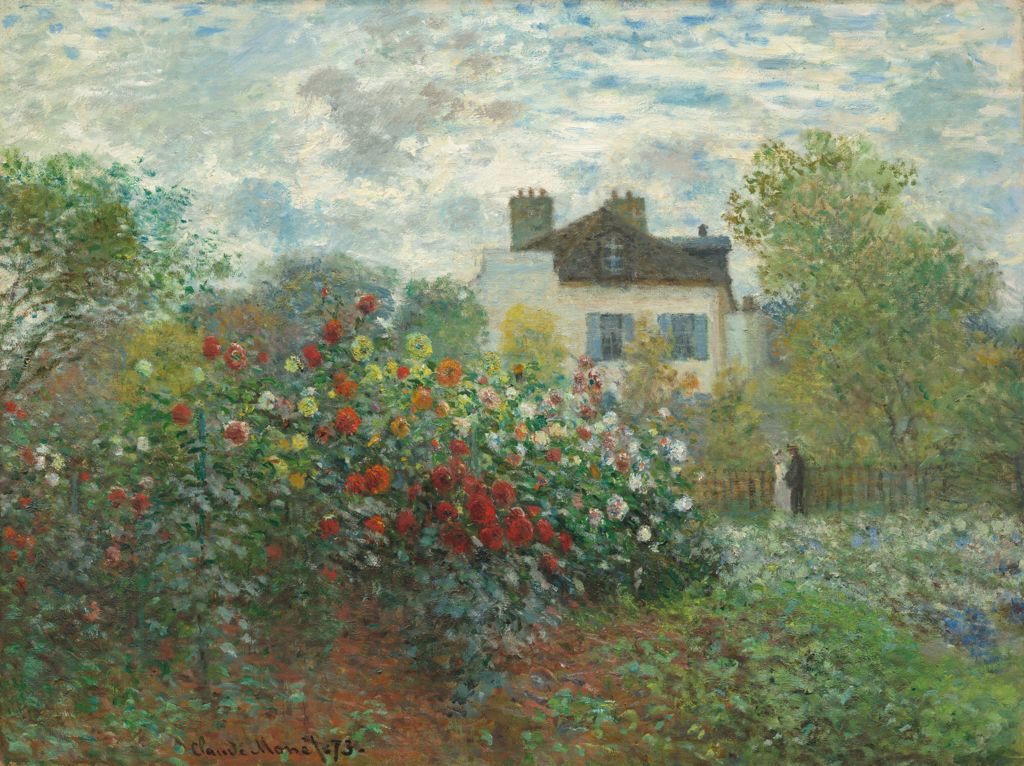
That distinction opens a useful comparison. Monet's picture gives the garden itself the larger role, spreading flowers across the view and leading towards the house. Renoir makes the worker visible. In his hands, the garden becomes a place where art is being made, with Monet's figure and easel placed against the plants. Both painters respond to cultivated colour, but one canvas shows the scene and the other also shows the act of observing it.
The shared year alone does not prove that Monet is painting the NGA canvas on the easel in Renoir's portrait. Yet the 2000 NGA exhibition catalogue goes further than a loose comparison: it identifies the blue-shuttered house and a tree as present in both paintings and suggests that Renoir's work may show Monet making A Corner of the Garden with Dahlias. That is a reasoned possibility, not a securely visible image on Monet's tiny canvas. Tucker also notes that the dahlias could be on neighbouring land rather than Monet's rented property. The two pictures help locate one another in a particular suburban garden, even while the exact sequence of their making remains uncertain. NGA catalogue, cats. 19–20. [2]
The comparison makes their different emphases sharper. Monet's view enlarges the flower beds and makes the house a strong, central presence. Renoir places the painter at the side, while more of the surrounding town crowds behind the garden. The NGA author argues that the same place becomes a relatively ordered, lush garden in Monet's canvas and a visibly ordinary suburban environment in Renoir's. This is a catalogue interpretation, but it can be tested by looking from the blue shutters to the surrounding buildings in each image. NGA catalogue, cats. 19–20. [2]
A related picture by Manet, one year later
Édouard Manet painted The Monet Family in Their Garden at Argenteuil in 1874, now at the Metropolitan Museum of Art. It shows a different arrangement and belongs to a different year. The Met's record says that, while Manet worked on his canvas, Renoir arrived, borrowed painting materials and made a picture of Camille Monet and her son nearby. Met object record. [7]
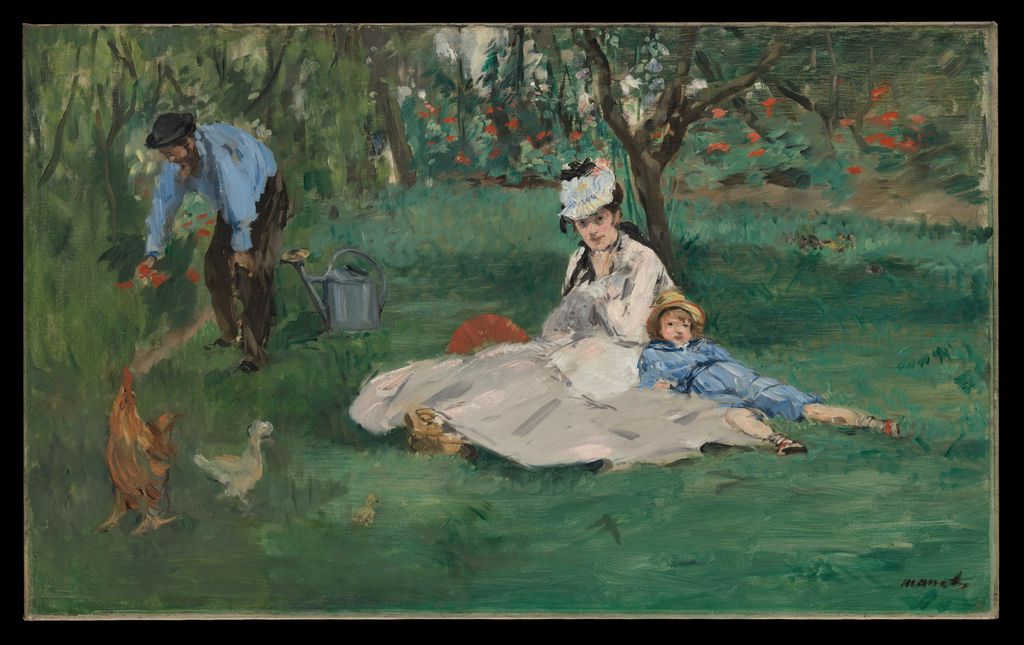
That account is evidence of the artists' continued contact at Argenteuil, but it must not be folded into the story of the 1873 Wadsworth picture. The work Renoir made beside Manet in 1874 was of Madame Monet and her son, not the earlier image of Claude Monet at the easel. Keeping the two episodes separate also makes the wider point clearer: the garden was repeatedly painted by artists who saw different possibilities in its people and plants.
A portrait of painting itself
Renoir could have made Monet's face the centre of the picture. Instead he places his friend to one side and lets the garden occupy most of the surface. The choice gives Monet an identity through action: he is the artist studying the flowers before him. The NGA exhibition catalogue compares this image with Renoir's earlier portrait of Monet reading, presenting the garden canvas as the active counterpart. That is a curatorial interpretation, but it fits the visible contrast between a painter absorbed in books and one standing outdoors before an easel.
The painting therefore links a personal relationship with a practical account of modern painting. Argenteuil was near the city and full of made spaces: houses, fences, gardens, railway and river structures. Renoir's portrait does not erase those surroundings to invent untouched nature. It finds colour and a working painter within them.
A portrait hidden beneath the garden
The Wadsworth's teaching manual reports that X-radiography revealed an earlier portrait of Camille Monet beneath the visible garden scene. The discovery gives the canvas a material history beyond its finished subject: an image of Monet's wife lies under Renoir's image of Monet working. The museum's account identifies the hidden sitter, but it does not establish who painted that earlier portrait, when the canvas was reused or why. Those questions cannot be answered from the surface of the garden picture alone. Wadsworth Atheneum, Art and Writing Teacher Manual. [1]
Where is the painting now?
Claude Monet Painting in His Garden at Argenteuil belongs to the Wadsworth Atheneum Museum of Art. Its accession number is 1957.614, and the museum credits the bequest of Anne Parrish Titzell. The work has travelled for exhibitions, but current display should be checked directly with the Wadsworth before a visit.
A 2016 Royal Academy loan record traces several earlier owners. It lists an 1896 Paris auction, followed by dealer Paul Durand-Ruel and Edmond Decap; after Georges Feydeau and a 1902 auction, Durand-Ruel acquired the canvas again. Charles A. Corliss and Anne Parrish bought it in 1925 or 1926. It passed to Anne Parrish Titzell and entered the Wadsworth by her 1957 bequest. This is a documented chain in the loan record, although its qualified 1925/26 date should not be turned into a more precise purchase year. Royal Academy loan provenance. [3]
Renoir artworks directory
Its exhibition history is part of the work's continued use as evidence for how the painters worked together. The 2000 Impressionists at Argenteuil exhibition was organised by the NGA and the Wadsworth, placing the Renoir canvas alongside Monet's garden paintings. A later Royal Academy loan record included it in Painting the Modern Garden: Monet to Matisse in 2016. These comparisons did not alter the picture's ownership: the Wadsworth remains its holder. NGA exhibition catalogue [2]; Royal Academy loan documentation. [3]
Questions about the painting
Renoir painted it. Its subject is Monet, shown working at an easel in his garden.
No. Monet's 1873 garden canvas is in the National Gallery of Art in Washington; Renoir's 1873 portrait of Monet painting is in the Wadsworth Atheneum in Hartford. They are useful comparisons, but they are distinct artworks.
No exact work can be read on the small easel in Renoir's picture. The NGA catalogue suggests Monet may have been making his 1873 dahlia garden canvas because the house and a tree appear in both works; the identification remains a possibility, not a documented fact.
Manet's picture shows Monet's family in the garden a year later. The Met records Renoir painting Camille Monet and her son nearby during that 1874 episode. That is separate from Renoir's 1873 portrait of Claude Monet at work.
Discussion
Look closely at Monet Painting in his Garden at Argenteuil and use the questions below to compare what you see with the documented history.
Reader Insights
Does the eye go first to Monet at the easel or to the garden around him?
Compare this Renoir picture with Monet’s separate Argenteuil garden works.
What can the visible picture establish about their collaboration, and what remains unknown?
Join the Conversation
Share a close observation or a source-backed question about Monet Painting in his Garden at Argenteuil. The prompts above are starting points for discussion.
References
- Wadsworth Atheneum Museum of Art, Art and Writing Teacher Manual, object credit and dimensions for accession 1957.614 View source.
- National Gallery of Art, The Impressionists at Argenteuil, catalogue discussion of Renoir's portrait and the painters' shared site View source.
- Royal Academy of Arts, Painting the Modern Garden loan list, Wadsworth dimensions and accession View source.
- National Gallery of Art, Argenteuil presentation View source.
- Picturing France teaching packet View source.
- National Gallery of Art, The Artist's Garden in Argenteuil object record View source.
- The Metropolitan Museum of Art, Manet, The Monet Family in Their Garden at Argenteuil, object record and historical note View source.