by Tom Gurney
Tom Gurney BSc (Hons) is an art history expert with over 20 years experience
Published on June 19, 2020 / Updated on October 2, 2026
Email: tomgurney1@gmail.com / Phone: +44 7429 011000
A nude woman sits with her back toward us at the edge of blue-green water. Her knees turn to the right, a rocky bank fills the foreground, and an ochre headland reaches across the distant horizon. The inherited image is widely reproduced as Pierre-Auguste Renoir’s Nude Bather Seated by the Sea, dated 1882 in secondary listings. An accessible museum or illustrated auction record for this exact composition has not been found. The date, dimensions and present ownership therefore need different levels of confidence: the date is a circulating attribution, while the other object facts remain unverified.
The painting brings body and landscape close together without making either a mere backdrop. Pale skin meets the dark shore, while the curve of the woman’s back answers the rounded rocks at right. The figure appears still, but the water’s marks and the stretched headland keep the scene moving around her.
Contents
- The work at a glance
- A seated figure seen from behind
- Water, rocks and headland
- A bather within Renoir’s repeated subject
- Titles and object identity
- Looking again at figure and place
Watch: Pierre-Auguste Renoir
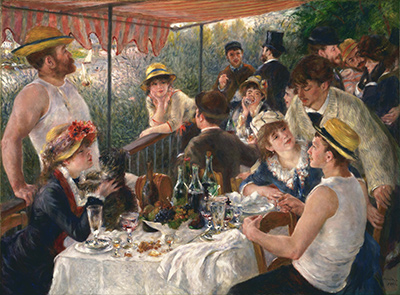
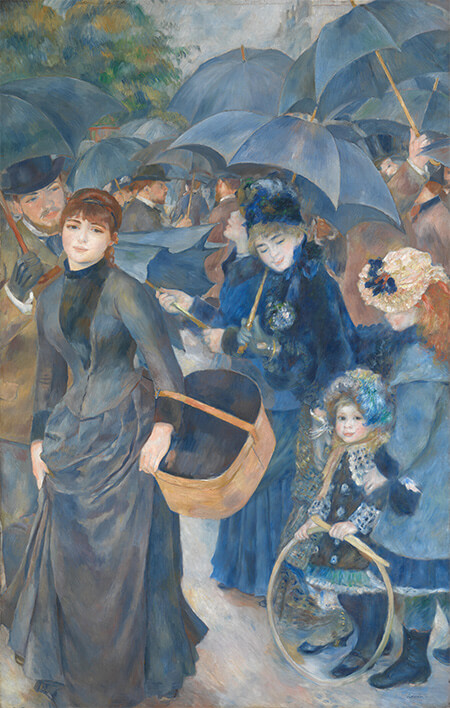
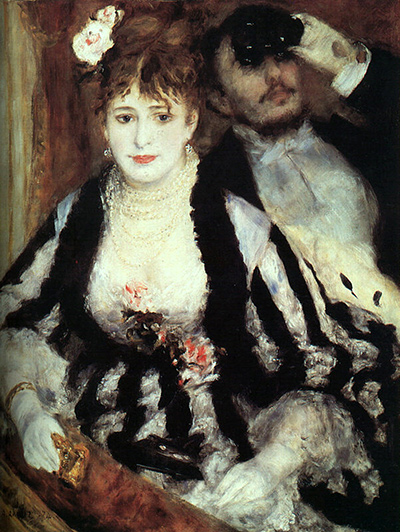
Explore a Montmartre dance, a gathering beside the Seine and the drawings behind Renoir’s paintings.
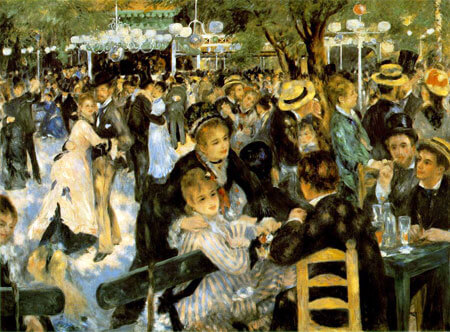
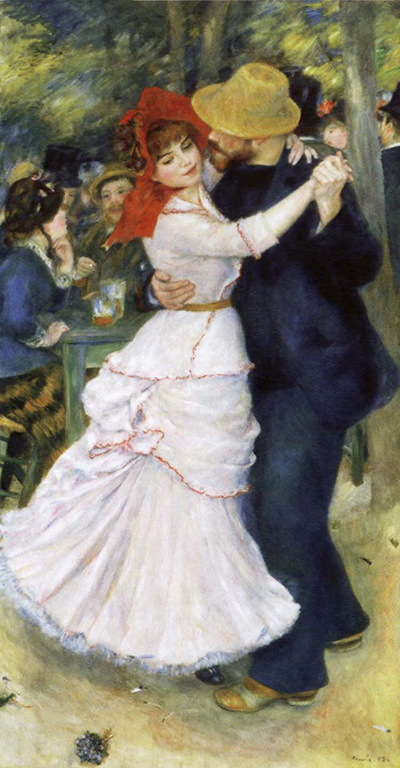
Renoir, Bal du moulin de la Galette
Dr. Beth Harris and Dr. Steven Zucker discuss Renoir’s 1876 Montmartre dance scene, its light and its crowds.
Watch on YouTubeAt a glance
- ArtistPierre-Auguste Renoir (1841–1919)
- Inherited titleNude Bather Seated by the Sea
- Date in illustrated secondary listings1882; exact-object verification still needed
- Support and mediumSecondary listings disagree: oil on canvas or oil on paper laid down on canvas; unverified
- Dimensions in some secondary listings81.5 × 65.5 cm; unverified for the exact work
- Present collectionNot independently verified
The Artchive listing [1], WikiArt-linked Commons reproduction [2] and French-titled Commons file [3] reproduce the same back-view woman and coast as the local image. They support an image match and the common title. They do not provide a dated owner record, catalogue number or direct documentation for the work’s stated size. Commercial pages sometimes assign it to the Clark Art Institute, but the Clark’s documented Blonde Bather is a different figure and viewpoint; that claim should not be repeated here.
A seated figure seen from behind
The woman’s back occupies the centre of the canvas. Her head turns slightly toward the left, so we see the dark hair gathered at the nape but little of her face. One arm reaches down to the ground at left; the other bends toward her leg. The pose makes a broad triangular shape that narrows at the head and widens toward the seated hips and extended legs.
The pale body is not enclosed by a single hard outline. Cream, pink and cool blue strokes meet the surrounding greens. A darker line around the shoulder and waist helps the form remain legible, while areas of the leg seem to dissolve into light. The figure is both firmly present and affected by the colour of the place around her.
Her posture gives no secure account of what she is thinking or doing next. The title calls her a bather, but the image does not show her in the water. She might be resting before or after bathing, or simply posed in a coastal setting. It would be unwarranted to identify her as a particular model or to claim that Renoir painted her outdoors from life without documentary evidence.
The viewpoint is intimate but not face to face. We share the shore behind her and look toward the same water. Because her face is turned away, attention falls on the sweep of the back, the bend of the arms and the relationship between flesh tones and landscape. The body acts as a path for the eye: from the head downward through the shoulders and hips, then rightward along the legs to the shore.
At the inherited resolution, some boundaries are difficult to distinguish. The left arm blends with warm rock and grass; the lower leg meets sand-coloured ground. A better object photograph could clarify those passages. The image is still clear enough to show that Renoir wanted the figure embedded in the coastal scene rather than isolated against a blank studio ground.
Water, rocks and headland
The sea occupies a strong horizontal band across the middle. Blue, turquoise and green strokes run in several directions, making its surface restless without forming precise waves. At right, two brownish rocks interrupt the water. Their blunt shapes echo the woman’s rounded shoulder and knee, but their darker colour gives the body a luminous contrast.
An ochre headland stretches from left toward the centre of the horizon. Its edge is relatively simple, a warm band between sea and pale sky. The headland gives distance to a scene otherwise dominated by the nearby figure and rocks. It also lets the painting alternate warm and cool: reddish land above blue water, pink skin against green-blue sea, warm shore beneath the figure.
The sky is brushed in pale blue, cream and grey. Its light appears diffuse rather than a sharp midday glare. We cannot identify a specific coastline or weather condition from these marks. The painting offers a coastal setting as a visual structure, not a map. No sail, house or landmark securely names the place.
The foreground rock and ground are mottled with rust, green and brown. They support the figure without becoming a carefully observed geological study. A strip of light sand or shore runs toward the right edge behind her leg. That pale passage opens the otherwise dense lower half and draws the eye back to the water.
Look at how the horizon crosses behind the seated woman near shoulder level. It gives the body scale against open distance. Yet the horizon is not rigidly drawn; the sea’s broken marks bring movement close to her. The stable seated form and shifting water make the scene feel balanced without being static.
A bather within Renoir’s repeated subject
Renoir returned to women by water throughout his career. The Clark Art Institute’s catalogue for Blonde Bather [4] describes a documented 1881 work made during his Italian trip, with a front-facing seated figure and its own coastal setting. The Pinacoteca Agnelli’s collection booklet [5] documents a related 1882 La Baigneuse blonde, 90 × 63 cm, also facing more toward the viewer. Neither is the back-view woman in this local image. Their owner records show Renoir testing a subject in several solutions; they do not establish this painting’s sitter or location.
The National Gallery, London’s A Bather [6] offers another distinct example. Its catalogue explains Renoir’s interest in the classical tradition of the seated nude alongside details of contemporary hair and dress. The work on this route similarly places a nude in an outdoor setting, but it lacks the National Gallery picture’s particular striped towel and pose. Comparison is useful for the theme, not for transferring the London painting’s date or provenance.
The Musée d’Orsay’s discussion of Renoir’s bathers [7] considers how he developed the contrast of figure and landscape after his early-1880s travels. It gives a broader art historical frame for the visible combination here. The exact work still needs its own catalogue evidence.
The small local image is close to a portrait format and focuses on one body. Renoir’s later large groups of bathers answer a different compositional problem: how several figures share an invented landscape. Calling all these works simply “bathers” can obscure the particular decisions in this one, where a solitary back creates a quiet point of entry into the sea view.
Titles and object identity
The French title Baigneuse nue assise au bord de la mer appears in secondary circulation. A title describing “a nude bather seated by the sea” is also broad enough to match multiple works. One should therefore look for the distinctive combination of back-view figure, ochre headland and two rocks at right before applying an auction or museum record.
Some online copy falsely places this painting at the Clark Art Institute. The Clark’s illustrated Blonde Bather has another pose and is the basis for a separate route in this cluster. A second related Blonde Bather belongs to Pinacoteca Agnelli. Their strong institutional records make the mismatch clear, even when less careful sites collapse them under a generic “bather by the sea” description.
Secondary sources also disagree on the support. Artchive [1] calls it oil on canvas, while an auction-linked MutualArt entry [8] describes oil on paper laid down on canvas. A stated size of 81.5 × 65.5 cm appears in secondary listings, but the original auction catalogue has not been independently checked. Neither the support nor the measurement should be presented as a verified exact-object fact.
Looking again at figure and place
Begin with the headland’s warm line, then follow the sea horizontally to the dark rocks. Return along the woman’s right arm and leg to the pale back. This circuit alternates distant land, moving water, solid stone and living body. Each part changes the way the next is seen.
The painting’s strongest contrast may be between two kinds of curve. The woman’s back and hip make one continuous sweep; the rocks are broken and angular despite their rounded masses. The water’s short brushstrokes cut across both. Renoir gives the central figure a sense of continuity while making the surroundings lively and fragmentary.
The back view also shapes the viewer’s role. We cannot easily read facial emotion, so the painting does not offer a personal story. It invites us to look with the figure toward the water and to notice how she belongs to the same field of light as the shore. That is a grounded response to what is visible, without inventing a sitter, a private moment or a named beach.
This page shows the inherited small image. No exact-object museum, collection or illustrated sale record has yet confirmed the date, dimensions or ownership; the small image also limits colour comparison. Until then, the guide can reliably show how the composition works while keeping its documentary limits visible.
Renoir artworks directory
Questions about Nude Bather Seated by the Sea
A nude woman seen from behind sits on a rocky shore, facing blue-green water, an ochre headland and pale sky.
Matching illustrated secondary listings give 1882. An exact-object catalogue is still needed to confirm the date.
No reliable identification of this specific back-view sitter has been found. Resemblance to other bathers does not establish her name.
No. The Clark’s documented 1881 painting shows a different pose and viewpoint. The local image’s figure faces away toward the water.
Present ownership has not been independently verified. Online claims assigning it to the Clark conflict with the Clark’s illustrated object record.
Discussion
How does the back-view figure lead you toward the sea?
How does the ochre headland set off the blue water?
Reader Insights
How does the ochre headland set off the blue water?
The circulated 1882 date still needs an exact-object catalogue record.
Where do the shoreline rocks draw your eye?
Join the Conversation
Share a close observation or a source-backed question about this sea bather.
References
- Artchive, Artchive, Nude Bather Seated by the Sea View source.
- Artchive, Wikimedia Commons reproduction View source.
- French-titled Commons file View source.
- Clark Art Institute, Clark Art Institute, Blonde Bather catalogue View source.
- Clark Art Institute, Pinacoteca Agnelli collection booklet View source.
- Clark Art Institute, National Gallery, London, A Bather View source.
- Musée d’Orsay, Les Grandes Baigneuses de A à Z: broader context for Renoir’s bather compositions View source.
- Artchive, MutualArt auction-linked entry View source.