by Tom Gurney
Tom Gurney BSc (Hons) is an art history expert with over 20 years experience
Published on June 19, 2020 / Updated on October 2, 2026
Email: tomgurney1@gmail.com / Phone: +44 7429 011000
A woman in a red headscarf sits in profile, one arm resting on a yellow spotted drape. This small, upright painting is the image attached to this site's Odalisque page. Image records identify it as Pierre-Auguste Renoir's Odalisque in a private collection, usually dated circa 1895 and measured 41.2 × 32.7 cm. The former page text instead described the much larger, reclining Odalisque that Renoir exhibited in 1870 and that now belongs to the National Gallery of Art, Washington. Those are different paintings. Bridgeman Images, later Odalisque [1]; National Gallery of Art, 1870 Odalisque. [2]
At a glance
- ArtistPierre-Auguste Renoir
- Title used by image recordsOdalisque
- DateCirca 1895 in the Bridgeman/Christie's image record; Commons leaves the date undetermined
- Medium and sizeOil on canvas, 41.2 × 32.7 cm
- CollectionPrivate collection, according to the image record
- Distinguishing viewSeated woman in red headscarf, upright format, spotted yellow drape
Watch: Pierre-Auguste Renoir
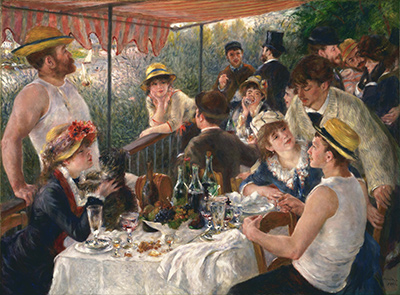
Explore a Montmartre dance, a gathering beside the Seine and the drawings behind Renoir’s paintings.
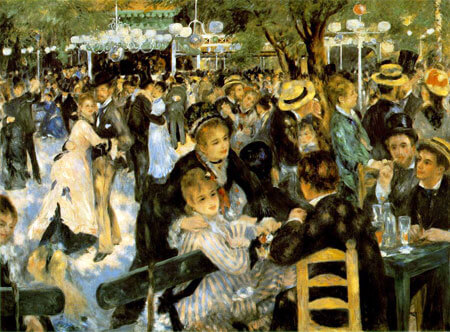
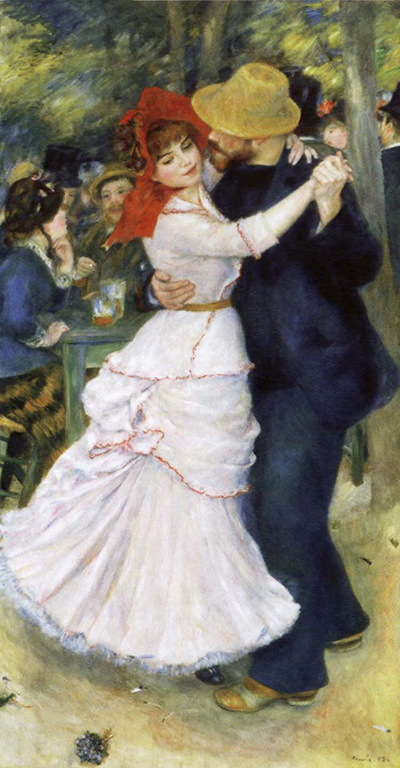
Renoir, Bal du moulin de la Galette
Dr. Beth Harris and Dr. Steven Zucker discuss Renoir’s 1876 Montmartre dance scene, its light and its crowds.
Watch on YouTubeThe dating and collection are less firmly documented here than for a museum-owned work with a current object page. Bridgeman lists an image credited to Christie's Images and calls the painting Odalisque, circa 1895; the matching Commons file records the size and medium but not a date. There is no public owner catalogue attached to the local image. We therefore treat “circa 1895” as a qualified image-record date and avoid inventing a named sitter, a precise year or a full provenance. Bridgeman image record [1]; Commons file record. [3]
A quiet figure in a busy surface
The sitter turns to the left and lowers her eyes. The knot and trailing fabric of her headscarf draw a vivid red arc around her pale face. A dark background gives her profile a clear edge; a yellow-green vertical passage at the far right adds a second bright strip behind her. Renoir's colour therefore moves from the red of her head covering through the warm gold of her costume to the spotted yellow fabric beside her.
Her right forearm crosses the middle of the picture and rests on the drape. That simple gesture creates a diagonal link between face and lower half. It also holds the woman in a still pose: she does not appear to be acting out an event. The marks on the drape suggest an animal pattern, though the image alone cannot prove whether it is a real skin, a textile imitation or another painted furnishing. Describing the visible spots is safer than assigning a specific material.
Look closely at the contrast between face and costume. The face is built with relatively soft transitions of light and shadow. The jacket and cloth break into small yellow, blue, red and green touches. A broad red band at the waist echoes the headscarf without repeating its exact shape. Renoir keeps the sitter readable while letting the surrounding fabrics carry much of the colour and movement.
What the title suggests, and what it cannot tell us
“Odalisque” belongs to a long European painting tradition of imagined women in settings associated with Ottoman or North African interiors. The term and costume do not identify this model's ethnicity, nationality or social position. In the later Renoir canvas, we see a staged, richly dressed woman, not a documented portrait of an Algerian person or a verified view of an Algerian home. The available image records do not name the model or the place where she posed. Bridgeman record. [1]
The National Gallery of Art's interpretation of Renoir's 1870 Odalisque is useful context, with an important limit: that work was staged in Renoir's Paris studio as a fantasy of a private North African space. The museum discusses both Renoir's pleasure in rendering textiles and the colonial stereotypes the painting advanced. Those comments help us ask better questions of the later costume picture, but the gallery's evidence about a particular 1870 studio sitting cannot by itself establish the later picture's setting or model. National Gallery of Art, 1870 Odalisque, curator and guest commentary. [2]
Renoir did travel to Algeria in 1881 and 1882. The later canvas has often been placed about a decade after those trips, but it would be misleading to call this a scene observed there. The motif is a European pictorial construction, and no available exact-object record links the present sitter to a journey. Costume and place should be kept separate. Christie's discussion of Renoir's return to Orientalist subjects [4]; National Gallery of Art, 1870 object interpretation. [2]
The two Renoir paintings called Odalisque
The difference is immediately visible. The private-collection painting on this page is upright, about 41 cm high, and shows one seated woman from head to lap. Her red scarf, decorated jacket and spotted drape dominate the design. The NGA picture is horizontal, 69.2 × 122.6 cm, and shows a full reclining figure in a patterned interior. Its signature reads “A. Renoir. 70.”, and the NGA documents it at the Salon of 1870 as Femme d'Alger. That exhibition and inscription belong to the Washington painting alone. Bridgeman, later canvas [1]; NGA, dimensions, inscription and exhibition history. [2]
The old local article combined the upright splash with claims about the 1870 Salon. It also suggested Renoir went to Algeria in 1881 while seeking a model for that Salon work, a chronological impossibility. This rewrite uses the local image as the object to describe and gives the 1870 canvas its own comparison. Similar titles are not enough to transfer a sitter, date, exhibition or location between objects.
Another related work, Parisiennes in Algerian Costume or Harem of 1872, belongs to the National Museum of Western Art in Tokyo. That museum describes the models as Parisian women and notes Renoir's debt to Delacroix's Women of Algiers. It is a third painting, with several figures rather than the single seated woman shown here. It helps place Renoir's interest in costume and imagined interiors, while again resisting a claim that this later small canvas records a specific Algerian scene. National Museum of Western Art, Tokyo. [5]
Date and source limits
The matching Commons image was uploaded from the Art Renewal Center and marks the painting's date as unknown. Bridgeman's Christie's Images credit gives circa 1895. Some later art-image sites repeat the latter date and private-collection designation, but they do not add a current owner record or a documented provenance. The proper conclusion is a working identification: this is the small, later private-collection Odalisque, not the 1870 NGA Odalisque. Exact date and ownership history remain open for a catalogue or auction-record review. Commons source metadata [3]; Bridgeman record. [1]
This uncertainty does not prevent close looking. The red headscarf provides a sharp focal point, while the scattered colours of the jacket and spotted furnishing slow the eye. Renoir lets the sitter's quiet profile and the lively paint coexist in a small space. The painting may invite a story about costume and place, but its surviving image record supports a more precise description than the old, borrowed 1870 narrative.
Looking again
Begin with the red scarf and follow its line down to the woman's shoulder. Compare the soft cheek with the active strokes in her jacket. Then examine the spotted fabric beneath her arm: it nearly fills the lower right corner, counterbalancing the light face above. That balance is visible without assuming a sitter's name or a destination beyond the picture.
Renoir artworks directory
Questions about Renoir's later Odalisque
No. That is the large horizontal painting now at the National Gallery of Art, shown in 1870 as Femme d'Alger. The local image shows a small upright painting generally dated circa 1895.
The available exact-object image records do not name her. The title and costume do not establish that she was Algerian.
Bridgeman's image record places it in a private collection. A current public owner catalogue and full provenance have not been located for this exact canvas.
It is a qualified date in the Bridgeman/Christie's image record. Commons calls the matching painting undated. A documented catalogue record would be needed to resolve the difference.
Discussion
What do you notice when you return to Odalisque?
How do the red headscarf and spotted drape structure this small seated portrait?
Reader Insights
How do the red headscarf and spotted drape structure this small seated portrait?
The local image matches a private-collection Odalisque generally dated around 1895, not the NGA’s horizontal 1870 painting.
What can the costume show us about Renoir’s painted fantasy without identifying the sitter as Algerian?
Join the Conversation
Share a close observation or a source-backed question about Renoir’s odalisque.
References
- Bridgeman Images, Christie's Images credit for Odalisque, circa 1895: exact-object photograph listing title, approximate date, size, medium and private collection View source.
- National Gallery of Art, National Gallery of Art, Odalisque , 1963.10.207 View source.
- Wikimedia Commons, Pierre-Auguste Renoir - Odalisque - 02.jpg: matching whole-work image, 2297 × 3000 pixels, sourced from Art Renewal Center and marked Public Domain/PD-Art; its metadata leaves the date unknown. The reduced image shown here follows that Commons file View source.
- Christie's discussion of Renoir's return to Orientalist subjects View source.
- National Gallery of Art, National Museum of Western Art, Parisiennes in Algerian Costume or Harem , P.1959-0182 View source.