by Tom Gurney
Tom Gurney BSc (Hons) is an art history expert with over 20 years experience
Published on June 19, 2020 / Updated on October 2, 2026
Email: tomgurney1@gmail.com / Phone: +44 7429 011000
A yellow-red pear leans at the left of a cluster of apples and other rounded fruit. All rest on a white cloth drawn across a golden table, against a muted blue-grey background. This is the inherited image on the Pears and Apples route. Illustrated secondary reproductions match the composition and usually date it 1890, but an exact-object museum or illustrated auction catalogue has not been securely linked to this image. The guide presents that date as a conventional attribution and keeps the painting’s measurements, provenance and present ownership open.
The subject is ordinary; the arrangement is carefully built. Renoir moves from the pear’s upright taper to the round yellow fruit in the centre and the smaller red and pale green shapes at right. The cloth unites them, creating a bright stage of folds and shadows. Nothing in the image identifies the person who laid out the fruit or a particular household. Its interest is in colour, weight and the contact between surfaces.
Contents
- The work at a glance
- A cluster of different forms
- The cloth and the table
- Colour and brushwork
- Several paintings share the title
- Looking closely without inventing a story
Watch: Pierre-Auguste Renoir
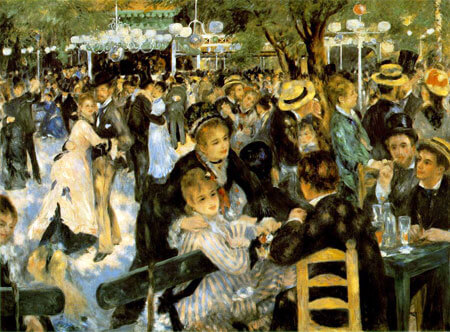
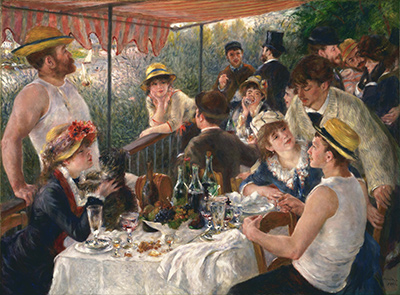
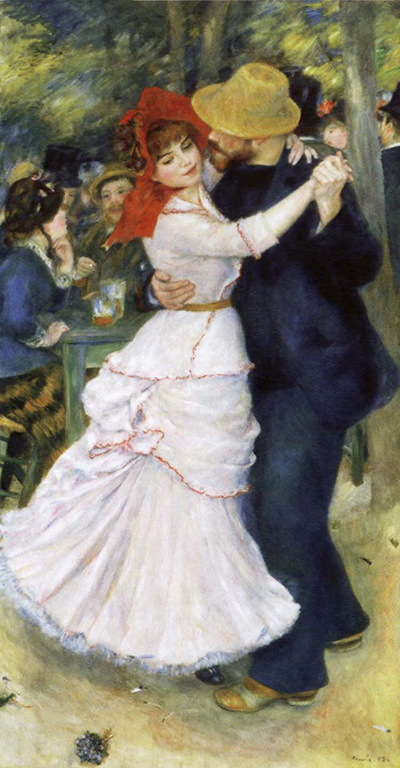
Explore a Montmartre dance, a gathering beside the Seine and the drawings behind Renoir’s paintings.
Renoir, Bal du moulin de la Galette
Dr. Beth Harris and Dr. Steven Zucker discuss Renoir’s 1876 Montmartre dance scene, its light and its crowds.
Watch on YouTubeAt a glance
- ArtistPierre-Auguste Renoir (1841–1919)
- Inherited titlePears and Apples
- Date in illustrated secondary listings1890; exact-object verification still needed
- Medium in secondary listingsOil on canvas; exact-object verification still needed
- DimensionsNot reliably established for this exact image
- Present collectionNot independently verified
The Gallerix reproduction [1], WikiArt listing [2] and Wikimedia Commons file [3] show the same pear at left, dark red fruit behind the yellow centre and white cloth as the local splash. They are evidence for an image match and a commonly circulated title and date. They do not provide a dated owner record or a dependable object number. “Private collection,” where repeated in secondary listings, is not a verified statement of present ownership.
A cluster of different forms
The pear is the most recognisable shape. Its narrow stem rises from a warm yellow body touched with orange-red on one side. Renoir lets it lean slightly toward the large central fruit. That tilt begins a chain of contacts across the tabletop. Behind it, a deep crimson apple adds a dark, rounded peak to the cluster.
The broad yellow fruit at the centre acts almost like a second light source. Its colour is warmer than the cloth beneath it and more continuous than the broken blue-grey background. A small dark notch near its base gives it a point of contact with the fabric. The object is often called an apple in the reproduced title, but it is more useful to notice the visual role of its roundness and colour than to force every partly hidden fruit into a precise variety.
To the right, red and yellow-green forms overlap. One red fruit seems tucked behind another. At the far edge, a pale rounded fruit has a rosy streak and a small circular end facing the viewer. Their boundaries are soft, so some edges seem to merge. The eye separates them through shifts in temperature—red beside yellow, green beside orange—and through the dark pockets between them.
The arrangement is asymmetric but stable. The tall pear occupies one end, while the small fruit at right spreads the weight horizontally. The dark red apple near the back gives height to the centre; the white cloth makes the entire group feel gathered rather than scattered. There is no bowl, and the fruit sits directly on the drapery.
This matters when matching records. Renoir painted more than one apples-and-pears still life. A catalogue entry describing a bowl of fruit, for example, cannot automatically describe the loose pile on cloth shown here. Title words are less reliable than the pattern of objects and their placement.
The cloth and the table
The white fabric runs beneath the fruit as a wide, irregular ribbon. At left its edge is raised into grey creases; in the middle it dips under the weight of the yellow fruit. At right it bunches and folds back on itself. The dark accents in those folds are as important as the light areas: they make the cloth feel thick and give the fruit a surface to press against.
The fabric is not a neutral background. Its broad white shape separates the warm fruit from the golden tabletop and the cool wall. In the lower half of the image, black and blue-grey lines cut through pale cream paint. A triangular fold points toward the fruit at right, while a longer horizontal fold brings the eye back toward the pear.
Below the cloth, the ochre table occupies a narrow strip. Its simple colour provides a firm base after the lively texture above it. The lower edge of the painting seems to contain a small inscription at right in the inherited reproduction, but the file is too small for the mark to establish a signature’s wording or authenticity. Physical examination or a high-resolution catalogue image would be needed.
The rear field is brushed in slate blue, grey and tan. It is not clear whether it depicts a wall, screen or hanging. Broad curved strokes move around the fruit rather than describing architectural depth. The coolness of that field pushes the oranges, yellows and reds forward. Renoir needs little more than a table edge and these colour contrasts to create a convincing space.
Colour and brushwork
The fruit appears solid even though its contours are not evenly drawn. The pear’s warm side is made of broad yellow and red strokes; the apples’ darker forms use layered reds and browns. The central yellow object has smoother transitions, so it seems fuller and closer. In contrast, the white cloth is broken into sharp changes of light and shadow.
Look especially at the meeting of the pear and central fruit. The pear’s orange edge sharpens against the yellow circle. The crimson apple behind them supplies a dark bridge between the two. That small triangle of colours holds the eye near the middle of the picture before it moves to the paler fruit at right.
Renoir’s strokes in the background turn and overlap. They are visible enough to remind us that the cool field is paint rather than an exact physical setting. The foreground table is more horizontal and quiet. This difference in handling helps the fruit appear weighty without enclosing every form in a hard line.
The small inherited reproduction can support observations about placement and major colour relationships. It cannot settle surface texture, pigment changes, restoration or whether the image’s colour balance accurately matches the canvas. Those require a reliable source photograph and object record.
Several paintings share the title
The Musée de l’Orangerie’s Pommes et poires [4] is a documented Renoir still life dated about 1895. Its museum description features apples and pears piled in a bowl, with a white tablecloth. The bowl is absent from the inherited image on this route. The Orangerie’s accession number, dimensions, provenance and location therefore belong to another picture. The museum also notes other similar Renoir fruit compositions, a useful reminder that the motif was repeated.
Christie’s Poires et pommes [5] is catalogued as painted in 1890, oil on canvas 32.4 × 40.4 cm, with a stamped signature at upper right. The small inherited reproduction appears to place an inscription near the lower right. Christie’s accessible text page does not provide enough inspectable image evidence to establish that its lot and this route’s splash are the same object. Its measurements and provenance should not be transferred here on title and date alone. The catalogue’s sale-room correction also changes its stated provenance, another reason to use the exact lot with care.
Still lifes offered Renoir a way to work with simple forms repeatedly. In the Christie’s lot essay, the auction house discusses the growing market for his still lifes around 1890 and quotes a later recollection that he recommended the genre as a way to learn to paint quickly. This is helpful period context; it does not prove when, where or for whom the specific painting on this route was made.
The Orangerie comparison is more revealing visually. One painting builds a mound inside a vessel; the inherited image lays the fruit directly across cloth. Both use pale fabric against warm fruit, but the handling of support changes the composition. The art historical question is therefore more precise than “which Pears and Apples?” It is which exact arrangement, source photograph and object history belong together.
Looking closely without inventing a story
Begin at the pear’s stem and follow its descending curve to the cloth. Trace the dark red apple behind the yellow centre, then cross to the smaller fruit at right. The forms feel crowded, but their colours let each one claim a place. The fold of cloth at the right edge turns the eye back into the cluster.
The picture does not show harvesting, cooking or dining. A still life can suggest the presence of people because someone arranged its objects, yet it records no named person or event. Reading the fruit as a lesson in shape, light and touch is grounded in the image. Assigning it a particular home, patron or symbolic programme would require evidence beyond this reproduction.
The 1890 date remains useful as a guide to how this image circulates, but it should be checked against a catalogue raisonné or a clearly illustrated owner or sale record. The inherited image supports formal description, while its modest resolution leaves finer colour and brushwork judgments open. For now, its strongest evidence is visible: a warm cluster of fruit held together by a white cloth against a cool, unsettled background.
Renoir artworks directory
Questions about Pears and Apples
A pear and several round red, yellow and pale green fruits rest directly on a folded white cloth over a golden tabletop. No bowl appears in the inherited image.
Illustrated secondary sources commonly give 1890, but an exact-object catalogue match is still needed to confirm the date.
No. The Orangerie’s documented painting has fruit piled in a bowl and is dated about 1895. The route image shows fruit directly on cloth.
That remains unverified. Christie’s describes a signature stamp at the upper right, while the inherited image appears to show a mark at the lower right; title and date alone cannot establish a match.
Present ownership has not been independently established for the exact image. A general “private collection” label in secondary listings is not a dated owner record.
Discussion
How does the leaning pear begin the group of fruit?
How does the cool background affect the warm fruit?
Reader Insights
How does the cool background affect the warm fruit?
The commonly reproduced 1890 date still needs an exact-object catalogue record.
Where do the white cloth folds take your eye?
Join the Conversation
Share a close observation or a source-backed question about this fruit arrangement.
References
- Gallerix, Gallerix, Pears and Apples View source.
- Gallerix, WikiArt, Pears and Apples View source.
- Gallerix, Wikimedia Commons reproduction View source.
- Musée de l’Orangerie, Pommes et poires: a distinct, documented Renoir fruit still life containing a bowl, used to prevent title confusion View source.
- Christie’s, Poires et pommes, lot 267: a 1890 lot whose text and stated signature position do not yet establish an exact match to the inherited splash; catalogue essay used only for broader still-life context View source.