by Tom Gurney
Tom Gurney BSc (Hons) is an art history expert with over 20 years experience
Published on June 19, 2020 / Updated on October 2, 2026
Email: tomgurney1@gmail.com / Phone: +44 7429 011000
Two little girls stand hand in hand before a dark curtain. Their lace dresses are almost identical, but one has a pink sash and the other a blue one. The familiar title Pink and Blue turns those colours into names. The children had names of their own: Alice Cahen d’Anvers, at left in pink, and her older sister Elisabeth, at right in blue. Pierre-Auguste Renoir painted them in 1881 for their family. The canvas is now in the Museu de Arte de São Paulo (MASP), inventory MASP.00099. MASP object record. [1]
The portrait is 119 × 75.5 cm, unusually tall for two young sitters. It lets them stand almost full length, showing hair ribbons, lace, stockings and shoes as carefully as their faces. Alice was five and Elisabeth six when Renoir painted them. Their shared handclasp gives the formal image a small moment of support. MASP curatorial essay. [1]
At a glance
- ArtistPierre-Auguste Renoir
- Holder titlePink and Blue – The Cahen d’Anvers Girls; Portuguese Rosa e azul – As meninas Cahen d’Anvers
- Date1881
- MediumOil on canvas
- Dimensions119 × 75.5 cm
- SittersAlice at left in pink; Elisabeth at right in blue
- CollectionMuseu de Arte de São Paulo, MASP.00099; credited as a 1952 gift of the people of São Paulo
This work in Renoir’s career
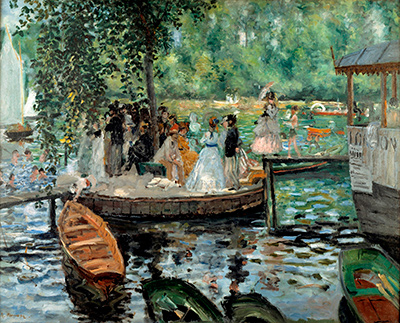
La Grenouillère
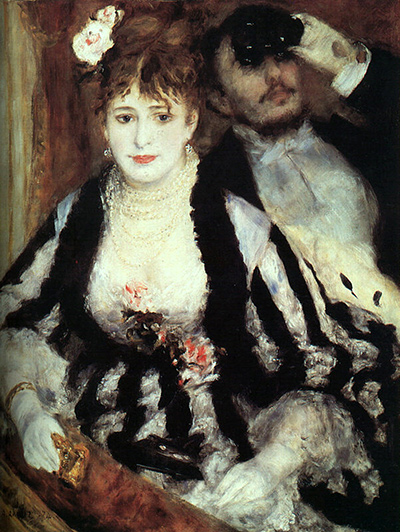
1869La Loge
1874Pink and Blue
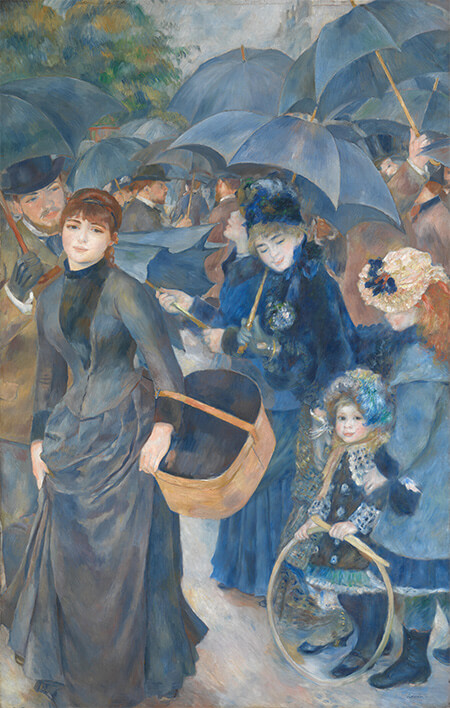
1881The Umbrellas
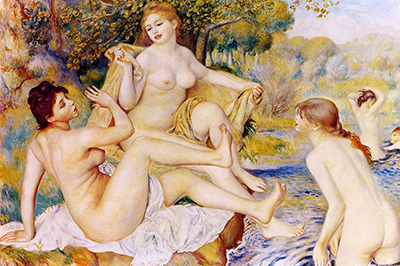
c. 1881–86The Great Bathers
1884–87The Bathers
1918–19Contents
- Annotated details of the painting
- Two sisters, one formal pose
- Why pink and blue are not just decoration
- A family commission in 1881
- Their sister Irène's separate portrait
- Beyond the title
- Looking again
Annotated Details from Pink and Blue
Alice in pink and Elisabeth in blue stand hand in hand in Renoir’s 1881 family portrait.
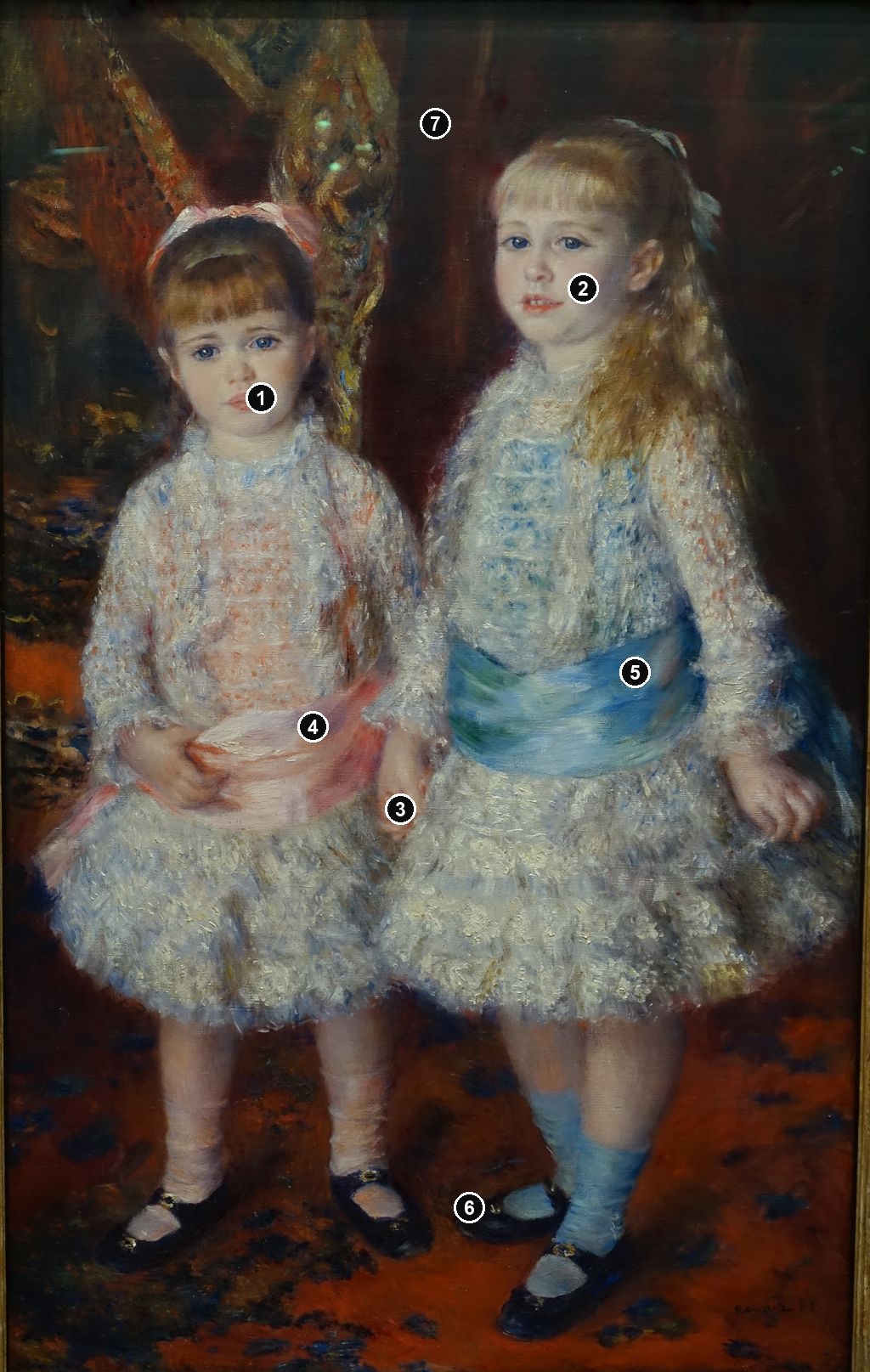
Details from PINK AND BLUE
The details identify the sisters according to the MASP catalogue, not only by the picture’s colour nickname.
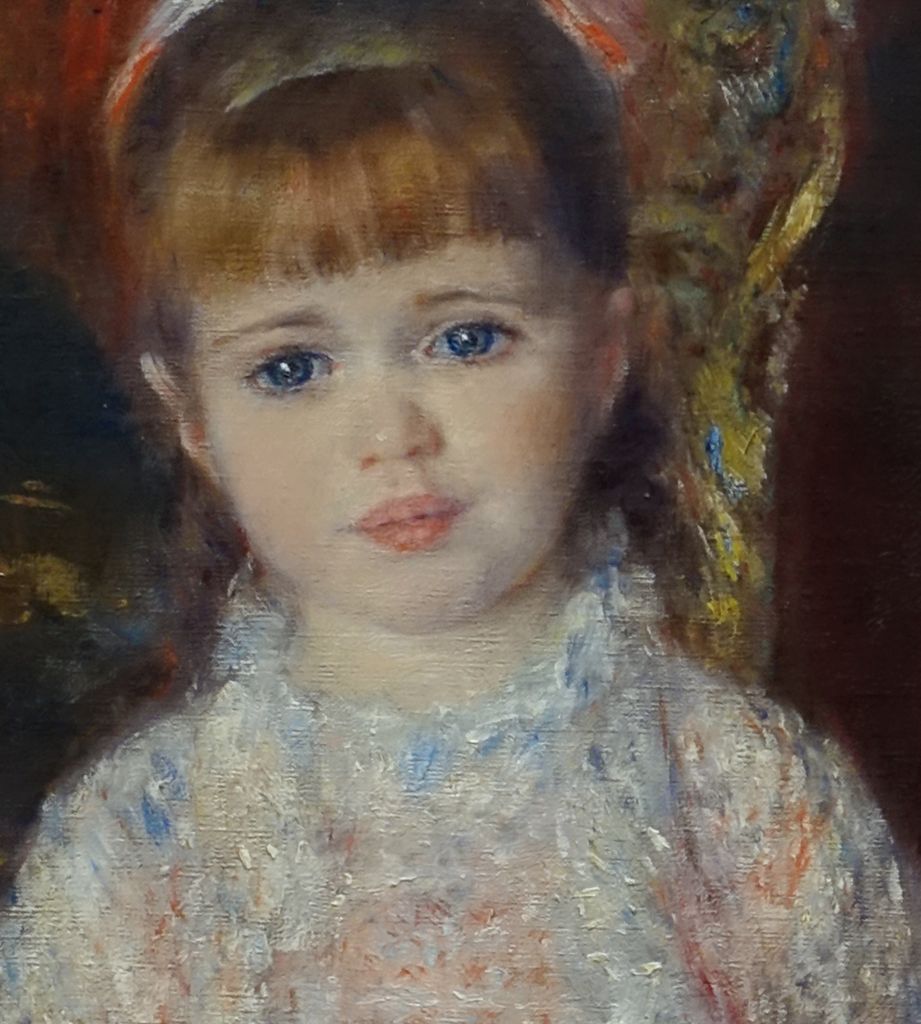
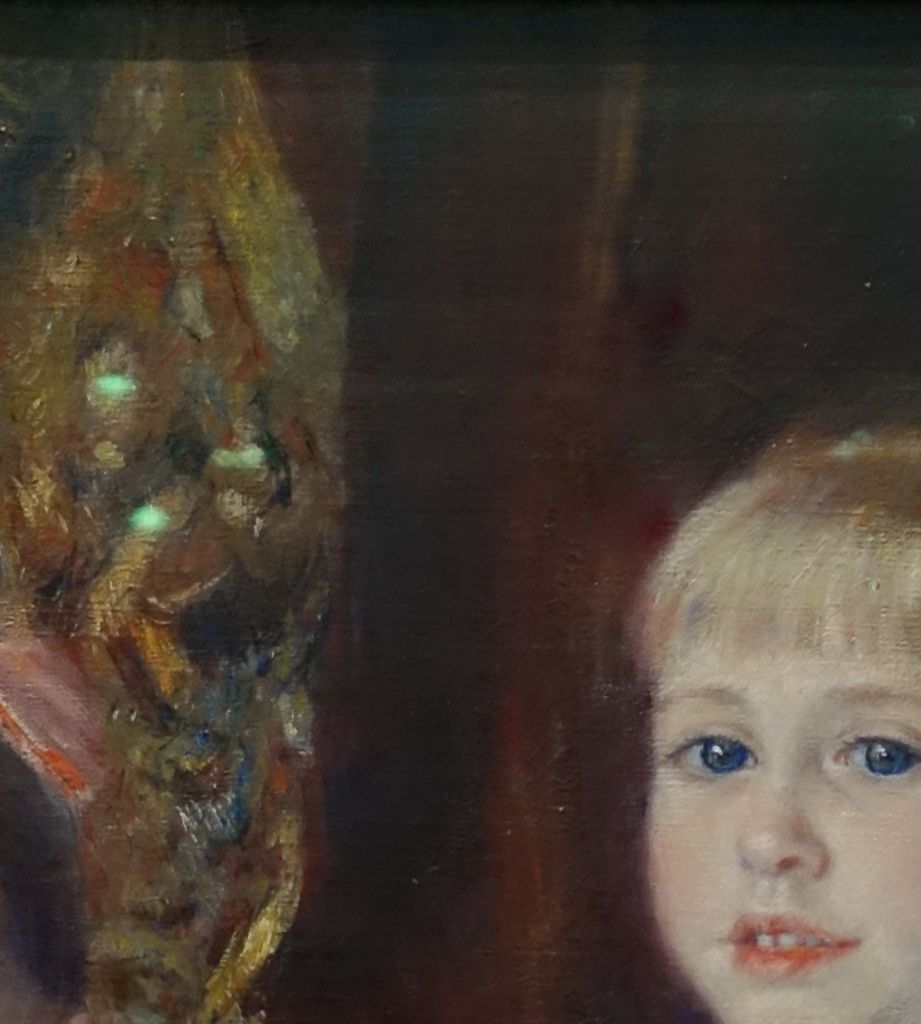
Alice in pink
Alice, age five, stands at left with a pink sash and a direct gaze.
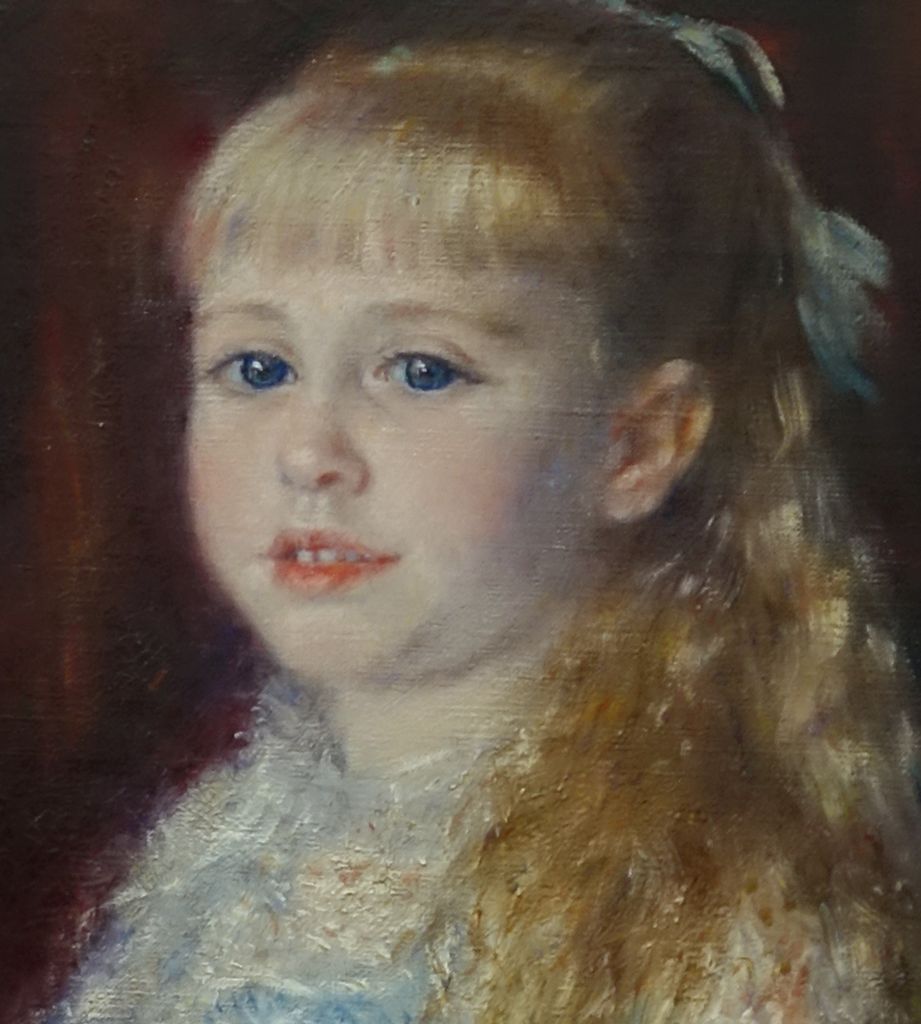
Elisabeth in blue
Elisabeth, age six, stands at right with a blue sash.
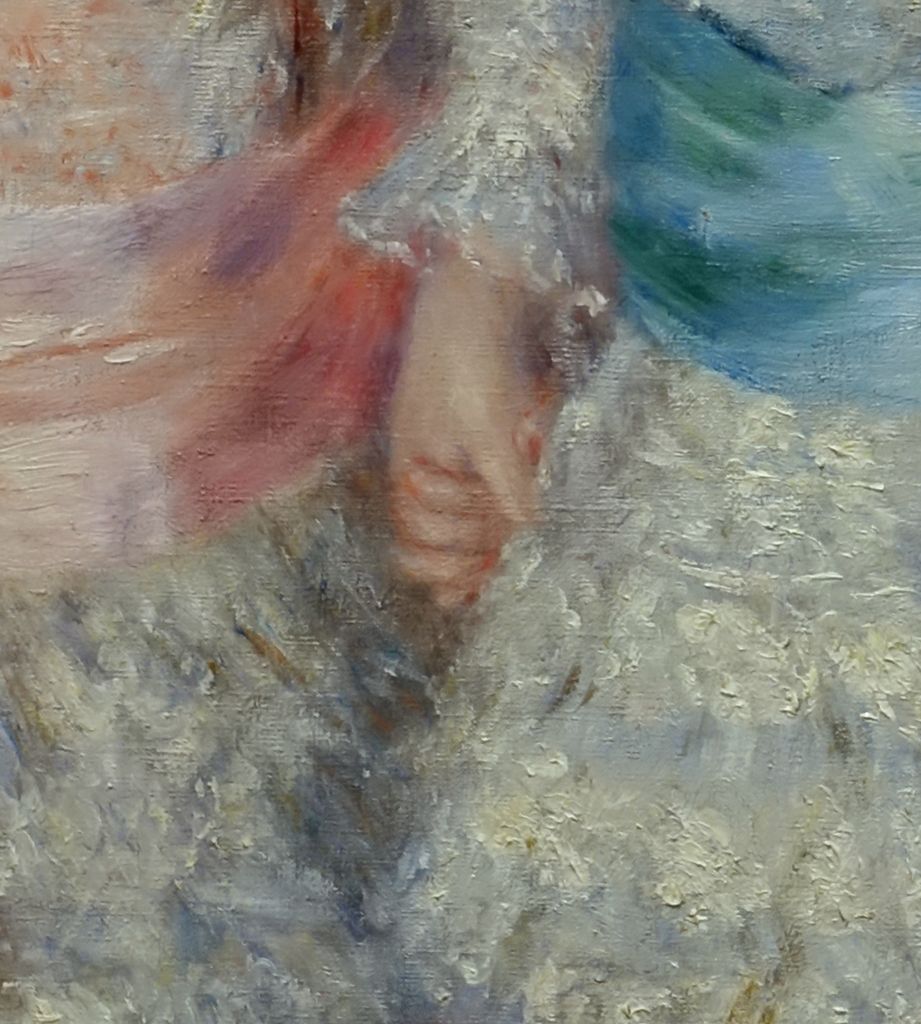
Joined hands
The sisters clasp hands near the centre of the composition.
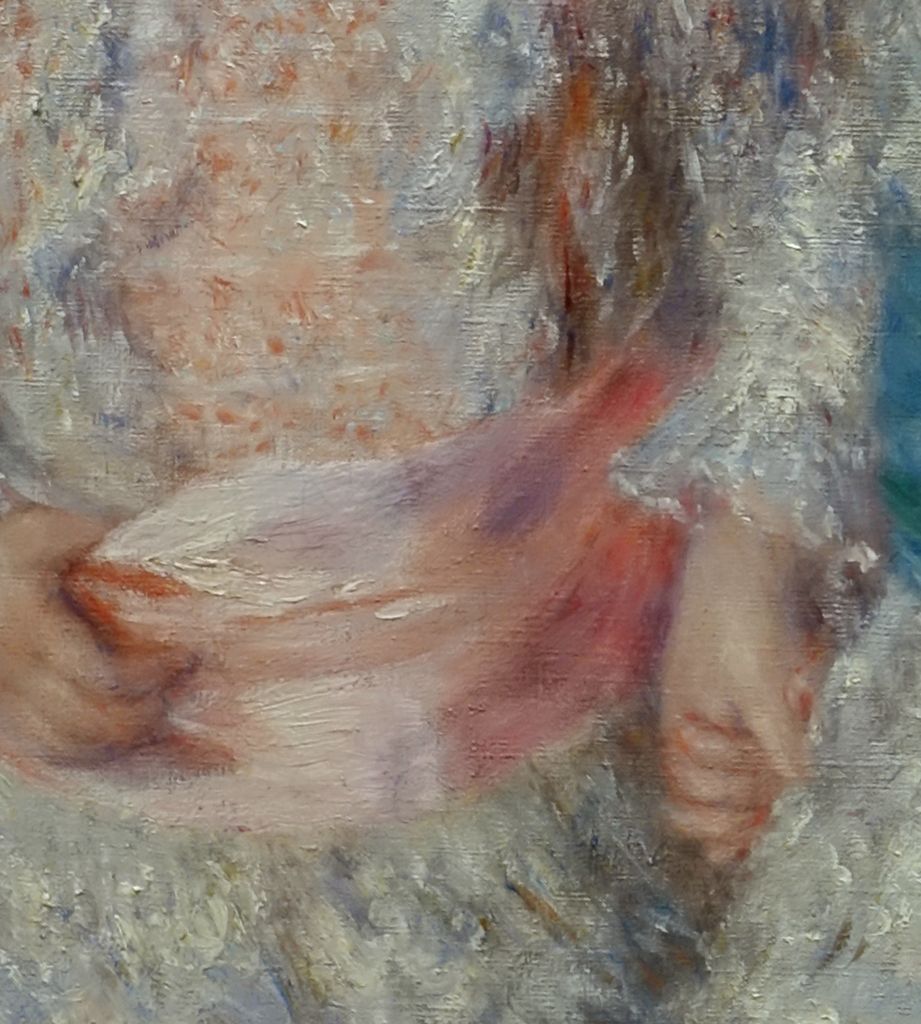
Pink sash and lace
Renoir varies pale lace with warm pink fabric in Alice’s dress.
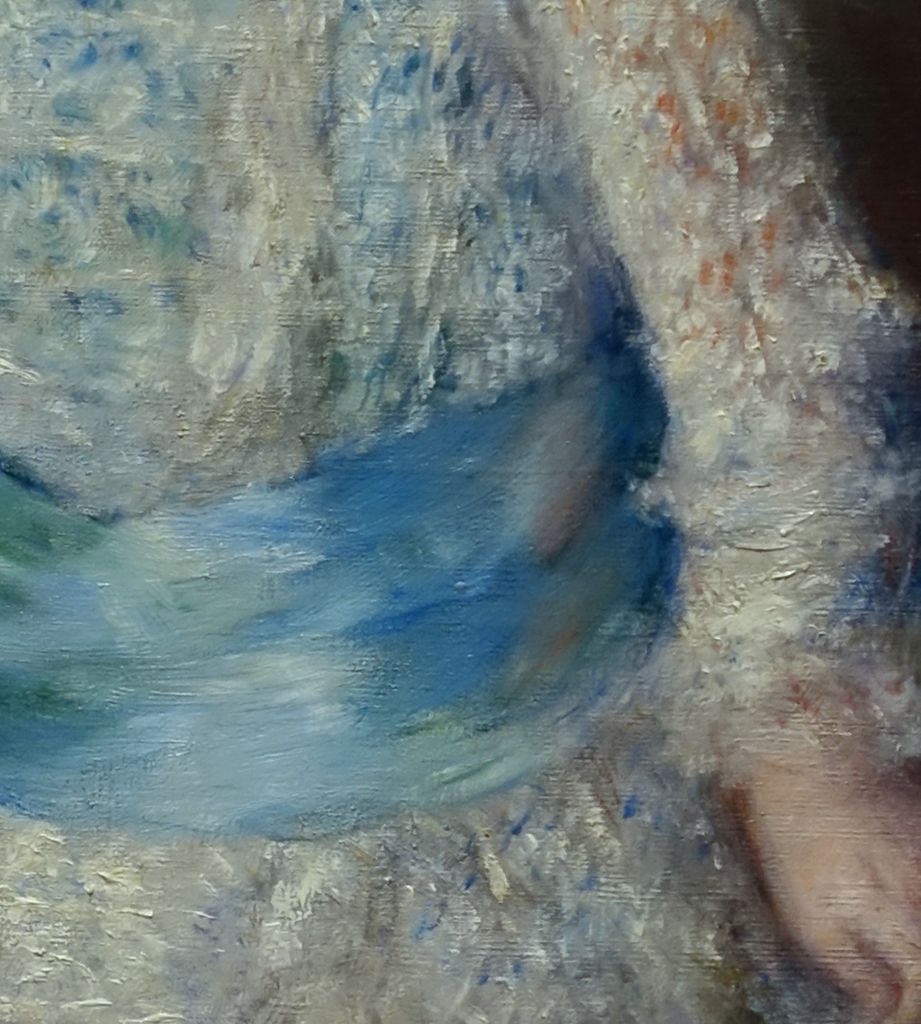
Blue sash and lace
The blue sash and light dress distinguish Elisabeth’s side of the pair.
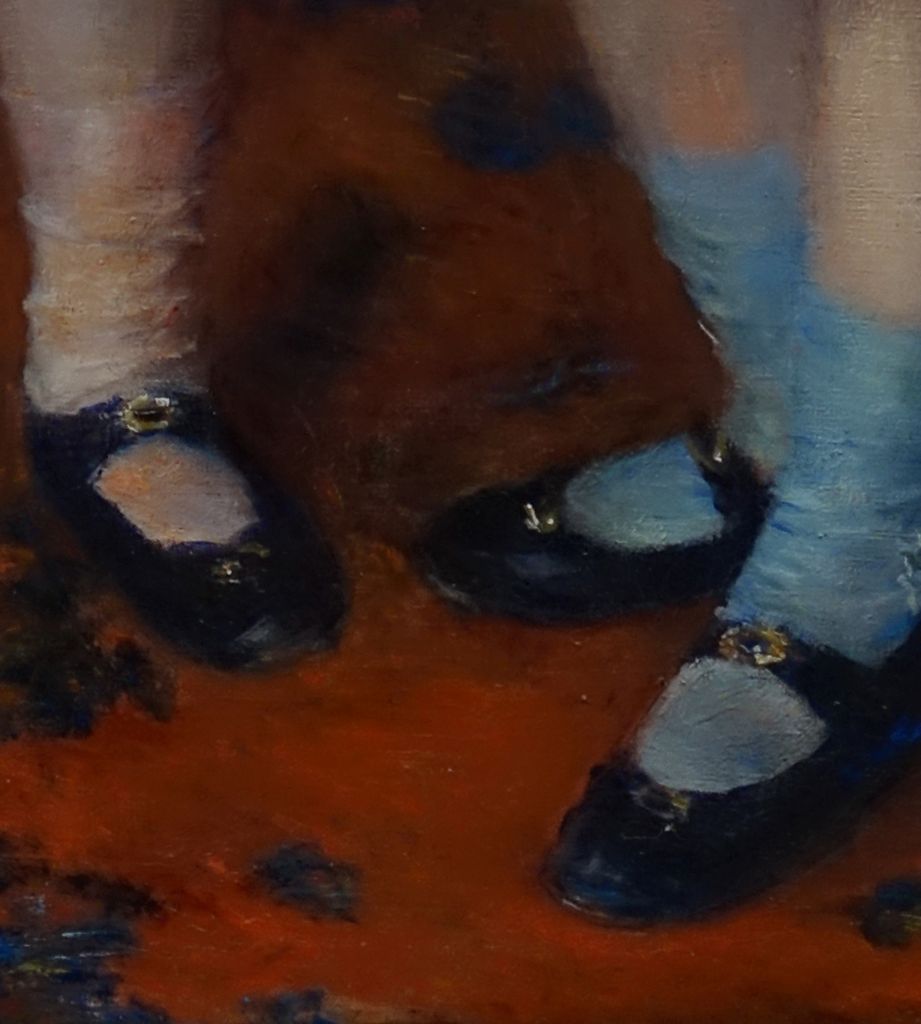
Shoes and stockings
The full-length format includes the children’s stockings and shoes.
Curtain and room
A dark curtain and warm interior make the pastel dresses stand forward.
Watch: Pierre-Auguste Renoir
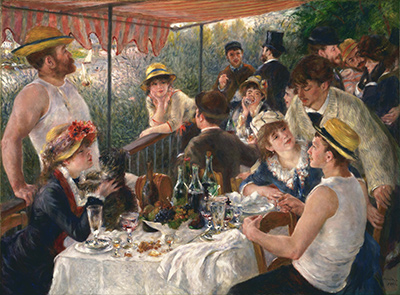
Explore a Montmartre dance, a gathering beside the Seine and the drawings behind Renoir’s paintings.
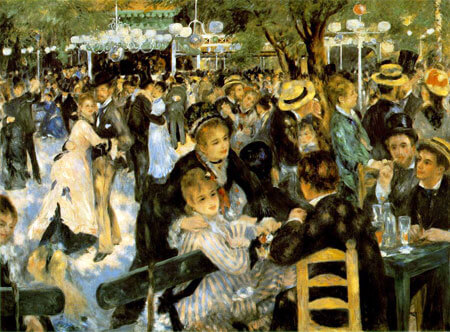
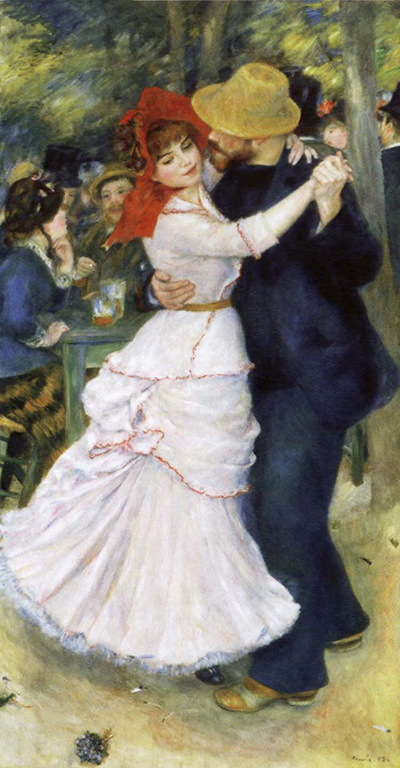
Renoir, Bal du moulin de la Galette
Dr. Beth Harris and Dr. Steven Zucker discuss Renoir’s 1876 Montmartre dance scene, its light and its crowds.
Watch on YouTubeRenoir artworks directory
Two sisters, one formal pose
The girls' matching dresses establish them as a pair. Their sashes, stockings and ribbons then separate them into pink and blue. Alice stands slightly behind and looks straight out; Elisabeth's taller figure turns just enough to make the arrangement less rigid. Their clasped hands are a hinge between the two bodies. MASP's catalogue describes the girls as reticent sitters, while noting the portrait's careful handling of faces, lace and satin. The handclasp is visible fact; any specific emotion we assign to it remains an interpretation. MASP catalogue essay. [1]
Renoir gave different surfaces different kinds of paint. The hair and sashes have smoother glints; the lace is built up in pale, broken marks. Against the heavy curtain, the girls' dresses almost seem to shine. The room's warm floor and dark background make the pastel pink and blue more vivid without turning the canvas into only a colour exercise. MASP catalogue essay. [1]
The tall format connects the work with a long tradition of standing portraits. MASP's curator compares its scale and finish to portraits by Van Dyck. This is a useful formal comparison rather than a claim that Renoir copied a single older painting. He had to make a commissioned family likeness that met expectations of dress and status while still giving the children presence as individuals. MASP catalogue essay. [1]
The girls' poses are not interchangeable. Alice's shoulders are a little lower, and she looks directly towards the viewer. Elisabeth turns her head and body slightly, with one hand held by her sister and the other resting near her skirt. That small difference keeps a carefully balanced double portrait from becoming a mirror image. Their hands join near the centre, where pink and blue sleeves meet. It is the quietest detail in a painting full of expensive fabric, yet it gives the sisters a relationship visible without any supplied anecdote.
The setting makes the light clothing especially prominent. A heavy curtain fills much of the background, while the reddish floor and dark furniture frame their legs. MASP's catalogue suggests an elegant family interior and notes the contrast between formal surroundings and the children's reticence. The painting does not identify every furnishing, and the room is not an invitation to reconstruct a specific party or conversation. It establishes the social world in which the commissioned portrait was made. MASP catalogue essay. [1]
Why pink and blue are not just decoration
The colour pairing is easy to remember because Renoir repeats it. Pink appears in Alice's sash, hair ribbon and stockings; blue travels through Elisabeth's sash, dress and stockings. These are not two solid blocks. White lace catches cool shadows and warm highlights, so the colours enter the fabric as pale variations. The dark curtain makes the dresses luminous, while the reddish floor keeps the lower half from seeming weightless.
MASP's curatorial text calls attention to the exceptional detailing of the dresses and the glimmer of satin. Its historical essay distinguishes smooth passages in hair, sashes and stockings from more raised touches in the lace and flounces. This difference in handling is visible even in a reproduction: the faces and hands read as carefully drawn, while the decorative surfaces break into many small marks. The title Pink and Blue points us toward two hues; the painting rewards a closer look at all the surfaces between them. MASP object and historical essays. [1]
The sisters' almost matching clothes also raise a question of individuality. The commission presented them together, and the painter gave them an unmistakably paired appearance. Yet their height, glance and posture remain distinct. A viewer can identify Alice and Elisabeth without guessing from the sash colours alone because MASP preserves the sitter record. The picture's design joins the two children while allowing each face to remain a separate likeness.
A family commission in 1881
Alice and Elisabeth were daughters of Louis Raphaël Cahen d’Anvers, a banker, and Louise Morpurgo. Renoir's connection to the family came through collector Charles Ephrussi, according to MASP's historical account. He had already painted their eldest daughter, Irène, in a separate portrait. For the two younger sisters, the family chose a joint image. Keeping the three children and the two canvases distinct avoids an easy naming error. MASP catalogue essay. [1]
The girls sat for several sessions before Renoir left for Algiers in early 1881. MASP cites a 4 March letter to Théodore Duret in which the artist was exhausted after completing their portrait and uncertain about its quality. That glimpse of his working experience contrasts with the finished picture's polished calm. It does not tell us how Alice or Elisabeth felt at every sitting. MASP catalogue essay. [1]
MASP's catalogue also reports an adult Alice later remembering that the boredom of posing was offset by pleasure in wearing the elegant lace dress. The recollection is quoted through later scholarship, not a surviving note from the five-year-old sitter. It offers a rare perspective on the sessions, but it should not be stretched into a claim that both girls enjoyed or disliked the sittings equally. The painter's letter and Alice's later memory tell different parts of the portrait's making. MASP historical essay. [1]
MASP's historical essay, citing Colin Bailey, places the sittings at the family's home at 66 Avenue Montaigne in Paris. The family did not move to the house at the corner of Rue Bassano and Rue Bizet until 1883–84. This distinction gives the portrait a more reliable setting than a generic reference to the Cahen d'Anvers household, while it still does not prove that every furnishing Renoir painted can be identified from the present image. MASP historical essay. [1]
The two Cahen portraits appeared at the 1881 Salon. MASP reports that the family apparently did not like the double portrait, placed it in servants' quarters and delayed payment. These details come through later historical accounts cited by the museum; they should not be made into a claim that the children themselves rejected it. The canvas later resurfaced with dealers Bernheim-Jeune. At their gallery around 1900, the colour-based title Pink and Blue became established. MASP historical essay. [1]
There is also a contemporary archival anchor for the Salon presentation. The Louvre catalogues an Easter Monday 1881 letter from Renoir to Théodore Duret that refers to showing the portrait of the young Cahen girls at the Salon. The Louvre's description supports the exhibition connection directly, although it does not provide a catalogue number or by itself establish how visitors responded. Louvre, Renoir letter A 3581. [2]
The reported dissatisfaction is striking because Renoir put so much attention into the children and their clothes. It does not prove a single reason the family may have preferred a different likeness. MASP cites later scholarship that reads the work's structure as relatively formal for Renoir, perhaps suited to a conventional commission. A critic's response at the Salon, the family's reported view and a present-day viewer's admiration are separate kinds of evidence. None should be substituted for the others. MASP historical essay. [1]
Their sister Irène's separate portrait
Renoir had painted the older Cahen d'Anvers daughter Irène in 1880. That single-sitter portrait is a different canvas, now in the Emil Bührle Collection on long-term loan at Kunsthaus Zürich, inventory BU 0090. Its holder records 65 × 54 cm, much smaller than MASP's tall double portrait. The two paintings belong to the same family commission history, but Irène is not one of the girls in Pink and Blue. Kunsthaus Zürich object dossier [3]; MASP historical essay. [1]

The comparison clarifies Renoir's choices. Irène is represented alone, with attention drawn to her face and hair against a quieter setting. Alice and Elisabeth stand full length in coordinated dresses and a richly furnished interior. One format concentrates a likeness; the other organizes two individual likenesses as a pair. It would be a mistake to borrow the Zürich picture's later ownership and restitution history for MASP's canvas. Each work has its own documented path after leaving the family.
Beyond the title
The popular title is memorable, but it can make the sisters seem like symbols of two colours rather than people. Alice lived until 1965, according to MASP's catalogue. Elisabeth's life ended in the Holocaust. MASP records that during a 1987 exhibition in Switzerland, her nephew Jean de Monbrison recognized her portrait and wrote to the museum. His account says she died in March 1944 on a train bound for Auschwitz. MASP gives her age as 69. The source is a family report preserved in the museum's catalogue; it should be presented as such, with care. MASP curatorial and historical essays. [1]
Renoir could not have known that future when he painted two children in formal dress. A close reading need not force their later lives into every brushstroke. It can, however, preserve their names and the history that a decorative nickname leaves out.
The painting entered MASP in 1952 with the credit line “Gift of the people of São Paulo.” Its position in a Brazilian public collection gives the portrait another history beyond the Paris household where it began. The museum's object page is the authority for its inventory number, size and credit. MASP object record. [1]
The museum's own writing shows why the portrait acquired a life beyond the original commission. MASP calls it one of the most familiar works in its collection. Visitors may first know it by colour, but the institution also publishes the sisters' names, the circumstances of the sitting, the painting's later title and the report about Elisabeth. Those layers let the work remain a beloved image of childhood without erasing the children as historical people. MASP object page. [1]
Looking again
First locate the sisters' joined hands. Then follow the pink and blue sashes up to their faces and the ribbons in their hair. The dresses announce family wealth and formal portraiture; the eyes and handclasp return attention to Alice and Elisabeth themselves. The painting can be admired for Renoir's handling of lace and light while still keeping the sitters' names in view.
Questions about Pink and Blue
Alice, the younger sister, stands at left in pink. Elisabeth, the older sister, stands at right in blue. MASP identifies both in its catalogue.
No. Irène was their eldest sister and sat for a different portrait by Renoir. Pink and Blue depicts Alice and Elisabeth together.
The title refers to the girls' differently coloured sashes and dresses. MASP traces the popular colour title to a Bernheim-Jeune gallery showing around 1900.
At MASP in São Paulo, Brazil, inventory MASP.00099. Check the museum's current record for display information.
Discussion
Look closely at Pink and Blue and use the questions below to compare what you see with the documented history.
Reader Insights
How do the two girls’ dresses and poses distinguish them?
MASP identifies Alice in pink and Elisabeth in blue.
How does later family history affect, but not replace, a reading of the 1881 portrait?
Join the Conversation
Share a close observation or a source-backed question about Pink and Blue. The prompts above are starting points for discussion.
References
- MASP, Pink and Blue – The Cahen d’Anvers Girls, MASP.00099, object data and curatorial/historical essays View source.
- Louvre, Renoir letter to Théodore Duret, Easter Monday 1881, A 3581, archival description referring to the Cahen girls portrait at the Salon View source.
- Kunsthaus Zürich, Irène Cahen d'Anvers, BU 0090, object dossier for the separate portrait of the sisters' elder sibling View source.
- Whole-work photograph: Daderot / Wikimedia Commons, CC0. The image shown here crops its visible frame; it is not the separately credited MASP website photograph View source.