by Tom Gurney
Tom Gurney BSc (Hons) is an art history expert with over 20 years experience
Published on June 19, 2020 / Updated on October 2, 2026
Email: tomgurney1@gmail.com / Phone: +44 7429 011000
Renoir brings a sunlit rocky rise close to the front of this small canvas. A dark tree fills the centre; behind it, pale stone climbs at left and trails away under a blue-lavender sky. The view is compressed and steep, with little open ground to lead us inward. The painting matches Rochers de l’Estaque, a signed and dated 1882 work documented by Christie’s and held privately at the time of its catalogue listing. It is a separate object from Renoir’s larger Rocky Crags at L’Estaque in Boston. Christie’s object record and image. [1]
The two Renoir paintings came from the same period at L’Estaque, near Marseille, where Renoir encountered Paul Cézanne in January 1882. Similar titles can easily blur them together. Christie’s explicitly describes its smaller picture as a closer view of a motif in the upper-left of the Boston painting. In the Boston canvas, a path opens a broad ravine between pale cliffs. Here the rocky rise, foliage and sky occupy almost the whole surface. Their relationship is a reason to compare them, not to combine their measurements, owners or histories. Christie’s comparative essay [1]; MFA Boston object details. [2]
At a glance
- ArtistPierre-Auguste Renoir
- Catalogue titleRochers de l’Estaque
- Date and inscription1882; signed and dated “Renoir 82” at lower left
- Medium and sizeOil on canvas, 32.3 × 40.3 cm
- Catalogue raisonnéDauberville 775; Fezzi 509 in the 1972 listing
- CollectionPrivate ownership recorded in Christie’s catalogue; subsequent transfers unconfirmed
Watch: Pierre-Auguste Renoir
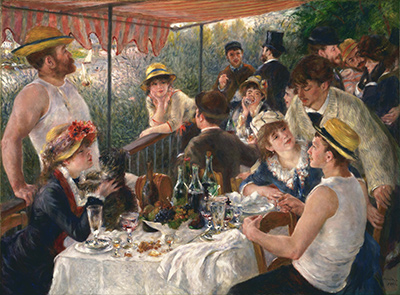
Explore a Montmartre dance, a gathering beside the Seine and the drawings behind Renoir’s paintings.
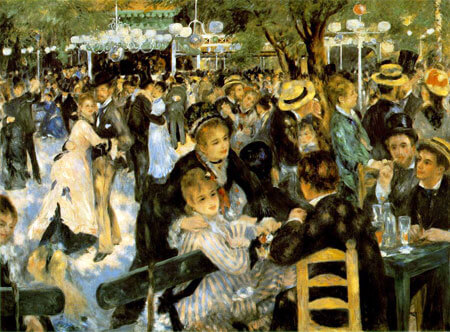
Renoir, Bal du moulin de la Galette
Dr. Beth Harris and Dr. Steven Zucker discuss Renoir’s 1876 Montmartre dance scene, its light and its crowds.
Watch on YouTubeChristie’s gives both the signature and the compact measurements. The Boston painting measures 66.4 × 81.0 cm and is catalogued as Dauberville 774. Those identifiers make it possible to follow each picture through scholarship despite the recurring French words rochers and Estaque. The painting’s current holder is less certain than the object’s identity: an auction record documents owners up to its catalogue date but does not guarantee a permanent public location. Christie’s details, literature and provenance. [1]
A rock face under a moving sky
The highest ridge starts near the upper-left corner and falls in irregular steps toward the right. Light catches some of the exposed stone in cream, yellow and pale pink. Cooler blue and violet strokes occupy fissures and shadows. Renoir does not outline every edge before filling it with colour. Texture and changing tone make rock, plants and air meet on the surface.
The tree at the centre is the painting’s strongest dark mass. Its green crown covers part of the ridge, and its thin trunk reaches into the orange and cream grasses below. At right, another patch of foliage pushes against the slope. These plants soften the geology without concealing it. They also give a scale to the rise: we understand it as a hillside seen from nearby, rather than an abstract pattern of coloured stone.
Above the rocks, the sky has broad diagonal strokes of blue and lavender. Their direction contrasts with the broken marks of foliage. The sky opens a large calm space on the upper right, but its surface is still active. Christie’s calls attention to parallel strokes there and in the foreground when discussing Renoir’s engagement with Cézanne’s methods. The visible marks support the comparison; they do not require us to assign every individual stroke to Cézanne’s influence. Christie’s lot essay. [1]
Renoir’s visit to Cézanne
Renoir arrived at L’Estaque in January 1882 during his return from Italy. Christie’s reports that he stayed at the Hôtel des Bains and wrote enthusiastically about the light and rocky countryside. His letter to dealer Paul Durand-Ruel says he had run into Cézanne and that they intended to work together. The correspondence supports the artists’ meeting and shared landscape interests; it does not identify the precise hours spent on this particular small canvas. Christie’s essay and cited letters. [1]
Cézanne had returned repeatedly to L’Estaque, where rocky paths, a viaduct and views toward the sea gave him different subjects. The Museum of Fine Arts, Houston discusses the complicated dating of Cézanne’s related ravine painting and the documentary evidence for the 1882 meeting. Some scholars have dated that Cézanne work several years earlier on stylistic grounds. Renoir’s own signed year is secure; the link between their paintings should be expressed as a documented meeting and visual comparison, with the disputed chronology acknowledged. MFA Houston scholarly catalogue. [3]
The L’Estaque terrain appears in more than one Cézanne composition. The Allen Memorial Art Museum traces the site of its Cézanne Viaduct at L’Estaque and relates it to Renoir’s broader Boston view. That research helps locate the encounter in a real landscape. This smaller Renoir crop then shows how differently he could frame a feature of it: he closes the view around a rock face and tree, leaving little sign of a path or distant destination. Allen Memorial Art Museum research. [4]
A small canvas beside a large one
Christie’s describes this work and the Boston painting as two views made during Renoir’s L’Estaque stay. Its essay says the small motif corresponds to the upper-left portion of the larger composition. This is a useful visual guide. In the Boston work, the ridges spread across an 81 cm width, with a path and trees anchoring the foreground. In this 40.3 cm canvas, Renoir pushes close to one rise, and the central tree interrupts the meeting of stone and sky. Christie’s comparison [1]; MFA Boston image and measurements. [2]
The word “study” can suggest that one picture was simply preparation for the other. Christie’s identifies related motifs but does not establish a strict sequence of execution. The small canvas is signed and dated, with its own long ownership and exhibition record. Its close viewpoint is complete as a way to experience the hillside, even if Renoir also made a wider treatment nearby.
A documented route through collections
The Christie’s provenance places the painting with Galerie Durand-Ruel in Paris by September 1886, then in the dealer’s New York gallery by April 1888. Catholina Lambert bought it in 1892. At Lambert’s 1916 sale, Durand-Ruel reacquired it; C. J. Coté bought it in 1919. Later auction records in 1989, 1996 and 2016 mark further changes of ownership. The catalogue also lists private owners after the 2016 sale, without making their identities public. Christie’s provenance. [1]
The work appeared in a National Academy of Design exhibition in New York in 1887 and in later Renoir exhibitions, including the 2007 Renoir Landscapes exhibition at London’s National Gallery. These are Christie’s documented exhibition entries for this small painting. They should not be transferred to the Boston canvas merely because the works share a place and year. Christie’s exhibition history. [1]
Christie’s object details also cite the 2009 Dauberville catalogue raisonné, no. 775. The auction house says the painting is expected in a forthcoming Wildenstein Plattner Institute digital catalogue. A forthcoming entry is not yet evidence of its published contents. For now, the signed 1882 painting, the dimensions and the recorded provenance are the concrete identifiers available from the lot catalogue. Christie’s literature and catalogue note. [1]
Looking again
Begin at the bright top of the rocky rise, then let the ridge descend behind the dark central tree. Follow the tree’s trunk toward the warm grasses and return through the cool shadows in the stone. The painting’s small scale keeps those changes close together. Renoir turns a hillside he shared with Cézanne into an intimate study of light, foliage and rugged form.
Renoir artworks directory
Questions about Rocks at L’Estaque
The Christie’s catalogue records a lower-left signature and date: “Renoir 82.” Renoir was at L’Estaque in January 1882.
No. The Boston canvas is about twice as wide and shows a broad ravine. This 32.3 × 40.3 cm painting gives a close view of a rocky rise and trees.
Renoir wrote that he had met Cézanne at L’Estaque and expected to work with him. The surviving paintings invite comparison, but the letter does not prove a simultaneous sitting for this exact canvas.
Christie’s catalogued it from private ownership. Its historical provenance is recorded there, but a later sale or transfer could change the current holder.
Discussion
What do you notice when you return to Renoir’s Rocks at L’Estaque?
How do the dark central tree and pale rocky rise divide the close view?
Reader Insights
How do the dark central tree and pale rocky rise divide the close view?
Christie’s identifies this signed 1882 private canvas as Dauberville 775, separate from MFA Boston’s larger Dauberville 774.
Does a shared motif prove which Renoir canvas was painted first?
Join the Conversation
Share a close observation or a source-backed question about Renoir’s Rocks at L’Estaque.
References
- Christie’s, Rochers de l’Estaque: exact-object image, inscription, measurements, provenance, exhibitions and comparison with the Boston canvas View source.
- MFA Boston, Rocky Crags at L’Estaque via Google Arts & Culture: separate, larger 1882 painting View source.
- Museum of Fine Arts, Museum of Fine Arts, Houston, Bottom of the Ravine, L’Estaque View source.
- Museum of Fine Arts, Allen Memorial Art Museum, Viaduct at L’Estaque View source.
- Image: the original 400 × 317 legacy reproduction, retained under the owner-declared public-domain legacy-image policy. Its composition matches the illustrated Christie’s catalogue entry.