by Tom Gurney
Tom Gurney BSc (Hons) is an art history expert with over 20 years experience
Published on June 19, 2020 / Updated on October 2, 2026
Email: tomgurney1@gmail.com / Phone: +44 7429 011000
A loose bouquet rises from a brown vase on a red-edged table. White and pink roses mingle with red flowers and dark leaves; a folded fan reaches diagonally in from the lower left. The picture on this page matches the illustrated Sotheby’s 2024 lot Bouquet de fleurs à l’éventail. [1] The French title means a bouquet of flowers with a fan. The route’s familiar Roses in a Vase is also documented as an earlier exhibition title for this exact canvas.
Sotheby’s catalogues the work as a signed 1872 oil on canvas, 67 × 43.9 cm. It records the signature “A. Renoir.” at lower right, where a dark inscription is visible in the local image. The 2024 sale record supplies a substantial ownership and exhibition history, but it does not establish where the painting is held now. The article therefore treats its historical labels and documented owners as dated evidence, not as a current collection claim.
Contents
- The painting at a glance
- A bouquet built from colour
- The vase and its setting
- Why the titles differ
- A documented ownership path
- The young Renoir and flower painting
- Looking again
Watch: Pierre-Auguste Renoir
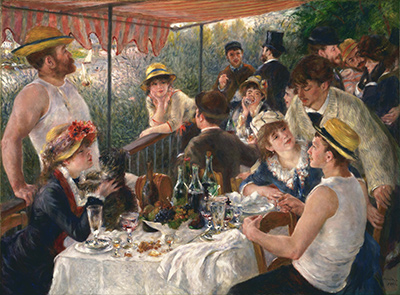
Explore a Montmartre dance, a gathering beside the Seine and the drawings behind Renoir’s paintings.
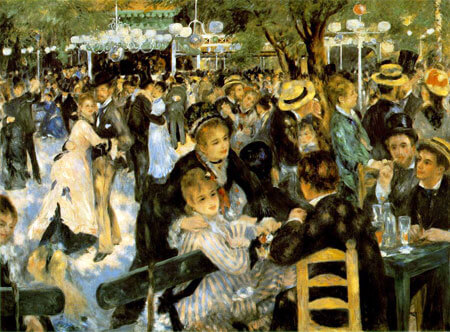
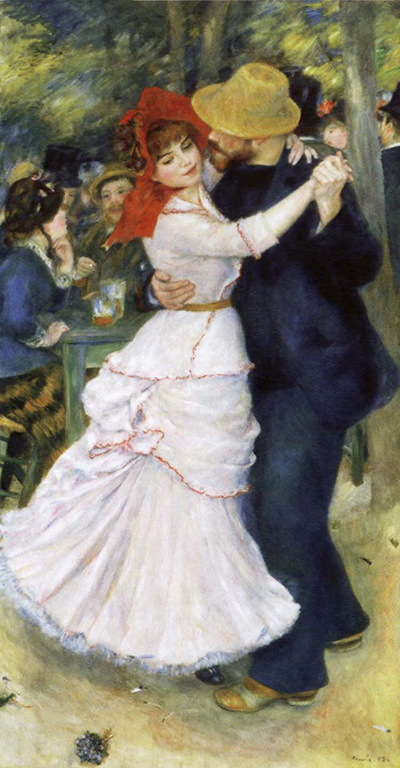
Renoir, Bal du moulin de la Galette
Dr. Beth Harris and Dr. Steven Zucker discuss Renoir’s 1876 Montmartre dance scene, its light and its crowds.
Watch on YouTubeAt a glance
- ArtistPierre-Auguste Renoir (1841–1919)
- Current auction titleBouquet de fleurs à l’éventail
- Established local titleRoses in a Vase
- Date1872 in Sotheby’s 2024 catalogue
- MediumOil on canvas
- Size67 × 43.9 cm
- Signature“A. Renoir.”, lower right
- Present ownerNot established by the 2024 sale record
The unusual combination of bouquet, fan, rounded brown vase, red table edge and right-hand signature makes the image match specific. Many Renoir flower paintings have roses or vases; those common subjects alone would not identify this object.
A bouquet built from colour
The flowers fill nearly all the upper half of the narrow canvas. Renoir gives the largest pale rose a central place just above the vase, but it does not hold the entire arrangement still. Red and white petals pull the eye upward and outward. A dark blue-purple flower near the upper right changes the temperature of the bouquet and keeps it from reading as one mass of pink.
Some blooms are described by a few broad strokes; others have curling pale edges that separate petal from shadow. The foliage is nearly black in places. It gives the light flowers a surface to shine against, while the red touches leap forward from the quieter background. The painting does not ask the viewer to identify every species in the vase. Sotheby’s title and the visible fan are firmer object identifiers than an exhaustive floral list drawn from a small reproduction.
The stems and flowers spread unevenly. One spray leans left, another reaches right, and upright red flowers push beyond the dark centre. This asymmetry gives the bouquet movement without making it look accidental. Renoir has arranged colour clusters across the picture: pale flowers around the middle, warm accents at the outside, and dark leaves binding them together.
The vase and its setting
The vessel is rounded at the base and narrows sharply to a short neck. Brown and ochre strokes make it feel substantial beneath the crowded bouquet. A small blue reflection or touch on its front breaks the warm surface. Its shape also repeats, in a compact form, the swelling outline of the flowers above it.
The table is only partly visible. A strong red band runs behind the vase, and lighter cloth or paper appears across the lower right. Renoir keeps this supporting space simple. It gives the flowers a location while leaving most attention on their brushwork. The pale wall behind the bouquet is similarly restrained, though it carries subtle variations of cream, grey and green rather than one flat tone.
The fan is easy to miss when the eye starts with the roses. Its folded leaves enter from the lower left and point toward the vase. Their angled lines cut across the otherwise vertical arrangement. The fan is not merely an accessory named by Sotheby’s French title: it changes how the bottom of the canvas works. It leads the viewer from the edge toward the vessel and supplies a crisp counter-rhythm to the soft petals.
Why the titles differ
Sotheby’s exhibition list shows this same picture under several names. A 1954 Wildenstein flower exhibition called it Roses in a Vase; a 1965 show used Fleurs dans un Vase; a 1968 London listing used Roses dans un vase; and later records again used the English rose title. The 2024 sale title, Bouquet de fleurs à l’éventail, calls attention to the fan as well as the flowers.
These changes do not require different paintings. The consistent image, dimensions and chain of exhibitions connect the labels to this one object. A title may shift as cataloguers choose which visible feature to emphasise. Here, “roses” focuses on a recognisable flower, while “with a fan” distinguishes the composition from Renoir’s many other bouquets.
The title can also mislead if it suggests the bouquet contains only roses. The image includes differently shaped red and dark blooms. It is safest to describe what can be seen and retain the documented title history. No named recipient, occasion or intended symbolism is supplied in the auction record.
A documented ownership path
Sotheby’s published provenance begins with Henri Baderou in Paris. Wildenstein & Co. acquired the painting from him in 1950 and sold it to Sita Devi, Maharanee de Baroda, in 1956. The record shows Wildenstein buying it back in 1958, selling it to Morton Downey in 1962, and reacquiring it in 1967. By 1974 it was in a private collection in England.
The later chain includes another Wildenstein entry, James Kessler in Florida, who acquired it in 1983, and Sam Porter Fine Arts in New York. The 2024 catalogue says the seller or prior owner acquired it from Sam Porter Fine Arts in June 1997. Each of these is a recorded waypoint. The catalogue does not prove that the painting remained with the same owner after the June 2024 auction.
Sotheby’s further states that the painting had an Attestation of Inclusion from the Wildenstein Institute and was to be included in a forthcoming Renoir digital catalogue raisonné. It also reported forthcoming inclusion in a supplement to the Dauberville catalogue. Those are the auction house’s documented catalogue statements; this article does not convert them into a claim that either later publication has now appeared.
The young Renoir and flower painting
An 1872 date makes this an early Renoir floral still life, before his best-known later bouquets. The National Gallery of Art’s Flowers in a Vase [2] is a different Renoir painting dated about 1866, with wildflowers in a red clay jug. Together the two works show that flowers interested him well before his mature period, but the NGA canvas cannot supply this picture’s dimensions, provenance or vase description.
The Art Institute of Chicago’s scholarly entry for Renoir’s 1857 Vase of Flowers drawing [3] offers an even earlier point in his practice. It concerns a graphite drawing by the teenage artist, not the signed oil on this route. The comparison is useful for chronology: flowers were a subject he revisited across media and decades. This page’s close reading stays with the 1872 painting and its unusually prominent fan.
Looking at the brushwork, the flowers do not appear carefully enclosed by contour lines. Petal and shadow often meet as changes of colour. Yet the vase’s weight, the fan’s angle and the table’s red band give the whole composition a clear structure. Renoir is already balancing freedom of touch with placement of objects. The painting is more than a generic “pretty bouquet” because those specific relationships make the eye move.
Looking again
Begin with the fan at the lower left. Follow its diagonal to the vase, then let the pale rose above it take your eye into the darker foliage. Move through the red sprays and the purple-blue flower before returning to the signature at lower right. This circuit reveals how much of the picture lies outside its shortest English title.
Roses in a Vase remains a useful local name because it has a documented exhibition history. Sotheby’s Bouquet de fleurs à l’éventail restores the fan to view. Both names point to the same 1872 canvas, whose colour and carefully placed objects reward a slower look.
Renoir artworks directory
Questions about Roses in a Vase
No. Sotheby’s catalogued this exact canvas as Bouquet de fleurs à l’éventail in 2024 and lists earlier exhibitions that called it Roses in a Vase, Roses dans un vase and Fleurs dans un Vase.
The 2024 Sotheby’s entry dates it to 1872 and records the artist’s signature at lower right.
It measures 67 × 43.9 cm, according to the Sotheby’s lot description.
It is a folded fan entering from the lower left. Sotheby’s current French title includes à l’éventail, “with a fan.”
The 2024 sale entry documents owners and exhibitions through the auction, but it does not verify a present owner or display location. The current location should be checked before a visit or a collection claim.
Discussion
What do you notice when you return to this bouquet and fan?
How does the folded fan lead your eye toward the vase?
Reader Insights
How does the folded fan lead your eye toward the vase?
Sotheby’s catalogued this signed oil as 1872, 67 × 43.9 cm.
How do the dark leaves change the pale flowers?
Join the Conversation
Share a close observation or a source-backed question about Renoir’s floral still life.
References
- Sotheby’s, Bouquet de fleurs à l’éventail, 2024 lot 50: exact illustrated match, 1872 date, signature, medium, size, provenance, exhibition titles and catalogue status View source.
- National Gallery of Art, Flowers in a Vase: separate c. 1866 Renoir flower painting used only for early-career comparison View source.
- Art Institute of Chicago, Vase of Flowers, 1857: separate drawing used only for longer chronology of Renoir’s flower subjects View source.