by Tom Gurney
Tom Gurney BSc (Hons) is an art history expert with over 20 years experience
Published on June 19, 2020 / Updated on October 2, 2026
Email: tomgurney1@gmail.com / Phone: +44 7429 011000
A large cream sail crosses the upper edge of Renoir’s Sailboats at Argenteuil. One person sits in the boat and another stands at the end of a narrow jetty. Smaller sails, a moored craft, trees and a few ducks fill the rest of the river view. Painted in the summer of 1874, this is a scene of leisure boating at Argenteuil, a town on the Seine outside Paris. Its people are too small to support the story invented by the older page about a sailor returning to his family after work.
The National Gallery of Art’s exhibition catalogue [1] identifies the exact canvas, then compares it with Claude Monet’s view made from the same spot. The local image matches the catalogue’s Renoir composition: the tall sail at left, standing figure on the jetty, boat at anchor on the right and ducks along the bottom. A second Renoir river painting, Regatta at Argenteuil, is held by the National Gallery of Art itself; its different image and accession record must not be transferred to this page.
Contents
- The work at a glance
- Reading the crowded river scene
- Two painters at the same viewpoint
- Argenteuil and the summer of 1874
- The original in Portland, Oregon
Watch: Pierre-Auguste Renoir
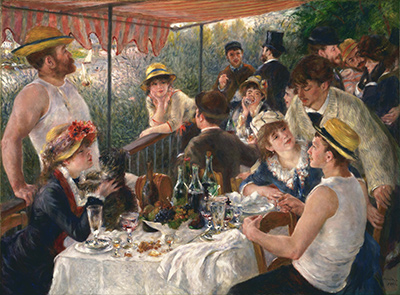
Explore a Montmartre dance, a gathering beside the Seine and the drawings behind Renoir’s paintings.
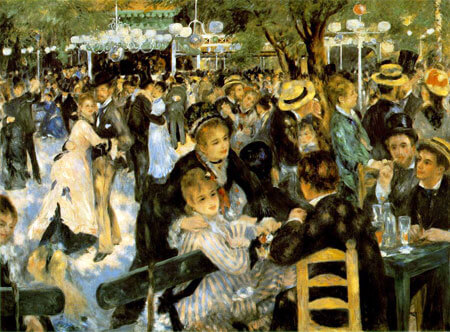
Renoir, Bal du moulin de la Galette
Dr. Beth Harris and Dr. Steven Zucker discuss Renoir’s 1876 Montmartre dance scene, its light and its crowds.
Watch on YouTubeAt a glance
- ArtistPierre-Auguste Renoir (1841–1919)
- Published titleSailboats at Argenteuil; also recorded by Portland as The Seine at Argenteuil
- Date1874
- MediumOil on canvas
- Size51 × 65 cm, National Gallery of Art catalogue
- CollectionPortland Art Museum, Oregon, accession 35.26
- CreditBequest of Winslow B. Ayer
The National Gallery of Art’s 2000 exhibition publication gives the painting’s date, dimensions, location and credit. Portland Art Museum’s own collection document [2] names the work The Seine at Argenteuil and lists accession 35.26 among Ayer’s gifts. Both refer to the museum in Portland, Oregon. Some image databases confuse it with the separately named Portland Museum of Art in Maine; the owner’s document resolves that location error.
Reading the crowded river scene
The foreground sail is a large near-white shape, but it does not simplify the painting. Its mast leans slightly, a thin spar projects to the right, rigging crosses the canvas, and the jetty meets the boat at an oblique angle. A seated person in a reddish garment and a standing person in dark clothing provide a human scale. The painting does not identify them by name or establish their relationship.
Behind the main boat, smaller craft are spaced across the water. The moored boat to the right adds a darker horizontal form beneath a bare mast. Renoir’s background trees do not make a flat screen; their heights rise and fall, allowing glimpses of a pale building and a bridge towards the right. There is activity across the whole surface, from the ducks low in the picture to the distant sails.
The river is painted with broken patches of blue, violet, grey and warm reflected colour. The main sail’s reflection is scattered rather than a smooth mirror shape. That movement prevents the foreground boat from feeling fixed like an object on a shelf. Grass at the lower right also reminds us that the painter’s viewpoint is on the bank, looking across the water and into the recreation area.
This is not a sea scene or a generic picture of traders moving goods. Argenteuil was a Seine town with both work and leisure on its banks. The boats in this particular composition are sailboats, and the National Gallery’s catalogue [3] discusses them as part of the modern leisure setting that drew the painters there. The visible canvas does not establish the occupations, thoughts or destination of the two people nearest us.
Two painters at the same viewpoint
Renoir’s canvas has an unusually close companion: Monet’s Sailboats at Argenteuil, also dated 1874. In the NGA exhibition catalogue, Paul Hayes Tucker places the two paintings side by side and argues that they were made during the same summer, probably on the same days and from the same spot. “Probably” matters here: the close agreement of viewpoint is strong evidence, but the exact session is not documented to the hour.
The paintings share a large foreground sailboat, riverbank viewpoint, distant trees and sunny water. They differ in the details that identify each work. Tucker notes that Renoir includes more sailboats, including one at anchor; Monet includes two sculls absent from Renoir’s picture. A white house appears among Renoir’s far-bank trees but not in Monet’s. Renoir’s dock emerges from grass, and his standing figure is silhouetted against the small sail; Monet positions a figure aboard the boat.
The ducks offer a surprisingly useful check. Both painters include four, but Tucker describes Renoir’s as two white and two brown, with one separated from the others. Monet’s four are white and organised in pairs. Such small features are better evidence for matching reproductions than an English title shared by two artists.
Tucker also compares the paintings’ handling of reflection and structure. Renoir’s broken sail reflections and irregular tree line make a busy, intertwined surface. Monet’s reflections and background forms are more controlled. These are the catalogue author’s comparative readings, supported by visible differences, rather than a ranking of one canvas above the other. The point is that painting together did not erase the artists’ distinct choices.
Argenteuil and the summer of 1874
The National Gallery of Art’s publication overview [1] describes Argenteuil as a working town a short train journey from Paris, where Monet settled in 1871 and where Renoir, Manet, Sisley, Boudin and Caillebotte worked at different times. Its boating basin and accessible riverbanks supplied a modern subject: people used the Seine for pleasure in a place that was also connected to the city and its commerce.
The year 1874 was also the year of the first Impressionist exhibition in Paris. That broader chronology helps situate the picture’s open-air subject and lively surface, but it does not mean this canvas was shown in that exhibition. The evidence used here identifies the summer painting and its later display in the NGA’s 2000 Argenteuil exhibition; it does not document a first public showing in 1874.
Renoir’s emphasis falls on a moment of ordinary activity. The sail catches light, the river changes colour around each boat, and the figures are absorbed in the setting rather than posed as named sitters. The older page’s description of an “evening” and a man saying farewell to a friend cannot be read from the image or the published catalogue. Bright warm light does not by itself tell us an exact hour.
The original in Portland, Oregon
This painting entered the Portland Art Museum in Oregon through the Winslow B. Ayer bequest. The museum’s 2021 collection document names it The Seine at Argenteuil and assigns 35.26. The National Gallery’s catalogue uses Sailboats at Argenteuil and records the same Oregon museum and bequest, with measurements of 51 × 65 cm. The alternative titles describe one object; they are not two separate Renoir sailboat paintings.
An accession and museum credit establish the collection, but they do not guarantee that a work is on a gallery wall on a particular day. For a visit, the museum’s current display information should be checked. The location should not be confused with the Portland Museum of Art in Maine, nor with the National Gallery of Art’s own Regatta at Argenteuil [4], another Renoir canvas of 1874 with a different composition and provenance.
The Portland view is especially valuable because its Monet companion lets us see painting as a set of choices rather than a photographic record. Two artists could look at the same boats from almost the same place and give different weight to figures, reflections, rigging, grass and distant shore. Renoir’s canvas keeps those details in lively competition with its large bright sail.
Renoir artworks directory
Questions about Sailboats at Argenteuil
The National Gallery of Art catalogue dates it to the summer of 1874.
It belongs to the Portland Art Museum in Oregon, accession 35.26, through the Winslow B. Ayer bequest. Current gallery display should be checked with the museum.
Yes. Monet made a separate Sailboats at Argenteuil in 1874 from the same viewpoint. The boats, figures, ducks and handling of reflections differ.
No. The National Gallery of Art holds another 1874 Renoir river canvas titled Regatta at Argenteuil. This page concerns the Portland painting with the large foreground sail and jetty.
The available catalogue does not identify them. The picture shows one seated in the boat and another standing at the jetty, without evidence for their names or personal story.
Discussion
What do you notice when you return to Sailboats at Argenteuil?
How do the rigging and jetty shape the scene?
Reader Insights
How do the rigging and jetty shape the scene?
The National Gallery of Art records the Portland canvas as an 1874 oil, 51 × 65 cm.
What changes when you compare Renoir’s boats with Monet’s view?
Join the Conversation
Share a close observation or a source-backed question about Renoir’s Argenteuil view.
References
- National Gallery of Art, Paul Hayes Tucker, The Impressionists at Argenteuil, especially catalogue entries 32–33, pp. 122–24: date, dimensions, exact image and comparison with Monet View source.
- Portland Art Museum, European art collection document: owner, alternate title, accession 35.26 and Ayer bequest View source.
- National Gallery’s catalogue View source.
- National Gallery of Art, Regatta at Argenteuil: separate Renoir painting used only to prevent title and object confusion View source.