by Tom Gurney
Tom Gurney BSc (Hons) is an art history expert with over 20 years experience
Published on June 19, 2020 / Updated on October 2, 2026
Email: tomgurney1@gmail.com / Phone: +44 7429 011000
A dark-haired man faces us against a subdued ground. His beard is untidy, but his striped collar and dark tie are carefully dressed. Short, broken strokes make the face seem alert and restless. This is Pierre-Auguste Renoir's Self-Portrait, dated circa 1875 by the Clark Art Institute. The older site route calls it Self Portrait II. That numbering is local to this website: the painting is the earlier of the two Renoir self-portraits in the Clark's collection. Clark catalogue, no. 266. [1]
At a glance
- ArtistPierre-Auguste Renoir
- Owner titleSelf-Portrait
- DateCirca 1875
- Medium and sizeOil on canvas, 39.1 × 31.6 cm
- CollectionClark Art Institute, Williamstown, 1955.584
- InscriptionSigned “Renoir” at lower right
Watch: Pierre-Auguste Renoir
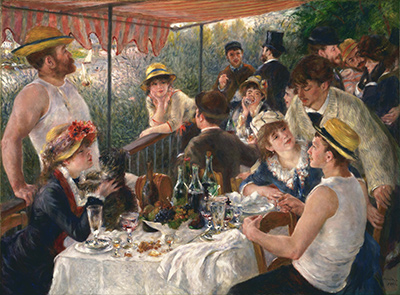
Explore a Montmartre dance, a gathering beside the Seine and the drawings behind Renoir’s paintings.
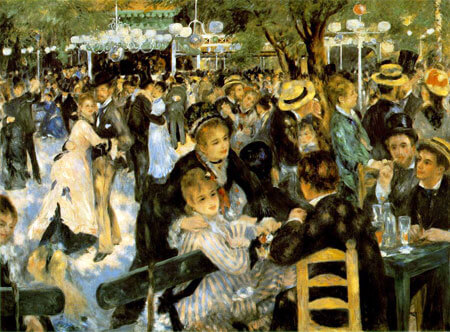
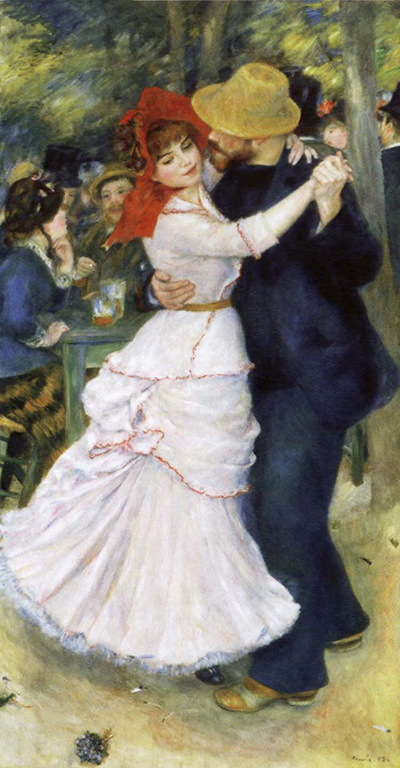
Renoir, Bal du moulin de la Galette
Dr. Beth Harris and Dr. Steven Zucker discuss Renoir’s 1876 Montmartre dance scene, its light and its crowds.
Watch on YouTubeThe accession number is useful because Renoir painted several portraits of himself, while English titles and numbered web labels vary. The Clark owns another Self-Portrait, 1955.611, dated 1899. It shows the older artist in a grey hat before patterned wallpaper and appears here under /self-portrait-i/. They are separate canvases, not two titles for one image. Clark catalogue, circa 1875 [1]; Clark catalogue, 1899. [2]
A face made from short strokes
Renoir gives his own face a direct gaze and a compact, slightly asymmetrical outline. Dark hair rises above the forehead, and the beard breaks into many small marks around his mouth and jaw. Blue and yellow touches interrupt the warmer flesh colour. The dark background is thinner and quieter, so the irregular, thicker paint of the head comes forward. The Clark catalogue describes this contrast between a worked face and a more lightly painted setting. Clark catalogue, no. 266. [1]
The clothes are more orderly than the hair. A pale, blue-striped collar catches light below the beard; a dark blue lavallière tie joins it to the jacket. Renoir does not equip himself with brushes, palette or an easel. A viewer who knew nothing about the sitter's profession might take this for a vivid portrait of a young Parisian man. The meeting of formal dress and unpolished hair is one of the picture's most particular effects. It can be described without inventing a statement Renoir intended to make about respectability. Clark catalogue. [1]
Look especially at the transition from cheek to beard. There is no single smooth contour. Colour and direction change across small strokes, and the darker beard seems to sit partly in front of, partly within, the face. The eyes remain precise enough to hold us even though the surrounding paint is visibly active. This is why the picture can seem at once like a close observation and a record of its own making.
At the second Impressionist exhibition
The Clark catalogue identifies this canvas as one of seventeen Renoir works shown at the second Impressionist exhibition in April 1876. An 1876 reviewer described a self-portrait by Renoir as built from hatched strokes. The catalogue argues that the Clark painting fits that description and was probably the work listed as Tête d'homme, no. 214. “Probably” matters: the exhibition list used a general title, not today's museum accession number. The identification combines the contemporary review, the catalogue entry and the picture itself. Clark catalogue, no. 266, exhibition history. [1]
The exhibition placed the picture in a group of Renoir portraits, including his painting of Claude Monet at work. This self-portrait makes a different proposal. It concentrates on head and shoulders, with almost no narrative setting or clue to an occupation. The painting's looseness did not keep it from circulation: it was lent to the 1876 show by Victor Chocquet, a collector who had met Renoir during the artists' March 1875 auction. Renoir's portrait of Chocquet belongs to this same early relationship, but it is another canvas. Clark catalogue. [1]
After the exhibition, Chocquet sold the self-portrait to Georges de Bellio, probably soon afterwards. Renoir later told a colourful story in which he had discarded the sketch and de Bellio then valued it highly. The Clark catalogue cautions that this retrospective account may be romanticized. The documented loan and collector chain provide firmer evidence than the anecdote for the work's early history. They also show why describing it simply as a picture Renoir kept in his studio would be misleading. Clark catalogue, provenance and essay. [1]
The route's misleading number
The old page title Self Portrait II suggested that this was a second, later step in a fixed series. There is no universal Renoir numbering system behind it. In this site's own image set, “I” is the 1899 Clark portrait and “II” is this circa 1875 work. The date, dimensions and accession number provide a safer identification than Roman numerals. Clark catalogue, 1955.584 [1]; Clark catalogue, 1955.611. [2]
A purported 1876 Renoir self-portrait at Harvard can cause another mix-up. The Clark catalogue notes that its sitter was not recognized as Renoir in his lifetime and could be a friend. This is not a reason to dismiss the Harvard canvas, but it is a reason to avoid using it as an unquestioned middle point in a neat sequence. The Clark's painting has its own exhibition and ownership record as well as a contemporary photograph that supports the sitter's identity. Clark catalogue, no. 266. [1]
From early collectors to Williamstown
The Clark's provenance begins with Renoir and Chocquet, then de Bellio by about 1876. De Bellio's daughter Victorine and her husband Eugène Donop de Monchy inherited it after his death in 1894. The record next passes through dealer Paul Rosenberg in 1917 and Henry Bernstein before Robert Sterling Clark bought the picture in 1939. It entered the Sterling and Francine Clark Art Institute in 1955. This named chain is unusually helpful for a small portrait that began with an informal appearance. Clark catalogue, provenance. [1]
Those owners did not all see the painting under one fixed title. The Clark lists the 1876 exhibition label Tête d'homme and an 1883 exhibition as Portrait. The modern title makes the identity of the sitter explicit, while the older titles remind us that catalogue names can be broad. The image and its documented trail establish which object we are discussing. Clark catalogue, exhibition history. [1]
Looking again
Begin with the blue-striped collar, then follow the short marks through the beard and up to the eyes. Move outward to the thin, dark background. That quieter field makes the changing paint on the face especially visible. Compare the 1899 Clark self-portrait: there, a grey hat and decorative wall carry more of the composition, and Renoir's head is surrounded by a narrower range of brown and grey. Both pictures show the artist well dressed, but their dates, surfaces and expressions are strikingly different. Clark catalogues, nos. 266 and 291. [1]
Renoir artworks directory
Questions about Renoir's circa 1875 Self-Portrait
No. “II” is this site's older route label. The Clark dates this canvas circa 1875. The painting shown under this site's “I” route is the Clark's 1899 self-portrait.
The Clark identifies it as an exhibited self-portrait and considers it probably the catalogue's Tête d'homme, no. 214. Contemporary review and Chocquet's loan support the match.
Victor Chocquet held it about 1875 and lent it in 1876. Georges de Bellio acquired it, probably soon after that exhibition.
No. This canvas shows his head and upper body in ordinary dress. A separate Harvard picture depicts an artist with brushes, but the Clark cautions that its sitter's identity is uncertain.
Discussion
What do you notice when you return to Renoir’s Self-Portrait (c. 1875) — Clark Art Institute?
Where do short strokes of blue and yellow animate Renoir’s face and beard?
Reader Insights
Where do short strokes of blue and yellow animate Renoir’s face and beard?
The Clark connects this circa 1875 canvas with Renoir’s contribution to the 1876 Impressionist exhibition.
What can its first collectors tell us about the painting’s early reception?
Join the Conversation
Share a close observation or a source-backed question about Renoir’s Self-Portrait (c. 1875) — Clark Art Institute.
References
- Clark Art Institute, European paintings catalogue, no. 266, Self-Portrait, 1955.584: owner date, size, signature, analysis, 1876 exhibition argument, provenance and comparison with the Harvard picture View source.
- Clark Art Institute, catalogue no. 291, Self-Portrait, 1955.611: separate 1899 portrait used for comparison View source.
- Whole-work preview: Wikimedia Commons TIFF file for Clark 1955.584. Commons describes the source TIFF as a public-domain faithful reproduction; its scan bears a Clark photograph credit. The image here is a reduced, border-cropped copy of the Wikimedia thumbnail View source.