by Tom Gurney
Tom Gurney BSc (Hons) is an art history expert with over 20 years experience
Published on June 19, 2020 / Updated on October 2, 2026
Email: tomgurney1@gmail.com / Phone: +44 7429 011000
A woman in pale clothing sits in a small boat tucked under long, drooping branches. The vessel is almost swallowed by the green, yellow and red vegetation around it. This is the painting shown in the inherited image on the route called The Skiff II. Museum and exhibition records identify the pictured work more securely as La Barque or The Boat (Das Boot in German), an oil on canvas dated about 1878, 54.5 × 65.5 cm, in Museum Langmatt, Baden, Switzerland. The exact image is reproduced in the museum’s exhibition material, including Belvedere’s presentation of the Langmatt collection [1] and Fondation de l’Hermitage’s work list. [2]
The inherited title needs care. “The Skiff” commonly names Renoir’s different 1875 canvas La Yole at the National Gallery, London: two women in an orange boat on open blue water. This page’s small, enclosed boat with one visible white-clad figure is not a second version of that National Gallery work. The “II” belongs to the old route name; it is not a museum title or documented sequence number.
Contents
- The painting at a glance
- A boat almost hidden by foliage
- Colour, shelter and movement
- Renoir’s boat paintings are distinct
- The Langmatt collection
- Looking again
Watch: Pierre-Auguste Renoir
Explore a Montmartre dance, a gathering beside the Seine and the drawings behind Renoir’s paintings.
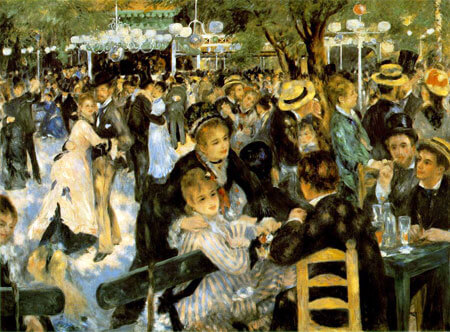
Renoir, Bal du moulin de la Galette
Dr. Beth Harris and Dr. Steven Zucker discuss Renoir’s 1876 Montmartre dance scene, its light and its crowds.
Watch on YouTubeAt a glance
- ArtistPierre-Auguste Renoir (1841–1919)
- Museum titleLa Barque / The Boat / Das Boot
- Established route titleThe Skiff II
- DateAbout 1878 in Belvedere and Fondation de l’Hermitage records
- MediumOil on canvas
- Size54.5 × 65.5 cm
- CollectionMuseum Langmatt, Stiftung Sidney und Jenny Brown, Baden, Switzerland
Fondation de l’Hermitage’s official 2022 exhibition list gives the French title, approximate date, medium, size and lender together. Belvedere’s later exhibition page confirms The Boat as a Langmatt Renoir. Museum Langmatt’s own 2024 annual report names Das Boot among works receiving conservation attention, although its report does not provide a full object catalogue entry. These institutional sources support the object identification without requiring an invented sitter, exact river or purchase date.
A boat almost hidden by foliage
The little boat sits slightly below the canvas’s centre. A pale figure in a light hat and dress draws the eye to its middle. Darker strokes make the hull and the shaded area under the branches, while a warm orange-brown edge runs across the boat. The person appears seated rather than actively rowing. No individual is named in the available museum captions, and the image does not establish whether the craft is drifting or resting close to the bank.
The vegetation carries most of the picture. Yellow leaves fall at the left; long green branches sweep down from above; pink and red strokes cluster at the right; bright orange grasses flare along the lower edge. Some leaves are made with separate short marks, others with broad strokes that merge into neighbouring colour. Renoir lets the enclosing plants become as visually active as the figure and boat.
This is why the painting feels different from a conventional river view. We do not look across an open panorama toward a horizon. The foreground and middle distance press together. Branches partly screen the water and the boat. A viewer first finds the pale woman, then gradually pieces together the hull, bank and hanging growth around her. The painting asks us to look through the foliage rather than around it.
Colour, shelter and movement
The woman’s white clothing gives the centre a quiet point, but white is not isolated. Small pale marks appear among the leaves and on the water. Orange-red touches cross from the right bank into the boat and nearby growth. Green, too, is not a single colour: dark blue-green depths sit behind yellow-green leaves and warmer olive passages. These repeated notes connect parts of the scene that might otherwise feel crowded.
The brushwork suggests movement even if the boat itself is still. Willow-like branches bend downward and across; strokes of grass turn diagonally upward; the dense mass at right leans toward the figure. The boat is a horizontal counterweight to all these changing directions. Its dark hull keeps the composition from dissolving into foliage.
There is an intimacy in the low viewpoint and the secluded setting, but the painting does not tell us a story about solitude, secrecy or the woman’s state of mind. Those are possible responses, not documented facts. What can be said securely is that Renoir arranged a light figure inside a protected pocket of colour. The surroundings are painted with more insistence than any facial detail.
Renoir’s boat paintings are distinct
The National Gallery’s The Skiff (La Yole) [3] shows two women in a bright orange boat on the Seine and is dated 1875. It offers broad open water, distant boats and a different geometry of leisure. The Langmatt La Barque has one clearly visible seated figure, a dark vessel and close foliage. The subjects are related, but the paintings have different dates, collections and compositions.
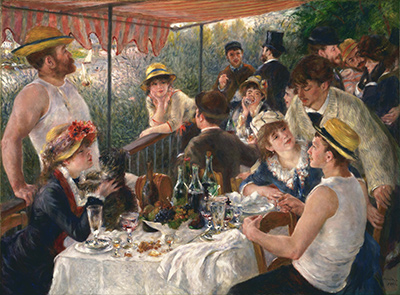
There are other Renoir boat works too. The National Gallery of Art’s Oarsmen at Chatou [4] shows rowers in an open riverside setting. Its figures, location and museum record should not be imported into the Langmatt picture. Renoir returned to boats because they gave him changing combinations of bodies, water, light and colour. A boat motif alone is not an identity test.
The route’s “II” may have been meant to differentiate two images in an older gallery. It cannot establish a second National Gallery skiff or an official numbered series. Keeping the established URL can preserve links, while the visible article and captions make the pictured work’s actual museum title clear. A future release could review how search results display the old URL, but it should not redirect the page to La Yole: that would send readers to a different canvas.
The Langmatt collection
Belvedere’s exhibition page [1] explains that Jenny and Sidney Brown built the collection now held by Museum Langmatt. Their Art Nouveau villa in Baden later became a public museum. The 2025–26 Belvedere exhibition presented selected Langmatt works while the Swiss institution’s building underwent renovation; the painting was listed as The Boat, circa 1878, on loan from Museum Langmatt. That is a dated exhibition fact, not a claim about what is on the wall today.
The Fondation de l’Hermitage list [2] records La Barque in a 2022 Langmatt collection exhibition. Its 54.5 × 65.5 cm dimensions fit the broad format seen here. Museum Langmatt’s 2024 annual report [5] documents frame and canvas-edge conservation work on Das Boot. Such records show the object’s continuing care, but the report excerpt is not a full account of its ownership before the Browns.
Some secondary accounts say the Browns bought the painting from Ambroise Vollard in 1917. That purchase detail needs a direct museum inventory or archival confirmation before it is presented here as fact. The current institutional evidence is sufficient for the collection, date and dimensions; it does not require filling every provenance gap.
Looking again
Follow the yellow foliage down the left edge until it reaches the dark side of the hull. Then find the white figure and trace the line of the boat through the red-green tangle to the right. Look at the hanging branches overhead and the orange grass at the bottom. The boat sits at the meeting of those movements, held in a small clearing that the painter makes visible through contrasts of light and dark.
The established Skiff II route is therefore best read as a guide to Langmatt’s The Boat, a circa 1878 Renoir painting. Its appeal lies in how a small human presence remains legible inside an almost all-encompassing landscape. The museum title and object record keep it separate from the more famous 1875 Skiff.
Renoir artworks directory
Questions about The Skiff II
The inherited image shows Renoir’s La Barque, also called The Boat or Das Boot, in Museum Langmatt, Baden. The Skiff II is the established route title, not the museum’s object title.
Belvedere and Fondation de l’Hermitage date it about 1878.
Fondation de l’Hermitage lists the oil on canvas as 54.5 × 65.5 cm.
No. The National Gallery’s 1875 La Yole shows two women in an orange skiff on open water. The Langmatt work has a pale seated figure in a dark boat amid dense foliage.
The collection belongs to Museum Langmatt, but loan and display arrangements change. Check the museum’s current visitor and exhibition information before travelling to see this specific work.
Discussion
What do you notice when you return to this boat beneath the branches?
How do the drooping branches lead your eye toward the pale figure?
Reader Insights
How do the drooping branches lead your eye toward the pale figure?
Langmatt’s The Boat is catalogued about 1878, 54.5 × 65.5 cm.
How does the dark hull hold the vivid foliage together?
Join the Conversation
Share a close observation or a source-backed question about Langmatt’s boat painting.
References
- Belvedere, Cézanne, Monet, Renoir: French Impressionism from the Museum Langmatt: illustrated institutional identification of The Boat, circa 1878, and dated 2025–26 exhibition context View source.
- Fondation de l’Hermitage, Langmatt exhibition work list: La Barque, circa 1878, oil on canvas, 54.5 × 65.5 cm, Museum Langmatt View source.
- National Gallery, The Skiff (La Yole): distinct 1875 boat painting used to clarify the legacy title View source.
- National Gallery of Art, Oarsmen at Chatou: distinct Renoir boat scene used only for comparison View source.
- Museum Langmatt, 2024 annual report: named conservation attention to Das Boot View source.