by Tom Gurney
Tom Gurney BSc (Hons) is an art history expert with over 20 years experience
Published on June 19, 2020 / Updated on October 2, 2026
Email: tomgurney1@gmail.com / Phone: +44 7429 011000
A seated guitarist bends toward his instrument, wearing an embroidered jacket, red trousers and a cloth tied around his head. A dark hat rests beside him on the stone seat. Renoir fills the middle of the canvas with the warm wooden body of the guitar, so the player’s hands and the instrument become the centre of attention. This is Pierre-Auguste Renoir’s The Spanish Guitarist (Le Guitariste espagnol) of 1894, in the Detroit Institute of Arts [1], accession 1994.57.
The title indicates a Spanish-themed subject and costume. It does not establish the sitter’s nationality or identity. Renoir also painted other guitar players, including a white-dressed woman in Lyon’s Woman Playing the Guitar [2] of 1896–97. These are different objects: the Detroit picture is the male guitarist with a headscarf and hat, while Lyon’s musician sits in an armchair with pink ribbons.
At a glance
- ArtistPierre-Auguste Renoir
- Owner titleThe Spanish Guitarist (Le Guitariste espagnol)
- Date1894
- Medium and sizeOil on canvas, 65.4 × 54.6 cm in a Detroit city inventory report
- CollectionDetroit Institute of Arts, Michigan
- Accession1994.57
- Collection entryGift associated with Rosemarie Kanzler, 1994, in the reproduced museum record
Watch: Pierre-Auguste Renoir
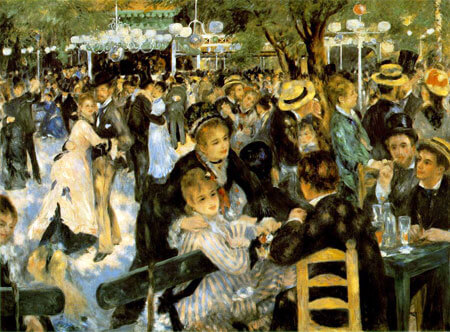
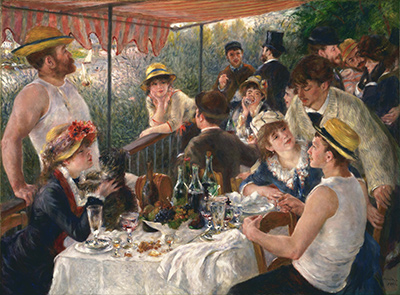
Explore a Montmartre dance, a gathering beside the Seine and the drawings behind Renoir’s paintings.
Renoir, Bal du moulin de la Galette
Dr. Beth Harris and Dr. Steven Zucker discuss Renoir’s 1876 Montmartre dance scene, its light and its crowds.
Watch on YouTubeThe DIA’s print listing [3] confirms the owner title and 1894 date. A Detroit city inventory report [4] records accession 1994.57 and gives 65.4 × 54.6 cm. A separate museum-record reproduction gives the width as 54.0 cm; the width remains qualified. The 54.6 cm figure is used here because it appears in the city inventory for that accession. The current DIA object page [1] has offered sparse details and a “not on view” notice; check it again before visiting.
A musician built around a diagonal
The guitar’s long neck crosses Renoir’s picture from low left toward upper right. It leads from the player’s right hand near the sound hole to his left hand on the neck, then on toward the headstock. His head tilts in the same general direction. The result is a network of glances, hands and instrument rather than a stiff front-facing portrait.
The instrument is not a small prop. Its broad, rounded body covers much of the torso, providing a quiet amber area against the busier jacket. Renoir sets the dark sound hole near the centre, where it becomes a visual stop before the eye travels along the neck. The hands are positioned to make playing plausible. A painting cannot tell us what music was sounding, whether the model could play or whether this was a pause during a sitting, so those questions remain open.
The figure sits sideways on a broad stone support. One red-clad leg angles across the front; a pale stocking descends at the lower left. The other leg turns downward toward the bottom of the picture. These angles give the musician a relaxed seated posture while keeping the body closely fitted to the canvas. The black hat at the right provides an extra dark shape that balances the headscarf and guitar neck above it.
In the upper left, a few dark rounded marks suggest foliage, but the background does not settle into a detailed location. Warm cream, russet and grey-brown strokes surround the musician. Renoir gives us enough setting to hold the figure and stone seat, but not enough to identify a street, garden or performance venue. The pictured costume and guitar are more specific than the place.
Costume, colour and the title
Gold, red, blue and dark brown marks animate the richly decorated jacket and trousers. The white cloth at the chest opens a bright gap between head and guitar, while the pale headscarf frames the face. Renoir uses the relatively even ochre of the guitar as a contrast to the costume’s small, shifting colour patches. The painting feels ornate without requiring each embroidered motif to be read separately.
The title The Spanish Guitarist invites a comparison with Spanish costume and music, but a costume is not a passport. The visible objects show a person dressed for a Spanish-themed image; the sources used here do not identify the model by name, place of birth or profession. Calling him a professional guitarist, a bullfighter or a visiting Spaniard would go beyond the object record. The hat and jacket support a description of how Renoir staged the image, not a biography of its sitter.
Renoir painted this canvas late enough in his career to be interested in fuller figures and costumes that are not tied tightly to ordinary Parisian dress. Yet the brushwork remains lively. His treatment of the face is softer than a detailed photographic likeness; the jacket and stone contain marks that stay conspicuously painterly. The result combines a recognisable musical activity with the pleasure of colour and surface.
Look again at the player’s face. It is turned toward the guitar rather than presented squarely to the viewer. That choice makes his attention part of the composition. His hands are the next points of focus, because they connect the portrait-like figure to the rounded instrument. Renoir’s subject is therefore a person engaged with an object, not simply an exhibition of costume.
In the Detroit Institute of Arts
The Detroit canvas is identified by accession 1994.57. An archived transcription of DIA provenance data [5] records Sir Chester Beatty holding it by 1929, Durand-Ruel reacquiring it in 1935, Sam Salz buying it in 1943, a Christie’s London sale in 1974, and the Ernest Kanzler family thereafter. It records a 1994 gift to the DIA associated with Rosemarie Kanzler. This is a historical transcription of a museum listing, not an independent new provenance investigation; consult the museum for updates or corrections.
The reported path is more specific than a generic statement that the painting “came from a private collection.” It shows movement through collectors and dealers before the 1994 gift. It does not name the original transaction from Renoir or prove where the work was hung at every stage. In particular, the Detroit city report’s object identity is firmer evidence for its inventory number and size than a loosely copied web caption.
The DIA collection page [1] is the right place to check current display information. At the time this page was prepared, its accessible text said not on view. A historic image of a painting in a gallery, or a print offered by a museum shop, does not establish that visitors can see the original on a given day.
A separate woman guitarist in Lyon
The Musée des Beaux-Arts de Lyon [2] dates its Woman Playing the Guitar to 1896–97, gives it inventory B 624, and describes a seated woman in a pale Spanish-style dress with pink ribbons. Renoir’s return to guitar subjects makes comparison worthwhile. The instrument joins a seated figure and costume in both works, but pose, sitter, colours and ownership identify separate paintings.
The Detroit musician’s guitar rises across a patterned jacket toward a cloth-wrapped head; the Lyon guitarist’s instrument cuts across a largely white dress and armchair. Renoir could use the same theme for different arrangements of warm and cool colours. Neither owner says the Lyon work is a copy of Detroit’s or that the sitters were related. The secure connection is their shared musical subject within Renoir’s late-1890s interests.
Another Renoir image, Young Spanish Woman with a Guitar in Washington [6], is a further distinct work. The National Gallery of Art discusses its 1898 female player. The Detroit man, Lyon woman and Washington woman show why exact object records matter more than a generic search for “Renoir guitar.”
Looking again
Begin at the dark sound hole, move along the guitar neck to the player’s left hand, then return through his face and headscarf. From there follow the embroidered jacket down to the red trousers and black hat. Renoir keeps the figure recognisable while allowing the paint to break into colour and texture. The instrument gives the picture its strong line; the costume and softened surroundings make it a staged, vivid encounter with a musician.
Renoir artworks directory
Questions about The Spanish Guitarist
The Detroit Institute of Arts lists the painting as 1894.
No personal name or profession is established in the cited museum records. The title describes the picture’s Spanish-themed guitarist, not documented biographical facts about the sitter.
It belongs to the Detroit Institute of Arts, accession 1994.57. Check the DIA’s current object page before visiting; its accessible record said not on view when this text was prepared.
A Detroit city inventory lists 65.4 × 54.6 cm. A reproduced museum record gives a slightly different width, 54.0 cm, so the width remains qualified.
No. Lyon’s 1896–97 canvas shows a woman in a white dress with pink ribbons. Detroit’s 1894 canvas shows a man in an embroidered costume with a headscarf and dark hat.
An archived transcription of the museum’s provenance lists a 1994 gift associated with Rosemarie Kanzler after earlier ownership by the Kanzler family.
Discussion
What do you notice when you return to Spanish Guitarist?
How does the guitar’s diagonal connect the musician’s hands and lowered face?
Reader Insights
How does the guitar’s diagonal connect the musician’s hands and lowered face?
The Detroit Institute of Arts identifies its 1894 Spanish Guitarist; the city inventory records accession 1994.57.
Which details distinguish this man from Renoir’s later woman guitarists in Lyon and Washington?
Join the Conversation
Share a close observation or a source-backed question about Renoir’s spanish guitarist.
References
- Detroit Institute of Arts, Detroit Institute of Arts, collection entry View source.
- Musée des Beaux-Arts de Lyon, Musée des Beaux-Arts de Lyon, separate Woman Playing the Guitar View source.
- Detroit Institute of Arts, DIA Custom Prints, The Spanish Guitarist View source.
- Detroit city, Detroit city, expert inventory report View source.
- Detroit city, archived transcription of DIA provenance data View source.
- Musée des Beaux-Arts de Lyon, National Gallery of Art, Young Spanish Woman with a Guitar View source.
- Wikimedia Commons, Wikimedia Commons, DIA-derived reproduction of The Spanish Guitarist View source.
- Creative Commons, CC BY-SA 4.0 View source.