by Tom Gurney
Tom Gurney BSc (Hons) is an art history expert with over 20 years experience
Published on June 19, 2020 / Updated on October 2, 2026
Email: tomgurney1@gmail.com / Phone: +44 7429 011000
A steep stairway climbs between a sunlit wall and luxuriant planting. At the top are railings, buildings and a strip of blue sky; near the bottom sits a small figure in pale blue. The inherited image on this route is commonly reproduced as Pierre-Auguste Renoir’s Steps in Algiers, or Escalier à Alger, and generally dated about 1882. The title and date fit Renoir’s second visit to Algeria, but an accessible museum or auction record for this exact canvas has not yet been found. This guide therefore describes the painting visible here without presenting a current owner, precise location in the city, or detailed provenance as established fact.
The image has more to offer than a travel label. Renoir uses the steps as an armature for contrasting surfaces: painted masonry, dense leaves, reddish earth and blue garments. The path up the centre holds those passages together, while the small people give a sense of scale. It is a view of a built place that is almost overtaken by vegetation and colour.
Contents
- The work at a glance
- A stairway that shapes the picture
- Colour across stone, plants and sky
- Renoir in Algeria, and the limits of this record
- What remains undocumented
Watch: Pierre-Auguste Renoir
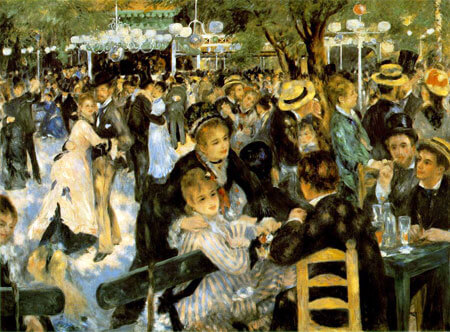
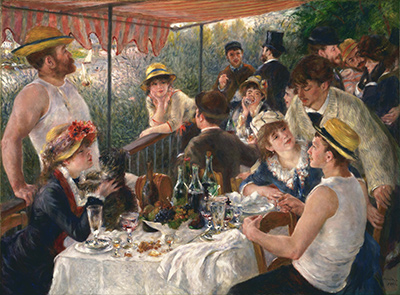
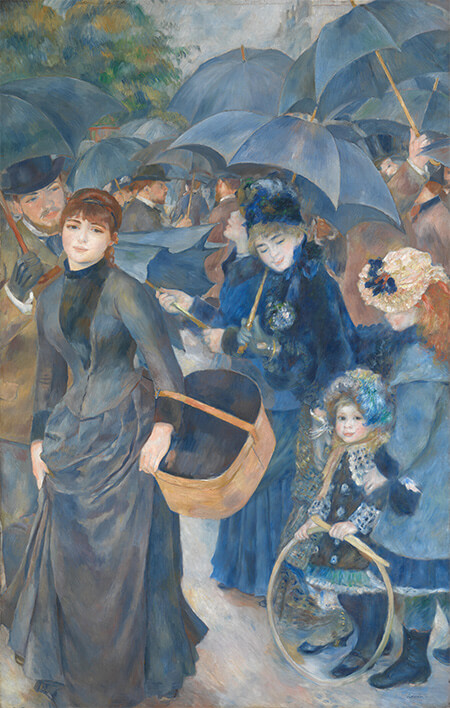
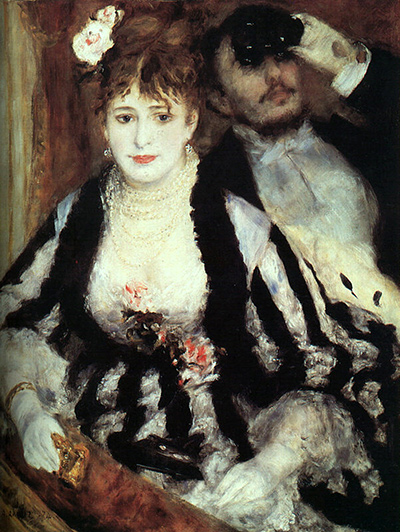
Explore a Montmartre dance, a gathering beside the Seine and the drawings behind Renoir’s paintings.
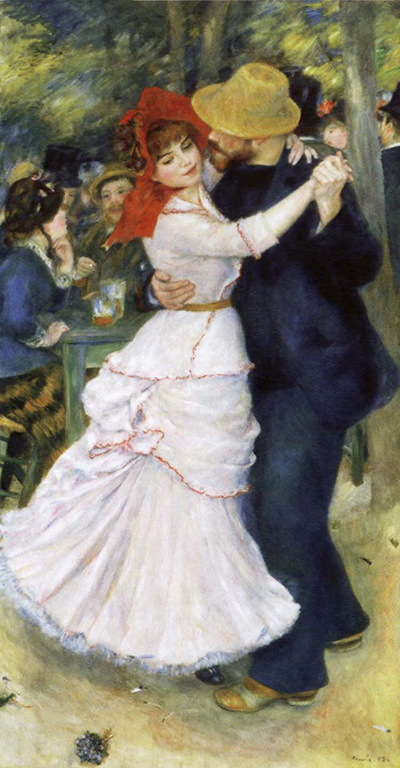
Renoir, Bal du moulin de la Galette
Dr. Beth Harris and Dr. Steven Zucker discuss Renoir’s 1876 Montmartre dance scene, its light and its crowds.
Watch on YouTubeAt a glance
- ArtistPierre-Auguste Renoir (1841–1919)
- Commonly reproduced titleSteps in Algiers / Escalier à Alger
- Date used in illustrated cataloguesAbout 1882; an exact-object institutional record is still needed
- Medium in secondary listingsOil on canvas, pending exact-object confirmation
- Dimensions in secondary listingsAbout 73 × 60–60.5 cm; not independently verified here
- Present collectionUnverified; no current owner is asserted
The figures in this table deliberately distinguish a reproduced identification from a verified museum object record. Commercial print listings and image aggregators agree on a roughly 73 × 60 cm canvas, but agreement between such listings can result from copying a common database. The local image itself proves neither dimensions nor ownership. Neither the dimensions nor present owner can be treated as verified object metadata here.
A stairway that shapes the picture
The steps occupy a narrow channel through the centre of the composition. They do not march upward as neat, equally spaced lines. Some treads are broad red-brown bands, some disappear into shadow, and the upper flight is partly obscured. A light-coloured parapet rises at left in repeated diagonal sections; at right, plants and rough ground interrupt any comparable architectural order. This unequal framing makes the route feel steep and irregular.
The parapet is one of the painting’s brightest forms. Its creamy upper edges catch light, while pink, lavender and pale orange strokes make the wall below. It is tempting to read the stairway as a precise record of a named street, but the picture supplies no street sign or distinct landmark. Its architecture is specific enough to describe, not specific enough by itself to map.
Near the top, a small figure appears on the stairs. Lower down, a seated or crouching person in pale blue occupies the right side of the foreground. Their scale matters: without them, the masonry and foliage could look like a compressed, almost abstract arrangement. They make us sense the climb and the size of the space. The image does not tell us their names, relationship, occupation or reason for being there.
Renoir places the foreground person partly in shadow. The soft blue clothing and face are made with only a few marks, yet the cool colour stands apart from the ochre ground. The eye can travel up the stairs and return to this figure. That circular movement keeps the painting from becoming a simple view toward a distant destination.
Colour across stone, plants and sky
There are strong colour passages in a scene that could have been rendered mostly in brown stone. The left wall holds pink and violet against yellow-white edges. The central stairs alternate rust, red, mauve and dark umber. At right, black-green growth is broken by orange and yellow touches. The upper sky is a narrow blue-violet field, and the seated figure repeats its cooler note below.
These colours organize the painting more decisively than fine outlines. The leaves are seldom individually defined. Instead, strokes of different size and direction build a heavy mass that presses toward the stairs. The wall, by contrast, has a clearer zigzag silhouette. The two sides of the path therefore have different textures: masonry is measured by edges, planting by layered marks.
Look also at the transition between the dark middle and luminous foreground. The broad, pale patch near the lower centre gives the composition a place to rest. It makes the darker steps appear to recede, even though the scene is tightly packed. A viewer may experience heat, shade or late-afternoon light in these contrasts, but a precise time of day cannot be established from the image alone.
The paint is loose where a documentary city view might be crisp. That does not make the setting imaginary. It means that Renoir selected and compressed what mattered pictorially: an ascending path, a bright wall, densely planted land and small human presences. The painting lets the edges of those things blend, especially where foliage meets buildings near the top.
Renoir in Algeria, and the limits of this record
Renoir travelled to Algeria in 1881 and again in 1882. The Metropolitan Museum of Art’s North Africa chronology [1] places his visits within a wider nineteenth-century pattern of French artists working in Algeria. The Art Institute of Chicago’s scholarly catalogue [2] documents several distinct Renoir pictures with Algerian subjects, including Mosque at Algiers, Old Arab Woman and Ali, the Young Arab. Those records establish that the city and its people formed part of his work in this period; they do not identify the precise staircase in this image.
The setting also belonged to a French colonial city. Algeria was under French rule during Renoir’s visits. A nineteenth-century European artist’s view of Algiers is therefore a partial view, shaped by where he went and what he chose to paint. The tiny figures here should not be treated as anonymous evidence of an entire society. The familiar title identifies a place, but it does not explain the lives of the people shown.
One might assume the canvas was painted entirely outdoors on the steps. The looseness and apparent immediacy of the brushwork make that plausible, yet they cannot prove where the final painting was completed. Nor can the picture tell us whether the figures posed, were observed in passing, or were adjusted afterward. An artist can make an outdoor view from studies and later changes. The responsible description stays with what the image and documented itinerary actually support.
A Sotheby’s 2014 catalogue entry for L’Escalier, Alger [3] documents a separate 1882 staircase painting. Its illustration places two veiled women prominently in the foreground, unlike the inherited image on this page, and its 55 × 45.5 cm measurement cannot be assigned to this canvas. The catalogue says Renoir made two staircase scenes near the Mosque of Sidi Abd-er-Rahman and discusses their different foregrounds and architectural detail. That comparison makes the mosque precinct a plausible context for the inherited image, but it does not establish its exact site, dimensions or provenance. Old Arab Woman and Mosque at Algiers are further distinct works.
What remains undocumented
The inherited reproduction is small, so subtle objects or inscriptions may be lost. A good-quality reproduction from a catalogue or lender would allow a closer inspection of the upper buildings, figures and surface. If a reliable exact-object record is located, the painting’s date, support, measurements, title variants and ownership can be updated together.
For now the picture can be read carefully on its own terms. Start at the pale wall in the lower left and follow its diagonals toward the top. Look across to the railings and the sliver of sky. Then descend along the darker stair treads and settle on the blue-clad person at right. This route through the image reveals why the work is more than an illustration of a stairway: architecture provides the movement, while plants, colour and people complicate it.
The title Steps in Algiers is a useful name for the inherited picture, and about 1882 is a reasonable date used in illustrated listings. The object’s current collection, exact dimensions and site within Algiers remain open here. That distinction lets the page offer a substantial visual guide without turning an attractive image into an unsupported museum record.
Renoir artworks directory
Questions about Steps in Algiers
It shows a steep stairway between a pale parapet and dense planting, with small figures on or beside the steps and buildings above.
Illustrated listings generally date the picture about 1882, the year of Renoir’s second visit to Algeria. A verified exact-object record is needed to state a firmer date.
No street or landmark has been securely identified from the available evidence. The title places the scene in Algiers but does not locate the steps more precisely.
The accessible records do not name them. The image shows a small figure higher on the stairs and a blue-clad person in the foreground, but does not establish their identities.
No current owner has been independently verified for the exact canvas pictured here. A private collection is repeated in secondary listings, but this page does not treat that as a current, documented location.
Discussion
What do you notice when you return to this Algiers stairway?
How does the pale wall lead your eye up the stairs?
Reader Insights
How does the pale wall lead your eye up the stairs?
The image is commonly dated about 1882; its exact-object record still needs confirmation.
How do the small figures change your sense of scale?
Join the Conversation
Share a close observation or a source-backed question about Renoir’s Algiers view.
References
- Metropolitan Museum of Art, “Egypt and North Africa, 1800–1900 A.D.”: museum historical context for French artists in Algeria View source.
- Art Institute of Chicago, scholarly catalogue for Madame Léon Clapisson: documented Renoir Algerian works and references to primary records; used for period context, not this canvas’s metadata View source.
- Sotheby’s, L’Escalier, Alger, 2014 lot 43: separately illustrated staircase composition, its own dimensions and ownership history, and the catalogue’s account of two related staircase paintings View source.
- Artchive, Artchive, Steps in Algiers View source.
- Artchive, WahooArt listing View source.