by Tom Gurney
Tom Gurney BSc (Hons) is an art history expert with over 20 years experience
Published on June 19, 2020 / Updated on October 2, 2026
Email: tomgurney1@gmail.com / Phone: +44 7429 011000
A seated musician looks down as her hands meet a guitar. Its long neck rises across Pierre-Auguste Renoir’s painting, cutting diagonally through the folds of her white dress. Pink ribbons, a warm brown armchair and a yellow-green cushion make the quiet indoor scene unexpectedly colourful. The Musée des Beaux-Arts de Lyon [1] identifies this work as Femme jouant de la guitare, painted in 1896–97 and held as inventory B 624.
The title is important because Renoir painted more than one person with a guitar. This Lyon canvas shows a woman in a pale Spanish-style costume. It is different from the Detroit Institute of Arts’ The Spanish Guitarist [2], a separate 1894 work featuring a male musician. A general phrase such as “Renoir’s guitarist” can obscure the difference between those objects.
At a glance
- ArtistPierre-Auguste Renoir
- Owner titleFemme jouant de la guitare (Woman Playing the Guitar)
- Date1896–97
- Medium and sizeOil on canvas, 81 × 65 cm
- CollectionMusée des Beaux-Arts de Lyon, France
- InventoryB 624
- AcquisitionPurchased from Paul Durand-Ruel’s gallery in 1901
Watch: Pierre-Auguste Renoir
Explore a Montmartre dance, a gathering beside the Seine and the drawings behind Renoir’s paintings.
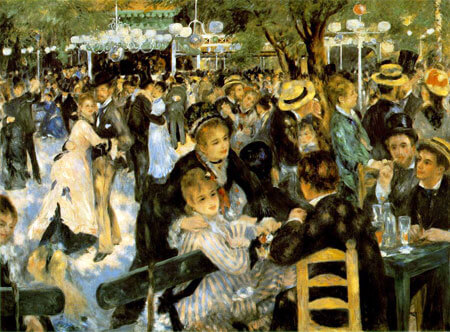
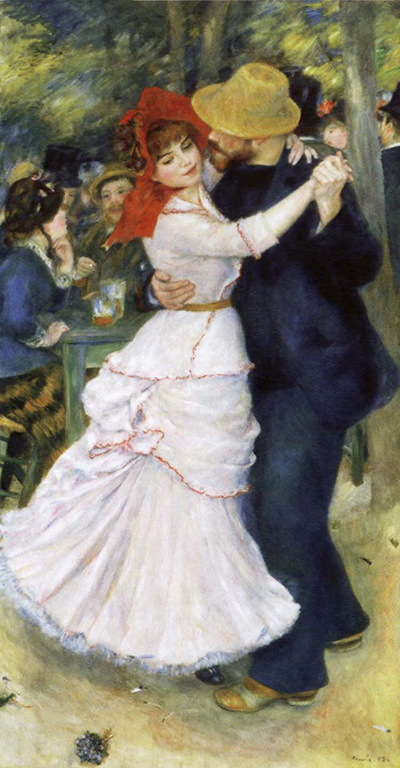
Renoir, Bal du moulin de la Galette
Dr. Beth Harris and Dr. Steven Zucker discuss Renoir’s 1876 Montmartre dance scene, its light and its crowds.
Watch on YouTubeAll of these object details come from the Lyon museum’s own record. [1] Its caption appears to contain an older or approximate “vers 1890” label for the photograph, while the artwork heading and label consistently give 1896–97. This page uses the museum’s explicit object date and records the caption discrepancy for final editorial checking.
The diagonal instrument
The guitar is the picture’s strongest line. Its body rests across the sitter’s lap, and the dark neck climbs toward the upper right. Her left hand holds the neck while her right rests near the strings. The downward turn of her head connects the two. Renoir makes the object large enough to divide the composition, but it remains part of a seated figure rather than becoming a still life detached from her.
One can follow a simple route through the painting: begin at the yellow-green cushion in the lower left, travel across the pale skirt to the rounded wooden body, then climb the fretted neck toward her hand and face. The armchair pushes against the guitar from behind, its curved back repeating the instrument’s rounded body. The vertical strips at the far right check that diagonal movement and keep the room from seeming to tip with the instrument.
The museum’s description [1] identifies the pink ribbon bows as parts of a Spanish costume rather than ordinary contemporary dress. One sits at her shoulder; others appear lower on the gown. They help guide the eye down the pale fabric and back toward the cushion. We should not read that costume as evidence that the woman was Spanish, that Renoir visited Spain for this work or that he documented a particular performance. The owner record does not name the sitter or a musical piece.
The arrangement feels absorbed and quiet. The sitter’s gaze meets the instrument rather than the viewer. Her hands give a plausible sense of playing, although a still image cannot reveal whether we are seeing a sound just made, a pause, or a posed moment. Renoir presents the guitar as an active part of her posture. The gesture, the turned head and the long diagonal are enough to make music the subject without inventing a tune.
Warm and cool surfaces
Renoir’s white is not a single flat white. Blue and grey notes give the skirt and sleeves shadow and depth, while warmer cream touches bring folds forward. The painter lets the dress occupy much of the lower picture, then breaks its pale mass with the brown guitar and pink ribbons. The armchair brings another warm area at the right. Against those passages, the green backdrop feels cooler and more distant.
The Lyon museum draws attention to the mixture of warm and cool colours and to the dress’s swirling contours. Those curves link cloth, chair and cushion. They also distinguish this picture from a formal musician’s portrait built around a straight-backed pose. The seated figure is enclosed by soft shapes, while the guitar’s neck supplies a firm directional line. Musée des Beaux-Arts de Lyon, object account. [1]
Close looking shows how Renoir varies the degree of finish. The guitar’s dark neck and sound hole keep the instrument legible. The white dress is less exact at its edge, where small patches of colour suggest loose folds and lace. The green wall does not demand attention as a detailed setting; its texture gives the figure space. Renoir balances a clear action with paint that remains visible as paint.
The yellow-green cushion at the lower left is a useful test of that balance. It is recognisable as an object, but its precise material and pattern are not specified. Its colour stops the white gown from filling the entire foreground and answers the cooler greens behind the sitter. Small supporting objects can shape a composition as decisively as the main subject.
A late-1890s Renoir
The museum places this painting among Renoir’s late-1890s guitar subjects. It calls the Lyon example probably one of the first in a series of men and women playing the instrument. “Probably” matters: the owner does not supply a complete chronological list or say every guitar picture derived from this one. What is secure is the picture’s 1896–97 date and its place in a group of musical figure paintings.
Lyon’s curatorial text connects the costume and imposing, rounded forms to Renoir’s turn toward a more classical figure style. It notes his admiration for Camille Corot’s imagined musicians and for older painting traditions associated with Titian and Rubens. Those comparisons explain why this quiet scene can feel more staged and timeless than an observed moment in a modern café. They do not establish that Renoir copied a specific Corot, Titian or Rubens canvas to make it. Lyon museum. [1]
The guitar itself lets Renoir combine an intimate subject with a deliberate structure. Its neck creates a diagonal; the seated dress supplies a broad light area; the armchair and cushion give weight to the lower corners. The woman’s absorbed expression keeps the arrangement from becoming only a formal exercise. It is a painting about looking at someone engaged with an instrument and about how paint gives that engagement colour and volume.
From Durand-Ruel to the museum
The Lyon museum [1] records buying Woman Playing the Guitar from Paul Durand-Ruel’s gallery in 1901. It calls the purchase the museum’s first Impressionist painting. That is a significant date in this object’s history: within a few years of its creation, the work entered a public collection rather than remaining solely in the dealer’s stock or a private home.
The owner page does not set out a complete path from Renoir’s studio to Durand-Ruel, and a missing detail should not be filled by assumption. The documented acquisition is enough to identify why the work is in Lyon today. For visiting arrangements, consult the museum’s current display information rather than treating an earlier photograph or catalogue image as proof that the canvas is on a wall now.
Related guitar pictures, distinct objects
Renoir’s The Spanish Guitarist in Detroit [2] is dated 1894 in the owner’s print listing. It shows a male figure in a different costume. The Lyon painting is a later female musician, 81 × 65 cm, inventory B 624. A shared guitar subject does not make the paintings two names for the same canvas.
Lyon also notes that Renoir made further guitar scenes with men and women. The theme allowed changes in pose, clothing and colour. When comparing reproductions, identify the figure, instrument placement, collection and date before borrowing a description from one image for another. This page concerns the white-dressed woman in the Lyon armchair with pink bows and a yellow-green cushion.
Looking again
Begin at her hands. Follow the neck of the guitar up to the dark headstock, then return to her lowered face. Let the eye move down through the white folds to the cushion and across to the warm chair. The painting feels still, but its curves and diagonal are active. Renoir gives a musician’s concentration a carefully arranged, richly coloured form.
Renoir artworks directory
Questions about Woman Playing the Guitar
The Musée des Beaux-Arts de Lyon dates its B 624 canvas 1896–97.
It belongs to the Musée des Beaux-Arts de Lyon. Check the museum’s current display information before visiting.
The owner records 81 × 65 cm, oil on canvas.
The Lyon object account does not name her. Its description identifies her clothing as a Spanish costume.
No. Detroit’s 1894 Spanish Guitarist features a man. The Lyon work is a separate 1896–97 painting of a woman.
The museum purchased the canvas from Durand-Ruel’s gallery in 1901 and identifies it as its first Impressionist painting.
Discussion
What do you notice when you return to Woman Playing The Guitar?
How does the guitar’s long diagonal link the sitter’s hands and lowered face?
Reader Insights
How does the guitar’s long diagonal link the sitter’s hands and lowered face?
The Musée des Beaux-Arts de Lyon identifies its 1896–97 canvas as B 624, bought from Durand-Ruel in 1901.
Which curves and colour contrasts make the still pose feel active?
Join the Conversation
Share a close observation or a source-backed question about Renoir’s woman playing the guitar.
References
- Musée des Beaux-Arts de Lyon, Woman playing the guitar, B 624: owner title, date, size, collection history and interpretation of costume, colour and artistic context View source.
- Detroit Institute of Arts, The Spanish Guitarist (1894): separate guitar picture used for object distinction View source.
- Ken and Nyetta / Ken Fairfax, Ken and Nyetta / Ken Fairfax, independent Lyon museum photograph via Wikimedia Commons View source.
- Creative Commons, CC BY 2.0 View source.