 by Tom Gurney
Tom Gurney BSc (Hons) is an art history expert with over 20 years experience
Published on June 19, 2020 / Updated on August 21, 2026
Email: tomgurney1@gmail.com / Phone: +44 7429 011000
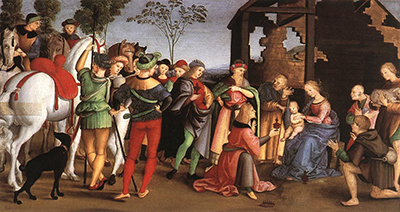
The centre of Raphael's Oddi predella is filled by arrival. Mary holds the Christ Child at one side of the sacred meeting while the Magi and their attendants approach with gifts. Kneeling homage creates a still point near the infant; behind it, standing figures, servants and horses extend the journey into a dense procession.[1][2]
The scene had to solve a difficult format. It is the central compartment of a long strip only about 38 centimetres high. Raphael fits courtly display, animals, architecture and landscape into that shallow field without losing the small Child who is the object of every movement. The Vatican identifies his key innovation as a unified space: figures recede by stages and horses set on crossed diagonals reinforce the vanishing point.[2]
Painted about 1502–04, the Adoration belongs between the Annunciation at the left and Presentation in the Temple at the right. It was never an autonomous panel with its own altar. All three scenes formed the poplar predella beneath the Oddi Crowning of the Virgin in San Francesco al Prato, Perugia.[1][2]
At a Glance
- ArtistRaphael
- SubjectAdoration of the Magi
- Date1502–04
- Place in the altarmiddle episode of the Oddi narrative base
- Support and techniquetempera grassa and oil on poplar wood
- Size of the full painted stripabout 38–39 × 188–190 cm
- Principal figuresVirgin Mary, Christ Child, Joseph, three Magi and their retinue
- Original locationOddi Chapel, San Francesco al Prato, Perugia
- PatronAlessandra degli Oddi
- Current objectVatican catalogue MV.40335.0.0
- Related full-scale drawingNationalmuseum, Stockholm, NMH 296/1863
- Recent careconserved in the Vatican laboratory before its 2022 loan to Milan
Contents
- The centre of a continuous story
- Mary and the Child as a point of stillness
- The Magi: approach, kneeling and succession
- A retinue compressed into a predella
- Horses and crossed diagonals
- A low field made deep
- The full-scale Stockholm study
- From paper procession to painted colour
- Perugino's language and Raphael's spatial answer
- Gifts, sight and recognition
The centre of a continuous story
The Oddi predella narrates three episodes associated with Mary and Christ's infancy. The Annunciation begins with Gabriel's message. The Adoration shows distant visitors recognising the Child. The Presentation brings him into the Temple.[1][2]
Central placement gives the Magi scene special breadth and density. It serves as a hinge between a quiet encounter in architecture and a formal ritual interior. Its procession converts promise into public recognition.
The whole predella remained one long material object. Modern images often crop the centre and make it resemble a cabinet painting, but its first frame, sightline and neighbours governed its proportions. Figures in all three compartments share a small scale and continuous horizontal rhythm.
The central subject also echoes the main field above. Apostles recognise Mary's empty tomb in the Coronation; Magi recognise divine kingship in a child. Both are communities learning to see more than ordinary appearance.
Mary and the Child as a point of stillness
Raphael anchors the crowded scene in the Virgin and Child. Mary presents or supports Jesus while the nearest Magus kneels. Their compact group resists the lateral pull of the retinue.
The Child is physically small, as both subject and format require. Raphael ensures visibility by clearing the immediate interval around him and directing bodies, faces and gifts toward that point.
Mary's seated stability contrasts with the visitors' stages of approach. She has not travelled into the scene; she receives. Her stillness gives the procession a destination.
Joseph stands within or near the family group without displacing mother and son as the devotional centre. His quieter presence completes the human household before which foreign splendour bends.
The architectural shelter or ruin around the family remains modest beside the courtly company. Raphael makes kingship paradoxical: expensive gifts and mounted attendants recognise a child in humble circumstances.
The Magi: approach, kneeling and succession
The Magi do not all occupy the same stage of homage. One kneels nearest Christ; another advances; the remaining figure and attendants stand farther back. Their sequence turns a group portrait into action.
Matthew's Gospel says that magi came from the east, followed a star, entered the house, prostrated themselves and offered gold, frankincense and myrrh.[5] It does not specify three visitors or call them kings; those features developed through later Christian interpretation.[5]
Raphael works within that established visual tradition. Differentiated age, dress and posture allow the three principal visitors to represent a succession of responses. Kneeling gives the foreground a low curve; upright figures extend the composition into depth.
Gifts make recognition material. Containers and hands carry value toward a child who possesses no visible court. Homage reverses ordinary hierarchy: rank approaches humility and lowers itself.
The Magi also broaden the altarpiece beyond Perugia. Within Christian interpretation, their arrival signifies recognition of Christ by peoples outside Israel. A local family chapel contains an image of devotion crossing distance and culture.
A retinue compressed into a predella
Behind the principal exchange, attendants fill the centre with profiles, garments and overlapping bodies. Raphael must imply a much larger company than the narrow strip can comfortably hold.
He avoids spreading the figures in a flat row. Heads rise at different levels and bodies diminish as they recede. Some attendants are visible only in part, allowing overlap to suggest more people beyond the frame.
Costume and headwear create variety at a scale where facial psychology alone would be difficult to read from the chapel. Bright colour separates adjacent bodies and lends the eastern visitors visual splendour.
The crowd's direction remains controlled. Even figures not yet kneeling belong to the flow toward Mary and Christ. No secondary anecdote breaks the main act of arrival.
At the same time, the retinue prevents devotion from becoming private. The nearest king's intimacy is witnessed by a travelling community. Raphael makes homage both personal gesture and public event.
Horses and crossed diagonals
The Vatican dossier singles out the horses as a major spatial device. Positioned along crossed diagonals, they emphasise the vanishing point and help unify the scene.[2]
Horses carry the history of travel into the moment of worship. They are no longer moving rapidly, but their angled bodies preserve the energy of a journey just completed.
Their larger forms also solve crowd depth. A horse can rise behind human figures, appear in fragment and still remain recognisable. Heads, necks and backs create diagonals that pass through the retinue without requiring open ground.
Crossing directions prevent the procession from looking like a parade pasted onto the picture plane. One animal's alignment draws inward; another counters it. The eye is pulled toward the sacred group through a web of movement.
This is where Raphael moves beyond simple dependence on Perugino. The Vatican acknowledges the teacher's strong influence but identifies an unprecedented unity in the way people and animals are scaled through space.[2][3]
A low field made deep
Predella proportions create a special perspective problem. There is little vertical room for a high horizon or monumental architecture. Raphael must suggest recession primarily across width.
He uses diminution, overlap and diagonal placement. Figures closest to the encounter are larger and more complete. Those behind are partially screened and set higher or farther into the spatial chain.
The procession does not disappear into a single narrow corridor. Instead, it fans out while remaining oriented toward the Child. Unity comes from shared destination rather than rigid symmetry.
Landscape and architecture provide quieter depth around the human density. An opening beyond the group suggests that the road continues into a world outside the painted band.
The result makes the scene feel larger than its physical dimensions. Raphael turns compression into energy: the crowd seems to press into a sacred centre too small for its splendour.
The full-scale Stockholm study
A full-scale composition study survives in the Nationalmuseum, Stockholm, inventory NMH 296/1863. The Metropolitan Museum dates it about 1503–04 and identifies it as preparation for the central Oddi predella scene.[4]
The drawing measures 27.2 by 42 centimetres, close to the painted compartment's working scale.[4] It is not a distant thumbnail. Raphael could test the positions of figures and animals at a size directly useful for production.
On the recto, pen and brown ink sit over extensive stylus and leadpoint preparation. The reverse is partly blackened with charcoal or black chalk.[4] That blackening could support transfer by a tracing method, turning the sheet into a functional intermediary between design and panel.
The layered media show search beneath decision. Stylus and leadpoint establish quiet construction; ink clarifies visible forms. The crowded result was built through an understructure largely invisible in reproduction.
The drawing's survival is especially valuable because the Vatican identifies spatial unity as the scene's innovation.[2] The sheet lets viewers connect that painted effect with measured preparation rather than imagining inspired improvisation.
From paper procession to painted colour
Drawing can establish scale, overlap and direction, but it cannot solve every painted relationship. Colour must separate the Magi from attendants, the family from visitors and horses from the dense group.
Raphael distributes saturated garments through the procession so the crowd does not become a brown knot. Lighter flesh, pale architecture and open landscape create intervals around the principal figures.
The gifts need small metallic or bright accents to remain visible. Their preciousness is conveyed not by size but by contrast and the ceremonial care with which they are held.
Paint also softens the geometry of the study. Diagonal structure remains active, yet drapery, animal bodies and atmosphere prevent the viewer from seeing only a perspective exercise.
The scene demonstrates Raphael's early ability to make construction disappear into event. Order is present everywhere, but the first impression is a company arriving and kneeling.
Perugino's language and Raphael's spatial answer
The Vatican describes the Oddi Altarpiece as the early Raphael work closest to Perugino and notes his teacher's influence throughout the predella.[1][2]
Perugino provided models for graceful figures, calm landscape, small sacred narratives and clear devotional hierarchy. Such influence gave Raphael a highly developed starting language.
In the Adoration, Raphael's independent contribution appears in integration. The procession is not divided into isolated clusters. Scaled figures and crossed horse diagonals make bodies participate in one receding field.[2]
This difference should not be inflated into a dramatic break with the master. Raphael develops from inside the tradition. Innovation is a new spatial pressure within familiar grace.
The scene's modernity lies precisely in that restraint. Perspective does not call attention to itself through empty architectural display; it organises living abundance.
Gifts, sight and recognition
Gold, frankincense and myrrh are named in Matthew as the treasures offered to Jesus.[5] Raphael compresses the identity and symbolism of the gifts into precious vessels and the actions surrounding them.
The nearest Magus's lowered body is itself an offering. Before an object changes hands, posture acknowledges rank. Vision leads to homage.
Other members of the company witness and wait. The scene stages recognition spreading through a hierarchy: one kneels, another approaches, others remain mounted or standing.
The Child receives without performing adult sovereignty. Raphael preserves the theological paradox on which the Adoration depends. A traveller's expectation of kingship meets an infant held by his mother.
That contrast links the predella to the Coronation above. The Child recognised here will later crown Mary in heaven. The altar's vertical structure lets infancy and celestial authority interpret one another.
Conservation and recovered colour
The complete predella was conserved in the Vatican Museums before its loan to the Museo Diocesano in Milan for the 2022–23 exhibition.[3] The institution reports that the treatment restored brilliance to Raphael's precious colours.
The intervention matters greatly for the Adoration because colour separates a crowded company. Darkened or yellowed surface layers can collapse distinctions between adjacent figures and diminish the spatial steps Raphael designed.
Conservation did not turn three scenes into separate objects. The entire poplar strip was treated and exhibited, reinforcing its continuous identity.[2][3]
The complete predella is listed as approximately 38 by 190 centimetres in the research dossier, while the exhibition release gives 39 by 188 centimetres.[2][3] These small official variations reflect measurement and rounding, not multiple versions.
From the Oddi Chapel to the Vatican
The altarpiece remained in San Francesco al Prato until French confiscation under the 1797 Treaty of Tolentino. Paris became its next destination; it came back to Italy after Napoleon's defeat.[1][2]
Rather than return the ensemble to the Oddi Chapel, Pius VII placed it in the Vatican collection.[1][2] The scene's present museum identity therefore follows political seizure and papal reinstallation.
The predella retains its wooden support, unlike the main Coronation field, which was transferred to canvas.[1][2] One altar now contains different conservation biographies.
In Room VIII of the Pinacoteca, viewers can approach the small procession more closely than most worshippers could in Perugia. That advantage should be balanced by remembering the missing altar height and surrounding frame.
How to look at the Oddi Adoration
Find Mary and the Child first, then identify the nearest kneeling Magus. Let that small exchange anchor the crowd.
Follow the remaining kings backward through their stages of approach. Notice how rank is translated into posture.
Trace the horses' crossed diagonals until they meet the procession's deeper spatial pull.
Compare fully visible foreground bodies with partial heads and forms behind. Overlap makes a narrow strip hold a retinue.
Finally, look beyond the crop. Annunciation precedes this homage; Presentation follows it.
Why the scene matters
Raphael makes a crowd intelligible without thinning it. Perspective, animal diagonals, diminution and colour convert abundance into a unified act of recognition.
The scene captures his development within Perugino's language. Its grace is inherited; its spatial compression and dynamic coherence are increasingly his own.
The Stockholm drawing proves that this unity was prepared at near painted scale through stylus, leadpoint, ink and transfer blackening. The procession travelled through paper before it reached Bethlehem in paint.
Artist Up Close
Find the point where two horses send the eye in crossing directions.
Look at the smallest gift vessel and ask how colour makes preciousness legible without enlargement.
Then compare the Child's physical scale with the number of bodies directed toward him. Raphael builds authority from attention.
Frequently Asked Questions
Discussion
What detail most changes how you read The Adoration of the Magi in Raphael's Oddi Predella?
Reader Insights
Which source detail gives the page its strongest anchor?
Which visual or historical distinction should readers keep in mind?
How does this page change the wider picture of Raphael's career?
Join the Conversation
Share your reading below.
References
- Vatican Museums, “Raffaello Sanzio, Crowning of the Virgin,” including Oddi predella object data. View source.
- Vatican Museums, “Predella della Pala Oddi,” 2022 research dossier. View source.
- Vatican Museums, “Raffaello: Annunciation, Adoration of the Magi, Presentation in the Temple,” 2022–23 exhibition and conservation record. View source.
- Metropolitan Museum of Art, “The Adoration of the Magi (Full-Scale Composition Study for the Central Scene in the Predella of the Oddi Altarpiece),” Nationalmuseum NMH 296/1863. View source.
- United States Conference of Catholic Bishops, Matthew 2:1–12. View source.