 by Tom Gurney
Tom Gurney BSc (Hons) is an art history expert with over 20 years experience
Published on June 19, 2020 / Updated on November 6, 2026
Email: tomgurney1@gmail.com / Phone: +44 7429 011000
The Madonna and Child with Saints and a Donor by Sebastiano del Piombo
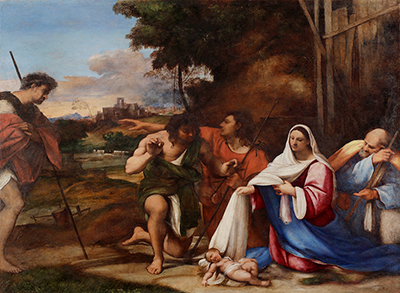
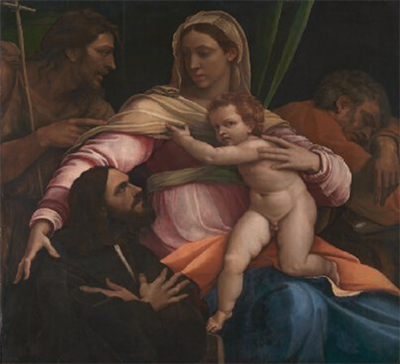
Sebastiano del Piombo's Madonna and Child with Saints and a Donor gathers the Virgin, Christ, Saint Joseph, Saint John the Baptist and a kneeling worshipper into a compact horizontal picture. The Virgin extends a protective arm around the donor. The Child looks outwards, while the Baptist's pointing gesture helps make him the focus of the surrounding figures. The result joins portraiture to devotion without dividing them into separate compartments.
The National Gallery, London, records the painting as NG1450 and dates it to 1517. Its fuller catalogue title identifies Joseph and John the Baptist explicitly. It is a distinct object from the Louvre's Holy Family with Catherine, Sebastian and a donor, despite the resemblance between their abbreviated English titles. [1]
At a Glance
- CollectionNational Gallery, London, NG1450
- Date1517
- DonorProbably Pierfrancesco Borgherini
Works in context
Contents
The Virgin's protective gesture
The Virgin's arm is central to the meaning of the group. It connects her body with the donor's shoulder and makes his proximity to the sacred figures visible. The gesture can be read as protective and welcoming without requiring the viewer to imagine a literal encounter that took place in an earthly room.
The kneeling position maintains a difference in status. The donor does not become another member of the Holy Family simply because he is close to Mary. His posture establishes devotion, while his recognisable individuality brings a person from the painting's own time into the sacred arrangement.
This balance is one of the composition's achievements. A portrait placed too independently could interrupt the devotional group; a donor made too generic could lose the force of personal presence. Sebastiano gives the figure an intelligible role in the whole while allowing the head to retain the specificity of a likeness.
The Child and the direction of attention
The Christ Child provides a point around which the figures' different attitudes can be organised. The Baptist's gesture identifies him, the Virgin supports him and the donor approaches the company in which he is central. The Child's outward attention also creates a relationship with the spectator beyond the painted group.
That outward look changes the devotional encounter. The viewer is not simply watching a closed scene from outside. The composition includes a route back towards us. A small face and a direction of gaze can perform this task more effectively than an exaggerated gesture.
Joseph's comparatively withdrawn presence supplies another register. The group contains attention, protection and repose at once. These differences keep the gathering from becoming a row of figures engaged in the same action, while the overall design continues to bind them together.
Diagonals within a horizontal picture
The format encourages a reading across the company, but diagonals give the image its internal movement. Arms, inclining heads and the Child's body direct the eye between different levels. The composition can feel stable without being inert because those lines repeatedly carry attention towards the principal figures.
Colour contributes another kind of organisation. Large areas of drapery establish the weight and position of bodies, while skin and smaller highlights bring faces and hands forward. The viewer can register the scene broadly, then move into the more particular encounter between the Virgin and donor.
This relationship between overall arrangement and local detail is worth preserving when comparing reproductions. A reduced image can make the scene look like a simple grouping. At a larger scale, the placement of fingers, the turn of a head and the meeting of differently lit surfaces become more consequential.
Sebastiano and Michelangelo
The painting belongs to the period of Sebastiano's close artistic relationship with Michelangelo. Their collaboration is documented through correspondence and through drawings associated with particular works. It should not be described as a uniform system in which one artist always supplied a complete design and the other merely coloured it.
For this picture, the National Gallery discusses a 1517 request for a design and a red-chalk drawing in Rotterdam that may have provided a starting point. The connection is plausible rather than certain in every detail. The painting itself does not show evidence of transfer from a full-sized cartoon. [1]
The distinction gives Sebastiano's role its proper scope. A small drawing could prompt the relationship between figures without predetermining every decision in the finished picture. Colour, likeness, surface and the development of the group remained problems for the painter working on the object.
Identifying the donor
The kneeling man is often identified as the Florentine merchant Pierfrancesco Borgherini, a patron associated with Sebastiano and Michelangelo. The National Gallery presents this as a likely identification, supported by the documentary and visual context, rather than an unquestionable name established by an inscription beside the sitter. [1]
That qualification should remain visible. Portrait identification often works through several kinds of evidence that reinforce one another: a commission described in a letter, a plausible date and comparison with other likenesses. Such a combination can be persuasive without eliminating every uncertainty.
The painting's human effect does not depend on suppressing the uncertainty. Whether or not the proposed name is accepted, the donor's position and individualised head establish a relationship between a contemporary person and the sacred figures. A name enriches that relationship historically; it does not create it pictorially.
A composition developed through making
Technical examination can reveal that a finished group did not emerge all at once. The National Gallery describes evidence that the donor's profile was established early and that the composition developed around it. Such findings help distinguish the sequence of making from the apparent completeness of the final image. [1]
For a viewer, this offers a useful alternative to imagining the painting as the straightforward execution of a single fixed plan. The process could include adapting a suggestion, accommodating a portrait sitting and reconsidering the relationship between figures. The coherent result contains the history of those decisions even where they are no longer visible to the unaided eye.
This is particularly significant in a work that joins portraiture and devotion. The practical requirements of likeness and the broader requirements of sacred composition had to be reconciled on one surface. The painting's balance is an achievement of that reconciliation, not proof that the process was effortless.
Looking between Venice and Rome
Sebastiano's career makes the painting an important meeting point between Venetian colour and the figure-based ambitions of Rome. Those terms are useful when they describe visible choices rather than rigid regional oppositions. The substantial bodies, coordinated gestures and saturated draperies belong to one functioning picture.
The work rewards attention to the transitions between its participants: an arm placed around a shoulder, a finger pointing, a head turned towards the viewer. Through these modest actions, a donor portrait becomes part of a devotional encounter. The most persuasive account preserves both the painting's unity and the qualified evidence through which its making and patronage are understood.
Artworks and records
Selected documented works and records relevant to this article; this is not a complete catalogue.
| Name | Date | Record |
|---|---|---|
| Holy Family with Catherine, Sebastian and a Donor | Sixteenth century | Painting |
| Madonna and Child with Saints and a Donor | 1517 | Painting |
| Martyrdom of Saint Agatha | 1520 | Painting |
| Portrait of a Lady with the Attributes of Saint Agatha | Early 1530s | Painting |
| Visitation | about 1519 | Painting |
Discussion
Share a reading of the figures, materials or relationships discussed in this article.
Reader Insights
Which detail most affects your reading?
Which comparison would you like to explore further?
Join the Conversation
Share a detail, comparison or question about The Madonna and Child with Saints and a Donor by Sebastiano del Piombo below.
References
- National Gallery, London, The Madonna and Child with Saints and a Donor, NG1450, 1517, object and technical discussion. View source.
- National Gallery, Michelangelo & Sebastiano: In focus, documented partnership and artistic context. View source.
- Giorgio Vasari, Life of Sebastiano del Piombo, historical account of the painter and his relationship with Michelangelo; read critically alongside object records. View source.
- National Gallery, Lady with the Attributes of Saint Agatha, NG24. View source.