 by Tom Gurney
Tom Gurney BSc (Hons) is an art history expert with over 20 years experience
Published on June 19, 2020 / Updated on November 6, 2026
Email: tomgurney1@gmail.com / Phone: +44 7429 011000
Martyrdom of Saint Agatha by Sebastiano del Piombo
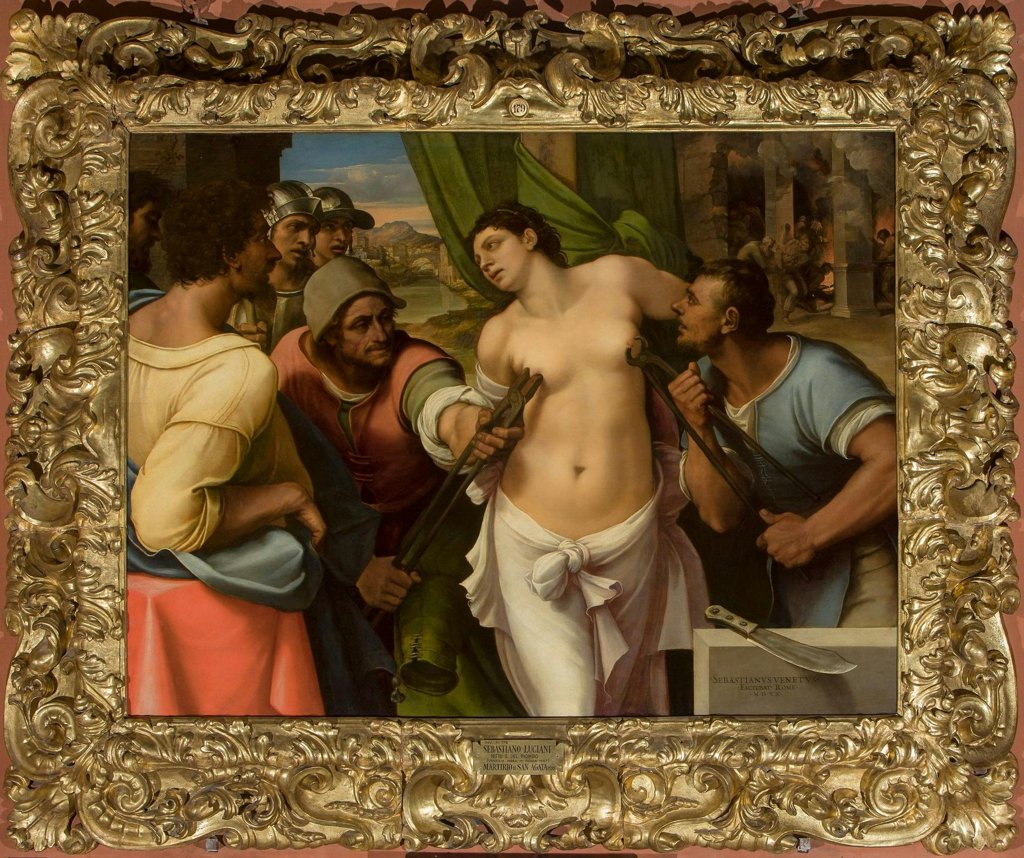
Sebastiano del Piombo's Martyrdom of Saint Agatha is a large horizontal painting in the Palatine Gallery at the Pitti Palace, Florence. It places the saint's exposed body among the men responsible for her torture, creating an unsettling contrast between carefully organised Renaissance form and an act of violence. Agatha remains the central presence, while gestures, instruments and surrounding figures make the threat to her body explicit.
The Uffizi Galleries record the work as oil on wood, 132 by 178 centimetres, inventory 1912 no. 179. It is signed and dated Rome 1520. This is a different painting from Sebastiano's later Portrait of a Lady with the Attributes of Saint Agatha in London. The narrative martyrdom and the portrait must be kept separate even though they concern the same saint. [1] [2]
At a Glance
- CollectionPalatine Gallery, Pitti Palace
- Date1520; related letter dated 1519
- Object1912 no. 179; oil on wood
Works in context
Contents
Agatha's story and its representation
Agatha belongs to the tradition of early Christian martyrs associated with Sicily. Her story centres on the refusal to submit to the demands of a powerful Roman official, Quintianus. The account of her suffering became an established subject of Christian art, in which the instruments and bodily consequences of torture served to identify her.
The tradition should be distinguished from a modern documentary account of the events. A Renaissance painter was working with a devotional narrative transmitted over centuries. The painting's historical significance lies in how that narrative was selected and represented for its own audience, rather than in its value as eyewitness evidence of third-century Sicily.
Sebastiano chooses the encounter with the torturers rather than a calm image of the saint displaying an attribute after the event. This brings the viewer close to the machinery of coercion. Her endurance is made visible through the contrast between her body and the actions directed against it.
Violence inside a controlled composition
The picture's horizontal structure accommodates several bodies without turning the scene into a confused crowd. The saint occupies a central position, while surrounding figures lean, reach and turn. Their actions carry attention across the surface and back towards her.
The organisation of the image matters ethically as well as visually. Beautifully painted skin and fabric can make a violent subject compelling to look at. The viewer is asked to confront suffering through a surface that also displays the painter's skill. That tension should be acknowledged rather than resolved by describing the scene only as beautiful or only as horrific.
The instruments sharpen the effect because they translate an abstract idea of persecution into an intelligible physical threat. Their hard shapes differ from the modelling of flesh and cloth. The painting uses that material contrast to make the violence immediate, while the broader arrangement prevents the details from becoming disconnected incidents.
The saint's presence
Agatha's significance does not depend solely on what the men do. Her head, posture and relation to the surrounding figures determine how the scene is read. The body is vulnerable, but it remains the point around which the composition is organised.
It is useful to distinguish vulnerability from passivity. A martyrdom picture can show a person subjected to force while also presenting resistance, steadfastness or spiritual attention. Those meanings are not established by an imaginary quotation from the sitter. They arise from the relation between visible actions and the religious narrative known to the audience.
The viewer's position is uncomfortable because the painting does not supply a neutral distance from the event. We can inspect the men, their tools and the saint within one field. The act of looking becomes part of the work's difficulty: the subject demands attention while making that attention troubling.
A Roman commission and a Venetian painter
The Uffizi connects the painting with Cardinal Ercole Rangone and a letter that Sebastiano sent to Michelangelo on 29 December 1519 about a recently finished work. The signed 1520 date belongs to the object. These pieces of evidence should be reported together rather than treated as a reason to erase one date in favour of the other. [1]
Sebastiano's position between Venice and Rome helps explain the painting's formal ambition. He had brought to Rome a strong interest in colour and atmosphere, while his developing relationship with Michelangelo sharpened the importance of the monumental human figure. Those elements do not operate as two separable layers. Bodies, gestures and coloured fabric form one visual system.
The scene's breadth is especially striking in that context. A format suitable for a calm gathering can also accommodate an act of violence. The effect depends on the differences of action within a stable overall design. The composition gives the event weight without requiring every figure to share the same emotional emphasis.
Foreground and background
The foreground establishes proximity through bodies and objects close to the lower edge. The surrounding setting then carries the eye beyond the immediate encounter. A troubled architectural background adds another scale of disturbance to the human violence taking place before it.
The relationship is more important than a catalogue of isolated symbols. The foreground makes the threat tangible; the distance enlarges the world in which it occurs. A building, a landscape opening or an area of fire can contribute to narrative atmosphere while also balancing the arrangement of the principal figures.
This is a useful way to approach the painting's detail. First identify the overall distribution of bodies and light. Then consider how a smaller object changes the reading of an action. The most forceful details are effective because the composition has already given them a place within the larger encounter.
A documented early response
Vasari included the painting in his life of Sebastiano and associated it with the collection of the Duke of Urbino. His account is a historical response, written after the work was made, rather than a substitute for the surviving object and modern collection record. It nevertheless shows that the painting's subject and force were noticed within the sixteenth century. [3]
The Uffizi records its later arrival in Florence with Vittoria della Rovere's dowry in 1631. That passage into the Medici collections belongs to its history as a portable and valued painting, distinct from the original circumstances of its commission. [1]
The work should finally be compared with the London Agatha portrait to clarify, rather than blur, its identity. The London painting represents one woman with attributes that technical examination identifies as later additions. The Pitti painting stages the martyrdom itself. Keeping that distinction intact allows each object to raise its own questions about devotion, bodies, identity and the uses of painting.
Artworks and records
Selected documented works and records relevant to this article; this is not a complete catalogue.
| Name | Date | Record |
|---|---|---|
| Holy Family with Catherine, Sebastian and a Donor | Sixteenth century | Painting |
| Madonna and Child with Saints and a Donor | 1517 | Painting |
| Martyrdom of Saint Agatha | 1520 | Painting |
| Portrait of a Lady with the Attributes of Saint Agatha | Early 1530s | Painting |
| Visitation | about 1519 | Painting |
Discussion
Share a reading of the figures, materials or relationships discussed in this article.
Reader Insights
Which detail most affects your reading?
Which comparison would you like to explore further?
Join the Conversation
Share a detail, comparison or question about Martyrdom of Saint Agatha by Sebastiano del Piombo below.
References
- Uffizi Galleries, Martyrdom of St Agatha, Palatine Gallery, 1912 no. 179. View source.
- National Gallery, London, Portrait of a Lady with the Attributes of Saint Agatha, NG24, distinct comparison painting. View source.
- Giorgio Vasari, Life of Sebastiano del Piombo, historical description of the Agatha painting. View source.
- Splash image: Sebastiano del Piombo, Martyrdom of Saint Agatha, 1520, Galleria Palatina, Palazzo Pitti, inventory no. 179. Photograph: Le Gallerie degli Uffizi. View source.