by Tom Gurney
Tom Gurney BSc (Hons) is an art history expert with over 20 years experience
Published on June 19, 2020 / Updated on November 6, 2026
Email: tomgurney1@gmail.com / Phone: +44 7429 011000
Portrait of Charles the Bold: A Historical Attribution Question
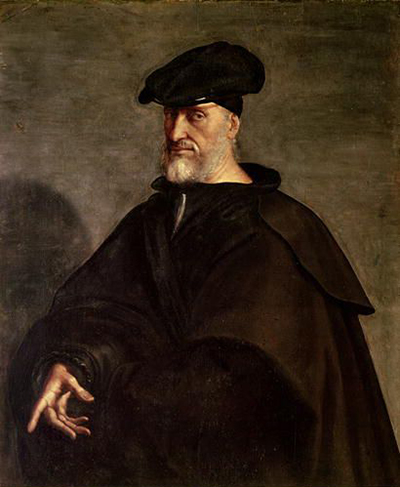
The title Portrait of Charles the Bold has been attached to a painting in the Statens Museum for Kunst, Copenhagen, inventory KMSsp142, traditionally associated with Sebastiano del Piombo. Neither the sitter's name nor the artist's name should be treated as an unquestioned result. The work is a useful case in which a familiar label preserves the history of an attribution rather than settling the identity of the person and painter.
Fabio Franz's study of the Danish investigations of Crowe and Cavalcaselle discusses KMSsp142 as a portrait of a warrior, with Charles the Bold proposed in parentheses. He relates it to the composition of Dosso Dossi's Saint William of Aquitaine in the Royal Collection, RCIN 405775, and questions the traditional assignment to Sebastiano. The comparison is an attributed scholarly argument, not a licence to rename every similar armoured figure automatically. [1]
At a Glance
- ObjectSMK KMSsp142
- Historical titlePortrait of Charles the Bold
- StatusArtist and sitter identifications require qualification
Contents
What the title can establish
A portrait title may contain several different kinds of information. “Portrait” identifies a general category. “Warrior” describes a role suggested by appearance. “Charles the Bold” proposes a historical individual. These statements do not all have the same evidential strength.
The distinction matters because an armoured figure may be a likeness, a saint, an invented historical character or a later version of an earlier composition. Armour alone cannot decide among those possibilities. A name recorded in an old inventory can guide research while still requiring comparison with other likenesses and documentary sources.
Charles the Bold died in 1477, before Sebastiano's career. A painting associated with the later artist could therefore not be a portrait made from a contemporary sitting with that ruler. If the identification were accepted, the image would have to be understood through a posthumous portrait tradition or another form of historical representation. That chronological distinction should remain explicit.
The Copenhagen object and the Royal Collection comparison
Franz identifies the Copenhagen painting as oil on panel, 90 by 67 centimetres. His comparison is with the different support, dimensions and attribution of the Royal Collection's Saint William of Aquitaine. Keeping the two inventory numbers separate prevents a discussion of related compositions from becoming a false assertion that the records concern one travelling object. [1]
A compositional relationship can take several forms. One work may copy another; both may descend from a lost design; or a later painter may adapt a familiar arrangement to a new subject. The relationship has to be investigated through the actual correspondences of pose, costume, objects and setting.
The word “variant” is useful precisely because it does not require every detail to match. It directs attention towards both continuity and difference. Those differences may be particularly important when a religious figure is reinterpreted as a secular ruler or when a collector supplies a prestigious historical name.
Why an armoured figure can change identity
Renaissance images of military saints often use the same language of authority that appears in secular portraits: armour, a commanding pose, a prominent head and objects associated with status or service. The shared visual vocabulary can make a subject easy to recognise in general terms but difficult to identify exactly.
A saint's attribute may once have clarified the image. If that detail is lost, altered, cropped or overlooked, later viewers may read the remaining figure as a historical commander. This is a possible mechanism of changing interpretation, not a claim that a particular alteration has been technically demonstrated on KMSsp142.
Conversely, a secular portrait can acquire religious associations through later interpretation or modification. The important point is that subject identification requires the whole object and its history. A title in a reproduction catalogue is a starting point for that work, rather than independent proof of it.
Artist attribution is a separate question
Identifying the sitter and identifying the painter are connected but distinct tasks. A correct name for the subject would not automatically establish Sebastiano as the author. Equally, accepting a painter's hand would not necessarily tell us who the figure represents.
The traditional Sebastiano label belongs to the history of the work's reception. Franz's discussion places it within the nineteenth-century study of paintings in Danish collections and draws attention to the need for comparison beyond that inherited name. His point is specific: the Copenhagen object has a relationship with a composition associated with Dosso. It should not be expanded into an unsupported reconstruction of a commission, workshop or chain of copies. [1]
This is how a useful attribution discussion differs from a list of competing names. Each proposal should explain something visible or documented. An attribution becomes stronger when it accounts for the handling, design, materials and chronology together, rather than depending on one vaguely similar face or pose.
Copying as evidence rather than failure
A work related to another composition need not be dismissed as worthless. Copies and variants preserve evidence of demand, circulation and changing interpretation. They can show which images remained useful to collectors and how a composition acquired new identities in different settings.
The critical task is to describe the relationship accurately. “After”, “workshop of”, “attributed to” and “variant of” make different claims. Substituting one for another can produce a misleading certainty even when the underlying comparison is sensible.
For KMSsp142, the responsible account keeps the historical title, inventory number and qualified attribution visible while explaining the Dosso comparison. It does not need to invent a moment at which Sebastiano met Charles the Bold, an impossible sitting, or a lost commission for which no evidence has been supplied.
An inventory number is especially valuable when old titles migrate into reproduction catalogues. The same historical name can be attached to several related images, while one physical painting may appear under several names. KMSsp142 fixes the Copenhagen object in that unstable field of labels. It allows a reader to follow a comparison without assuming that every Portrait of Charles the Bold reproduced elsewhere must have the same dimensions, support, authorship or collection history.
Reading the historical label today
The published SMK photographic metadata preserves the title Portrait of Charles the Bold and Sebastiano's name, while the scholarly study makes the uncertainty explicit. These sources perform different functions. The photographic record identifies the image that has circulated under the label; the research examines what that label can support. [1] [2]
The painting is therefore best approached as an object with a history of interpretation. Its interest includes the effort to recognise authority in an armoured figure and the ways in which collectors and scholars have assigned names to that presence. A carefully qualified title allows those questions to remain open without pretending that the object has no identity at all.
Artworks and records
Selected documented works and records relevant to this article; this is not a complete catalogue.
| Name | Date | Record |
|---|---|---|
| Holy Family with Catherine, Sebastian and a Donor | Sixteenth century | Painting |
| Madonna and Child with Saints and a Donor | 1517 | Painting |
| Martyrdom of Saint Agatha | 1520 | Painting |
| Portrait of a Lady with the Attributes of Saint Agatha | Early 1530s | Painting |
| Visitation | about 1519 | Painting |
Discussion
Share a reading of the figures, materials or relationships discussed in this article.
Reader Insights
Which detail most affects your reading?
Which comparison would you like to explore further?
Join the Conversation
Share a detail, comparison or question about Portrait of Charles the Bold: A Historical Attribution Question below.
References
- Fabio Franz, “Disvelando pale, effigi e panneggi: Le ricognizioni danesi di Crowe e Cavalcaselle”, MDCCC 1800 7, 2018, discussion of KMSsp142 and Royal Collection RCIN 405775. View source.
- SMK photographic metadata for KMSsp142, preserved with the museum-sourced image and historical title. View source.