 by Tom Gurney
Tom Gurney BSc (Hons) is an art history expert with over 20 years experience
Published on June 19, 2020 / Updated on October 2, 2026
Email: tomgurney1@gmail.com / Phone: +44 7429 011000
The Raising of Lazarus by Sebastiano del Piombo: Introduction
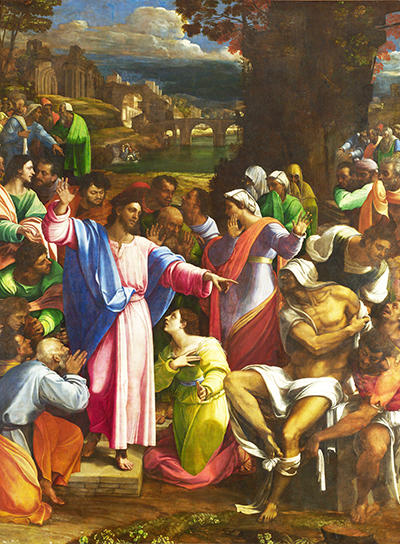
Sebastiano del Piombo’s The Raising of Lazarus turns Christ’s miracle into a crowded public event. More than forty figures gather around the tomb, reacting through kneeling bodies, raised hands, turned heads and sudden recoil. Christ stands at the centre of the command, while Lazarus sits on the tomb edge, still bound in burial cloths and suspended between death and restored life.
Painted in Rome between 1517 and 1519 for Narbonne Cathedral, the enormous altarpiece united Sebastiano’s Venetian command of oil and colour with the monumental figure design of central Italy. Michelangelo supplied designs for some of its principal figures, most securely for the revived Lazarus, yet the painting is not simply a Michelangelo idea executed by another hand. The National Gallery credits it to “Sebastiano del Piombo, incorporating designs by Michelangelo,” a formulation that recognises collaboration without surrendering Sebastiano’s authorship. Technical study has strengthened that distinction: Sebastiano began and developed the composition, made extensive revisions as he painted, and incorporated Michelangelo’s intervention into an already ambitious work.[1]
Its subsequent history is almost as eventful as its making. Removed from Narbonne in the eighteenth century, transferred from its original wooden panel to canvas, transferred again to a modern composite support, and affected by changes in several pigments, the painting no longer looks exactly as it did in 1519. It nevertheless remains a commanding record of Sebastiano at the height of his Roman career—and, as inventory number NG1, a landmark in the history of the National Gallery itself.
At a Glance
- TitleThe Raising of Lazarus
- Artist creditSebastiano del Piombo, incorporating designs by Michelangelo
- Date1517–19
- Medium and supportOil, originally on wood, transferred to composite board
- Dimensions381 × 289.6 cm
- Commissioned byCardinal Giulio de’ Medici, probably in late 1516
- Original destinationThe Cathedral of Saint-Just and Saint-Pasteur, Narbonne
- Current collectionNational Gallery, London
- Inventory numberNG1
Contents
- Introduction
- The biblical story—and a crowd learning how to see
- A commission for Narbonne—and a consequential pairing with Raphael
- Michelangelo’s drawings and Sebastiano’s authorship
- How the composition turns narrative into movement
- Colour, light and the evidence of revision
- From wooden altarpiece to composite support
- Narbonne, Orléans, Angerstein and the meaning of NG1
- How to look—and why the painting still matters
The biblical story—and a crowd learning how to see
The subject comes from the Gospel of John. Lazarus of Bethany has fallen ill, and his sisters, Martha and Mary, send for Christ. By the time Christ arrives, Lazarus has been in the tomb for four days. Martha first meets him outside the village and declares her faith that God will grant what he asks. Mary then comes with mourners, and Christ is moved by their grief. At the tomb he orders the stone removed, prays, and calls Lazarus out. The dead man emerges bound in grave cloths, and Christ tells the onlookers to free him.[2]
Sebastiano does not illustrate the emergence from a cave. He concentrates the drama into the moment immediately after Christ’s command—“Lazarus, come forth”—when the revived man is already seated on the rim of a stone sarcophagus. This choice makes the miracle visible as a bodily fact. Lazarus is neither a distant silhouette nor a serene emblem. His pallid torso turns with effort; one leg lifts; his arms strain against the cloth that still holds him. A kneeling man at the right works to unwind the shroud, while another figure braces Lazarus from behind. Resurrection here has weight, resistance and temperature. The living must handle the body of the man who has just ceased to be dead.
Christ stands to the left, dressed in blue and red. His right hand rises, connecting the event to divine power, while his left arm points across the composition towards Lazarus. The two gestures have different directions but one purpose. They make Christ the hinge between heaven and the newly animated body. A generous interval separates him from the tomb. Rather than fill that gap, Sebastiano allows the command to travel through it, turning empty ground into charged space.
Around these two poles, the crowd supplies a spectrum of possible responses. Mary kneels near Christ’s feet, looking upward. Martha, placed closer to Lazarus, raises both hands and turns away. Her averted face may register amazement, fear, or the shock of confronting the brother whose death she had accepted. Saint Peter kneels at the lower left. Behind him, disciples confer. To the right, men and women lean forward or pull back, and one woman covers her nose—a reminder of Martha’s warning in John that the body had lain four days in the tomb. Sebastiano converts the biblical detail into an immediate sensory response.
No single reaction explains the event. The painting gives us faith, doubt, curiosity, physical disgust, concentration and wonder at once. Some witnesses look at Lazarus, some at Christ, and others at their neighbours. Their sightlines create paths across the surface, so that viewing the painting begins to resemble joining the crowd. We too must decide where to look, what to believe, and how the separate human responses relate to the central miracle.
This multiplication of witnesses also serves the altarpiece’s religious purpose. The subject is not resurrection as an abstract doctrine; it is a sign disclosed before a community. In John’s account, the miracle anticipates Christ’s own death and resurrection and intensifies the conflict that will lead to the Passion. Sebastiano’s figures therefore confront both a restored life and a prophecy. Lazarus is living evidence of Christ’s power, but the burial cloths around him keep mortality visibly present.
A commission for Narbonne—and a consequential pairing with Raphael
Cardinal Giulio de’ Medici, a cousin of Pope Leo X and the future Pope Clement VII, probably commissioned the altarpiece in late 1516. He had become archbishop of Narbonne in 1515, although he governed the southern French see from Rome. Lazarus had particular resonance for Narbonne because local tradition associated the saint with preaching in the region. A monumental image of the miracle could therefore speak both to a central Christian belief and to local sacred identity.[1]
Giulio commissioned another large altarpiece for the same cathedral at about the same time: Raphael’s Transfiguration. The subjects formed an intelligible pair. The Transfiguration reveals Christ’s divine glory on a mountain; the raising of Lazarus demonstrates his power over death before a gathered crowd. Medieval and Renaissance traditions had already connected the two manifestations of divinity. The Vatican Museums, where Raphael’s painting is now held, confirms that the two works were intended for Narbonne, although only Sebastiano’s was ultimately sent there.[3]
The double commission inevitably placed the painters in comparison. Raphael was the leading painter at the papal court, directing a large workshop and engaged on some of Rome’s most prestigious projects. Sebastiano, a Venetian who had moved to Rome around 1511, had established himself through works that combined atmospheric colour with increasingly monumental figures. His friendship with Michelangelo gave him access to drawings and ideas from Raphael’s most formidable rival.
Surviving letters show anxiety about the two altarpieces, their schedules and their possible display together. They are vivid evidence, but they are not neutral transcripts of an evenly staged contest. Much of the correspondence comes from Sebastiano’s circle and was addressed to Michelangelo. It reflects the loyalties, suspicions and tactical language of that group. The documents support the existence of competition and concern over comparison; they do not require every compositional choice to be read as a move in a personal duel.[4]
The chronology helps keep the story in proportion. Early in 1517, a letter reported arrangements for timber and money for Sebastiano’s panel. Work continued through 1517 and 1518, with periods of delay. Sebastiano wrote to Michelangelo in July 1518 that the altarpiece was almost finished, but he remained wary of allowing Raphael to see it before Raphael’s own work had advanced. By May 1519 The Raising of Lazarus was sufficiently complete to be viewed in Sebastiano’s studio. It was varnished and shown at the Vatican in December, where reports described an admiring reception.[5]
Raphael’s Transfiguration followed a different and ultimately tragic course. Raphael died on 6 April 1520, leaving a work that became closely bound to the memory of his death. Later that month, Sebastiano’s and Raphael’s altarpieces were brought together for comparison. Sebastiano wrote that he had carried his panel to the palace beside Raphael’s and had no cause for shame. The remark is proud, but it also reveals the extraordinary standard against which the work was tested.[5]
The paintings did not remain a pair. Cardinal Giulio kept Raphael’s original in Rome and eventually gave it to San Pietro in Montorio; a copy was sent to Narbonne instead. Sebastiano’s altarpiece travelled to the cathedral, where it occupied the setting for which it had been designed. The episode is therefore not simply the story of Raphael defeating Sebastiano or of Michelangelo trying to defeat Raphael through a proxy. It is the story of two major, distinct responses to a linked commission—responses that developed in awareness of one another and helped define the possibilities of the monumental Roman altarpiece.
For Sebastiano, the commission was transformative. It allowed him to make a work on the scale and public importance of Raphael’s great altarpieces while demonstrating qualities that remained his own: saturated oil colour, slowly built atmosphere, tactile flesh and fabric, and a particular gravity in the meeting of bodies and landscape. To understand that achievement, Michelangelo’s contribution must be neither minimised nor allowed to consume the whole.
Michelangelo’s drawings and Sebastiano’s authorship
The National Gallery’s credit—“Sebastiano del Piombo, incorporating designs by Michelangelo”—is unusually precise. It names the painter and records the presence of another artist’s designs. The wording matters because collaboration in Renaissance art could take many forms. A drawing supplied by one artist might be copied closely, adapted, combined with other studies, or altered during painting. Authorship cannot be reduced to the first person who imagined a pose.
Michelangelo’s most securely documented contribution concerns Lazarus. Related red-chalk studies survive in the British Museum and the Musée Bonnat-Helleu in Bayonne. The British Museum sheet studies the revived man seated on the tomb, supported by other figures and entangled in his shroud. It records more than one stage of thought, including a study drawn with the sheet inverted. Museum scholarship describes how the development of Michelangelo’s conception can be traced across the related sheets and how Sebastiano combined elements from them in the painted group.[6]
That evidence does not make the finished Lazarus a mechanical enlargement of a single drawing. In the altarpiece, the revived man belongs to a tightly organised group: helpers pull and support him; the tomb establishes a horizontal ledge; the shroud makes a pale, broken rhythm around his body; and Christ’s gesture reaches him across open space. Sebastiano had to translate red chalk into coloured, life-size flesh, integrate the pose into changing light, and bind it to neighbouring figures. The transformation from study to painting is itself an act of design.
Technical examination has further complicated the older idea that Michelangelo planned the essential work and Sebastiano merely realised it. Research presented by the National Gallery in connection with its 2017 exhibition concluded that Michelangelo intervened at a relatively advanced stage, revising the figure of Lazarus after Sebastiano had already painted it. Infrared and other forms of examination reveal substantial changes and support a more independent role for Sebastiano during the composition’s development.[7]
The evidence for Michelangelo’s involvement elsewhere is less uniform. His designs have been connected with other principal figures, and scholars have often considered a role in the conception of Christ. Yet the degrees of certainty should remain visible. Extant drawings establish the Lazarus group most clearly; broader claims depend on comparisons, documentary context and interpretation. The safest account is not that Michelangelo “painted through” Sebastiano, nor that his contribution was negligible. He supplied potent designs that Sebastiano selected and assimilated within a work whose pictorial structure, oil technique and execution remained Sebastiano’s responsibility.
This balance clarifies the character of their partnership. Sebastiano del Piombo brought knowledge that Michelangelo, primarily a sculptor and fresco painter, did not possess in the same form: the behaviour of oil over a large surface, the use of translucent glazes, the orchestration of intense colours, and the creation of atmospheric depth. Michelangelo offered an unrivalled understanding of the expressive body and poses that could carry narrative pressure. Their collaboration was valuable because the two practices were different.
The distinction can be felt in Lazarus himself. The pose has Michelangelesque torsion and muscular force, but its meaning depends on Sebastiano’s paint. The skin is a sickly mixture of warmth and pallor; the white bindings flash against darker bodies; the shadows around the torso give the figure both bulk and an unsettling proximity to the tomb. Form and colour work together. Drawing supplies an anatomy of revival, while painting makes resurrection appear as a change in the state of flesh.
Sebastiano also revised freely. Beneath the visible surface, the design is not the product of a perfectly fixed cartoon transferred once and obeyed. Technical study found broadly brushed preparatory layers, underdrawing executed with a brush, particles consistent with charcoal in places, and alterations made as the composition evolved. This is a painter thinking at full scale. Even when a borrowed design entered the process, it entered a living structure rather than a predetermined diagram.[8]
The authorship question therefore leads back to the visible work. Who established the great alternation of blue, red, green, yellow and white? Who adjusted the figures to the breadth of the panel, embedded them in landscape, and used layers of oil to give draperies different depths and textures? Those are not secondary matters. They are the means by which the image exists. Michelangelo’s contribution is essential to the painting’s history; Sebastiano’s authorship is essential to the painting itself.
How the composition turns narrative into movement
At first glance, the altarpiece can seem almost overfull. Yet its crowd is not an undifferentiated mass. Sebastiano arranged the action in interlocking zones and used gesture to move attention between them. Christ anchors the left foreground; Lazarus and his helpers occupy the right; Mary and Martha help bridge the central interval; disciples and witnesses extend the narrative towards both edges. The distant landscape carries the eye upward, but the high horizon ensures that the human drama remains dominant.
The principal movement runs from Christ’s raised hand down through his body, outward along his pointing arm, and across to Lazarus. Lazarus reverses that directional force. His body twists back towards Christ while his raised knee and diagonal limbs push into the space around the tomb. The relationship is not a simple straight line. It is a tension between command and response, stability and effort. Christ stands; Lazarus struggles to sit. One is composed and declarative, the other newly subject to gravity.
Mary creates a lower counterpoint. Kneeling at Christ’s feet, she directs attention upward while her position stabilises the base of his figure. Martha’s lifted hands repeat the language of revelation but break it into surprise. Saint Peter’s kneeling form at lower left helps keep the foreground from dispersing, while the turning disciples behind him make the miracle propagate through conversation. On the right, the labour of unbinding Lazarus turns belief into action.
Sebastiano’s use of a high horizon has precedents in contemporary altarpiece design, including Raphael’s Christ Falling on the Way to Calvary, often called the Spasimo di Sicilia. Bringing the chief action into the lower foreground allows it to read at a distance, while roads, architecture and smaller figures can extend the story behind it. This was an effective answer to the difficulty of fitting a multi-figure narrative into a tall vertical panel. Sebastiano’s solution is not a copy, however. His broad foreground feels like a stage cut into deep terrain, and his figures carry a Venetian richness of colour that repeatedly interrupts pure linear flow.[1]
The landscape is easy to neglect because the bodies are so commanding. On the left, a walled settlement and water lead towards bluish mountains. On the right, trees and broken ground frame the tomb. The setting distances the miracle from ordinary urban life while keeping that life visible. People continue to occupy roads and buildings beyond the immediate witnesses. The effect is temporal as well as spatial: a singular event unfolds in the foreground while the wider world persists behind it.
Architecture appears in fragments rather than as a complete classical setting. The stone tomb is the most important construction, functioning as grave, platform and measure of Lazarus’s body. Its hard edges intensify the softness of shroud and flesh. The deep opening beside the revived man retains the darkness from which he has emerged. Resurrection does not erase the tomb; it reorganises the picture around a body that no longer belongs inside it.
Repeated arms and hands give the composition its nervous energy. Christ points. Martha raises both hands. Lazarus’s helpers grip cloth and body. Disciples indicate, question and shield themselves. These gestures are not only expressive additions to faces; in a work designed to be seen from below and at a distance, they are the clearest syntax of the story. They tell viewers where power originates, where it lands, and how astonishment spreads.
The crowd also prevents the miracle from becoming effortless spectacle. Lazarus’s emergence demands assistance. The witnesses do not instantly agree on what they have seen. Their reactions unfold at different speeds. Sebastiano thereby preserves the narrative’s human difficulty: a divine command has been issued, but bodies and minds must catch up. The painting’s grandeur lies partly in this refusal to make revelation simple.
Colour, light and the evidence of revision
Sebastiano was born and trained in Venice, where oil painting had developed exceptional capacities for saturated colour, translucent shadow and atmospheric unity. In Rome he encountered the monumental bodies and complex figure arrangements associated with Michelangelo and Raphael. The Raising of Lazarus brings those traditions together without dissolving their differences. Its forms are emphatic, but colour is not merely applied to them; colour organises the drama.
Christ’s blue mantle and red robe make him the strongest chromatic anchor on the left. Across the painting, green, yellow, orange, rose, violet and white recur in shifting intensities. Large areas of drapery establish a pattern visible from a distance, while glazes create subtler changes within each cloth. The eye moves not only along outlines and gestures but from one colour interval to the next.
In several passages Sebastiano shifts abruptly from one hue to another instead of modelling fabric only through lighter and darker tones of the same colour. The acid yellow-green clothing near the centre is a conspicuous example. Such colour changes evoke iridescent textiles and connect Sebastiano’s palette to Michelangelo’s bold juxtapositions on the Sistine Chapel ceiling, while the oil medium gives the effects transparency and layered depth.[1]
Technical examination reveals expensive and carefully manipulated materials. Ultramarine contributes to Christ’s mantle; red lakes and other pigments enrich robes and flesh; powdered glass was used in paint mixtures, probably helping the drying of oil. Sebastiano often built flesh from darker foundations towards lighter passages. The method gives bodies weight and allows light to appear embedded in the paint rather than simply laid across a pale ground.[8]
The work also preserves evidence of experimentation. Brush underdrawing and compositional alterations show that figures and contours were adjusted during execution. This matters for how we imagine the studio. The altarpiece did not advance in a perfectly straight line from complete design to coloured surface. Sebastiano worked through problems on the panel, responding to new drawings, to relationships between figures and perhaps to knowledge of Raphael’s progress. Revision was not a sign of uncertainty alone; it was one of the instruments by which the complex design became coherent.
Light in the painting is expressive rather than mechanically uniform. Lazarus’s pale wrappings and exposed torso stand out beside the dark tomb. Mary’s face and clothing are illuminated so that devotion remains legible within the crowd. Some figures seem almost spotlit, while others sink into shadow or turn away. The unevenness helps articulate psychological distance. Those most important to the action are not simply closest to an imaginary light source; they receive the light needed to make the narrative read.
The colours visible today are not identical with the colours Sebastiano first laid down. The painting has undergone extensive structural treatment, and several pigments have changed chemically. The sky, intended as a deeper blue appropriate to late afternoon, has darkened. Red and yellow materials have altered in different ways. Flesh transitions may appear harsher than they originally did, and earlier restorations introduced abrasion and repainting. The present surface preserves evidence of Sebastiano’s design and technique, but it is not an untouched window onto 1519.[8]
This material history sharpens close looking. A darkened sky is not automatically a deliberate nocturne, and a startling flesh contrast may combine original intention with later change. The autumnal foliage and coloured robes still communicate the painting’s ambitious harmony, while technical evidence shows how much the surface has aged, been treated and been reinterpreted over time.
From wooden altarpiece to composite support
The support history of The Raising of Lazarus is unusually dramatic. Sebastiano painted it on a large wooden panel assembled for the Narbonne commission. The vertical boards had to carry an immense, heavy painted surface. Documentary and technical evidence suggest that the original construction was sound enough to remain in use for centuries; later intervention, rather than catastrophic original failure, produced many of the complications now associated with the work.[8]
After the altarpiece entered the Orléans collection, it was moved to Paris. In 1771 the restorer Jean-Louis Hacquin began transferring the paint from wood to canvas. This process was far more invasive than relining a canvas painting. The wood was progressively removed from the back, along with much of the original preparatory structure, until the fragile paint layer could be attached to a new fabric support. The operation changed the object permanently. The painting that had left Sebastiano’s studio as oil on panel became, in physical terms, a transferred painting.
Transfer was once promoted as a means of saving panel paintings from warping, splitting or decay. It could also make very large works easier to transport. Yet it sacrificed evidence: the original boards, joins and parts of the ground were lost. In this case, the eighteenth-century intervention introduced a new pinkish-brown transfer layer behind the paint. The work’s later behaviour cannot therefore be understood as the behaviour of Sebastiano’s original panel alone.
The canvas support developed problems. Glue layers responded to changes in humidity and contributed to compression and lifting. Blisters were recorded in the twentieth century, and the painting suffered small flake losses during the Second World War. Its enormous size magnified every structural challenge. A slight movement across almost four metres could place significant stress on a brittle paint film already separated from its first foundation.[8]
Between 1958 and 1967, the National Gallery undertook another major structural treatment. The nineteenth- and eighteenth-century supporting layers were removed as far as judged necessary, and the paint was attached through a wax-resin system to new materials, including a synthetic fabric and a composite board built around a lightweight core. Retouching took months. The treatment stabilised the painting and allowed it to be displayed, but it also added another chapter to an object whose physical identity had repeatedly changed.[8]
The current support is lighter and more rigid than the original panel would have been, although it can still flex and twist. For that reason, moving the painting is a substantial operation. Its size is only part of the difficulty; conservators and art handlers must protect a complex laminate whose historic paint has survived multiple separations and reattachments.
Conservation history affects more than logistics. It sets limits on certainty about surface and colour. The loss of the original ground, changes in pigments, old cleanings and retouchings complicate any attempt to reconstruct exactly how the altarpiece first appeared. At the same time, technical investigation has recovered knowledge that the visible surface alone cannot supply: how Sebastiano underdrew, where he revised, which pigments he chose, and how later materials entered the structure.
It is tempting to treat conservation as an afterlife separate from art history. Here the two are inseparable. The painting’s transfers influenced how generations saw Sebastiano’s modelling; pigment changes influenced interpretations of his light; structural interventions made possible its continued public presence. The Raising of Lazarus is both a Renaissance altarpiece and a record of changing beliefs about how paintings should be preserved.
Narbonne, Orléans, Angerstein and the meaning of NG1
After the comparison with Raphael’s Transfiguration in Rome in April 1520, The Raising of Lazarus was sent to Narbonne. There it remained for roughly two centuries. An early visitor’s account and later records attest to the high value attached to the work, while copies helped extend its reputation beyond those able to see the original in the cathedral.[9]
The painting left Narbonne in the early eighteenth century and entered the collection of Philippe II, Duke of Orléans, Regent of France during the minority of Louis XV. The circumstances were bound up with negotiation between the Regent and the cathedral chapter. A copy by Carle van Loo replaced Sebastiano’s original at Narbonne, and the lower part of an early frame associated with the altarpiece survives there. The exchange moved the painting from a liturgical setting into one of Europe’s most celebrated princely collections.[8]
During the French Revolution, the Orléans collection was dispersed. The Raising of Lazarus appeared in the London sale of 1798 and was purchased by the banker and collector John Julius Angerstein for 3,500 guineas, a price that indicates its exceptional status. In Angerstein’s house the painting became part of a compact but distinguished collection that helped shape the idea of a national picture gallery in Britain.
When the British government bought 38 paintings from Angerstein’s heirs in 1824, the purchase founded the National Gallery. Sebastiano’s altarpiece received inventory number NG1. That number does not mean it was the Gallery’s first purchase considered in isolation; it identifies the first entry in the catalogue of the foundational group. Nevertheless, NG1 gives the work a distinctive institutional identity. A painting made for a French cathedral by a Venetian working in Rome became a starting point in the public history of Britain’s national collection.[1]
Its provenance changes the conditions under which it is viewed. At Narbonne, the altarpiece’s height, architectural frame and sacred setting would have shaped its meaning. In the Orléans collection, it entered a dynastic display of artistic prestige. In Angerstein’s house, it represented both connoisseurship and economic power. At the National Gallery, it became available to a broad public and was repeatedly classified, cleaned, moved and reinterpreted.
None of those settings is neutral, and none cancels the others. The painting carries traces of all of them: the scale of a cathedral commission, the transfer associated with its Parisian collection history, the fame that justified Angerstein’s purchase, and the number that ties it to the Gallery’s foundation. Provenance here is not a list appended to the art. It is part of the explanation for why the object looks as it does and why it matters now.
How to look—and why the painting still matters
Begin at a distance. Let the two principal forces become clear: Christ’s calm, extended gesture on the left and Lazarus’s twisting return to life on the right. Notice how the gap between them remains open. Sebastiano could have filled it with another figure, but the empty ground allows command and response to face one another. The miracle occupies an interval.
Then follow the reactions. Move from Mary kneeling at Christ’s feet to Martha’s raised hands, from Saint Peter at the lower left to the disciples behind him, and from the helpers around the tomb to the witnesses at the far right. Ask which figures see Lazarus, which see Christ, and which look towards someone else. The crowd is a map of attention. Every diverted gaze changes the pace at which the event becomes understood.
Look next at the body of Lazarus. Michelangelo’s designs help explain its concentrated physical power, but Sebastiano’s paint determines its disturbing presence. Compare the flesh to the white shroud and to the warmer bodies nearby. The colouring marks Lazarus as neither corpse nor fully recovered man. Technical research warns that time has sharpened some contrasts, yet the basic idea remains: restored life is shown as a difficult transition embodied before us.
Now allow colour to compete with story. Follow Christ’s blue across the reds, greens and yellows of the crowd. Seek passages where a drapery shifts abruptly from one hue to another. Notice how white appears in bindings, sleeves and head coverings, repeatedly catching the eye. The chromatic sequence prevents the many figures from collapsing into brown shadow and reveals Sebastiano’s Venetian inheritance within a Roman monument.
Finally, look into the landscape and the tomb. The distant city reminds us that the miracle belongs to a world beyond this gathering. The open grave reminds us that resurrection has not abolished death as an idea; it has reversed one death as a sign of power and promise. The altarpiece holds distance and immediacy, theology and bodily effort, in the same field.
The painting matters because it resists the easiest versions of its own story. It is not only a document of rivalry with Raphael. It is not only a collaboration with Michelangelo. It is not only an early National Gallery treasure or a damaged survivor of drastic transfers. Each of those histories is true, but Sebastiano’s achievement lies in making them converge on a persuasive image: one voice commands, one body rises, and a whole community struggles to comprehend the change.
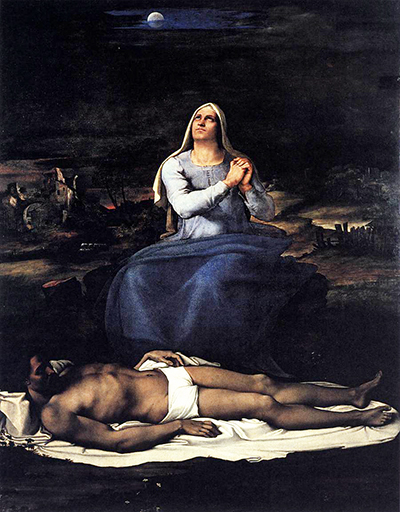
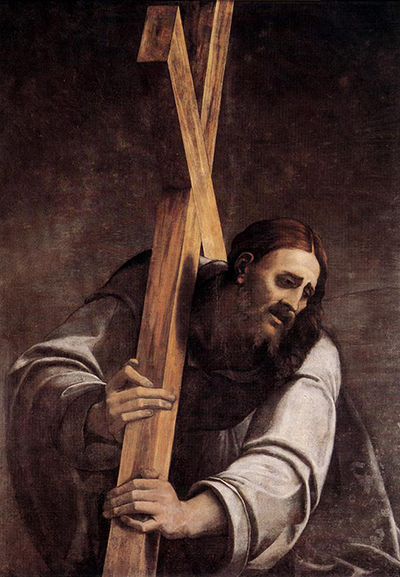
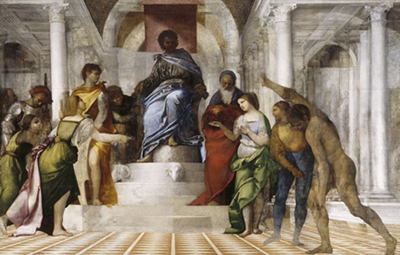
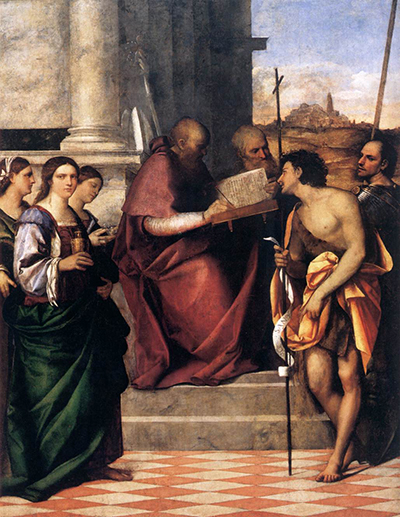
Within Sebastiano’s career, the work can be read beside the nocturnal Pietà, the intense Christ Carrying the Cross, and the monumental figure groups of the Judgement of Solomon. His Venetian beginnings remain visible in works such as the San Giovanni Crisostomo Altarpiece, while his biography explains the move to Rome and the relationships that reshaped his art. Seen within the broader survey of Sebastiano’s paintings, these works show that The Raising of Lazarus was not an isolated victory borrowed from Michelangelo but the grandest convergence of abilities he had been developing across cities, media and commissions.
The current surface requires historical imagination. We have to acknowledge darkened pigments and transferred supports without pretending we can peel five centuries away. That is not a barrier to experience. It makes looking more alert. The painting becomes a meeting between what Sebastiano made, what materials did, what restorers changed, and what scholarship has recovered.
At almost four metres high, the altarpiece still asks for the bodily response it assigns to its witnesses: step back, approach, turn from one figure to another, and test each impression against the whole. Its miracle is instantaneous, but its understanding is slow. That is why the crowd is so necessary—and why, five centuries later, there is still room among them for another viewer.
Discussion
The Raising of Lazarus rewards slow looking because its evidence sits in the space between biblical narrative, Roman patronage, Michelangelo's designs and Sebastiano's oil technique.
Use the prompts below to keep authorship, conservation and viewing experience in balance without turning the painting into a simple rivalry story.
Reader Insights
Where does Michelangelo's contribution sharpen the Lazarus group, and where does Sebastiano's colour, surface and revision make the finished painting his own?
Which reactions in the crowd feel closest to belief, uncertainty, fear or physical shock?
How should the painting's transfers, pigment changes and conservation history affect the way we describe what is visible now?
Join the Conversation
Share your reading of Sebastiano del Piombo's The Raising of Lazarus below.
References
- National Gallery, London, “Sebastiano del Piombo, incorporating designs by Michelangelo, The Raising of Lazarus, 1517–19,” NG1, object record, in-depth account, provenance and bibliography.
- The Holy Bible, King James Version (1611), John 11:1–44. The narrative is paraphrased; the brief phrase spoken by Christ follows verse 43.
- Vatican Museums, “Raffaello Sanzio, The Transfiguration”, Pinacoteca, Room VIII.
- Michael Hirst, Sebastiano del Piombo (Oxford: Clarendon Press, 1981), pp. 66–75. The correspondence must be read as partisan evidence rather than a neutral record.
- Stefania Di Monte, “Luciani, Sebastiano, detto Sebastiano del Piombo”, Dizionario Biografico degli Italiani, Treccani; Hirst, Sebastiano del Piombo, pp. 66–75.
- British Museum, “Lazarus raised from the dead,” museum number 1860,0714.1, red-chalk drawing by Michelangelo, 1516.
- National Gallery, London, “The Credit Suisse Exhibition: Michelangelo & Sebastiano”, research summary, 2017.
- Jill Dunkerton and Helen Howard, “Sebastiano del Piombo’s Raising of Lazarus: A History of Change”, National Gallery Technical Bulletin 30 (2009), pp. 26–51.
- Christa Gardner von Teuffel, “Sebastiano del Piombo, Raphael and Narbonne: New Evidence,” The Burlington Magazine 126, no. 981 (1984), pp. 265–66; and “An Early Description of Sebastiano’s Raising of Lazarus at Narbonne,” The Burlington Magazine 129, no. 1008 (1987), pp. 185–86.