by Tom Gurney
Tom Gurney BSc (Hons) is an art history expert with over 20 years experience
Published on June 19, 2020 / Updated on November 6, 2026
Email: tomgurney1@gmail.com / Phone: +44 7429 011000
The Visitation by Sebastiano del Piombo
Sebastiano del Piombo's Visitation centres on the meeting of Mary and Elizabeth. The two women occupy the foreground with a physical weight that makes their encounter feel monumental, while other figures and the setting extend the scene beyond them. A familiar biblical event becomes an occasion to explore recognition through posture, touch and the relation between bodies.
The Louvre catalogues the painting as La Visitation, inventory INV 357, dating it to about 1519. Its record describes an oil painting transferred from wood to canvas, measuring 168 by 132 centimetres. The work should be distinguished from later copies and from other paintings of the same subject associated with Sebastiano's name. [1]
At a Glance
- CollectionMusée du Louvre, INV 357
- Dateabout 1519
- SupportTransferred from wood to canvas
Works in context
Contents
The encounter in Saint Luke
The subject comes from the first chapter of Luke's Gospel. Mary visits Elizabeth after the Annunciation. Both women are pregnant: Mary with Christ and Elizabeth with John the Baptist. Elizabeth recognises the significance of Mary's presence, and their meeting becomes an affirmation of the relationship between the two children before their births.
The narrative gives a painter a problem different from an overtly miraculous spectacle. Much of its meaning lies in recognition, speech and inward response. These cannot be represented simply by adding a visible object to the scene. The relationship between the women has to carry the event.
Sebastiano makes that relationship bodily. The women turn towards one another, and their contact supplies a centre for the composition. Their difference in age is important to the story, but the encounter does not depend only on a contrast between young and old. It depends on their shared attention and the mutual acknowledgment made visible through gesture.
Monumentality at close range
The figures' size within the picture makes the meeting more than a small incident in a broad landscape. Their bodies occupy much of the foreground and establish the scale through which the surrounding setting is understood. The viewer approaches the event through human presence before exploring the distance.
Drapery contributes strongly to that presence. Large folds give the women weight and help explain the direction of their turns. Cloth can both conceal the body and make its movement legible. A shoulder, an elbow or an advancing leg becomes understandable through the arrangement of fabric around it.
This is a useful way to consider Sebastiano's interest in monumental figures. Monumentality is not merely largeness. It depends on the relationship between a body, its surrounding space and the rhythm of the composition. The women can appear substantial without being frozen into identical, frontal poses.
Touch and the organisation of attention
The meeting of hands and arms creates a point at which separate figures become a connected group. The viewer can follow that contact towards the faces, then return to the larger shapes of the bodies. Narrative and composition reinforce one another.
Other participants broaden the scene while remaining secondary to the central encounter. Their placement gives the event a social setting, but their presence does not need to produce several competing stories. The painter must make a hierarchy of attention without removing the surrounding world altogether.
The vertical format supports this concentration. It allows the principal bodies to dominate while retaining space above and beyond them. Compared with a wide gathering of saints, the design encourages an upward and inward movement around the two women. The meeting feels concentrated even though the picture contains more than two figures.
Colour, light and the Roman setting
The picture belongs to Sebastiano's Roman career, when his interest in colour was increasingly joined to ambitious figure compositions. His Venetian background and his relationship with Michelangelo are relevant contexts, but neither should become a complete explanation of every choice visible on the surface.
Colour differentiates the principal figures and gives drapery its weight. Light helps articulate the contact between them and separates nearer forms from the surrounding setting. These effects operate together. A fold is at once a coloured area, a change of plane and a clue to bodily movement.
The painting therefore resists a simple division in which drawing supplies structure and colour supplies decoration. Its figures are persuasive because their modelling, contours, fabrics and environment belong to one pictorial system. The meeting is made legible through paint, rather than through an abstract design that could be detached completely from it.
Luke’s account also gives Mary a voice through the Magnificat, the song of praise that follows Elizabeth’s greeting. A painted Visitation cannot reproduce the whole passage as an unfolding text. It can instead hold the women in the charged interval of recognition from which the words emerge. This difference between reading and viewing helps explain the concentration on their contact: an extended scriptural exchange becomes a visible relationship sustained within a single moment.
A painting that travelled
The Louvre records the picture's public exhibition in Rome in 1519 and its probable presentation to Francis I by Venice in 1521. These dates concern different moments in its history: completion and display in Rome, and subsequent movement into French royal ownership. They should not be compressed into one unexplained production date. [1]
The painting's subsequent history through royal collections is documented in the provenance supplied for the National Gallery's 2017 exhibition. That history connects the object with Fontainebleau, Versailles and the eventual national museum. The changes of setting form part of how the work was encountered and valued after its original commission. [2]
The transfer from wood to canvas adds another dimension to that history. The support visible today is not necessarily the support on which the painter began. Such a material change matters when describing the object and when considering the relationship between its present surface and earlier states.
Copies and the persistence of the composition
The Compiègne collection records a later Visitation by Josse de Voltigeant after Sebastiano. This is a separate painting, not another title for Louvre INV 357. Its existence shows how a composition could circulate through copying and continue to serve new settings and audiences. [3]
A copy can preserve important aspects of a design while differing in scale, handling, colour or detail. It should therefore be identified through its own record. A familiar arrangement of Mary and Elizabeth is not sufficient to assign a reproduced image to the Louvre original.
That distinction strengthens rather than diminishes the original's importance. Sebastiano made a meeting of two women visually memorable enough to be repeated. The painting's enduring force lies in the concentration of the encounter: large bodies brought close, gestures that establish recognition and a setting that gives the event breadth without distracting from its human centre.
Artworks and records
Selected documented works and records relevant to this article; this is not a complete catalogue.
| Name | Date | Record |
|---|---|---|
| Holy Family with Catherine, Sebastian and a Donor | Sixteenth century | Painting |
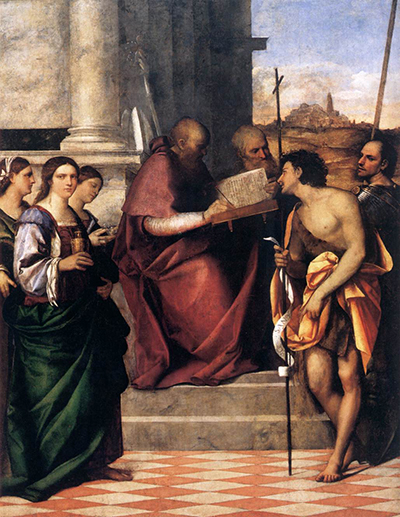
| Madonna and Child with Saints and a Donor | 1517 | Painting |
| Martyrdom of Saint Agatha | 1520 | Painting |
| Portrait of a Lady with the Attributes of Saint Agatha | Early 1530s | Painting |
| Visitation | about 1519 | Painting |
Discussion
Share a reading of the figures, materials or relationships discussed in this article.
Reader Insights
Which detail most affects your reading?
Which comparison would you like to explore further?
Join the Conversation
Share a detail, comparison or question about The Visitation by Sebastiano del Piombo below.
References
- Musée du Louvre, La Visitation, INV 357, current collection record. View source.
- National Gallery, 2017 exhibition loan record and Louvre-supplied provenance for The Visitation. View source.
- Château de Compiègne, Josse de Voltigeant after Sebastiano del Piombo, La Visitation, separate copy record. View source.
- Saint Luke, Gospel, chapter 1, verses 39–56, narrative source.
- National Gallery, Madonna and Child with Saints and a Donor, NG1450. View source.