 by Tom Gurney
Tom Gurney BSc (Hons) is an art history expert with over 20 years experience
Published on June 19, 2020 / Updated on November 5, 2026
Email: tomgurney1@gmail.com / Phone: +44 7429 011000
Shipbuilding on the Clyde
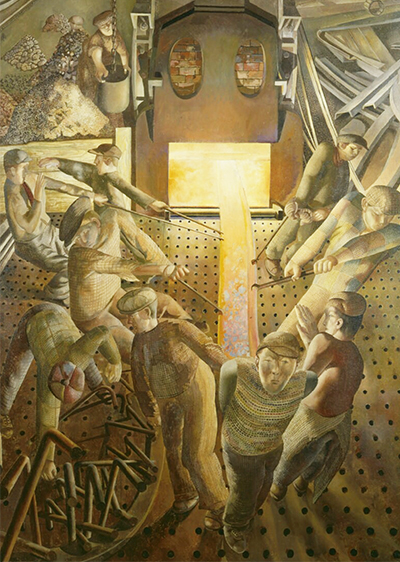
Men brace their feet, bend over steel and work together around a brilliant opening in a furnace. Their clothes are ordinary: caps, checked shirts and thick patterned pullovers. Yet the concentrated light and closely fitted bodies give their task an extraordinary intensity. This is The Furnaces, completed in 1946, one part of Stanley Spencer’s Shipbuilding on the Clyde. The series grew from a wartime commission into eight paintings, made between 1940 and 1946, which turn the specialised work of a shipyard into a sustained study of people making things together. [1] [5]
The distinction between the individual painting and the series matters. The Furnaces, illustrated here, is a tall composition gathered around one central action. Other works stretch sideways through separate groups of workers. Together they offer different ways of entering the same industrial world, sometimes following a trade, sometimes concentrating on the shaping of a single component. The collection belongs to Imperial War Museums. [2]
At a Glance
From the wartime commission to The Furnaces
Contents
A commission at Port Glasgow
Spencer was commissioned by the War Artists’ Advisory Committee on 6 June 1940, after drawing at Lithgow’s yards in Port Glasgow that May. He painted the first work, Burners, at the White Hart Inn in Leonard Stanley, Gloucestershire, during July and August. Observation and painting took place in different settings. [3]
These were merchant ships, built for the urgent business of carrying supplies. The Stanley Spencer Gallery identifies the vessels as ‘Y’ Class Standard Ships, constructed with increasing use of prefabrication to replace merchant shipping lost to submarines in the Atlantic. That context gives the quiet concentration of Spencer’s figures its wartime significance. Their absorbed actions are part of a much larger struggle, even when the fighting lies outside the picture. [4]
Port Glasgow also offered Spencer a subject that could sustain repeated looking. Shipbuilding involved different kinds of knowledge, different tools and very different movements of the body. Cutting a line in a steel plate was not the same action as fitting a pipe or hauling a heated section. Rather than compressing that variety into a distant view of a completed ship, the series gives particular operations room to unfold. Its titles preserve those differences: Burners, Welders, Riveters, Riggers, The Template, Bending the Keel Plate, Plumbers and The Furnaces. [5]
Paintings made from panels
Eight paintings need not mean eight canvases. IWM records that Burners comprises three, with an enlarged central section. A constituent panel, a complete composition and the whole series are different things. [3]
The long formats make an unusual demand on the viewer. A conventional view of a shipyard might give priority to a hull, cranes or a skyline. These paintings ask us to move along the work and pause over separate clusters of activity. The task, the person performing it and the surrounding pieces of metal continually share attention. There is no need to identify one commanding individual before the scene begins to make sense. Its subject is distributed through the work itself.
Art historian Thomas Bromwell describes the series as intended for an altarpiece-like display. That comparison helps explain how distinct scenes could contribute to a larger ensemble. It concerns the organisation of the pictures, without requiring each tool to become a religious symbol. [1]
The completed cycle should also be distinguished from Spencer’s larger ambitions for it. Plans for an installation extending around a room went beyond the eight finished works. The paintings that survive are substantial achievements in their own right, rather than evidence that a complete, larger decorative scheme was carried out. [5]
Looking into The Furnaces
In The Furnaces, the brightest area sits just above the centre. The rectangular furnace mouth appears almost white, while the heated metal descends towards the workers in a long band of yellow and orange. Dark framing above it gives the light a sharply defined enclosure. Instead of floating across the picture as a general glow, the heat seems to have a precise place of origin. The eye can find it immediately, then follow its effect through the surrounding bodies. [2]
The men occupy much more of the composition than the furnace opening. On either side they bend, reach or pull, their arms extending through the space between them. Some appear in profile, others turn their backs, and the nearest figure faces towards us. These changes of orientation keep the group from becoming a repeated row. Each man has a particular position within a collective action, and our view of him depends on where that action places his body.
Look especially at the foreground. A man in a patterned sleeveless pullover steps towards the lower edge, his head tilted down and his hands held behind him. Behind him, another figure bends across the space. At the left, a worker stoops beside a crowded container of metal implements. Such figures bring the picture almost up to the spectator’s feet. The furnace remains visible beyond them, but getting to it with the eye means passing through the men.
The floor is equally active. Rows of dark holes run across its warm brown surface, supplying a measured pattern underneath irregular boots, limbs and tools. The repeated dots establish a continuous field while the figures break it into changing shapes. Look from the floor to the clothes and another set of small repetitions appears: checks, stripes and the knitted pattern across the nearest man’s chest. The picture holds together through these modest visual correspondences, as well as through its central blaze.
Above, the workshop seems tightly packed. A man attends the fire at the upper left; at the right, stacked lengths of metal tilt through an angular framework. Two oval openings in the furnace structure bring another kind of rounded shape into the upper centre. Spencer leaves little empty space, yet the various materials remain legible. Soft clothing, hard metal and luminous heat are brought close enough to compare without becoming interchangeable. [2]
It is tempting to treat the furnace as the picture’s sole drama. The longer one looks, however, the more the different human postures matter. Heat supplies the striking centre, but effort spreads outwards through the whole group. The composition makes collective labour visible through differences of balance and direction. That is why the scene rewards attention even after its brightest effect has become familiar.
From observation to composition
A surviving Plumbers drawing at the Stanley Spencer Gallery helps reveal the distance between noticing a useful detail and finding its final place in a painting. Dated about 1944, it is worked in pencil and coloured chalk on paper. The gallery identifies it as a study for a passage to the left of the central section in the finished Plumbers, dated 1944–45. The sheet is therefore evidence of preparation for a particular part, rather than a miniature version of the entire composition. [4]
In the drawing, large curving pipes occupy the space alongside workers, and a squared grid extends across the paper. The pipe bends insist on being followed: a rounded elbow turns the eye before a straight length directs it elsewhere. Human bodies have to fit around those fixed shapes. Even at this preparatory stage, the relationship between a worker and the thing being handled is more informative than an isolated likeness would be. The grid adds a second order to the scene, crossing the irregular forms with small, regular divisions. [4]
IWM describes Spencer painting Burners in patches, moving between figures and metal plates. In his November 1942 letter to Elmslie Owen at the Ministry of Information, quoted by IWM, Spencer called the workers “a series of decorative figures”, explaining his interest in their varied positions. [3]
Work, attention and belief
Bromwell connects Spencer’s attentiveness to humble tasks with his belief that they could glorify God. That context allows a religious dimension to the shipbuilding pictures without assigning identities as saints to particular workers. Meaning can reside in the attention bestowed on an ordinary act. [1]
The shipbuilding paintings remain a separate group from the Port Glasgow resurrection pictures discussed by Bromwell. Here, the bodies perform practical operations; they are not rising from graves. Their visual importance comes through their closeness, the elaborate compositions and the care with which their activity occupies the picture. [1]
Public pictures of wartime labour
The series began reaching an audience while the war was still being fought. Burners appeared in the War Artists’ Exhibition at the National Gallery in October 1940. Its early exhibition reminds us that these were contemporary public images of wartime work, made while the need for ships was immediate. The finished cycle nevertheless extended beyond the war: Spencer completed it in his house at Cookham in 1946. [3] [6]
In The Furnaces, urgency takes the form of directed effort. A boot is planted, a shoulder turns, hands maintain their grip and a group makes the difficult movement possible. The furnace’s light holds the centre, but the action carries our attention away from it, through the men and towards the foreground. The series preserves that scale of human action within the immense undertaking of building ships.
Artworks directory
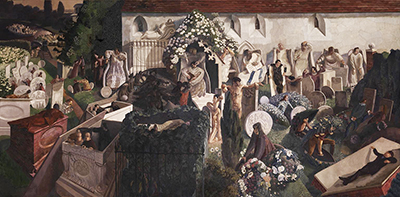
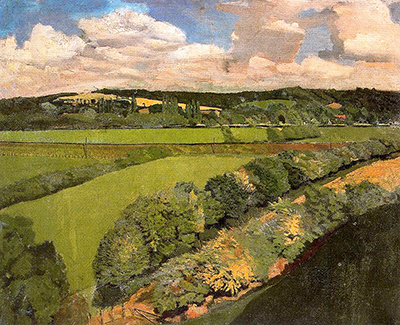
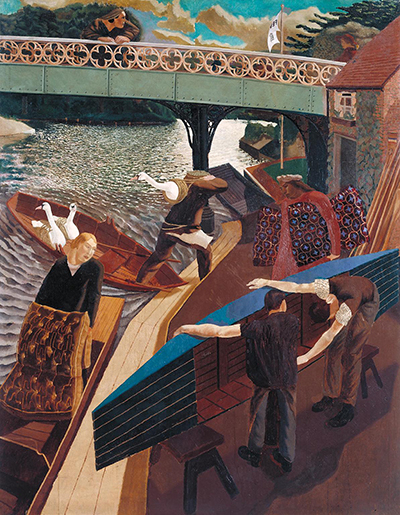
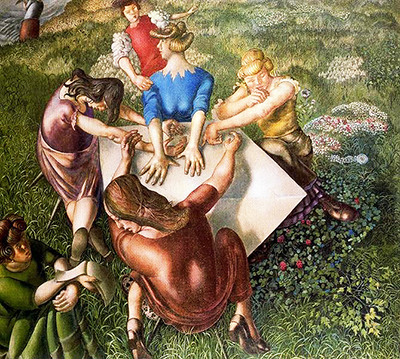
Selected landscapes and shipbuilding works documented in the cited museum records and catalogues. Burners is one painting made from three canvases; the Plumbers study is a separate drawing. A dash means that no individual object date is supplied here. Additional Tate entries retain the museum’s unmaintained October 2014 catalogue snapshot. This selection is not a complete catalogue. [7]
| Name | Date | Medium |
|---|---|---|
| Cookham (Tullie) | 1914 | Painting |
| Garden View, Cookham Dene | 1938 | Painting |
| Shipbuilding on the Clyde: The Furnaces | 1946 | Painting |
| Shipbuilding on the Clyde: Burners (three canvases) | 1940 | Painting |
| Plumbers (study) | about 1944 | Drawing |
| Shipbuilding on the Clyde: Plumbers | 1944–45 | Painting |
| Shipbuilding on the Clyde: Welders | — | Painting |
| Shipbuilding on the Clyde: Riveters | — | Painting |
| Shipbuilding on the Clyde: Riggers | — | Painting |
| Shipbuilding on the Clyde: The Template | — | Painting |
| Shipbuilding on the Clyde: Bending the Keel Plate | — | Painting |
| Christ Carrying the Cross (Tate N04117) | 1920 | Painting |
| The Resurrection, Cookham (Tate N04239) | 1924–7 | Painting |
| Camouflaged Grenadier. Verso: Two Composition Studies for Burghclere Chapel (Tate N04245) | 1922–3 | Drawing |
| Terry’s Lane, Cookham (Tate N04678) | c.1932 | Painting |
| Turkeys (Tate N04800) | 1925 | Painting |
| The Robing of Christ (Tate N04925) | 1922 | Painting |
| The Disrobing of Christ (Tate N04926) | 1922 | Painting |
| Rickett’s Farm, Cookham Dene (Tate N04942) | 1938 | Painting |
| Daphne (Tate N05148) | 1940 | Painting |
| The Sword of the Lord and of Gideon (Tate N05321) | 1921 | Painting |
| The Bridge (Tate N05393) | 1920 | Painting |
| The Roundabout (Tate N05556) | 1923 | Painting |
| P.J. Spencer (Tate N05607) | c.1932 | Drawing |
| ‘Man Goeth to his Long Home’ (Tate N05608) | 1911 | Drawing |
| Apple Gatherers (Tate N05663) | 1912–3 | Painting |
| Mr Joe Buchanan, Charge Hand Blacksmith (Tate N05732) | 1943–4 | Drawing |
| William McBrearty, Sawyer (Tate N05733) | 1943–4 | Drawing |
| Study for ‘The Bridge’ and other works (Tate N05775) | 1912–20 | Drawing |
| The Resurrection: Port Glasgow (Tate N05961) | 1947–50 | Painting |
| Tree and Chicken Coops, Wangford (Tate N06150) | 1925 | Painting |
| Self-Portrait (Tate N06188) | 1914 | Painting |
| Study for ‘Apple Gatherers’ (Tate N06233) | c.1912 | Drawing |
| Retrieving a Ball (Tate P11032) | 1954 | |
| Study for ‘Joachim among the Shepherds’ (Tate T00048) | 1912 | Drawing |
| Dinner on the Hotel Lawn (Tate T00141) | 1956–7 | Painting |
| The Centurion’s Servant (Tate T00359) | 1914 | Painting |
| Swan Upping at Cookham (Tate T00525) | 1915–9 | Painting |
| Mending Cowls, Cookham (Tate T00530) | 1915 | Painting |
| St Francis and the Birds (Tate T00961) | 1935 | Painting |
| Turk’s Boatyard Cookham (Tate T01207) | c.1931 | Painting |
| Jacob and Esau (Tate T01769) | 1910–1 | Drawing |
| Double Nude Portrait: The Artist and his Second Wife (Tate T01863) | 1937 | Painting |
| Early Sketch for ‘Resurrection: Rejoicing’ (Tate T03035) | date not known | Drawing |
| Drawing for the Left Panel of ‘Resurrection: Rejoicing’ (Tate T03036) | date not known | Drawing |
| Drawing for Centre Panel of ‘Resurrection: Rejoicing’ (Tate T03037) | date not known | Drawing |
| Drawing for Right Panel of ‘Resurrection: Rejoicing’ (Tate T03038) | 1944 | Drawing |
| Drawing for the Right Hand Section of ‘Resurrection: Port Glasgow’ (Tate T03039) | date not known | Drawing |
| Drawing for Left Section of ‘Resurrection: Port Glasgow’ (Tate T03040) | date not known | Drawing |
| Drawing for Centre Section of ‘Resurrection: Port Glasgow’ (Tate T03041) | date not known | Drawing |
| Drawing for Right Section of ‘Resurrection: Port Glasgow’ (Tate T03042) | date not known | Drawing |
| Drawing for Left Panel of ‘Resurrection: Waking Up’ (Tate T03043) | 1944 | Drawing |
| Drawing for Right Panel of ‘Resurrection: Waking Up’ (Tate T03044) | date not known | Drawing |
| Drawing for Left Panel of ‘Resurrection: Reunion’ (Tate T03045) | 1945 | Drawing |
| Drawing for Centre Panel of ‘Resurrection: Reunion’ (Tate T03046) | date not known | Drawing |
| Drawing for Right Panel of ‘Resurrection: Reunion’ (Tate T03047) | 1944 | Drawing |
| Drawing for Left Panel of ‘Resurrection: Tidying’ (Tate T03048) | 1944 | Drawing |
| Drawing for Right Panel of ‘Resurrection: Tidying’ (Tate T03049) | 1944 | Drawing |
| Mother and Children (Tate T03050) | date not known | Drawing |
| Figures on Either Side of a Window (Tate T03061) | date not known | Drawing |
| Trumpet Player with Other Figures (Tate T03062) | date not known | Drawing |
| Self-Portrait (Tate T03335) | 1959 | Painting |
| Study for ‘Christ Carrying the Cross’ (Tate T03336) | 1920 | Drawing |
| Portrait of Louis Behrend (Tate T03337) | date not known | Drawing |
| Study for Double Nude Portrait: the Artist and his Second Wife (Tate T05525) | c.1937 | Drawing |
| Study for the Resurrection of Soldiers: Burghclere Chapel (Tate T05526) | 1927–8 | Drawing |
| Study for Double Nude Portrait: the Artist and his Second Wife (Tate T05527) | c.1937 | Drawing |
| Farm Pond, Leonard Stanley (Tate T05762) | 1940 | Painting |
| Zacharias and Elizabeth (Tate T07486) | 1913–4 | Drawing |
| Woman Feeding a Calf (Tate T07794) | date not known | Drawing |
| The New Shawl (Tate T07795) | date not known | Drawing |
| Kissing Patricia’s Hand (Tate T11919) | c.1936–8 | Drawing |
| Self-Portrait (Tate T11974) | 1913 | Drawing |
| The Woolshop (Tate T12548) | 1939 | Painting |
Frequently Asked Questions
He drew at Lithgow’s yards in Port Glasgow before receiving the commission in June 1940. [3]
Discussion
Move from the brilliant furnace opening to the workers’ different postures and the small repeated patterns of floor and clothing.
Reader Insights
Which worker first draws you away from the light?
How does the tall composition organise collective effort?
What changes when a painting, its panels and the whole series are kept distinct?
Join the Conversation
Share a detail, comparison or question about Shipbuilding on the Clyde below.
References
- Thomas Bromwell, “Stanley Spencer”, in James Crossley and Alastair Lockhart, eds., Critical Dictionary of Apocalyptic and Millenarian Movements, 9 June 2021, “Life and work” and discussion of everyday tasks and religious belief. DOI: 10.17863/CAM.121454. View source.
- Imperial War Museums, Shipbuilding on the Clyde: The Furnaces, collection image and accession number Art.IWM ART LD 5781; associated IWM object record. View source 1. View source 2.Splash image: Shipbuilding on the Clyde: The Furnaces, 1946. Imperial War Museums, Art.IWM ART LD 5781. One painting in the eight-work series.
- Imperial War Museums, Shipbuilding on the Clyde: Burners, IWM collection text on Google Arts & Culture; Art.IWM ART LD 432–4. Includes the museum’s account of the diaries and an extract from Spencer’s November 1942 letter to Elmslie Owen. View source.
- Stanley Spencer Gallery, Plumbers (Ship Building on the Clyde Series), c.1944, pencil and coloured chalk on paper, 658 × 507 mm; collection commentary and study image. View source.
- Fiona Campbell, “Artists at War: Stanley Spencer and the Second World War”, Richmond upon Thames Library Services, 3 May 2017, section “Stanley Spencer”: completed titles and larger installation plans. View source.
- Stanley Spencer Gallery, “Stanley Spencer: the artist”, “A short biography”, paragraph on the 1940 commission and completion at Cookham in 1946. View source.
- Tate, Tate Collection metadata, artwork_data.csv, October 2014 snapshot, released under CC0. Repository readme states that this dataset is no longer maintained. Downloaded and artist rows inspected 28 October 2026. View source.