


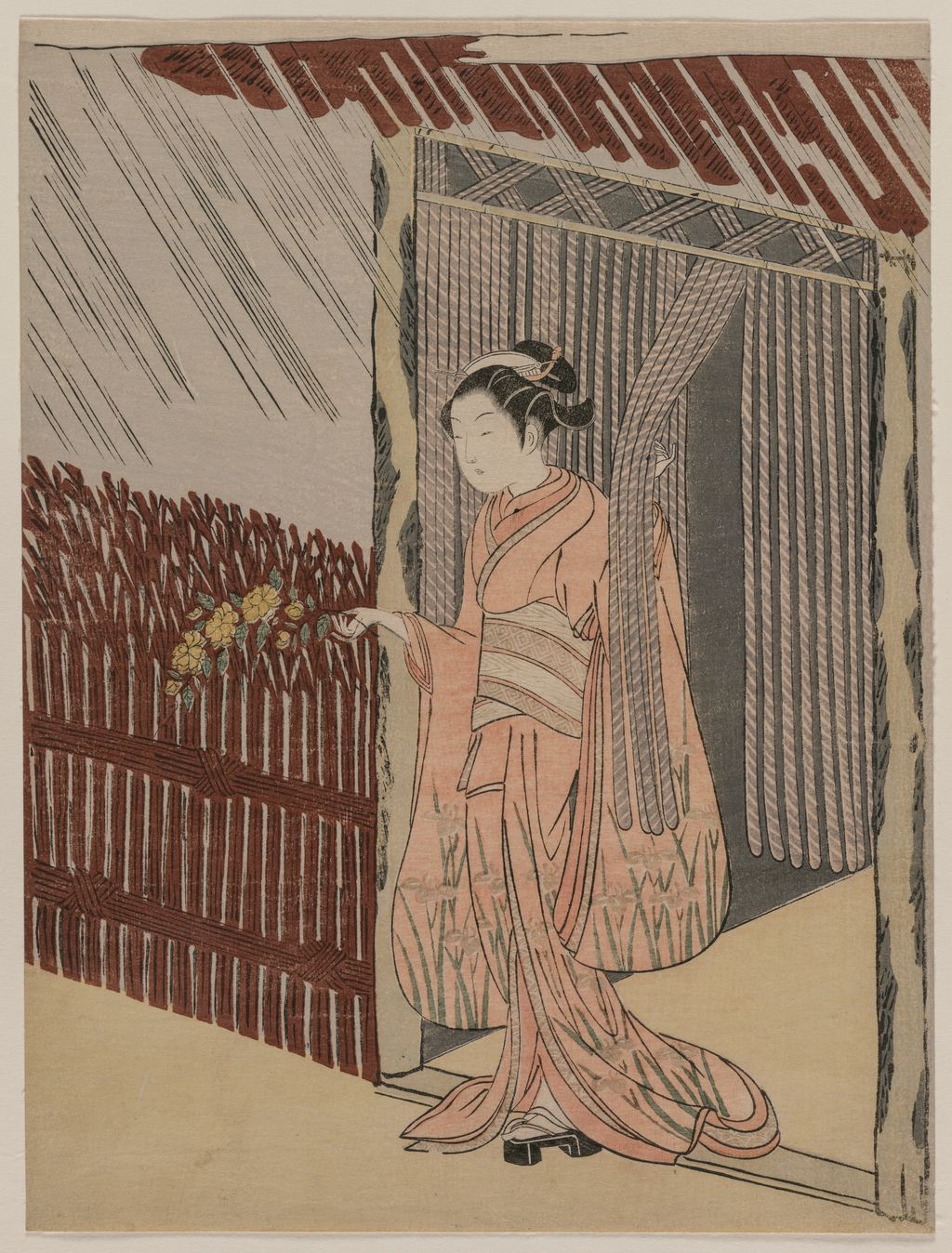
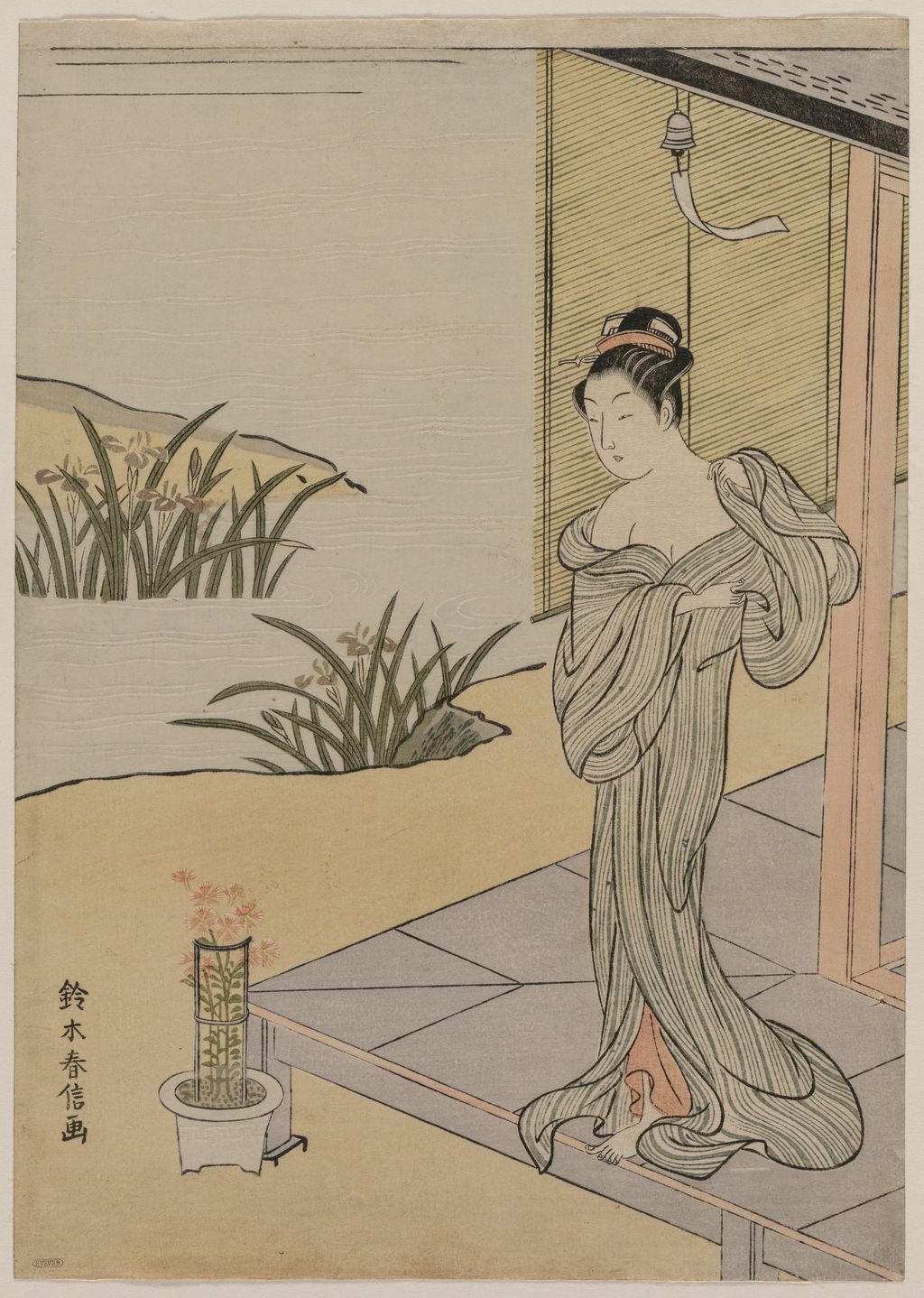
Suzuki Harunobu, A Girl Dressing in Pink, 1766. Cleveland Museum of Art, 1930.175. Museum object record.
 by Tom Gurney
Tom Gurney BSc (Hons) is an art history expert with over 20 years experience
Published on September 25, 2026 / Updated on September 25, 2026
Email: tomgurney1@gmail.com / Phone: +44 7429 011000
Suzuki Harunobu: the life we can trace
Suzuki Harunobu died in 1770, after a short but remarkably consequential career in Edo printmaking. Within that final decade he designed limited-colour sheets, privately exchanged picture calendars, prints made for sale and illustrated books. The objects let us follow changing commissions and working relationships more securely than they let us describe his childhood. A Japanese national literature institute calls his birth year unknown. British Museum and Tokyo National Museum catalogue labels give 1724 and “1725?” respectively. “About 1724 or 1725” is a useful convention, but neither year should be presented as a documented birthday. [1] [2] [3]
The imbalance in the evidence should shape the biography. A 1761 theatre print has a date and a museum accession number. A 1765 calendar has an inscription that identifies a commissioner. A 1770 book has an edition and a publisher. By comparison, a claim that Harunobu grew up in Kyoto depends on a later reconstruction of his family. These are different kinds of information. Taken together, they describe an artist who worked in and for the print culture of Edo, whose success arose within a network of patrons, cutters, printers, publishers, writers and readers. They do not justify an invented day-by-day life. [3] [4] [5]
Contents
- Suzuki Harunobu: the life we can trace
- An uncertain beginning
- Before 1765: work in a changing print trade
- The picture-calendar circle
- When a private design entered the shop
- The later 1760s: a recognisable visual world
- Look closely at the screen and flowers
- Named beauties, publishers and books
- Death, successors and an attribution problem
- Reading a short career carefully
- Books on Japanese Art
His name appears today beside nishiki-e, literally “brocade pictures,” because the richly coloured prints that emerged in the mid-1760s changed the medium. The connection is justified; the familiar claim that he single-handedly “invented colour printing” is too compressed to explain how an individual sheet was made. Harunobu supplied designs; patrons could pay for elaborate private projects; specialist carvers and printers translated drawings into aligned impressions on paper. Earlier prints had already combined a restricted number of colours. A biography can show why the collaborative breakthrough gathered force at this particular moment without assigning every technical decision to the artist. [3] [4] [6]
At a glance
- LifeBirth year unknown–1770
- Dated anchors1761 actor print; 1765 calendars
- Named patronŌkubo Tadanobu (Kyosen)
- Late bookSeirō bijin awase, 1770
An uncertain beginning
Harunobu's place of birth has not been established in the sources checked for this article. Hayakawa Monta, drawing on the earlier research of Hayashi Yoshikazu, describes a proposed Suzuki family history in which members of a shogunal retainer family lost their positions and moved to Kyoto. Hayakawa then says explicitly that it is uncertain whether the artist was born in Edo or Kyoto, although a Kyoto upbringing has been suggested. The reconstruction offers a possible context for his later access to sophisticated literary circles. It is not a surviving birth record, household register or contemporary account written by Harunobu. Its vivid details should remain attached to the scholars who proposed them. [4]
The same caution applies to a teacher. Two names recur: Nishimura Shigenaga, an Edo print designer, and Nishikawa Sukenobu, the Kyoto maker of influential illustrated books. The British Museum presents both as possibilities. Shimane Art Museum says that accounts linking Harunobu to either artist have been transmitted but his artistic lineage is unclear. Hayakawa notes that Harunobu's name and death date appear in a Nishikawa family death registry and considers a connection with Sukenobu plausible. The chapter does not reproduce a training agreement, diary entry or the registry itself. One may discuss the visual affinity and the documentary clue, but “pupil of Sukenobu” remains a theory, not a secure first line of his résumé. [2] [4] [7]
Even an apparent age at death does not close the question of birth. Hayakawa says Harunobu is said to have died at forty-six, then uses that reported age to picture a late start in public printmaking. It is tempting to calculate a precise birth year from it. But a reported age can depend on the source and on conventions for counting age; the chapter gives no birth document that would settle the matter. The Japanese national literature institute's plain “birth year unknown” is the better statement of the underlying evidence. It leaves open which parts of an older life story may eventually be corroborated. [4] [1]
This uncertainty need not make the early career empty. The most useful boundary is between what can be dated on a surviving print and what is proposed about formative years. Harunobu may have learned from more than one model, whether or not he belonged to a formal workshop. His later allusions to poetry and old stories show literary fluency in the work; they do not reveal where he sat as a child or exactly which books he first saw. Holding that distinction prevents a stylish image from becoming a fictional memory of its maker. [2] [7] [1]
Before 1765: work in a changing print trade
Tokyo National Museum records a work by Harunobu from Hōreki 11, or 1761: a theatre print naming actors Ichimura Kamezō and Segawa Kikunojō, accession A-10569-1235. Its catalogue calls it a wide-format benizuri-e, a print using a limited palette in which red and green were especially important. This is a much stronger chronological marker than an assumed apprenticeship ending in a guessed year. The named actors and format place an identifiable Harunobu design within the theatre-oriented market before the picture-calendar boom. The 1761 date establishes that he was producing this kind of work then; it does not prove the sheet was his first design. [3]
The museum's exhibition sequence also includes narrow benizuri-e sheets from Fūryū yatsushi nana Komachi, a remaking of episodes associated with the poet Ono no Komachi. These works complicate a simple “first actor prints, then women, then full colour” ladder. Literary transformation already belonged to Harunobu's limited-colour practice. A modern-looking figure could stand in for an old subject, while a title or poem supplied the connection. The form of the printed sheet and the audience's reading skills were developing together. Later nishiki-e amplified that play, but it did not create his interest in it from nothing. [3] [8]
Chiba City Museum identifies another strand, mizue, prints in which blue could be used in place of the usual black key line. The museum estimates thirty-six known examples and dates this mode broadly from the later Hōreki to early Meiwa years. Such a record makes “limited colour” more than one technique. Harunobu was not simply waiting for a new palette to be handed to him. Yet there is no reason to imagine a smooth personal experiment recorded sheet by sheet. The surviving objects represent only what was printed, kept, collected and catalogued, sometimes in later impressions. A dated example can anchor a phase; it cannot make every missing step visible. [9]
The early sheets also remind us how commercial print design differs from a solitary painter's studio practice. Actors, fashionable subjects, poems, publishers and formats offered multiple reasons to commission a design. A woodblock image passed through a material sequence after it left the designer's hand. If we describe Harunobu's formation only as learning an artist's style, we miss the work of learning what a print audience wanted and how a composition would survive carving and repeated printing. The 1761 theatre sheet and the Komachi designs are evidence of a working designer in that trade, not a preliminary sketchbook for the famous prints of 1765. [3] [6]
The picture-calendar circle
The decisive documented shift comes with e-goyomi, or picture calendars. A lunar year contained long and short months; a privately made image could conceal the information in patterns, lettering or objects. Guests exchanged such prints and enjoyed both their finish and the puzzle. Japanese museums date the especially influential exchange activity to 1765. Hayakawa describes wealthy, literate patrons competing over ingenious designs and expensive workmanship; he names a gathering associated with Abe Masahiro, known in poetry as Sakei. The detail belongs to his historical account rather than to a meeting invitation reproduced in the material checked here. What survives more concretely is the print made for an identifiable commissioner. [3] [4] [6]
Chiba City Museum's Parody of Hanshan and Shide, accession 2933001, bears the phrase 巨川工, “devised by Kyosen.” The museum identifies Kyosen as Ōkubo Jinshirō Tadanobu, a hatamoto or direct shogunal retainer with a 1,600-koku stipend. Its legible writing specifies the short months of Meiwa 2, or 1765. Two young women stand in for Hanshan and Shide, traditionally pictured with a scroll and broom. The substitution turns a familiar old pairing into contemporary figures while the months remain embedded in the design. Here patronage, date, subject and play can all be tied to one catalogued sheet. Kyosen's name is not another artist signature; it records the commissioning idea. [5]
Other calendar sheets distribute their evidence differently. In the Metropolitan Museum's Visit to a Shrine at the Hour of the Ox, the 1765 month numbers are embossed in a woman's robe. The Met's catalogue also identifies an artist signature, a commissioner seal and the name of carver Sekine Kaei. These marks let us see several contributors on one physical impression. The embossing is difficult to find even in a photograph, so a casual reproduction may conceal the very feature that defines the sheet as a calendar. A biographical article should not ask readers to infer Harunobu's role from a vaguely similar later image; it should identify which impression carries which information. [10]
The calendar is a material object as well as a social event. Different blocks needed to meet accurately; colour, pressure and sometimes uninked relief created effects that depended on a skilled workshop. A patron could reward complexity that might be uneconomic for a routine shop print. The Ōta Memorial Museum describes 1765 as a turning point for nishiki-e, but the prints also show how that turn depended on money, collaboration and a reason to seek unusually fine execution. Harunobu's achievement was to make designs worthy of that ambition. It is also an achievement of the people whose names are usually harder to recover. [6] [10] [4]
Hayakawa additionally proposes a role for Hiraga Gennai in explaining new technique to the circle. His own wording is tentative. No source checked for this biography documents a particular surviving calendar block that Gennai carved, printed or commissioned. The proposal can broaden the account of an inventive social world, but it cannot be silently upgraded to “Gennai invented the method with Harunobu.” The named commissioner on Chiba's sheet and the named cutter on the Met sheet are firmer evidence for what happened in those objects than a retrospective invention story. [4] [5] [10]
When a private design entered the shop
The passage from a private exchange to a public print did not happen in only one way. Chiba's Night Rain at the Double-Shelf Stand, from Eight Views of the Parlour, is a particularly instructive case. The museum says its displayed example is a second printing. A first privately circulated version carried Kyosen's name and seals; a publisher removed those identifiers when the composition was offered for sale as an Azuma nishiki-e. The sheet's “night rain” is a domestic sound, associated with water in a kettle, rather than a storm outside. Most important for its biography, Chiba says the design was not a calendar. Its private origin and Kyosen connection must not be confused with a hidden-month e-goyomi. [11]
Another Chiba record, Parody of Meng Zong, concerns a different kind of alteration. Its first version carried the long-month numbers for 1765 within bamboo leaves. The museum's own later impression no longer has them. In the inherited Chinese story Meng Zong's devotion to his mother is linked to finding bamboo shoots in winter; the calendar changes how the visual pun functions in a particular year. When the month marks disappeared, the remade story could circulate without that dated function. The difference between first design and surviving later impression matters to the life story because it reveals how an artist's work could cross from one social occasion into another market. [12]
The British Museum's example of the ox-hour shrine design is also catalogued as a later printing, with the original robe's numbers described rather than present in the same way. These records allow a cautious account of reuse; they do not prove that every calendar automatically became a retail print or that Harunobu personally directed the removal of each mark. Block owners and publishers had interests of their own. The privately commissioned design might become valuable as an image after its calendrical information expired. The artist's career thus moved within an adaptable publishing economy, rather than along a single line from exclusive art to mass production. [13] [11] [12]
Hayakawa's account widens the circle of patrons beyond the samurai officials commonly named in short biographies. He mentions writers, poetry participants, prosperous merchants, people connected with the Yoshiwara pleasure quarter and booksellers who recognised an audience for Harunobu's designs. That account supports a mixed social world, but it is not a customer list for every individual print. It would be misleading to call every woman represented a patron or to assume that all buyers shared the learned jokes of an original private group. A named seal, a published imprint and an image's subject are separate pieces of evidence for production and reception. [4]
This wider circulation helps explain both fame and uncertainty. A print may survive in many impressions, yet only some preserve original colours, seals or embossed details. A design dated by the calendar it once held can be printed later for a person who did not need a calendar at all. The biographical date belongs to the conception or first issue only when the catalogue justifies it; the date of the physical sheet on the page may be different. Keeping those dates apart allows the reader to see Harunobu as a working artist whose designs were handled by other people over time. [11] [12] [13]
The later 1760s: a recognisable visual world
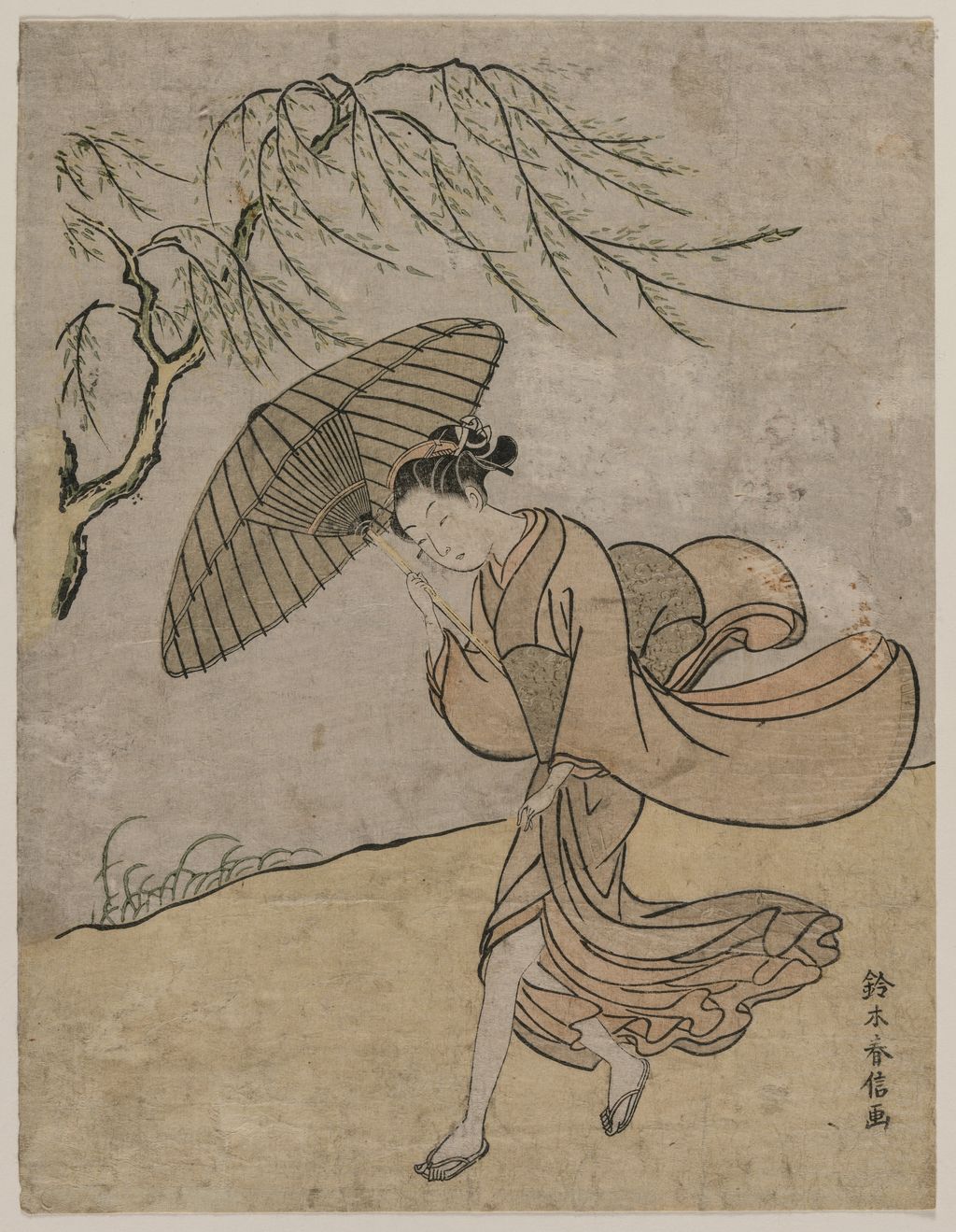
By 1766–67, museum-dated sheets display the colour, small-format intimacy and carefully organised figures for which Harunobu became best known. Cleveland's A Girl Dressing in Pink, accession 1930.175, is dated 1766. Its title sounds like a narrative action, yet the visible woman raises a hanging screen with one hand and reaches toward flowers with the other; the picture does not settle that she is getting dressed. Cleveland's Woman Running Past a Willow Tree in a Breeze, accession 1942.148, dates to 1766 or 1767. It makes movement legible through body and branches. These two prints are useful career markers precisely because they reward attention without being made to stand for one undocumented event in the artist's own life. [14] [15]
Look closely at the screen and flowers
Choose a number to enlarge a detail from the high-resolution museum image. Find its position in the whole print and compare the explanation below.
Explained details
The hand at the hanging screen
One hand lifts the hanging screen. Its repeated vertical lines frame the figure; they do not show that she is changing clothes.
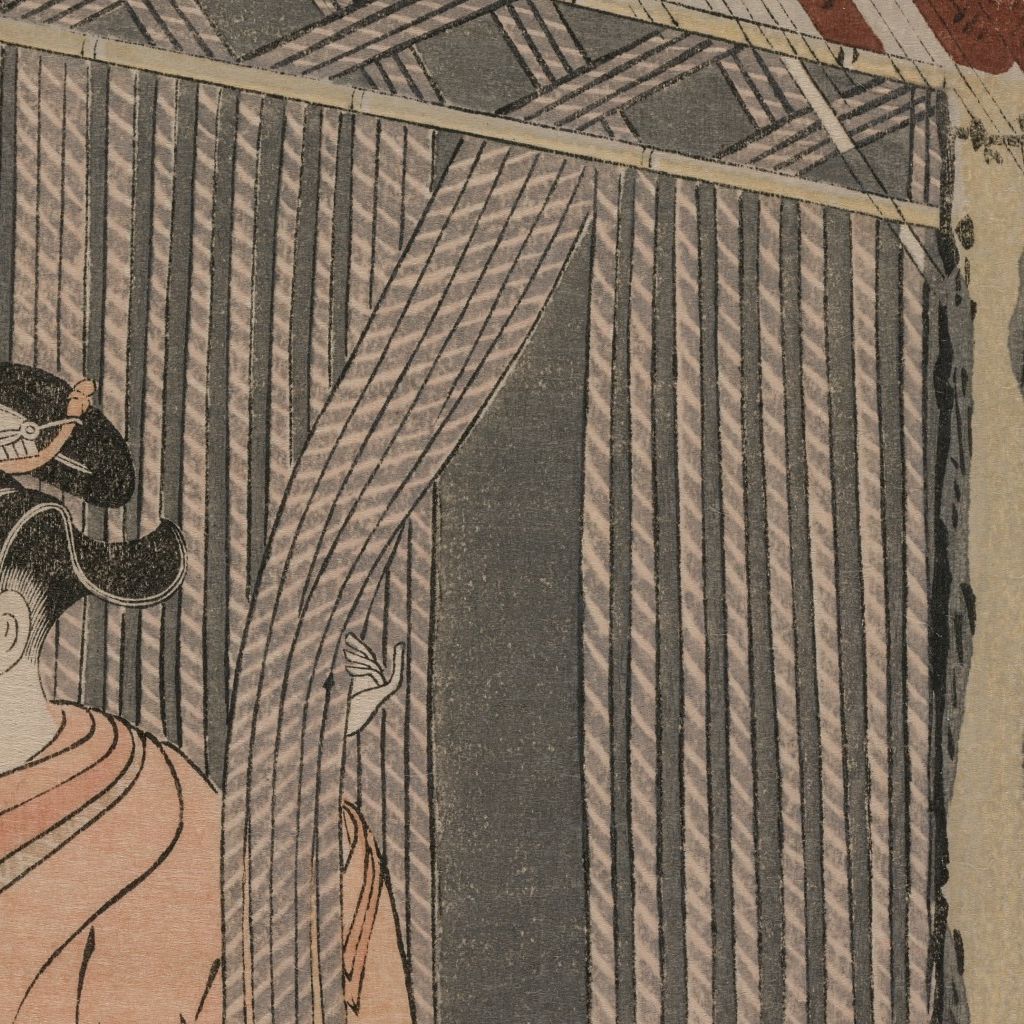
Cleveland Museum of Art Object record 1930.175. Editorial crop and resize disclosed.
The hand by the flowers
Her other hand reaches toward the flowers at the fence. Return to the complete sheet to connect the hand, flowers and pink sleeve.
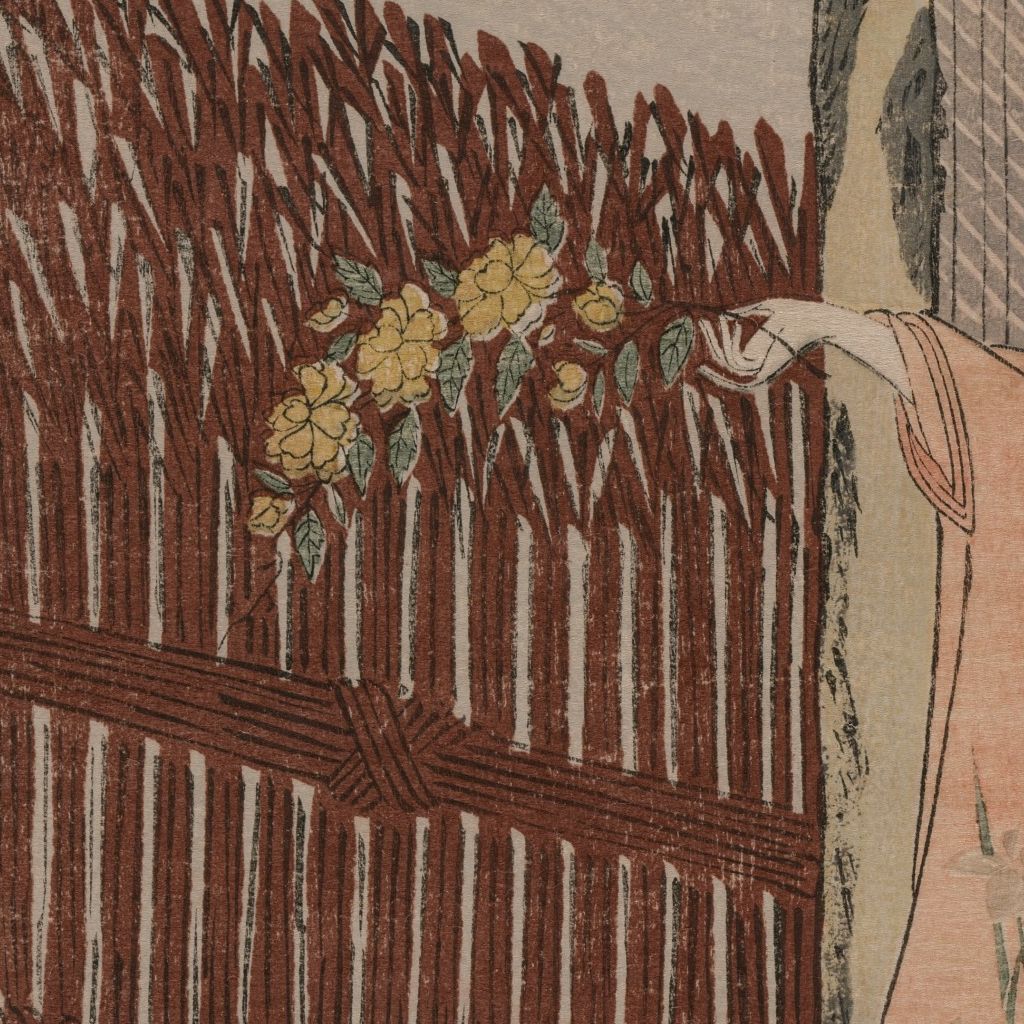
Cleveland Museum of Art Object record 1930.175. Editorial crop and resize disclosed.
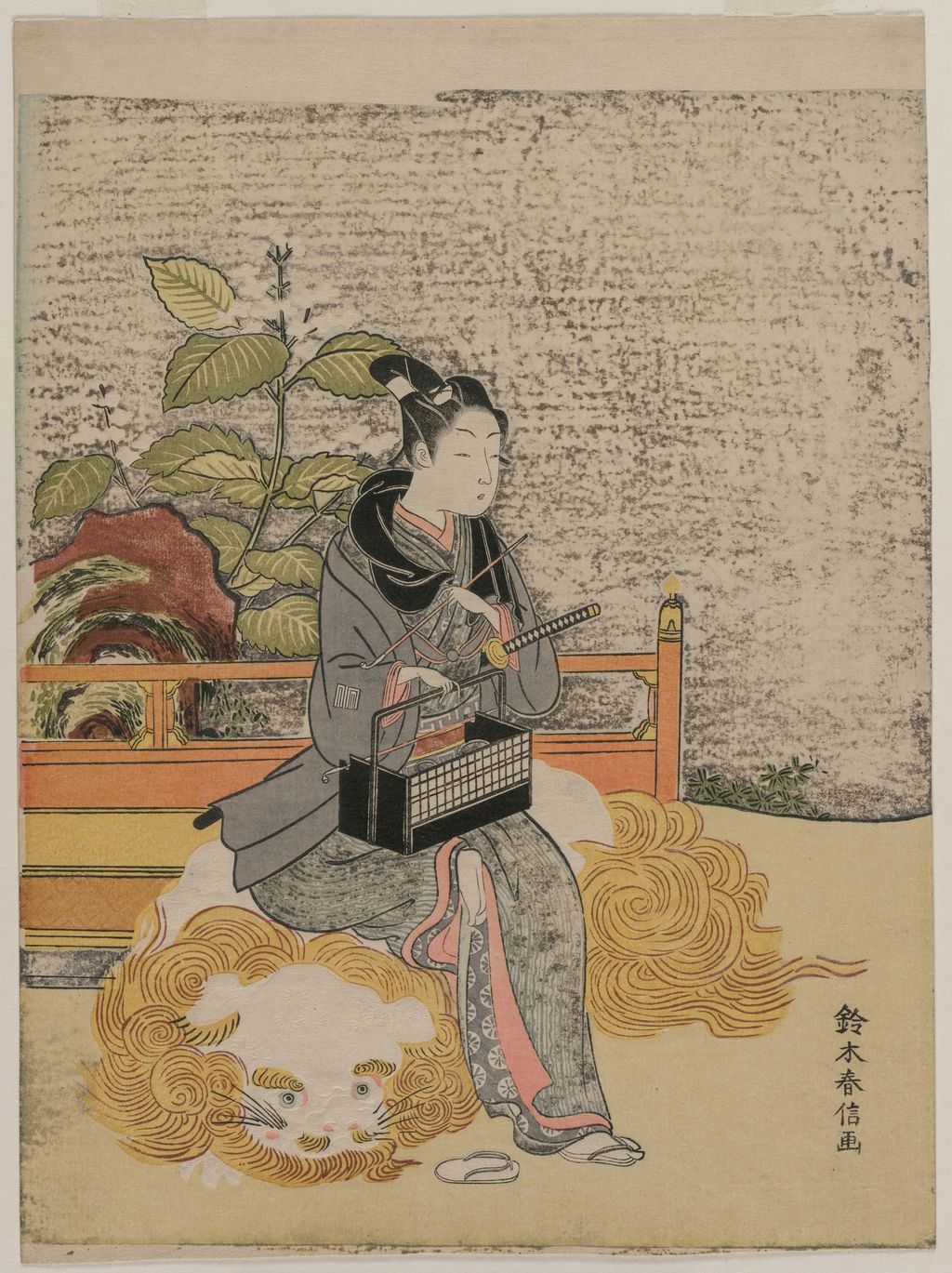
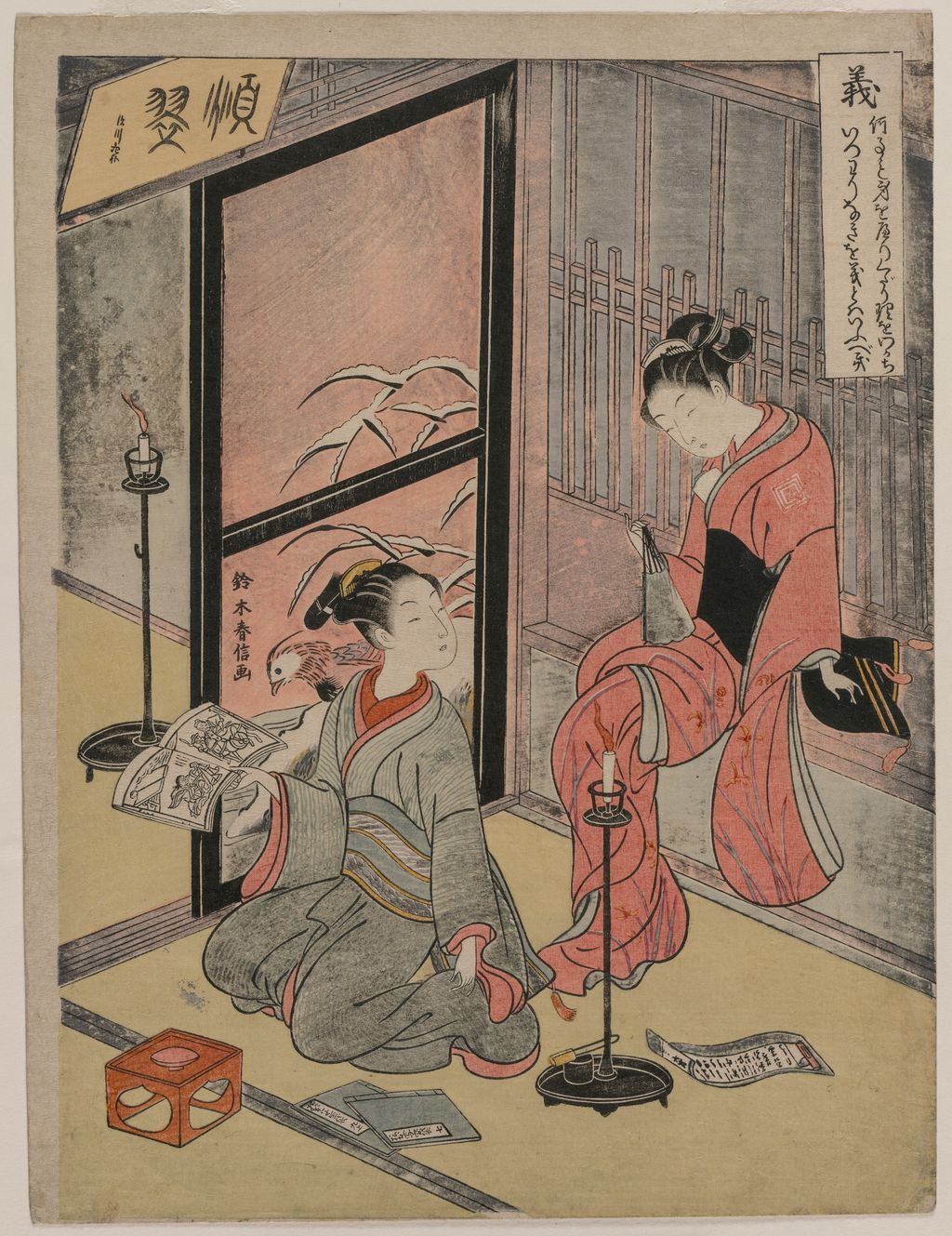
Around 1767, Cleveland's Youth as a Stand-in Monju calls an old Buddhist subject into a new form. Righteousness, from The Five Virtues, relates a contemporary figure to a moral classification. A pot of pinks appears in another sheet Cleveland dates around the same year. The span of subjects shows that Harunobu's success was not a single formula for courtly women. A designer could draw on Buddhist and Chinese ideas, poetry, fashionable dress and a small domestic observation. The title and series matter: “Monju” and “Five Virtues” are not generic descriptions of any elegant youth. Yet the images still need to be read as images. Identifying a textual allusion does not tell us who modelled or bought each impression. [16] [17] [18]
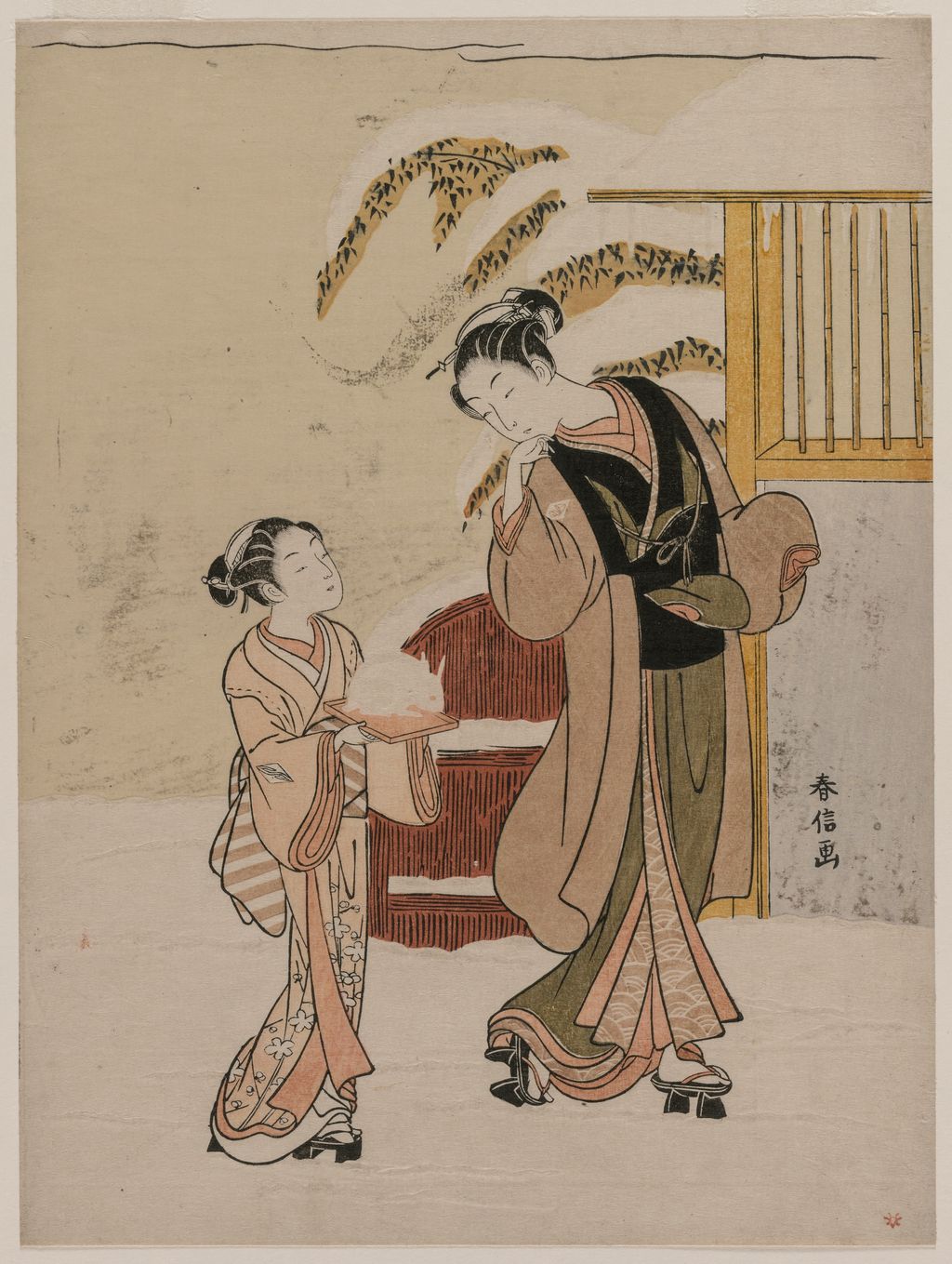
Cleveland's Young Woman Admiring a Snow Rabbit is dated only to the late 1760s. The rabbit fashioned from snow gives another example of a small observed activity rather than a named historical figure. Its broad date should stay broad: an attractive image cannot be fitted to 1767 merely because neighbouring sheets in a catalogue bear that year. Together with the pot of pinks, it shows why a biography needs more than a list of famous subjects. Harunobu could organise visual attention around an ordinary object while his calendar and poem designs addressed readers prepared to solve learned puzzles. [28] [18]
Tokyo National Museum's list places several later nishiki-e works under old poem names and mitate, or contemporary remakings of older themes. The National Institute of Japanese Literature's reading of Chūnagon Kanesuke shows how much that could demand of an audience: a tenth-century poem, the arrangement of a contemporary room, a mosquito net and a scene of youthful flirtation are brought into relation without simply illustrating the poem's original setting. The institute also draws attention to the net's extraordinarily fine carving and to embossing that is difficult to see digitally. The sheet belongs to the artist's mature work, not to a known episode in his romantic life. It is a document of invention and of the technical skill that served it. [1] [3]
Prints of women working, reading, carrying objects or moving through doorways also connected his art with contemporary urban life. Some women are identifiable in titles or inscriptions; others are not. The title “courtesan” or a Yoshiwara series affiliation can be reliable catalogue information, whereas an unsupported claim that a specific popular woman posed for an unrelated print would turn a marketable image into a fabricated encounter. A biography should ask what the publisher and surviving inscription actually name before claiming access to a living sitter. This is especially important for Harunobu, whose stylised figures can make different people appear related even when their identities are unknown. [19] [20]
Named beauties, publishers and books
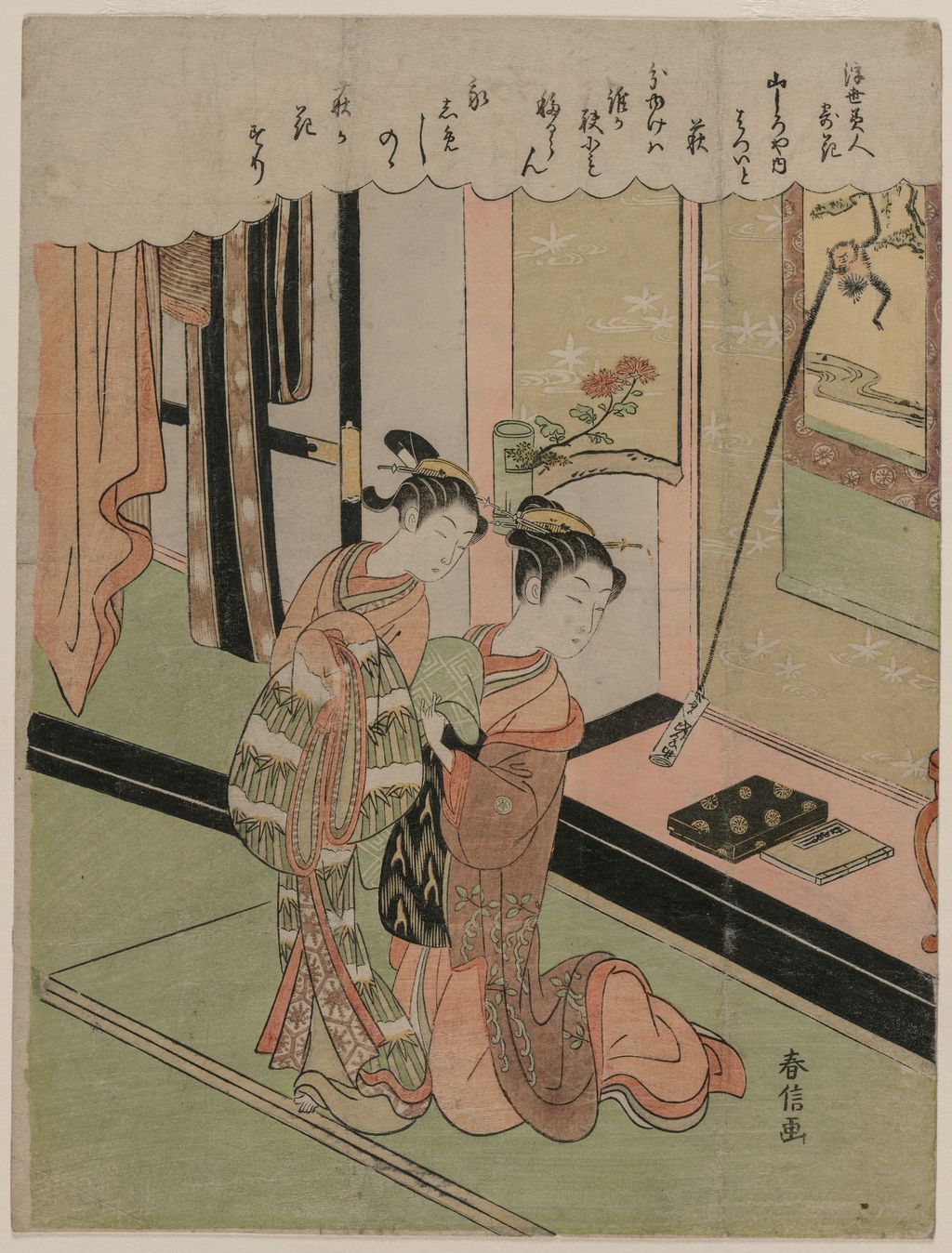
One later line of work brings the question of named women into sharp focus. Cleveland catalogues Hatsuito of the Yamashiroya Likened to Bush Clover in the series Beauties of the Floating World Compared to Flowers, dated 1769–70. Here the printed title supplies a named subject and a plant comparison. It is more precise evidence than the vague assertion that Harunobu painted “famous beauties.” The Japanese title, 浮世美人寄花内 山城屋初糸 萩, also keeps the terms of the comparison visible for Japanese readers. A late sheet can thus show how publishers connected a recognisable person or professional name with an organised series. It cannot alone establish where Harunobu met her or whether she approved the image. [20]
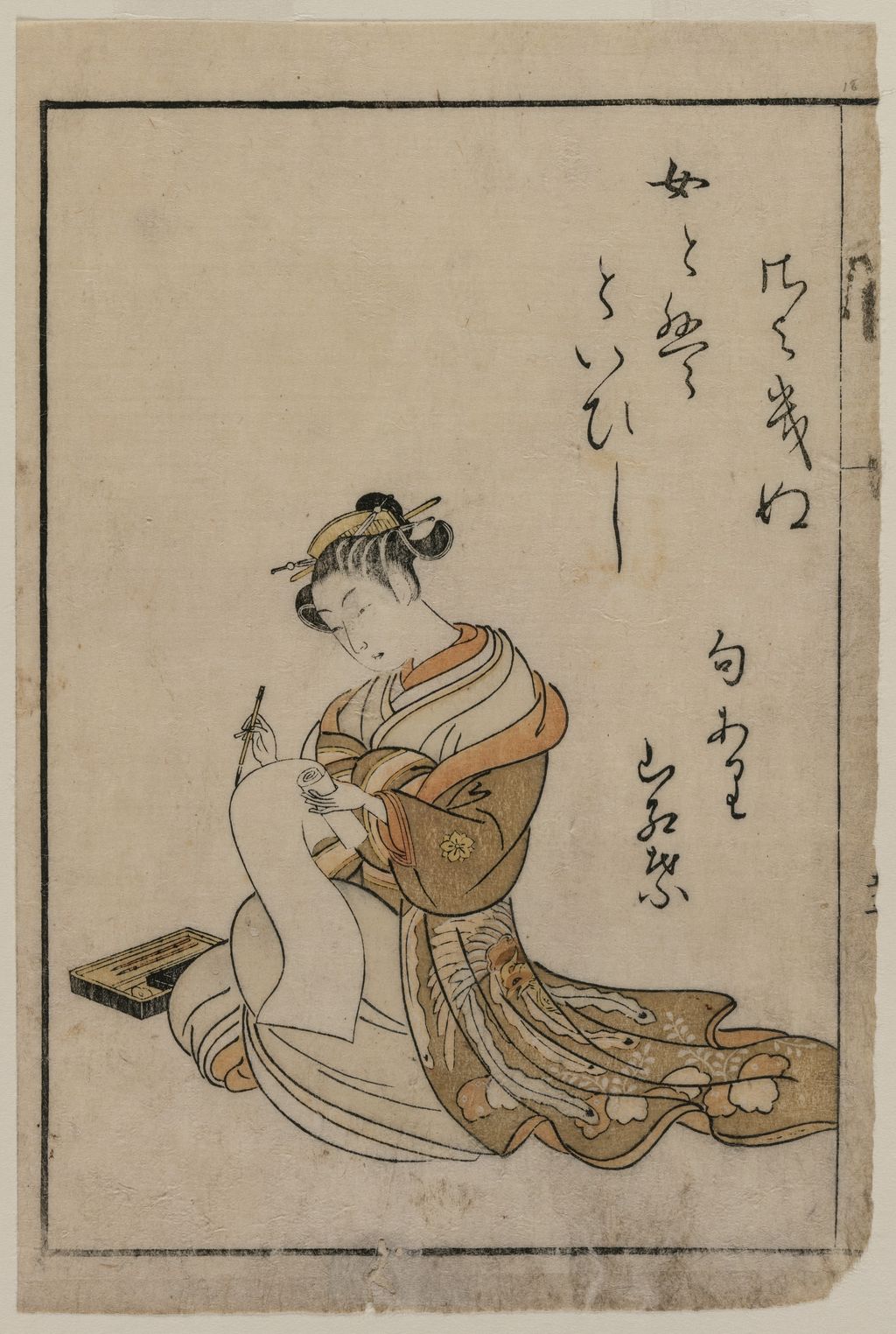
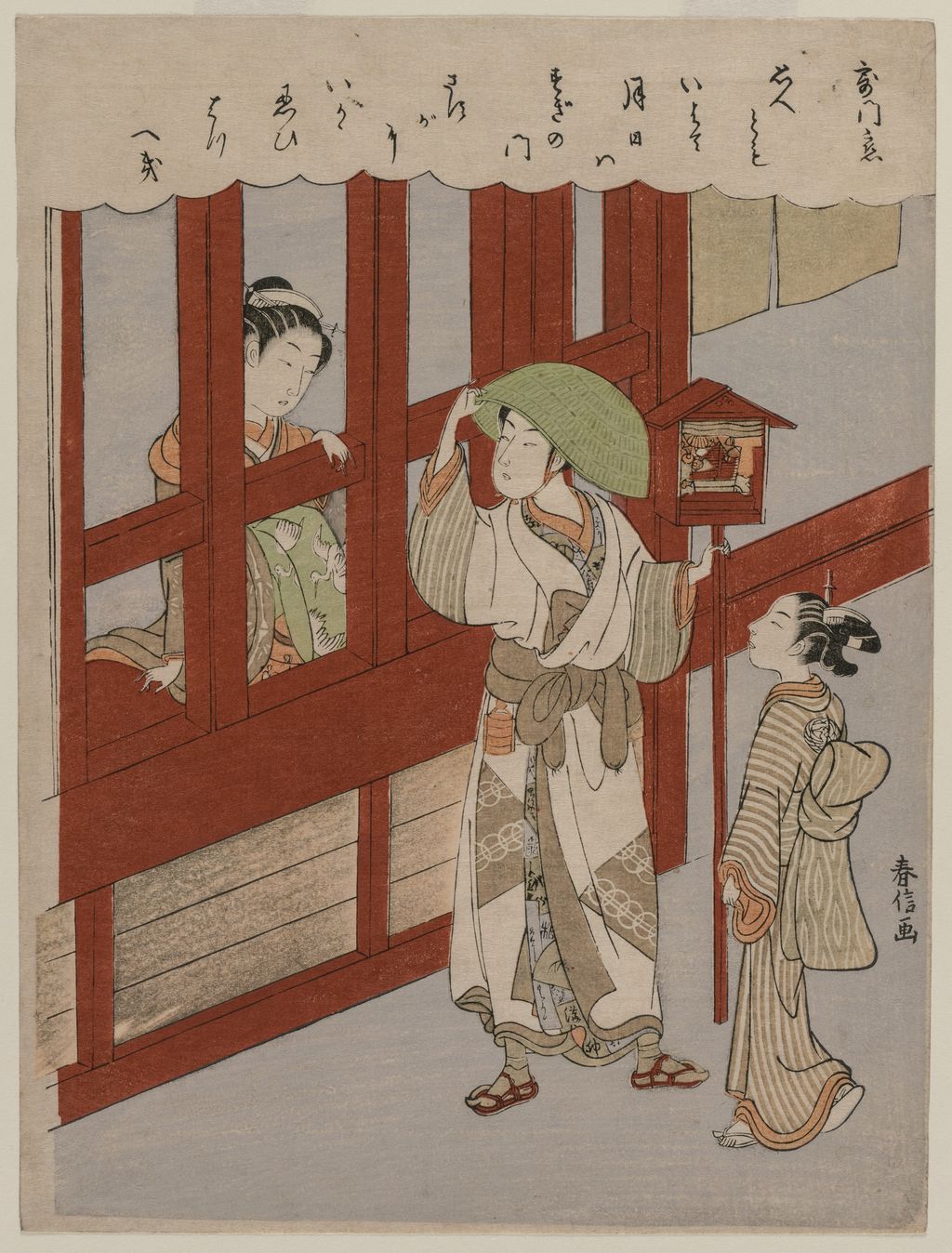
Cleveland's The Courtesan Writing from a Book, dated 1770, belongs to a series its catalogue calls A Collection of Beautiful Women of the Yoshiwara. The act of writing and the book within the image are worth noticing; they complicate a purely decorative reading of the figure. The 1770 date places the sheet close to the end of the career, although an object date is not proof of the month in which it was designed or printed. Another Cleveland print, Love at the Brothel Gate, is dated only to the late 1760s. The differing precision should remain visible in captions. A biography should not force both into a fictional “final year” scene simply because they share pleasure-quarter subject matter. [19] [21]
The book trade offers a different view of late work. The National Diet Library records the five-volume Seirō bijin awase (青楼美人合) as a coloured illustrated book by Harunobu, published in Edo in Meiwa 7, or 1770, by Funaki Kasuke and others. Its material form matters. A multi-volume work asks the viewer to move through pages, while the production and sale of a book involve binding, edition planning and a retailer's shelf as well as images. It shows Harunobu's designs at work in a publishing format beyond the individual print. The title includes seirō, a term for the pleasure quarter, but the NDL catalogue entry by itself cannot tell us every reader's response or establish how many copies sold. [22] [23]
This 1770 book must be kept distinct from Seirō bijin awase sugatami, which the NDL's publication chronology places in 1776. Their similar English renderings can invite a mistaken “last work” story if the titles are collapsed. The NDL identifies Seirō bijin awase by call number WA32-5 and holds the fifth volume under a specific permanent identifier; it identifies the 1776 book separately as WA32-4. Those catalogue details are not decorative. They prevent a later production from being smuggled into Harunobu's lifetime oeuvre under a familiar-looking title. [23] [24]
Harunobu also worked on illustrated books with writers. Hayakawa mentions commissions linked to Ōta Nanpo, the poet and author later known as Shokusanjin, and describes the wider circle of affluent literati and townspeople around printmaking. The statement can help explain why a designer skilled in visual allusion mattered to book publishers. It does not supply a complete list of titles or dates, and the NDL's exact 1770 volume should carry more weight in a chronology than a general description of literary friendships. The book's original pages may eventually support a separate illustrated-book essay once volumes and reuse terms have been examined individually. [4] [22]
Death, successors and an attribution problem
Harunobu died in 1770. The sources checked here do not establish a cause of death, and a short museum biography's “sudden” does not permit us to describe an illness or an exact final commission. The conclusion of the career is nevertheless unusually tangible: prints and the five-volume book are catalogued to around that year. Their dates need not mean he personally saw every copy leave a workshop. Prints could be issued or reissued by others; a book's publication year is a date for the edition, not a diary entry recording the designer's last act. [1] [22] [23]
The year after his death is especially useful for understanding how a famous name continued to function. Kokugakuin University art historian Fujisawa Murasaki studied Ehon haru no nishiki (絵本春の錦), published in 1771 with wording that presented it as Harunobu's posthumous work. In her 1994 study, as summarised on her university research profile, she argued from composition and figure treatment that the work may instead have been designed by Harushige, later Shiba Kōkan, who is associated with Harunobu's circle. The full journal paper has not been examined for this page, so this is a reported scholarly hypothesis, not an independent attribution verdict. The bibliographic record confirms the article and its page span; it does not turn the proposal into consensus. [25] [26]
That debate illustrates a general problem in writing this life. A book advertised under an artist's name may include designs prepared earlier, work finished by others, or later imitation. The precise answer requires examining the physical copy, its preface and colophon, and comparative images. A museum database can also contain prints marked “after Harunobu” or made in the Meiji period. Cleveland's holdings include such later works, which belong to his reception rather than to the 1760s career. Their existence shows how quickly a recognised style could detach from a person's own hand. A biography that treats every search result under his name as evidence of something he did before 1770 would be inaccurate. [25] [27]
Harunobu's influence does not need a direct teacher–pupil line for every later designer to be meaningful. His small figures, poetic transformations and full-colour sheet became models for a wider print culture. But “influence” is an art-historical comparison; it is not by itself a document proving that he trained every artist who borrowed a composition. The disputed 1771 book makes the point sharply. Attribution depends on an individual object and an argument, not on the later fame of its cover name. The stronger account of his legacy is therefore precise: a flourishing market adopted the visual and technical possibilities of the prints associated with his short mature career, while later hands complicated the boundary of his oeuvre. [4] [25] [27]
Reading a short career carefully
The dated trace is compact. A 1761 limited-colour theatre sheet anchors his early public practice. Named 1765 calendar commissions connect him with Kyosen and with the skilled people who cut and printed elaborate designs. Later impressions show how private ideas could enter commerce. Museum objects from 1766 onward display an increasingly recognisable colour and allusive range; named beauty prints and a 1770 illustrated book show work continuing into the final year. Death followed in 1770, while a 1771 book already raises questions about who could work under or near his name. That is a substantial life in evidence, even without a proved birthplace or teacher. [3] [5] [11] [22] [25]
Each stage rests on a different document. A museum's object date can establish a print's place in a career while leaving the meeting between artist and publisher unknown. An inscription can name a commissioner or a cutter but not reveal every person who handled the paper. A later scholar's reconstruction can propose a childhood and a lineage, provided that its status is made plain. A book's colophon can offer a publication year while complicating authorship. Such differences are not obstacles to telling Harunobu's story. They are the practical means of keeping his real, densely connected printmaking career visible through the thin record of his personal life. [3] [10] [4] [25]
The prints themselves remain the best way back into that world. A calendar number hidden in a robe and a named commissioner on another sheet tell us who and what a particular project was for. A later printing with the marks removed tells us that the image found another use. A 1770 book tells us that design moved across page sequences as well as single sheets. Harunobu's biography is therefore the history of a person partly obscured by the workshop, patrons and publishers that made his art possible. The surviving works let us recover some of those relationships without pretending to know the thoughts he did not leave in writing. [5] [10] [12] [22]
Frequently Asked Questions
His birth year and place are not securely documented in the sources checked here. Catalogues commonly give about 1724 or 1725. A proposed Kyoto upbringing is a later scholarly reconstruction, not a proved birthplace. [1] [2] [4]
Nishimura Shigenaga and Nishikawa Sukenobu have both been proposed. The British Museum presents them as alternatives, and Shimane Art Museum says his artistic lineage remains unclear. [2] [7]
He supplied designs for elaborate picture calendars exchanged among patrons. Named 1765 impressions connect him with commissioner Kyosen and with the collaborative production of richer multicolour prints. The change involved patrons, carvers and printers as well as Harunobu. [5] [6] [10]
Yes. The National Diet Library records the five-volume illustrated Seirō bijin awase as a Harunobu work published in 1770. Similar-sounding later titles should be checked separately. [22] [23]
Discussion
Compare what a dated print, a commissioner’s inscription and a later account can each establish about Harunobu’s life.
Reader Insights
Which claims about Harunobu’s early life rest on later reconstruction?
What does Kyosen’s mark on the 1765 calendar establish?
How do later states and a posthumous book complicate authorship?
Join the Conversation
Share a documented example or reliable source below, keeping observation separate from inference.
References
- National Institute of Japanese Literature, Iriguchi Atsushi, “江戸の粋─鈴木春信のやつし絵─,” 12 May 2025. Read in full; explicitly says birth year unknown and analyses Chūnagon Kanesuke.
- British Museum, Suzuki Harunobu artist biography. Museum date convention and tentative teacher theories.
- Tokyo National Museum, 2013 Harunobu exhibition and 34-object list. Accession A-10569-1235, dated 1761, and series/format distinctions.
- Hayakawa Monta, translated by Patricia J. Fister, The Shunga of Suzuki Harunobu: Mitate-e and Sexuality in Edo (Nichibunken Monograph Series 4, 2001), chapter 2, pp.7–14. Chapter read in full. Family account is Hayashi Yoshikazu's proposal summarised by Hayakawa; Gennai suggestion is Hayakawa's conditional interpretation.
- Chiba City Museum of Art, Parody of Hanshan and Shide, 2933001. Exact 1765 calendar, Kyosen name, status and short-month inscription.
- Ōta Memorial Museum, 2015 exhibition on the emergence of nishiki-e.
- Shimane Art Museum, Suzuki Harunobu artist biography. Notes traditional teacher claims and uncertain lineage.
- Metropolitan Museum of Art, Shimizu Temple, JP699. Limited-colour Komachi interpretation; object record warns that visible yellow may have been added later.
- Chiba City Museum of Art, Wang Ziyou Visits Dai Kui,
子猷訪戴図. Museum account of Harunobu's mizue practice and estimate of surviving designs. - Metropolitan Museum of Art, Visit to a Shrine at the Hour of the Ox, JP2438. Exact calendar marks, commissioner and named carver.
- Chiba City Museum of Art, Night Rain at the Double-Shelf Stand, 2933004. Private first versus commercial second printing; not a calendar.
- Chiba City Museum of Art, Parody of Meng Zong, 2993002. Calendar-bearing first printing and later removal of month marks.
- British Museum, later printing of Visit to a Shrine at the Hour of the Ox, 1925,0406,0.12. Its record distinguishes later impression from calendar-bearing original.
- Cleveland Museum of Art, A Girl Dressing in Pink, 1930.175.
- Cleveland Museum of Art, Woman Running Past a Willow Tree in a Breeze, 1942.148.
- Cleveland Museum of Art, Youth as a Stand-in Monju, 1930.177.
- Cleveland Museum of Art, Righteousness, from The Five Virtues, 1985.307.
- Cleveland Museum of Art, Young Woman Looking at a Pot of Pinks, 1985.304.
- Cleveland Museum of Art, The Courtesan Writing from a Book, 1921.1281.
- Cleveland Museum of Art, Hatsuito of the Yamashiroya Likened to Bush Clover, 1916.1157.
- Cleveland Museum of Art, Love at the Brothel Gate, 1921.349.
- National Diet Library, 青楼美人合, fifth volume, WA32-5, permanent ID 1286780. Catalogues five-volume coloured book, Edo, Funaki Kasuke and others, 1770.
- National Diet Library, historical exhibition on Edo-period cross-cultural material. Book description and 1770 publication.
- National Diet Library, chronological table of Japanese publishing. Distinct entries for
青樓美人合(1770, WA32-5) and青樓美人合姿鏡(1776, WA32-4). - Kokugakuin University, research profile of Fujisawa Murasaki. Profile abstract summarises the 1771 Ehon haru no nishiki attribution hypothesis; the 1994 article itself was not read.
- CiNii Research, bibliographic entry for Fujisawa's 1994 春信晩年の絵本研究――「絵本春の錦」について, 哲学会誌 18, pp.37–60. Bibliography verified, full paper not read.
- Cleveland Museum of Art, The Heron Maiden Standing Beneath a Willow Tree, 1985.310. Museum attributes it to a later maker “after Suzuki Harunobu”; one of three excluded later examples in the source-image ledger.
- Cleveland Museum of Art, Young Woman Admiring a Snow Rabbit, 1985.306. Broad late-1760s date.