


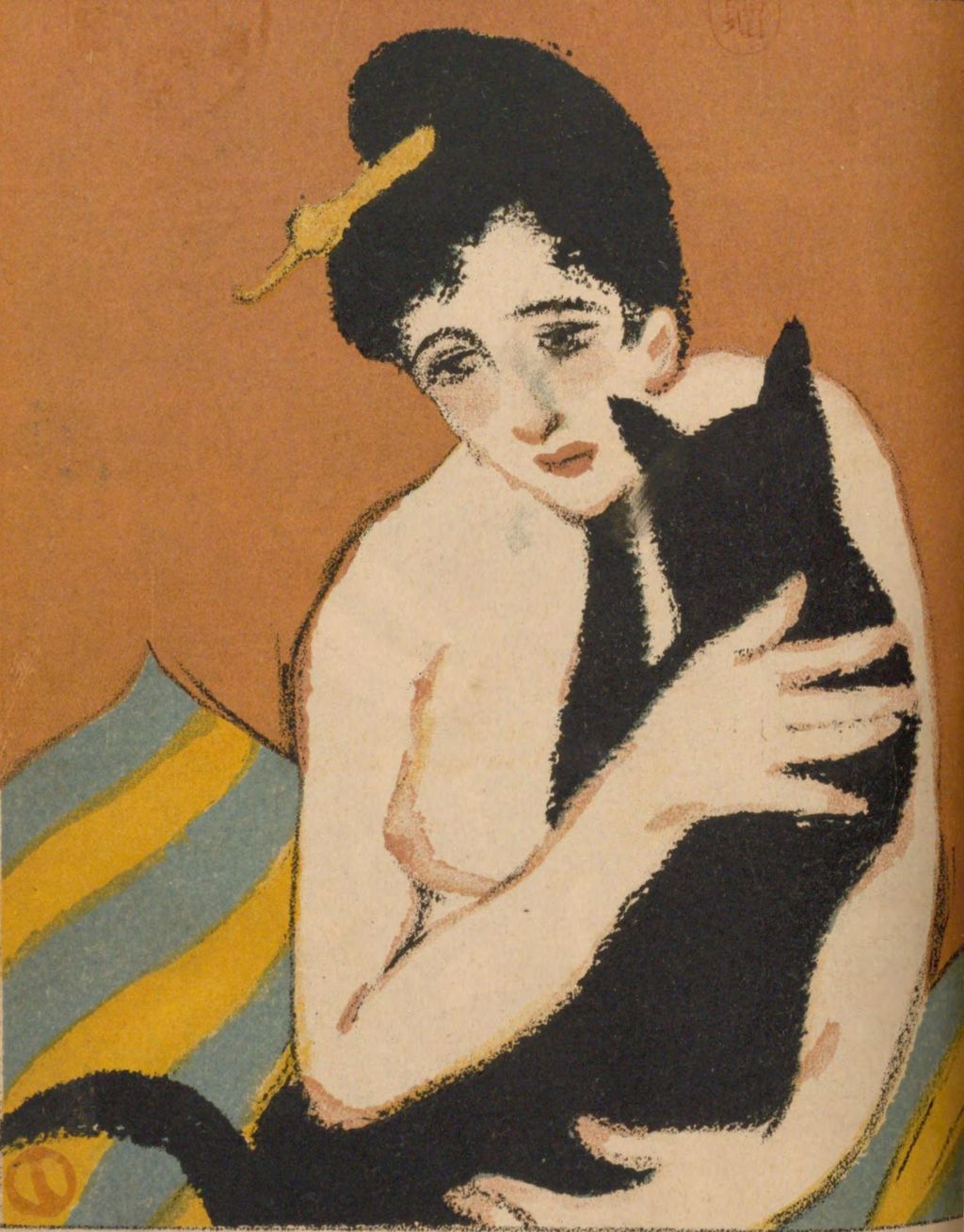
Takehisa Yumeji, cover illustration for Shōsetsu Club 5(3), 1921. Source: NDL Image Bank, National Diet Library, Japan. Original item.
 by Tom Gurney
Tom Gurney BSc (Hons) is an art history expert with over 20 years experience
Published on September 25, 2026 / Updated on September 25, 2026
Email: tomgurney1@gmail.com / Phone: +44 7429 011000
Takehisa Yumeji: an image people could live with
Takehisa Yumeji (竹久夢二, 1884–1934) drew women whose faces are immediately recognisable: elongated and intent, often with large eyes and a quiet expression. But a visitor who encounters only a framed reproduction of a “Yumeji beauty” sees only one part of his art. His images appeared in newspapers and magazines, on postcards, book pages and covers, sheet music, envelopes and goods intended to be handled or worn. He also made original paintings. The same eye for line and colour moved among these formats, but each format gave a picture a different job. A silk hanging scroll addressed one setting; a magazine cover could appear in many homes in one month. [1] [2] [3]
The National Diet Library describes illustrations by Yumeji in roughly forty-five newspapers and magazines by 1910. This scale matters. His popularity was formed through repeated encounters with images, not simply through a few celebrated paintings seen in exhibitions. A reader might recognise his drawn woman before knowing the title of a single work. The term Yumeji-shiki—“Yumeji style”—was already in use in a newspaper editorial of 28 May 1907. It came to describe a look that could extend to clothing, hair, make-up and bearing. Yumeji's pictures entered a culture in which the modern woman's appearance was being discussed, bought and changed. [2]
Contents
- Takehisa Yumeji: an image people could live with
- What makes a “Yumeji beauty”?
- Read the wisteria cover closely
- First, the page: illustration and illustrated poetry
- Minatoya: pictures leave the page
- Poems, songs and music covers
- Paintings, printed versions and the problem of a famous title
- Beyond Taishō: disaster, new fashion and travel
- How to look at Yumeji now
- Books on Japanese Art
That popularity can make his work seem too easy to summarise. “Taishō romanticism” is a useful historical signpost, but it does not explain the early satirical drawings, his interest in European art, the business of his shop, or the young women in his later covers who dress differently from the figures that first made him famous. The National Museum of Modern Art, Kyoto, connects his early illustrations to the newspaper of the Heimin-sha group and notes the avant-garde interests that continued beneath an apparently old-fashioned lyrical surface. An overview must leave room for those tensions. What looks nostalgic in one picture may have reached its first audience through a very modern form of publishing. [4] [5]
At a glance
- Life1884–1934
- PeriodLate Meiji to early Shōwa
- MediaPaintings, magazines, books, songs and goods
- Look forSeparate an original, first appearance, reprint and edition
What makes a “Yumeji beauty”?
The familiar figure often has an oval face, a slim body and eyes that hold our attention. Yet these features are not a recipe that Yumeji repeated unchanged. In the 1921 Shōsetsu Club cover image, a woman's bare shoulders and arms form a pale curve around a black cat. Her eyes turn down towards it; the animal's pointed ears and dark back create a second, sharper shape against her. The quietness comes partly from that physical contact and the broad, almost empty brown around them. The work communicates without a named sitter or a painted room. Nothing in the NDL record identifies the figure as one of the women in Yumeji's life, so a caption should not invent one. [6]
The NDL's account of Yumeji-shiki bijin asks readers to look beyond the size of the eyes. It describes an early 1908 magazine illustration of a kimono-clad woman who carries a parasol and wears a shawl, while the accompanying children wear Western clothes. Her appearance is not simply “traditional Japanese” or “Western”: it is assembled from choices made in a changing city. The NDL traces the shift in ideals of feminine beauty through eye shape, dress, hairstyle, make-up and movement. A Yumeji woman is thus a designed modern image, not just a sad face. This explanation does not require us to assume that all contemporary women wanted to resemble her. It shows how a particular pictured ideal became widely visible. [2]
It also matters who was able to define the image. A male artist drew the women; editors, publishers and shops selected and sold them; readers could admire, criticise or borrow aspects of the look. The NDL column documents the spread of a fashionable ideal, not the private feelings of every woman who wore a particular kimono. When describing an individual figure, the safest route is to name the decisions visible on the sheet—posture, costume, glance and surrounding pattern—then state separately what a contemporary source says about the wider fashion. That separation makes space for the woman's pictured presence without pretending that the picture is her own testimony. [2]
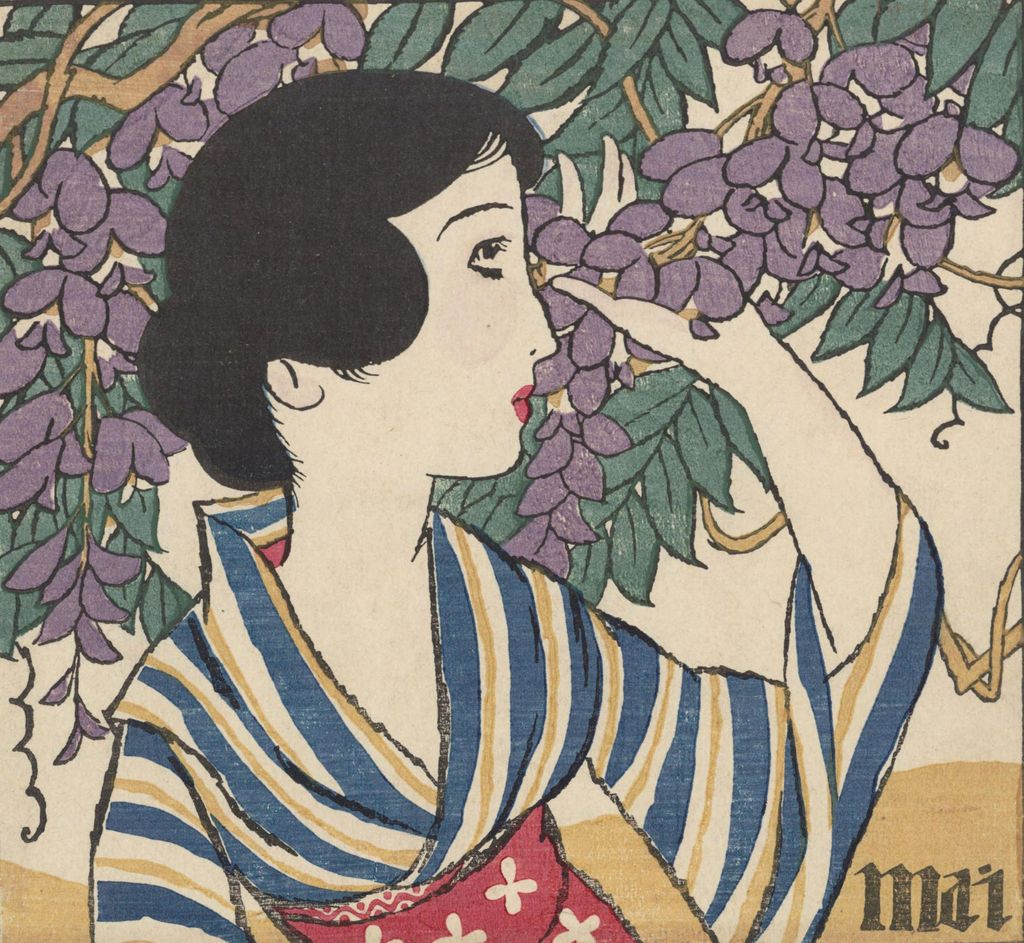
Two Fujin Graph covers make the point by comparison. The NDL's image from volume 3, number 5 (May 1926), sets a woman among masses of purple wisteria. Her blue and cream striped garment gives the eye a rhythm quite different from the clustering flowers. Her profile and raised arm cut through the hanging blossoms, so the face does not need to fill the entire design. In the next month's cover, volume 3, number 6, the figure bends over her work beside a patterned fan. These are two separate issues, each with its own composition and visual idea. They are particularly useful because they let us see a female figure with surroundings and activity rather than isolating an expression. Their publication dates are documented; the identity of either model is not. [7] [8] [9]
The 1926 wisteria image is especially revealing at high resolution. The woman's black bob defines one nearly solid shape, while the vines break into small purple and green units around it. Her raised hand interrupts the cascade at the point where a cover might otherwise become a continuous decorative field. Blue stripes on the robe repeat the linear movement of the branches but at a larger interval; a red sash and small red accents in the face prevent the cool palette from feeling uniform. These observations belong to this exact NDL file. They could support three genuine annotation details—the face and hand, the wisteria, and the contrasting textile—rather than generic labels for “woman,” “flower” and “kimono.” A digital enlargement can help the reader test the design argument; it cannot prove the pigment chemistry or the number of printing blocks used. [7]
Read the wisteria cover closely
Choose a number to enlarge a detail from the retained high-resolution NDL image. Locate it in the whole cover, then read the explanation below.
Explained details
Face and hand
The wisteria comes between face and hand. Follow gaze and gesture without inventing a sitter’s identity.
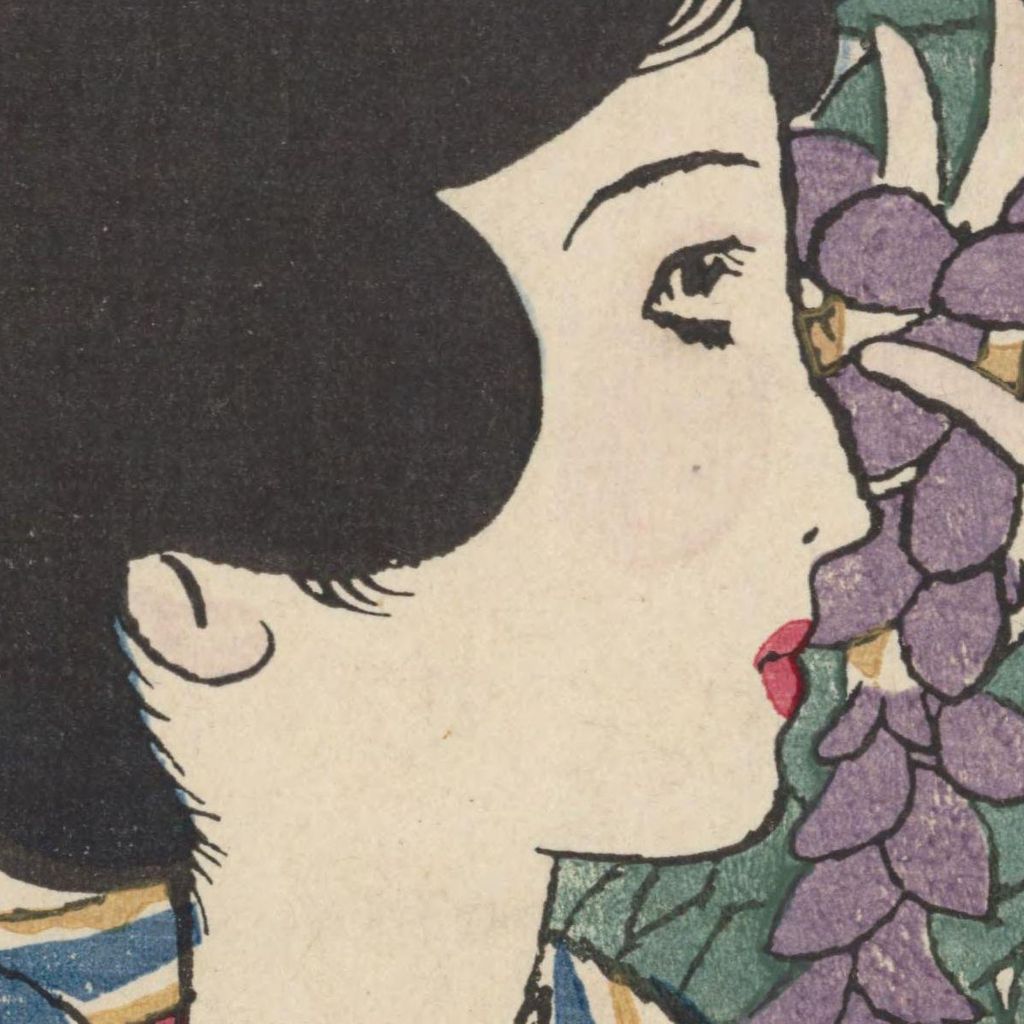
Source: NDL Image Bank, National Diet Library, Japan. Original item. Editorial crop and resize.
Wisteria
Purple blossoms and green leaves frame the hair, setting off the light face.
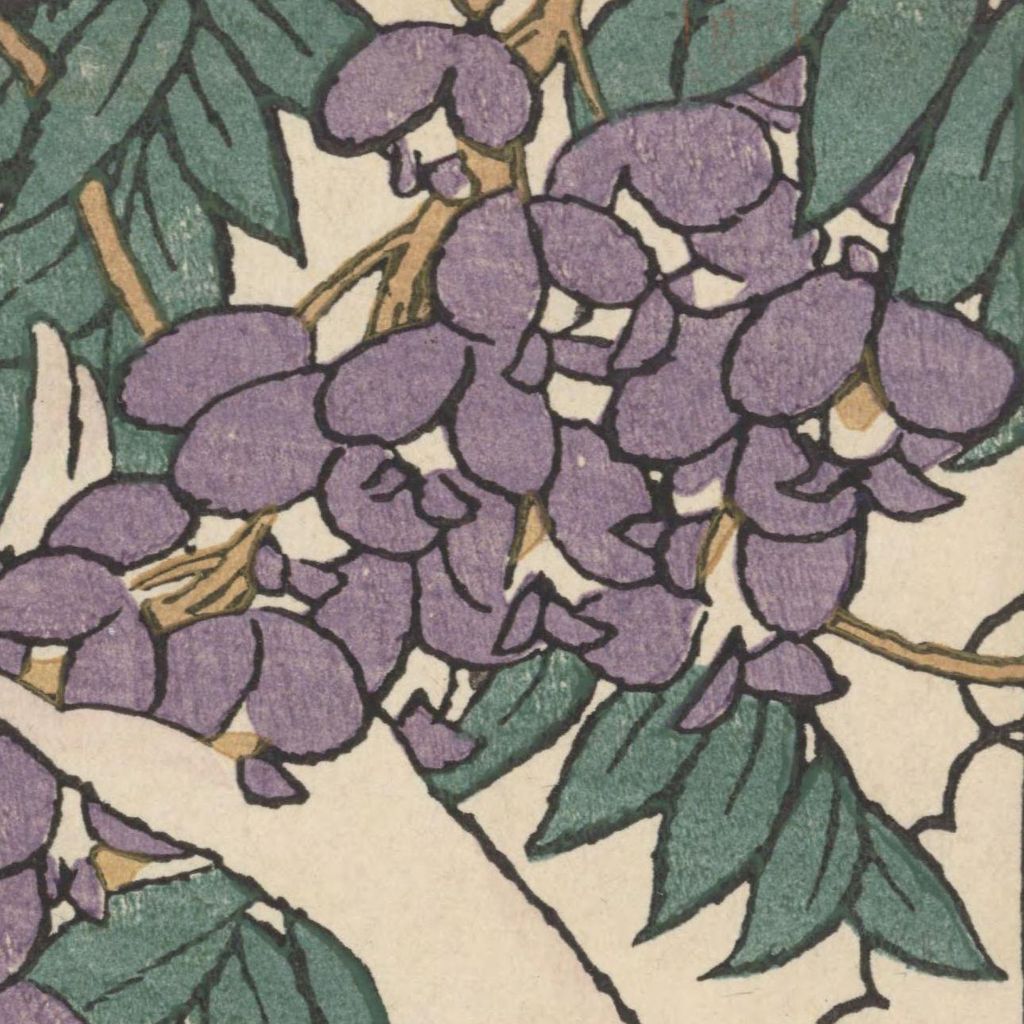
Source: NDL Image Bank, National Diet Library, Japan. Original item. Editorial crop and resize.
Striped fabric
Broad blue and white stripes answer the small colour patches of the flowers. Cropping to the face removes that design.
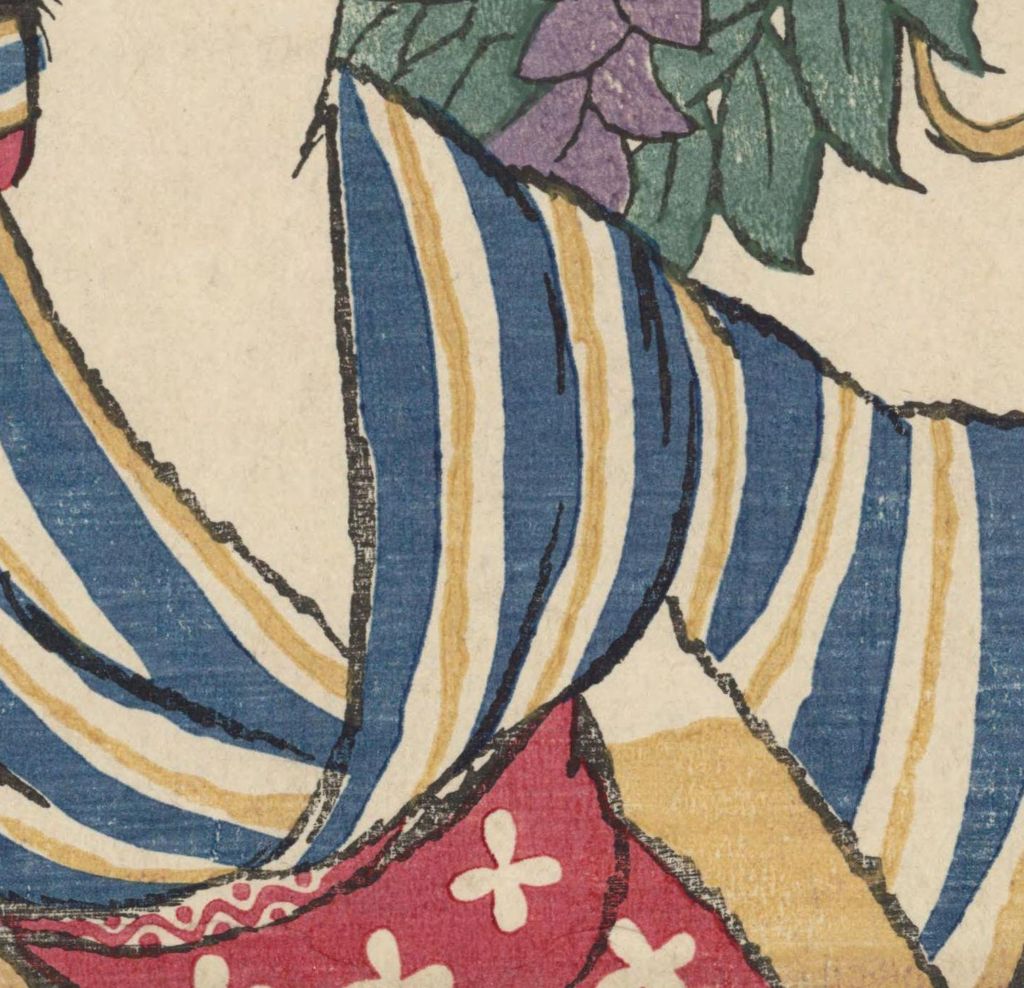
Source: NDL Image Bank, National Diet Library, Japan. Original item. Editorial crop and resize.
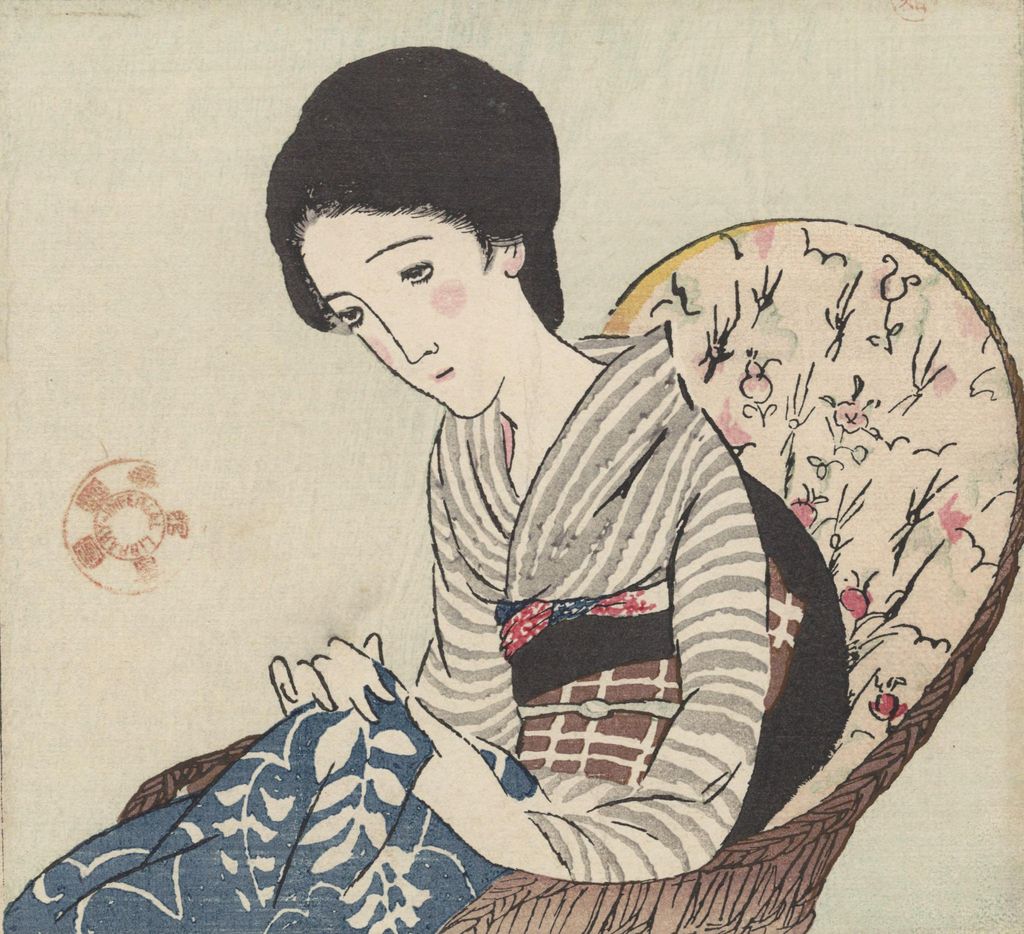
There is a danger of treating the word “beauty” as if it described a single kind of object. Miyagi Museum of Art holds At a Glass Wholesaler in Summer, a 1914 hanging scroll in colour on silk, more than a metre tall. It links a particular female figure and season to the same year Yumeji opened his Minatoya shop. The material and scale belong in the account: a hanging painting was not the same experience as seeing one of his reproductions in a monthly magazine. The museum's record does not clear its photograph for this site, so the painting can be discussed and linked without using that web image. The point is also broader. Yumeji made original paintings and images designed for circulation; one category should not erase the other. [10] [1]
First, the page: illustration and illustrated poetry
Yumeji's path into public view began with text and print. The Okayama Yumeji Art Museum dates an early published contribution to 1905 and records the first volume of Yumeji Gashū: Spring Volume in December 1909. The first solo exhibition followed in Kyoto in 1912, with 137 works in the museum's chronology, including an oil painting called First Love. A quick life summary might race from one date to the next. For an artist home, the more revealing question is how these different kinds of showing worked. A book could gather Yumeji's image and writing for repeated reading; an exhibition could place paintings and works on paper before viewers as objects. Both helped create the artist people thought they knew. [1] [11]
The NDL image galleries make early illustrated publishing tangible. Their selected page from Shinyaku Eiri Ise Monogatari, dated 1917 in the catalogue, is not a stand-alone portrait. It is one piece of a designed literary book with several Yumeji illustrations and a separate cover image. Figure, costume, flat colour and surrounding paper all belong to the reading object. To interpret the scene as a particular episode from the Ise Monogatari, one must check the adjacent text; the selected image alone is not enough. The safe, informative caption names the book, the edition year and the exact page while describing what is visible. [12] [13]
The NDL's selected images also reveal that a “book illustration” is not one fixed scale. In one Ise Monogatari scene, a boat sits on blue water, with distant shore and comparatively small figures; another arranges two people around a well and foliage; a third lets a traveller's coloured clothing stand against a large blue backdrop. The page series moves from a broad setting to a closer human encounter. Even without a complete reading of the source story, the visible variation shows Yumeji adapting line, colour and empty space to sequential literary scenes. That adaptability is worth more to an overview than reproducing several near-identical portraits. When a future book page is accepted, it should read the full volume and treat its visual sequence as the reader's object of study. [12]
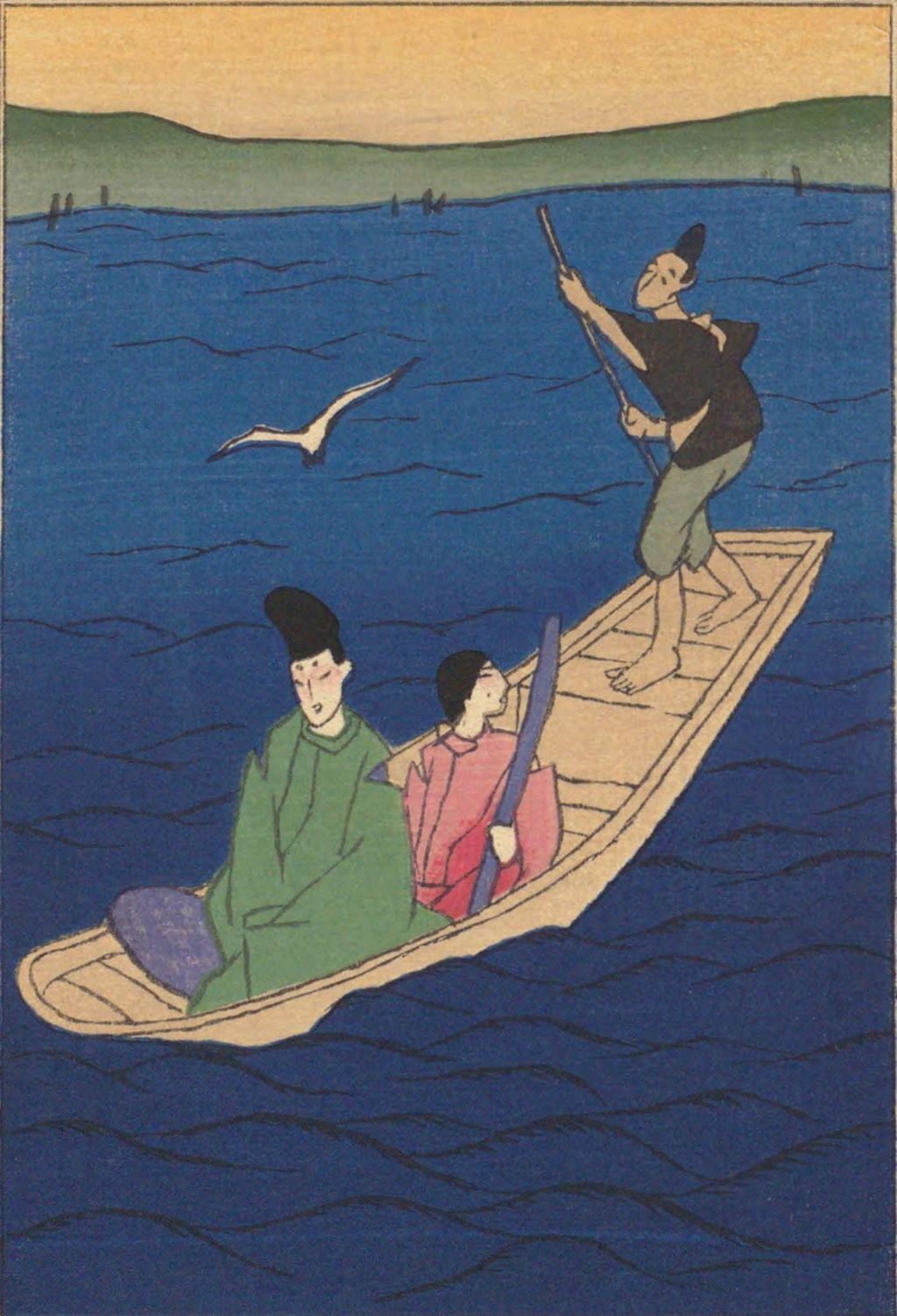
Printed literary images ask for a different kind of close looking from a hanging painting. A book's proportions encourage the artist to leave space for turning, text and sequence. The NDL gallery includes several pages from the same Ise Monogatari volume: a boat scene, figures at a well, a traveller against a blue field, and a more spare figure among dark tree forms. The varied scenes refute the idea that Yumeji's published work consisted only of one repeated female pose. We need not load all those images onto a home page. One or two precise examples can establish range and direct readers to the full digitised volume. [12]
The painted side of his early career deserves its own place in that story. The Yumeji Art Museum's collection includes oil painting, watercolour, drawings and later original works; its named examples include First Love and the paintings Autumn Rest and Tatsuta-hime. A genre label like bijin-ga is helpful only when it points us back to an actual object: its surface, size, original use and date. The English and Japanese versions of this page should link to verified museum records for those works, while reproducing only files whose reuse terms are suitable. That practice also makes it possible for a reader to see what changes when an image is republished many years after its first creation. [11] [14]
Minatoya: pictures leave the page
In October 1914 Yumeji opened Minatoya in Tokyo's Nihonbashi district. The NDL explains that the shop sold goods bearing his designs: obis, collars, hand-dyed yukata, hand towels and dolls among them. A buyer could therefore adopt something of the illustrated style in daily dress or in the home. The national Yumeji exhibition calls this artist-led selling of his own designed goods a striking experiment; it also records a relationship between Minatoya and other younger artists. The shop belongs in an art history of Yumeji because it changed how an image circulated. It made the boundary between seeing a design and using it unusually thin. [1] [2] [9]
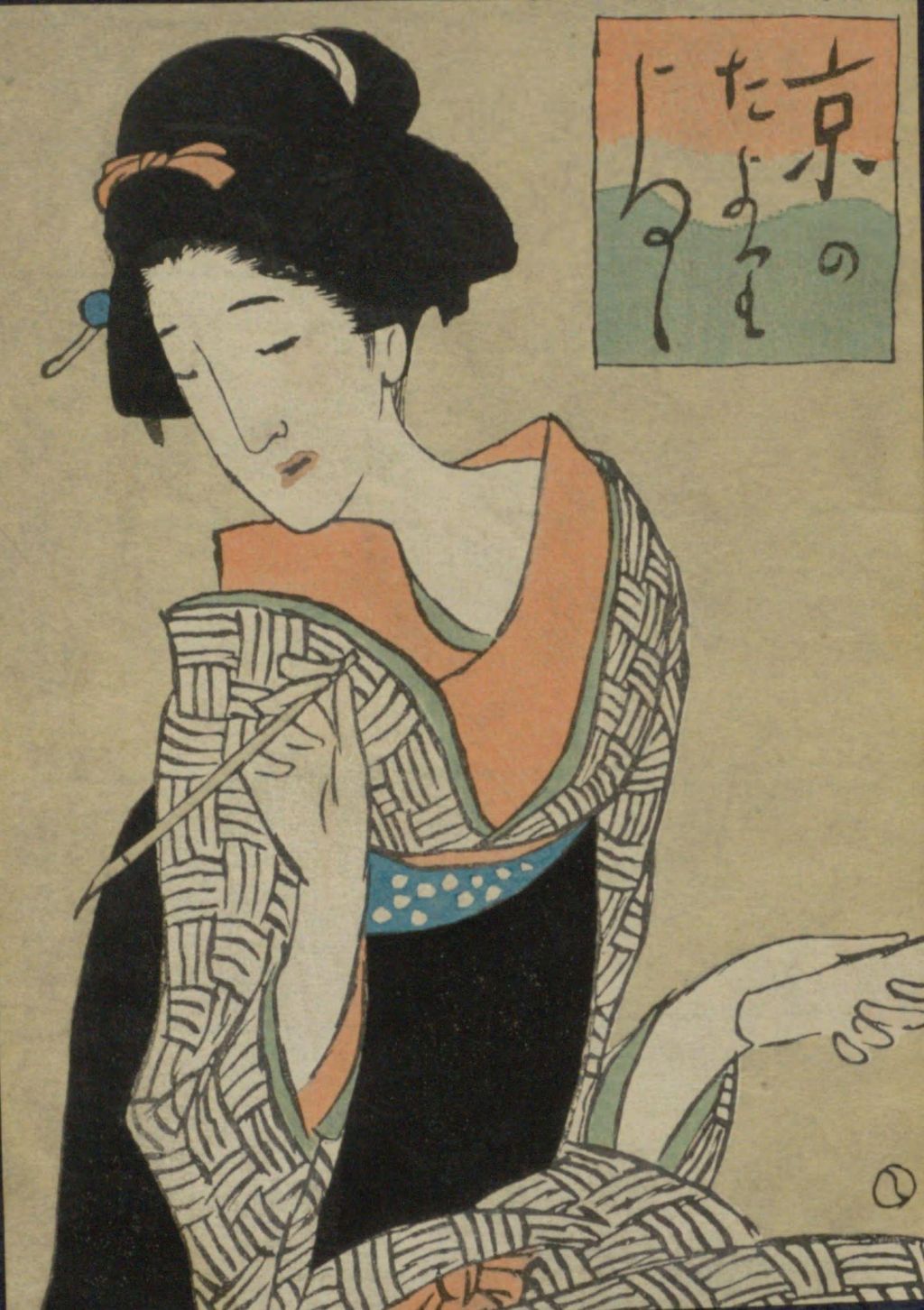
There was no single “Minatoya look.” The Tokyo Takehisa Yumeji Museum's designer handout points to chiyogami, patterned paper that could be used in small objects, and to Yumeji's combination of Japanese and Western design interests. The National Museum of Modern Art, Kyoto, describes an artist who followed contemporary European and Japanese movements rather than merely reviving an inherited ukiyo-e formula. A bold flower can fill a sheet of paper without a human figure at all; elsewhere a sharply posed woman becomes the centre of a tiny piece of stationery. The NDL's 1919 Yumeji Envelope Patterns, First Series is an exact example of the second kind. It shows why a study of Yumeji needs to look at material for ordinary correspondence as well as museum pictures. [4] [15] [16]
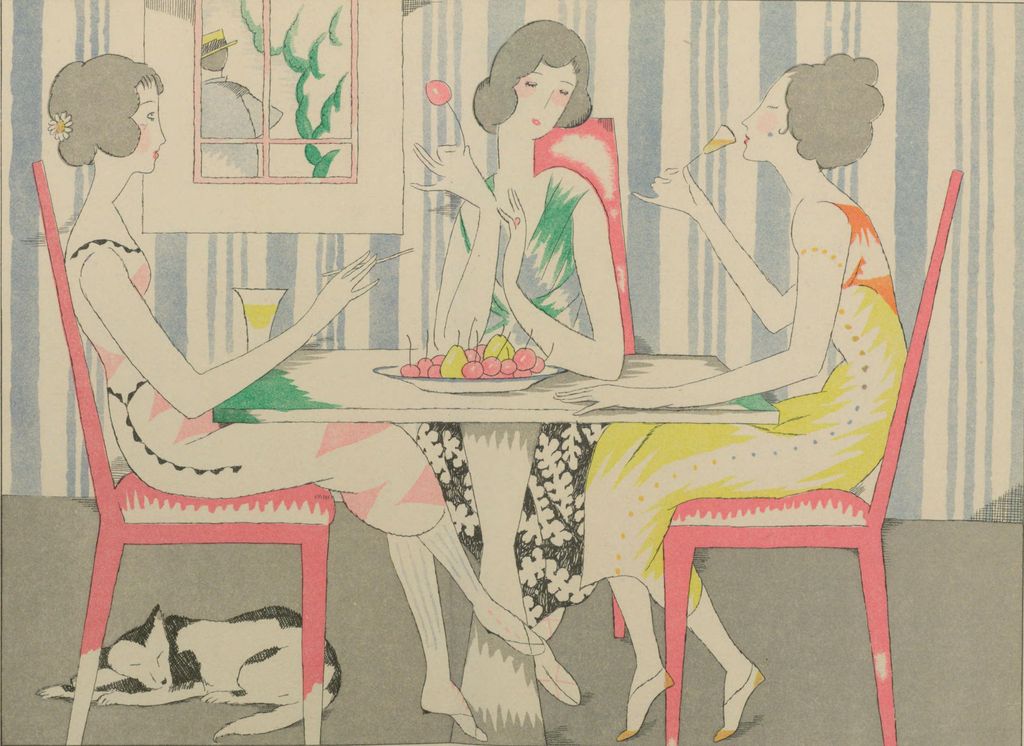
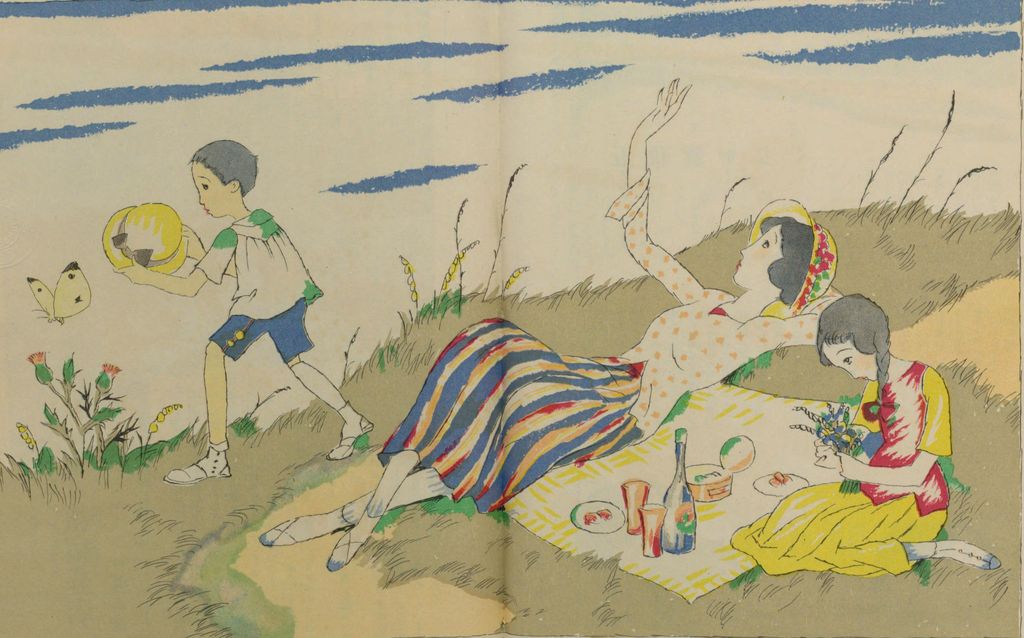
The two Mitsukoshi images in the NDL selection bring the argument into the world of a commercial magazine and department store. 《凉しき裝ひ》, reproduced in volume 15, number 6 (1925), seats several women inside a decorative interior, so that bodies, furniture and ornament make one visual field. 《野遊》 in another 1925 issue opens the arrangement outdoors. It is tempting to call these simply “fashion pictures,” but each has a subject and a publishing context. One stages a designed interior; the other makes outdoor recreation picturesque. Together they show that Yumeji could organise a group and a setting, not only isolate a single expressive face. The exact scans and catalogue dates support this comparison; they do not tell us how the original pages were received by every reader. [17] [18]
Look more closely at the indoor picture and it becomes a scene of sociability rather than three interchangeable examples of dress. One woman holds a cigarette, another a small round object, and a third raises a glass or similarly shaped vessel; a plate of fruit sits at the centre. A sleeping dog lies beneath one chair. The pink chair frames, striped wall and yellow-and-green garments organise the figures into a clean horizontal design. The room is detailed enough to suggest a contemporary leisure setting, yet the pale faces and spare outlines hold it together as illustration. The work does not tell us whether these are portraits of particular patrons, nor should the plate of fruit be decoded as a symbol without a source. Its visual evidence is already specific and interesting. [17]
The outdoor 《野遊》 spreads people across a very different field. A child in shorts follows a butterfly at left, a reclining woman lifts one hand toward the sky, and another bends over a cluster of flowers on the right. A bottle and picnic things sit on the cloth between them. The wide areas of lightly coloured ground and the sparse blue clouds keep the scene open, while stripes on a skirt and small patches of yellow and red restore the decorative cadence. Putting these two images side by side would let a reader see how Yumeji designed a modern leisure scene indoors and outdoors with different uses of empty space. The visible central fold also reminds us that we are looking at a printed spread or page selection, not an untouched painting made at this width. [18]
An artist-led shop and a department-store magazine seem opposed in scale, but both connected design to purchasing. The NDL column describes the peak of the Yumeji-shiki fashion around 1914–19 and its decline towards 1926. Yet his work did not stop when a particular fashion passed. The 1925 and 1926 images in this very selection show him producing for new settings and readers. A careful page should separate the history of a style's popularity from a claim that the artist's creative life ended with that style. [2] [17] [7]
Poems, songs and music covers
Yumeji was a writer as well as an image maker. The museum chronology records the first form of his poem 「宵待草」 in the magazine Shōjo in 1912, the familiar revised form in Dontaku in 1913, and a setting by composer Tadasuke Ōno (多忠亮) published by Senoo in 1918. The distinction is important even for a visual overview: a poem, its musical setting and the paper cover that carried the music are related, but they are not the same object. The national exhibition's object guide identifies a 1921 Senoo score as a later printing of the 1918 first edition. A caption that used “1921” as the date Yumeji wrote the poem would collapse three stages into one. [1] [9] [26]
The museum dates Yumeji's Senoo cover work from 1916 and says he made more than 270 such covers into the Shōwa years. That quantity does not mean one repeated composition. The National Museum of Modern Art, Kyoto, points to their stylistic diversity and to his interest in arts from different periods and places. A sheet-music cover had to be legible as a cover, attractive in a shop and related to a particular musical publication. That practical work can produce artistic invention. It also explains how an image might reach someone who did not attend an exhibition or buy a framed print. [1] [4]
The available NDL Yumeji Jojōga Senshū images extend this story of re-circulation. Its two volumes were edited by Iwata Jun'ichi and published by Hōbunkan in 1927. One picture, 《シーサイド》, is listed in the upper volume's contents as having appeared in Fujin Graph in August 1924. The album therefore gives us a documented second setting for an image: first a magazine, then an anthology. Seeing the same design in an anthology is not identical to seeing the 1924 issue, and the scan is not a photograph of an independent painting. This is why the full publication trail belongs in the reference list and caption. Other NDL-selected images from the anthology may be earlier than 1927, but their original publication dates cannot be supplied merely by looking at them. [19] [20]
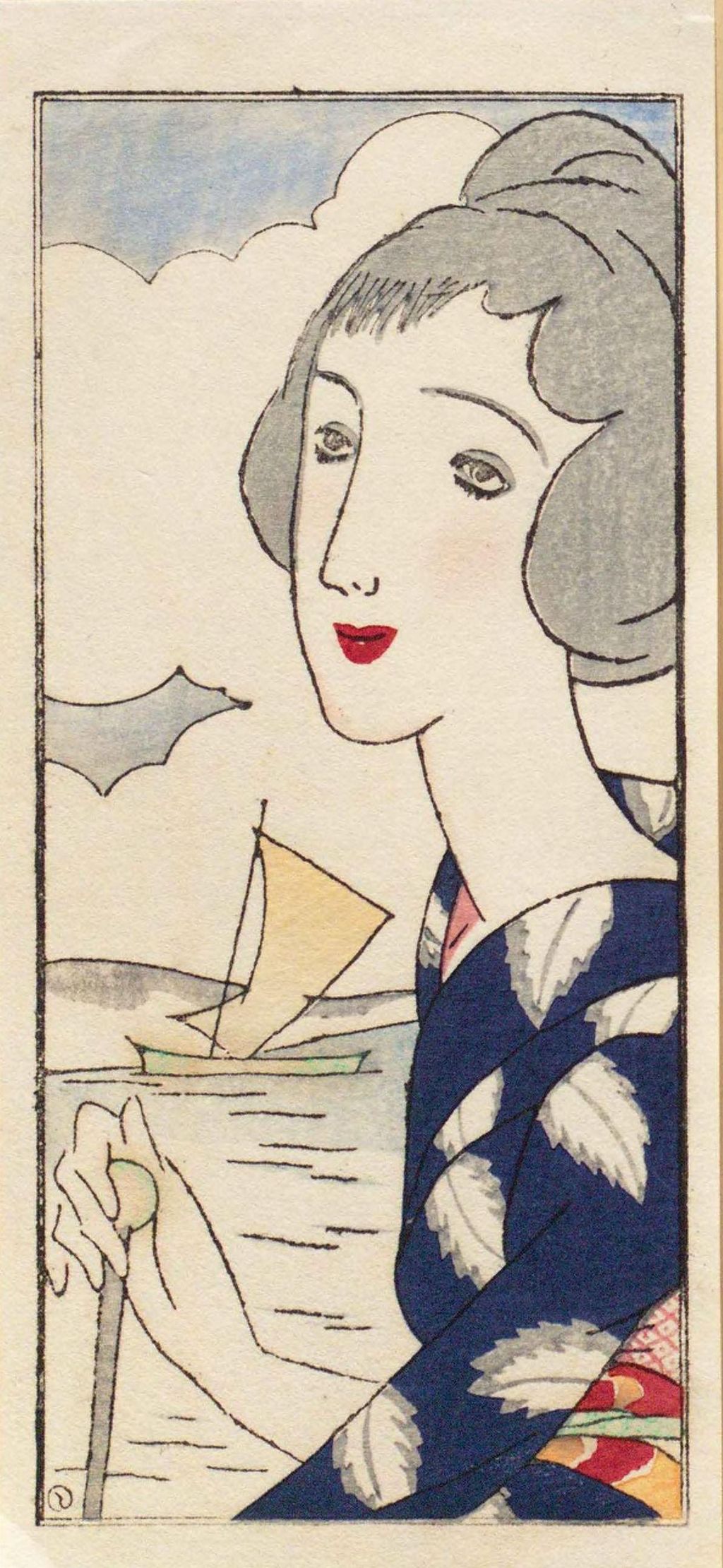
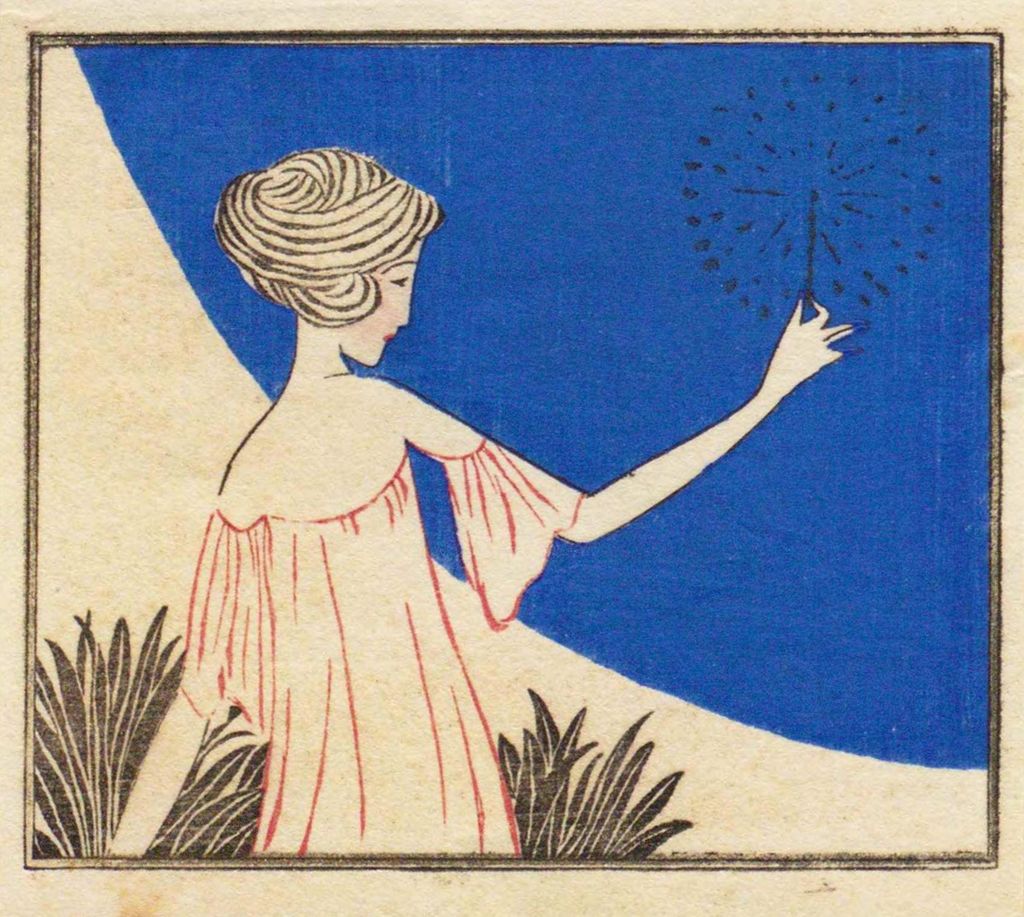
The lower anthology volume offers seasonal designs such as 《紅梅》 and 《花火》. Each deserves to be called by its own title, not folded into a generic category of pretty women. In 《紅梅》, a woman in a patterned robe occupies a field punctuated by branches of red blossom. In 《花火》, a figure turned away from us stretches an arm towards a point of light against a dense blue ground. Their effects are distinct: one builds a decorative portrait around face, costume and flowers; the other turns an action and a dark colour field into the subject. The 1927 volume date is secure, but a first-creation date for either image has not yet been established. [20]
Paintings, printed versions and the problem of a famous title
The most searched individual Yumeji painting in the Japanese data is 《黒船屋》, Kurofuneya or Black Ship Woman. The current national exhibition identifies the original as a 1919 work held by the Takehisa Yumeji Ikaho Memorial Museum. Its woman, dark cat and highly contrasted figure have become shorthand for an artist's whole career. A dedicated page could examine the exact painting's materials, physical dimensions, image, ownership, exhibition history and interpretations of its model. It should not be built from an image of a different print merely because the subject seems similar. The original museum and exhibition photographs are not automatically available for this site's commercial reproduction. [9] [21]
The NDL Image Bank includes a picture titled 《黒船》 in the 1927 upper Yumeji Jojōga Senshū. Its title resembles the famous painting's title but is not the same title; its reproduced composition and publication form are different. The distinction is not pedantry. If a page labels that anthology image “the original 1919 Black Ship Woman,” it gives the reader false visual evidence for whatever analysis follows. The safe route is to discuss the 1919 painting with the holding institution's record and to reserve a large, exact image for the moment its use is cleared. The anthology image can be used, if needed, as an independently named work with its own date and NDL source. [19] [9]
The same issue appears more generally in modern print culture. The British Museum's artist catalogue includes lifetime work and later prints made after Yumeji's death. A date such as 1935 or 1941 on one of those objects is a publication or production date, not a new phase in the artist's life. The Rijksmuseum's records likewise include distinct editions and impressions, and several public-domain catalogue entries have no digital image attached at all. This home page can teach a useful habit: read the maker, editor, publisher, edition and accession alongside the title. An image on a screen can conceal the difference between a painted scroll, an original illustrated magazine, a compiled anthology and a later print from an earlier design. [5] [22]
An original painting also resists being reduced to its most reproduced detail. The Okayama museum's holdings include 《立田姫》, 《西海岸の裸婦》, 《秋のいこい》 and 《加茂川》, works in different subjects and media. Miyagi's 1914 hanging scroll demonstrates the scale and material of another painting. The Smithsonian's Star Maiden, a newly acquired ink-and-colour work on paper, offers an American institutional record with dimensions and provenance. Its image remains marked “Usage Conditions Apply,” so it is a research comparison, not a free illustration. These collection records let the prose acknowledge painted work even while the production image set chiefly shows printed design. [14] [10] [23]
Beyond Taishō: disaster, new fashion and travel
The Great Kantō Earthquake of September 1923 disrupted Yumeji's Tokyo world. The Okayama museum dates the destruction of his proposed Dontaku design enterprise to that event and records his subsequent Tokyo Disaster Sketches in a newspaper. The 2026 national exhibition places an example of the quake drawings beside the later plan for an art institute at Mount Haruna. These two projects speak to an artist attentive to how people lived: one responded to a suddenly damaged city, the other imagined a new relation among art, craft, everyday objects and nature. This is an interpretation of the documented projects, not a claim that a single image explains the earthquake. [1] [9]
Yumeji's later women also met a changing visual culture. The national exhibition describes short hair, Western accessories, Western dress and more modern ways of wearing kimono in his late Taishō and early Shōwa images. A 1926 Fujin Graph cover can therefore be read as part of an evolving picture of the modern girl, even if the woman in it is not literally a documentary portrait of an identifiable reader. The wisteria cover's graphic balance between textile stripes and flowers shows continuity with his earlier attention to pattern; its fashionable silhouette also moves away from a fixed idea that every “Yumeji beauty” looks alike. [9] [7]
His work was still changing after the Taishō era ended in 1926. The Kyoto National Museum of Modern Art notes interest in Russian Futurism and abstraction as well as older Japanese and European art. The Okayama museum dates his plan for a Haruna art institute to 1930, his American journey to 1931–32 and a workshop on Japanese painting at the Itten-Schule in Berlin to 1933. The Tokyo museum's designer handout describes his unrealised aim to establish an institute for the design of daily necessities. These projects should not be presented as a completed school or movement. They show an artist continuing to seek a place for art in modern life. The separate biography can examine the difficult personal and travel chronology in detail. [1] [4] [15]
The British Museum describes a later twentieth-century revival of interest in Yumeji as part of a broader return to Taishō culture. That account is a useful explanation of his position in collections today, but it should not make “Taishō” a box around his career. Even the familiar term Yumeji style needs a date: its social high point came long before the last of his illustrated publications. The artwork, its first audience and its later revival are three different histories. Asking how they relate gives the artist a more durable place in Japanese modern art than an atmosphere of nostalgia alone. [5] [2]
How to look at Yumeji now
Begin with the kind of thing in front of you. If it is the 1921 Shōsetsu Club cover image, ask what the woman's body, black cat and large empty field do within a repeatable piece of print culture. If it is the 1914 Miyagi hanging scroll, ask how colour on silk and an upright format change the encounter. If it is the 1919 envelope design, ask how an illustration works when carried in a hand or sent through the post. If it is a 1927 anthology page, ask whether the design first appeared elsewhere. None of those questions requires deciding that commerce makes one image less artistic than painting. Each directs attention to a different set of choices and a different viewer. [6] [10] [16] [20]
The original works and reproductions also sit in different museums and libraries. The Okayama Yumeji Art Museum holds a major body of paintings and papers. Miyagi supplies an exact painted hanging-scroll record. The NDL preserves published examples in dated volumes and gives open access to selected public-domain images through its Image Bank. The British Museum identifies printed objects and later editions, while the Smithsonian records another painting without granting general reuse of its file. These sources can be followed from each caption and reference rather than collapsed into one “Yumeji collection.” Where more than one impression or publication survives, the accession or page number matters. [14] [10] [24] [5] [23]
Yumeji's achievement lies partly in refusing to keep drawing, painting, writing and designing in separate rooms. The same visual intelligence could turn a woman and cat into an intimate magazine cover, a group of women into a department-store scene, or a season into a memorable anthology picture. His art helped readers imagine a style, and his design gave that style physical routes into daily life. To see its full range, look closely at the exact work, and then ask how the image moved. [2] [17] [20]
Frequently Asked Questions
It means a “Yumeji-style beauty,” but the NDL shows that the phrase referred to more than a large-eyed face. It involved slender form, expression, dress, hair and the fashionable goods that helped the look spread. The term appears in a 1907 newspaper editorial; it reached its greatest vogue in the following decade. [2]
Both descriptions are useful. He made original paintings, including a documented 1914 silk hanging scroll, while also illustrating newspapers and books, designing magazine and sheet-music covers, and making patterns for household and dress goods. Name the medium of each exact work rather than assigning one label to his entire career. [10] [1] [15]
No. The NDL selection is an image named 《黒船》 in a 1927 illustrated anthology. The separately titled original 《黒船屋》, Black Ship Woman, is a 1919 painting held by the Ikaho memorial museum. Similar words or motifs do not make the objects interchangeable. [19] [9]
He wrote the poem, first published in 1912 and revised in the 1913 book Dontaku. Tadasuke Ōno (多忠亮) set it to music, and Senoo published the musical setting in 1918. The poem, musical composition and sheet-music design have related but distinct authorship and dates. [1] [9] [26]
The Okayama Yumeji Art Museum and Tokyo Takehisa Yumeji Museum hold major collections; Miyagi has a documented 1914 silk painting. The NDL Image Bank provides public-domain selections from dated books and magazines. British Museum and Smithsonian records help identify other exact objects, though their image-use terms must be checked separately. [14] [25] [10] [24] [5] [23]
Discussion
Compare Yumeji’s images with their original media and later printed versions in mind.
Reader Insights
What changes when an image appears as a painting, magazine cover or later anthology plate?
Which records distinguish Kurofuneya from the anthology picture Kurofune?
How do flower and fabric change the way you see the face on the Fujin Graph cover?
Join the Conversation
Share a documented example or reliable source below, keeping observation separate from inference.
References
- Yumeji Art Museum, “竹久夢二の足跡” / career chronology. Japanese museum chronology and media/career introduction; traditional counted ages are not reused.
- National Diet Library Image Bank, “The captivating charm of yumejishiki” and Japanese original. Social meaning, early press circulation and dated term.
- National Diet Library Image Bank, Yumeji covers and illustrations. Official selected illustrated-book, magazine and stationery images.
- National Museum of Modern Art, Kyoto, Yumeji collection essay. Early satirical work, modernist interests, Senoo covers and Berlin teaching.
- British Museum, Takehisa Yumeji artist record BIOG6460. Media, catalogue objects and later reception; bibliography noted only as leads.
- NDL Image Bank, Shōsetsu Club 5(3) cover illustration and NDL issue catalogue. Image Bank file
1479984_1; 1921. - NDL Image Bank, Fujin Graph 3(5) cover and NDL issue catalogue. Image Bank file
2799512_1; 1926. - NDL Image Bank, Fujin Graph 3(6) cover and NDL issue catalogue. Image Bank file
2799513_1; 1926. - National Yumeji exhibition, “作品紹介” / work guide. Exact named works, chapter interpretations, Kurofuneya holding and selected publication dates.
- Miyagi Museum of Art, At a Glass Wholesaler in Summer. Exact 1914 silk hanging scroll, dimensions and interpretive entry; image not cleared for production.
- Yumeji Art Museum, First Love. The collection page identifies this oil work and its museum context; no image downloaded from the museum.
- NDL Image Bank, Shinyaku Eiri Ise Monogatari, selected illustration. Image Bank file
1908145_17, with other pages in the same curated gallery. - NDL catalogue, Shinyaku Eiri Ise Monogatari. Edition 1917; verify specific narrative episode against volume text before naming it.
- Yumeji Art Museum, collection overview. Major original works and collection scale; research images only.
- Takehisa Yumeji Museum, “Yumeji as a designer” exhibition handout. Checked one-page institutional handout; the exhibition year is not an artwork date.
- NDL Image Bank, Yumeji Envelope Patterns, first series and NDL catalogue. Image Bank file
1182862_2; 1919. - NDL Image Bank, 《凉しき裝ひ》 in Mitsukoshi 15(6) and issue catalogue. Image Bank file
1524610_4; 1925. - NDL Image Bank, 《野遊》 in Mitsukoshi 15(10) and issue catalogue. Image Bank file
1524614_13; 1925. - NDL Image Bank, 《シーサイド》 and 《黒船》 in Yumeji Jojōga Senshū, upper volume. 1927 anthology, edited by Iwata Jun'ichi; contents date Seaside to August 1924 Fujin Graph. Selected pages 7 and 21.
- NDL Image Bank, 《紅梅》 and 《花火》 in Yumeji Jojōga Senshū, lower volume. 1927 anthology, edited by Iwata Jun'ichi; selected pages 8 and 18.
- Takehisa Yumeji Ikaho Memorial Museum. Holding institution for the original Kurofuneya; image use not assumed.
- Rijksmuseum, Narrow Meadow Paths, RP-P-2005-606. Exact public-domain illustrated-book object with retained master; other catalogue-only records are not production-image files.
- Smithsonian National Museum of Asian Art, Star Maiden, S2024.4.19. Exact painting, provenance and restricted media-use statement; research only.
- National Diet Library Image Bank, About/reuse terms. Selected Image Bank files are public domain and commercially reusable with source credit.
- Takehisa Yumeji Museum, collection overview and image-use information. Tokyo collection and separate image-archive process.
- PTNA Piano Music Encyclopedia, Yoimachigusa composer record. Identifies 多忠亮 as Tadasuke Ōno/Oono; the Japanese Yumeji Art Museum chronology establishes the 1918 Senoo publication.